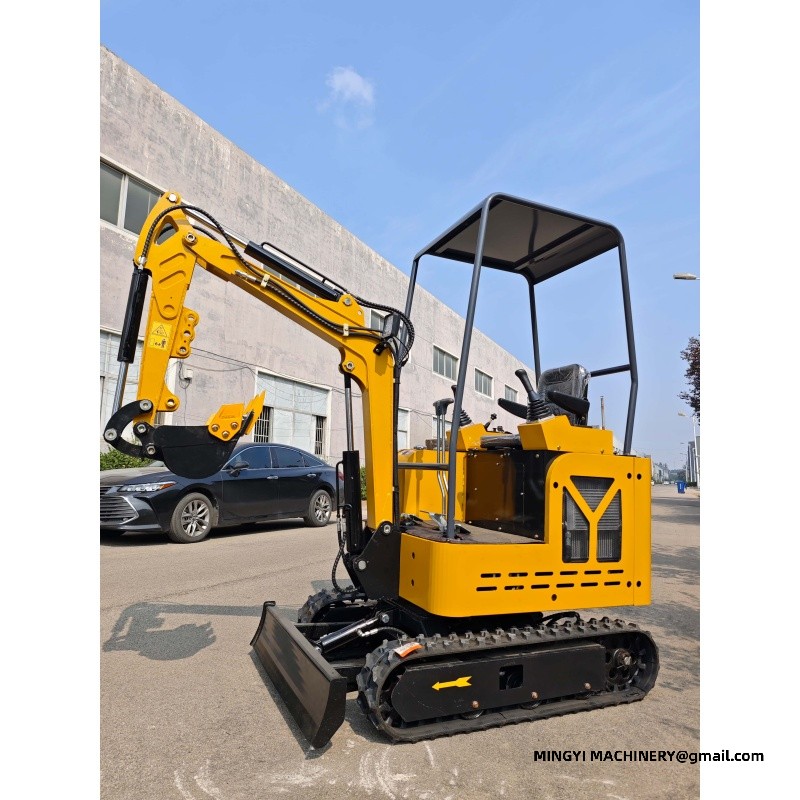
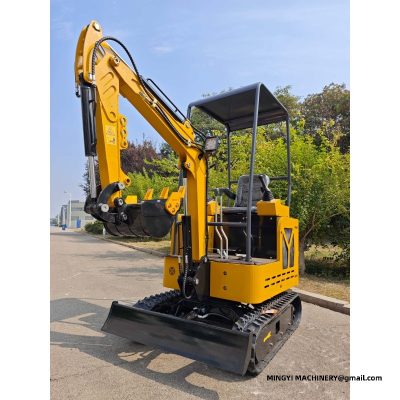
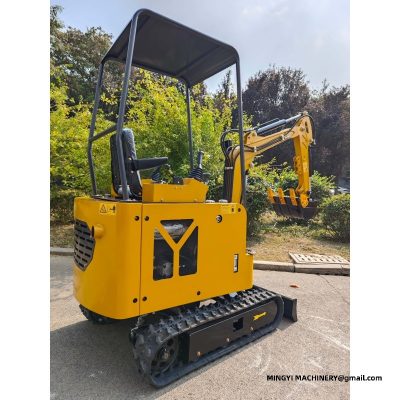
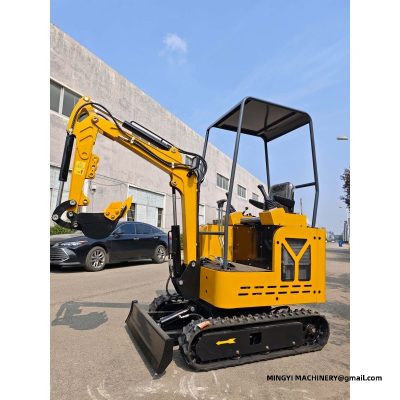
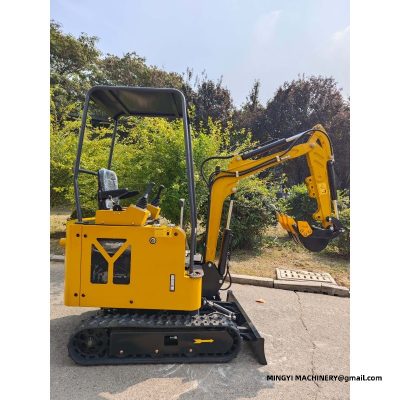
Gardening crews use a mini excavator for the digging that sits behind every planting plan: stripping tired turf, shifting topsoil, cutting borders and lifting failed shrubs. A compact crawler starts from a trailer on the street and reaches the rear of the plot without crossing finished beds.
MINGYI builds these machines for garden contractors who move between sites all week and want equipment that starts and digs without ceremony. Classes across the range let the digging force match the gardens a crew actually serves.
Gardening work this digger takes on
Across a normal week the machine opens trenches for irrigation lines, digs pits for specimen trees, levels ground before turfing and strips overgrown borders ready for replanting. Rubber tracks let it travel across lawns without cutting the surface, and a swing boom digs close to fences.
Where soil is heavy or laced with roots, a soil loosener opens the ground before the bucket finishes the hole. An auger adds planting and trellis post holes without a second machine on site.
Specifying a machine for garden sites
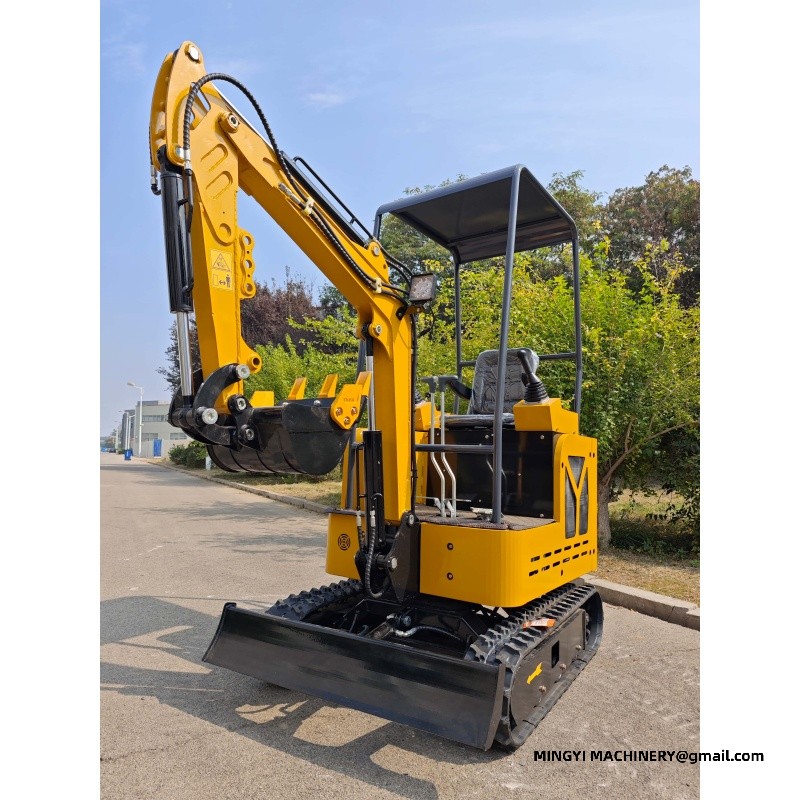
Garden work rewards control more than raw force, so many crews pick a smaller class fitted with a tilting bucket for grading beds and finishing levels. A quick coupler keeps the change between bucket, grass rake and auger short on jobs measured in minutes.
When ordering, confirm the narrowest gate the unit must pass, the track type suited to lawns, and the attachment list for the coming season. Machines are built to order, so these details are fixed before production begins.
A gardening excavator earns its place by cutting out the hand digging that slows crews down. Sharing the gardens you serve and the tools you expect to run lets MINGYI settle a specification shaped around the work.
OEM and fleet customisation of mini digger for garden sites Distributors and rental fleets usually need the machine to look like theirs. Paint, decals, seat colour and attachment branding can be specified on the excavator at build time rather than applied after import. Documentation can be prepared to suit the importer. Manuals, parts books and decal sets for this class of machine can be supplied with the buyer's own branding where the order size justifies it. Operator technique for mini digger for garden sites The second habit is tool discipline. Running the unit in daily use with the right bucket width for the trench means less spoil, less reinstatement and a cleaner job than a wide bucket and a lot of trimming. Stability is the third. A machine of this size working across the tracks rather than over the corners keeps the machine steady and the undercarriage loaded evenly, which shows up as track life at the end of the season. Parts, service and support for mini digger for garden sites Support after delivery is a parts question. Wearing items for the equipment on site - filters, belts, track components, bucket teeth and pins - are the items a buyer should plan to hold before the first service interval. Engine parts availability usually drives the engine choice. The machine itself built with an engine the local network already carries is serviced from stock rather than from an international order. Hydraulic circuits on a mini digger for garden sites Auxiliary hydraulic lines are what let a machine drive a tool rather than only a bucket. The model in question specified with the right circuits and flow runs a breaker or an auger without an add-on power pack bolted to the frame. Hydraulic specification is easier to settle at build time than to correct later. The machine in that duty delivered without auxiliary lines can still dig, but every additional tool becomes a retrofit project. Canopy or enclosed cab on a mini digger for garden sites A canopy keeps the machine light and the operator aware of the surroundings, which suits short jobs in warm weather. A fully enclosed cab is specified where rain, dust or cold are part of the working year, and it can be added to the unit on the job as a retrofit rather than only at build time. Enclosure also changes noise and dust exposure. A sealed cab on a machine built for the work keeps dust out on dry sites and lets the machine work through weather that would otherwise stop a canopy machine for the day. Interior and light demolition with mini digger for garden sites Interior demolition is an access and a weight question. The equipment in service that fits through a doorway and works on a suspended floor does jobs that would otherwise be done by hand or by a larger machine that cannot enter. Breaking out a floor slab, a wall footing or a concrete step is routine work for the excavator with a breaker. The machine is small enough to work inside and heavy enough to run the tool at a practical rate. Working on slopes and uneven ground with this class of machine Slope work is a stability question before it is a traction question. Knowing the gradient the unit in daily use is rated for, and working across rather than straight up where the ground allows, removes most of the risk. Ground that looks level often is not. A machine of this size crossing a filled trench, a soft edge or a hidden void behaves differently from one on undisturbed ground, and those are the places worth walking before driving. What owners should plan for beyond the equipment on site The useful comparison is demand per working hour, not demand per machine. The machine itself that works more hours a year spreads its standing takes over more output, which is why utilisation usually matters more than the invoice figure. Downtime is the hidden line item. The model in question waiting on a part earns nothing while it stands, so parts availability and service access belong in the plan as much as fuel does. Trenching work with the machine in that duty Service trenches are the most common reason the unit on the job is hired. Water, sewage, cable and gas runs are narrow, shallow and often close to existing services, which is exactly the work a full-size machine cannot do safely. Trench quality depends on the bucket width and the operator, not on machine size. A machine built for the work with a narrow bucket and a swing boom cuts a clean run along a boundary without disturbing the ground either side of it. Acceptance checks when the equipment in service arrives A function check before the machine goes to work is worth the hour. Running through the controls, the travel and the attachment circuit on the excavator confirms it is set up as specified and ready for the site. Documentation should arrive with the machine. Parts list, service schedule and any certificates for this class of machine are what the workshop needs later, and they are much easier to obtain at delivery than in month six. Boom configuration for the unit in daily use Extended and offset boom configurations change reach and working range. A machine of this size with a longer arm reaches further but lifts less at full extension, so the specification is set against the deepest and furthest point on the job list. Detachable boom sections are used where transport length matters. The equipment on site that has to travel on a standard trailer can be built so the arm comes off for the road and goes back on at the site. Export packing and shipping of the machine itself Export documentation, decals and paint are settled before packing. Asking for them with the machine in that duty order avoids a second handling session and keeps the machine on the booked vessel. Buyers who import regularly plan the spare parts with the machine. The model in question ordered with a wearing-parts kit arrives ready to work rather than ready to wait for the first service interval. Specification data for the unit on the job Where a machine built for the work is being specified for a job list, the table below gives the factory figures that matter most: what the machine weighs, how deep and how far it works, and what it measures on a trailer. Figures are factory figures and are confirmed on the build sheet for the equipment in service. Where a job sits between two models, the larger machine usually takes less time than the smaller one spends on rework. Confined sites are decided by dimensions. Overall width, tail swing and the space needed to work the arm are what let the excavator operate inside a building, between walls or in a courtyard. Ventilation is the other indoor constraint. Running this class of machine inside a closed structure needs air movement, and that is a planning item rather than something to discover after the first hour.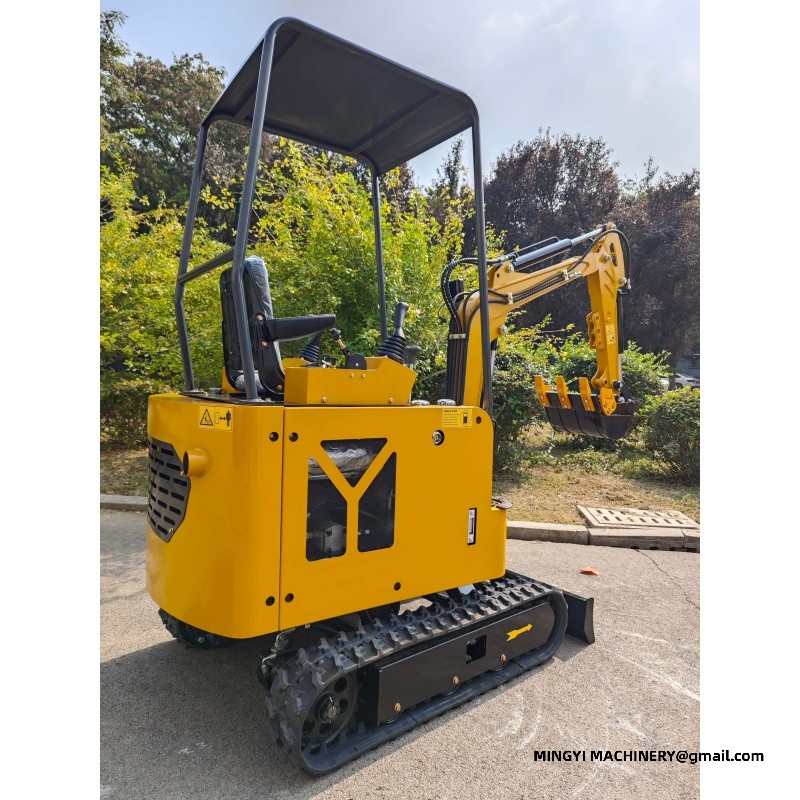
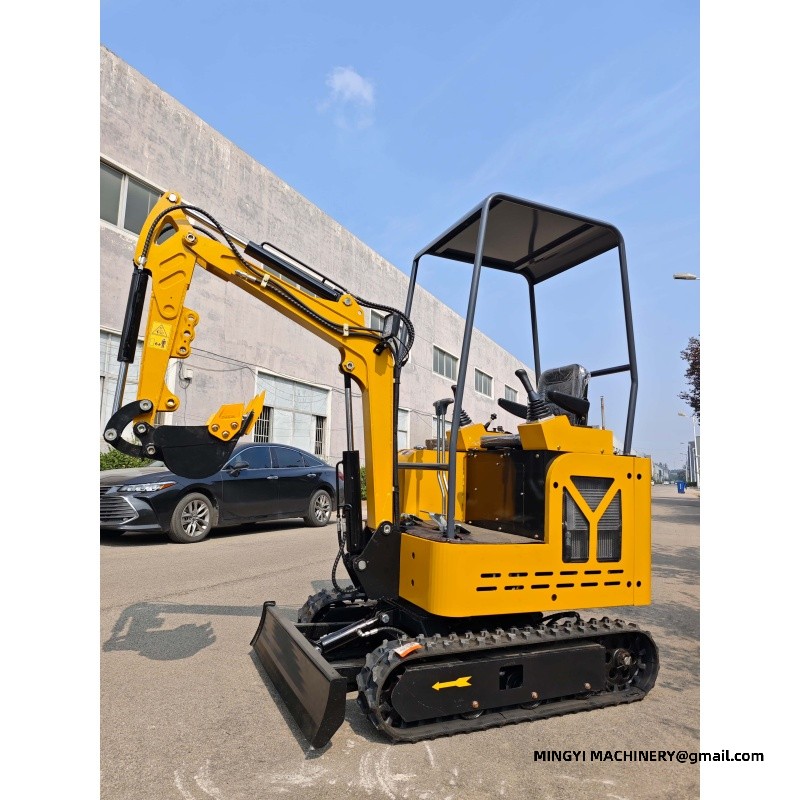
Reference specification — mini excavator range 12W 15W 30-2W 15L Operating weight 1200 kg (2645.55 lb) 1400 kg (3086.47 lb) 2700 kg (5952.48 lb) 1400 kg (3086.47 lb) Transport size (L×W×H) 2200 × 930 × 2250 mm 2200 × 930 × 2250 mm 3000 × 1100 × 2700 mm 2200 × 930 × 2250 mm Max digging depth 1630 mm (64.17 in) 1630 mm (64.17 in) 2200 mm (86.61 in) 1700 mm (66.93 in) Max digging height 2750 mm (108.27 in) 2750 mm (108.27 in) 3000 mm (118.11 in) 2750 mm (108.27 in) Max dumping height 1960 mm (77.17 in) 1960 mm (77.17 in) 2000 mm (78.74 in) 1960 mm (77.17 in) Max digging radius 2900 mm (114.17 in) 2900 mm (114.17 in) 3800 mm (149.61 in) 2900 mm (114.17 in) Max digging distance 2100 mm (82.68 in) 2100 mm (82.68 in) 3050 mm (120.08 in) 2300 mm (90.55 in) Minimum turning radius 1300 mm (51.18 in) 1300 mm (51.18 in) 1750 mm (68.9 in) 1450 mm (57.09 in) Travel speed 3 km/h (1.86 mph) 3 km/h (1.86 mph) 7 km/h (4.35 mph) 3 km/h (1.86 mph) Gradeability 30° 30° 30° 30° Fuel consumption 1-1.3 L/h (0.264—0.343 gal) 1-1.3 L/h (0.264—0.343 gal) 2-3 L/h (0.528—0.793 gal) 1-1.3 L/h (0.264—0.343 gal) Fuel tank capacity 10 L (2.64 gal) 10 L (2.64 gal) 16 L (4.23 gal) 10 L (2.64 gal) Hydraulic oil tank 16 L (4.23 gal) 16 L (4.23 gal) 20 L (5.28 gal) 16 L (4.23 gal) Dozer blade lift height 180 mm (7.09 in) 180 mm (7.09 in) 230 mm (9.06 in) 180 mm (7.09 in) Dozer blade drop depth 210 mm (8.27 in) 210 mm (8.27 in) 280 mm (11.02 in) 210 mm (8.27 in)
Q. Who uses the unit in daily use?
A. Softscape and turf work judge a machine by what it leaves behind, which is why compact excavators with the right tracks and valves own this trade. With a thumb or a tree-moving grab the digger opens the root ball, lifts and sets the plant in one motion - the work of a crew. Read a machine of this size together with the engine, track and attachment pages: jobs around garden sites are decided by how those choices line up, not by any single number on the sheet.
Q. What does a landscape crew actually dig in a week?
A. Bed preparation, path base, drainage, planting holes and the odd tree - varied, light, and judged by the finish. That mix is exactly what the compact class is built around.
Q. How do I get a specification?
A. Send the model, the destination and the attachment list by email or LINE - the channels listed just below this section. The reply covers the specification, lead time, packing and freight in one document, with the garden sites build sheet attached.
Keeping a service record for the equipment on site
Patterns show up in the record before they show up in the machine. Rising oil consumption or a filter that keeps blocking on the machine itself is obvious on paper long before it becomes a failure on site.
Planning the season around the model in question
Downtime is simplest when it is planned. Booking the service for the machine in that duty in the quiet part of the season takes nothing from the schedule, while the same work in the busy weeks gives up a day of output every time.
E-mail : sales@mingycn.com
LINE ( ID ): mingyicn
Related pages
steel tracked ditching mini excavator · mini excavator for utility trenches · Compact Wheel Loader: Choosing Between the Two Entry Builds · Mini Excavators









