Municipal repair work is carried out in public places, often while they remain in use. Footpaths stay open, traffic passes the trench and residents keep their access, which puts as much weight on the machine's size as on its digging performance.
MINGYI builds compact crawler excavators in the 0.8 to 6 tonnes class for this type of work, assembled to order. The track type, the tail swing and the attachment set are all chosen for street conditions rather than for open ground.
Street and pavement repair work
The typical jobs are footpath and kerb repair, drainage and gully work, small patching and reinstatement. Each is short in duration, so the machine has to be productive within minutes of arriving rather than after a long set-up.
Rubber tracks allow the machine to be positioned on paving and tarmac without cutting up the surface it is there to repair. A compact tail lets it work inside a fenced footprint that keeps pedestrians clear of the excavation.
Working around live services
Utility corridors rarely contain only one service, and the machine has to cut past ducts, cables and pipes it must not touch. A narrow trenching bucket and controlled, shallow passes reduce the risk of contact.
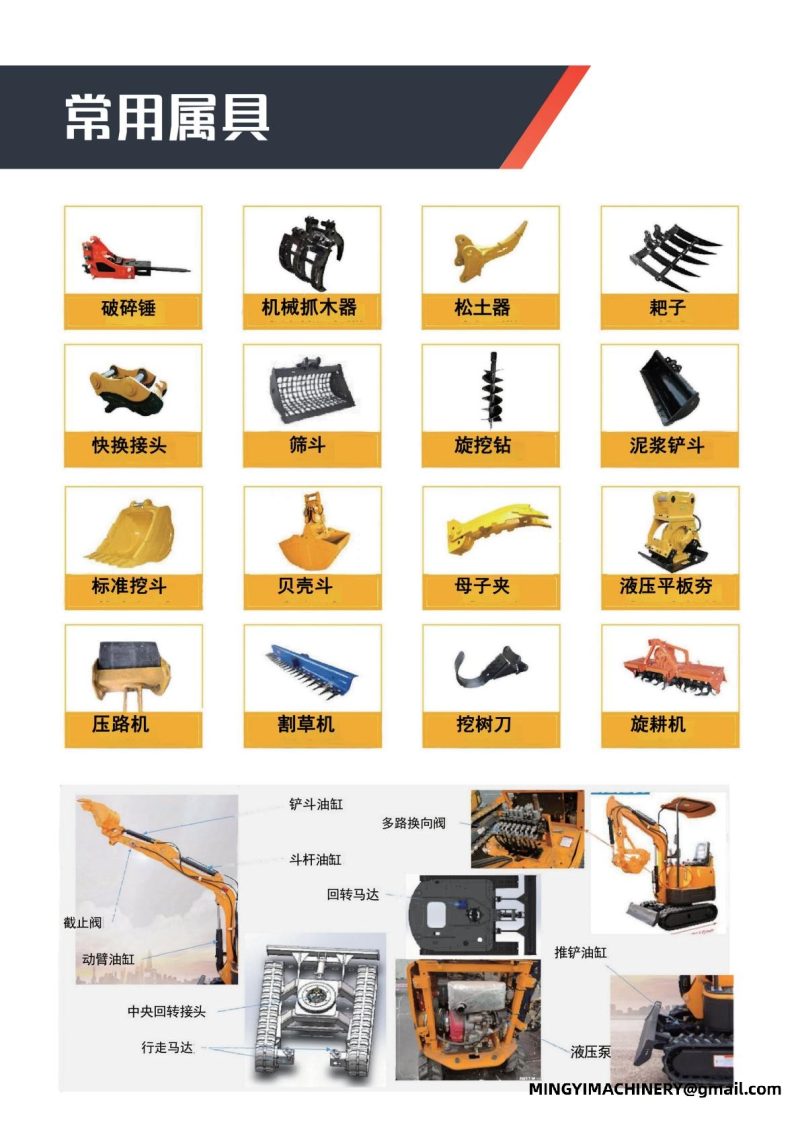
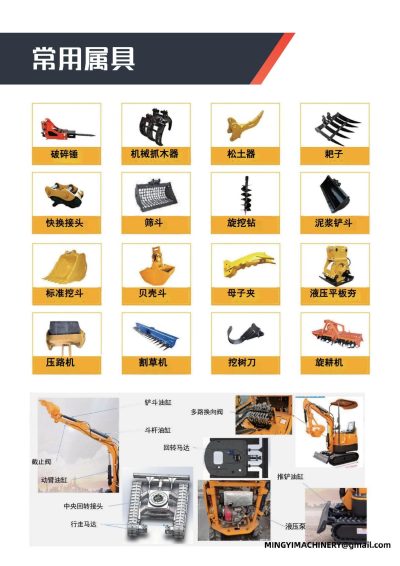
Where concrete or old tarmac has to be opened first, a breaker hammer on a quick coupler allows the same machine to break and excavate without a second unit being brought to the street. A thumb bucket or fork is often added for lifting covers, signs and materials.
Municipal repair work is won and lost on disruption. A compact utility excavator that fits inside a small footprint, moves over paving without damaging it and changes tools quickly keeps streets open and the work moving in the same shift.
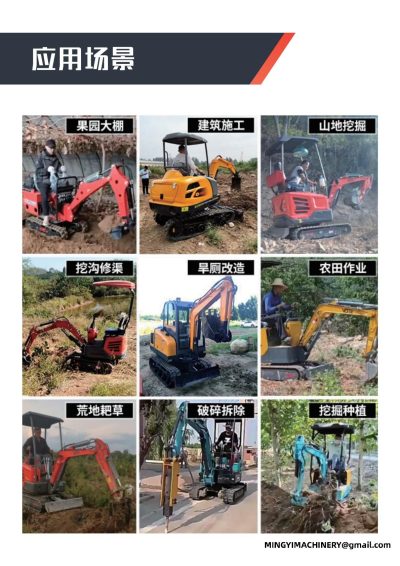
Quick coupler practice on municipal and utility repair excavator A quick coupler is the single option that changes how a machine is used day to day. Fitted to the excavator, it turns an attachment change from a two-person workshop job into a task the operator does alone in minutes. Couplers are specified early because they affect the arm and the hydraulic kit. Adding one to this class of machine after delivery means new pins, new hoses and a fitment session; adding it at build time is a line on the sheet. Boom configuration for municipal and utility repair excavator Extended and offset boom configurations change reach and working range. The unit in daily use with a longer arm reaches further but lifts less at full extension, so the specification is set against the deepest and furthest point on the job list. Detachable boom sections are used where transport length matters. A machine of this size that has to travel on a standard trailer can be built so the arm comes off for the road and goes back on at the site. Hydraulic circuits on a municipal and utility repair excavator Auxiliary hydraulic lines are what let a machine drive a tool rather than only a bucket. The equipment on site specified with the right circuits and flow runs a breaker or an auger without an add-on power pack bolted to the frame. Hydraulic specification is easier to settle at build time than to correct later. The machine itself delivered without auxiliary lines can still dig, but every additional tool becomes a retrofit project. Hiring versus owning a municipal and utility repair excavator The choice follows the hours. Work that fills a few weeks a year is usually better hired, while the model in question that would be on site most weeks starts to justify ownership once the transport and booking time is counted. Ownership brings obligations that hiring does not. Storage, servicing, insurance and an operator are the items to set against the hire rate before deciding which way the machine in that duty should be supplied. Noise, dust and working near occupied buildings Work near housing or occupied premises brings constraints that open sites do not. Start times, exhaust condition and how often the unit on the job needs to reverse are the practical limits that neighbours notice. Dust control is often part of the same conversation. Water, timing and work sequence reduce what leaves the site, and agreeing them in advance keeps a machine built for the work working rather than stopped after a complaint. Municipal and public works with municipal and utility repair excavator Drainage repair, tree planting, footway reconstruction and cemetery work are all within the range of the equipment in service. The jobs are small individually and continuous across the year. Noise and surface protection matter on public work. The excavator on rubber tracks across paving, with a sealed cab for the operator, suits the conditions better than a larger tracked machine. Canopy or enclosed cab on this class of machine A canopy keeps the machine light and the operator aware of the surroundings, which suits short jobs in warm weather. A fully enclosed cab is specified where rain, dust or cold are part of the working year, and it can be added to the unit in daily use as a retrofit rather than only at build time. Enclosure also changes noise and dust exposure. A sealed cab on a machine of this size keeps dust out on dry sites and lets the machine work through weather that would otherwise stop a canopy machine for the day. Acceptance checks when the equipment on site arrives A function check before the machine goes to work is worth the hour. Running through the controls, the travel and the attachment circuit on the machine itself confirms it is set up as specified and ready for the site. Documentation should arrive with the machine. Parts list, service schedule and any certificates for the model in question are what the workshop needs later, and they are much easier to obtain at delivery than in month six. Orchard, vineyard and farm use of the machine in that duty Orchard and vineyard work is carried out between rows. The unit on the job with a narrow chassis and a swing boom works down the row without damaging the trees, which is the reason a full-size machine is not used at all. Farms also use a machine built for the work for general maintenance - clearing a watercourse, repairing a track, loading a spreader. One carrier with a few attachments covers most of the jobs that would otherwise wait for a contractor. Working the equipment in service in confined spaces Confined sites are decided by dimensions. Overall width, tail swing and the space needed to work the arm are what let the excavator operate inside a building, between walls or in a courtyard. Ventilation is the other indoor constraint. Running this class of machine inside a closed structure needs air movement, and that is a planning item rather than something to discover after the first hour. Trenching work with the unit in daily use Service trenches are the most common reason a machine of this size is hired. Water, sewage, cable and gas runs are narrow, shallow and often close to existing services, which is exactly the work a full-size machine cannot do safely. Depth control matters more on service work than speed. The equipment on site working beside live services is chosen because it can be placed precisely and stopped instantly, which is what the job actually requires. Landscaping and ground care with the machine itself Landscape contractors use the model in question for planting holes, pond excavation, grading and retaining work. The machine is light enough to cross finished lawn and narrow enough to work between established trees. Grass cutting heads, rakes and tillers extend the machine in that duty into ground care. The same carrier that digs a border in spring can cut and clear the same area later in the season. Specification data for the unit on the job Where a machine built for the work is being specified for a job list, the table below gives the factory figures that matter most: what the machine weighs, how deep and how far it works, and what it measures on a trailer. Figures are factory figures and are confirmed on the build sheet for the equipment in service. Where a job sits between two models, the larger machine usually takes less time than the smaller one spends on rework. Rubber tracks suit paved and landscaped ground because they spread the machine weight and leave the surface intact. Steel tracks with rubber blocks are specified where the ground is rougher or the working day is longer, and the choice can be made per machine rather than accepted as a factory default. Undercarriage selection is a ground question, not a preference question. The excavator running on finished paving needs rubber; the same machine on demolition rubble or rock wears rubber quickly, so steel with rubber blocks becomes the better answer over a full season.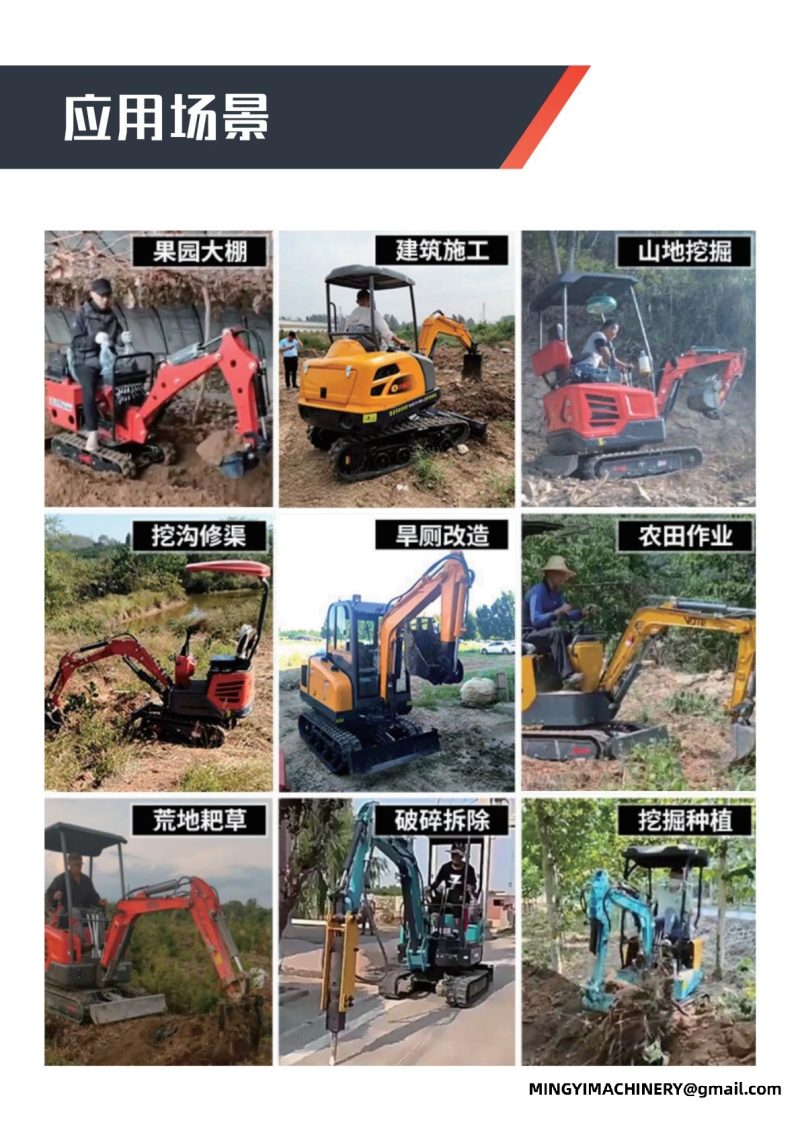
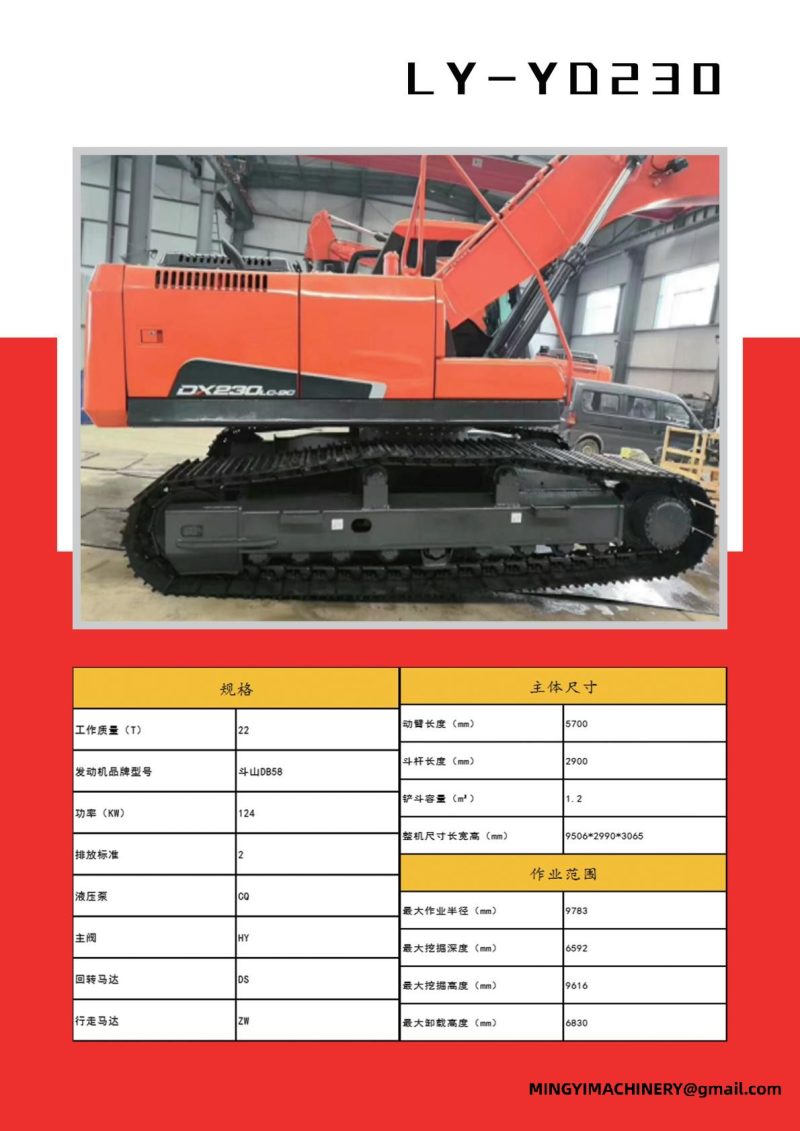
Reference specification — mini excavator range 09W 15W 20-1W 15L Operating weight 1100 kg (2425.08 lb) 1400 kg (3086.47 lb) 1800 kg (3968.32 lb) 1400 kg (3086.47 lb) Transport size (L×W×H) 1800 × 750 × 1970 mm 2200 × 930 × 2250 mm 2550 × 1100 × 2200 mm 2200 × 930 × 2250 mm Max digging depth 1250 mm (49.21 in) 1630 mm (64.17 in) 1800 mm (70.87 in) 1700 mm (66.93 in) Max digging height 2800 mm (110.24 in) 2750 mm (108.27 in) 2820 mm (111.02 in) 2750 mm (108.27 in) Max dumping height 1700 mm (66.93 in) 1960 mm (77.17 in) 2050 mm (80.71 in) 1960 mm (77.17 in) Max digging radius 2570 mm (101.18 in) 2900 mm (114.17 in) 3050 mm (120.08 in) 2900 mm (114.17 in) Max digging distance 1869 mm (73.58 in) 2100 mm (82.68 in) 2300 mm (90.55 in) 2300 mm (90.55 in) Minimum turning radius 1000 mm (39.37 in) 1300 mm (51.18 in) 1450 mm (57.09 in) 1450 mm (57.09 in) Travel speed 3 km/h (1.86 mph) 3 km/h (1.86 mph) 5 km/h (3.11 mph) 3 km/h (1.86 mph) Gradeability 30° 30° 30° 30° Fuel consumption 1-1.3 L/h (0.264—0.343 gal) 1-1.3 L/h (0.264—0.343 gal) 2-3 L/h (0.528—0.793 gal) 1-1.3 L/h (0.264—0.343 gal) Fuel tank capacity 8 L (2.11 gal) 10 L (2.64 gal) 16 L (4.23 gal) 10 L (2.64 gal) Hydraulic oil tank 16 L (4.23 gal) 16 L (4.23 gal) 18 L (4.76 gal) 16 L (4.23 gal) Dozer blade lift height 180 mm (7.09 in) 180 mm (7.09 in) 180 mm (7.09 in) 180 mm (7.09 in) Dozer blade drop depth 210 mm (8.27 in) 210 mm (8.27 in) 210 mm (8.27 in) 210 mm (8.27 in)
Q. What is this class of machine used for?
A. Most compact excavator hours are spent in the ground for services and drainage, and the whole job is matching the machine to exactly that work. Depth control comes from the machine holding position, not from the operator chasing the grade. MINGYI builds the 08, 12 and 18 models covering the 0.8 to 6 tonne class, and the unit in daily use is where that range meets municipal utility repair.
Q. Which bucket digs a clean trench?
A. A narrow trenching bucket matched to the pipe or cable, with teeth only when the ground is hard. MINGYI specifications bucket widths with the machine, so the trench and the tool arrive matched instead of guessed.
Q. Does MINGYI supply attachments with the machine?
A. Yes - buckets, breakers, augers, rakes and the rest of the working set ship with the carrier, matched to the hydraulic flow and the coupler. For municipal utility repair the package is confirmed on the build sheet, so machine and tools arrive together and start work together.
Pre-delivery inspection before a machine of this size leaves the shop
The last hour before packing is the best time to find a fault. Running the equipment on site through its full working cycle, checking for leaks under load and confirming that the controls match the specification avoids a conversation across time zones later.
Storage and long idle periods for the machine itself
Rubber, seals and hoses age whether the machine works or not. Keeping the model in question out of direct sun and off damp ground slows that, and running it briefly at intervals keeps everything moving.
E-mail : sales@mingycn.com
LINE ( ID ): mingyicn
Related pages
tree moving mini excavator with thumb · refurbished mini excavator · Hydraulic Wheel Loader Log Grapple: Circuit and Cylinders · Mini Excavators









