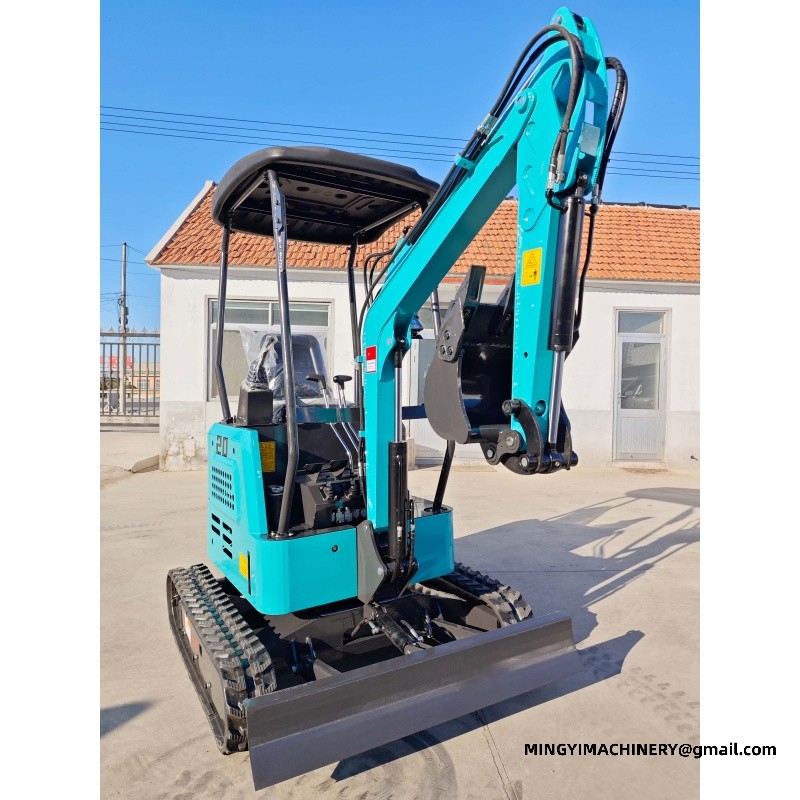
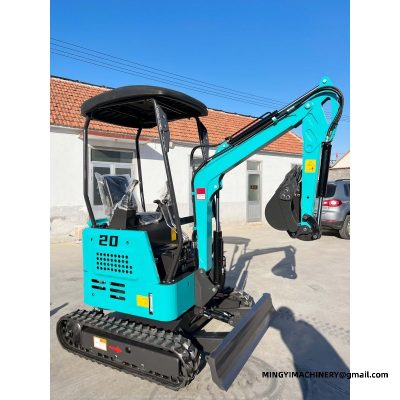
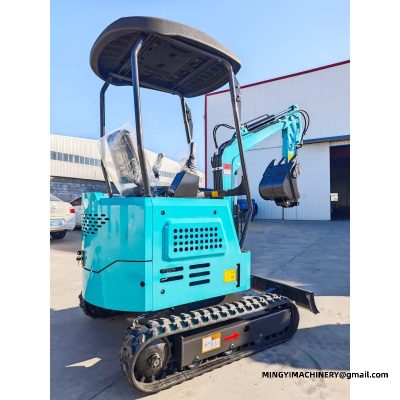
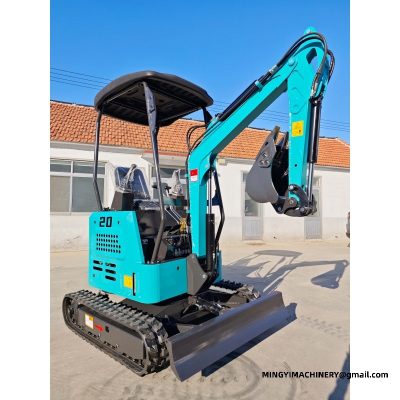
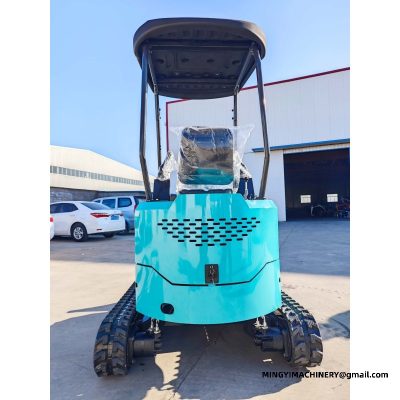
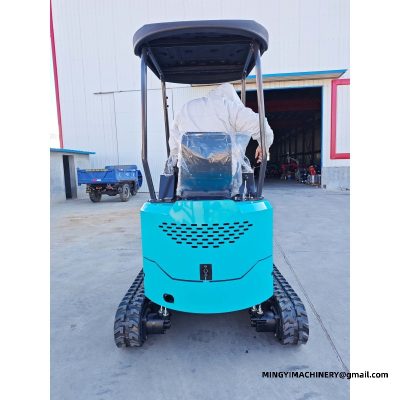
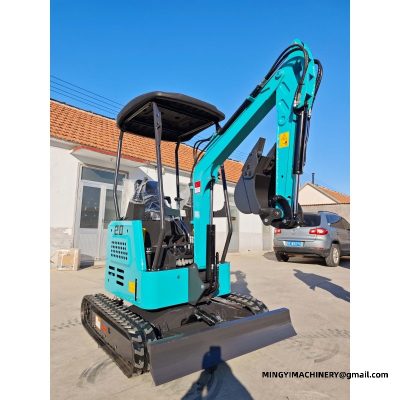
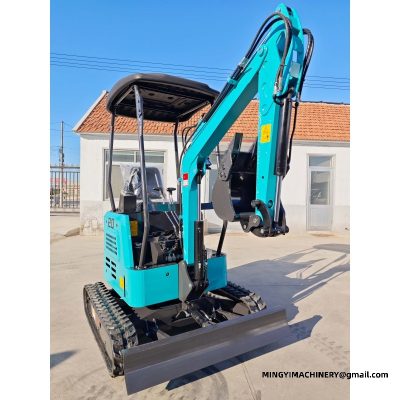
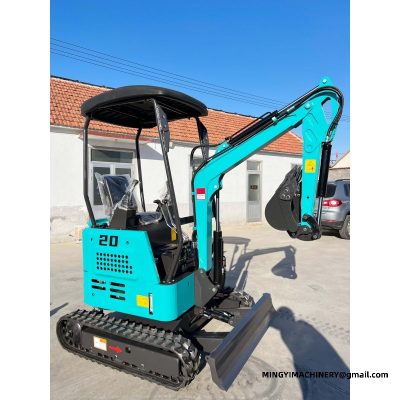
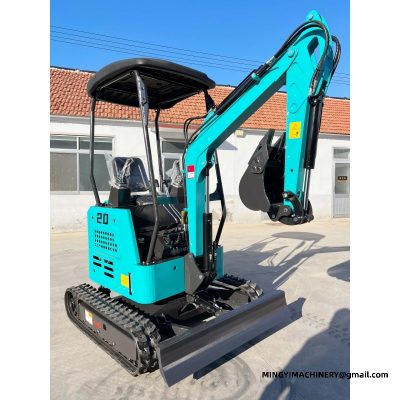
Landscaping mixes shaping, planting, drainage and clearing in a single visit, and a compact crawler excavator can move between those tasks without damaging finished ground. Buyers in this trade tend to judge the machine on how gently it travels rather than on raw digging power.
MINGYI builds the class as a compact unit with rubber tracks as the usual choice, since they spread load and mark lawns and paving less. Steel tracks with rubber blocks remain available where the site is rougher.
Grading and shaping on landscape projects
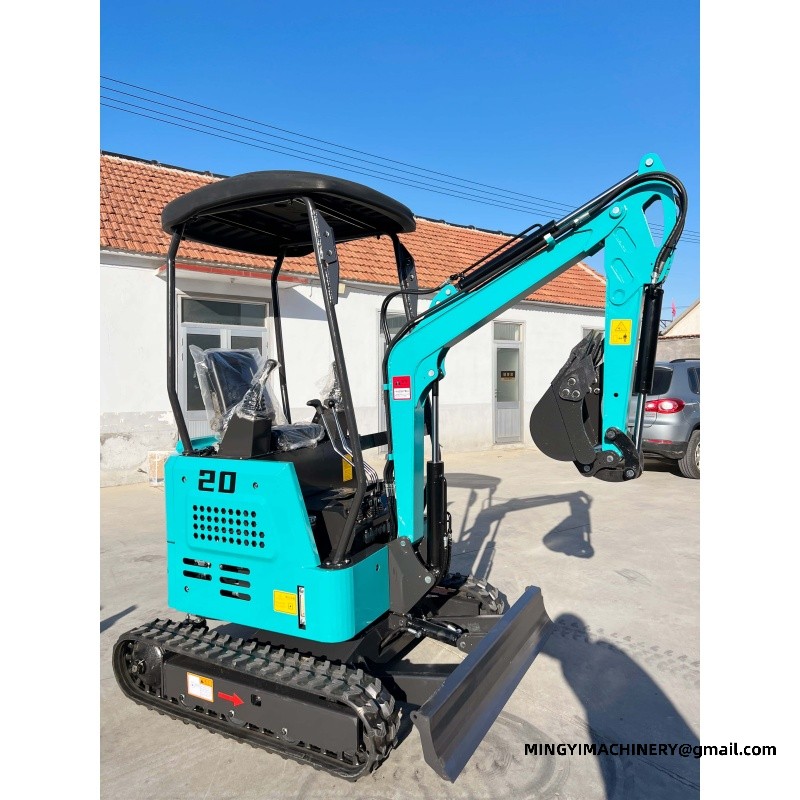
Shaping a garden or a commercial landscape is mostly about forming slopes, terraces and beds to a consistent line. A tilting bucket lets the operator cut a fall without repositioning, and the boom follows curves a larger machine would flatten.
Where soil has to be loosened before planting, a rotary tiller or soil loosener mounted on the same machine prepares the bed in place. The bucket is then used only to move material, which keeps the finished levels accurate.
Planting and clearing attachments for landscapers
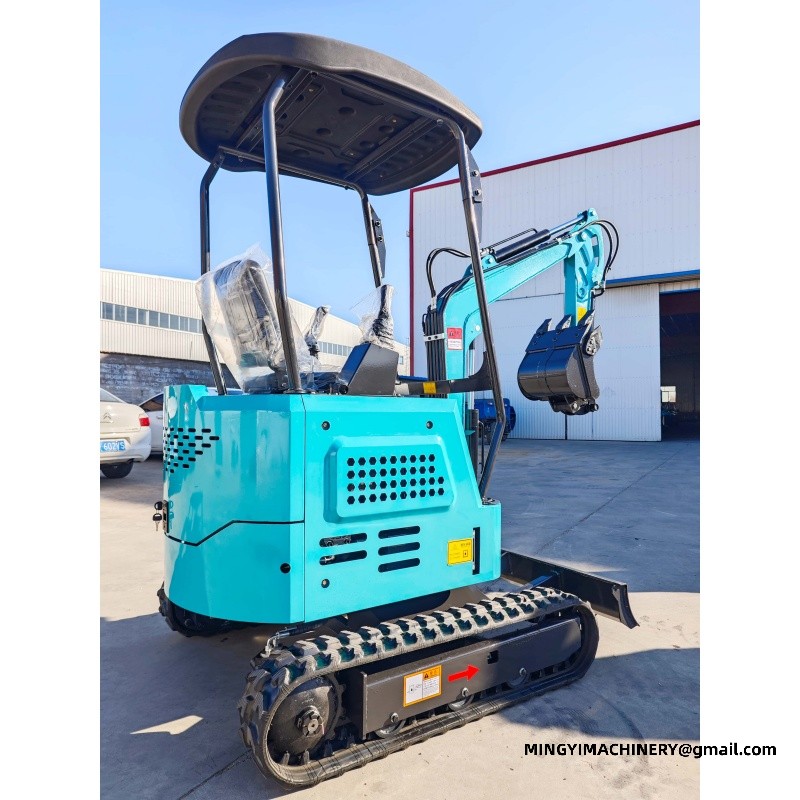
Tree and shrub work is handled with a plant grabber or a grass and tree grabber, which lift root balls and branches without the operator leaving the cab. A thumb bucket is often specified alongside for handling logs, stone and lengths of pipe.
Green maintenance adds a different set of tools again: a lawn mower or flail mower for rough grass, a grass rake for tidying, and a hedge pruner for boundary planting. Because they share one coupler, a single machine can carry the whole set.
For landscaping buyers the deciding factors are usually track type and attachment list rather than digging depth. A two tonne excavator ordered with rubber tracks and the green-work attachments named up front keeps ground damage low.
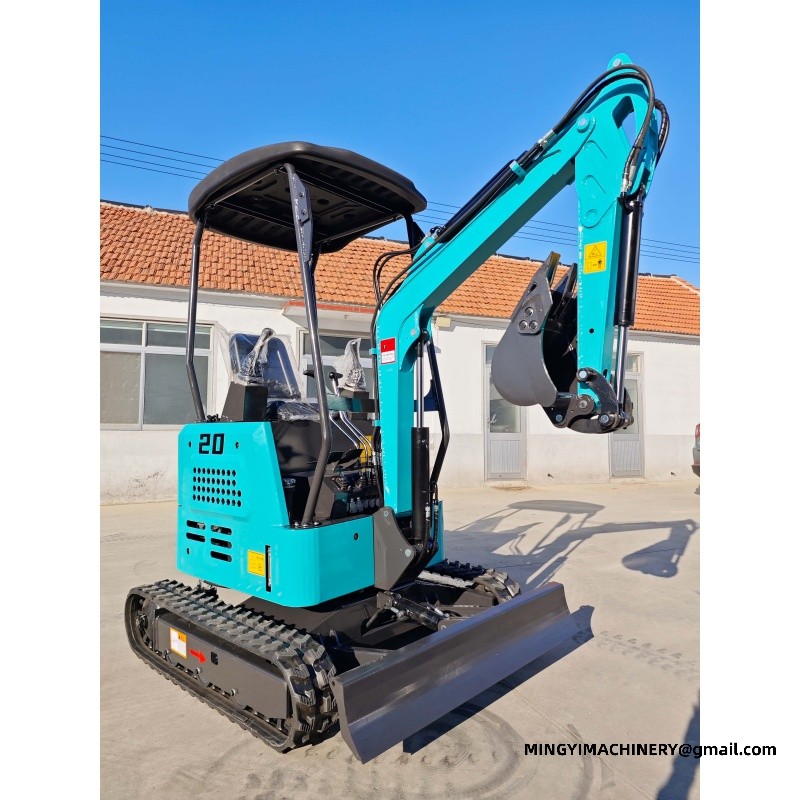
Specifying two tonne mini excavator for landscaping against a job list The practical way to specify is to write the job list first: the narrowest access, the deepest trench, the heaviest tool and the surfaces the machine must cross. The excavator is then matched to those four numbers. Buyers who skip this step either over-buy or under-buy. This class of machine specified only from machine size tends to arrive without the coupler, the circuits or the track type the work actually needs. Parts, service and support for two tonne mini excavator for landscaping Support after delivery is a parts question. Wearing items for the unit in daily use - filters, belts, track components, bucket teeth and pins - are the items a buyer should plan to hold before the first service interval. Remote support is handled by video. A machine of this size fault can often be diagnosed on a walk-around call with the panel open, which is faster than waiting for a visit and avoids shipping a part that is not needed. Noise, dust and working near occupied buildings Work near housing or occupied premises brings constraints that open sites do not. Start times, exhaust condition and how often the equipment on site needs to reverse are the practical limits that neighbours notice. Enclosure and machine condition both reduce noise. The machine itself with intact panels, sound mounts and a maintained exhaust is measurably quieter than the same machine with loose guards, and the difference matters on restricted sites. Matching two tonne mini excavator for landscaping to ground conditions Soft ground is a flotation problem, not a power problem. The model in question on wide rubber tracks crosses lawn, sand and cultivated soil that would stop a narrower machine or a wheeled unit of the same capacity. Mixed sites are common and argue for a compromise specification. Most buyers choose rubber for the machine in that duty and accept the wear, unless the majority of the work is on material that will damage it. Working near live services with two tonne mini excavator for landscaping The risk on utility work is not machine power but machine placement. The unit on the job that fits the working width leaves the surrounding ground undisturbed, which keeps the trench stable and the reinstatement small. Utility crews specify a machine built for the work with a narrow bucket and good visibility for exactly this reason: the machine has to stop at the service, not at the edge of the operator's view. Orchard, vineyard and farm use of two tonne mini excavator for landscaping Orchard and vineyard work is carried out between rows. The equipment in service with a narrow chassis and a swing boom works down the row without damaging the trees, which is the reason a full-size machine is not used at all. Ditching, fertilising and drainage on farmland suit the excavator because the work is spread over a large area in short bursts. The machine travels behind a pickup and works where it stops. Interior and light demolition with this class of machine Interior demolition is an access and a weight question. The unit in daily use that fits through a doorway and works on a suspended floor does jobs that would otherwise be done by hand or by a larger machine that cannot enter. Breaking out a floor slab, a wall footing or a concrete step is routine work for a machine of this size with a breaker. The machine is small enough to work inside and heavy enough to run the tool at a practical rate. Working the equipment on site in confined spaces Confined sites are decided by dimensions. Overall width, tail swing and the space needed to work the arm are what let the machine itself operate inside a building, between walls or in a courtyard. Clearance above matters as much as around. Door heights, pipework and overhead services set the limit for the model in question indoors, and measuring them first avoids a machine that arrives and cannot be used. Lifting and material handling with the machine in that duty Stability changes with reach. A load the unit on the job handles close in becomes a different proposition at full extension, so the working radius belongs in the plan before the lift rather than during it. Ground condition under the machine is part of every lift. Soft or uneven support is the common factor in handling incidents, and checking it takes less time than recovering a machine built for the work that has settled. Working on slopes and uneven ground with the equipment in service Slope work is a stability question before it is a traction question. Knowing the gradient the excavator is rated for, and working across rather than straight up where the ground allows, removes most of the risk. Planning the direction of travel helps. Working so that the this class of machine is stable under load and not required to turn on a slope is a decision made before the job starts, not a correction made during it. What owners should plan for beyond the unit in daily use Purchase decision is the visible part of the effort. Fuel, filters, tracks or tyres, the operator and the transport between sites are the items that decide what a machine of this size actually demands over a few seasons, and they are worth listing before the order. The useful comparison is demand per working hour, not demand per machine. The equipment on site that works more hours a year spreads its standing takes over more output, which is why utilisation usually matters more than the invoice figure. Specification data for the machine itself Buyers comparing the model in question usually start from four numbers - weight, digging depth, reach and transport width - because those are the ones that decide whether the machine can be delivered and whether it can do the job once it is there. Every value shown is as built for the machine in that duty; options such as cab, side swing or a telescopic undercarriage change the transport dimensions and are confirmed at order stage. Loading practice matters as much as the numbers. The unit on the job is driven up ramps under its own power with the boom lowered and the tracks aligned, and secured at the points the manufacturer specifies. Detachable components reduce transport length. A machine built for the work built with a removable arm section or a folding step fits a shorter trailer and may avoid an oversize movement permit.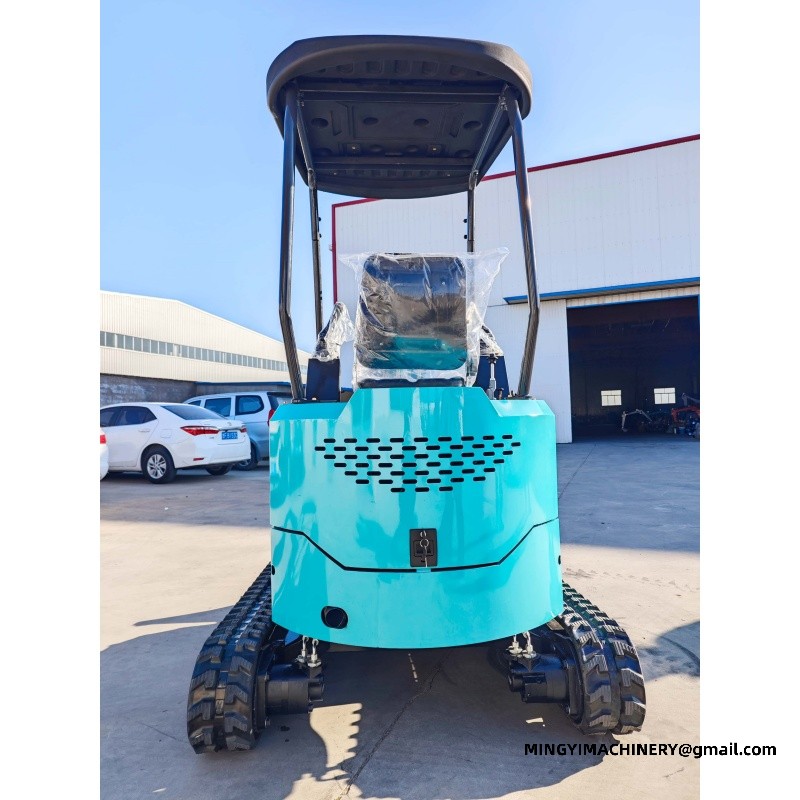
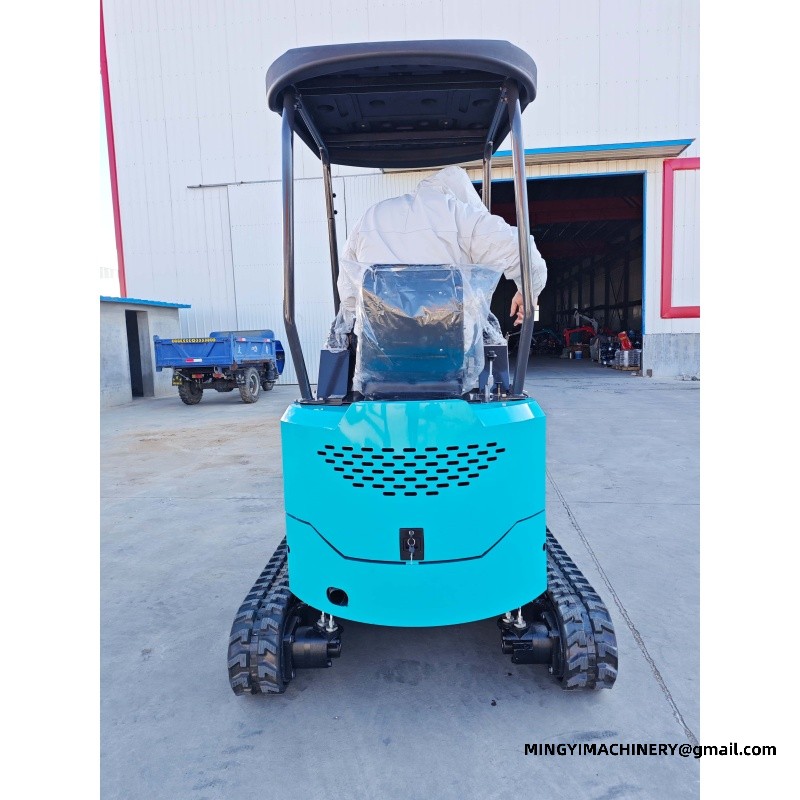
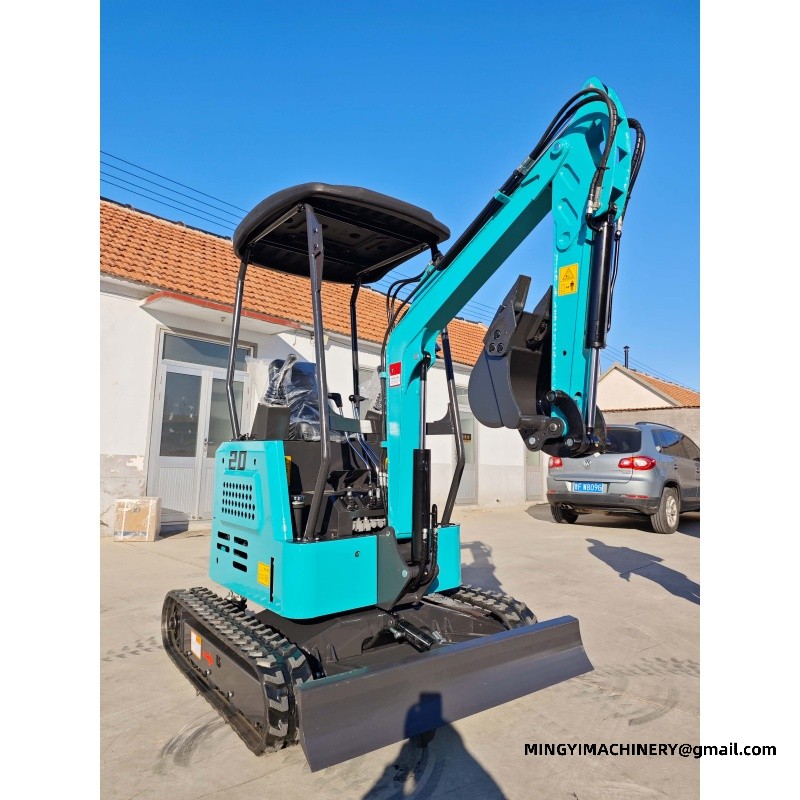
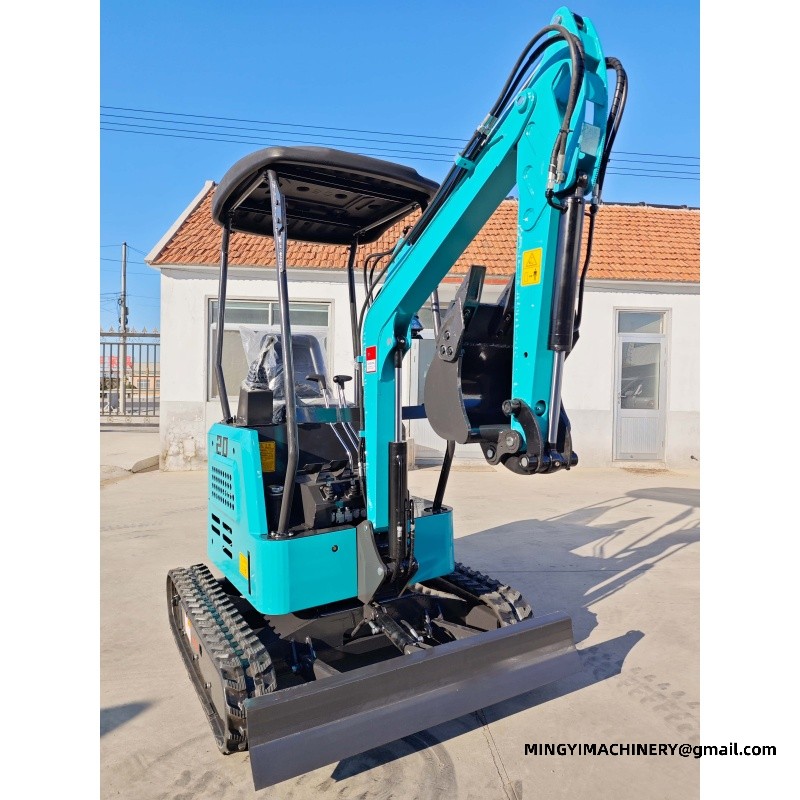
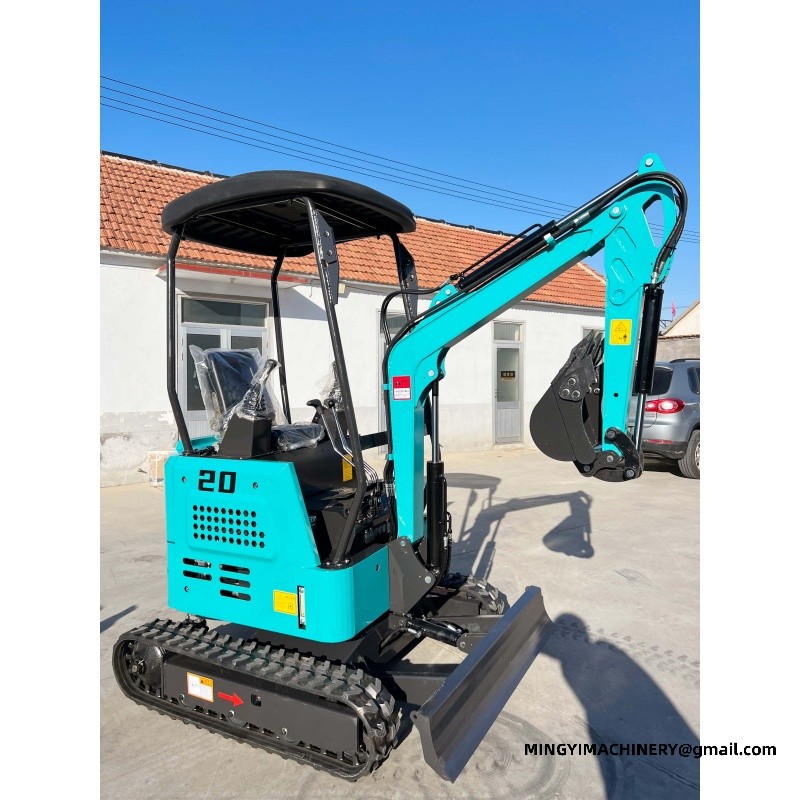
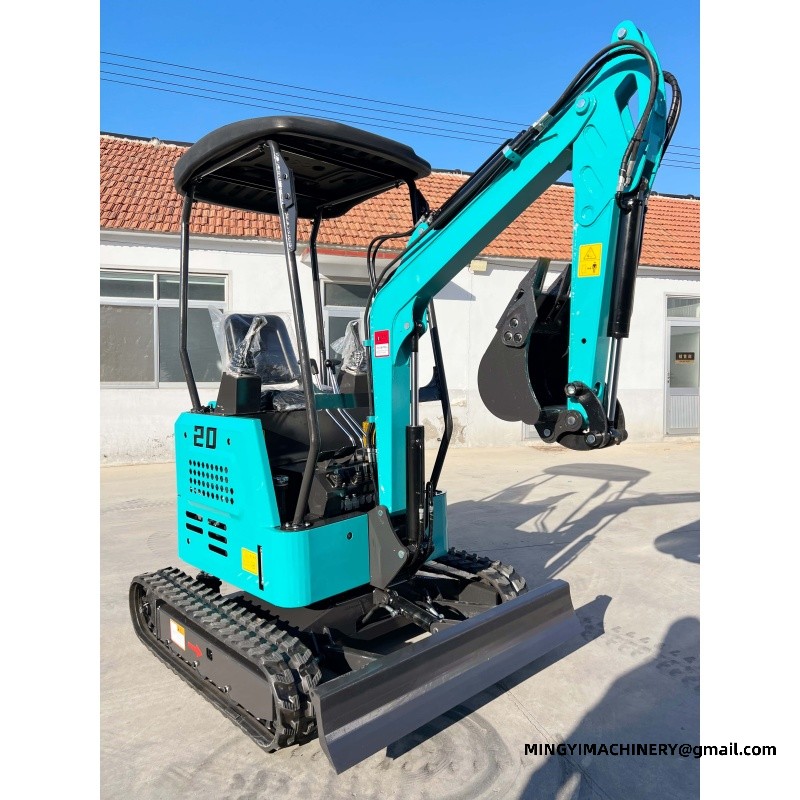
Reference specification — mini excavator range 13W 20-1WL 30-1W 30-2W Operating weight 1300 kg (2866.01 lb) 1900 kg (4188.78 lb) 2900 kg (6393.41 lb) 2700 kg (5952.48 lb) Transport size (L×W×H) 2200 × 930 × 2250 mm 2550 × 1100 × 2200 mm 3000 × 1250 × 2780 mm 3000 × 1100 × 2700 mm Max digging depth 1630 mm (64.17 in) 1800 mm (70.87 in) 2200 mm (86.61 in) 2200 mm (86.61 in) Max digging height 2750 mm (108.27 in) 2820 mm (111.02 in) 3400 mm (133.86 in) 3000 mm (118.11 in) Max dumping height 1960 mm (77.17 in) 2050 mm (80.71 in) 2400 mm (94.49 in) 2000 mm (78.74 in) Max digging radius 2900 mm (114.17 in) 3050 mm (120.08 in) 4000 mm (157.48 in) 3800 mm (149.61 in) Max digging distance 2100 mm (82.68 in) 2300 mm (90.55 in) 2800 mm (110.24 in) 3050 mm (120.08 in) Minimum turning radius 1300 mm (51.18 in) 1450 mm (57.09 in) 2000 mm (78.74 in) 1750 mm (68.9 in) Travel speed 3 km/h (1.86 mph) 5 km/h (3.11 mph) 5 km/h (3.11 mph) 7 km/h (4.35 mph) Gradeability 30° 30° 30° 30° Fuel consumption 1-1.3 L/h (0.264—0.343 gal) 2-3 L/h (0.528—0.793 gal) 2-3 L/h (0.528—0.793 gal) 2-3 L/h (0.528—0.793 gal) Fuel tank capacity 10 L (2.64 gal) 16 L (4.23 gal) 16 L (4.23 gal) 16 L (4.23 gal) Hydraulic oil tank 16 L (4.23 gal) 18 L (4.76 gal) 20 L (5.28 gal) 20 L (5.28 gal) Dozer blade lift height 180 mm (7.09 in) 180 mm (7.09 in) 420 mm (16.54 in) 230 mm (9.06 in) Dozer blade drop depth 210 mm (8.27 in) 210 mm (8.27 in) 210 mm (8.27 in) 280 mm (11.02 in)
Q. What is the equipment in service?
A. Softscape and turf work judge a machine by what it leaves behind, which is why compact excavators with the right tracks and valves own this trade. With a thumb or a tree-moving grab the digger opens the root ball, lifts and sets the plant in one motion - the work of a crew. For landscaping applications the practical route is to send the job list to the factory and let the build sheet answer it - which is exactly what this page invites.
Q. How do you avoid damaging finished ground?
A. Rubber tracks, boards or mats under the machine, and a dig plan that treads where the hard surface will be. A fine-control valve grades to the line on the first pass, which is where the care shows.
Q. How do I get a specification?
A. Send the model, the destination and the attachment list by email or LINE - the channels listed just below this section. The reply covers the specification, lead time, packing and freight in one document, with the landscaping build sheet attached.
Packing, loading and shipment of the excavator
The paperwork matters as much as the packing. Serial numbers, dimensions and weights recorded for this class of machine at loading are the same figures the destination needs, and a mismatch here loses more days than the voyage itself.
Planning the season around the unit in daily use
The calendar decides more than the specification does. Planning when a machine of this size will be working, when it will be serviced and when it can be spared keeps the maintenance out of the weeks that matter.
E-mail : sales@mingycn.com
LINE ( ID ): mingyicn
Water, mud and recovery planning for two tonne mini excavator for landscaping
Water is the enemy of bearings, electrical connectors and anything that is supposed to be sealed, and it rarely announces where it got in.
A stuck machine is usually recovered badly, and a rated recovery point, a proper sling and a second machine with enough capacity keep a delay from becoming a repair.
Greasing before and after wet work pushes water out of the pins, and it is the single habit most worth keeping through a muddy season.
Related pages
mini excavator in the 1 to 3.5 tonne class · mini excavator for trailer transport · Wheel Loader Manufacturer: Frame Tiers and Parts Commonality · Mini Excavators









