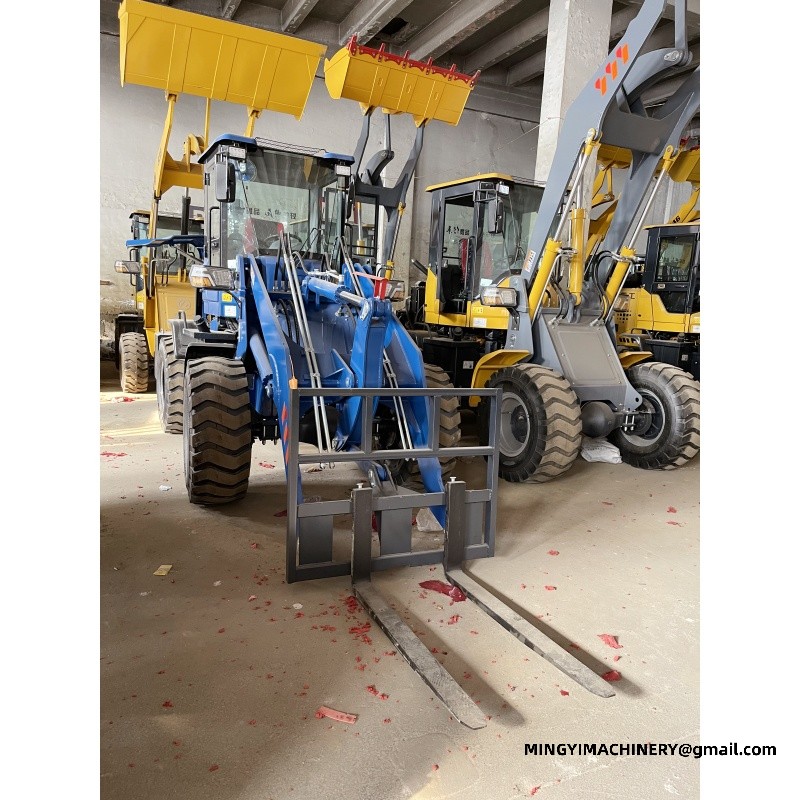
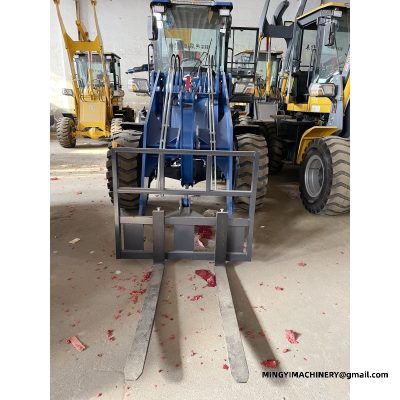
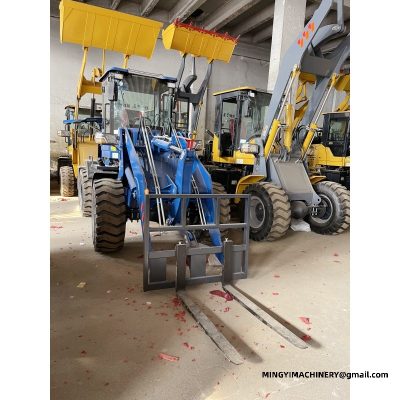
Buying a wheel loader fork attachment is mostly deciding what you are willing to give up.Reach takes stability, capacity takes weight, speed takes heat, and a longer arm loads the hinge harder on every pass. The range publishes each of those trade-offs, so the decision can be made deliberately. Taking the heavy-duty 3.2 m small-frame wheel-side reduction wheel loader — 0.4 m³ bucket, 3.2 m of lift, 30 mm cross-member — against the heavy-duty 3.5 m small-frame wheel-side reduction wheel loader at 0.4 m³, 3.5 m and 30 mm, this page shows what each choice buys and what it takes.
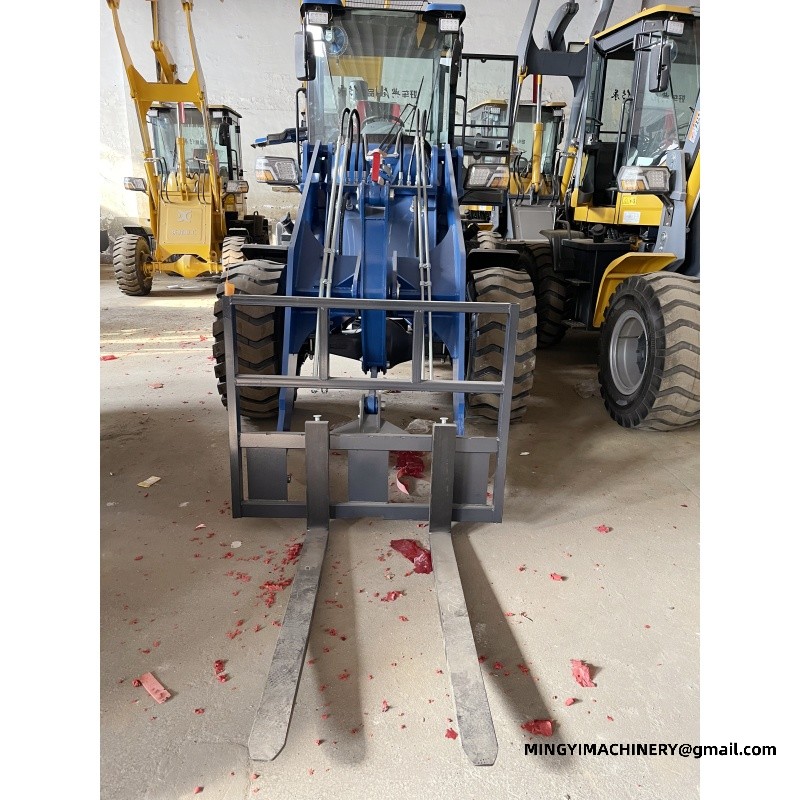
Attachments are specified against the carrier, not against the machine's size class. The figures that matter are the boom section and the hinge geometry: 430 mm on the heavy-duty 3.2 m small-frame wheel-side reduction wheel loader against 430 mm on the heavy-duty 3.5 m small-frame wheel-side reduction wheel loader, and centre distance 890 mm against 890 mm. Two loaders of the same rated capacity from different frame families will not share a fork frame.
Within one frame family the section and spacing match, so a single tool set covers the light and heavy builds of that frame — a genuine advantage for a mixed fleet. Across families it does not work. If you intend to run hydraulically actuated tools, a grapple, a four-in-one bucket or a hydraulic snow blade, order the third circuit at build time; the 40 pump (490 engine); 1045 pump (4102 turbo engine) and 40 pump (490 engine); 1045 pump (4102 turbo engine) circuits are specified per build and plumbing added later is the most common source of field leaks.
Every axle specification is a compromise between traction and speed, and the range resolves it with two families: 1.5 m (wheel-side reduction axle); 1.45 m (Isuzu axle) track on the heavy-duty 3.2 m small-frame wheel-side reduction wheel loader and 1.5 m (wheel-side reduction axle); 1.45 m (Isuzu axle) on the heavy-duty 3.5 m small-frame wheel-side reduction wheel loader. The wider track adds stability; the reduction layout decides whether the torque reaches the ground. Ask which ground the machine will spend eighty per cent of its hours on, then read the axle line.
Stability also comes from elsewhere in the table. The heavy-duty 3.2 m small-frame wheel-side reduction wheel loader carries a 4.1 m front-wheel-to-counterweight length and a 0.4 m³ bucket at 3.2 m; the heavy-duty 3.5 m small-frame wheel-side reduction wheel loader carries 4.1 m with 0.4 m³ at 3.5 m. A wide track on a short wheelbase is less stable than a narrower track on a long one, which is why the footprint figure belongs in the same conversation as the axle. On soft or rutted ground, take the hub reduction every time.
Battery capacity appears in the table as 60 Ah (490 engine); 80 Ah (4102 turbo engine) for the heavy-duty 3.2 m small-frame wheel-side reduction wheel loader and 60 Ah (490 engine); 80 Ah (4102 turbo engine) for the heavy-duty 3.5 m small-frame wheel-side reduction wheel loader. On builds with two engine options the two figures track the engines: the naturally aspirated unit cranks on less, the turbo needs more, and the 24 V system exists precisely because cranking a turbo diesel at minus ten needs the extra headroom.
What buyers should confirm before dispatch is not the capacity but the condition and the connections. Machines ship with batteries disconnected and boxed, so the first start is also the first check of every terminal. On the heavy-duty 3.2 m small-frame wheel-side reduction wheel loader that pack feeds the 4100 core (490 engine); 4105 core (4102T engine) cooling circuit's fan drive and the instrument cluster; on the heavy-duty 3.5 m small-frame wheel-side reduction wheel loader it feeds 4100 core (490 engine); 4105 core (4102T engine) and the same cluster. A marginal earth shows up as a slow crank in winter and as gauge flicker in summer.
| Reference specification — light-duty 4.5 m medium-frame wheel-side reduction wheel loader | |
|---|---|
| Bucket capacity | 0.52 m³ |
| Dump height | 4.5 m |
| Track width | 1.6 m |
| Boom arm thickness | 30 mm |
| Boom arm width | 450 mm |
| Boom arm length | 3.35 m |
| Boom arm centre distance | 960 mm |
| Cross-member thickness | 45 mm |
| Front hinge plate thickness | 45 mm |
| Rear hinge plate thickness | 30 mm |
| Rear frame section | 300 mm high x 800 mm wide |
| Hydraulic cylinders | centre cylinder 60 / side cylinder 50 |
| Fuel tank | 70 L (75# large tank) |
| Battery | 80 Ah |
| Front wheel to counterweight | 4.7 m |
| Radiator | 4105 core |
| Work pump | 2063 pump |
| Travel pump | 25 pump |
Track width decides two things at once: whether the machine stays upright on a slope, and whether it fits through what you need it to fit through. This build runs 1.5 m (wheel-side reduction axle); 1.45 m (Isuzu axle), against 1.6 m on the light-duty 4.5 m medium-frame wheel-side reduction wheel loader. Wider is more stable and needs more room. The choice is made by your narrowest gate, not by your widest heap.
The axle behind the track matters as much as the number. A wheel-side reduction axle puts the final reduction at the hub, which lowers the load on the half-shafts and suits soft, rutted or sandy ground. The alternative pattern suits hard, level surfaces and runs cooler at road speed. Where a build offers both, the hub-reduction figure in 1.5 m (wheel-side reduction axle); 1.45 m (Isuzu axle) is the one for quarry floors and unmade haul roads.
Four numbers describe a loader frame: front hinge plate, rear hinge plate, cross-member thickness and rear frame section. The heavy-duty 3.2 m small-frame wheel-side reduction wheel loader lists 30 mm, 20 mm, 30 mm and 280 mm high x 800 mm wide. The heavy-duty 3.5 m small-frame wheel-side reduction wheel loader lists 30 mm, 20 mm, 30 mm and 280 mm high x 800 mm wide. Everything else on a specification sheet — paint, cab trim, lighting package — is cosmetic next to those four.
The rear frame section is the one that surprises people. A wider rear frame lets the counterweight bolt directly to the chassis instead of hanging off brackets, and bracket-mounted counterweights crack. On the heavy-duty 3.2 m small-frame wheel-side reduction wheel loader the 280 mm high x 800 mm wide section carries the ballast for a 0.4 m³ bucket at 3.2 m; on the heavy-duty 3.5 m small-frame wheel-side reduction wheel loader the 280 mm high x 800 mm wide section carries it for 0.4 m³ at 3.5 m. Compare those against the 4.1 m and 4.1 m front-wheel-to-counterweight lengths and you have the whole stability picture in four figures.
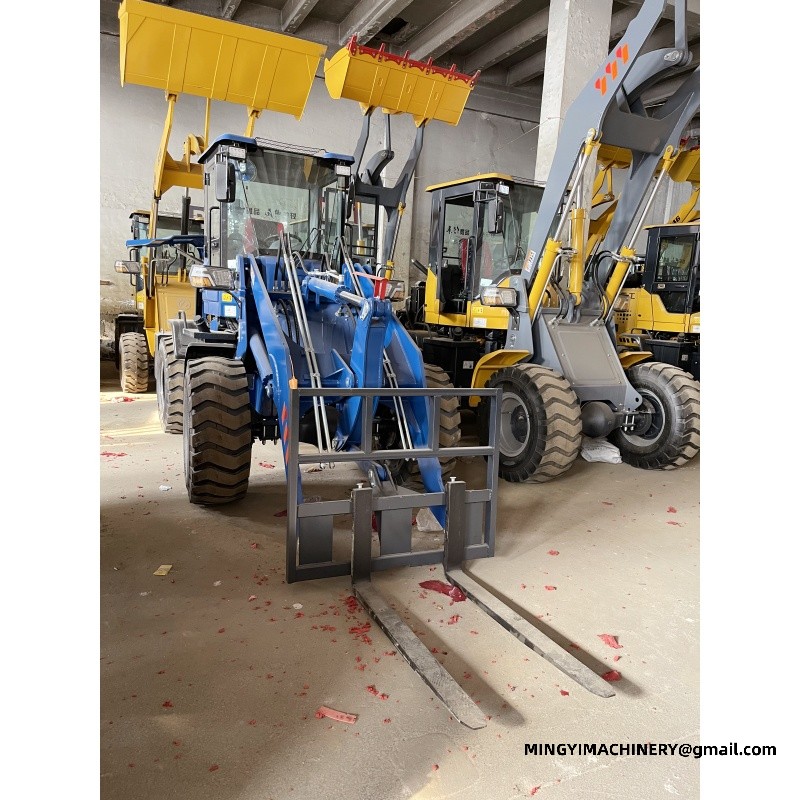
Lift and tilt come from a cylinder set and a pump pair, and both are specified per build. The heavy-duty 3.2 m small-frame wheel-side reduction wheel loader runs centre cylinder 45 / side cylinder 45 with a 40 pump (490 engine); 1045 pump (4102 turbo engine) work pump and a 316 pump travel pump; the heavy-duty 3.5 m small-frame wheel-side reduction wheel loader runs centre cylinder 45 / side cylinder 40 with a 40 pump (490 engine); 1045 pump (4102 turbo engine) work pump and a 316 pump travel pump. Splitting lift from travel is what keeps boom speed up while the machine is climbing a ramp loaded.
Cycle time is a product, not a published figure: bucket fill, lift height, travel distance and the operator's line all move it. What you can compare honestly is the hardware behind it. A centre cylinder 45 / side cylinder 45 set working a 2.3 m arm to 3.2 m is a different proposition from a centre cylinder 45 / side cylinder 40 set working 2.62 m to 3.5 m. On a short haul the smaller combination wins; over a longer push, or where the bucket is digging rather than shovelling, the larger bore and the 890 mm centre distance earn back the extra seconds of lift.
Most loader downtime is avoidable and most of what is avoidable is grease, coolant and hoses. Grease the articulation and the boom pins on the interval — on the heavy-duty 3.2 m small-frame wheel-side reduction wheel loader that is the 30 mm and 20 mm plates and the 890 mm boom mounts. Keep the 4100 core (490 engine); 4105 core (4102T engine) core clean, because overheating presents as lost power long before it presents as a fault.
Hoses are the second most common cause of a stopped machine and the easiest to plan for: a chafing hose on the centre cylinder 45 / side cylinder 45 circuit weeps before it bursts, and a weekly look finds it. Pumps — 40 pump (490 engine); 1045 pump (4102 turbo engine) and 316 pump on the heavy-duty 3.2 m small-frame wheel-side reduction wheel loader — rarely fail without warning; they get noisy first. On the heavy-duty 3.5 m small-frame wheel-side reduction wheel loader the equivalents are centre cylinder 45 / side cylinder 40, 40 pump (490 engine); 1045 pump (4102 turbo engine) and 316 pump. Keep a hose set and a filter set on site and most of this becomes a tea break rather than a week.
A site loader spends its life doing the same cycle, and the cycle punishes three components: the rear hinge, the cooling pack and the tyres. On the heavy-duty 3.2 m small-frame wheel-side reduction wheel loader the rear hinge is 20 mm over a 30 mm cross-member; on the heavy-duty 3.5 m small-frame wheel-side reduction wheel loader it is 20 mm over 30 mm. Which of those you need depends on how often the machine turns under load.
Cycle time is the economics. A 0.4 m³ bucket at 3.2 m on a 2.3 m arm loaded by centre cylinder 45 / side cylinder 45 cylinders is quick in a tight site; a 0.4 m³ bucket at 3.5 m on a 2.62 m arm with centre cylinder 45 / side cylinder 40 is quicker where there is room to work. Neither is universally faster, and any supplier who claims otherwise is describing a different site from yours.
How much clearance do I need over a truck board?
Dump height is measured at the bucket edge, so subtract the crest of the material. The heavy-duty 4.2 m small-frame wheel-side reduction wheel loader gives 4.2 m and the light-duty 3.8 m medium-frame wheel-side reduction wheel loader gives 3.8 m; the board has to sit under the lower of the two with allowance.
What does a daily check on a wheel loader fork attachment actually consist of?
Look at the ground under the machine, check coolant and oil, grease the hinge pins behind the 30 mm front and 20 mm rear plates, and glance at the cylinder rods. Ten minutes, every shift.
What extra care does a wheel loader fork attachment need in dusty work?
Core cleaning at the end of every shift and more frequent air filter changes. The core is 4100 core (490 engine); 4105 core (4102T engine); a blocked one shows up as a slow loss of power rather than a stoppage.
How do I keep one spares bin covering a mixed fleet?
Buy within one frame family and one engine. That keeps the 40 pump (490 engine); 1045 pump (4102 turbo engine) pump, the 4100 core (490 engine); 4105 core (4102T engine) core and the 60 Ah (490 engine); 80 Ah (4102 turbo engine) battery common across every machine.
How does wet ground change how a wheel loader fork attachment is used?
Rolling resistance rises, so wheel spin and driveline load rise with it. Track is 1.5 m (wheel-side reduction axle); 1.45 m (Isuzu axle), and the hub-reduction option is the one for soft ground.
What does winter duty change on a wheel loader fork attachment?
Cold cranking, oil viscosity and operator access. Battery 60 Ah (490 engine); 80 Ah (4102 turbo engine) covers the first; the 64.7 L (75# small tank) tank covers the longer idling that cold work brings.
How many passes will fill a truck with a wheel loader fork attachment?
Divide body volume by bucket volume, then check the height. Against 3.5 m of lift with a 0.4 m³ bucket, a body that is too tall is not a pass-count problem at all.
Keep this page against the delivery paperwork. Bucket 0.4 m³, lift 3.2 m, track 1.5 m (wheel-side reduction axle); 1.45 m (Isuzu axle) and cylinders centre cylinder 45 / side cylinder 45 are the four rows that settle any later question about what was actually ordered.
Contact MINGYI Machinery for the current wheel loader lineup, configuration options and a formal specification for your market. E-mail: sales@mingycn.com | LINE (ID): mingyicn
Wheel Loader Snow Blower: Winter Duty and Cold Starts · Wheel Loader Snow Blower: Running the Third Circuit · Wheel Loader Manufacturer: Frame Builds, Range and Export Terms · Wheel Loader









