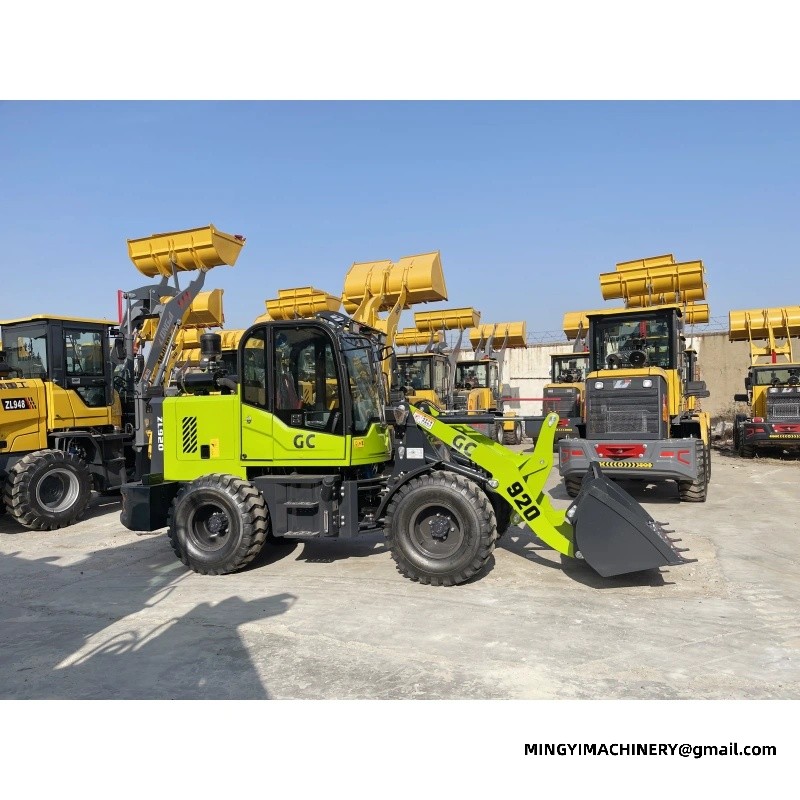
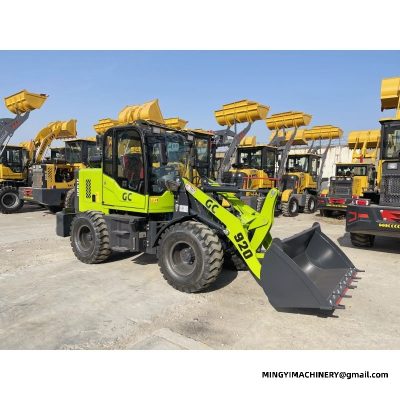
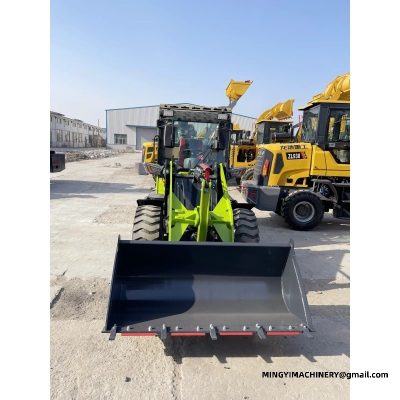
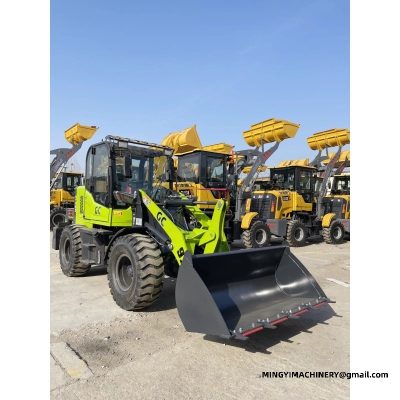
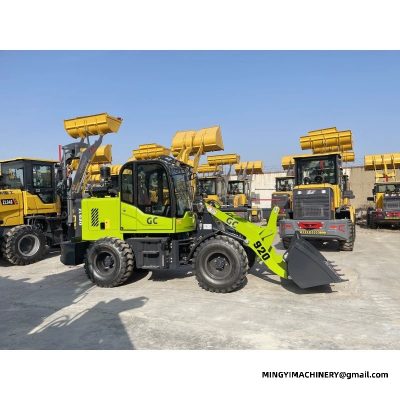
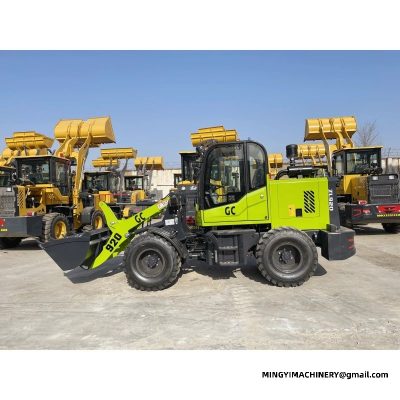
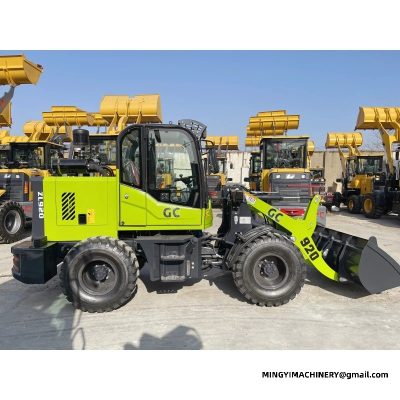
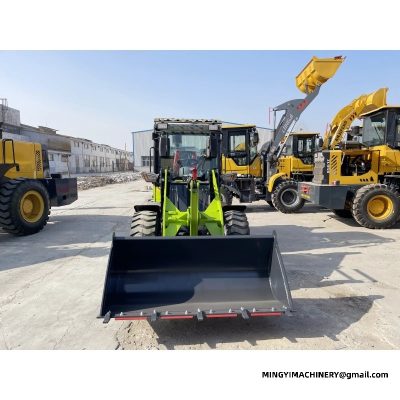
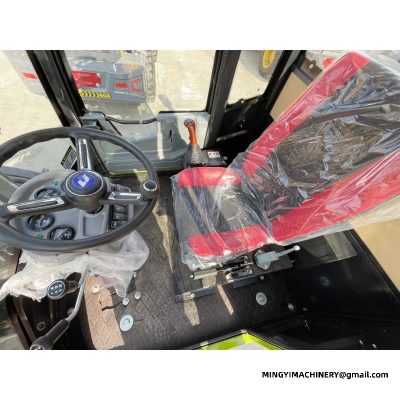
Owners judge a OEM wheel loader manufacturer on things a brochure never lists. Does it start on a cold morning. Does it clear the body it was bought to clear. Does the steering still feel tight after two seasons. Those outcomes are decided by published figures: battery 45 Ah (24 V), dump height 2.8 m, hinge plates 16 mm front and 16 mm rear. This page takes each of them in turn, using two builds from the range — the standard 2.8 m low-profile wheel loader and the heavy-duty 3.2 m low-profile wheel loader — to show what the numbers mean once the machine is working.
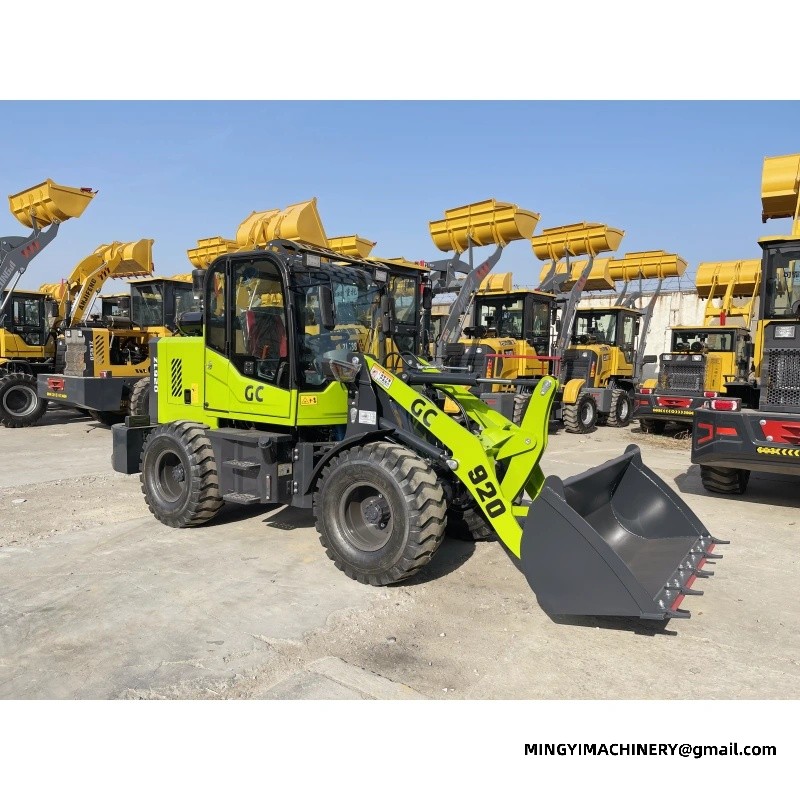
The standard bucket on this build is 0.3 m³, and it is the right tool for loose material moved from a heap to a body. Everything else is a compromise in one direction or another: forks give precision and lose volume, grapples give grip and lose speed, a snow blower gives reach and needs flow the bucket never asked for.
What makes attachments practical is whether the machine can lift them. Boom wall 20 mm and section 300 mm decide how much side load the arm takes, and the hinge plates — 16 mm at the front, 16 mm at the rear — decide how long the frame takes it. A grapple hanging off the end of a long arm is a side load the bucket never produces.
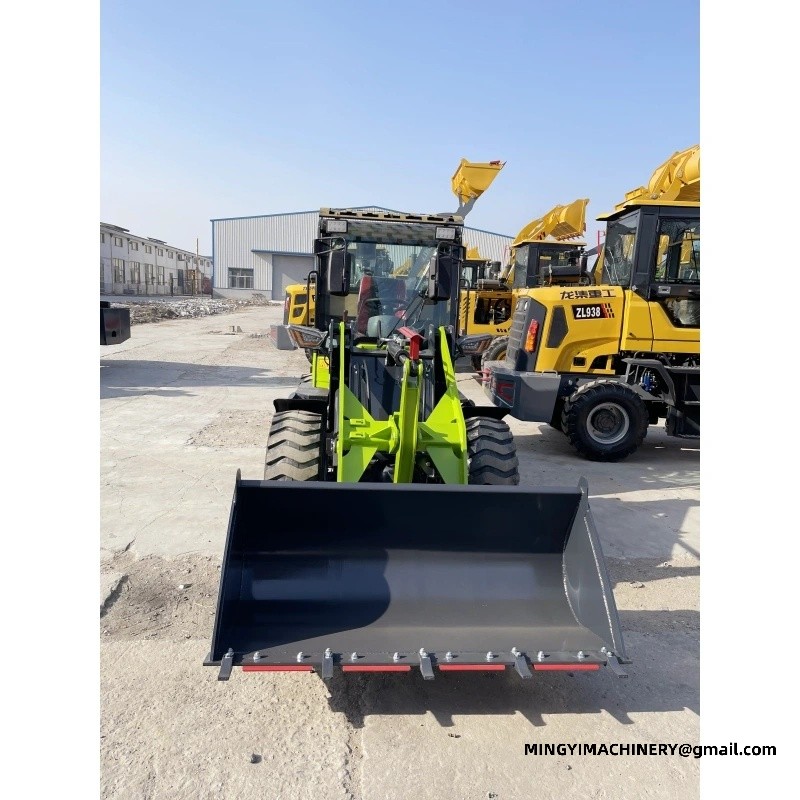
Every axle specification is a compromise between traction and speed, and the range resolves it with two families: 1.2 m (Isuzu axle); 1.3 m (wheel-side reduction axle) track on the standard 2.8 m low-profile wheel loader and 1.5 m (wheel-side reduction axle); 1.45 m (Isuzu axle) on the heavy-duty 3.2 m low-profile wheel loader. The wider track adds stability; the reduction layout decides whether the torque reaches the ground. Ask which ground the machine will spend eighty per cent of its hours on, then read the axle line.
Stability also comes from elsewhere in the table. The standard 2.8 m low-profile wheel loader carries a 3.5 m front-wheel-to-counterweight length and a 0.3 m³ bucket at 2.8 m; the heavy-duty 3.2 m low-profile wheel loader carries 4.1 m with 0.4 m³ at 3.2 m. A wide track on a short wheelbase is less stable than a narrower track on a long one, which is why the footprint figure belongs in the same conversation as the axle. On soft or rutted ground, take the hub reduction every time.
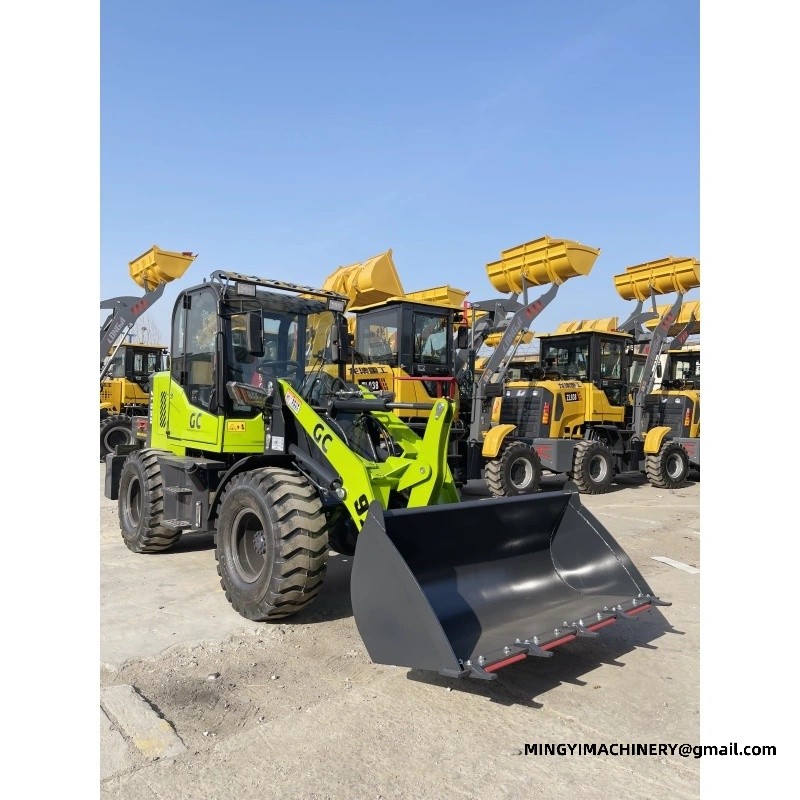
Bucket capacity is the first figure stated and the last one that should be decided. The standard 2.8 m low-profile wheel loader carries 0.3 m³; the heavy-duty 3.2 m low-profile wheel loader carries 0.4 m³. What those volumes mean depends on the material: a heaped bucket of dry sand weighs far less than the same heaped bucket of wet gravel or crushed rock, and the machine's stability, not its volume, sets the real limit.
Match the bucket to the receiving body and the material, in that order. A 0.3 m³ bucket at 2.8 m clearing a low pan mixer is correctly specified; the same bucket feeding a highway truck is a slow day. Against that, a 0.4 m³ bucket at 3.2 m needs the frame behind it — 30 mm front and 20 mm rear hinge plates, a 30 mm cross-member — or it will be a fast machine with a short life.
| Specification extract — heavy-duty 3.5 m small-frame wheel-side reduction wheel loader | |
|---|---|
| Bucket capacity | 0.4 m³ |
| Dump height | 3.5 m |
| Track width | 1.5 m (wheel-side reduction axle); 1.45 m (Isuzu axle) |
| Boom arm thickness | 25 mm |
| Boom arm width | 430 mm |
| Boom arm length | 2.62 m |
| Boom arm centre distance | 890 mm |
| Cross-member thickness | 30 mm |
| Front hinge plate thickness | 30 mm |
| Rear hinge plate thickness | 20 mm |
| Rear frame section | 280 mm high x 800 mm wide |
| Hydraulic cylinders | centre cylinder 45 / side cylinder 40 |
| Fuel tank | 64.7 L (75# small tank) |
| Battery | 60 Ah (490 engine); 80 Ah (4102 turbo engine) |
| Front wheel to counterweight | 4.1 m |
| Radiator | 4100 core (490 engine); 4105 core (4102T engine) |
| Work pump | 40 pump (490 engine); 1045 pump (4102 turbo engine) |
| Travel pump | 316 pump |
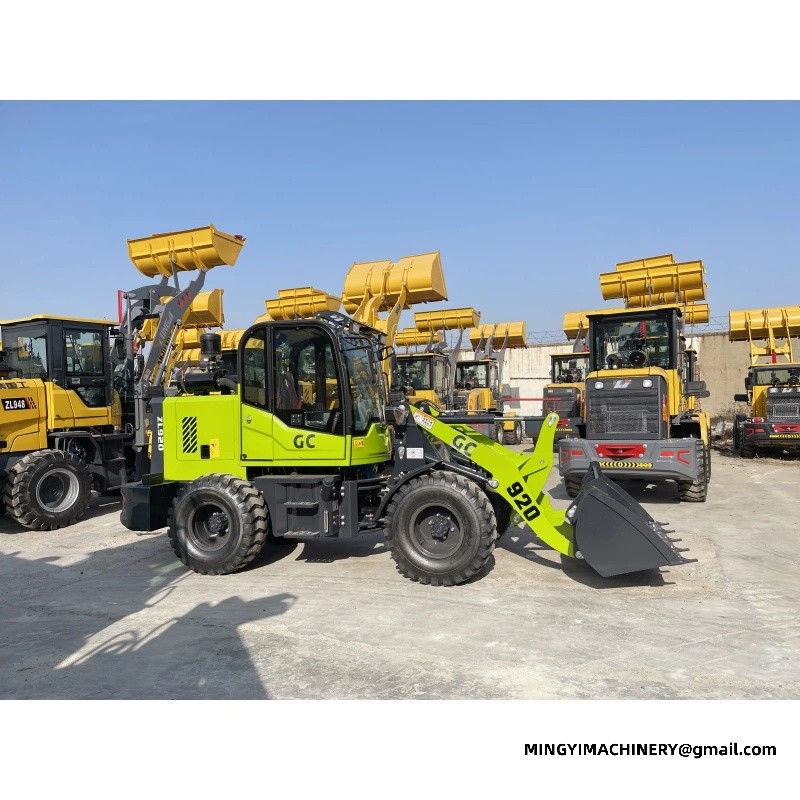
On builds with two engine options the cooling package changes with the engine, which is why the radiator line in the table reads as a pair: 4100 core on the standard 2.8 m low-profile wheel loader and 4100 core (490 engine); 4105 core (4102T engine) on the heavy-duty 3.2 m low-profile wheel loader. The 4100 core serves the 490 engine; the 4105 raised core serves the 4102 turbo. The raised core is not a marketing variant — it is more core area in the same footprint, and it is the difference between finishing a dusty shift and stopping at noon to blow out the fins.
Where the machine will work is the deciding factor. Grain handling, lime, cement raw meal, crushing and screening all load a radiator with fine material; road building on a wet day does not. If the application is dusty, specify the raised core and a reversible fan if offered. Then check the rest of the package matches: 30.8 L (48# large tank, 20.5/70-16 tyres); 24.6 L (48# small tank, 8.25-16 tyres) fuel on the standard 2.8 m low-profile wheel loader against 54 L (50# tank) on the heavy-duty 3.2 m low-profile wheel loader, and the battery at 45 Ah (24 V) against 60 Ah (490 engine); 80 Ah (4102 turbo engine).
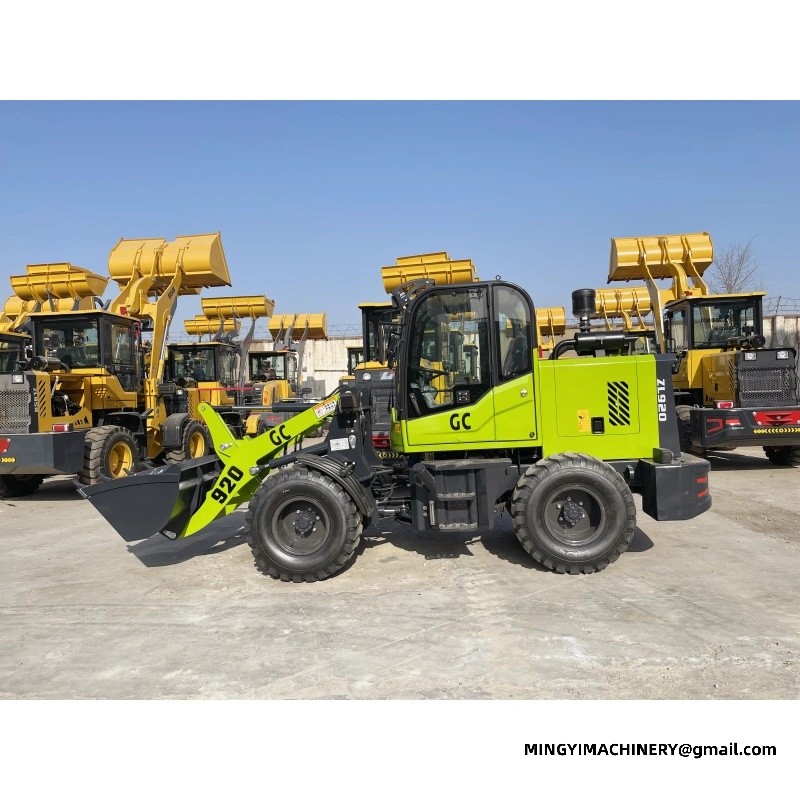
Operators describe a good machine as tight and a tired one as loose, and they are describing the hinge pins. New, the geometry is set by the plates: 30 mm forward, 20 mm aft. After a few thousand hours the geometry is set by how much those plates have allowed the pins to move, which is a function of thickness and of the 30 mm cross-member behind them.
This is why the figures are worth asking for rather than assuming. On the light-duty 3.8 m medium-frame wheel-side reduction wheel loader the same two numbers are 45 mm and 30 mm. A machine that will spend its life on short cycles — many steering inputs per hour — should be bought on these figures rather than on bucket capacity, because capacity is simple to add and hinge life is not.
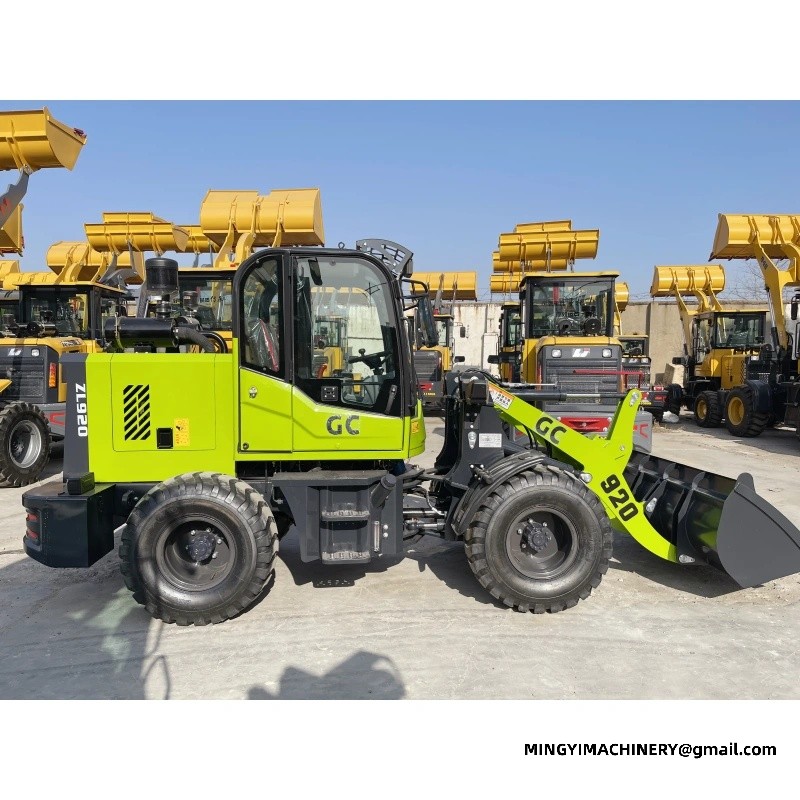
The first hour of running tells you more than the first month of paperwork. Watch the cooling: 4100 core should hold temperature at working load without the fan running continuously. Listen to the hydraulics: centre cylinder 45 / side cylinder 40 on a 32 pump should lift a full 0.3 m³ bucket to 2.8 m without the relief valve complaining.
Then check the electrical side under load, which is what the 45 Ah (24 V) rating exists for. Restart the machine hot, restart it cold, and watch the cranking. A battery that is marginal on day one will fail in the first cold week, and it is far easier to settle at commissioning than six months later.
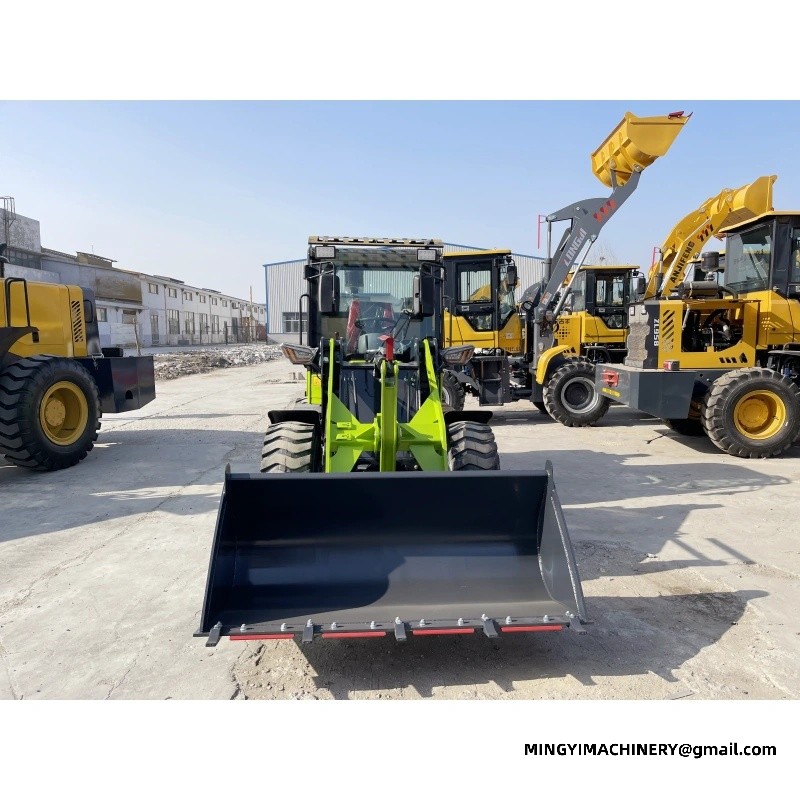
Site work is a truck-loading problem. The machine fills, reverses, turns, approaches and dumps, several hundred times a day, and the numbers that govern it are dump height, hinge steel and cycle time. The heavy-duty 3.2 m low-profile wheel loader brings 0.4 m³ at 3.2 m with 30 mm and 20 mm hinge plates; the heavy-duty 4.2 m small-frame wheel-side reduction wheel loader brings 0.4 m³ at 4.2 m with 30 mm and 20 mm.
Backfilling and heel-in work load the rear hinge harder than loading does, because the machine turns while pushing. That is why the rear plate figure — 20 mm against 20 mm — is the one to read for a site machine, ahead of engine power. Add the cooling question: site dust loads a radiator fast, so the raised core and the 4100 core (490 engine); 4105 core (4102T engine) package earn their keep where the 4100 core (490 engine); 4105 core (4102T engine) spec would need blowing out at lunch.
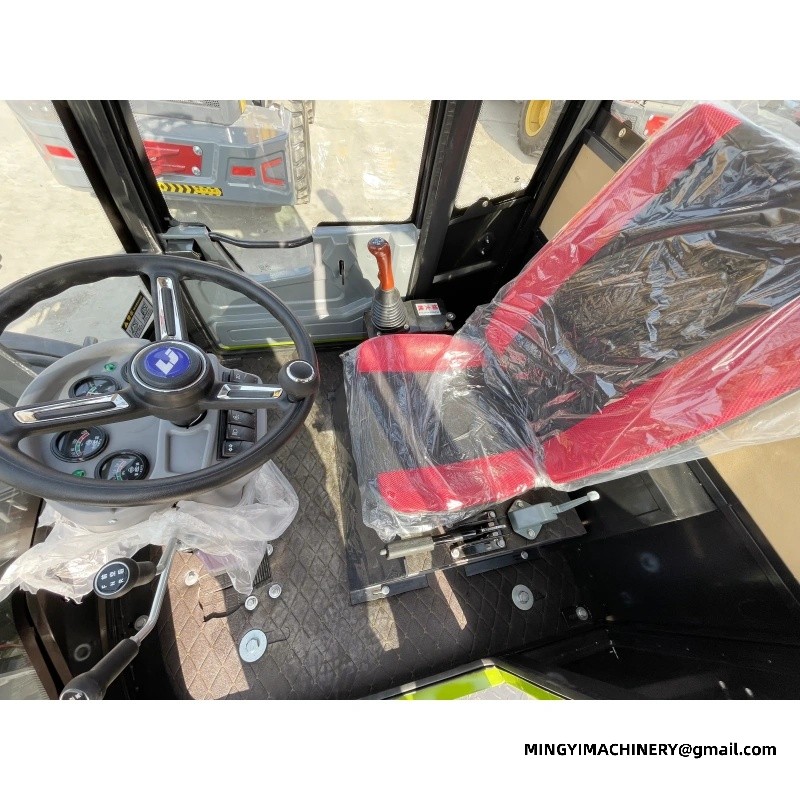
A loader standing idle while a truck reverses is the most common waste on a site, and it is usually a layout problem rather than a machine problem. What the machine contributes is turn radius and visibility, and both come out of the dimensions: 3.5 m from front wheel to counterweight, 1.2 m (Isuzu axle); 1.3 m (wheel-side reduction axle) of track, and a rear frame section of 200 mm high x 750 mm wide. A shorter machine turns inside its own length and works a tighter bay.
The other half is dump geometry. With 2.8 m of clearance and a 2.05 m arm, the standard 2.8 m low-profile wheel loader can stand back from the body and still place material where the driver wants it, which is safer than crowding the board. The heavy-duty 4.2 m small-frame wheel-side reduction wheel loader reaches 4.2 m with a 3.15 m arm; on a narrow bay the shorter of the two may be the faster machine even if it holds less.
What do I check the day a OEM wheel loader manufacturer is delivered?
Bucket 0.3 m³, lift 2.8 m, cylinders centre cylinder 45 / side cylinder 40, track 1.2 m (Isuzu axle); 1.3 m (wheel-side reduction axle) and length 3.5 m. Photograph all five; they settle any later question about what was ordered.
How do I choose the axle on a OEM wheel loader manufacturer?
By surface. Track is 1.5 m (wheel-side reduction axle); 1.45 m (Isuzu axle) here; where two figures are listed the wider one is the hub-reduction axle for soft or rutted ground, the narrower one suits hard standing.
How do I clean the radiator on a OEM wheel loader manufacturer working in dust?
From the clean side outwards, against normal airflow, so debris comes out rather than being pushed deeper. The core on this build is 4100 core (490 engine); 4105 core (4102T engine); blocked fins are the usual cause of gradual power loss.
What should I check before running a grapple on a OEM wheel loader manufacturer?
Side load. A grapple levers the arm in a way a bucket does not, so the 20 mm wall and 300 mm section matter more than capacity. The hinge plates at 16 mm take the reaction.
How is a OEM wheel loader manufacturer transported between sites?
On a low-loader, arm strapped down, secured to the frame rather than the cylinders. Front wheel to counterweight is 3.5 m and track is 1.2 m (Isuzu axle); 1.3 m (wheel-side reduction axle), which is what the haulier needs.
How many passes will fill a truck with a OEM wheel loader manufacturer?
Divide body volume by bucket volume, then check the height. Against 3.2 m of lift with a 0.4 m³ bucket, a body that is too tall is not a pass-count problem at all.
How should a OEM wheel loader manufacturer be stored for a season?
Isolate the battery, which is rated 80 Ah, grease the pins, and protect the cylinder rods on the centre cylinder 60 / side cylinder 50. Machines stored outside suffer at the pins and the electrics.
Every figure stated on this page — bucket 0.3 m³, lift 2.8 m, hinge plates 16 mm and 16 mm — comes from the published build data for the standard 2.8 m low-profile wheel loader and the heavy-duty 3.2 m low-profile wheel loader. Send your board heights, material and shift pattern and the comparison can be run against your own numbers.
Storage and long idle periods for OEM Wheel Loader Manufacturer: Repeating a Build Exactly
Standing still is harder on a machine than working. Preparing OEM Wheel Loader Manufacturer: Repeating a Build Exactly for a long idle period means clean fluids, a charged battery and protection for the exposed surfaces, because neglect is not the same as rest.
Wear items and spares worth holding for OEM Wheel Loader Manufacturer: Repeating a Build Exactly
Holding spares is about downtime rather than the shelf itself. The question for OEM Wheel Loader Manufacturer: Repeating a Build Exactly is not how large the part is but how long the machine sits while it is found, and a small shelf answers that better than a fast courier.
Contact MINGYI Machinery for the current wheel loader lineup, configuration options and a formal specification for your market. E-mail: sales@mingycn.com | LINE (ID): mingyicn
China Wheel Loader Factory Supplier: Repeat Orders and Spares · China Wheel Loader Factory Supplier: Steady Supply Planning · Compact Wheel Loader: Clearance, Footprint and Low Profile · Wheel Loader









