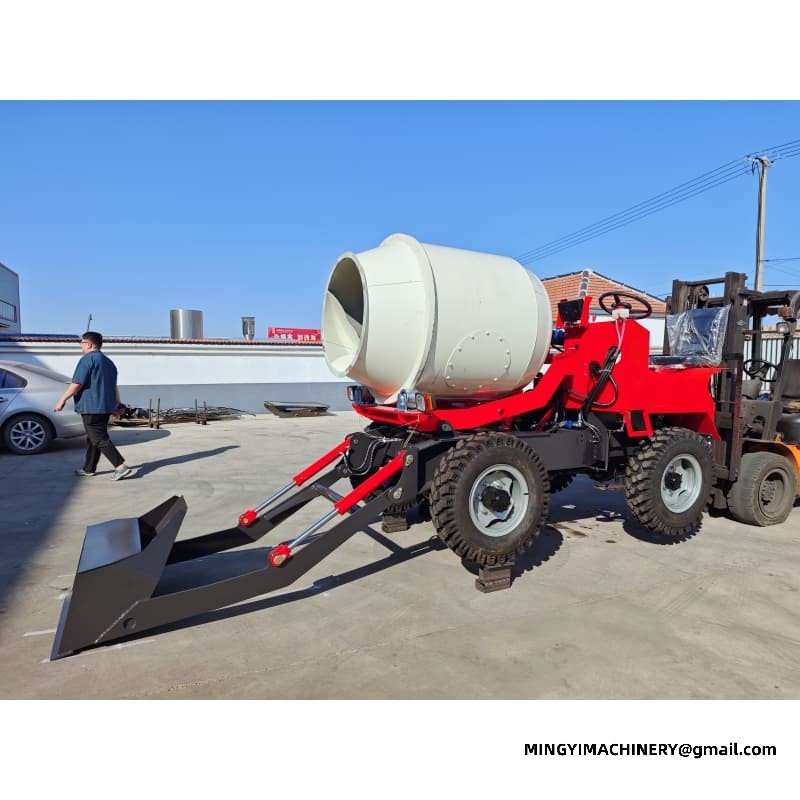
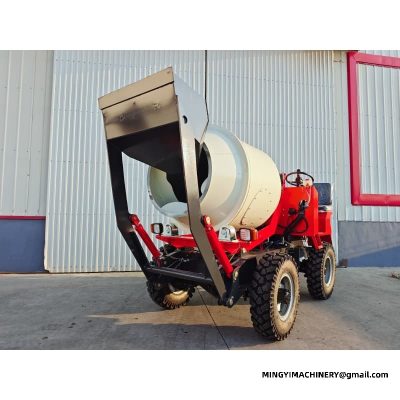
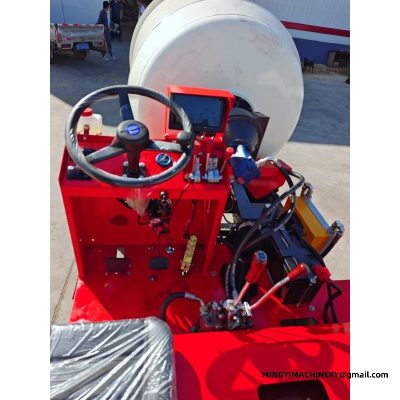
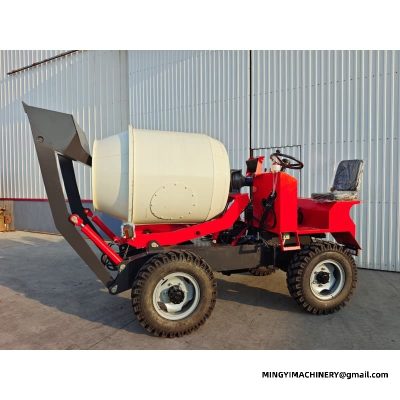
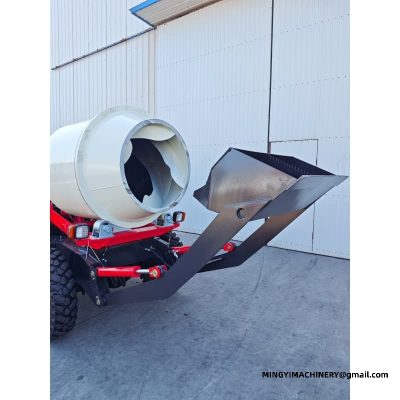
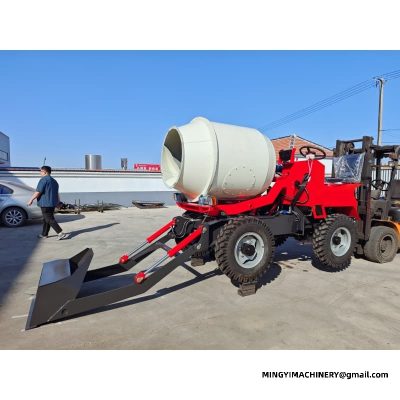
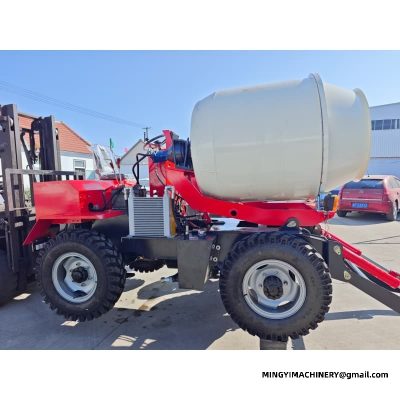
0.8m3 Mobile Concrete Batching Truck, Portable 0.8m³ Cement Mixer, Site Batching
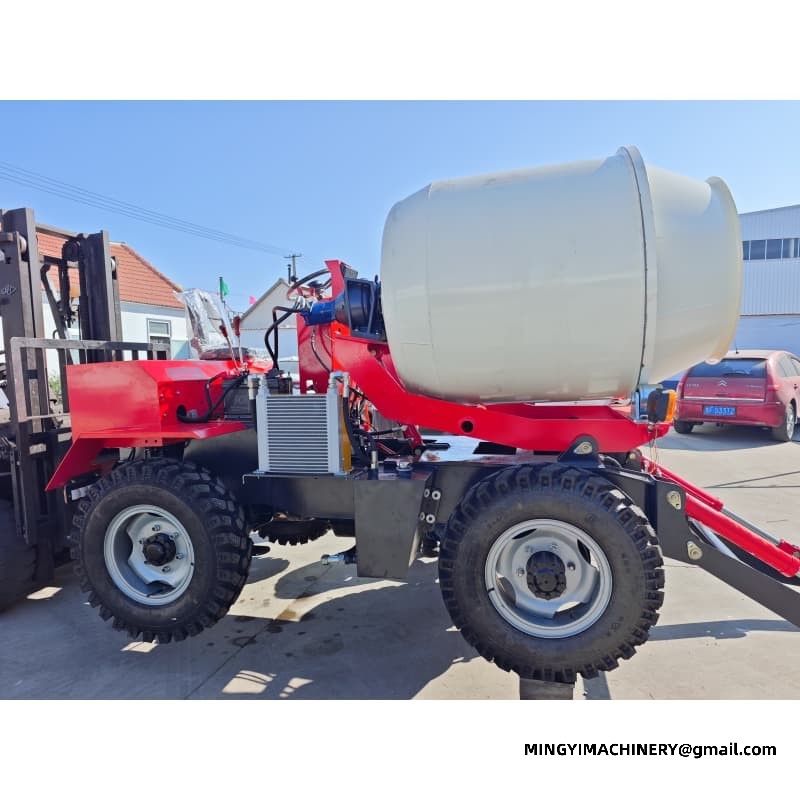
A self-loading mixer is bought for the distance between the aggregate pile and the pour. The 0.8 m³ drum, the 1,500 kg payload and the front shovel that feeds them answer one question — who mixes, and who carries? This page reads the published table as a 0.8m3 mobile concrete batching truck buyer meets it on a building site: capacity first, then the drive and steering that decide where the machine can actually stand.
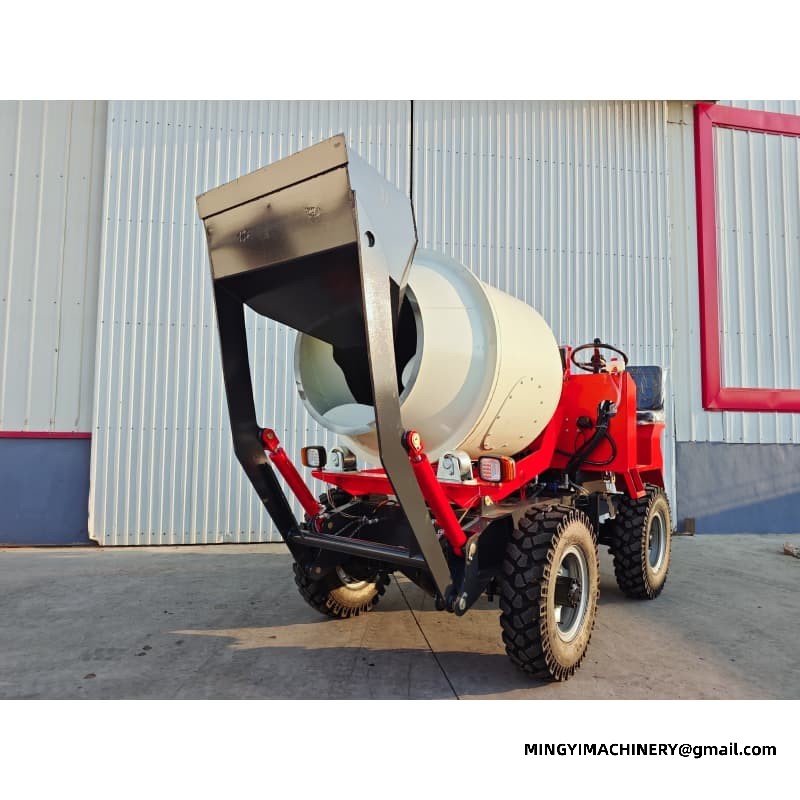
The drum wash-out belongs here too — it is listed in the drum section but it is a daily item, not a weekly one. A machine parked clean on a building site is a machine that starts the next morning without arguments.
The monthly drum inspection matters more than it sounds: blades wear, and a worn blade mixes slowly and mixes badly. Replacing blades at the wear line keeps 0.8 m³ truly equal to 0.8 m³.
There is also a hybrid pattern worth naming: the self-loader feeds a static pump or a crane skip on bigger jobs, batching at the rate the placing crew sets. The machines are complements more often than competitors.
Sizing honestly is the service a good supplier performs. Recommending this machine into pump-scale work, or plant-scale work into a village lane, fails the customer in opposite directions.
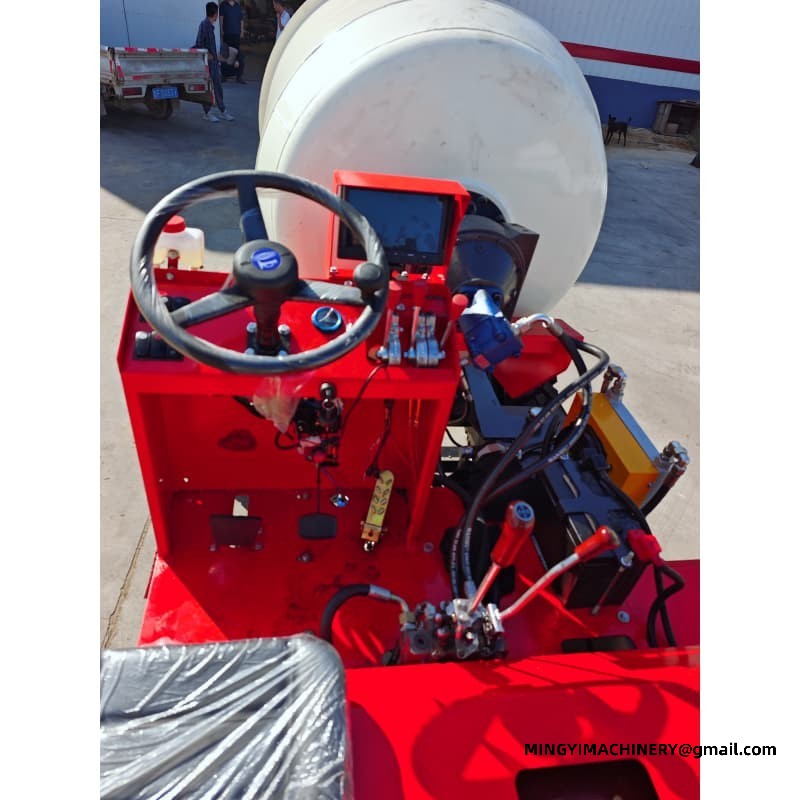
Because rotation and tilt are hydraulic, the operator can hold a partial discharge — trickle into a barrow, stop, move, resume — which no hand-cranked drum offers. That control is worth as much as the 0.8 m³ itself on pours with fussy geometry.
A drum cleaned daily lasts the machine's life; a drum cleaned weekly builds a heel of hardened paste that permanently cuts capacity below 0.8 m³ and unbalances the blades. The five minutes after the last pour are the simplest maintenance the machine ever gets.
| Published build data — 0.8 m³ 4WD self-loading concrete mixer | |
|---|---|
| Rated load | 1,500 kg |
| Rated capacity | 0.8 m³ |
| Overall dimensions (L x W x H) | 3,500 x 1,600 x 2,200 mm |
| Front tyre size | 8.25-16 |
| Rear tyre size | 7.50-16 |
| Minimum ground clearance | 204 mm |
| Steering angle | 28° |
| Turning dimension (outer tyre) | 2,464 mm |
| Maximum travel speed | 24 km/h |
| Transmission | 4WD |
| Gears | 3 forward / 1 reverse + travel gear |
| Front axle | 130 drive axle |
| Rear axle | 212 selectable 4WD steering axle |
| Engine | single-cylinder diesel / 25 hp |
| Steering | hydraulic power steering |
Four-wheel drive also changes how the machine fails — or rather, how rarely. Wheels that share the work share the wear, and a chassis that is never bogged is a chassis that never needs towing out of a pour on a building site.
The front axle is a 130 drive axle; the rear is a 212 axle that steers and can be selected into four-wheel drive. The split is deliberate: the front pulls the loaded machine, the rear steers it through a 28° angle and adds drive when the surface turns soft.
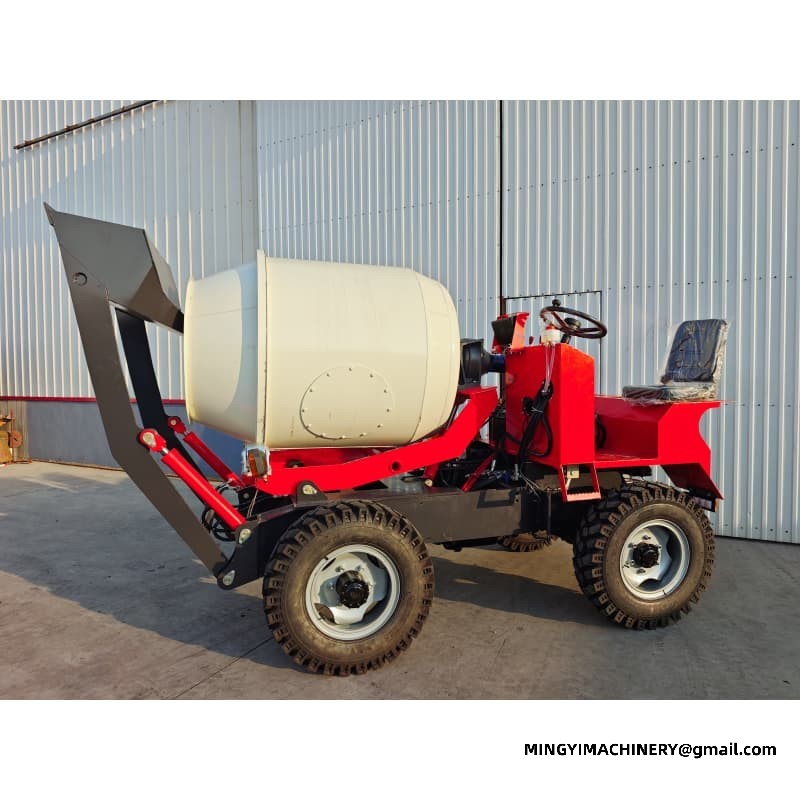
The machines that age well are washed and greased on schedule; the machines that age badly are the ones where wash-out slipped and dust won. Nothing exotic — just the daily five minutes, kept.
The honest arithmetic counts wages not spent, ready-mix charges avoided and pours kept on schedule. Against those, the purchase decision is the smallest line on the page.
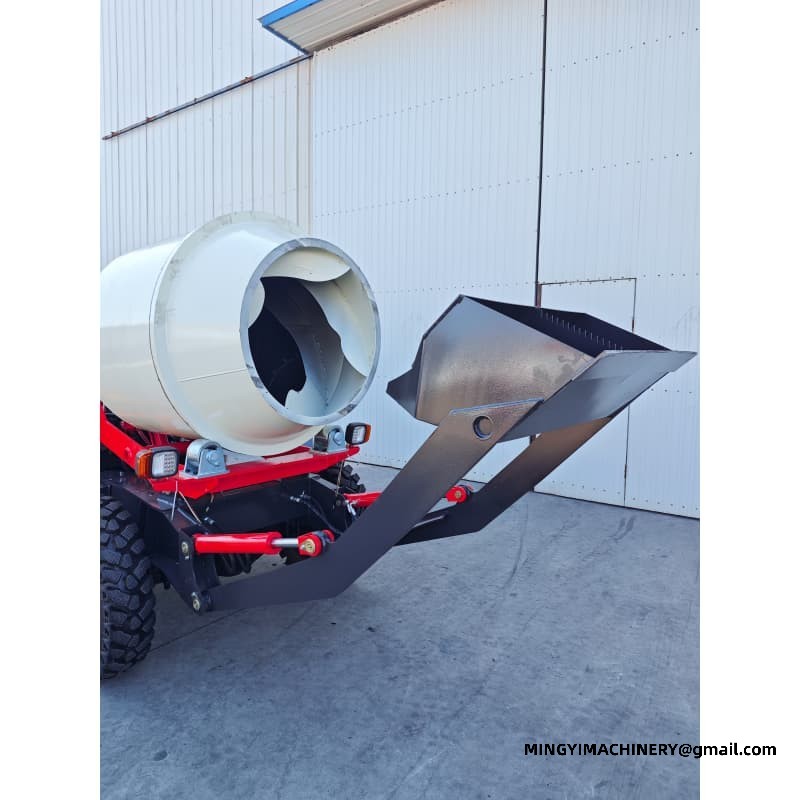
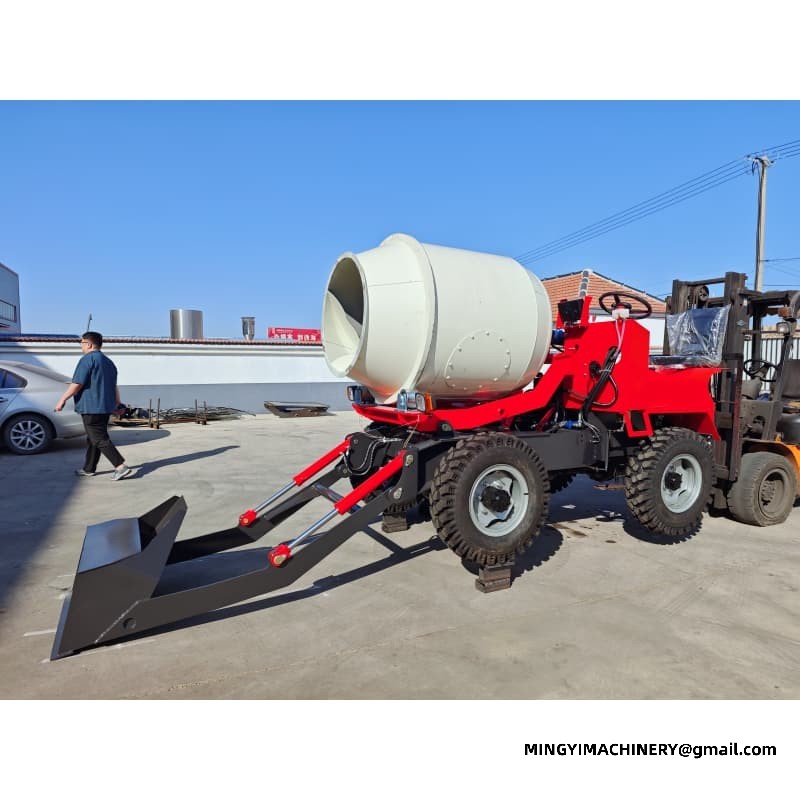
The shovel reaches a pile close to the front wheels, so the stockpile layout decides how fast a batch assembles. Keep aggregate and sand within a shovel's reach of the machine's standing position and the drum fills in seconds rather than minutes.
The discipline that keeps it healthy: scoop shallow, drop into the drum rather than onto its rim, and keep the shovel clean before park-up. Operators who treat it gently on a building site get years from it; operators who use it as a dozer replace pins and bushings far sooner.
Cement count, aggregate count, water measure, drum time — four numbers per mix design, and every crew member should be able to recite them. The machine's repeatability turns those four numbers into strength rather than into hope.
Where workability genuinely must rise, change the mix design rather than the habit — plasticisers exist for exactly this reason, and a measured dose beats an unmeasured splash every time on a building site.
First gear is for loading position and the worst ground; second covers most site hauls; the travel gear belongs on the public road between sites. Reverse plus the steered rear axle does the positioning, because the shovel leads and the operator wants to back toward a pour with the drum already pointing at it.
Plan the standing spot before the first batch, not after. A machine that has rehearsed its approach discharges in a minute; a machine improvising each approach spends more time manoeuvring than mixing over a shift.
Report faults honestly and in time. A small hydraulic weep described in a photograph reaches the right seal before it becomes a failed hose on a pour day, and crews that communicate get parts that fit the first time.
Keep the order history with the parts book. The second order — a blade, a seal, a hose — placed a year later is a two-minute email when the references are at hand, and a half-day search when they are not.
The first week should include one empty drum deliberately: let the new operator feel the 28° rear steer, the 2,464 mm circle and the stopping distance without a live load aboard. Familiarity earned empty arrives safely loaded.
Write them on the machine, not in the office. The habits that survive are the ones the operator sees at the start of every shift.
Aggregate temperature is the hidden variable in hot-weather concrete: stockpiles in the sun can carry the mix temperature past the design window before the drum spins. Shade, sprinkling and morning batching are the simple answers.
Antifreeze discipline applies to the engine year-round in cold markets, and the drum benefits from the same thinking: a wash-out that leaves water pooled in a low point will freeze, and ice in a drum is a morning's chiselling.
Board over exposed ducts and mark headroom limits. The machine crosses most ground on a building site; it crosses a buried cable only once, and the second time is a strike.
The survey is not paperwork; it is the first batch. Measure the gate, the turn and the ground while the machine is still on the truck, and the 2,464 mm turning circle and 204 mm clearance become numbers you have already checked rather than surprises you meet with a full drum.
Output is decided by the cycle, not the drum. Loading the shovel, mixing, travelling and discharging repeat, and the slowest of the four sets the rate. With 0.8 m³ per batch and a short haul, the drum rarely waits; with a long carry at 24 km/h, travel becomes the constraint and the arithmetic changes.
The practical advice is to plan pours around the cycle rather than around the clock. A crew that knows each batch of foundation and plinth concrete takes a predictable interval can keep formwork continuously fed, which matters more on cold joints than raw volume ever does.
Agree the acceptance test before the deposit: drum turns both ways, shovel lifts and holds, steering reaches full lock, and the machine travels in every gear. Thirty minutes at handover prevents the kind of dispute that outlives the purchase.
Order the spares kit against the parts manual's own numbers and file the correspondence with the manual. When the second order goes in a year later on a building site, the reference numbers make it a two-minute email.
A lifting shovel commands a exclusion zone whether or not the site paints one. Nobody stands within the shovel's arc; nobody rides a load; nobody walks under a raised bucket — even briefly, even empty.
On a building site, where paths cross the machine's working circle, the operator stops loading until the path is clear. The five seconds of waiting are simpler than every alternative, and the habit takes nothing by the end of a week.
Why does my 0.8m3 mobile concrete batching truck lose traction on wet ground?
Check tyre pressures first, then whether rear four-wheel drive is actually engaged. The 212 axle must be selected in — running two-wheel on soft ground is the usual cause.
Can the 0.8m3 mobile concrete batching truck work at night?
With site lighting, yes — the workflow does not change. The operator's visibility of the shovel arc and the discharge zone is the item to solve, not the machine.
What should I confirm before ordering a 0.8m3 mobile concrete batching truck?
The specification against the published table — 0.8 m³ capacity, 1,500 kg load, 4WD, 25 hp engine, the 130 and 212 axles — plus what is standard versus optional in your build.
How often do 0.8m3 mobile concrete batching truck shovel pins need greasing?
Weekly under normal work, daily in dust or mud. Grease is simple; the pins and bushings it protects are the shovel's whole wearing life.
Is the 0.8m3 mobile concrete batching truck suitable for plant-hire fleets?
It is a natural hire asset: simple controls, single-operator working, and a specification small fleets can describe to any customer in one page.
How many batches an hour can a 0.8m3 mobile concrete batching truck do?
Whatever the cycle allows: load, mix, travel, discharge, return. Short hauls keep the drum busy; long carries make travel the constraint. Plan pours around the cycle, not the clock.
Does a 0.8m3 mobile concrete batching truck waste concrete?
Less than scheduled supply does. Batching stops when the pour stops, so there are no returned-load charges — the effort control hides in batching to demand.
Will the 0.8m3 mobile concrete batching truck fit through a garden gate?
At 1,600 mm wide it passes standard double gates with room for mirrors. Measure the narrowest point and the turn immediately inside it before delivery.
Worked on a building site, the machine pays for itself in the batches it keeps on schedule and the crews it frees from barrow chains. The specification above is the whole story — short, honest and enough to size the decision.
Reading the early symptoms on 0.8m3 Mobile Batching: Batching to Demand, Not to Schedule
Machines rarely fail without warning. A change in sound, a slower function or a new leak on 0.8m3 Mobile Batching: Batching to Demand, Not to Schedule is the machine saying something early, and listening then takes a fraction of the time that waiting does.
Keeping a service record for 0.8m3 Mobile Batching: Batching to Demand, Not to Schedule
The record should follow the machine, not the owner. When 0.8m3 Mobile Batching: Batching to Demand, Not to Schedule changes hands the service history travels with it, and a complete folder is often the difference between a quick sale and a long one.
Later additions and retrofits on 0.8m3 Mobile Batching: Batching to Demand, Not to Schedule
Retrofitting is limited by the base machine. Before anything is added to 0.8m3 Mobile Batching: Batching to Demand, Not to Schedule the hydraulic flow, the mounting interface and the stability allowance have to be checked, because those limits are what decide what is sensible.
Handover and getting familiar with 0.8m3 Mobile Batching: Batching to Demand, Not to Schedule
Familiarisation is not the same as reading the manual. Sitting on 0.8m3 Mobile Batching: Batching to Demand, Not to Schedule, working through the controls at low speed and learning where the machine balances takes an hour, and that hour is what keeps the first week uneventful.
Storage and long idle periods for 0.8m3 Mobile Batching: Batching to Demand, Not to Schedule
The battery and the fuel are the first things to suffer in storage. Preparing 0.8m3 Mobile Batching: Batching to Demand, Not to Schedule properly at the start of the idle period avoids the flat battery and the contaminated tank that greet an unprepared machine.
Contact MINGYI Machinery for the current self-loading concrete mixer specification, export packing and a formal specification for your market. E-mail: sales@mingycn.com | LINE (ID): mingyicn
China 0.8m3 4WD Mixer Manufacturer: What Ships, What Serves · 0.8m3 4WD Mixer: From Specification to Delivery · construction dumper hydraulic tipping with hydraulic tipping body · Mini Self-Loading Concrete Mixer









