China 0.8m3 4WD Self Loading Mixer Manufacturer, Factory Direct 0.8m³ Mixer, Supplier
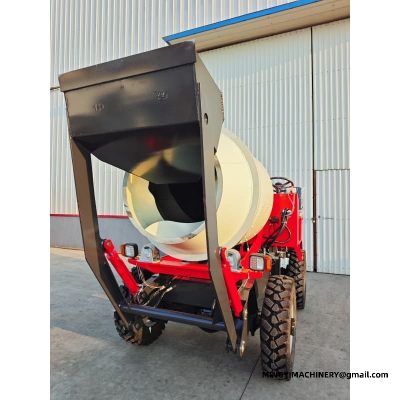
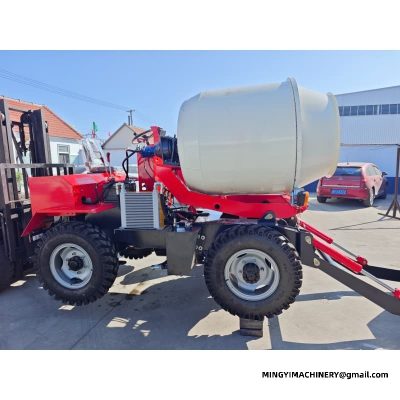
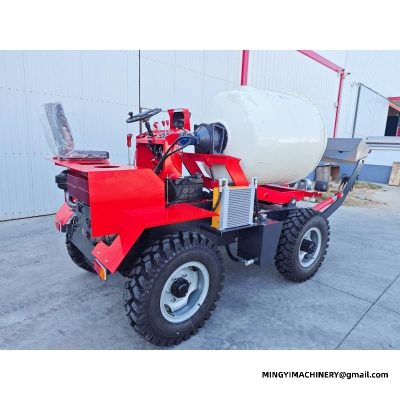
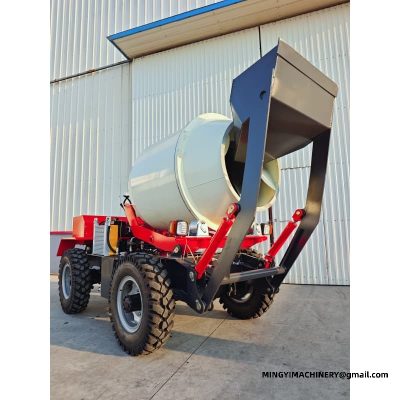
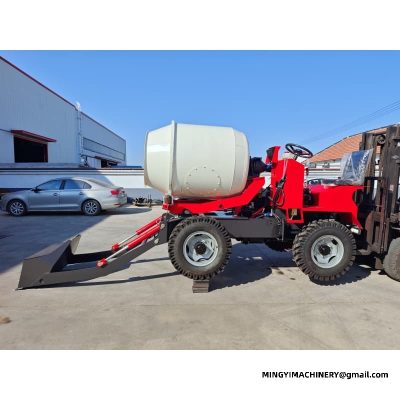
One operator, one drum, one shovel — that is the whole machine. Conventional site concreting splits the job across a loader, a mixer and a barrow chain; the china 0.8m3 4wd self loading mixer manufacturer folds it into a single 25 hp 4WD chassis. This page works through what the published specification means in practice on a building site, starting with the shovel and ending at the discharge.
The comparison also holds when ready-mix is available but the pour is small: a part-load minimum pays for concrete nobody placed, while a drum batches exactly what the formwork needs and stops when it stops.
Depreciation favours the machine too, because the 3,500 x 1,600 x 2,200 mm envelope keeps transport takes between jobs near nothing. The biggest single effort of plant is often moving it; this one rides a tag trailer behind a pickup.
At 3,500 x 1,600 x 2,200 mm the machine ships in a standard container without disassembly beyond lashing. On arrival: check the drum and shovel for transit damage, turn the engine by hand before first start, prime the hydraulic system, and run the drum empty before the first batch.
A short commissioning routine protects the warranty and the pour schedule alike. Most early faults reported on exported machines trace to skipped first-service basics rather than to the machine itself.
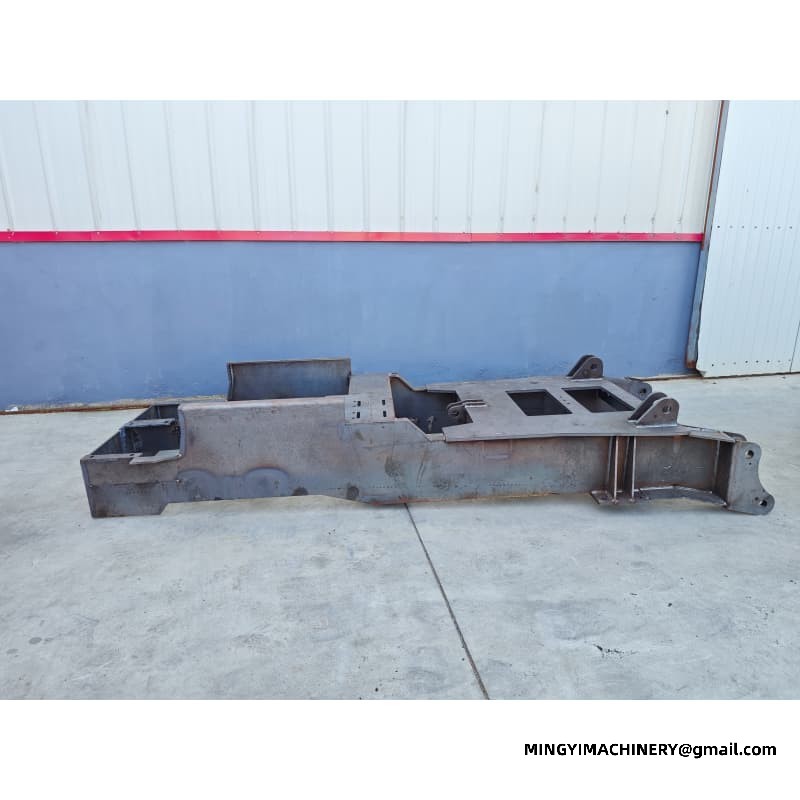
On a building site, the single-operator loop is the productivity claim that matters. The machine replaces the barrow chain, the hoist and the arguments about whose turn it is to mix, and it does so with the shovel and the drum doing what two labourers used to do.
The risk arrives when crews rotate through the seat. A laminated recipe card, a marked water container and a fixed scoop count effort nothing and survive any change of operator.
| Specification extract — 0.8 m³ 4WD self-loading concrete mixer | |
|---|---|
| Rated load | 1,500 kg |
| Rated capacity | 0.8 m³ |
| Overall dimensions (L x W x H) | 3,500 x 1,600 x 2,200 mm |
| Front tyre size | 8.25-16 |
| Rear tyre size | 7.50-16 |
| Minimum ground clearance | 204 mm |
| Steering angle | 28° |
| Turning dimension (outer tyre) | 2,464 mm |
| Maximum travel speed | 24 km/h |
| Transmission | 4WD |
| Gears | 3 forward / 1 reverse + travel gear |
| Front axle | 130 drive axle |
| Rear axle | 212 selectable 4WD steering axle |
| Engine | single-cylinder diesel / 25 hp |
| Steering | hydraulic power steering |
At 3,500 x 1,600 x 2,200 mm, the machine loads onto a tag trailer behind a light truck or ships one per small container. For plant hire fleets and export buyers that footprint is money: no escort, no low-loader, no special port handling.
Shovel-up travel is the one posture that moves weight forward sharply. The operator carries the shovel low and the drum level, on a building site, and the machine handles exactly as the geometry promises.
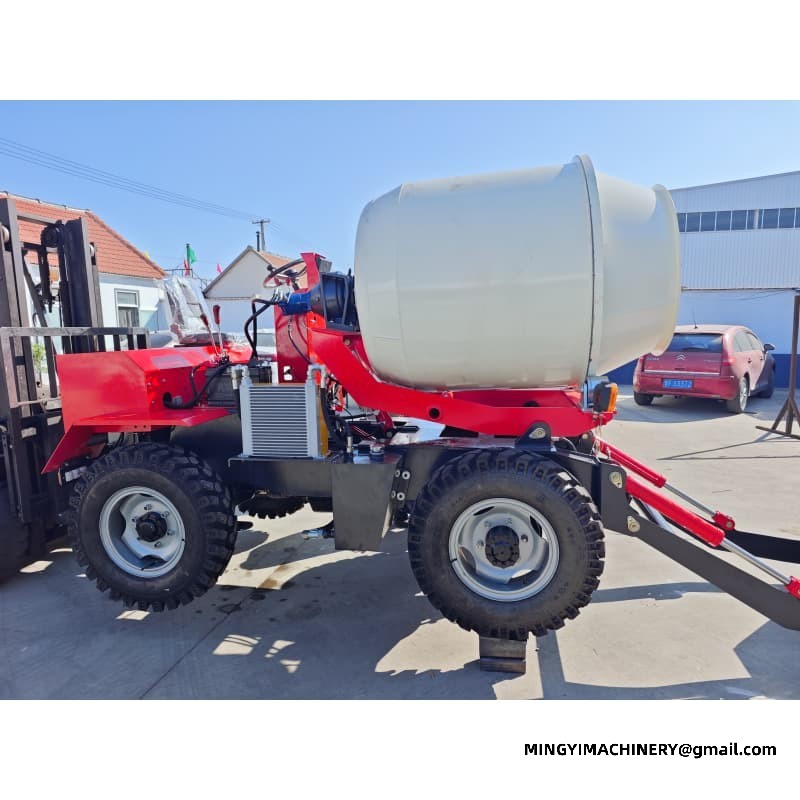
204 mm also sets the maintenance floor: axle drain plugs, the gearbox sump and the hydraulic filter all live above that line, and none of them wants to meet a rock. The clearance is a working figure, not a styling choice.
The rules that keep it upright are old ones: straight up, straight down, no turning across a loaded slope, and no sudden stops with 0.8 m³ of wet concrete shifting in the drum. None of them takes the crew any time worth measuring.
The machines that age well are washed and greased on schedule; the machines that age badly are the ones where wash-out slipped and dust won. Nothing exotic — just the daily five minutes, kept.
Add the intangible line while doing the sums: the pours won because the crew could promise concrete on a date. Plant that wins work is plant whose hourly effort stops mattering on a building site.
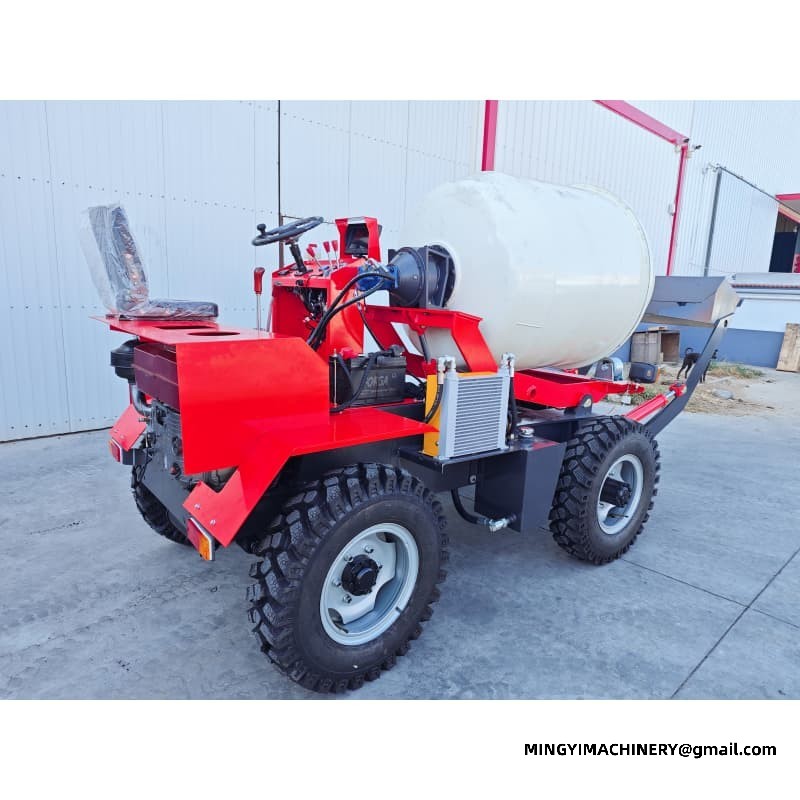
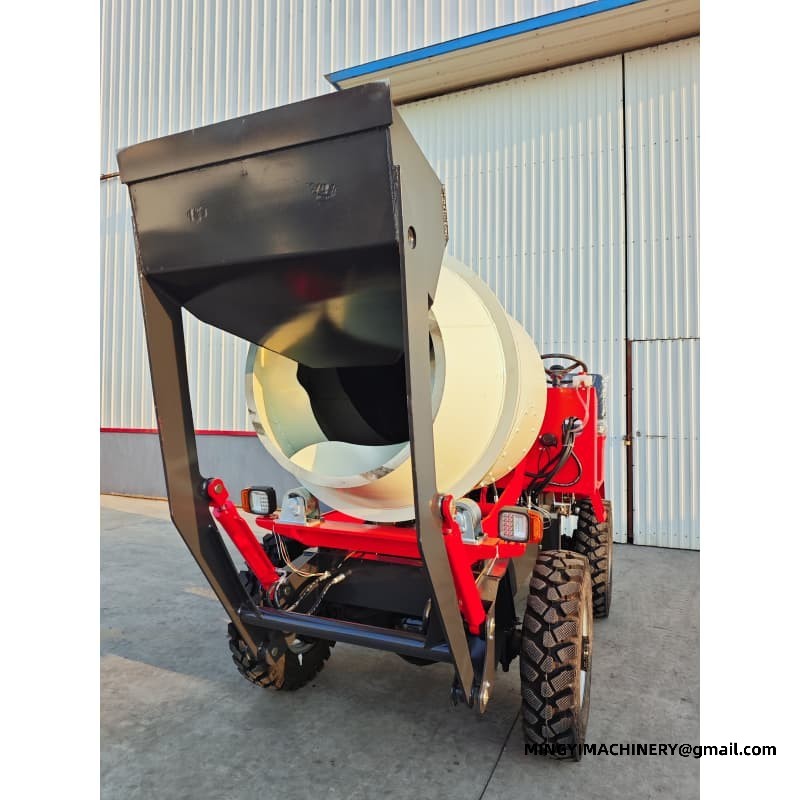
The shovel reaches a pile close to the front wheels, so the stockpile layout decides how fast a batch assembles. Keep aggregate and sand within a shovel's reach of the machine's standing position and the drum fills in seconds rather than minutes.
Inspection is a two-minute weekly job: pins, teeth or cutting edge, and the two hoses that flex with every lift. Caught early, a weeping fitting or a worn bushing is a teatime repair; left alone, it becomes a pour-day stoppage on a building site.
On larger sites the profile widens: an operator plus a spotter at the discharge, plus whoever feeds the cement and measures the water. The machine still needs one trained person; it simply stops needing a barrow chain behind them.
The hire argument is simplest of all: one machine, one trained person, one service book. A fleet built on that simplicity spends its money on work, not on complexity it will later have to support.
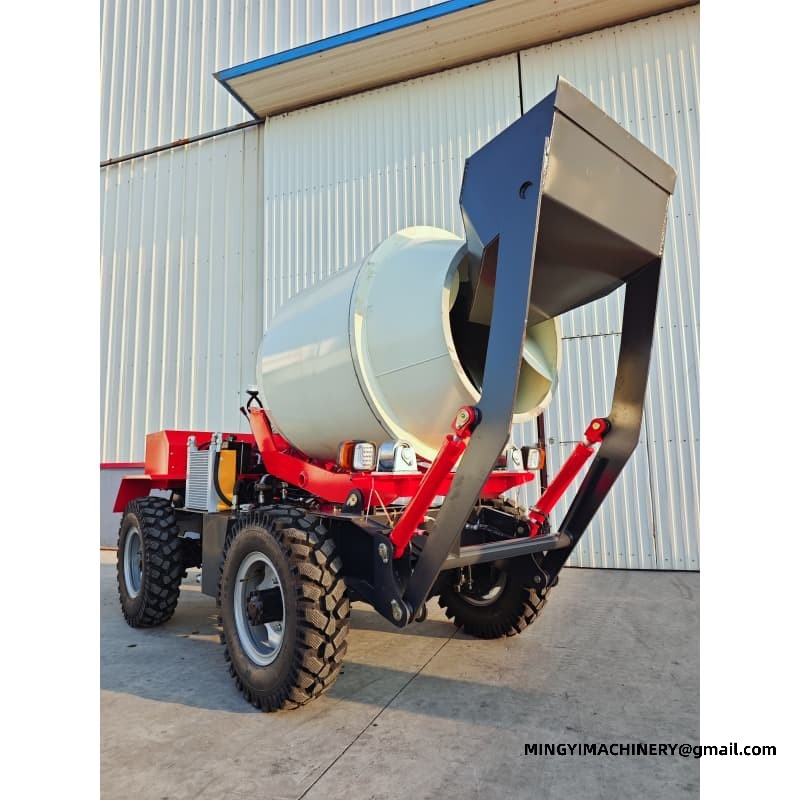
Steering effort drops to nothing at crawl speed, which is precisely when a loaded machine needs precision. The 28° rear steer responds proportionally, so the wheel's first inch means a small correction and the last inch means the full lock.
2,464 mm is measured at the outer tyre, so walls and posts at body height are the real constraint — the machine's shoulders swing wider than its tyres. Crews that remember this stop clipping mirrors and handrails on a building site.
The machine's natural work is the small structural pour — bases, posts, beams, ties — and the non-structural one beside it: paths, kerbs, patching, linings. Both consume 0.8 m³ per batch in quantities the drum and the crew handle naturally.
The work it should refuse is the continuous slab and the high-volume pour, where plant supply wins outright. Saying so is the service, and the customer who hears it trusts the next recommendation more, not less.
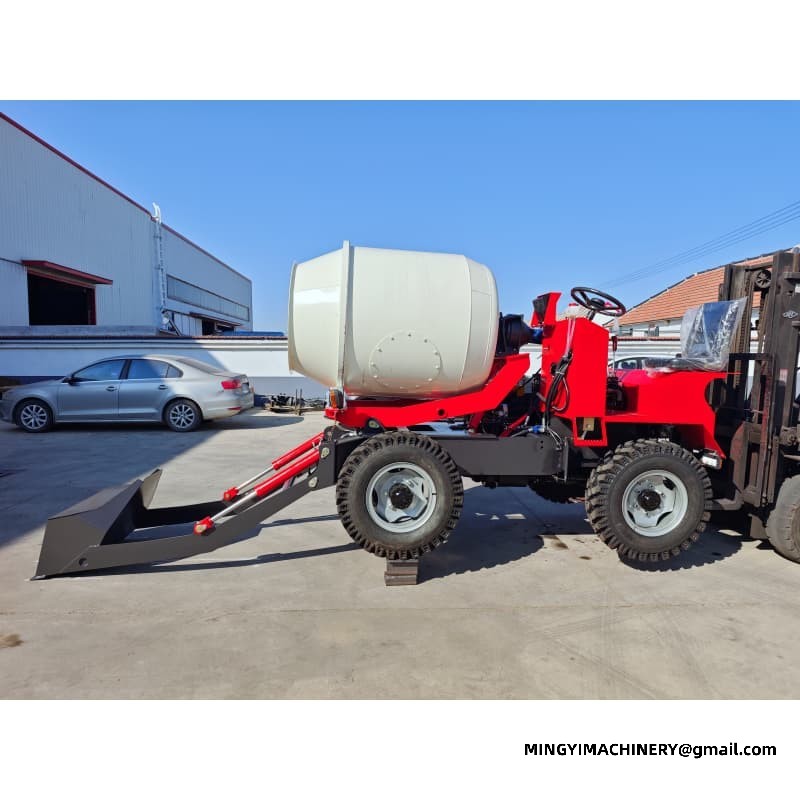
The first week should include one empty drum deliberately: let the new operator feel the 28° rear steer, the 2,464 mm circle and the stopping distance without a live load aboard. Familiarity earned empty arrives safely loaded.
Reinforce the habits with the machine itself: a marked water container lashed beside the seat, a laminate of the recipe in a sleeve on the splash board. Cues that live on the machine survive operator changes; cues in the site office do not.
First gear is for loading position and the worst ground; second covers most site hauls; the travel gear belongs on the public road between sites. Reverse plus the steered rear axle does the positioning, because the shovel leads and the operator wants to back toward a pour with the drum already pointing at it.
Reverse also serves the stockpile: backing toward the pile with the shovel leading keeps the loading line short and the machine's nose pointed at the next haul. Operators who plan their turnarounds move more concrete per hour than operators who rush.
plan the inputs with the machine, not after it. A drum that sits idle because the cement ran out is a drum that takes money while earning none, and the discipline of stocking ahead is part of owning well.
Ownership's quiet effort is the inputs — cement, aggregate, water — that must be on hand before the drum can turn. plan them with the machine from day one, because an idle drum takes money while it earns nothing.
Four-wheel drive also changes how the machine fails — or rather, how rarely. Wheels that share the work share the wear, and a chassis that is never bogged is a chassis that never needs towing out of a pour on a building site.
Selectable rear drive means the operator runs two-wheel steering on hard standing and engages full 4WD when the ground degrades. The machine spends most of its life in the lighter mode and keeps the heavy mode for the mornings it is needed.
Can the china 0.8m3 4wd self loading mixer manufacturer cross a small culvert or slab on site?
If the structure is engineered for the machine's axle loading, yes. Unverified culverts, covers and basements deserve a check before the wheels arrive, not after.
How much concrete does the china 0.8m3 4wd self loading mixer manufacturer mix per batch?
The drum mixes 0.8 m³ per batch, and the chassis carries 1,500 kg while doing it. Batch size and payload were drawn to match, so a full drum never overloads the machine.
Who supports the china 0.8m3 4wd self loading mixer manufacturer after delivery?
The supplier, by shipment of machine-specific parts and by guidance on the engine and axle pattern any local mechanic can service. E-mail sales@mingycn.com or LINE (ID): mingyicn and the conversation continues after the sale.
Why do china 0.8m3 4wd self loading mixer manufacturer wheel nuts need checking?
Rough ground loosens them. The daily walk-round includes a nut check for the same reason it checks the drum — small things caught early never become pour-day failures.
How do you keep batches consistent in a china 0.8m3 4wd self loading mixer manufacturer?
A fixed recipe: the same scoop count, the same measured water, the same mixing time. The machine repeats whatever routine it is given, on a building site included.
Is a second-hand china 0.8m3 4wd self loading mixer manufacturer a good buy?
A machine with hours, records and an honest drum beats a simple one with neither. Check for a heel in the drum, worn shovel pins and cracked hoses — three tells that predict the next season's takes.
Is the china 0.8m3 4wd self loading mixer manufacturer stable on slopes?
Within site-ramp grades, driven slowly and straight. Cross-slopes with a full drum deserve a straighter line than empty running, and no turning across a loaded slope.
How heavy is the china 0.8m3 4wd self loading mixer manufacturer?
The published table specifications 1,500 kg of rated load and the overall envelope; for the transport weight of your specific build, ask the supplier for the shipping specification in writing.
Nothing on this page is complicated, and that is the point: a 0.8 m³ drum, a shovel, four driven wheels and a routine. Crews that keep the routine keep the machine earning on a building site for years.
Handover and getting familiar with China 0.8m3 4WD Mixer Manufacturer: What Ships, What Serves
The first day with a new machine sets the pattern for the next five years. Handover for China 0.8m3 4WD Mixer Manufacturer: What Ships, What Serves covers the control layout, the daily check points and the limits the operator needs to know before the first real load is lifted or carried.
Hot, humid and dusty conditions around China 0.8m3 4WD Mixer Manufacturer: What Ships, What Serves
Tropical operation is a specification question as much as a maintenance one. The cooling capacity, the sealing and the corrosion protection fitted to China 0.8m3 4WD Mixer Manufacturer: What Ships, What Serves are what make the difference once the ambient temperature rises.
Packing, loading and shipment of China 0.8m3 4WD Mixer Manufacturer: What Ships, What Serves
Container loading is a planning exercise. The overall dimensions and the operating weight of China 0.8m3 4WD Mixer Manufacturer: What Ships, What Serves decide whether it ships whole, partly disassembled or with the attachment removed, and that decision is made before the booking.
Keeping a service record for China 0.8m3 4WD Mixer Manufacturer: What Ships, What Serves
A written record is worth more than a good memory. Dates, hours and the parts fitted on China 0.8m3 4WD Mixer Manufacturer: What Ships, What Serves turn a guess about the next service into a fact, and they are the first thing a buyer asks to see.
Moving China 0.8m3 4WD Mixer Manufacturer: What Ships, What Serves between sites
Travel time is not working time, and it should be planned as its own item. The hours spent moving China 0.8m3 4WD Mixer Manufacturer: What Ships, What Serves between jobs are hours not worked, and a trailer that matches the machine reduces them every single trip.
Contact MINGYI Machinery for the current self-loading concrete mixer specification, export packing and a formal specification for your market. E-mail: sales@mingycn.com | LINE (ID): mingyicn
0.8m3 4WD Mixer: From Specification to Delivery · 0.8m3 Farm Mixer: Concrete Where Trucks Cannot Turn · off road dumper for farm and estate work · Mini Self-Loading Concrete Mixer









