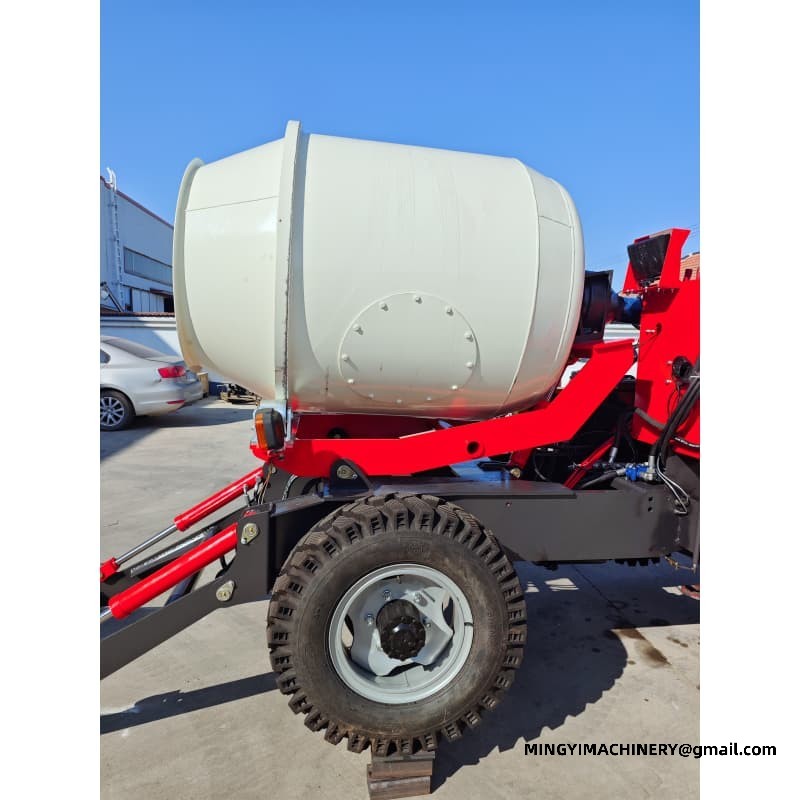
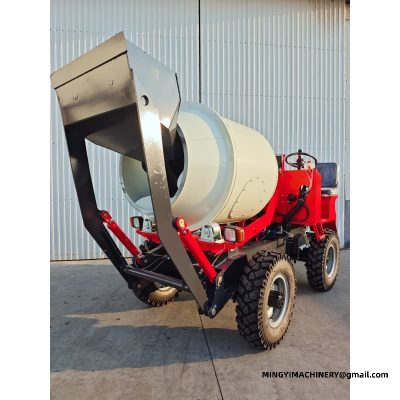
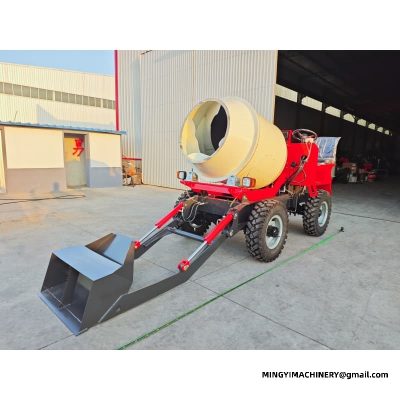
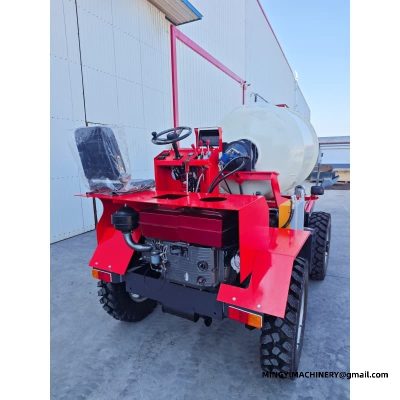
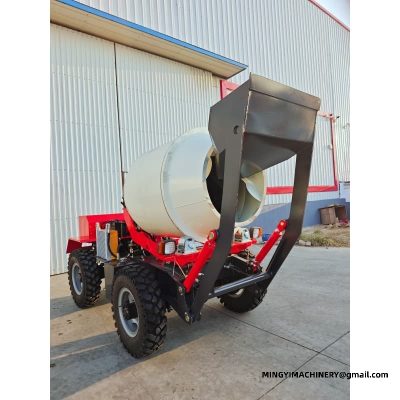
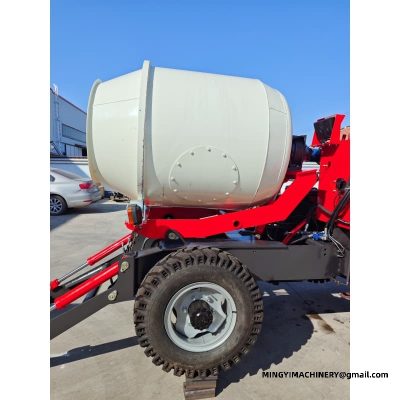
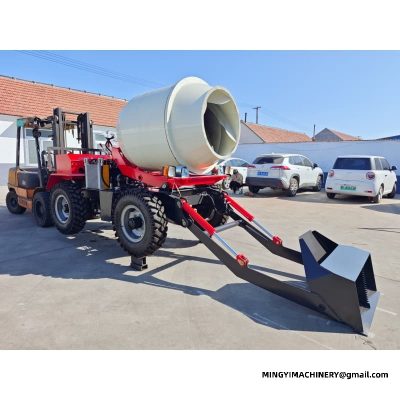
0.8m3 Farm & Plantation Concrete Mixer, Orchard Pathway 4WD Truck, Agricultural Mixer
The published table on a 0.8m3 farm and plantation concrete mixer is short, and every line on it is a decision. 0.8 m³ capacity, 1,500 kg rated load, 3,500 x 1,600 x 2,200 mm overall, 4WD through a 130 axle with a 212 steering axle behind. This page takes those lines one at a time and reads them the way a crew meets them: loading, mixing, hauling and discharging on canal work.
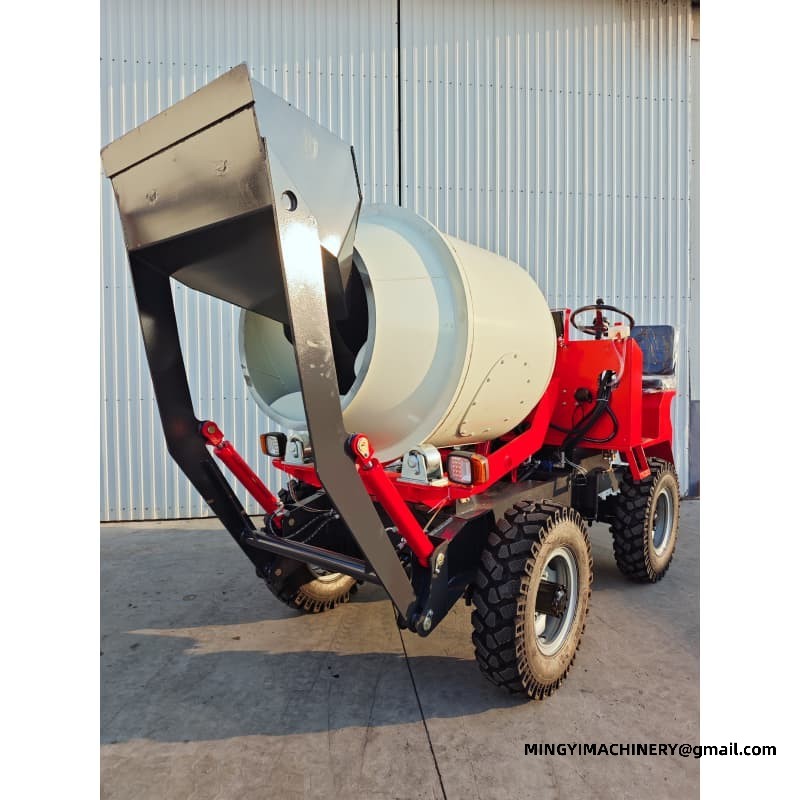
Single-cylinder engines also teach their operators. The rhythm of a healthy 25 hp unit — exhaust note, vibration, smoke colour — tells an attentive operator more than a dashboard of warning lamps, and small deviations get fixed small.
Fuel quality is the one consumable worth policing. Dirty or wet diesel is the single biggest cause of injector trouble in engines of this pattern, and a simple water separator in the fuel line is simpler than one injector on canal work.
The machine's resale case is its simplicity: a buyer can see the drum, the axles and the engine in a walk-round, and the service book tells the rest. Machines with records, straight shovels and clean drums sell within days in most markets.
Buy a used one with the same eye: a drum true to its blades, axles dry at the seals, and hours that match the story. The three tells predict the next season's takes better than any salesman's.
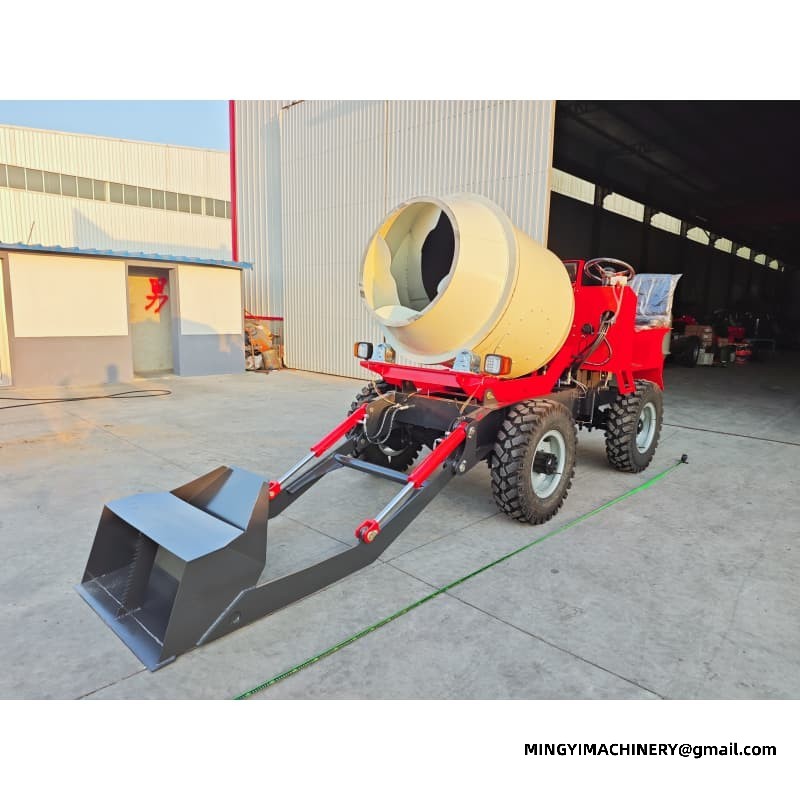
Four-wheel drive also changes how the machine fails — or rather, how rarely. Wheels that share the work share the wear, and a chassis that is never bogged is a chassis that never needs towing out of a pour on canal work.
Both axle patterns are agricultural standards, which matters more than any performance figure: seals, bearings and crown wheels for the 130 and 212 patterns are stocked wherever farm machinery is sold, and that is everywhere this machine works.
| Published build data — 0.8 m³ 4WD self-loading concrete mixer | |
|---|---|
| Rated load | 1,500 kg |
| Rated capacity | 0.8 m³ |
| Overall dimensions (L x W x H) | 3,500 x 1,600 x 2,200 mm |
| Front tyre size | 8.25-16 |
| Rear tyre size | 7.50-16 |
| Minimum ground clearance | 204 mm |
| Steering angle | 28° |
| Turning dimension (outer tyre) | 2,464 mm |
| Maximum travel speed | 24 km/h |
| Transmission | 4WD |
| Gears | 3 forward / 1 reverse + travel gear |
| Front axle | 130 drive axle |
| Rear axle | 212 selectable 4WD steering axle |
| Engine | single-cylinder diesel / 25 hp |
| Steering | hydraulic power steering |
Front tyres are 8.25-16, rears are 7.50-16 — agricultural-pattern tyres with a tread that grips soft ground and shrugs off stones. Combined with four-wheel drive they carry a full drum across ground that stops two-wheel-drive machines.
Pressure discipline matters on soft ground. Tyres run too hard cut into wet surfaces and lose the footprint that floats the machine; run at correct pressure, the four contact patches plus 1,500 kg of payload stay within what most prepared sites bear.
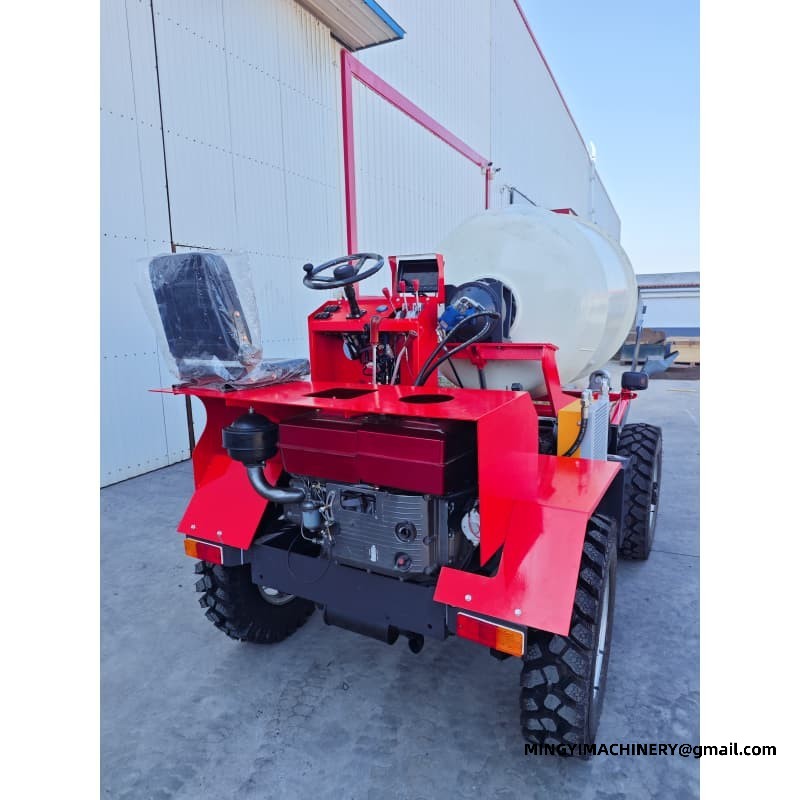
Cement count, aggregate count, water measure, drum time — four numbers per mix design, and every crew member should be able to recite them. The machine's repeatability turns those four numbers into strength rather than into hope.
Small jobs rarely cube-test, but simple checks still work: slump by the side-collapse eye, batch weight against the recipe, and a note of what each pour received. Crews that keep a chalkboard of batches trace a weak patch to its cause instead of guessing.
A lifting shovel commands a exclusion zone whether or not the site paints one. Nobody stands within the shovel's arc; nobody rides a load; nobody walks under a raised bucket — even briefly, even empty.
Gloves, boots and eye protection are not paperwork at the discharge end — wet cement is caustic, and the crews who treat it that way on canal work never spend an evening with cement burns.
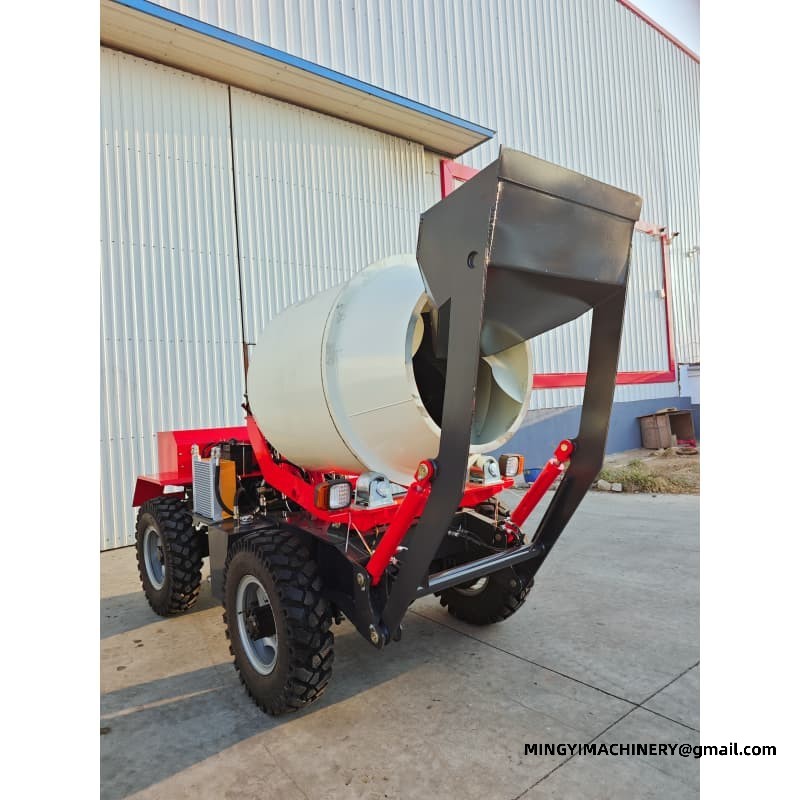
Build the plan around the standing spot rather than the drum: a machine that parks once and serves a bay from one position outserves a machine that shuttles. Positioning time is the only time the drum spends doing nothing.
Concrete sets on its own clock, and weather resets it. Heat shortens the working time between drum and formwork; cold lengthens it and delays strength. On days with weather windows, the machine's speed of positioning — in, mix, tip, out — is what lets a crew use the window fully.
Aggregate temperature is the hidden variable in hot-weather concrete: stockpiles in the sun can carry the mix temperature past the design window before the drum spins. Shade, sprinkling and morning batching are the simple answers.
Rain turns routes into the machine's worst case: 204 mm of clearance and agricultural tyres carry a full drum across wet ground only as well as the ground allows. Fill the ruts, gravel the standing spots, and plan pours away from the day's worst weather rather than through it.
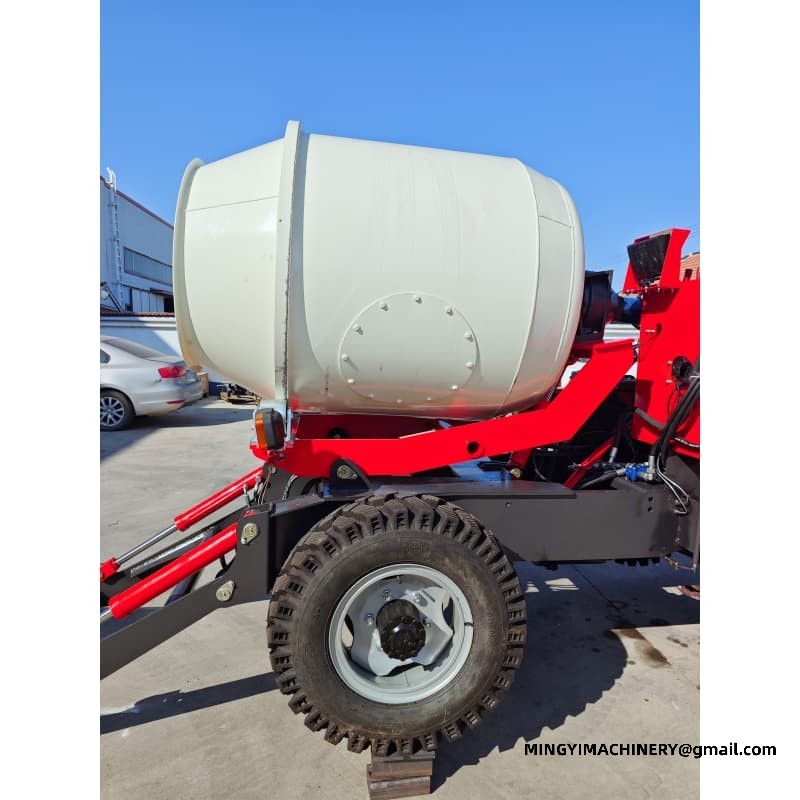
The first week should include one empty drum deliberately: let the new operator feel the 28° rear steer, the 2,464 mm circle and the stopping distance without a live load aboard. Familiarity earned empty arrives safely loaded.
Where the machine changes hands, the handover is a two-minute conversation with a written line: hours run, fuel state, anything odd heard or felt, wash-out done or not. The drum heel that one shift leaves is the next shift's complaint unless the note exists.
Steering effort drops to nothing at crawl speed, which is precisely when a loaded machine needs precision. The 28° rear steer responds proportionally, so the wheel's first inch means a small correction and the last inch means the full lock.
What the machine does — reach the pour under its own power, mix to a recipe, place canal lining concrete without a second handling — it does inside those limits, and crews that learn the limits plan around them instead of against them.
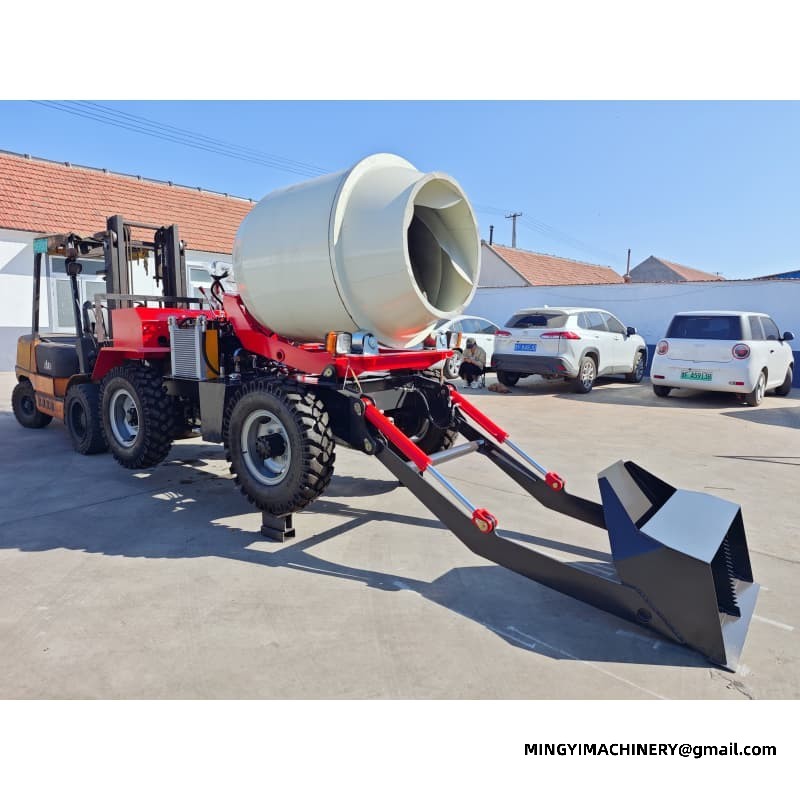
At 3,500 x 1,600 x 2,200 mm the machine ships in a standard container without disassembly beyond lashing. On arrival: check the drum and shovel for transit damage, turn the engine by hand before first start, prime the hydraulic system, and run the drum empty before the first batch.
A sensible first spares kit travels with the machine: filters for engine and hydraulics, a set of belts, hose clamps, a drum blade or two, shovel pins and bushings, and lamp bulbs. Everything on the list is small, simple and exactly what stops work on canal work when it fails unstocked.
The comparison also holds when ready-mix is available but the pour is small: a part-load minimum pays for concrete nobody placed, while a drum batches exactly what the formwork needs and stops when it stops.
Ready-mix that returns to the plant is paid for anyway; batches mixed on site stop when the pour stops. That flexibility is worth real money on the small, lumpy pours on canal work, where ordering to a schedule always ends with either a shortage or a surplus.
Board over exposed ducts and mark headroom limits. The machine crosses most ground on canal work; it crosses a buried cable only once, and the second time is a strike.
Mark the discharge point before the pour, not during it. A standing spot within barrow reach of the formwork is worth more than a tidy spot metres away, because the last metres are where batches lose their workability.
Bore, stroke and emission figures matter less than the parts supply behind them. Ask the supplier for the engine's own reference numbers, not just the mixer's, and the first filter change becomes a two-minute order rather than a search.
A line worth pausing on is the gear set — 3 forward, 1 reverse and a travel gear — because it tells you how the machine splits slow, strong work from the road run between sites. The travel gear is not for the load; it is for the empty road, and the distinction keeps the box alive.
Is the 0.8m3 farm and plantation concrete mixer four-wheel drive?
Yes. Transmission is 4WD — four-wheel drive through a 130 front drive axle, with the 212 rear axle selectable for four-wheel-drive steering. Rear drive is selectable, so the machine runs light on hard standing and engages all four wheels when the ground turns soft.
The 0.8m3 farm and plantation concrete mixer battery keeps going flat — why?
Short runs without charging time, or parasitic drain while parked. Run the machine long enough after starts to replace what the starter used, and disconnect or top up during idle weeks.
What engine does the 0.8m3 farm and plantation concrete mixer use?
A single-cylinder diesel rated at 25 hp. It drives the transmission, drum and hydraulics, and it services with filters and oil a general mechanic already stocks.
Do I need a concrete pump with a 0.8m3 farm and plantation concrete mixer?
Usually not. The machine drives to the pour and discharges over the front on canal work; a barrow stage covers the last few metres where wheels cannot stand.
Can a 0.8m3 farm and plantation concrete mixer place concrete around dense rebar?
Yes — the discharge lands where the operator aims it, and a spotter with a shovel and vibrator works the concrete in. Tight rebar changes the placing crew's job, not the machine's.
Is 24 km/h fast enough for a 0.8m3 farm and plantation concrete mixer?
For the job, yes — the machine carries wet concrete high on a short wheelbase, and the gearing keeps those loads sedate. Road moves between sites use the travel gear.
Do I need a vibrator with a 0.8m3 farm and plantation concrete mixer?
For structural work, yes — a poker vibrator belongs with the pour regardless of how the concrete arrived. The machine supplies placement; compaction is a separate duty.
How is visibility from the 0.8m3 farm and plantation concrete mixer seat?
The open station sees the shovel, the drum lip and the discharge point directly — no camera dependence. A spotter still covers the reversing approach at busy pours.
Small pours, distant sites and awkward access are exactly where this machine was drawn to work. Where the job matches that shape, the published table is all the sales argument needed.
A second operator for 0.8m3 Farm Mixer: Concrete Where Trucks Cannot Turn
Training is simpler than repair. An hour spent with a new operator on 0.8m3 Farm Mixer: Concrete Where Trucks Cannot Turn, covering the limits and the awkward cases, is the least lengthy hour in the whole ownership.
Cold weather and winter care for 0.8m3 Farm Mixer: Concrete Where Trucks Cannot Turn
Cold exposes weak batteries, thick oil and water in the fuel. Preparing 0.8m3 Farm Mixer: Concrete Where Trucks Cannot Turn for winter means the right grade of oil, a battery in good condition and fuel that will not wax in the tank overnight.
Fuel, oil and fluid quality for 0.8m3 Farm Mixer: Concrete Where Trucks Cannot Turn
Most engine trouble starts with what went into the tank. Clean fuel, stored properly and filtered before it reaches 0.8m3 Farm Mixer: Concrete Where Trucks Cannot Turn, prevents more downtime than any other single habit an owner can adopt.
Storage and long idle periods for 0.8m3 Farm Mixer: Concrete Where Trucks Cannot Turn
Rubber, seals and hoses age whether the machine works or not. Keeping 0.8m3 Farm Mixer: Concrete Where Trucks Cannot Turn out of direct sun and off damp ground slows that, and running it briefly at intervals keeps everything moving.
Handover and getting familiar with 0.8m3 Farm Mixer: Concrete Where Trucks Cannot Turn
Familiarisation is not the same as reading the manual. Sitting on 0.8m3 Farm Mixer: Concrete Where Trucks Cannot Turn, working through the controls at low speed and learning where the machine balances takes an hour, and that hour is what keeps the first week uneventful.
Contact MINGYI Machinery for the current self-loading concrete mixer specification, export packing and a formal specification for your market. E-mail: sales@mingycn.com | LINE (ID): mingyicn
Low Clearance 0.8m3 Mixer: Working Under 2,200 mm · 0.8m3 Road Construction Self Loader: Canal and Kerb Work · all terrain transporter for steep gradient sites · Mini Self-Loading Concrete Mixer









