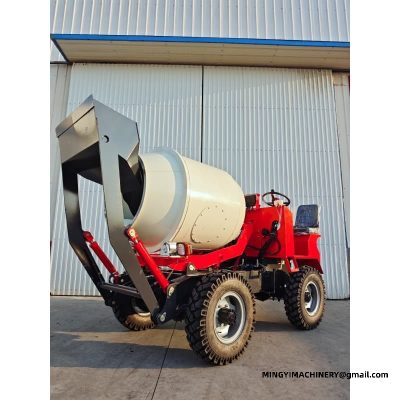
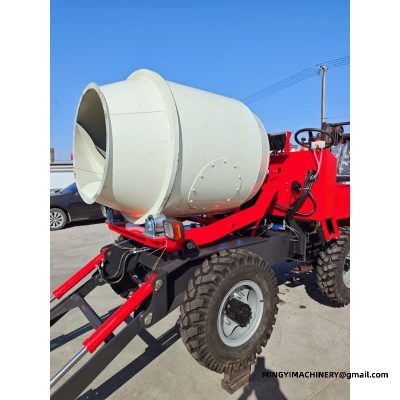
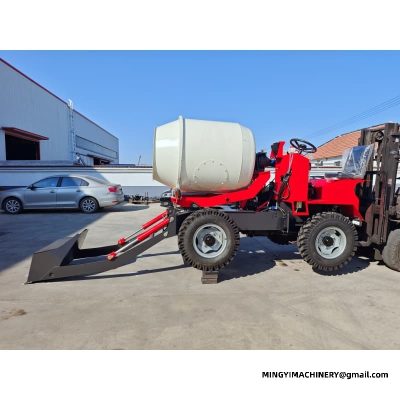
0.8m3 Road Construction Self Loader, Canal Paving 0.8m³ Mixer, Ditch Lining Truck
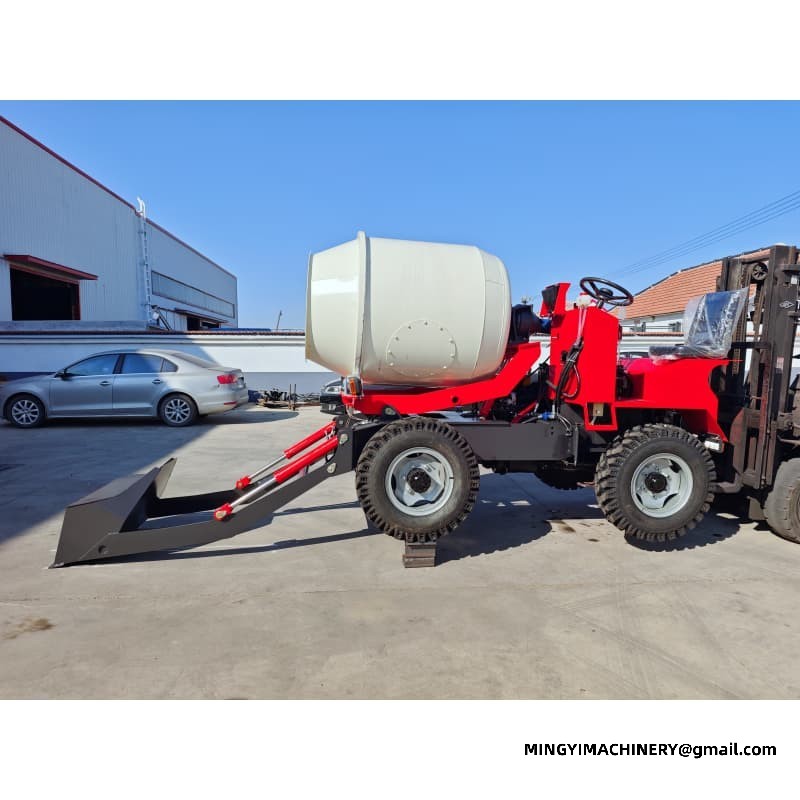
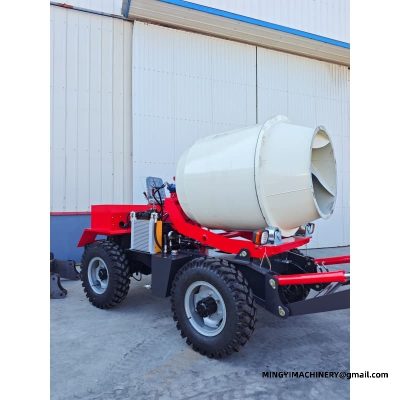
Small pours, repeated all day, are a logistics problem. The 0.8m3 road construction self loader answers it with a 0.8 m³ drum, a front shovel and four driven wheels — four-wheel drive through a 130 drive axle with a 212 steering axle behind. This page reads the specification the way an estimator would: what each batch contains, what the cycle takes in time, and where the machine's limits honestly sit.
The comparison also holds when ready-mix is available but the pour is small: a part-load minimum pays for concrete nobody placed, while a drum batches exactly what the formwork needs and stops when it stops.
Crews converting from hand-mixing should expect the savings to arrive in two waves: the obvious one in labour, the quieter one in rework, because batches mixed to a recipe need less patching, less remedial finishing and fewer disputes in orchard pathways.
At 3,500 x 1,600 x 2,200 mm the machine ships in a standard container without disassembly beyond lashing. On arrival: check the drum and shovel for transit damage, turn the engine by hand before first start, prime the hydraulic system, and run the drum empty before the first batch.
Buying the kit with the machine also proves the supply chain before it is needed. Ask the supplier to specification parts by the same reference numbers as the manual, so the second order places itself.
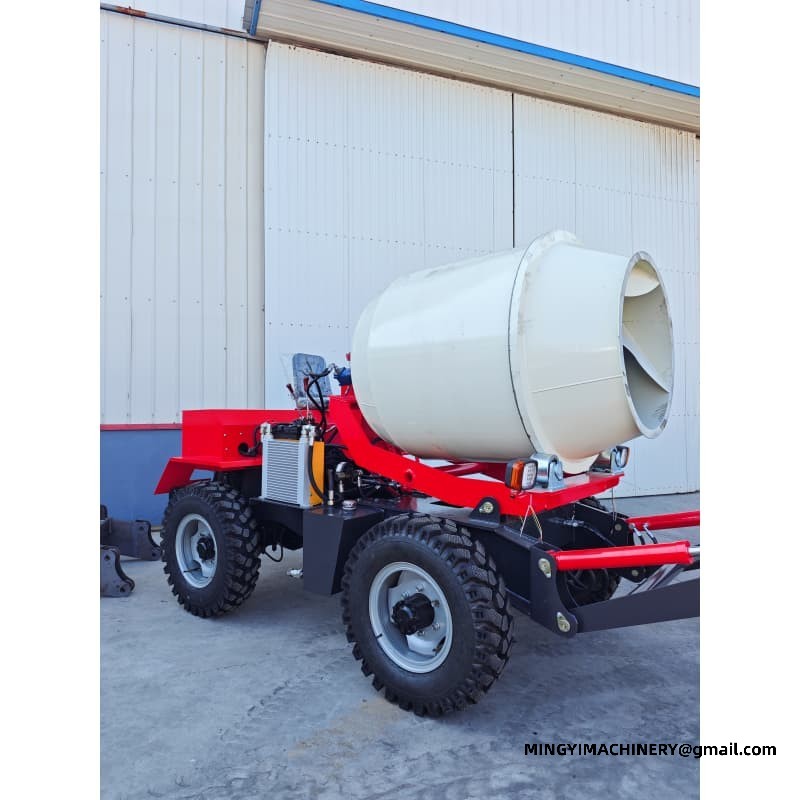
Output is decided by the cycle, not the drum. Loading the shovel, mixing, travelling and discharging repeat, and the slowest of the four sets the rate. With 0.8 m³ per batch and a short haul, the drum rarely waits; with a long carry at 24 km/h, travel becomes the constraint and the arithmetic changes.
Small structural work — columns, bases, tie beams, garden retaining walls — consumes concrete in units close to 0.8 m³, which is why the drum size and the common pour size match so well. Large slabs are a different animal and want continuous supply; a single machine cannot hold that rhythm alone.
| Reference specification — 0.8 m³ 4WD self-loading concrete mixer | |
|---|---|
| Rated load | 1,500 kg |
| Rated capacity | 0.8 m³ |
| Overall dimensions (L x W x H) | 3,500 x 1,600 x 2,200 mm |
| Front tyre size | 8.25-16 |
| Rear tyre size | 7.50-16 |
| Minimum ground clearance | 204 mm |
| Steering angle | 28° |
| Turning dimension (outer tyre) | 2,464 mm |
| Maximum travel speed | 24 km/h |
| Transmission | 4WD |
| Gears | 3 forward / 1 reverse + travel gear |
| Front axle | 130 drive axle |
| Rear axle | 212 selectable 4WD steering axle |
| Engine | single-cylinder diesel / 25 hp |
| Steering | hydraulic power steering |
The drum wash-out belongs here too — it is listed in the drum section but it is a daily item, not a weekly one. A machine parked clean in orchard pathways is a machine that starts the next morning without arguments.
Fleets that run paper this way in orchard pathways also spot the early trend: a filter that keeps clogging or a seal that keeps weeping is telling the crew something before it fails on a pour day.
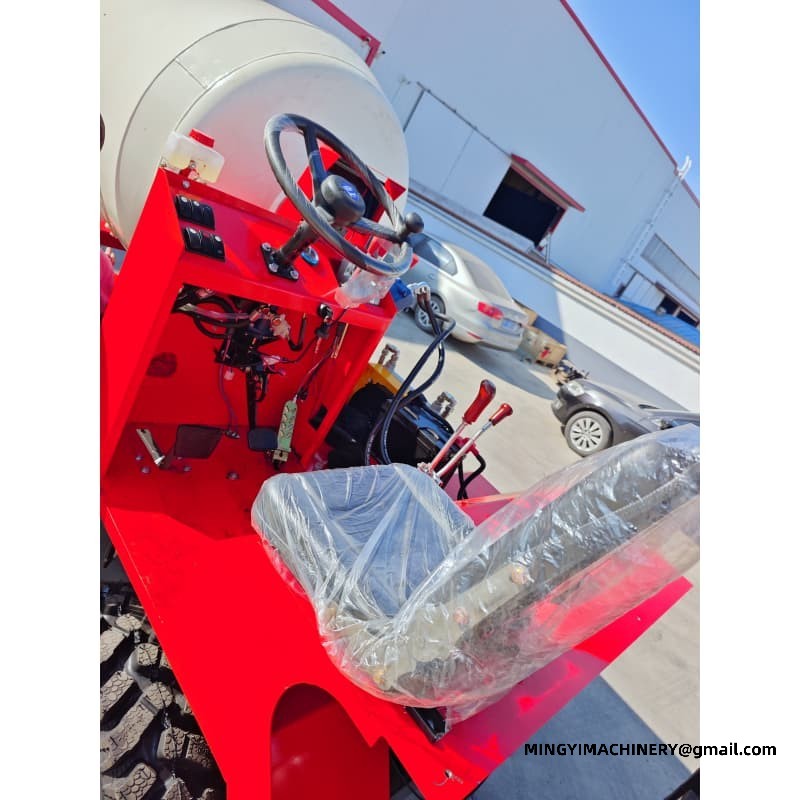
Consistency comes from a fixed recipe and a fixed routine: the same bucket counts, the same water measure, the same mixing time. Because the shovel weighs each scoop the same way and the drum turns each batch the same way, the machine rewards crews that work to a recipe with batches that finish identically.
The failure mode is improvisation — an extra scoop here, a splash of water there. Batches of path and drainage concrete mixed by eye vary, and the variation shows up as strength scatter in the finished work. A written recipe taped beside the controls takes nothing and fixes most of it.
Single-cylinder engines also teach their operators. The rhythm of a healthy 25 hp unit — exhaust note, vibration, smoke colour — tells an attentive operator more than a dashboard of warning lamps, and small deviations get fixed small.
Daily care is a two-minute walk-round: oil, fuel, air restriction, belt, and a check that the radiator front is not blinded by dust. Machines worked in dry conditions in orchard pathways need that filter check more often than the book says.
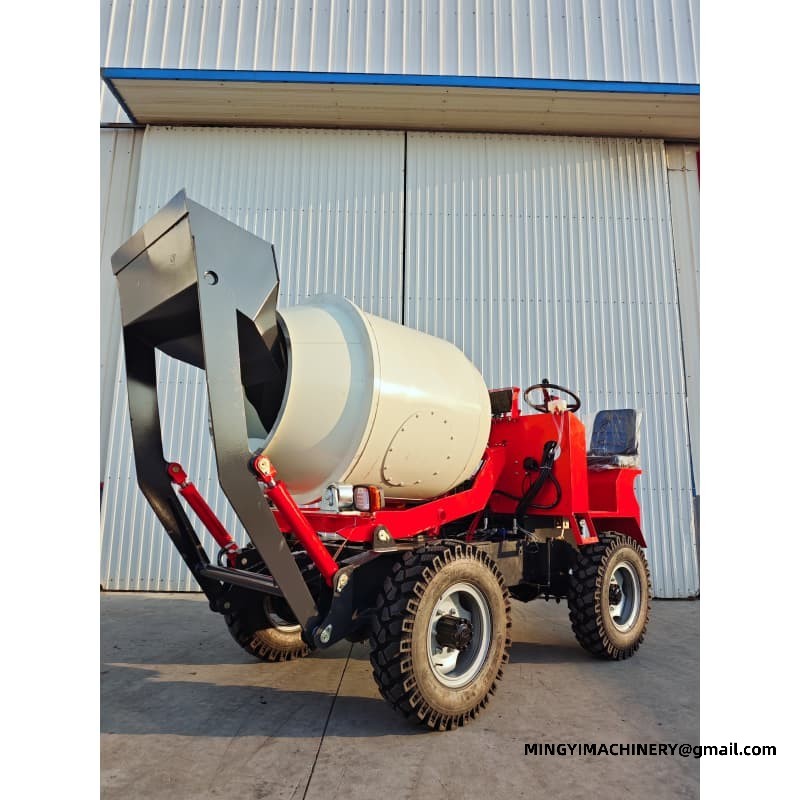
Cement count, aggregate count, water measure, drum time — four numbers per mix design, and every crew member should be able to recite them. The machine's repeatability turns those four numbers into strength rather than into hope.
Where the work is structural, test properly. The machine's uniformity makes test results meaningful — hand-mixed scatter hides problems that drum-mixed consistency exposes while they are still simple.
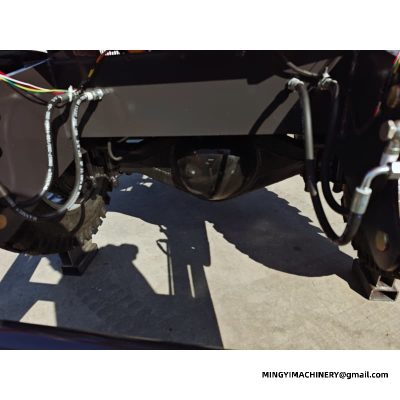
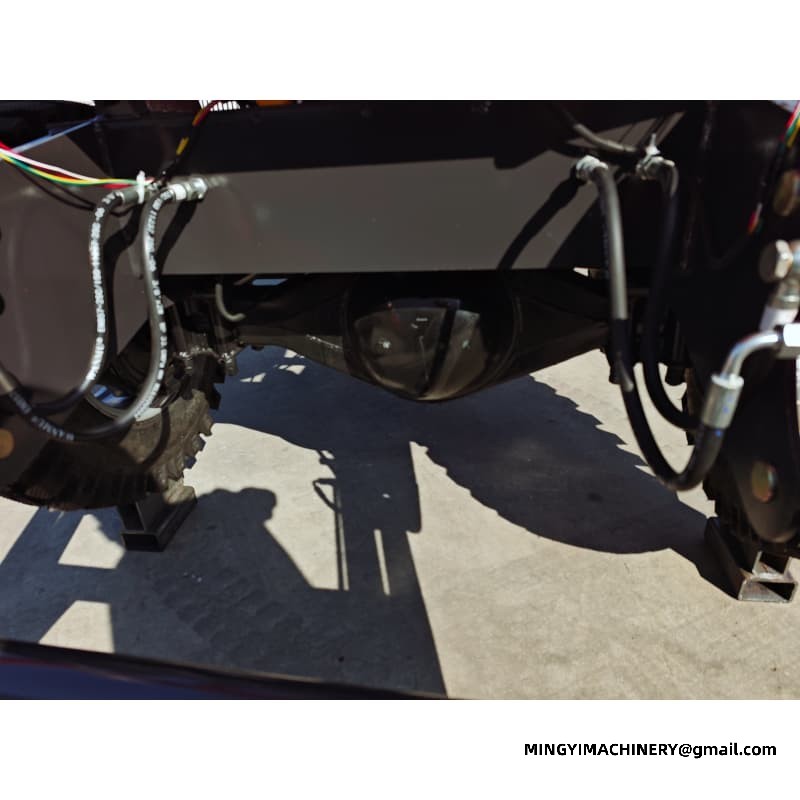
The 130 front drive axle and 212 rear steering axle are named because they are standard agricultural patterns, and that naming is part of the durability case. Bearings, seals, hubs and crown wheels for both exist wherever tractors are sold.
List the axle numbers on the same sheet as the engine numbers. A machine whose running gear is stocked regionally is a machine that spends its life working instead of waiting, and the difference shows up in the uptime over a season in orchard pathways.
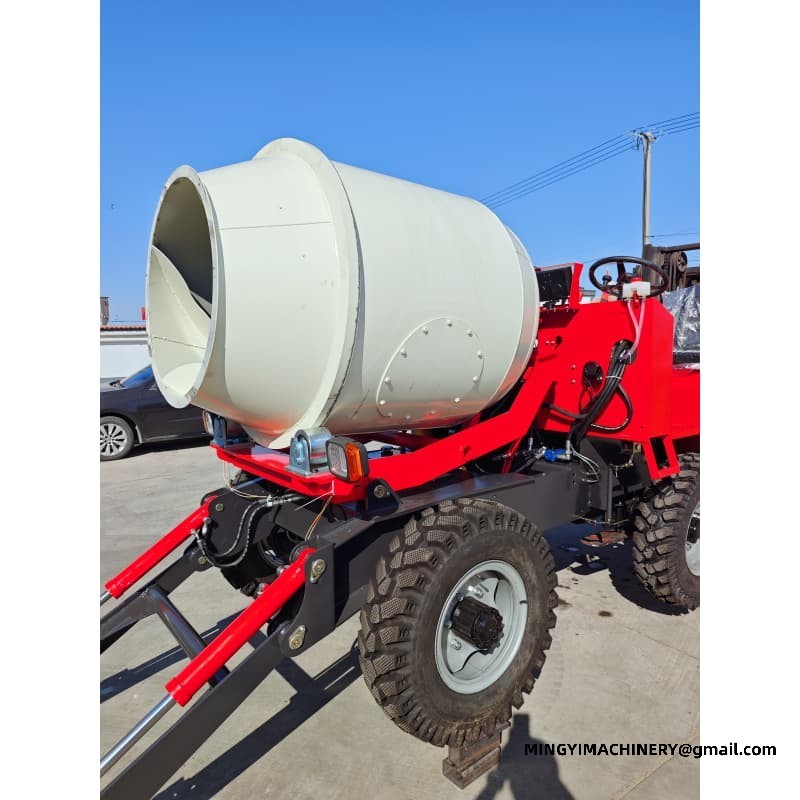
A lifting shovel commands a exclusion zone whether or not the site paints one. Nobody stands within the shovel's arc; nobody rides a load; nobody walks under a raised bucket — even briefly, even empty.
The discharge point concentrates people and machine in one small area — the operator tipping, the spotter barrowing, the crew placing. The safe pattern is a fixed standing spot, a spoken signal for stop, and a rule that the drum never turns while anyone stands in the discharge arc.
Keep the pairs matched left to right and the pressures even, because uneven fronts put the machine slightly out of square and the steering fights it all day. Tyres are the simplest component to treat well and the most lengthy to ignore.
Wheel nuts loosen on rough ground — the check is part of the daily walk-round for a reason. A wheel coming off under a full drum is the kind of event that ends careers and machines.
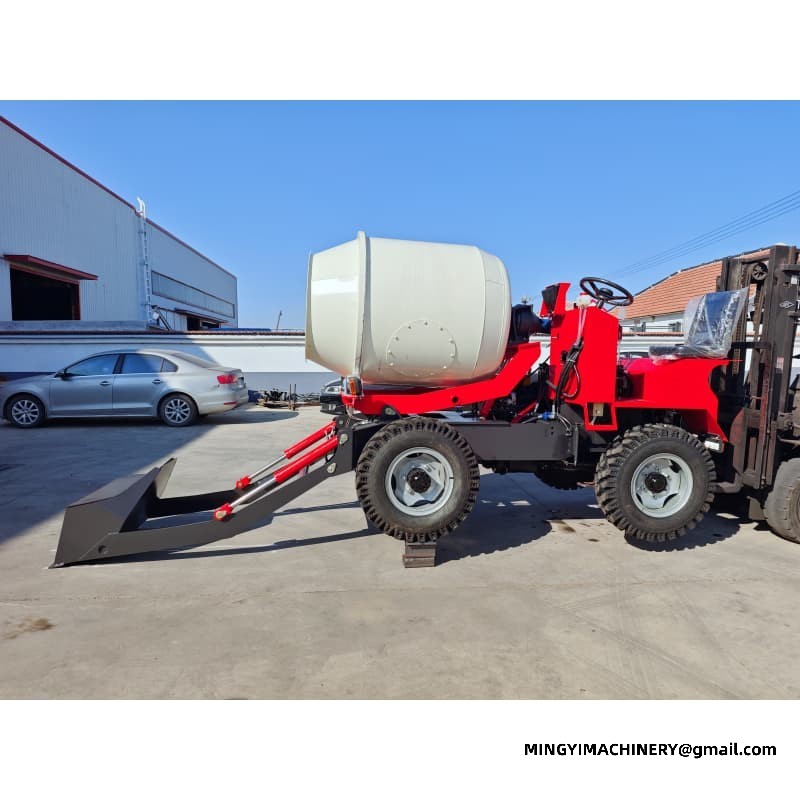
A tidy pile also protects the mix. Contamination from ground spoil is the usual cause of weak batches on sites that store material directly on soil; a hardened standing area takes little and keeps path and drainage concrete honest from the first scoop.
The discipline that keeps it healthy: scoop shallow, drop into the drum rather than onto its rim, and keep the shovel clean before park-up. Operators who treat it gently in orchard pathways get years from it; operators who use it as a dozer replace pins and bushings far sooner.
Front tyres are 8.25-16, rears are 7.50-16 — agricultural-pattern tyres with a tread that grips soft ground and shrugs off stones. Combined with four-wheel drive they carry a full drum across ground that stops two-wheel-drive machines.
Watch the rears on rough going — steering axles take sideways knocks that fronts never see. A five-minute look at both pairs after the first day on new ground in orchard pathways catches the stones and the cuts before they become failures.
Stand the machine where the finishing crew already is, not where it would be convenient to park. A discharge point within barrow reach of the formwork is worth more than a flat, tidy spot fifty metres away, because the last metres are where hand-mixed batches lose their workability.
The survey is not paperwork; it is the first batch. Measure the gate, the turn and the ground while the machine is still on the truck, and the 2,464 mm turning circle and 204 mm clearance become numbers you have already checked rather than surprises you meet with a full drum.
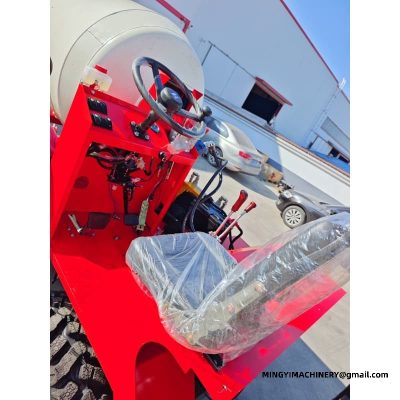
The first week should include one empty drum deliberately: let the new operator feel the 28° rear steer, the 2,464 mm circle and the stopping distance without a live load aboard. Familiarity earned empty arrives safely loaded.
One entry per shift is enough for the log — hours, batches, anything heard, wash-out done. The discipline takes a pencil's worth of effort and returns a machine whose history answers questions before they are asked in orchard pathways.
Can the 0.8m3 road construction self loader carry aggregate without mixing?
Yes, within the 1,500 kg payload — moving sand and gravel between stockpile and mixer is a common secondary use, discharged by tipping the drum.
How often should the 0.8m3 road construction self loader air filter be cleaned?
Far more often than the book says in dry conditions. Check it daily by restriction indicator or torch; a blinded filter takes power on every shovel lift.
A 0.8m3 road construction self loader hydraulic hose burst mid-pour — what now?
Contain the spill, replace with the correct rating, and refill with clean filtered oil. This is exactly why hoses and clamps belong in the spares kit that travels with the machine.
How many people does it take to run the 0.8m3 road construction self loader?
One. Load, mix, drive and discharge are all run from the seat; the crew handles only cement bags, the water measure and, at some pours, a barrow at the discharge end.
Does the 0.8m3 road construction self loader drum rust out?
Not if it is washed daily and left clean. The drum that dies young is the drum that sleeps with concrete in it — the heel holds moisture against the steel all season.
How is the 0.8m3 road construction self loader shipped?
At 3,500 x 1,600 x 2,200 mm it loads into a standard container with lashing alone. On arrival, check drum and shovel for transit damage and run the drum empty before the first batch.
What spares should I buy with a 0.8m3 road construction self loader?
Filters for engine and hydraulics, belts, hose clamps, drum blades, shovel pins and bushings, and lamp bulbs — the small parts that stop work in orchard pathways when unstocked.
What tyres does the 0.8m3 road construction self loader use?
8.25-16 at the front and 7.50-16 at the rear, agricultural-pattern tyres that grip soft ground and shrug off stones in orchard pathways.
The machine's arithmetic is short: 0.8 m³ per batch, 1,500 kg of payload, four driven wheels and one operator. Weighed against the labour it replaces and the ready-mix charges it avoids, the purchase decision is the smallest line on the page.
Cold weather and winter care for 0.8m3 Road Construction Self Loader: Canal and Kerb Work
Cold exposes weak batteries, thick oil and water in the fuel. Preparing 0.8m3 Road Construction Self Loader: Canal and Kerb Work for winter means the right grade of oil, a battery in good condition and fuel that will not wax in the tank overnight.
Documents that travel with 0.8m3 Road Construction Self Loader: Canal and Kerb Work
A clear parts book saves more time than any other document. When 0.8m3 Road Construction Self Loader: Canal and Kerb Work needs a replacement, the illustration and the part number are what turn a phone call into a shipment instead of a description.
Handover and getting familiar with 0.8m3 Road Construction Self Loader: Canal and Kerb Work
Familiarisation is not the same as reading the manual. Sitting on 0.8m3 Road Construction Self Loader: Canal and Kerb Work, working through the controls at low speed and learning where the machine balances takes an hour, and that hour is what keeps the first week uneventful.
Pre-delivery inspection before 0.8m3 Road Construction Self Loader: Canal and Kerb Work leaves the shop
Inspection is a list, not a glance. Before 0.8m3 Road Construction Self Loader: Canal and Kerb Work is released the fluid levels, belt tension, electrical connections and safety decals are each ticked off, and anything that fails stays in the shop rather than travelling with the machine.
Moving 0.8m3 Road Construction Self Loader: Canal and Kerb Work between sites
Securing the load is not optional. Lashing 0.8m3 Road Construction Self Loader: Canal and Kerb Work at the points intended for it, checking the tension before the vehicle moves and rechecking after the first kilometres is standard practice rather than extra care.
Contact MINGYI Machinery for the current self-loading concrete mixer specification, export packing and a formal specification for your market. E-mail: sales@mingycn.com | LINE (ID): mingyicn
4WD Diesel Self Discharging Mixer: Reverse, Tip, Drive Away · 4WD Diesel Tilting Drum Mixer: Rotation Both Ways · 4x4 Off Road Dumper for construction site haulage · Mini Self-Loading Concrete Mixer









