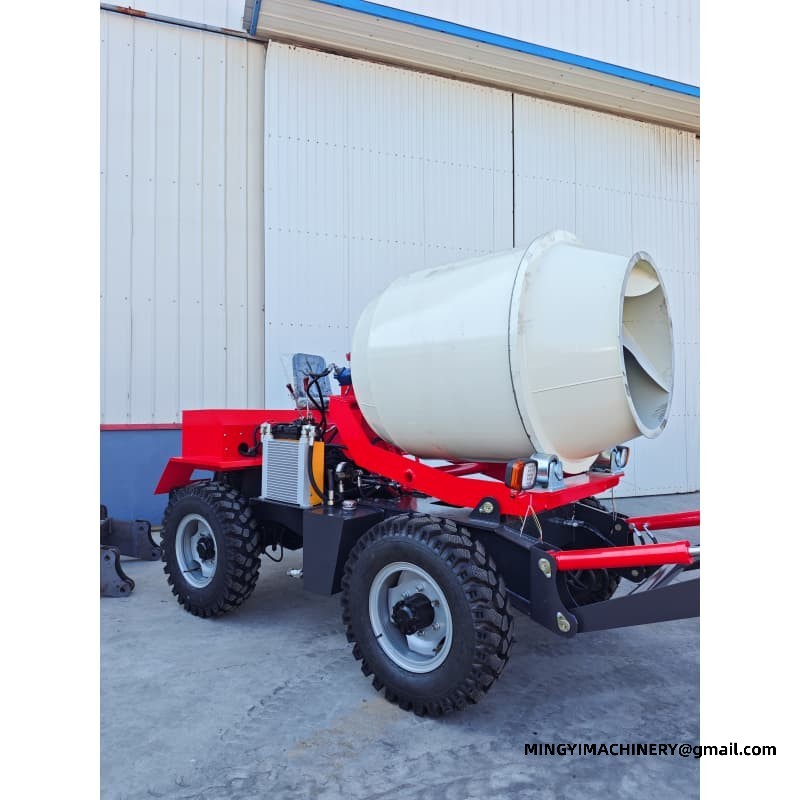
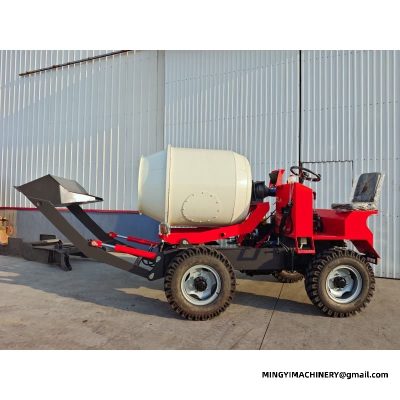
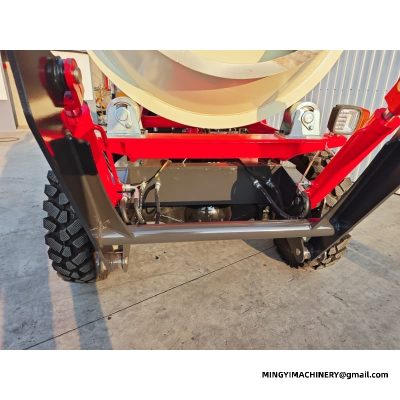
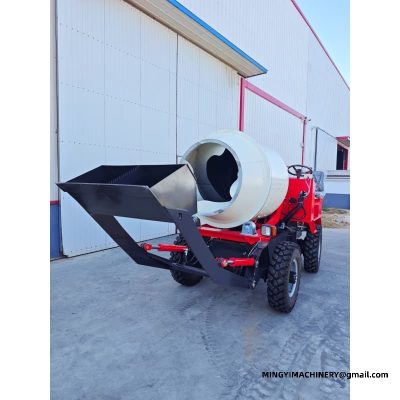
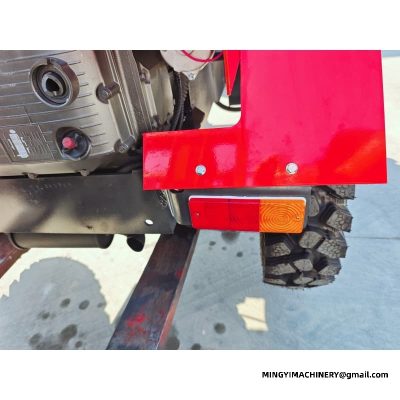
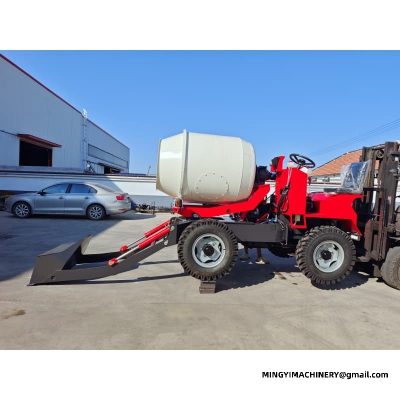
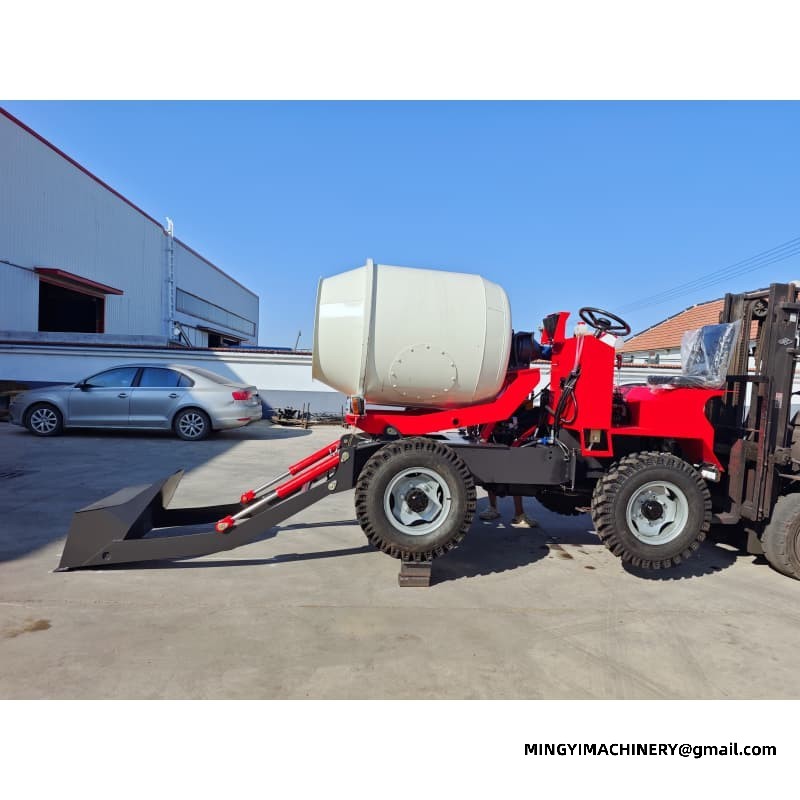
4WD Diesel Self Discharging Mixer, Auto Tilting 0.8m³ Drum, Hydraulic Discharge Truck
Buy the drum for the pour, the chassis for the ground. The two halves of a 4wd diesel self discharging mixer spec sheet answer different questions: 0.8 m³ and 1,500 kg describe what a batch is; the 4WD transmission, 204 mm of clearance and 28° of steering angle describe where that batch can travel. This page reads both halves in tunnel work.
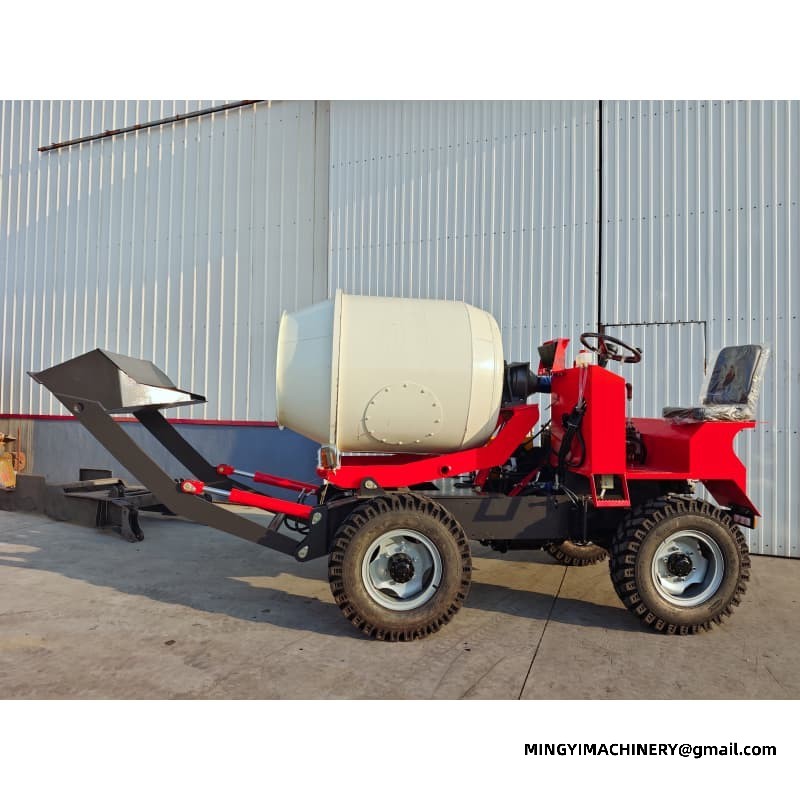
Against a hand-fed drum mixer, the comparison is labour: the self-loader replaces the shovel line that feeds the small mixer, and it moves the batch to the pour under its own power. One operator does what a barrow chain of four or five does, with fewer batches lost to delay.
The hand-fed mixer still wins where volumes are tiny and access is narrower than 1,600 mm — but that allowance is narrow, and it closes every time wages rise.
In tunnel work, the single-operator loop is the productivity claim that matters. The machine replaces the barrow chain, the hoist and the arguments about whose turn it is to mix, and it does so with the shovel and the drum doing what two labourers used to do.
One operator also means one accountable person for the wash-out, the fuel and the walk-round. Fleets that name the operator on the board each morning in tunnel work report fewer unexplained faults and fewer Friday-night short cuts.
Single-cylinder engines also teach their operators. The rhythm of a healthy 25 hp unit — exhaust note, vibration, smoke colour — tells an attentive operator more than a dashboard of warning lamps, and small deviations get fixed small.
Oil changes by the hour meter, not by the calendar — a machine that idles through wet weeks still accumulates hours on the oil. Operators who log the meter at each change in tunnel work never guess when the next one is due.
| Published build data — 0.8 m³ 4WD self-loading concrete mixer | |
|---|---|
| Rated load | 1,500 kg |
| Rated capacity | 0.8 m³ |
| Overall dimensions (L x W x H) | 3,500 x 1,600 x 2,200 mm |
| Front tyre size | 8.25-16 |
| Rear tyre size | 7.50-16 |
| Minimum ground clearance | 204 mm |
| Steering angle | 28° |
| Turning dimension (outer tyre) | 2,464 mm |
| Maximum travel speed | 24 km/h |
| Transmission | 4WD |
| Gears | 3 forward / 1 reverse + travel gear |
| Front axle | 130 drive axle |
| Rear axle | 212 selectable 4WD steering axle |
| Engine | single-cylinder diesel / 25 hp |
| Steering | hydraulic power steering |
Front tyres are 8.25-16, rears are 7.50-16 — agricultural-pattern tyres with a tread that grips soft ground and shrugs off stones. Combined with four-wheel drive they carry a full drum across ground that stops two-wheel-drive machines.
A loaded drum raises the centre of gravity, and every slope question follows from that. The machine handles site ramps and graded ground at crawl speed in low gear; it is not a slope specialist, and cross-slopes with a full drum deserve a slower, straighter line than empty running.
Stand the machine where the finishing crew already is, not where it would be convenient to park. A discharge point within barrow reach of the formwork is worth more than a flat, tidy spot fifty metres away, because the last metres are where hand-mixed batches lose their workability.
Mark the discharge point before the pour, not during it. A standing spot within barrow reach of the formwork is worth more than a tidy spot metres away, because the last metres are where batches lose their workability.
The drum's wear line is the inspection that predicts the machine's remaining economic life better than any other: a drum true to its blades and clean at the seam is a machine that has been loved, whatever its hours.
Engine hours are the honest odometer. A machine with records, steady hours and its original axles holds value strongly in the second-hand market, because the next owner can see what they are buying.
The 130 front drive axle and 212 rear steering axle are named because they are standard agricultural patterns, and that naming is part of the durability case. Bearings, seals, hubs and crown wheels for both exist wherever tractors are sold.
A line worth pausing on is the gear set — 3 forward, 1 reverse and a travel gear — because it tells you how the machine splits slow, strong work from the road run between sites. The travel gear is not for the load; it is for the empty road, and the distinction keeps the box alive.
A typical small outfit pairs the machine with two or three labourers — one on cement, one at the discharge with a barrow, one finishing. Three people and one machine outproduce a six-person hand-mixing line, and the comparison is the reason the machine exists in tunnel work.
The crew's skill matters more than its size. A crew that learns the recipe, the cycle and the wash-out keeps the machine busy; a crew that improvises keeps it stopped. The machine amplifies either habit.
The first week sets the machine's tone. Commission it properly — turn the engine by hand, prime the hydraulics, run the drum empty — then let a new operator feel the 28° steer and the 2,464 mm circle without a live load aboard.
Document the commissioning in the service book. The checklist protects the warranty and gives the next operator a known starting point, and the habit takes nothing the moment it is begun.
Measured water, counted scoops, timed drum, slow turns, low shovel in transit, wash-out before the break. Six habits cover nearly all of the machine's reliability and every one of its safety rules.
Write them on the machine, not in the office. The habits that survive are the ones the operator sees at the start of every shift.
Output is decided by the cycle, not the drum. Loading the shovel, mixing, travelling and discharging repeat, and the slowest of the four sets the rate. With 0.8 m³ per batch and a short haul, the drum rarely waits; with a long carry at 24 km/h, travel becomes the constraint and the arithmetic changes.
Honest sizing starts from the biggest continuous element in tunnel work. If that element needs more than the drum can supply, either batch with two machines or break the pour into planned bays. The 1,500 kg rating keeps the chassis within itself either way.
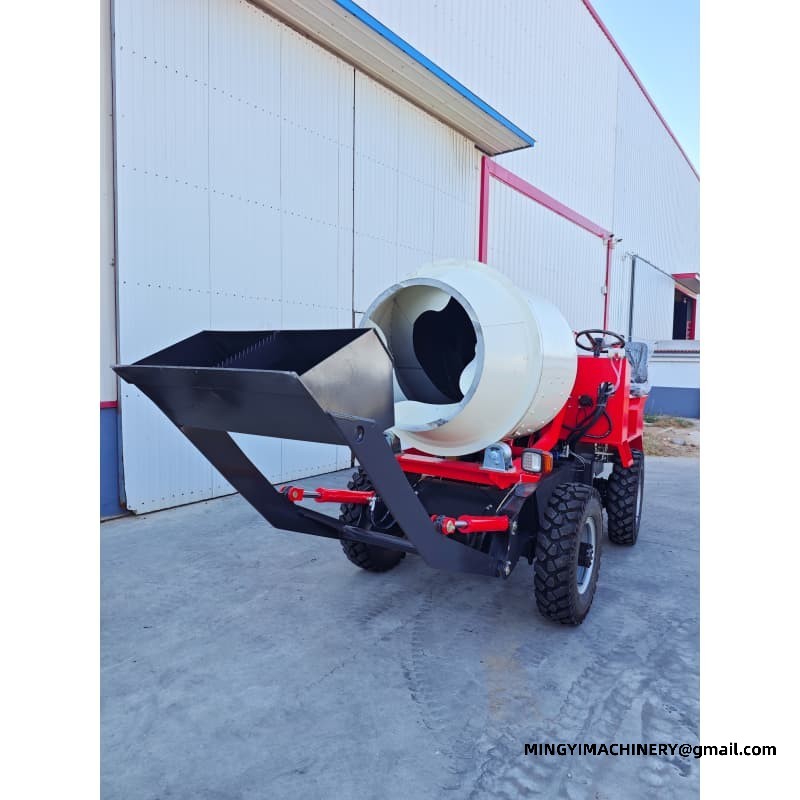
Tie it down at the chassis for transport, chock the wheels, and note that the shovel adds length when raised. The published envelope describes the machine in travel order; a few minutes of folding and lashing keeps it true.
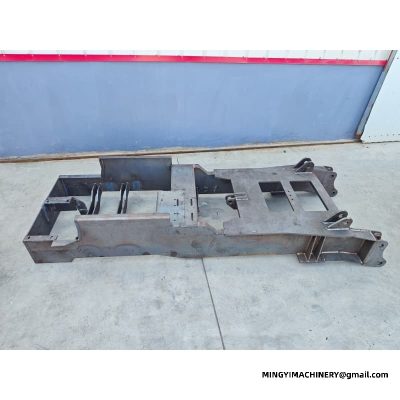
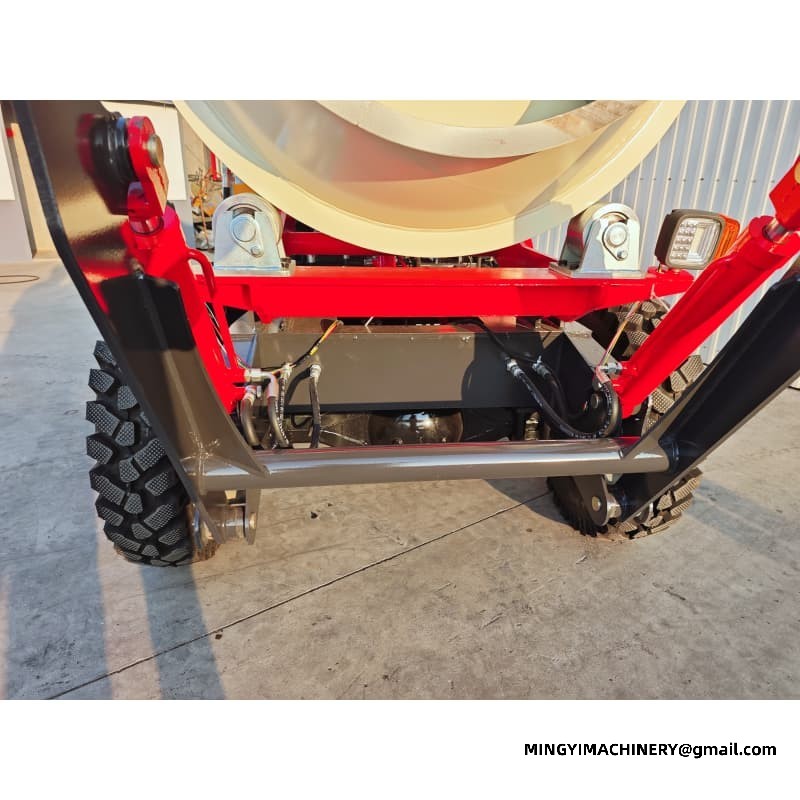
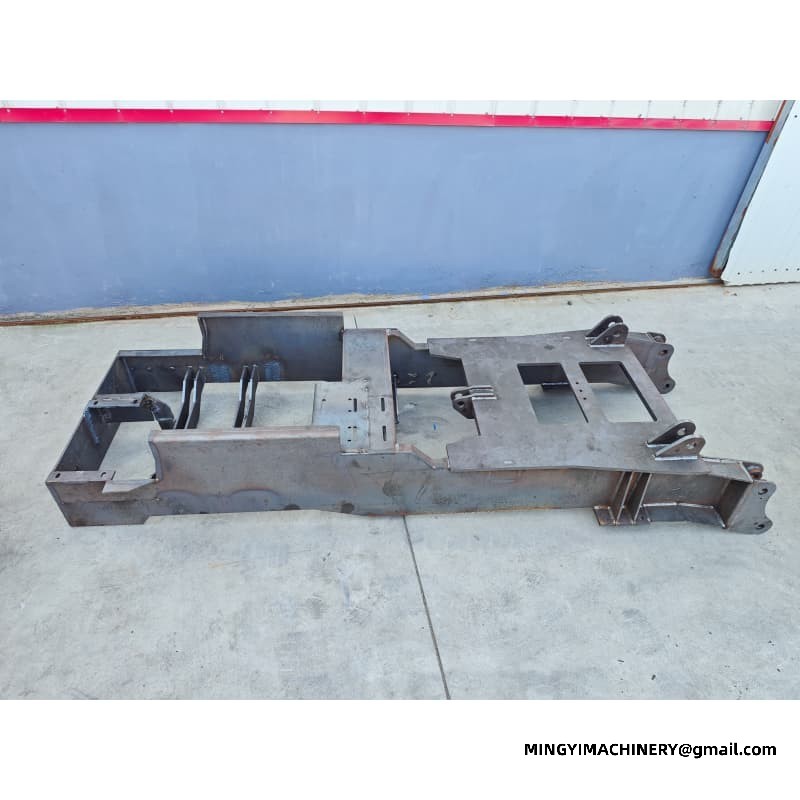
The frame carries 1,500 kg of payload over a short, wide stance, with the drum mounted low and between the axles rather than overhanging. That geometry is why a machine this size can carry wet concrete at all: the load stays inside the wheelbase where the chassis was drawn to take it.
The machine's natural work is the small structural pour — bases, posts, beams, ties — and the non-structural one beside it: paths, kerbs, patching, linings. Both consume 0.8 m³ per batch in quantities the drum and the crew handle naturally.
Lean foundation mixes and richer masonry mixes turn the same way and discharge the same way; the drum's job is uniformity, not chemistry. The recipe stays the engineer's, and the repetition stays the drum's.
At 3,500 x 1,600 x 2,200 mm the machine ships in a standard container without disassembly beyond lashing. On arrival: check the drum and shovel for transit damage, turn the engine by hand before first start, prime the hydraulic system, and run the drum empty before the first batch.
Order the spares kit against the parts manual's own numbers and file the correspondence with the manual. When the second order goes in a year later in tunnel work, the reference numbers make it a two-minute email.
How much ground clearance does the 4wd diesel self discharging mixer have?
204 mm under the axles. That clears ruts, rubble and standing water of that depth, and the low build is deliberate — it keeps the centre of gravity down under a raised drum.
What gears does the 4wd diesel self discharging mixer have?
Three forward, one reverse, plus a travel gear for road moves between sites. First and second cover loading and hauling in tunnel work.
How many labourers does a 4wd diesel self discharging mixer replace?
Commonly the two-to-four people of a hand-mixing and barrow chain, depending on the haul. The honest number comes from timing your own crew's cycle against the machine's.
Does a 4wd diesel self discharging mixer hold its value?
Well-kept machines resell quickly to small contractors. Hours and a service book carry more weight at resale than appearance.
Can a 4wd diesel self discharging mixer supply a full slab pour?
Only small slabs, and only with the pour broken into bays that match the drum's rhythm. Continuous large pours outrun 0.8 m³ per batch and belong to plant supply.
How should a 4wd diesel self discharging mixer be stored between jobs?
Washed, fueled, drum cracked to drain, battery tended, tyres off bare ground if the stand is long. The machine that is stored properly starts in tunnel work without a service call.
How much water should a 4wd diesel self discharging mixer batch take?
Whatever the mix design specifies — measured, not splashed. Extra water makes a stiff mix easy and weak; a marked container beside the controls solves most site water discipline.
When does a 4wd diesel self discharging mixer stop making sense?
Where ready-mix is close and pours are large, where access is narrower than the machine, or where work happens at height or reach no wheeled mixer can serve. Other tools win those.
A mixer that reaches the pour, mixes to a recipe and washes out on time is a mixer that earns for a decade. The habits in this page effort minutes a day; the machine they protect takes far more to neglect.
Pre-delivery inspection before the concrete mixer leaves the shop
Inspection is a list, not a glance. Before this class of machine is released the fluid levels, belt tension, electrical connections and safety decals are each ticked off, and anything that fails stays in the shop rather than travelling with the machine.
Hot, humid and dusty conditions around the unit in daily use
Dust is the enemy of every rotating joint. Keeping the radiator and the air intake of a machine of this size clean, and cleaning them before they are blocked rather than after, is what separates a machine that lasts from one that overheats.
Documents that travel with the equipment on site
A clear parts book saves more time than any other document. When the machine itself needs a replacement, the illustration and the part number are what turn a phone call into a shipment instead of a description.
Later additions and retrofits on the model in question
Retrofitting is limited by the base machine. Before anything is added to the machine in that duty the hydraulic flow, the mounting interface and the stability allowance have to be checked, because those limits are what decide what is sensible.
Keeping a service record for the unit on the job
Patterns show up in the record before they show up in the machine. Rising oil consumption or a filter that keeps blocking on a machine built for the work is obvious on paper long before it becomes a failure on site.
Fuel, oil and fluid quality for the equipment in service
The specification for oil is written for a reason. Using the grade and the change interval set for the concrete mixer keeps the engine and the hydraulic system inside the range they were designed for.
Contact MINGYI Machinery for the current self-loading concrete mixer specification, export packing and a formal specification for your market. E-mail: sales@mingycn.com | LINE (ID): mingyicn
4WD Diesel Tilting Drum Mixer: Rotation Both Ways · Single Operator 0.8m3 Concrete Mixer: The One-Person Loop · Articulated Dump Truck with hydraulic tipping body · Mini Self-Loading Concrete Mixer









