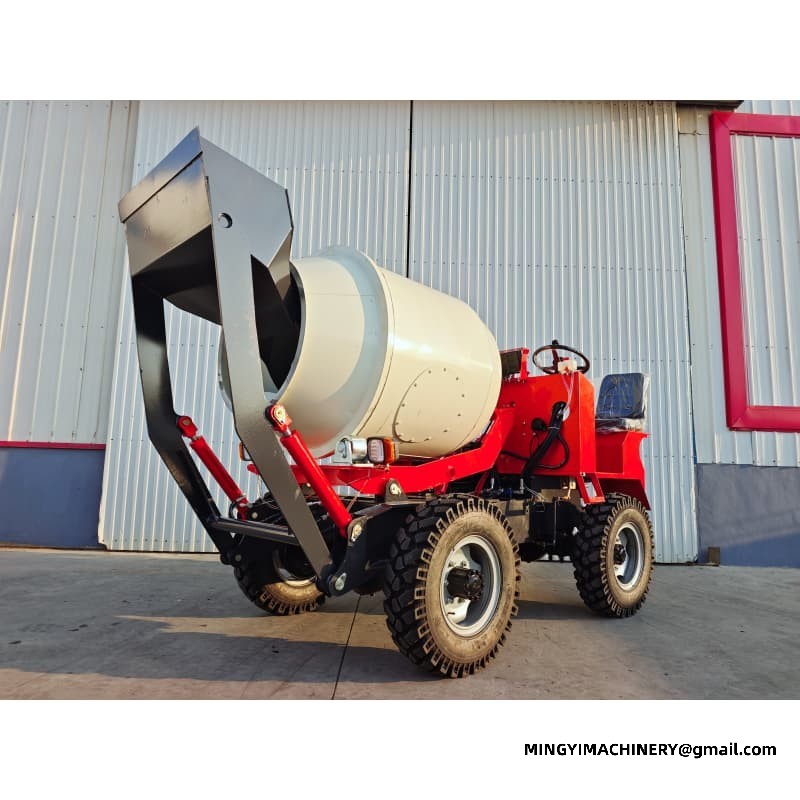
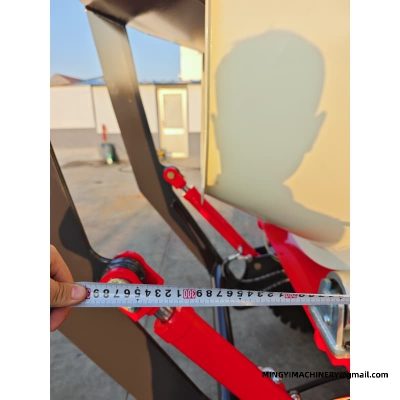
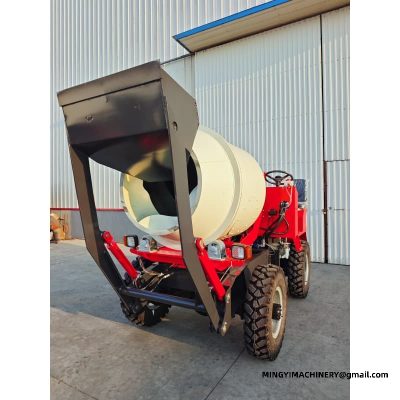
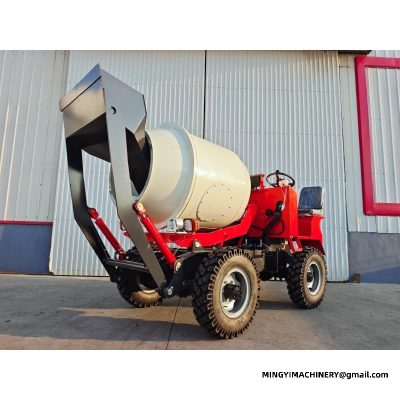
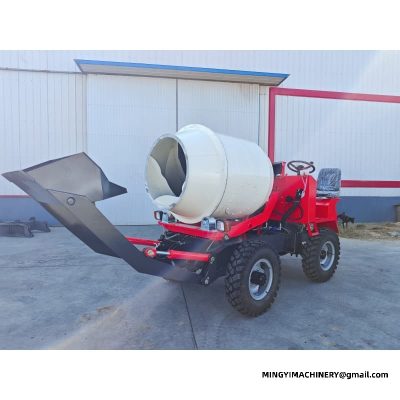
Single Operator 0.8m3 Concrete Mixer, One-Man 4WD Self Loader, Easy Control Truck
A self-loading mixer is bought for the distance between the aggregate pile and the pour. The 0.8 m³ drum, the 1,500 kg payload and the front shovel that feeds them answer one question — who mixes, and who carries? This page reads the published table as a single operator 0.8m3 concrete mixer buyer meets it on pole lines: capacity first, then the drive and steering that decide where the machine can actually stand.
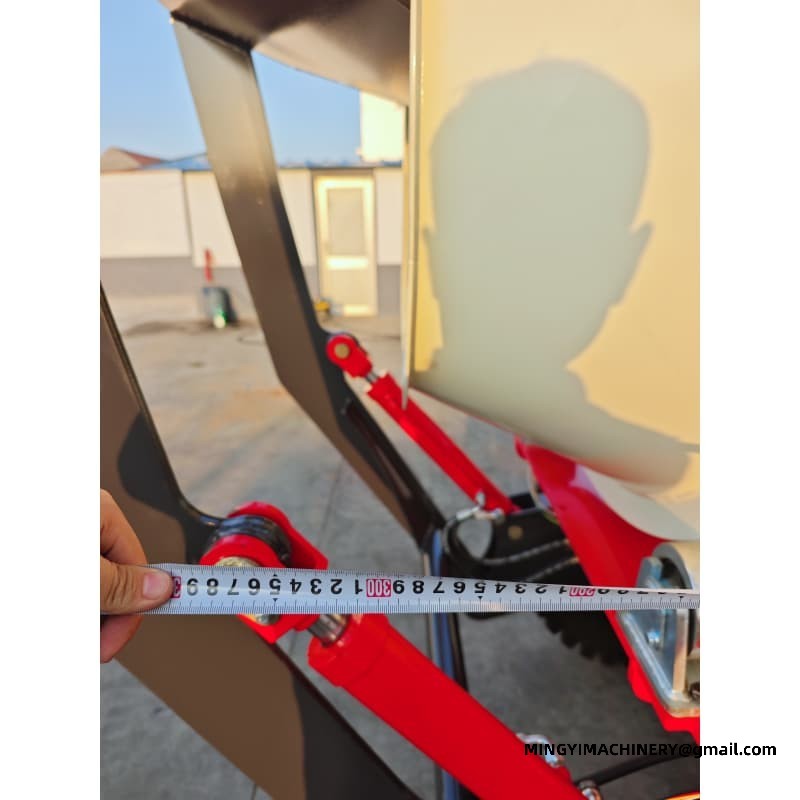
Measure the narrow gate before delivery on pole lines — width, height bar, and the turn immediately inside it. The 2,464 mm turning circle handles the inside turn; the measurement turns hope into a plan.
The steering angle is the narrow-site ally: with the rear axle steering through 28°, the machine pivots into gaps its wheelbase alone could not enter, and the operator learns to account for the tail swinging outward.
The open station is the machine's safety feature as much as its cab trade-off. Mirrors, a beacon and site lighting turn a fully visible operator into a fully visible machine, and on congested slabs that visibility is what prevents the near-misses closed cabs sometimes hide.
The caution is the same as for every small machine: extra structure changes the load case the 3,500 x 1,600 x 2,200 mm envelope was drawn for. A raised cab, a heavy counterweight or a wide attachment redistributes stress the chassis never agreed to carry, and the fault shows up later, elsewhere.
The drum wash-out belongs here too — it is listed in the drum section but it is a daily item, not a weekly one. A machine parked clean on pole lines is a machine that starts the next morning without arguments.
Photographs belong in the record too — a picture of a fresh hose chafe or a worn pin settles the later argument about when it appeared. Phones make the habit free; the claim it strengthens is not small.
| Reference specification — 0.8 m³ 4WD self-loading concrete mixer | |
|---|---|
| Rated load | 1,500 kg |
| Rated capacity | 0.8 m³ |
| Overall dimensions (L x W x H) | 3,500 x 1,600 x 2,200 mm |
| Front tyre size | 8.25-16 |
| Rear tyre size | 7.50-16 |
| Minimum ground clearance | 204 mm |
| Steering angle | 28° |
| Turning dimension (outer tyre) | 2,464 mm |
| Maximum travel speed | 24 km/h |
| Transmission | 4WD |
| Gears | 3 forward / 1 reverse + travel gear |
| Front axle | 130 drive axle |
| Rear axle | 212 selectable 4WD steering axle |
| Engine | single-cylinder diesel / 25 hp |
| Steering | hydraulic power steering |
The loop also teaches pace. A new operator charges; an experienced one settles into the rhythm the cycle actually allows, and by the second week the experienced operator is ahead — fewer spills, fewer re-batches, on pole lines, no injuries.
Honesty about the manual share keeps expectations right. Cement still goes in by bag, water by measure, and the discharge end may need a spotter with a barrow when the pour cannot take the drum's output directly.
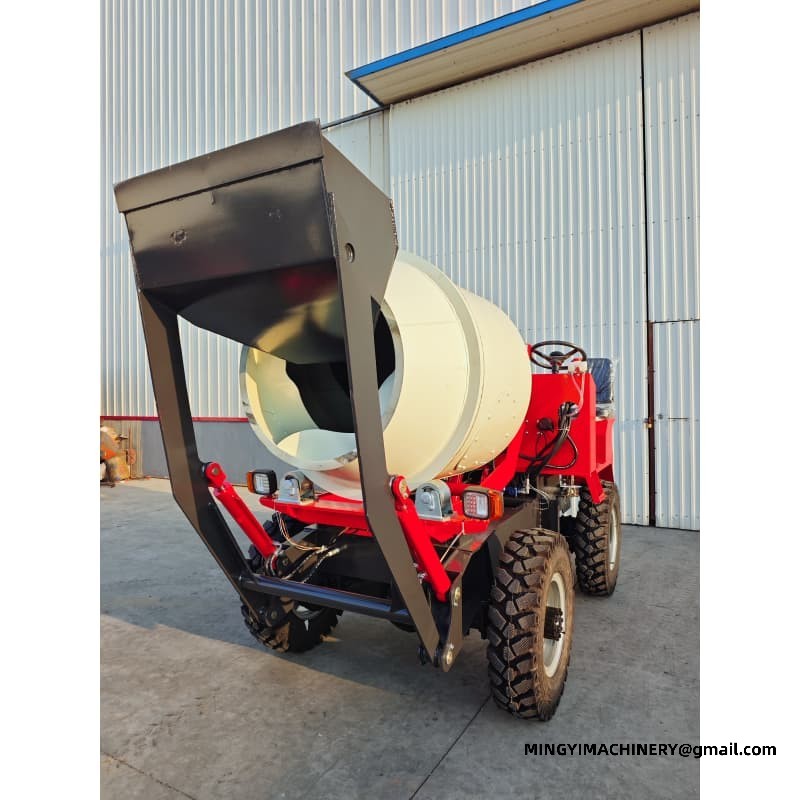
Four-wheel drive also changes how the machine fails — or rather, how rarely. Wheels that share the work share the wear, and a chassis that is never bogged is a chassis that never needs towing out of a pour on pole lines.
On pole lines, access decides everything, and a tight turning circle is the difference between driving to the pour and barrowing the last fifty metres. The 3,500 x 1,600 x 2,200 mm footprint was drawn around exactly those gateways.
Utilisation is the quiet number that decides payback. A machine used four hours a day beats an identical machine used one hour a day and parked the rest, and the difference is almost entirely waiting — for cement, for the finishers, for the next bay.
Where one machine cannot keep up, the answer is usually two at lower utilisation, not one pushed past its rhythm. Two machines serve two pours; one machine pushed past its cycle serves neither well and arrives at the next service early.
The design is deliberately conventional. Open-centre hydraulics of this pattern are understood by every agricultural mechanic, and hoses, seals and spool valves are stock items almost everywhere the machines are sold.
A spare suction hose and a couple of stocking joints in the spares box turn the most common cold-morning failure into a ten-minute fix. Hydraulics rarely fail without warning; they seep first, and the daily look catches the seep.
A typical small outfit pairs the machine with two or three labourers — one on cement, one at the discharge with a barrow, one finishing. Three people and one machine outproduce a six-person hand-mixing line, and the comparison is the reason the machine exists on pole lines.
For hire fleets, the machine is a starter asset: simple controls, one operator, a specification that fits on a single page and a resale market that is quick. The paperwork is as gentle as the machine — one service book, one engine pattern, one set of tyres to keep in stock.
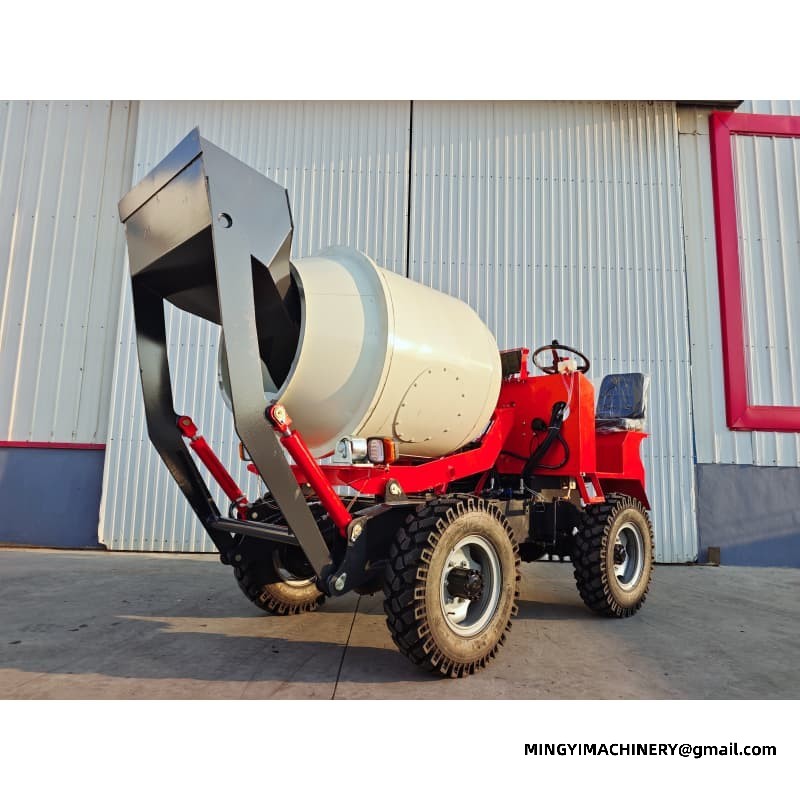
Rural road work, irrigation canals, farm buildings, village housing and small precast all sit inside that band. Each needs pole-setting concrete in quantities a plant would refuse and a shovel alone would take all day to supply.
Between those edges sits a wide country of work — on pole lines moving from hole to hole along the route — where the machine is simply the correct answer, and the crew that owns one plans around having it rather than around doing without it.
Keep the pairs matched left to right and the pressures even, because uneven fronts put the machine slightly out of square and the steering fights it all day. Tyres are the simplest component to treat well and the most lengthy to ignore.
Valve extenders on the rear axles make pressure checks a standing job instead of a kneeling one, and the crews who fit them check more often. The best maintenance habit is the one made convenient.
A single-cylinder diesel of this size burns a few litres an hour, runs on the same diesel as everything else on site, and services with filters and oil a general mechanic stocks. None of that is glamorous; all of it matters on pole lines, where the nearest dealer is a day away.
Fuel quality is the one consumable worth policing. Dirty or wet diesel is the single biggest cause of injector trouble in engines of this pattern, and a simple water separator in the fuel line is simpler than one injector on pole lines.
The first week sets the machine's tone. Commission it properly — turn the engine by hand, prime the hydraulics, run the drum empty — then let a new operator feel the 28° steer and the 2,464 mm circle without a live load aboard.
Commission the machine properly and write it down. The checklist protects the warranty and gives the next operator a known starting point, and the habit takes nothing the moment it begins.
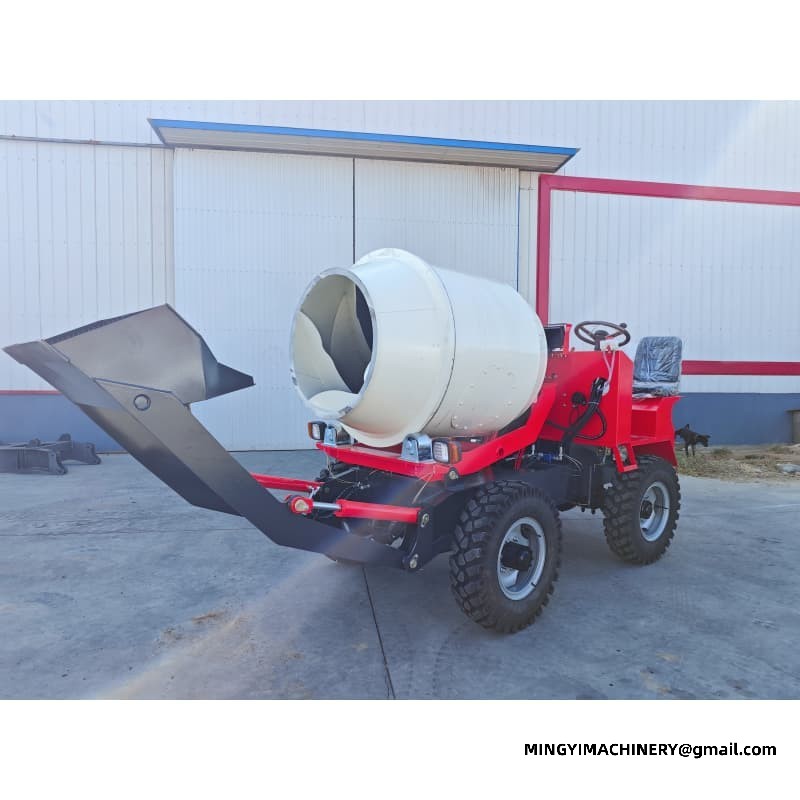
Against a hand-fed drum mixer, the comparison is labour: the self-loader replaces the shovel line that feeds the small mixer, and it moves the batch to the pour under its own power. One operator does what a barrow chain of four or five does, with fewer batches lost to delay.
The honest case for the hand mixer survives only at the very smallest scale — a two-man job, one batch an hour, concrete within barrow reach. One step past that, the self-loader's arithmetic takes over and does not give it back.
On sites that move the pile daily, a plate or a spreader keeps the loading face flat, and the shovel thanks you for it. Flat faces give full scoops; full scoops give predictable batches and a drum that reaches 0.8 m³ without a second bite.
The shovel is sized for this class of machine. It handles sand, gravel and coarse aggregate freely, and it will lift bagged cement if the crew breaks bags in first. It is not a demolition tool, and forcing it into compacted or oversized material shortens a working day quickly.
What axles does the single operator 0.8m3 concrete mixer run?
A 130 drive axle at the front and a 212 rear axle that steers and can be selected into four-wheel drive. The front pulls the load; the rear steers through a 28° angle.
Can the single operator 0.8m3 concrete mixer do canal lining work?
Yes. It runs along the towpath inside a 2,464 mm turning circle, batching lining concrete as it goes from section to section.
Is the single operator 0.8m3 concrete mixer fuel-hungry?
No. A 25 hp diesel works in short heavy efforts and loafs between them, which is where its economy comes from. Idle time, not work, wastes its fuel.
What gradient can the single operator 0.8m3 concrete mixer handle loaded?
Site ramps and graded ground in low gear. There is no published gradeability figure, so treat sustained loaded climbs as a test question for the supplier, not an assumption.
What records should a single operator 0.8m3 concrete mixer keep?
Service receipts, engine hours and a small logbook for handovers. The record doubles as the service history the resale market pays for.
How do you keep batches consistent in a single operator 0.8m3 concrete mixer?
A fixed recipe: the same scoop count, the same measured water, the same mixing time. The machine repeats whatever routine it is given, on pole lines included.
Can a single operator 0.8m3 concrete mixer replace ready-mix concrete?
For small, repeated pours beyond a plant's economical radius, yes — batching on site avoids minimum-load charges and part-load waste. Large continuous pours still belong to ready-mix.
Does the single operator 0.8m3 concrete mixer really load itself?
Yes. A front shovel scoops aggregate and sand from the stockpile and lifts it into the drum — no separate loader and no barrow chain. One operator runs load, mix, travel and discharge.
Worked on pole lines, the machine pays for itself in the batches it keeps on schedule and the crews it frees from barrow chains. The specification above is the whole story — short, honest and enough to size the decision.
Handover and getting familiar with Single Operator 0.8m3 Concrete Mixer: The One-Person Loop
Operators who come from a different machine need a short conversion. The controls on Single Operator 0.8m3 Concrete Mixer: The One-Person Loop follow the usual pattern, but the response, the sightlines and the stopping distance are learned by doing rather than by reading.
Cold weather and winter care for Single Operator 0.8m3 Concrete Mixer: The One-Person Loop
Cold exposes weak batteries, thick oil and water in the fuel. Preparing Single Operator 0.8m3 Concrete Mixer: The One-Person Loop for winter means the right grade of oil, a battery in good condition and fuel that will not wax in the tank overnight.
Commissioning Single Operator 0.8m3 Concrete Mixer: The One-Person Loop on site
Transport shakes things loose. A short check of Single Operator 0.8m3 Concrete Mixer: The One-Person Loop after the crate is opened, covering the same points the pre-delivery inspection covered, is the most useful insurance available on delivery day.
Wear items and spares worth holding for Single Operator 0.8m3 Concrete Mixer: The One-Person Loop
Wear items are predictable once the machine has settled in. After the first service interval the pattern on Single Operator 0.8m3 Concrete Mixer: The One-Person Loop is visible, and the parts that were replaced become the parts that are kept.
Planning the season around Single Operator 0.8m3 Concrete Mixer: The One-Person Loop
Downtime is simplest when it is planned. Booking the service for Single Operator 0.8m3 Concrete Mixer: The One-Person Loop in the quiet part of the season takes nothing from the schedule, while the same work in the busy weeks gives up a day of output every time.
Contact MINGYI Machinery for the current self-loading concrete mixer specification, export packing and a formal specification for your market. E-mail: sales@mingycn.com | LINE (ID): mingyicn
Mini Self Loading Concrete Mixer: The 0.8 m³ 4WD Machine · Small Self Loading Concrete Mixer: Drum, Shovel and Drive · All Terrain Transport Vehicle with hydraulic tipping body - export packing and shipping · Mini Self-Loading Concrete Mixer









