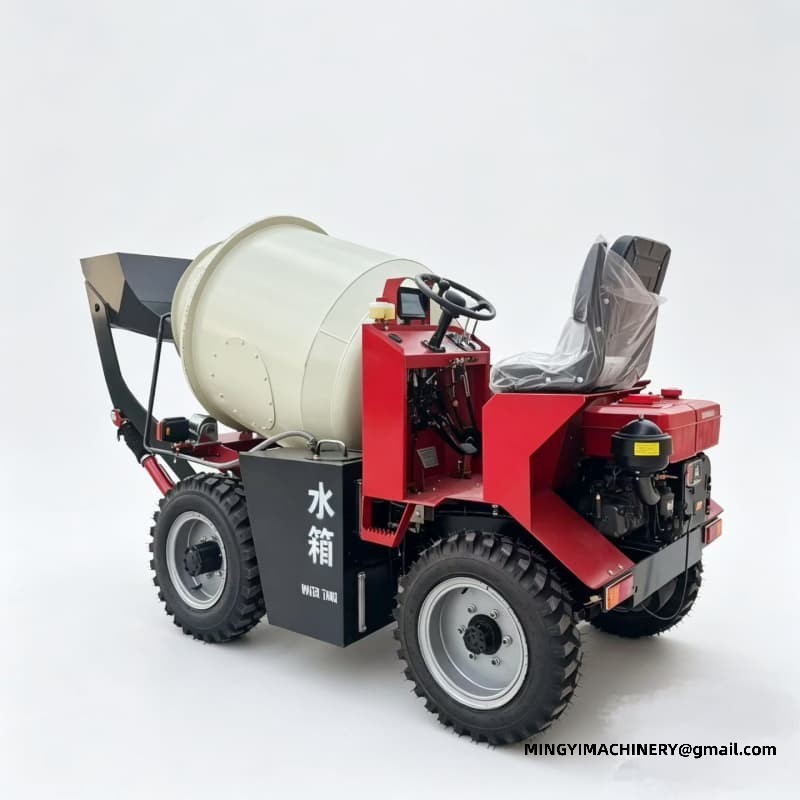
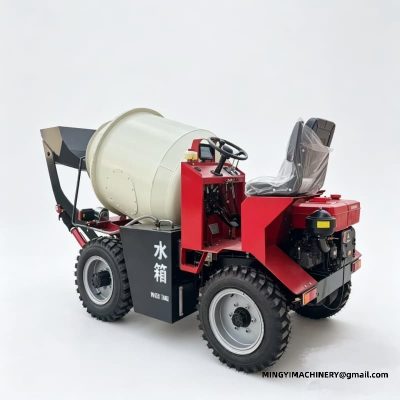
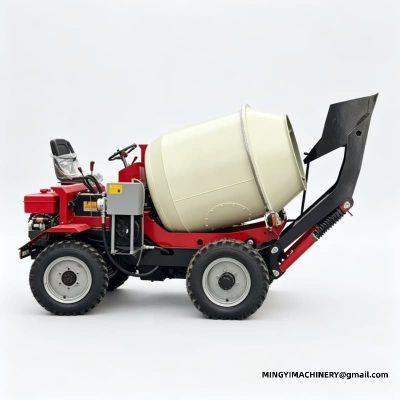
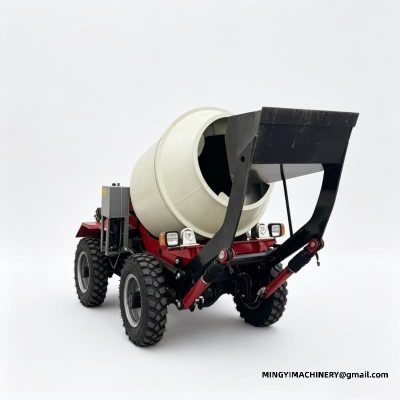
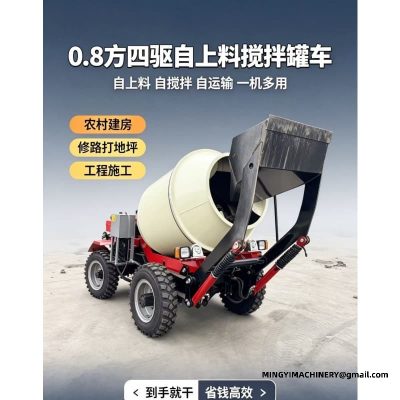
A self-loading mixer is bought for the distance between the aggregate pile and the pour. The 0.8 m³ drum, the 1,500 kg payload and the front shovel that feeds them answer one question — who mixes, and who carries? This page reads the published table as a mini self loading concrete mixer buyer meets it on a building site: capacity first, then the drive and steering that decide where the machine can actually stand.
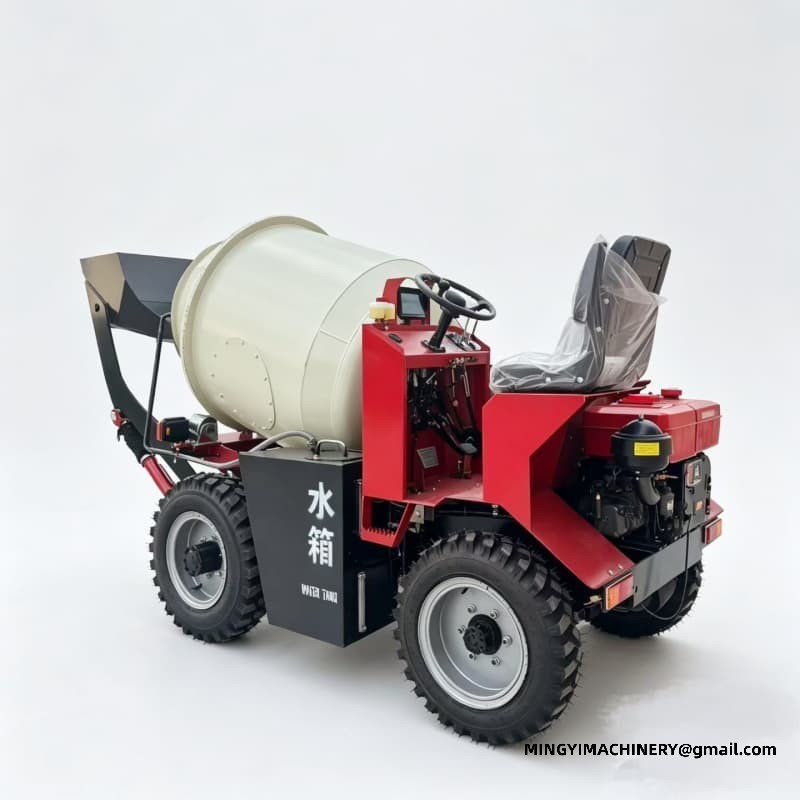
Ready-mix is the simpler source per cubic metre when a plant is close and the pour is large. Beyond that radius, minimum-load charges, queue time and the stiffening in the drum flip the arithmetic, and batching on a building site from stockpiled aggregate wins.
The machine sits squarely in that second case. Small, repeated pours, distant supply, awkward access — work where a transit mixer either refuses the job or charges for the wasted capacity of a part-load.
Confirm the specification in writing against the published table: 0.8 m³ capacity, 1,500 kg rated load, 4WD transmission, 25 hp single-cylinder diesel, the 130 front axle and 212 rear steering axle, and hydraulic power steering. Ask what is standard and what is optional in the build you are buying.
Ask for photographs of the actual unit and its serial plate, not brochure images. The machine is simple enough that a five-minute video call at handover — controls, drum, shovel, axles — answers more than a week of messages.
A transit mixer delivers volume from a plant; this machine delivers independence from a plant. For large continuous pours the transit wins outright. For small pours beyond the plant's radius — on a building site feeding foundations one hopper at a time — the transit's minimum charges and queue time make it the dearer option.
Many fleets run both: transit for the big slabs near town, self-loader for the long tail of small work everywhere else. The two machines rarely compete for the same batch.
| Reference specification — 0.8 m³ 4WD self-loading concrete mixer | |
|---|---|
| Rated load | 1,500 kg |
| Rated capacity | 0.8 m³ |
| Overall dimensions (L x W x H) | 3,500 x 1,600 x 2,200 mm |
| Front tyre size | 8.25-16 |
| Rear tyre size | 7.50-16 |
| Minimum ground clearance | 204 mm |
| Steering angle | 28° |
| Turning dimension (outer tyre) | 2,464 mm |
| Maximum travel speed | 24 km/h |
| Transmission | 4WD |
| Gears | 3 forward / 1 reverse + travel gear |
| Front axle | 130 drive axle |
| Rear axle | 212 selectable 4WD steering axle |
| Engine | single-cylinder diesel / 25 hp |
| Steering | hydraulic power steering |
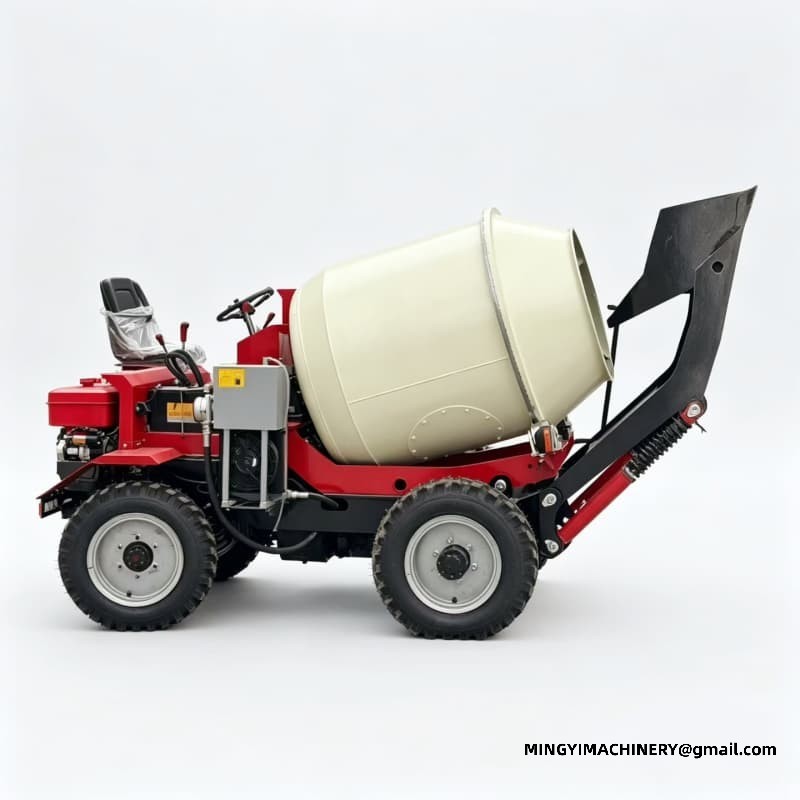
Power comes from a single-cylinder diesel rated at 25 hp. It drives the transmission, the drum and the hydraulics, and it does so with the mechanical directness that makes small site machines easy to keep alive: no electronics to fail, no dealership lock-out, one cylinder to know by heart.
25 hp is modest by highway standards and exactly right for this duty. The machine's work is short, heavy efforts — loading, climbing, tipping — and a small diesel spends most of its day loafing between them, which is where fuel economy and engine life both come from.
The break-even between owning and hiring is the number of batch-days, not the specification tag. A contractor with steady small-pour work crosses it in weeks; a contractor with one trench a month never does. The machine suits the first profile and politely declines the second.
Hire saves the capital and the storage; ownership saves the weekly rate and the waiting. For the user whose on a building site feeding foundations one hopper at a time recurs, the owned machine is usually the simpler one by the second season.
Drive goes to all four wheels — four-wheel drive through a 130 front drive axle, with the 212 rear axle selectable for four-wheel-drive steering. On firm ground two driven wheels would do, but site concrete rarely sits on firm ground. Wet spoil, sand, loose fill and grass all reward traction at every corner, which is what the 4WD transmission buys.
On a building site, the difference shows on the first wet morning. A two-wheel-drive machine spins and needs towing; this one keeps moving under its own traction with a full 1,500 kg in the drum circuit. Traction is capacity — a mixer that cannot reach the pour has none.
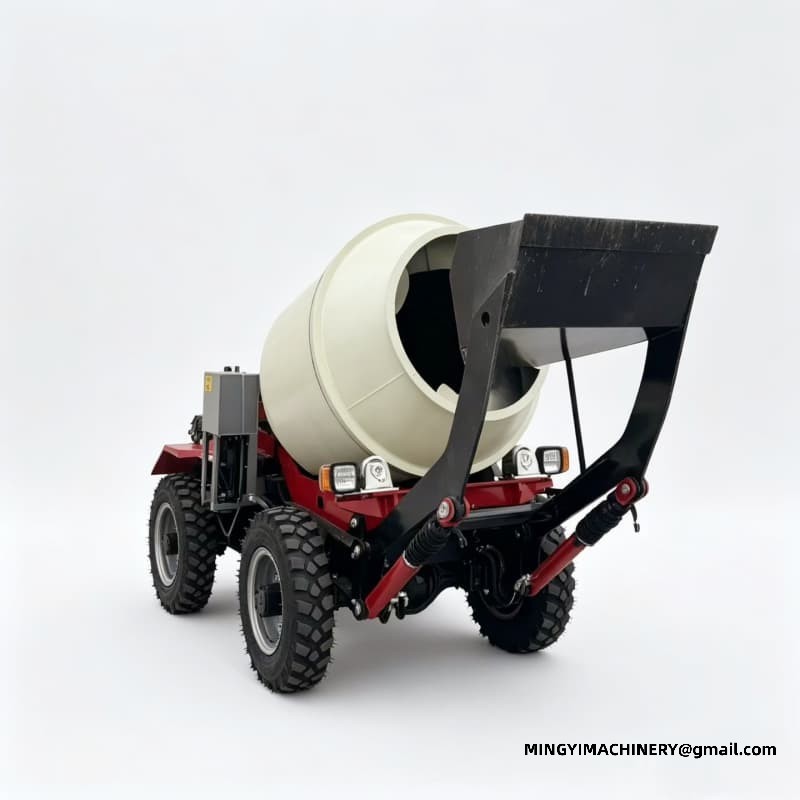
204 mm of clearance under the axles is the machine's ground rule. It clears ruts, rubble and standing water of that depth, and it does not clear more. The low build is what keeps the centre of gravity down under a raised drum, so the number is a design trade, not a deficiency.
Read the ground before the first trip of the day on a building site. A route that crossed easily yesterday may have a new trench, a spoil heap or a flooded patch overnight, and 204 mm gives the operator a plain number to judge it against.
A specification is a contract before it is a sales document, and this one is short enough to read in a minute. The first cluster — 0.8 m³ capacity, 1,500 kg rated load, the 3,500 x 1,600 x 2,200 mm envelope — describes what a batch is and where the machine can stand. The second — 4WD, the 130 and 212 axles, 204 mm clearance — describes whether it can reach the pour.
Read the two clusters against your site, not against the brochure. The figure that decides the sale is usually the smallest one: turning circle, clearance or width, whichever your worst gateway on a building site happens to be. The big numbers sell the machine; the small ones qualify it.
The machine earns its place wherever concrete is needed in small, repeated batches away from a batching plant: on a building site feeding foundations one hopper at a time. The common thread is distance — too far from the plant for ready-mix to be economical, too continuous for hand mixing.
Rural road work, irrigation canals, farm buildings, village housing and small precast all sit inside that band. Each needs foundation and plinth concrete in quantities a plant would refuse and a shovel alone would take all day to supply.
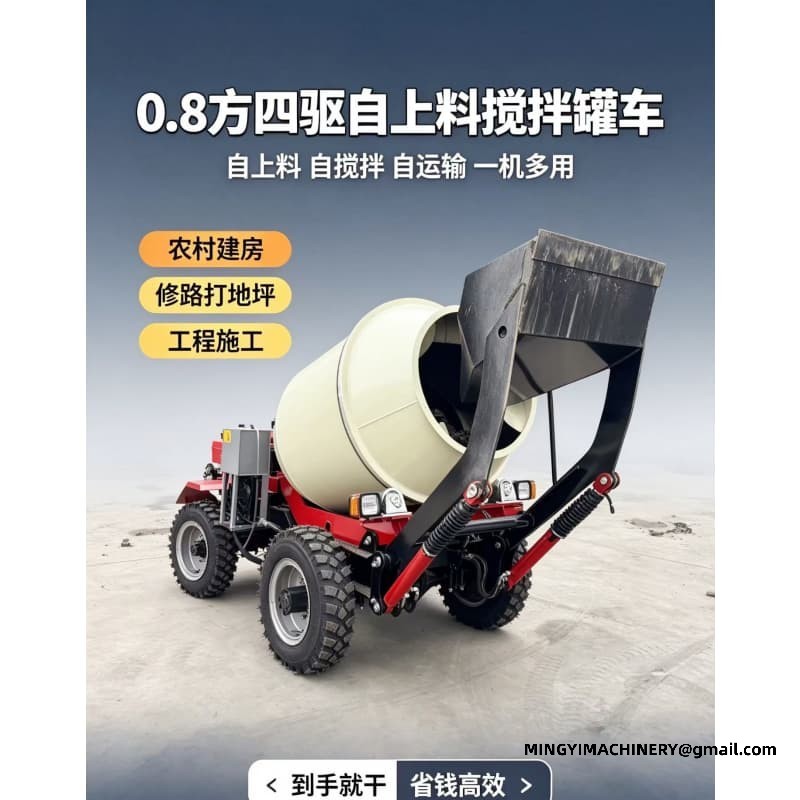
The gearbox gives three forward gears, one reverse and a separate travel gear, with a top speed of 24 km/h. On site the machine lives in first and second; the travel gear exists to move between jobs on a road without holding up traffic.
24 km/h is not fast and should not be. The machine carries 1,500 kg of wet concrete high on a short wheelbase, and the gearing keeps those loads sedate. Crews that respect the speed keep the concrete in the drum and the machine on its wheels.
The drum delivers 0.8 m³ at a rhythm, so the pour plan should be drawn in drum-sized bays: place, finish, move, repeat. Crews that lay out formwork to the machine's cycle pour all day without cold joints; crews that fight the rhythm chase stiffening edges by noon.
The arithmetic is simple enough for a whiteboard — batches per bay, cycles per hour, and the standing spot for each. Ten minutes of planning on a building site buys a full day of continuous placement.
Wet concrete moves. Cornering hard, braking sharply or crossing a slope swings 0.8 m³ of liquid load to one side, and the machine's stability depends on the operator not inviting that. The low drum mount and the wide stance help; the operator's right foot finishes the job.
The rules are short: slow through turns, gentle on the stops, drum level in transit and nobody riding on a machine built for one. Every accident report on mixers of this class starts with one of those rules broken.
How do you clean the mini self loading concrete mixer drum?
Rinse and spin the drum with clean water after the last pour of the day, dump the wash-out away from the stockpile, and leave the blades clean. A drum washed daily keeps its full 0.8 m³.
A mini self loading concrete mixer hydraulic hose burst mid-pour — what now?
Contain the spill, replace with the correct rating, and refill with clean filtered oil. This is exactly why hoses and clamps belong in the spares kit that travels with the machine.
What hydraulic oil does the mini self loading concrete mixer take?
The grade specified in the manual, kept clean and changed by the hour meter. Wipe every filler cap before opening it — dust, not hours, kills most site hydraulics.
How is a mini self loading concrete mixer delivered and commissioned?
Containerised delivery, then a short commissioning: turn the engine by hand before first start, prime the hydraulics, and run the drum empty before the first batch.
Are mini self loading concrete mixer parts available in my country?
The engine and axle pattern uses parts stocked wherever single-cylinder agricultural machinery sells, and the supplier supports the machine-specific items — drum blades, shovel pins, hydraulic parts — by shipment.
How many mini self loading concrete mixer machines fit in a container?
That depends on the container and the packing format, so confirm the loading plan at specification. The 3,500 x 1,600 x 2,200 mm envelope is what makes the packing conversation easy.
mini self loading concrete mixer or a small hand-fed drum mixer?
The self-loader replaces the shovel line feeding a hand mixer and hauls the batch to the pour under its own power — one operator does the work of a barrow chain.
How heavy is the mini self loading concrete mixer?
The published table specifications 1,500 kg of rated load and the overall envelope; for the transport weight of your specific build, ask the supplier for the shipping specification in writing.
Worked on a building site, the machine pays for itself in the batches it keeps on schedule and the crews it frees from barrow chains. The specification above is the whole story — short, honest and enough to size the decision.
Documents that travel with the concrete mixer
The machine is only half of what arrives. The parts book, the service schedule and the declarations that come with this class of machine are what let the owner register, insure and maintain it without a second round of emails.
Pre-delivery inspection before the unit in daily use leaves the shop
A machine should be inspected while it is still on our floor rather than after it lands. For a machine of this size that means the engine is run to temperature, the hydraulics are cycled through full travel, and every function is checked against the build sheet before the crate is closed.
Later additions and retrofits on the equipment on site
Later changes are easier when they were anticipated. Asking for the extra hydraulic circuit or the heavier mounting plate on the machine itself at build time adds little and leaves the option open.
Commissioning the model in question on site
The machine should be introduced to the site as well as the operator. Walking the route the machine in that duty will take, noting the soft spots and the turns, prevents the kind of first-day incident that has nothing to do with the machine.
Wear items and spares worth holding for the unit on the job
A spares list should follow the duty cycle. A machine built for the work working every day in abrasive dust consumes filters and cutting edges far faster than the same machine used once a week, and the shelf should be stocked for the harder case.
Cold weather and winter care for the equipment in service
A cold start is easier when the machine is prepared the night before. The routine that keeps the concrete mixer working through winter is mostly a matter of fuel, battery and patience in the first ten minutes of the day.
Contact MINGYI Machinery for the current self-loading concrete mixer specification, export packing and a formal specification for your market. E-mail: sales@mingycn.com | LINE (ID): mingyicn
Small Self Loading Concrete Mixer: Drum, Shovel and Drive · Diesel Self Loading Concrete Mixer: 25 hp Single Cylinder · small 4x4 water transport vehicle for mining and quarry work · Mini Self-Loading Concrete Mixer









