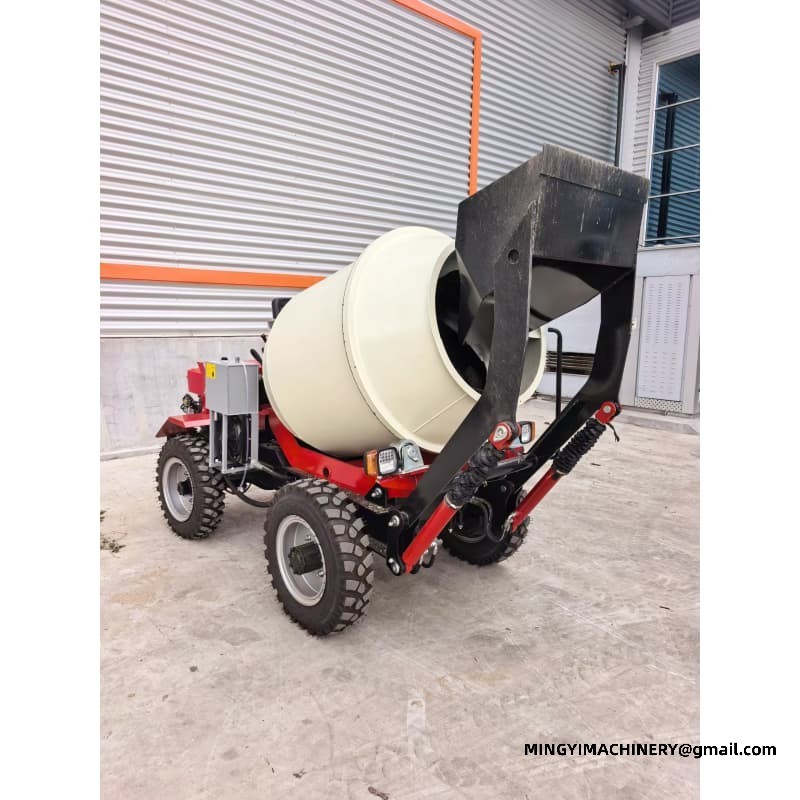
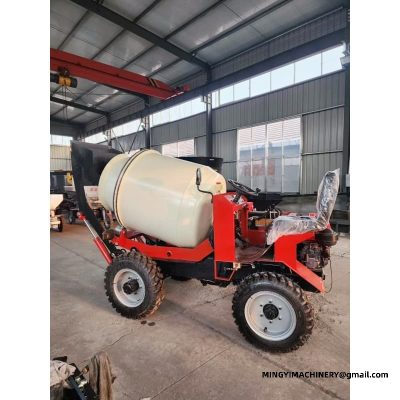
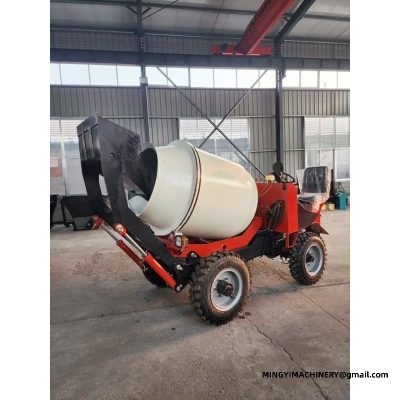
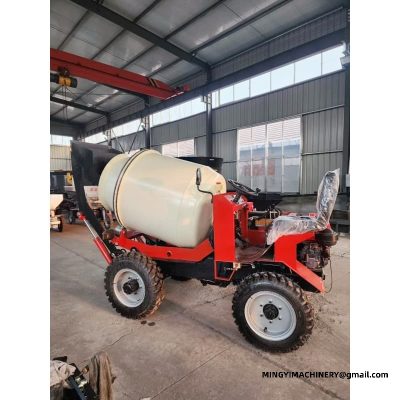
Concrete waits for nobody, and distance kills it. The diesel self loading concrete mixer self-loading mixer exists for pours that happen too far from a batching plant for ready-mix to answer — on rural road work pouring culverts and kerbs between villages. At 0.8 m³ per batch and 24 km/h of travel speed, the machine keeps the supply chain inside the site gate, and this page explains the published figures that make that work.
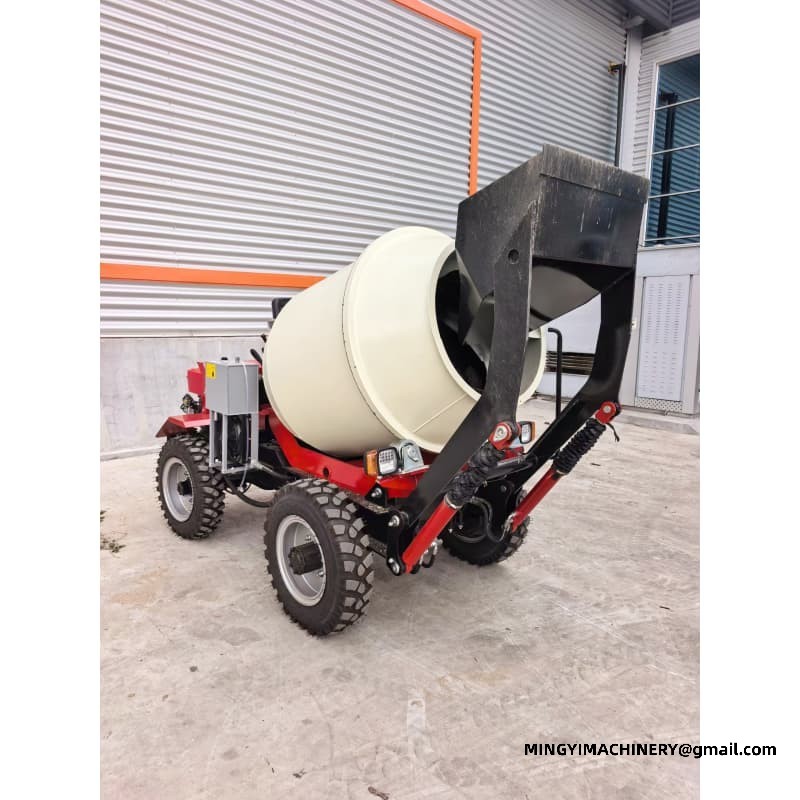
Load, mix, drive, discharge, return — one person runs the entire loop, and the controls are arranged so the sequence needs no second pair of hands. On small crews that is not a luxury; it is the difference between pouring today and waiting for a bigger gang.
On rural road work, the single-operator loop is the productivity claim that matters. The machine replaces the barrow chain, the hoist and the arguments about whose turn it is to mix, and it does so with the shovel and the drum doing what two labourers used to do.
3,500 x 1,600 x 2,200 mm is the whole machine: short enough for a site trailer, narrow enough for a garden gate, low enough for a container without a top-loader's paperwork. Every one of those three numbers earns its place somewhere on rural road work.
The height figure hides a detail worth checking on hire fleets and after modifications: the envelope assumes the shovel down and the drum level. A raised shovel adds materially to the length, and crews loading onto trailers should measure in travel order.
Inside the drum, rotation does the mixing; reversed rotation with the drum tipped does the discharging. The geometry is old and proven, and on a machine with hydraulic control the operator sets drum angle and speed from the seat without leaving the cab position.
Because rotation and tilt are hydraulic, the operator can hold a partial discharge — trickle into a barrow, stop, move, resume — which no hand-cranked drum offers. That control is worth as much as the 0.8 m³ itself on pours with fussy geometry.
| Specification extract — 0.8 m³ 4WD self-loading concrete mixer | |
|---|---|
| Rated load | 1,500 kg |
| Rated capacity | 0.8 m³ |
| Overall dimensions (L x W x H) | 3,500 x 1,600 x 2,200 mm |
| Front tyre size | 8.25-16 |
| Rear tyre size | 7.50-16 |
| Minimum ground clearance | 204 mm |
| Steering angle | 28° |
| Turning dimension (outer tyre) | 2,464 mm |
| Maximum travel speed | 24 km/h |
| Transmission | 4WD |
| Gears | 3 forward / 1 reverse + travel gear |
| Front axle | 130 drive axle |
| Rear axle | 212 selectable 4WD steering axle |
| Engine | single-cylinder diesel / 25 hp |
| Steering | hydraulic power steering |
The break-even between owning and hiring is the number of batch-days, not the specification tag. A contractor with steady small-pour work crosses it in weeks; a contractor with one trench a month never does. The machine suits the first profile and politely declines the second.
plan the inputs with the machine, not after it. A drum that sits idle because the cement ran out is a drum that takes money while earning none, and the discipline of stocking ahead is part of owning well.
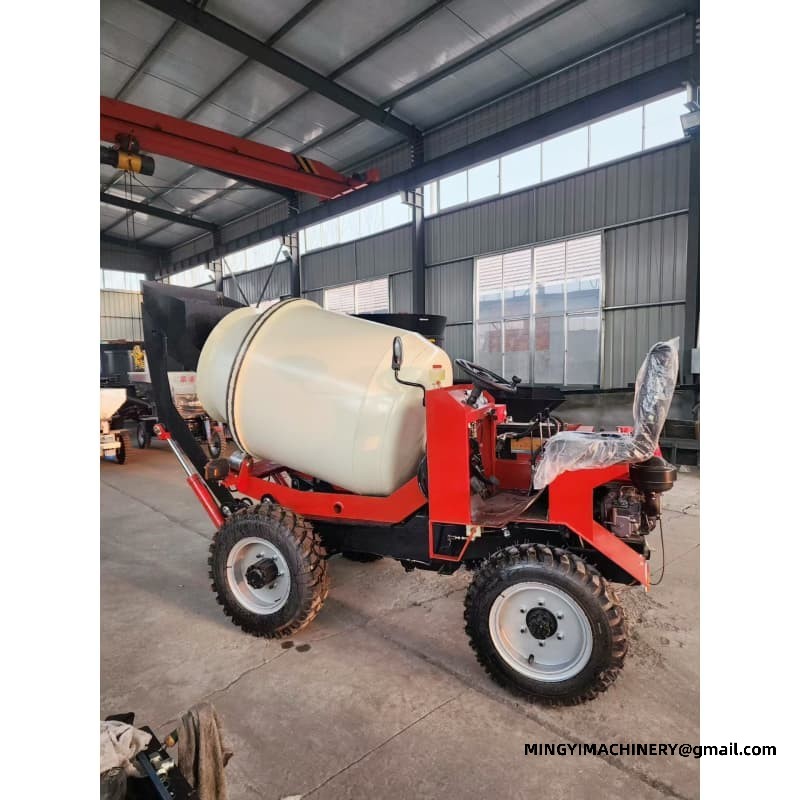
The hydraulic circuit drives the power steering, the drum rotation and the shovel hydraulics from one pump off the single-cylinder diesel. Three consumers, one source — which is why the engine's health and the oil's cleanliness are the same subject on this machine.
The design is deliberately conventional. Open-centre hydraulics of this pattern are understood by every agricultural mechanic, and hoses, seals and spool valves are stock items almost everywhere the machines are sold.
Wet concrete moves. Cornering hard, braking sharply or crossing a slope swings 0.8 m³ of liquid load to one side, and the machine's stability depends on the operator not inviting that. The low drum mount and the wide stance help; the operator's right foot finishes the job.
A lifting shovel commands a exclusion zone whether or not the site paints one. Nobody stands within the shovel's arc; nobody rides a load; nobody walks under a raised bucket — even briefly, even empty.
The drum delivers 0.8 m³ at a rhythm, so the pour plan should be drawn in drum-sized bays: place, finish, move, repeat. Crews that lay out formwork to the machine's cycle pour all day without cold joints; crews that fight the rhythm chase stiffening edges by noon.
Where a site has many small elements — bases, posts, patches — the machine's flexibility shines: mix for the first, place, then travel to the second without waiting on anyone's schedule but the drum's.
The gearbox gives three forward gears, one reverse and a separate travel gear, with a top speed of 24 km/h. On site the machine lives in first and second; the travel gear exists to move between jobs on a road without holding up traffic.
First gear is for loading position and the worst ground; second covers most site hauls; the travel gear belongs on the public road between sites. Reverse plus the steered rear axle does the positioning, because the shovel leads and the operator wants to back toward a pour with the drum already pointing at it.
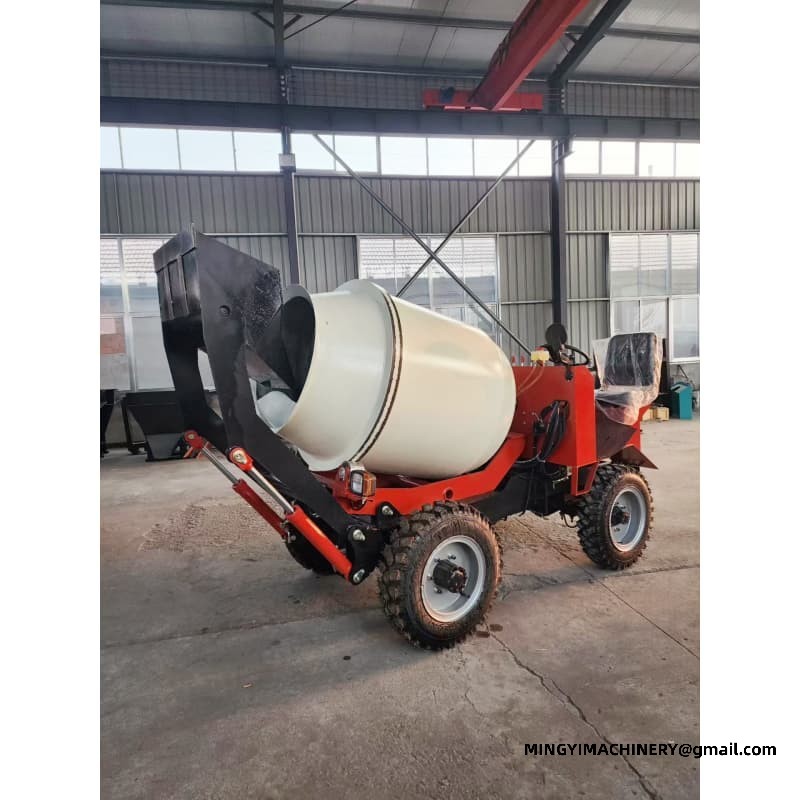
The machine-specific parts — drum blades, shovel pins, hydraulic seals — travel by shipment from the supplier, and the engine and axle patterns travel by the nearest agricultural network. Between them, little that breaks on this machine needs a wait measured in weeks.
Keep the parts book and the order history together. The second order, placed a year later for a blade or a seal, is a two-minute email when the reference numbers are at hand and a half-day search when they are not.
Steering is hydraulic power steering acting with the 28° rear-axle steer. The wheel is light under a full drum, the steering response stays predictable at crawl speeds, and the machine holds a straight line under load without fighting the operator.
Power steering also matters at the end of a shift. A loaded machine manoeuvring all day on a manual system tires the operator into mistakes; the hydraulic system keeps the last batch as controlled as the first.
A transit mixer delivers volume from a plant; this machine delivers independence from a plant. For large continuous pours the transit wins outright. For small pours beyond the plant's radius — on rural road work pouring culverts and kerbs between villages — the transit's minimum charges and queue time make it the dearer option.
There is also a hybrid pattern worth naming: the self-loader feeds a static pump or a crane skip on bigger jobs, batching at the rate the placing crew sets. The machines are complements more often than competitors.
Self-loading is the whole idea. A front shovel scoops aggregate and sand from a stockpile, lifts it over the drum, and releases it — no separate loader, no second machine, no third pair of hands. One operator runs the entire chain from pile to pour.
On rural road work, that single-operator loop is the economic argument. Labour is the biggest recurring effort on small concrete work, and the shovel removes most of it. Cement, water and aggregate are the only inputs the crew still handles by hand.
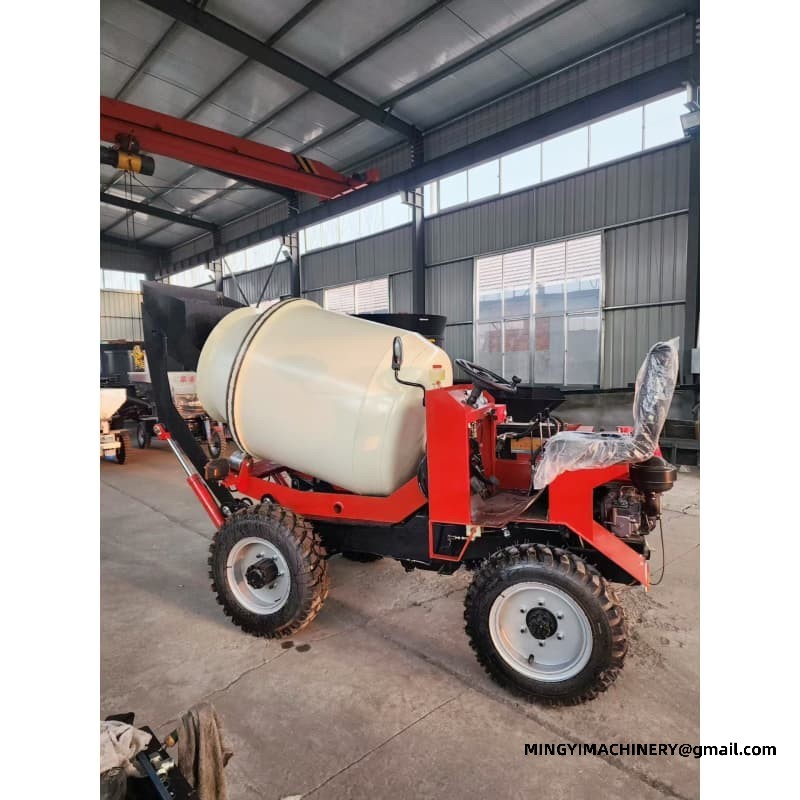
The route decides the job before the mixer does. Walk it first: gateway width, height bar, the tightest turn inside the gate, the worst ground between stockpile and pour, and the discharge spot itself. The 2,464 mm turning circle and 204 mm clearance turn each measurement into a plain yes or no.
Most sites need a little ground work before the machine earns its keep: grade the haul, fill the ruts, gravel the standing spots, and protect any services in the working line. An hour with a shovel and a bag of hardcore keeps the 4WD honest and the drum moving.
The control set is small — key start, gears, shovel levers, drum controls, steering — and a careful new operator works productively inside a day. The training that matters is judgement: slopes, loads, people, and the discipline of the wash-out.
The first week should include one empty drum deliberately: let the new operator feel the 28° rear steer, the 2,464 mm circle and the stopping distance without a live load aboard. Familiarity earned empty arrives safely loaded.
The diesel self loading concrete mixer battery keeps going flat — why?
Short runs without charging time, or parasitic drain while parked. Run the machine long enough after starts to replace what the starter used, and disconnect or top up during idle weeks.
How long do diesel self loading concrete mixer belts last?
By condition, not calendar: cracks, glazing or flutter say replace. A spare set travels in the first spares kit for good reason.
Does the diesel self loading concrete mixer have a chute?
Discharge is by tipped drum over the front, aimed by the operator. Where the pour needs a longer reach, a barrow stage or a locally made chute extension covers the gap — ask the supplier what is offered.
What strength concrete can a diesel self loading concrete mixer produce?
Whatever a correct recipe of good materials produces in a well-mixed drum — the machine's uniformity is the point. Structural mix designs come from the engineer, not from the machine.
How does the diesel self loading concrete mixer discharge the concrete?
The drum reverses and tips hydraulically, discharging over the front to a barrow, bucket or straight into formwork. The operator aims the pour from the seat.
How often should the diesel self loading concrete mixer air filter be cleaned?
Far more often than the book says in dry conditions. Check it daily by restriction indicator or torch; a blinded filter takes power on every shovel lift.
Why do diesel self loading concrete mixer wheel nuts need checking?
Rough ground loosens them. The daily walk-round includes a nut check for the same reason it checks the drum — small things caught early never become pour-day failures.
How often do diesel self loading concrete mixer shovel pins need greasing?
Weekly under normal work, daily in dust or mud. Grease is simple; the pins and bushings it protects are the shovel's whole wearing life.
Batched to demand, placed under its own power and maintained in five minutes a day, the machine replaces the small-plant overhead that most small pours never needed in the first place.
Handover and getting familiar with Diesel Self Loading Concrete Mixer: 25 hp Single Cylinder
Familiarisation is not the same as reading the manual. Sitting on Diesel Self Loading Concrete Mixer: 25 hp Single Cylinder, working through the controls at low speed and learning where the machine balances takes an hour, and that hour is what keeps the first week uneventful.
Pre-delivery inspection before Diesel Self Loading Concrete Mixer: 25 hp Single Cylinder leaves the shop
The last hour before packing is the best time to find a fault. Running Diesel Self Loading Concrete Mixer: 25 hp Single Cylinder through its full working cycle, checking for leaks under load and confirming that the controls match the specification avoids a conversation across time zones later.
Packing, loading and shipment of Diesel Self Loading Concrete Mixer: 25 hp Single Cylinder
How a machine travels decides how it starts on arrival. Securing Diesel Self Loading Concrete Mixer: 25 hp Single Cylinder against movement, protecting the exposed cylinders and keeping the battery and fluids in the right state for the voyage all belong to the packing list.
A second operator for Diesel Self Loading Concrete Mixer: 25 hp Single Cylinder
A machine that only one person can use is a single point of failure. Training a second operator on Diesel Self Loading Concrete Mixer: 25 hp Single Cylinder takes a day and removes the dependency that otherwise governs holidays, illness and busy weeks.
Fuel, oil and fluid quality for Diesel Self Loading Concrete Mixer: 25 hp Single Cylinder
The specification for oil is written for a reason. Using the grade and the change interval set for Diesel Self Loading Concrete Mixer: 25 hp Single Cylinder keeps the engine and the hydraulic system inside the range they were designed for.
Contact MINGYI Machinery for the current self-loading concrete mixer specification, export packing and a formal specification for your market. E-mail: sales@mingycn.com | LINE (ID): mingyicn
Self Loading Concrete Mixer for Sale: Reading the Spec · Self Loading Concrete Mixer: What Drives the Specification · 4x4 garbage transport vehicle for mining and quarry work · Mini Self-Loading Concrete Mixer









