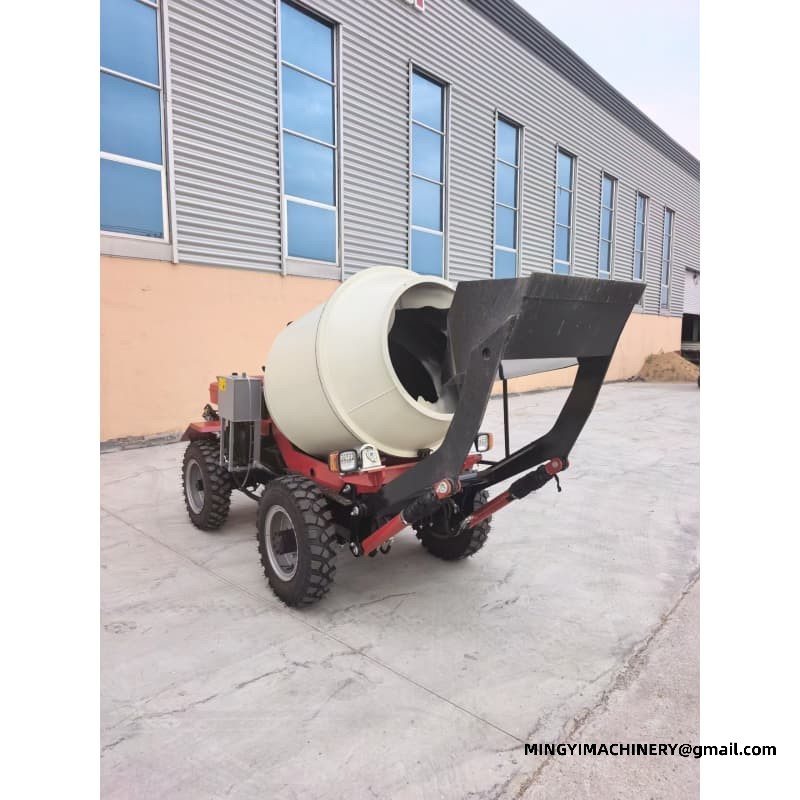
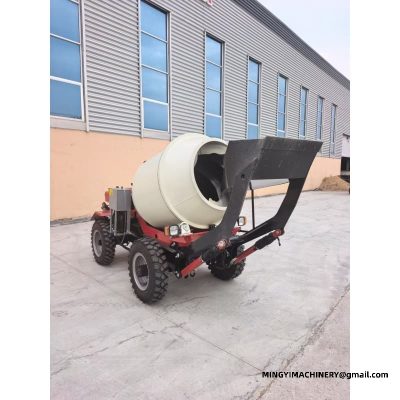
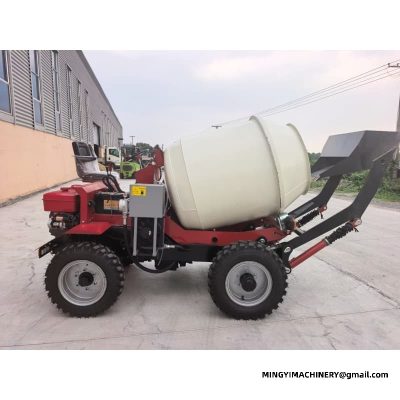
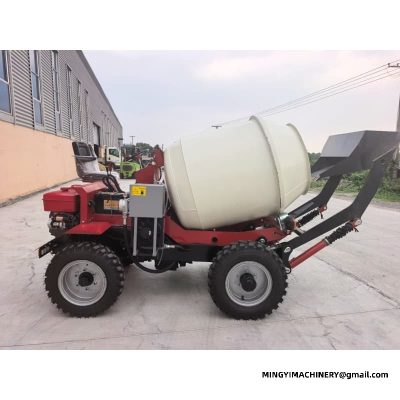
Access decides concrete work before capacity does.A transit mixer that cannot reach the pour is a plant on the street; a self loading concrete mixer specification at 3,500 x 1,600 x 2,200 mm overall and 2,464 mm of turning circle drives to where the formwork is. This page follows the machine on plantation work from the stockpile to the discharge point and reads each published figure along the way.
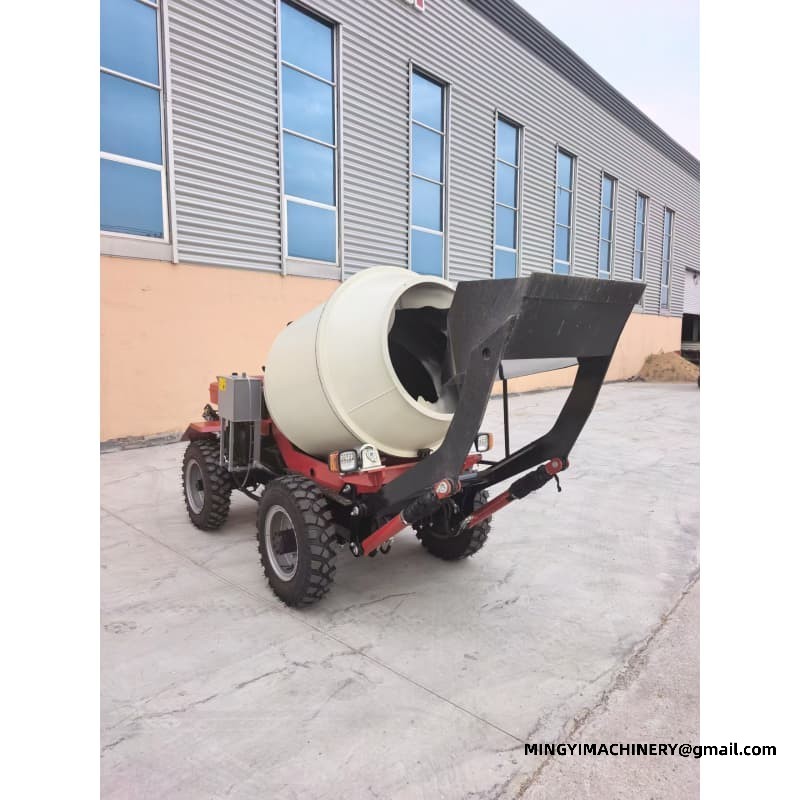
At 1,600 mm wide the machine threads standard double gates with room for its mirrors, which is the whole reason the envelope was drawn that way. Estate lanes, compound doors, orchard rows and basement entries all accept it where ordinary site trucks stop at the street.
At 2,200 mm high the machine works under low slabs, through basement ramps and inside tunnel inshots where a transit mixer's height alone disqualifies it. The drum does not add to the envelope, which is what makes the machine usable underground at all.
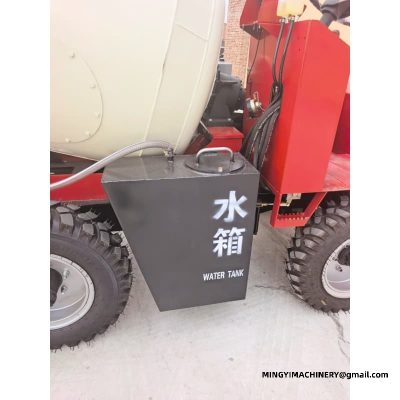
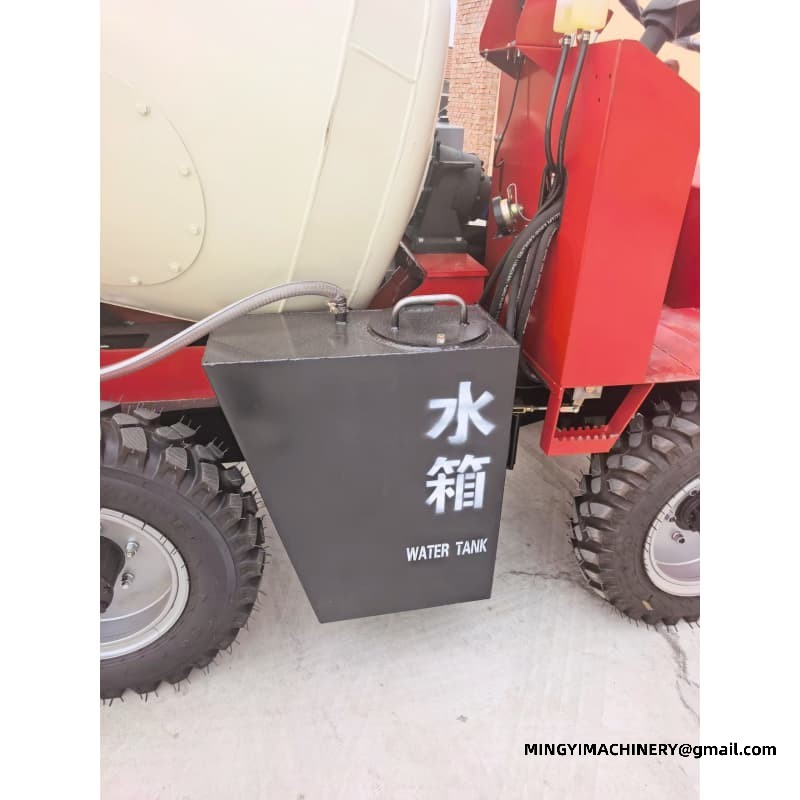
The discharge end is the natural place for add-ons: a short chute extension reaches past an obstacle, a tipping skip collects where a barrow cannot stand, and a measured water bowser rides the machine instead of trailing behind it. None of these change the drum; they change where its output lands.
Keep additions within the machine's published limits. A chute that adds reach also adds discharge height; a skip that adds capacity also adds the weight the chassis must carry. The 1,500 kg rating still governs the lot.
Ready-mix is the simpler source per cubic metre when a plant is close and the pour is large. Beyond that radius, minimum-load charges, queue time and the stiffening in the drum flip the arithmetic, and batching on plantation work from stockpiled aggregate wins.
Every batch has three takes: materials, fuel and labour. The machine attacks the third hardest — one operator replaces the barrow chain — and holds the second down with a single-cylinder diesel that sips fuel between cycles. Materials effort what they effort anywhere; the difference is made in labour and logistics.
| Published build data — 0.8 m³ 4WD self-loading concrete mixer | |
|---|---|
| Rated load | 1,500 kg |
| Rated capacity | 0.8 m³ |
| Overall dimensions (L x W x H) | 3,500 x 1,600 x 2,200 mm |
| Front tyre size | 8.25-16 |
| Rear tyre size | 7.50-16 |
| Minimum ground clearance | 204 mm |
| Steering angle | 28° |
| Turning dimension (outer tyre) | 2,464 mm |
| Maximum travel speed | 24 km/h |
| Transmission | 4WD |
| Gears | 3 forward / 1 reverse + travel gear |
| Front axle | 130 drive axle |
| Rear axle | 212 selectable 4WD steering axle |
| Engine | single-cylinder diesel / 25 hp |
| Steering | hydraulic power steering |
A transit mixer delivers volume from a plant; this machine delivers independence from a plant. For large continuous pours the transit wins outright. For small pours beyond the plant's radius — on plantation work setting posts and small bases far from any plant — the transit's minimum charges and queue time make it the dearer option.
The hand-fed mixer still wins where volumes are tiny and access is narrower than 1,600 mm — but that allowance is narrow, and it closes every time wages rise.
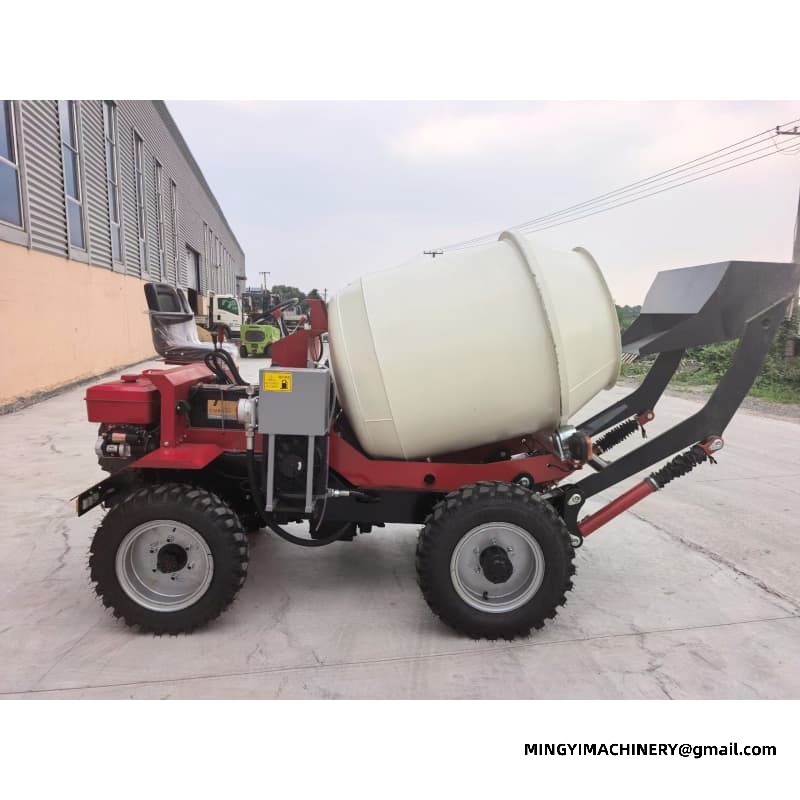
The route decides the job before the mixer does. Walk it first: gateway width, height bar, the tightest turn inside the gate, the worst ground between stockpile and pour, and the discharge spot itself. The 2,464 mm turning circle and 204 mm clearance turn each measurement into a plain yes or no.
Board over exposed ducts and mark headroom limits. The machine crosses most ground on plantation work; it crosses a buried cable only once, and the second time is a strike.
Self-loading is the whole idea. A front shovel scoops aggregate and sand from a stockpile, lifts it over the drum, and releases it — no separate loader, no second machine, no third pair of hands. One operator runs the entire chain from pile to pour.
The shovel reaches a pile close to the front wheels, so the stockpile layout decides how fast a batch assembles. Keep aggregate and sand within a shovel's reach of the machine's standing position and the drum fills in seconds rather than minutes.
The machine will reproduce whatever recipe it is given, faithfully and all day. That is its quality promise and its quality risk: a correct recipe repeated gives uniform strength, and a careless one repeated gives uniform trouble.
Fix the mix design for post-hole and shed-base concrete once, write it down, measure the water, count the scoops, time the drum — and the batches on plantation work will be more consistent than most hand-mixed concrete has ever been.
The drum delivers 0.8 m³ at a rhythm, so the pour plan should be drawn in drum-sized bays: place, finish, move, repeat. Crews that lay out formwork to the machine's cycle pour all day without cold joints; crews that fight the rhythm chase stiffening edges by noon.
Sequence the day by geography rather than by trade. Batching for two crews at opposite ends of a site doubles travel; batching for neighbours, one after another, keeps the hauls short and the drum earning.
Steering is hydraulic power steering acting with the 28° rear-axle steer. The wheel is light under a full drum, the steering response stays predictable at crawl speeds, and the machine holds a straight line under load without fighting the operator.
Steering effort drops to nothing at crawl speed, which is precisely when a loaded machine needs precision. The 28° rear steer responds proportionally, so the wheel's first inch means a small correction and the last inch means the full lock.
The front tyres are 8.25-16 and carry the drive under a full drum; the rears are 7.50-16 and steer. The heavier front fitment matches the heavier front duty — drive torque plus a loaded drum sitting between the axles.
Both sizes are simple where the machines sell, which is deliberate: a mixer stranded on tyres nobody stocks is a hire fleet's worst week. The sizes were chosen for availability first and performance second.
Confirm the specification in writing against the published table: 0.8 m³ capacity, 1,500 kg rated load, 4WD transmission, 25 hp single-cylinder diesel, the 130 front axle and 212 rear steering axle, and hydraulic power steering. Ask what is standard and what is optional in the build you are buying.
Agree the acceptance test before the deposit: drum turns both ways, shovel lifts and holds, steering reaches full lock, and the machine travels in every gear. Thirty minutes at handover prevents the kind of dispute that outlives the purchase.
The control set is small — key start, gears, shovel levers, drum controls, steering — and a careful new operator works productively inside a day. The training that matters is judgement: slopes, loads, people, and the discipline of the wash-out.
Measured water, counted scoops, timed drum, slow turns, low shovel in transit, wash-out before the break. Six habits cover nearly all of the machine's reliability and every one of its safety rules.
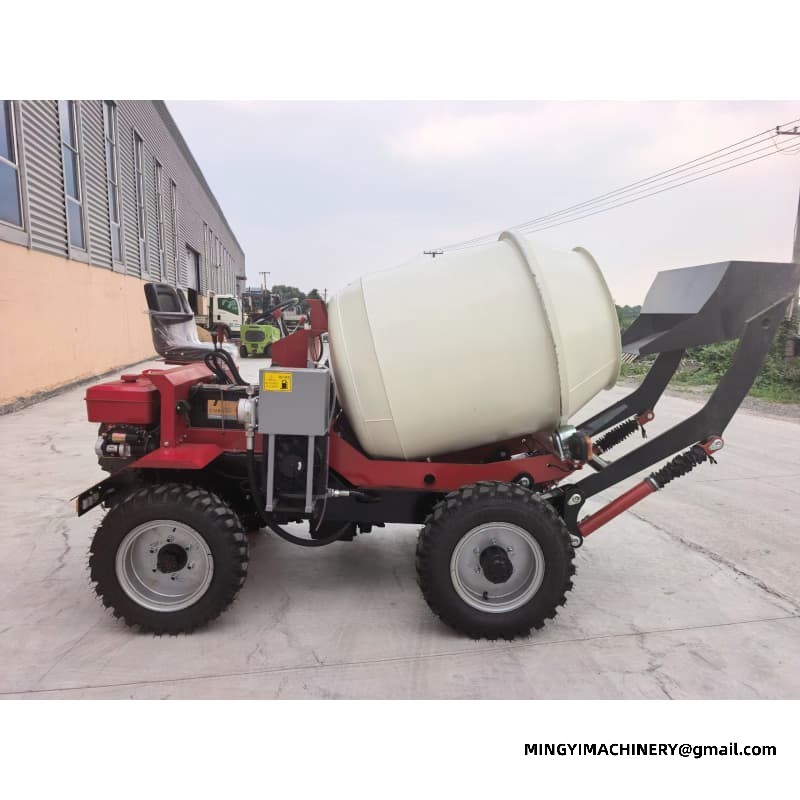
The drum takes 0.8 m³ per batch, and the chassis carries 1,500 kg while doing it. Those two figures together describe the machine's whole working day: load, mix, move a short distance, discharge, and come back for the next batch. A crew that pours post-hole and shed-base concrete in small, frequent quantities is exactly the customer this size was drawn around.
Put the two figures side by side and the machine's day writes itself: 0.8 m³ mixed, 1,500 kg carried, repeated until the pour is fed. Nothing in the specification is bigger than the job needs, and nothing the job needs is missing from the specification.
204 mm of clearance under the axles is the machine's ground rule. It clears ruts, rubble and standing water of that depth, and it does not clear more. The low build is what keeps the centre of gravity down under a raised drum, so the number is a design trade, not a deficiency.
Front tyres are 8.25-16, rears are 7.50-16 — agricultural-pattern tyres with a tread that grips soft ground and shrugs off stones. Combined with four-wheel drive they carry a full drum across ground that stops two-wheel-drive machines.
Can the self loading concrete mixer specification cross a small culvert or slab on site?
If the structure is engineered for the machine's axle loading, yes. Unverified culverts, covers and basements deserve a check before the wheels arrive, not after.
Can the self loading concrete mixer specification work in hot weather?
Yes — keep the air filter checked, shade the aggregate stockpile where possible, and batch slightly smaller so each load is placed inside the shortened working window.
How many labourers does a self loading concrete mixer specification replace?
Commonly the two-to-four people of a hand-mixing and barrow chain, depending on the haul. The honest number comes from timing your own crew's cycle against the machine's.
Can a self loading concrete mixer specification place concrete around dense rebar?
Yes — the discharge lands where the operator aims it, and a spotter with a shovel and vibrator works the concrete in. Tight rebar changes the placing crew's job, not the machine's.
How is the self loading concrete mixer specification shipped?
At 3,500 x 1,600 x 2,200 mm it loads into a standard container with lashing alone. On arrival, check drum and shovel for transit damage and run the drum empty before the first batch.
Can the self loading concrete mixer specification be towed behind a pickup?
On a braked tag trailer rated for the machine's weight, yes — the 3,500 x 1,600 x 2,200 mm footprint was drawn for it. Lash at the chassis, chock the wheels, fold the shovel to travel order.
What tyre pressures should a self loading concrete mixer specification run?
The pressures in the manual, kept even left to right. Too hard cuts into wet ground and shrinks the footprint; too soft overheats the sidewall under a full drum.
Where should self loading concrete mixer specification wash-out water go?
Into a designated wash-out pit or settling area, never into drains or against the stockpile. Cement-laden water is a controlled waste on most sites.
Measure the gateway, time the cycle, write the recipe — three small exercises that turn the published specification into a working plan for your site.
Commissioning Self Loading Concrete Mixer: What Drives the Specification on site
The machine should be introduced to the site as well as the operator. Walking the route Self Loading Concrete Mixer: What Drives the Specification will take, noting the soft spots and the turns, prevents the kind of first-day incident that has nothing to do with the machine.
Hot, humid and dusty conditions around Self Loading Concrete Mixer: What Drives the Specification
Heat and dust shorten service intervals rather than machine life. In these conditions the filters on Self Loading Concrete Mixer: What Drives the Specification need attention more often, and the cooling surfaces need to be kept clear to hold the working temperature.
Cold weather and winter care for Self Loading Concrete Mixer: What Drives the Specification
A cold start is easier when the machine is prepared the night before. The routine that keeps Self Loading Concrete Mixer: What Drives the Specification working through winter is mostly a matter of fuel, battery and patience in the first ten minutes of the day.
Moving Self Loading Concrete Mixer: What Drives the Specification between sites
Securing the load is not optional. Lashing Self Loading Concrete Mixer: What Drives the Specification at the points intended for it, checking the tension before the vehicle moves and rechecking after the first kilometres is standard practice rather than extra care.
Keeping a service record for Self Loading Concrete Mixer: What Drives the Specification
Service history also protects the warranty position. Evidence that Self Loading Concrete Mixer: What Drives the Specification was maintained at the specified intervals and with the specified fluids settles questions that would otherwise be argued.
Contact MINGYI Machinery for the current self-loading concrete mixer specification, export packing and a formal specification for your market. E-mail: sales@mingycn.com | LINE (ID): mingyicn
Concrete Mixer for Small Construction Projects: 0.8 m³ Batching · Mini Diesel Self-Loading Concrete Mixer: Fuel and Simplicity · 4WD trash transport vehicle for mining and quarry work · Mini Self-Loading Concrete Mixer









