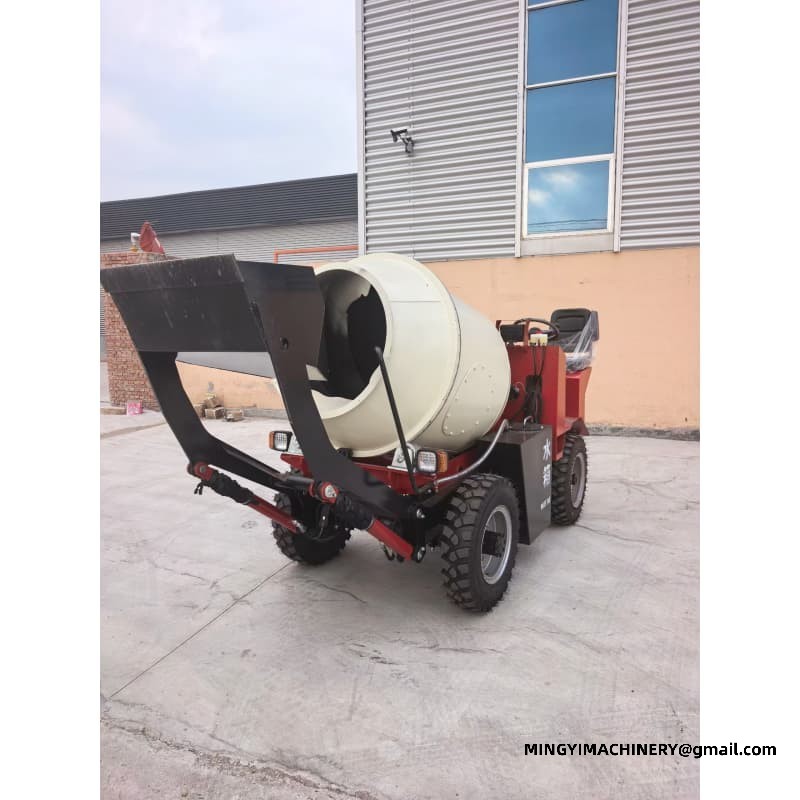
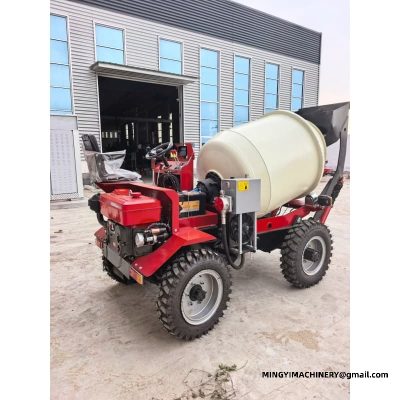
Small pours, repeated all day, are a logistics problem. The concrete mixer for small construction projects answers it with a 0.8 m³ drum, a front shovel and four driven wheels — four-wheel drive through a 130 drive axle with a 212 steering axle behind. This page reads the specification the way an estimator would: what each batch contains, what the cycle takes in time, and where the machine's limits honestly sit.
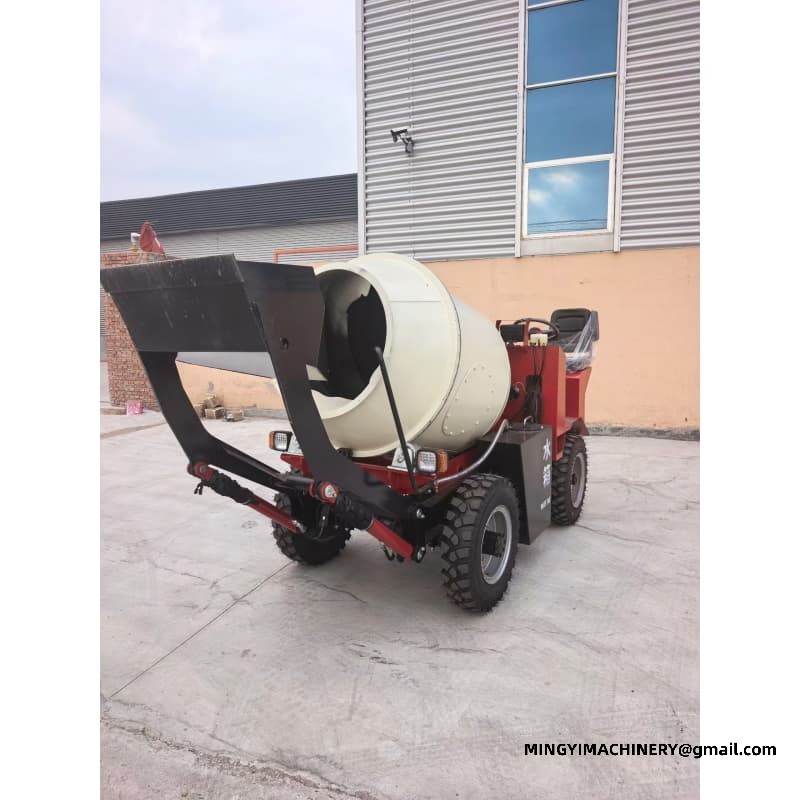
The discharge end is the natural place for add-ons: a short chute extension reaches past an obstacle, a tipping skip collects where a barrow cannot stand, and a measured water bowser rides the machine instead of trailing behind it. None of these change the drum; they change where its output lands.
The open station is the machine's safety feature as much as its cab trade-off. Mirrors, a beacon and site lighting turn a fully visible operator into a fully visible machine, and on congested slabs that visibility is what prevents the near-misses closed cabs sometimes hide.
Confirm the specification in writing against the published table: 0.8 m³ capacity, 1,500 kg rated load, 4WD transmission, 25 hp single-cylinder diesel, the 130 front axle and 212 rear steering axle, and hydraulic power steering. Ask what is standard and what is optional in the build you are buying.
At 3,500 x 1,600 x 2,200 mm the machine ships in a standard container without disassembly beyond lashing. On arrival: check the drum and shovel for transit damage, turn the engine by hand before first start, prime the hydraulic system, and run the drum empty before the first batch.
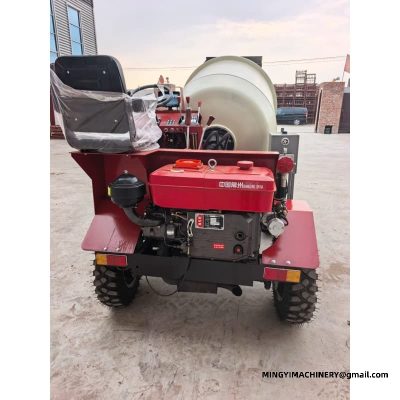
Power comes from a single-cylinder diesel rated at 25 hp. It drives the transmission, the drum and the hydraulics, and it does so with the mechanical directness that makes small site machines easy to keep alive: no electronics to fail, no dealership lock-out, one cylinder to know by heart.
A single-cylinder diesel of this size burns a few litres an hour, runs on the same diesel as everything else on site, and services with filters and oil a general mechanic stocks. None of that is glamorous; all of it matters in orchard pathways, where the nearest dealer is a day away.
| Specification extract — 0.8 m³ 4WD self-loading concrete mixer | |
|---|---|
| Rated load | 1,500 kg |
| Rated capacity | 0.8 m³ |
| Overall dimensions (L x W x H) | 3,500 x 1,600 x 2,200 mm |
| Front tyre size | 8.25-16 |
| Rear tyre size | 7.50-16 |
| Minimum ground clearance | 204 mm |
| Steering angle | 28° |
| Turning dimension (outer tyre) | 2,464 mm |
| Maximum travel speed | 24 km/h |
| Transmission | 4WD |
| Gears | 3 forward / 1 reverse + travel gear |
| Front axle | 130 drive axle |
| Rear axle | 212 selectable 4WD steering axle |
| Engine | single-cylinder diesel / 25 hp |
| Steering | hydraulic power steering |
On a well-run machine the chassis and drum outlast several sets of consumables: shovel pins and bushings, drum blades, tyres, belts, hoses and filters are the renewal cycle. The single-cylinder diesel is the long-life heart, and its overhaul parts are stocked wherever single-cylinder diesels are common.
The machines that age well are washed and greased on schedule; the machines that age badly are the ones where wash-out slipped and dust won. Nothing exotic — just the daily five minutes, kept.
Self-loading is the whole idea. A front shovel scoops aggregate and sand from a stockpile, lifts it over the drum, and releases it — no separate loader, no second machine, no third pair of hands. One operator runs the entire chain from pile to pour.
A tidy pile also protects the mix. Contamination from ground spoil is the usual cause of weak batches on sites that store material directly on soil; a hardened standing area takes little and keeps path and drainage concrete honest from the first scoop.
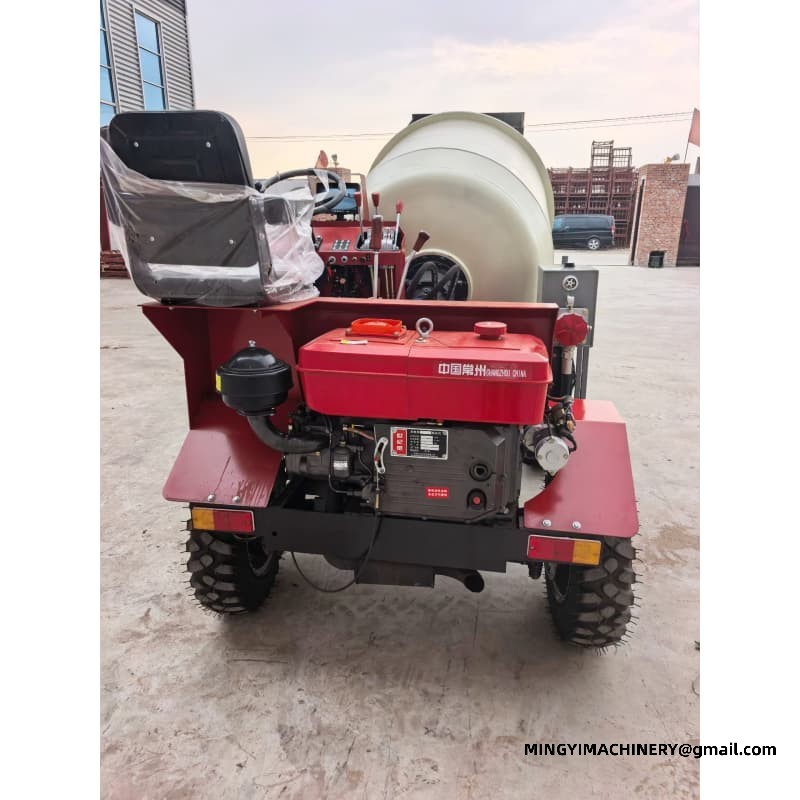
The operator profile is one person, but the people around the machine change by the hour. The mixer serves a foundation crew, a masonry crew and a patching gang in sequence, each with the recipe it needs and the standing spot it wants. The single seat is the reason the machine suits small contractors who cannot spare a second hand.
A typical small outfit pairs the machine with two or three labourers — one on cement, one at the discharge with a barrow, one finishing. Three people and one machine outproduce a six-person hand-mixing line, and the comparison is the reason the machine exists in orchard pathways.
The drum delivers 0.8 m³ at a rhythm, so the pour plan should be drawn in drum-sized bays: place, finish, move, repeat. Crews that lay out formwork to the machine's cycle pour all day without cold joints; crews that fight the rhythm chase stiffening edges by noon.
Between crews, the drum's rinse cycle doubles as the handover boundary — the second crew starts from a clean drum and a known recipe, in orchard pathways, and neither crew inherits the other's setting grout.
Heat shortens everything: the workability window, the wait between batches, the time a finisher has. In hot seasons the drum works slightly smaller batches, water is measured colder and exactly, and aggregate stockpiles are kept shaded where possible so the mix does not start hot.
Aggregate temperature is the hidden variable in hot-weather concrete: stockpiles in the sun can carry the mix temperature past the design window before the drum spins. Shade, sprinkling and morning batching are the simple answers.
The gearbox gives three forward gears, one reverse and a separate travel gear, with a top speed of 24 km/h. On site the machine lives in first and second; the travel gear exists to move between jobs on a road without holding up traffic.
The gear that surprises new operators is the travel gear's absence from site work. Under load, low gears keep the hydraulic pressure available for the drum and shovel; flogging third in orchard pathways starves both and heats the machine for no gain.
The machine-specific parts — drum blades, shovel pins, hydraulic seals — travel by shipment from the supplier, and the engine and axle patterns travel by the nearest agricultural network. Between them, little that breaks on this machine needs a wait measured in weeks.
Report faults honestly and in time. A small hydraulic weep described in a photograph reaches the right seal before it becomes a failed hose on a pour day, and crews that communicate get parts that fit the first time.
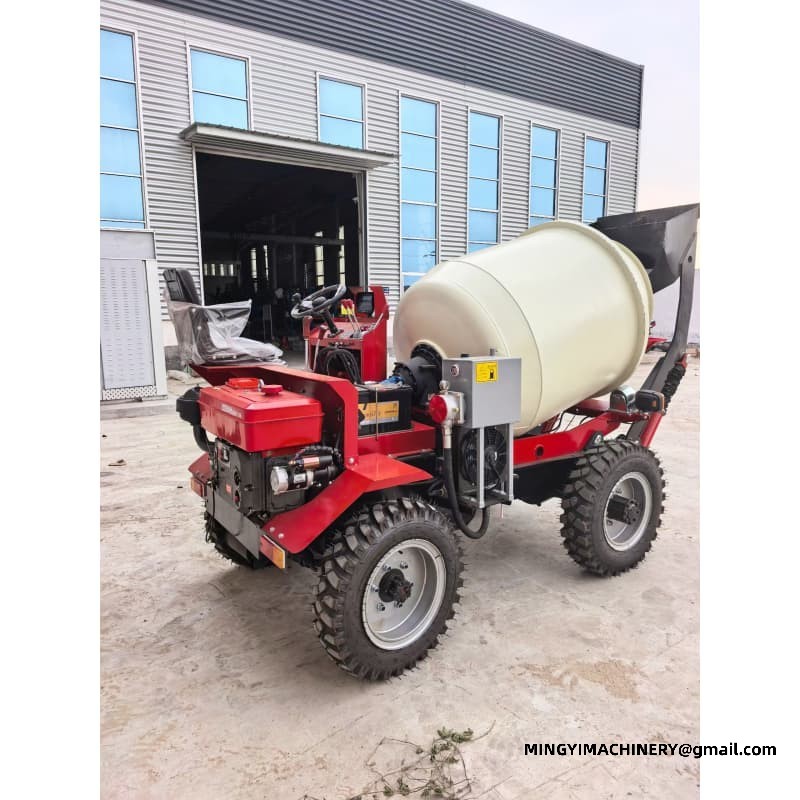
A transit mixer delivers volume from a plant; this machine delivers independence from a plant. For large continuous pours the transit wins outright. For small pours beyond the plant's radius — in orchard pathways where a full-size truck cannot turn — the transit's minimum charges and queue time make it the dearer option.
The honest case for the hand mixer survives only at the very smallest scale — a two-man job, one batch an hour, concrete within barrow reach. One step past that, the self-loader's arithmetic takes over and does not give it back.
Wet concrete moves. Cornering hard, braking sharply or crossing a slope swings 0.8 m³ of liquid load to one side, and the machine's stability depends on the operator not inviting that. The low drum mount and the wide stance help; the operator's right foot finishes the job.
Gloves, boots and eye protection are not paperwork at the discharge end — wet cement is caustic, and the crews who treat it that way in orchard pathways never spend an evening with cement burns.
3,500 x 1,600 x 2,200 mm is the whole machine: short enough for a site trailer, narrow enough for a garden gate, low enough for a container without a top-loader's paperwork. Every one of those three numbers earns its place somewhere in orchard pathways.
Tie it down at the chassis for transport, chock the wheels, and note that the shovel adds length when raised. The published envelope describes the machine in travel order; a few minutes of folding and lashing keeps it true.
Does the concrete mixer for small construction projects have a cab or canopy?
The machine is an open station by design — short, low and simple. Confirm with the supplier what weather protection options exist for your market before ordering.
Will the concrete mixer for small construction projects start in cold weather?
Electric key start with a decompression lever as the manual fallback. Warm the hydraulics and cycle the drum gently on cold mornings before the first loaded batch.
What strength concrete can a concrete mixer for small construction projects produce?
Whatever a correct recipe of good materials produces in a well-mixed drum — the machine's uniformity is the point. Structural mix designs come from the engineer, not from the machine.
What paperwork comes with a concrete mixer for small construction projects shipment?
Commercial invoice, packing list, and the shipping documents your market requires — confirm the exact set at specification so customs clears without surprises.
Does the concrete mixer for small construction projects come with a manual?
Ask for the operator and parts manuals with the machine, in your language where available, and check the parts references match what you will be ordering later.
How many people does it take to run the concrete mixer for small construction projects?
One. Load, mix, drive and discharge are all run from the seat; the crew handles only cement bags, the water measure and, at some pours, a barrow at the discharge end.
Is the concrete mixer for small construction projects suitable for plant-hire fleets?
It is a natural hire asset: simple controls, single-operator working, and a specification small fleets can describe to any customer in one page.
Can the concrete mixer for small construction projects drive on public roads?
It travels at 24 km/h in the road gear between sites. Registration and lighting requirements differ by market, so confirm local rules before regular road use.
The machine's arithmetic is short: 0.8 m³ per batch, 1,500 kg of payload, four driven wheels and one operator. Weighed against the labour it replaces and the ready-mix charges it avoids, the purchase decision is the smallest line on the page.
Planning the season around Concrete Mixer for Small Construction Projects: 0.8 m³ Batching
The calendar decides more than the specification does. Planning when Concrete Mixer for Small Construction Projects: 0.8 m³ Batching will be working, when it will be serviced and when it can be spared keeps the maintenance out of the weeks that matter.
Moving Concrete Mixer for Small Construction Projects: 0.8 m³ Batching between sites
Travel time is not working time, and it should be planned as its own item. The hours spent moving Concrete Mixer for Small Construction Projects: 0.8 m³ Batching between jobs are hours not worked, and a trailer that matches the machine reduces them every single trip.
Storage and long idle periods for Concrete Mixer for Small Construction Projects: 0.8 m³ Batching
Rubber, seals and hoses age whether the machine works or not. Keeping Concrete Mixer for Small Construction Projects: 0.8 m³ Batching out of direct sun and off damp ground slows that, and running it briefly at intervals keeps everything moving.
Pre-delivery inspection before Concrete Mixer for Small Construction Projects: 0.8 m³ Batching leaves the shop
Inspection is a list, not a glance. Before Concrete Mixer for Small Construction Projects: 0.8 m³ Batching is released the fluid levels, belt tension, electrical connections and safety decals are each ticked off, and anything that fails stays in the shop rather than travelling with the machine.
Later additions and retrofits on Concrete Mixer for Small Construction Projects: 0.8 m³ Batching
An added function should pay for itself quickly. Whether Concrete Mixer for Small Construction Projects: 0.8 m³ Batching gains a different bucket, a hydraulic service or a protection package, the test is the number of days a year it is actually used.
Contact MINGYI Machinery for the current self-loading concrete mixer specification, export packing and a formal specification for your market. E-mail: sales@mingycn.com | LINE (ID): mingyicn
Mini Diesel Self-Loading Concrete Mixer: Fuel and Simplicity · Wheeled Diesel Self-Loading Mixer: Tyres and Traction · 4x4 sanitation vehicle for mining and quarry work · Mini Self-Loading Concrete Mixer









