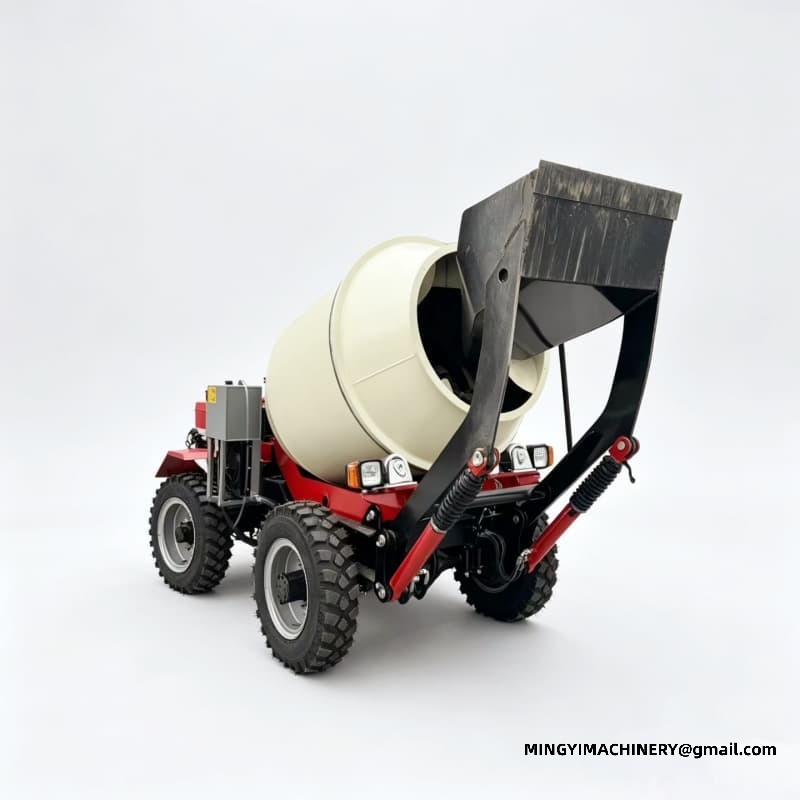
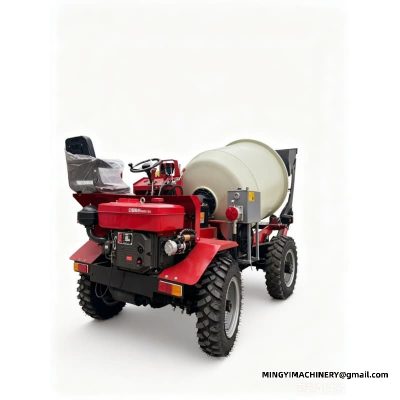
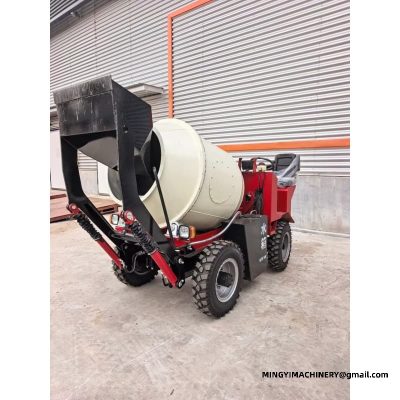
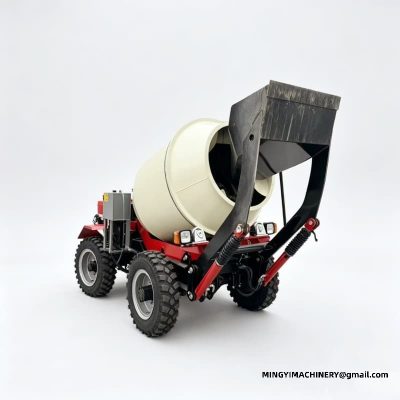
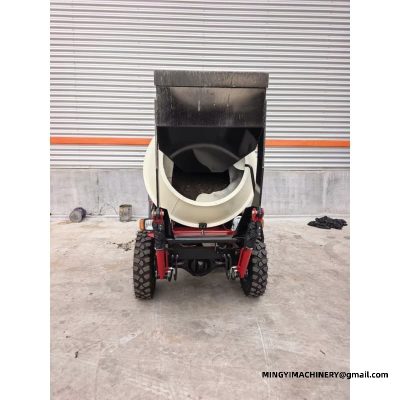
One operator, one drum, one shovel — that is the whole machine. Conventional site concreting splits the job across a loader, a mixer and a barrow chain; the small self loading concrete mixer folds it into a single 25 hp 4WD chassis. This page works through what the published specification means in practice on a building site, starting with the shovel and ending at the discharge.
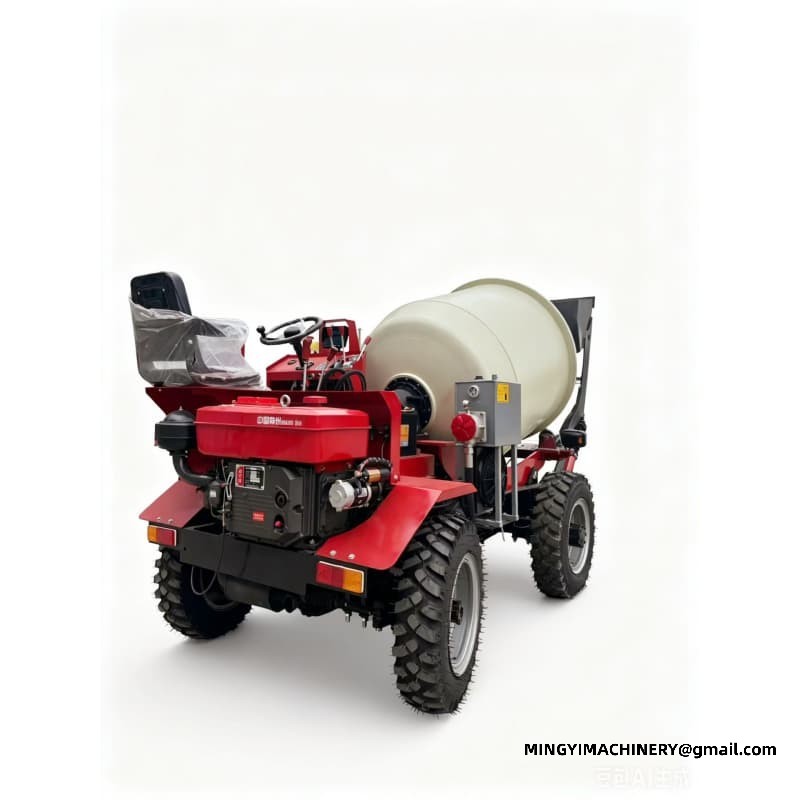
At 1,600 mm wide the machine threads standard double gates with room for its mirrors, which is the whole reason the envelope was drawn that way. Estate lanes, compound doors, orchard rows and basement entries all accept it where ordinary site trucks stop at the street.
Measure the narrow gate before delivery on a building site — width, height bar, and the turn immediately inside it. The 2,464 mm turning circle handles the inside turn; the measurement turns hope into a plan.
Ready-mix is the simpler source per cubic metre when a plant is close and the pour is large. Beyond that radius, minimum-load charges, queue time and the stiffening in the drum flip the arithmetic, and batching on a building site from stockpiled aggregate wins.
The comparison also holds when ready-mix is available but the pour is small: a part-load minimum pays for concrete nobody placed, while a drum batches exactly what the formwork needs and stops when it stops.
The drum takes 0.8 m³ per batch, and the chassis carries 1,500 kg while doing it. Those two figures together describe the machine's whole working day: load, mix, move a short distance, discharge, and come back for the next batch. A crew that pours mortar and screed batches in small, frequent quantities is exactly the customer this size was drawn around.
0.8 m³ is not a big drum by transit-mixer standards, and that is the point. Batches this size stay workable from drum to formwork without additives or rush, on a building site, where the distance from mixing point to pour is measured in metres rather than kilometres.
| Published build data — 0.8 m³ 4WD self-loading concrete mixer | |
|---|---|
| Rated load | 1,500 kg |
| Rated capacity | 0.8 m³ |
| Overall dimensions (L x W x H) | 3,500 x 1,600 x 2,200 mm |
| Front tyre size | 8.25-16 |
| Rear tyre size | 7.50-16 |
| Minimum ground clearance | 204 mm |
| Steering angle | 28° |
| Turning dimension (outer tyre) | 2,464 mm |
| Maximum travel speed | 24 km/h |
| Transmission | 4WD |
| Gears | 3 forward / 1 reverse + travel gear |
| Front axle | 130 drive axle |
| Rear axle | 212 selectable 4WD steering axle |
| Engine | single-cylinder diesel / 25 hp |
| Steering | hydraulic power steering |
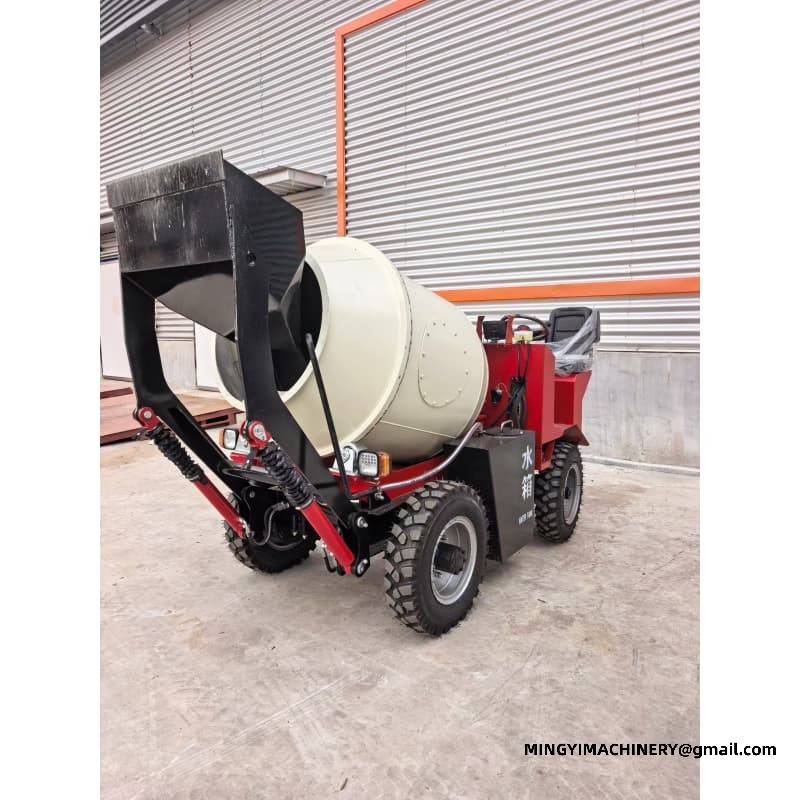
Inside the drum, rotation does the mixing; reversed rotation with the drum tipped does the discharging. The geometry is old and proven, and on a machine with hydraulic control the operator sets drum angle and speed from the seat without leaving the cab position.
Discharge lands where the operator aims it. That single fact shapes the whole workflow on a building site: the drum pours into a barrow, a bucket or straight to formwork, and the crew never moves concrete twice.
The route decides the job before the mixer does. Walk it first: gateway width, height bar, the tightest turn inside the gate, the worst ground between stockpile and pour, and the discharge spot itself. The 2,464 mm turning circle and 204 mm clearance turn each measurement into a plain yes or no.
Write the survey down and compare it with the published envelope before committing. Crews that skip this step discover the constraint with a full drum aboard, on a building site — the lengthy way to learn a number.
The operator profile is one person, but the people around the machine change by the hour. The mixer serves a foundation crew, a masonry crew and a patching gang in sequence, each with the recipe it needs and the standing spot it wants. The single seat is the reason the machine suits small contractors who cannot spare a second hand.
On larger sites the profile widens: an operator plus a spotter at the discharge, plus whoever feeds the cement and measures the water. The machine still needs one trained person; it simply stops needing a barrow chain behind them.
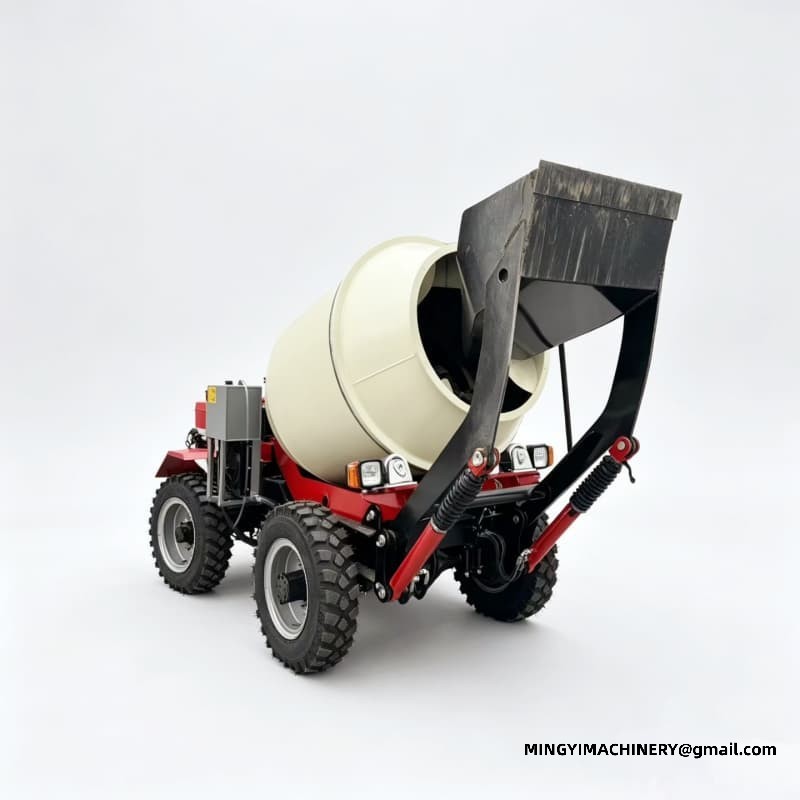
Wet concrete moves. Cornering hard, braking sharply or crossing a slope swings 0.8 m³ of liquid load to one side, and the machine's stability depends on the operator not inviting that. The low drum mount and the wide stance help; the operator's right foot finishes the job.
Seat position is part of the safety case: the open station puts the operator's eyes at drum height, with the shovel arc and the discharge point both in view. Machines that hide their own working parts invite the guesses that cause injuries.
The gearbox gives three forward gears, one reverse and a separate travel gear, with a top speed of 24 km/h. On site the machine lives in first and second; the travel gear exists to move between jobs on a road without holding up traffic.
The gear pattern also gives the machine its manners: low gears hold back a loaded drum on descents without riding the brakes, and the travel gear keeps engine speed economical on road sections. Good gearing is invisible until it is missing.
The control set is small — key start, gears, shovel levers, drum controls, steering — and a careful new operator works productively inside a day. The training that matters is judgement: slopes, loads, people, and the discipline of the wash-out.
Let the first day end early, clean and unhurried. Operators trained calmly on a building site keep the habits; operators trained in a rush learn shortcuts instead.
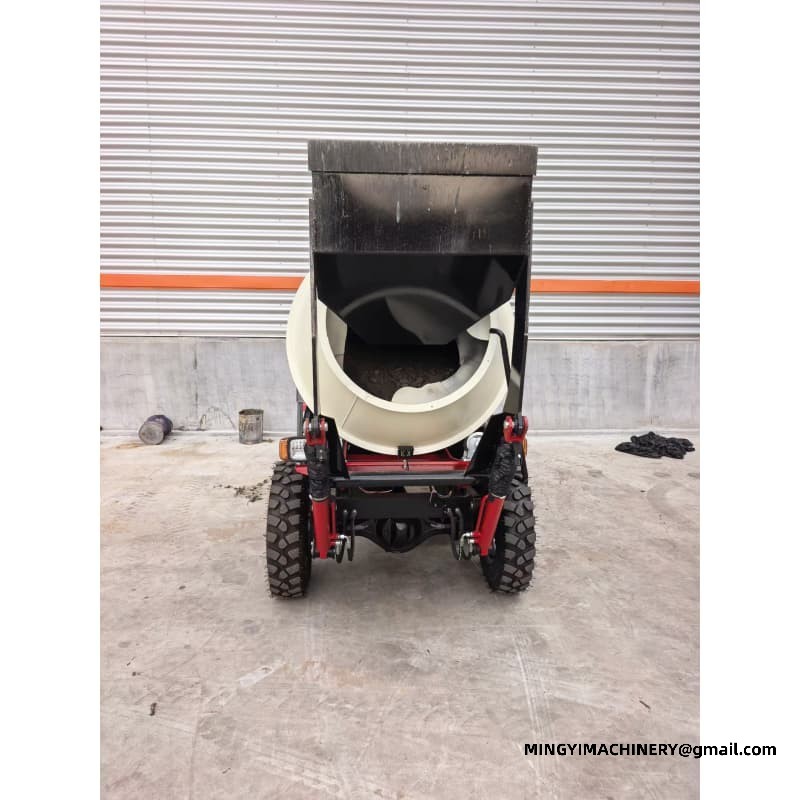
The drum is recipe-agnostic: lean foundation mixes, richer masonry mixes, and paving batches all turn the same way and discharge the same way. The machine's contribution is uniformity, not chemistry — the recipe is the engineer's, the repetition is the drum's.
Where the mix changes through a day — a lean base, a richer top — the machine carries the change as easily as the material, provided the crew keeps the recipe card current. Switching batches is a scoop count and a water measure, not a machine adjustment.
The drum delivers 0.8 m³ at a rhythm, so the pour plan should be drawn in drum-sized bays: place, finish, move, repeat. Crews that lay out formwork to the machine's cycle pour all day without cold joints; crews that fight the rhythm chase stiffening edges by noon.
Build the plan around the standing spot rather than the drum: a machine that parks once and serves a bay from one position outserves a machine that shuttles. Positioning time is the only time the drum spends doing nothing.
The break-even between owning and hiring is the number of batch-days, not the specification tag. A contractor with steady small-pour work crosses it in weeks; a contractor with one trench a month never does. The machine suits the first profile and politely declines the second.
Ownership's real takes are the visible ones: the machine, the spares kit, the fuel, and the operator's time. None is hidden, none is large, and all survive a spreadsheet. The effort that surprises new owners is the working capital tied in stockpiled aggregate and cement — the inputs, not the machine.
3,500 x 1,600 x 2,200 mm is the whole machine: short enough for a site trailer, narrow enough for a garden gate, low enough for a container without a top-loader's paperwork. Every one of those three numbers earns its place somewhere on a building site.
The width is the number that opens the most doors. At 1,600 mm the machine goes through standard double gates and between formwork lines that stop wider equipment, and it does so with a full drum because the drum sits inside the envelope, not above it.
The small self loading concrete mixer battery keeps going flat — why?
Short runs without charging time, or parasitic drain while parked. Run the machine long enough after starts to replace what the starter used, and disconnect or top up during idle weeks.
What hydraulic oil does the small self loading concrete mixer take?
The grade specified in the manual, kept clean and changed by the hour meter. Wipe every filler cap before opening it — dust, not hours, kills most site hydraulics.
Can I inspect my small self loading concrete mixer before it ships?
Ask for photographs and a running video of your actual unit with its serial plate, or a third-party pre-shipment inspection. Suppliers who refuse the request are answering it.
What is the rated load of the small self loading concrete mixer?
Rated load is 1,500 kg, carried over a short wheelbase with the drum mounted low between the axles on a building site.
What spares should I buy with a small self loading concrete mixer?
Filters for engine and hydraulics, belts, hose clamps, drum blades, shovel pins and bushings, and lamp bulbs — the small parts that stop work on a building site when unstocked.
How fast does the small self loading concrete mixer travel?
Top speed is 24 km/h with three forward gears, one reverse and a separate travel gear. Site work stays in low gears; the travel gear exists for moving between jobs.
Does the small self loading concrete mixer have power steering?
Yes — hydraulic power steering, working with the 28° rear-axle steer. The wheel stays light under a full drum and predictable at crawl speed.
What is the turning circle of the small self loading concrete mixer?
2,464 mm at the outer tyre, from the 28° steering angle. Measure your tightest gateway against that figure before the machine arrives.
Nothing on this page is complicated, and that is the point: a 0.8 m³ drum, a shovel, four driven wheels and a routine. Crews that keep the routine keep the machine earning on a building site for years.
Storage and long idle periods for the concrete mixer
A stored machine should be brought back carefully. Before this class of machine returns to work the fluids, the brakes and the controls are checked, because months of standing change more than a weekend does.
Planning the season around the unit in daily use
Downtime is simplest when it is planned. Booking the service for a machine of this size in the quiet part of the season takes nothing from the schedule, while the same work in the busy weeks gives up a day of output every time.
Cold weather and winter care for the equipment on site
A cold start is easier when the machine is prepared the night before. The routine that keeps the machine itself working through winter is mostly a matter of fuel, battery and patience in the first ten minutes of the day.
Pre-delivery inspection before the model in question leaves the shop
A machine should be inspected while it is still on our floor rather than after it lands. For the machine in that duty that means the engine is run to temperature, the hydraulics are cycled through full travel, and every function is checked against the build sheet before the crate is closed.
Packing, loading and shipment of the unit on the job
How a machine travels decides how it starts on arrival. Securing a machine built for the work against movement, protecting the exposed cylinders and keeping the battery and fluids in the right state for the voyage all belong to the packing list.
Wear items and spares worth holding for the equipment in service
Wear items are predictable once the machine has settled in. After the first service interval the pattern on the concrete mixer is visible, and the parts that were replaced become the parts that are kept.
Contact MINGYI Machinery for the current self-loading concrete mixer specification, export packing and a formal specification for your market. E-mail: sales@mingycn.com | LINE (ID): mingyicn
Diesel Self Loading Concrete Mixer: 25 hp Single Cylinder · Self Loading Concrete Mixer for Sale: Reading the Spec · agricultural water tank 4WD for mining and quarry work · Mini Self-Loading Concrete Mixer









