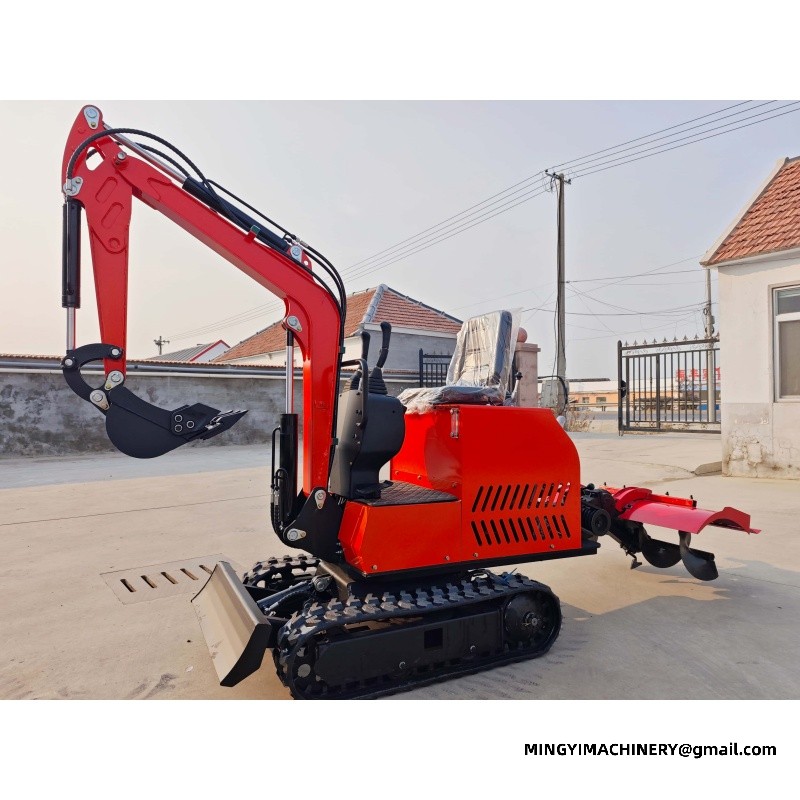
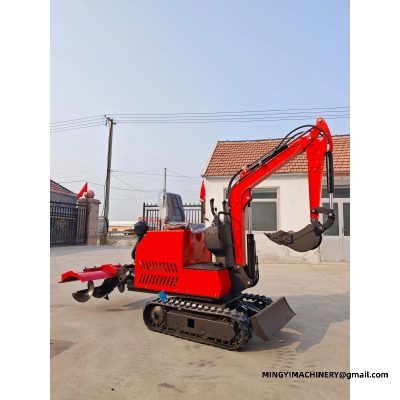
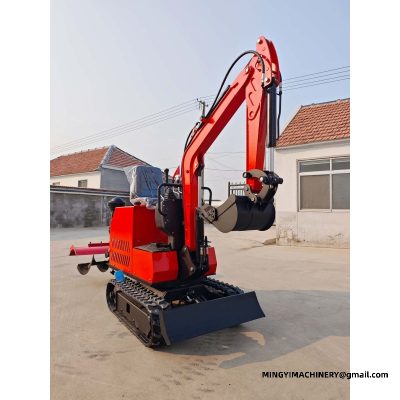
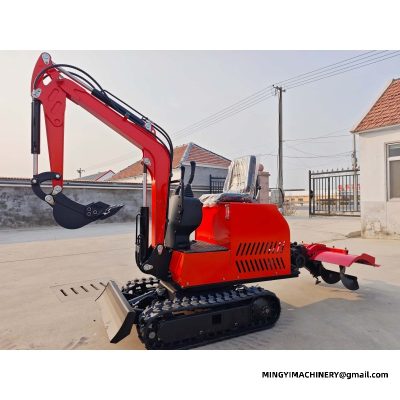
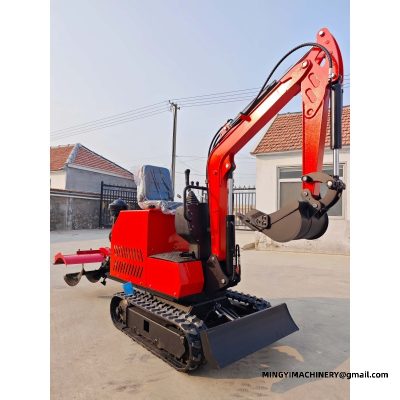
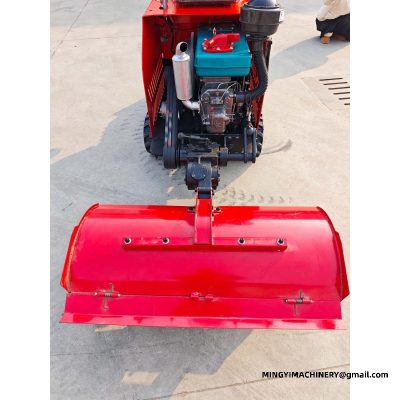
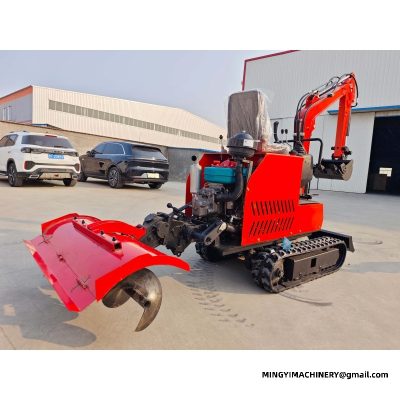
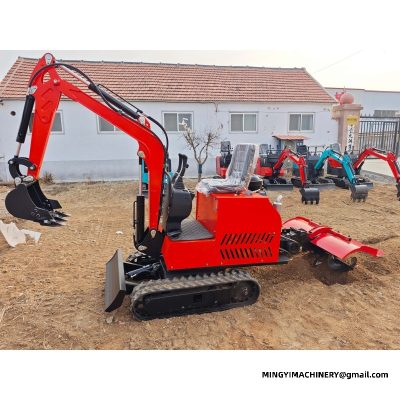
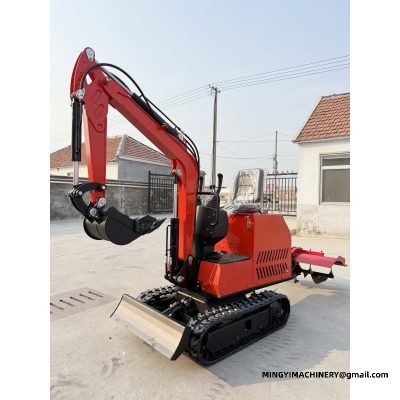
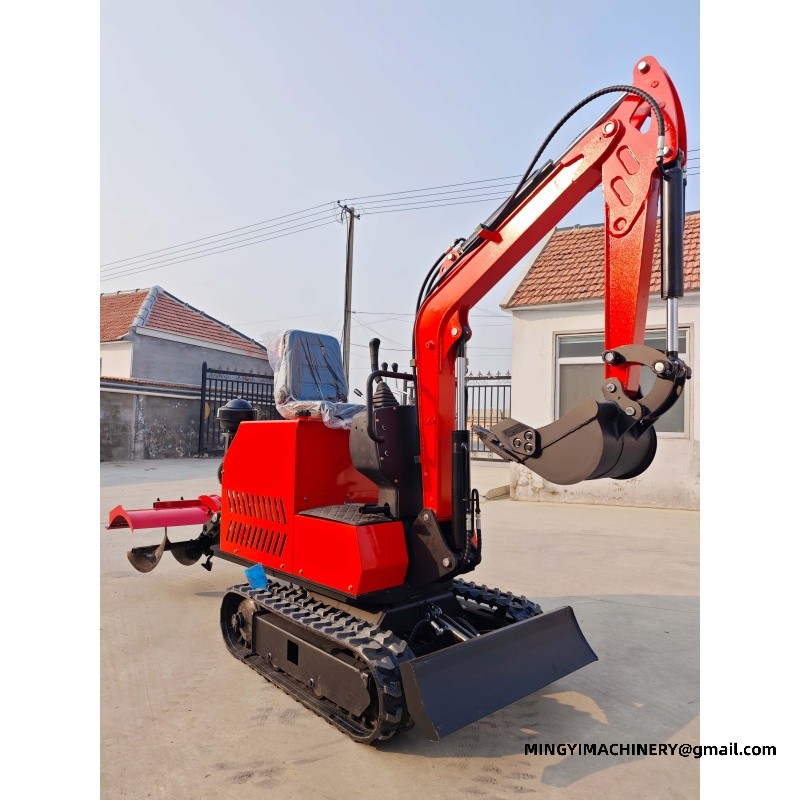
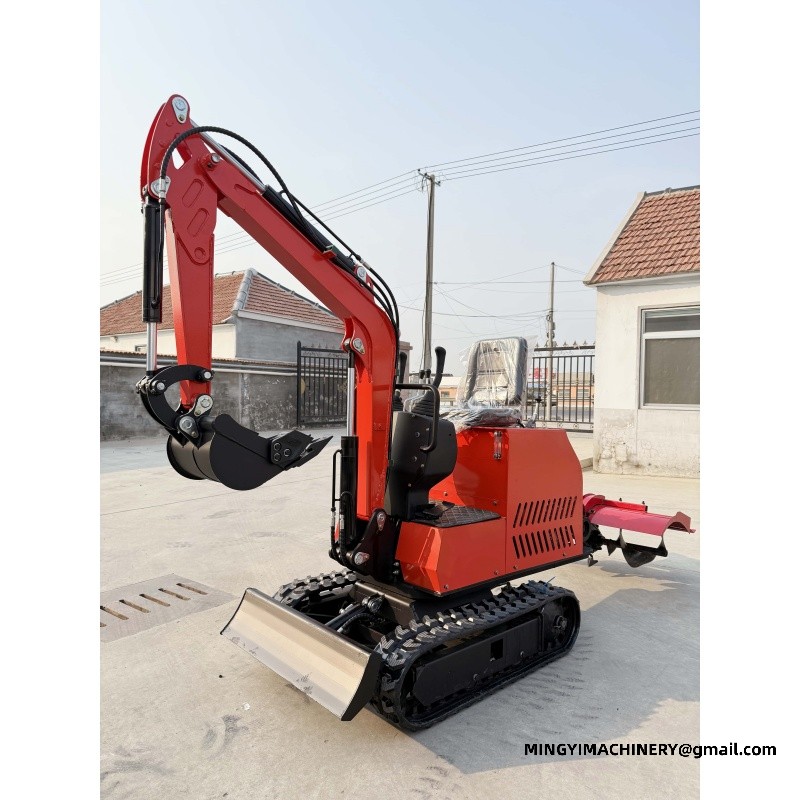
The combination of a mini digging machine and a rotary plough in one unit extends what a compact crawler machine can do on a smallholding. The same machine opens a drainage trench, then turns the soil beside it for planting.
MINGYI supplies this combination for horticultural, orchard and small-scale agricultural work on ground where tracked traction is an advantage.
How the combination works in practice
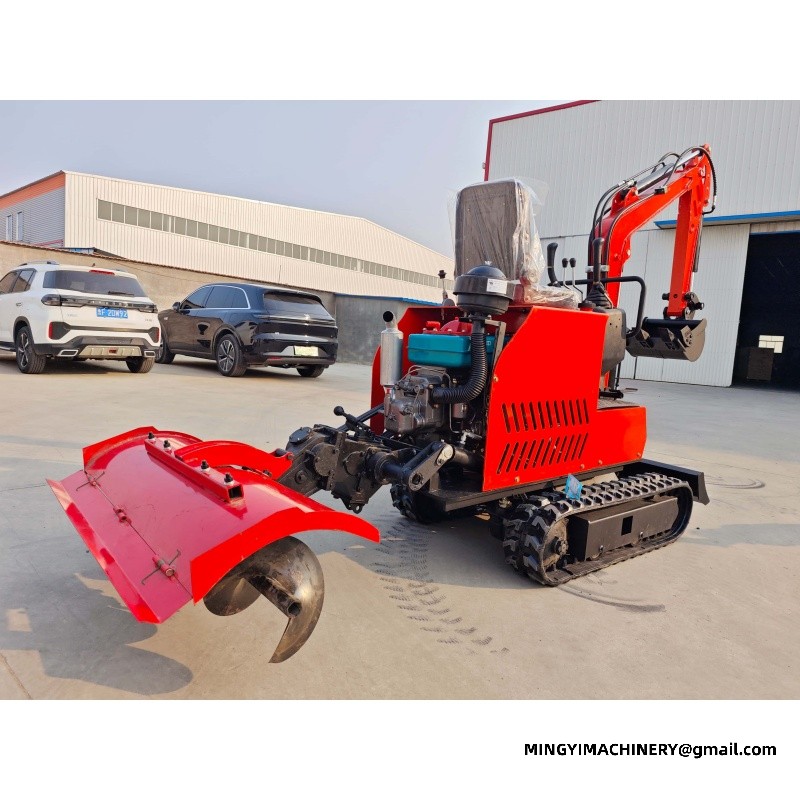
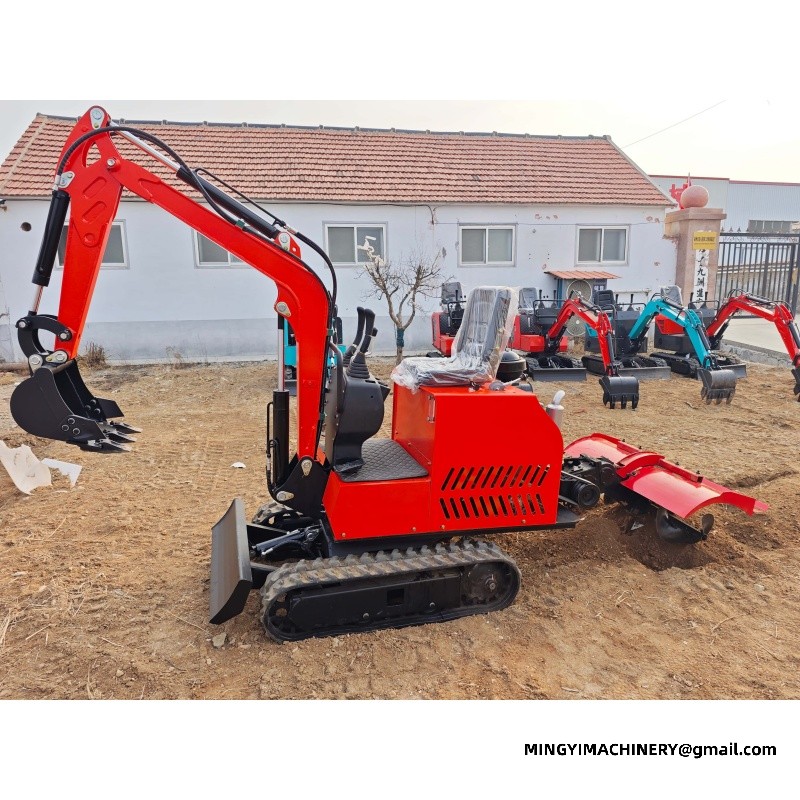
The base machine carries the hydraulic system and attachment interface. Digging tools — buckets, narrow trenching buckets and breaker hammers — handle excavation, drainage, ditch maintenance and clearance. The rotary plough attachment is fitted for soil cultivation, breaking and turning ground ahead of planting.
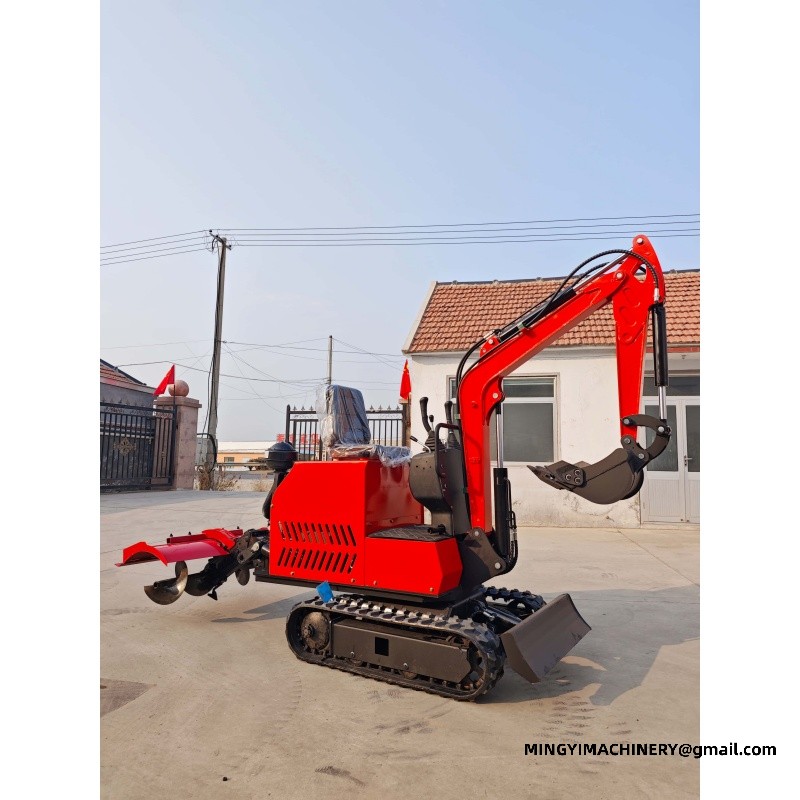
The two functions share one machine, one operator and one transport arrangement, which is the practical advantage on a holding where both jobs are needed but neither justifies a dedicated machine.
Where this combination earns its place
Orchards and vineyards, small vegetable and crop plots, terraced and hillside ground and nursery operations all combine cultivation with regular drainage and trenching work. On soft or sloping ground, a tracked machine keeps working where a wheeled tractor-based implement would lose traction.
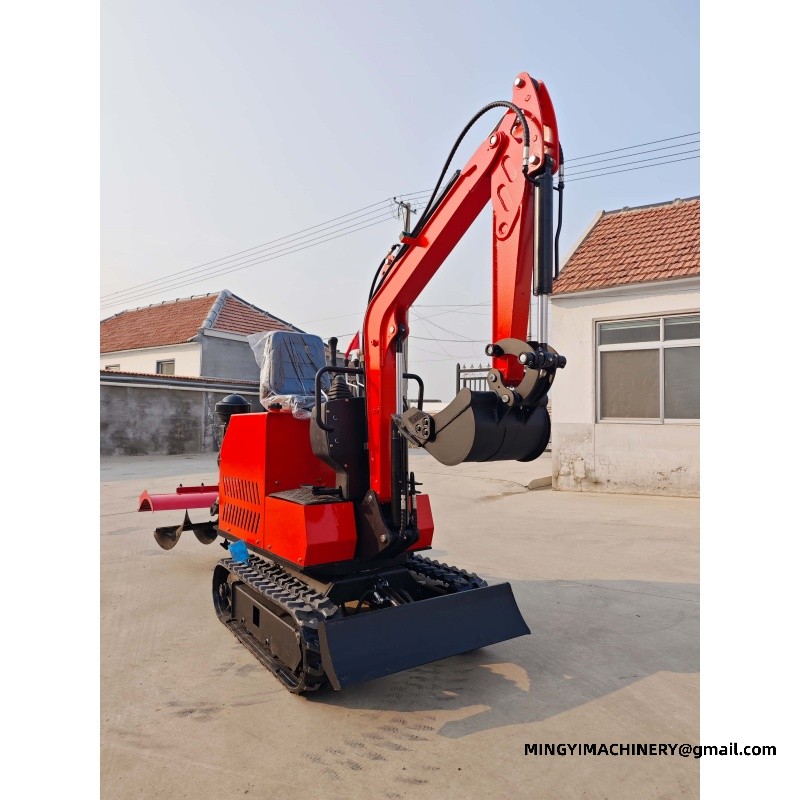
Applications
• Drainage and ditch maintenance followed by cultivation
• Orchard and vineyard row preparation
• Small plot and terrace soil preparation
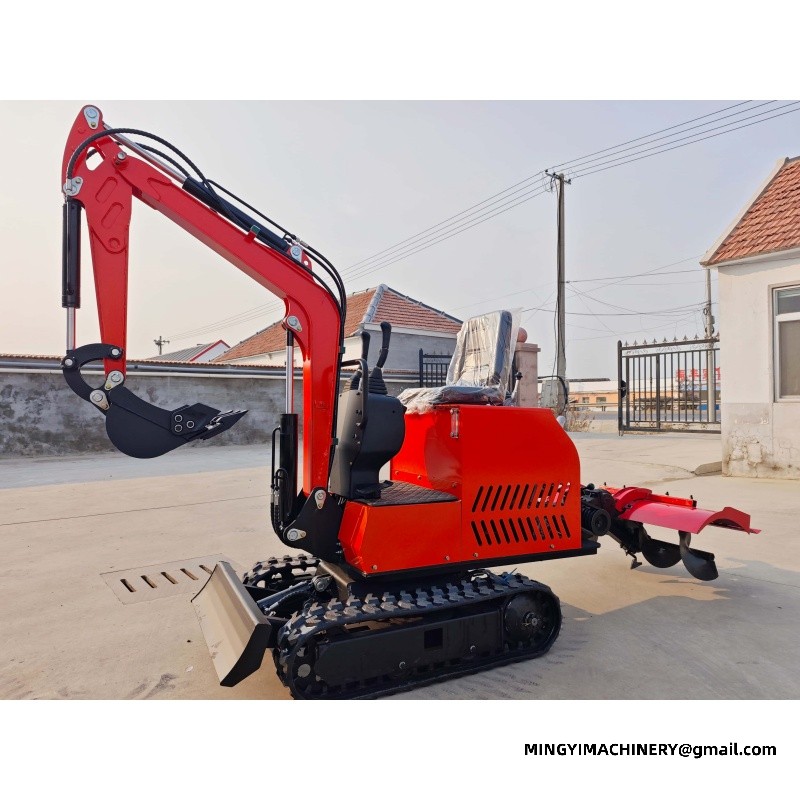
• Planting hole and trench preparation
• Clearance of scrub and ground before cultivation
Tell us the crop, plot size and ground conditions and we will confirm the machine and attachment combination for it.
Hiring versus owning a Multi-function Mini Digging and Rotary Ploughing Machine Combination The choice follows the hours. Work that fills a few weeks a year is usually better hired, while this class of machine that would be on site most weeks starts to justify ownership once the transport and booking time is counted. Availability is part of the decision. Owning the unit in daily use means it is there on the day the ground is ready; hiring means competing for the same machine at the same time as everyone else in the season. Working near live services with Multi-function Mini Digging and Rotary Ploughing Machine Combination Digging near water, gas and cable is a precision job. A machine of this size is used here because the operator can work in short controlled cuts and because the machine can be positioned without driving over the run being exposed. Utility crews specify the equipment on site with a narrow bucket and good visibility for exactly this reason: the machine has to stop at the service, not at the edge of the operator's view. Landscaping and ground care with Multi-function Mini Digging and Rotary Ploughing Machine Combination Landscape contractors use the machine itself for planting holes, pond excavation, grading and retaining work. The machine is light enough to cross finished lawn and narrow enough to work between established trees. On soft landscape work the surface is the constraint. The model in question on rubber tracks crosses turf without stripping it, which is why the same jobs are not given to a wheeled machine. What owners should plan for beyond the Multi-function Mini Digging and Rotary Ploughing Machine Combination Purchase decision is the visible part of the effort. Fuel, filters, tracks or tyres, the operator and the transport between sites are the items that decide what the machine in that duty actually demands over a few seasons, and they are worth listing before the order. Downtime is the hidden line item. The unit on the job waiting on a part earns nothing while it stands, so parts availability and service access belong in the plan as much as fuel does. Interior and light demolition with Multi-function Mini Digging and Rotary Ploughing Machine Combination Breaking out a floor slab, a wall footing or a concrete step is routine work for a machine built for the work with a breaker. The machine is small enough to work inside and heavy enough to run the tool at a practical rate. Dust, debris clearance and floor loading all argue for a compact machine indoors. The equipment in service spreads its weight over a wider track footprint than a wheeled machine of similar capacity. Lifting and material handling with this class of machine Lifting with a machine built to dig needs a plan. The load, the radius and the ground under the machine of this size all matter, and the safe figure is the one on the chart rather than the one that looks possible. Stability changes with reach. A load the unit in daily use handles close in becomes a different proposition at full extension, so the working radius belongs in the plan before the lift rather than during it. Parts, service and support for the equipment on site Engine parts availability usually drives the engine choice. The machine itself built with an engine the local network already carries is serviced from stock rather than from an international order. Remote support is handled by video. The model in question fault can often be diagnosed on a walk-around call with the panel open, which is faster than waiting for a visit and avoids shipping a part that is not needed. Canopy or enclosed cab on the machine in that duty The cab decision follows the climate and the hours. Operators working a full shift in the unit on the job benefit from a sealed cab with wipers and heating; operators stepping on and off every few minutes usually prefer the canopy for the visibility and the quick exit. Enclosure also changes noise and dust exposure. A sealed cab on a machine built for the work keeps dust out on dry sites and lets the machine work through weather that would otherwise stop a canopy machine for the day. Working the equipment in service in confined spaces Clearance above matters as much as around. Door heights, pipework and overhead services set the limit for this class of machine indoors, and measuring them first avoids a machine that arrives and cannot be used. Ventilation is the other indoor constraint. Running the unit in daily use inside a closed structure needs air movement, and that is a planning item rather than something to discover after the first hour. Acceptance checks when a machine of this size arrives A function check before the machine goes to work is worth the hour. Running through the controls, the travel and the attachment circuit on the equipment on site confirms it is set up as specified and ready for the site. Documentation should arrive with the machine. Parts list, service schedule and any certificates for the machine itself are what the workshop needs later, and they are much easier to obtain at delivery than in month six. Noise, dust and working near occupied buildings Work near housing or occupied premises brings constraints that open sites do not. Start times, exhaust condition and how often the model in question needs to reverse are the practical limits that neighbours notice. Dust control is often part of the same conversation. Water, timing and work sequence reduce what leaves the site, and agreeing them in advance keeps the machine in that duty working rather than stopped after a complaint. Specification data for the unit on the job Buyers comparing a machine built for the work usually start from four numbers - weight, digging depth, reach and transport width - because those are the ones that decide whether the machine can be delivered and whether it can do the job once it is there. Every value shown is as built for the equipment in service; options such as cab, side swing or a telescopic undercarriage change the transport dimensions and are confirmed at order stage. Extended and offset boom configurations change reach and working range. This class of machine with a longer arm reaches further but lifts less at full extension, so the specification is set against the deepest and furthest point on the job list. Detachable boom sections are used where transport length matters. The unit in daily use that has to travel on a standard trailer can be built so the arm comes off for the road and goes back on at the site.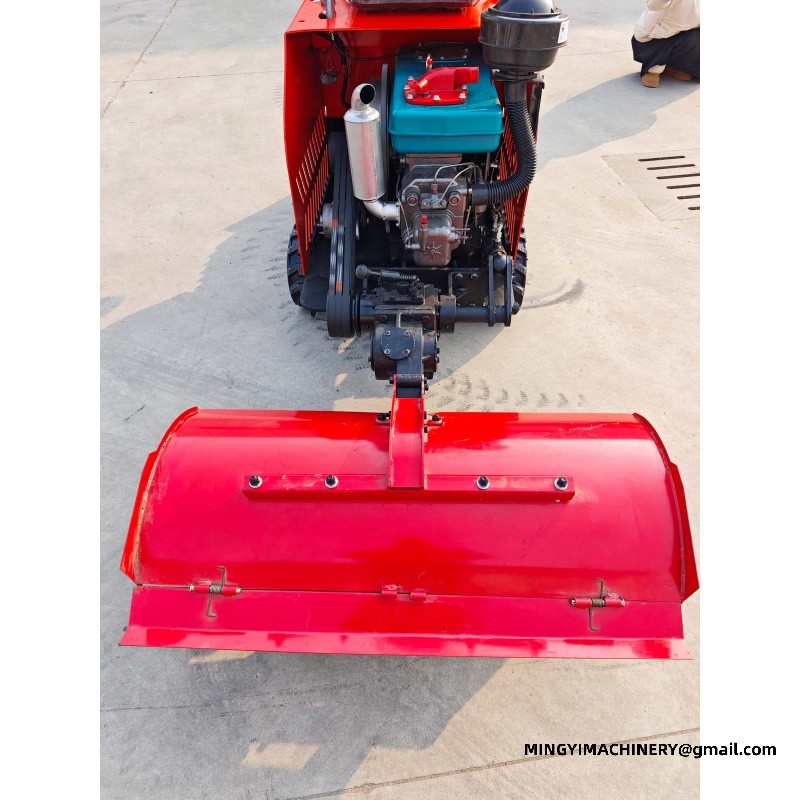
Reference specification — mini excavator range 12W 15W 20-3W 30-2L Operating weight 1200 kg (2645.55 lb) 1400 kg (3086.47 lb) 1900 kg (4188.78 lb) 2400 kg (5291 lb) Transport size (L×W×H) 2200 × 930 × 2250 mm 2200 × 930 × 2250 mm 2550 × 1100 × 2200 mm 2800 × 1500 × 2500 mm Max digging depth 1630 mm (64.17 in) 1630 mm (64.17 in) 1800 mm (70.87 in) 2200 mm (86.61 in) Max digging height 2750 mm (108.27 in) 2750 mm (108.27 in) 2820 mm (111.02 in) 2900 mm (114.17 in) Max dumping height 1960 mm (77.17 in) 1960 mm (77.17 in) 2050 mm (80.71 in) 2100 mm (82.68 in) Max digging radius 2900 mm (114.17 in) 2900 mm (114.17 in) 3050 mm (120.08 in) 3330 mm (131.1 in) Max digging distance 2100 mm (82.68 in) 2100 mm (82.68 in) 2300 mm (90.55 in) 2700 mm (106.3 in) Minimum turning radius 1300 mm (51.18 in) 1300 mm (51.18 in) 1450 mm (57.09 in) 1555 mm (61.22 in) Travel speed 3 km/h (1.86 mph) 3 km/h (1.86 mph) 5 km/h (3.11 mph) 7 km/h (4.35 mph) Gradeability 30° 30° 30° 30° Fuel consumption 1-1.3 L/h (0.264—0.343 gal) 1-1.3 L/h (0.264—0.343 gal) 2-3 L/h (0.528—0.793 gal) 2-3 L/h (0.528—0.793 gal) Fuel tank capacity 10 L (2.64 gal) 10 L (2.64 gal) 16 L (4.23 gal) 16 L (4.23 gal) Hydraulic oil tank 16 L (4.23 gal) 16 L (4.23 gal) 18 L (4.76 gal) 18 L (4.76 gal) Dozer blade lift height 180 mm (7.09 in) 180 mm (7.09 in) 180 mm (7.09 in) 230 mm (9.06 in) Dozer blade drop depth 210 mm (8.27 in) 210 mm (8.27 in) 210 mm (8.27 in) 280 mm (11.02 in)
Q. What is a rotary plough combination machine?
A. A compact crawler machine set up with a rotary plough for soil preparation, either as its main function or alongside a bucket set through a quick coupler. MINGYI matches the attachment to the machine's hydraulics at order stage.
Q. Which ground suits a plough combination?
A. Orchard rows, terraces, greenhouse and nursery beds and small plots where a wheeled tractor cannot operate. The crawler base spreads the weight and keeps traction on soft and sloping ground.
Q. Can one machine cover both ploughing and digging?
A. Yes, if it is ordered with a quick coupler and the full tooling list. That is how a contractor covers soil preparation and excavation with a single machine rather than buying two.
Cold weather and winter care for a machine of this size
A cold start is easier when the machine is prepared the night before. The routine that keeps the equipment on site working through winter is mostly a matter of fuel, battery and patience in the first ten minutes of the day.
Planning the season around the machine itself
Workload is rarely even across the year, and the machine should be specified for the busy weeks. The model in question sized only for the average month will be the limiting factor exactly when the work is worth the most.
Reading the early symptoms on the machine in that duty
Temperature and pressure are the two things worth watching. The unit on the job that runs hotter than it used to, or whose pressure has drifted, is reporting a problem that is still simple to fix.
E-mail : sales@mingycn.com
LINE ( ID ): mingyicn
Nameplate, serial number and documents for Multi-function Mini Digging and Rotary Ploughing Machine Combination
Engine, pump and axle numbers are recorded separately, because a machine can carry a different build of each within one model year.
A record of modifications matters as well, since an added hydraulic circuit or a changed attachment mount changes what the manual describes.
When a part is ordered, giving the serial number instead of the model name removes most of the guesswork.
Electrical system and battery care on Multi-function Mini Digging and Rotary Ploughing Machine Combination
Jump starting is a recovery rather than a repair, and the reason for the flat battery is worth finding the same day.
Related pages
Modification of Compact Small Excavator into Rotary Plough · reliable mini excavator manufacturer in China · enclosed cab mini excavator · PRODUCTS









