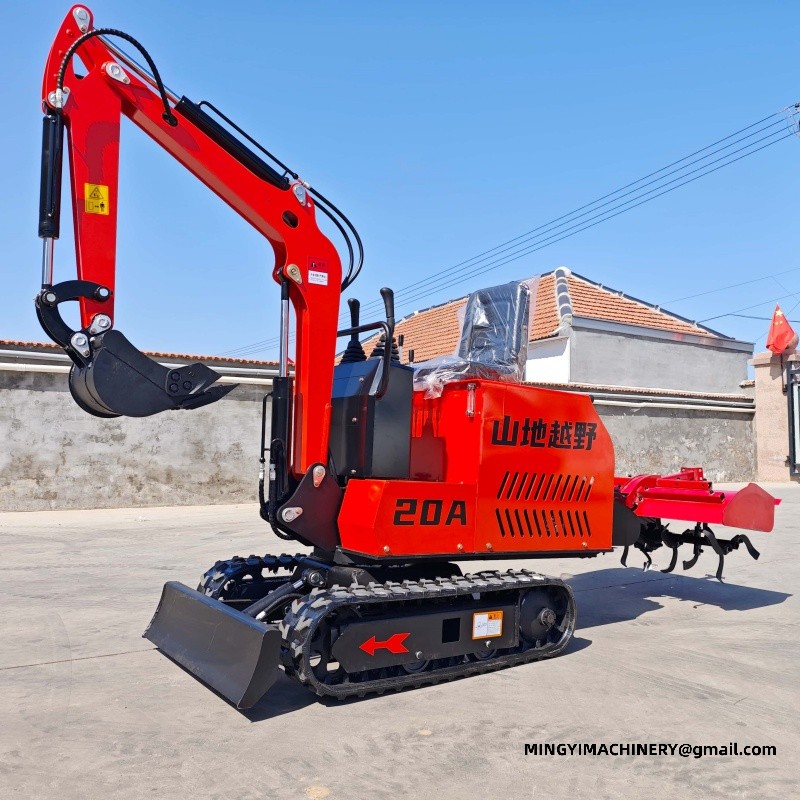
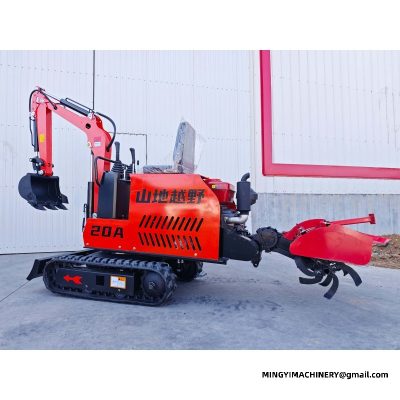
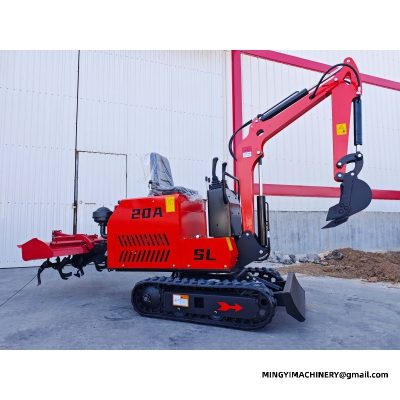
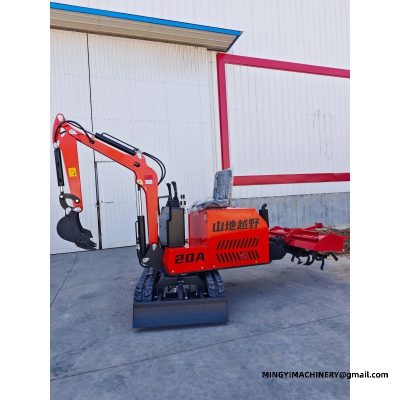
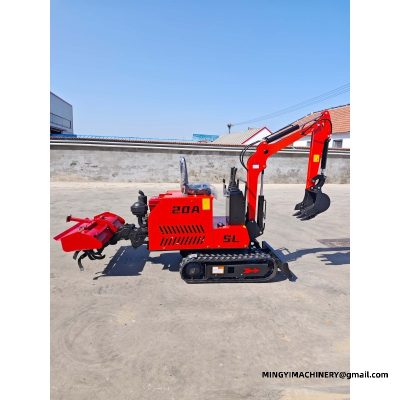
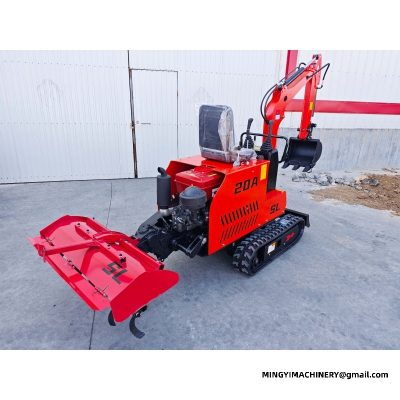
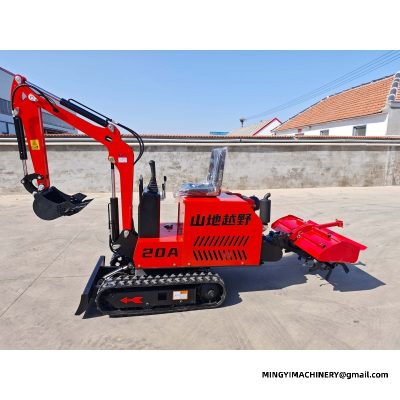
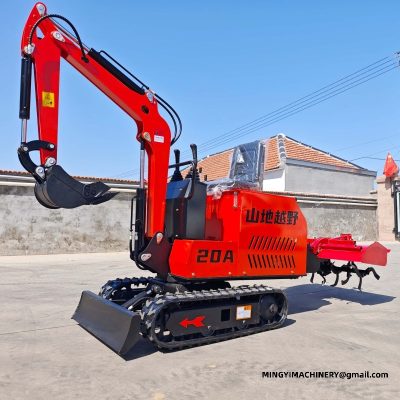
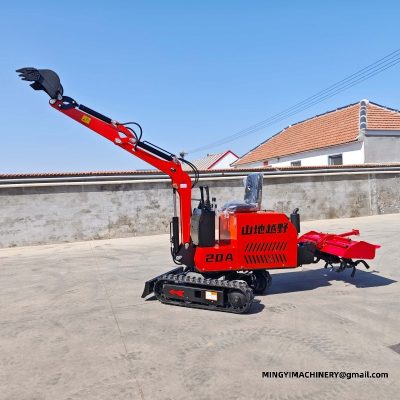
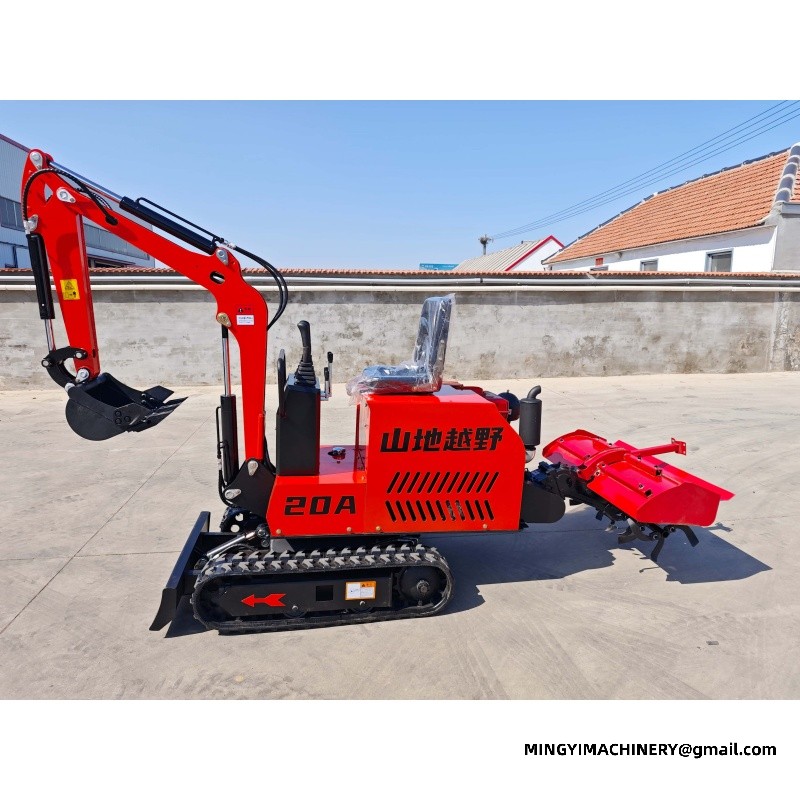
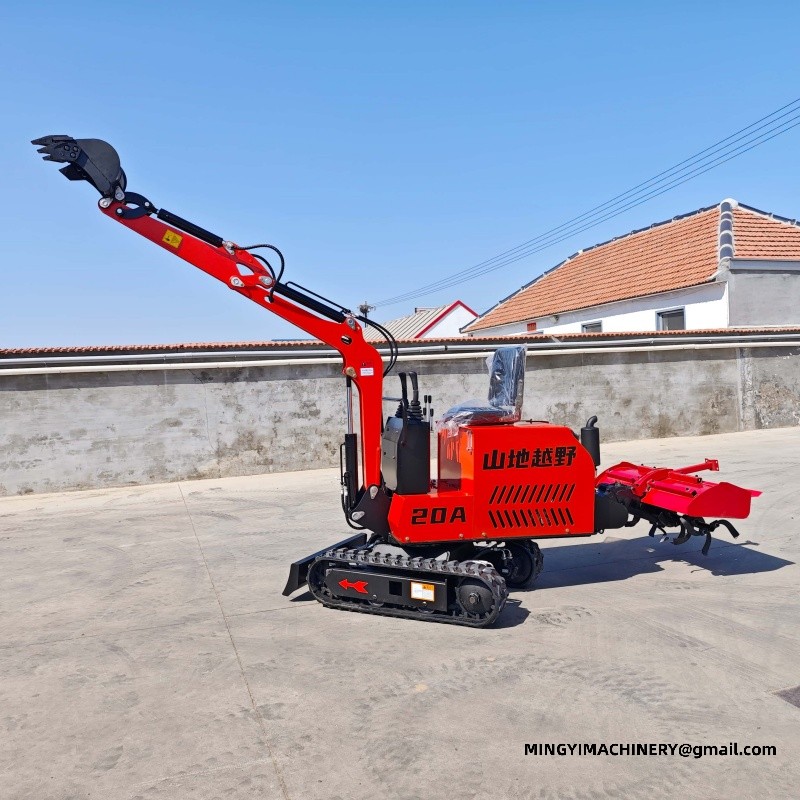
An excavator converted for rotary plough work becomes a dual-purpose machine: it cultivates soil when fitted with the plough and returns to excavation, trenching and breaking when the digging tool is refitted.
This conversion suits owners working ground that needs both drainage and cultivation within the same season.
The conversion in practice
The rotary plough mounts on the machine’s attachment interface in place of the bucket, driven from the excavator’s hydraulic system. The tracked undercarriage provides the traction, which is the key advantage on soft and sloping agricultural ground where wheeled implements lose grip.
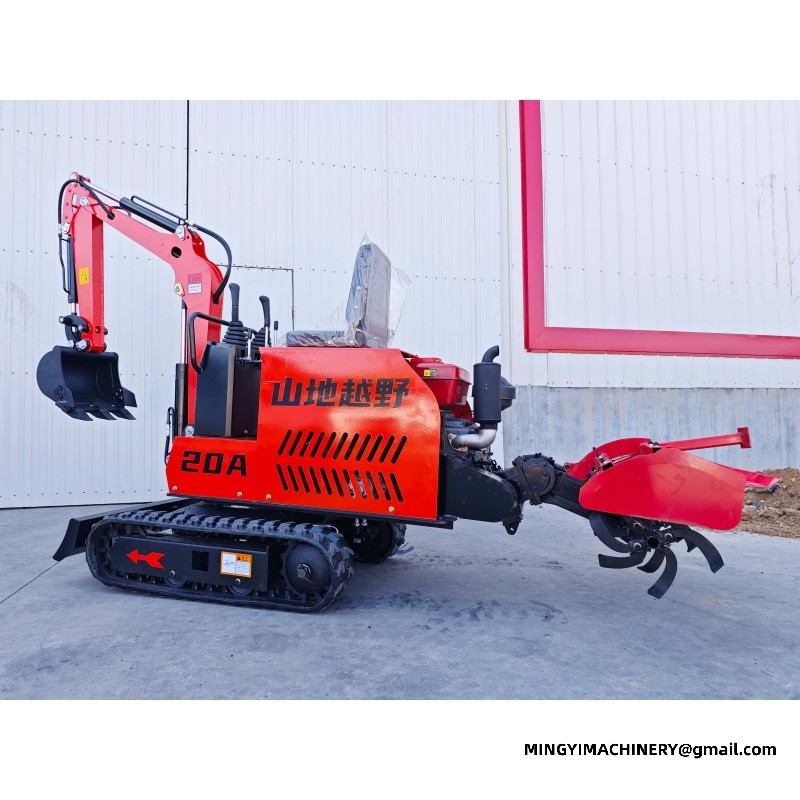
Because the change is a tool change, the machine is not committed to cultivation. Drainage work, ditch maintenance and ground clearance remain available on the same unit throughout the year.
Ground conditions that suit it
Small plots, orchard and vineyard rows, terraced ground and hillside fields are the typical applications. On all of them, the tracked machine’s traction and the compact size matter more than working width or speed.
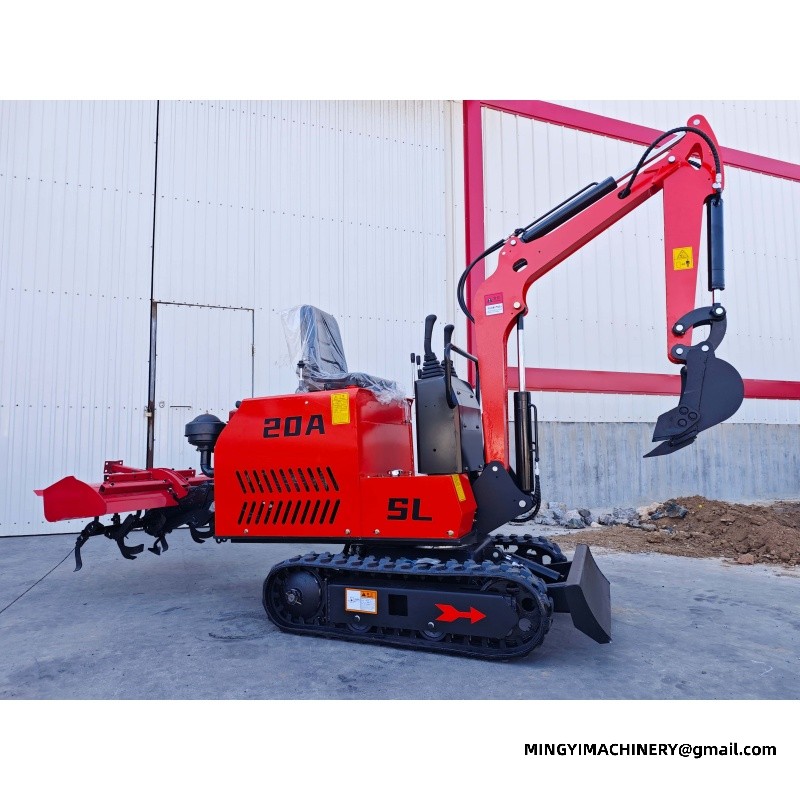
Where the conversion suits
• Holdings needing both drainage and cultivation
• Soft and wet ground where wheels lose traction
• Sloping and terraced plots
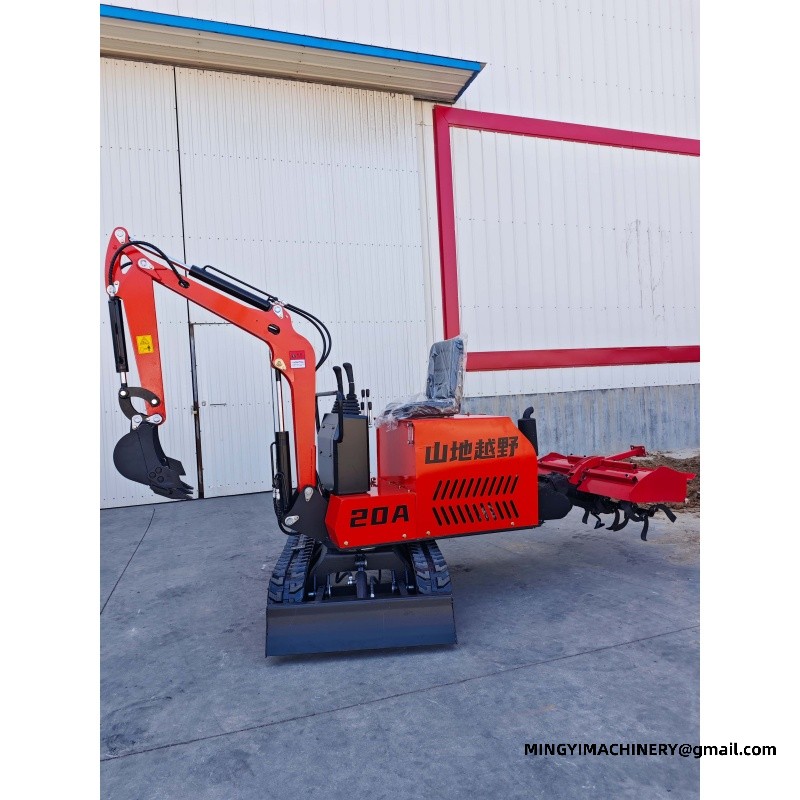
• Orchard and vineyard rows
• Owners wanting cultivation without a second machine
Tell us your excavator model, the crop and the ground and we will confirm the conversion and attachment.
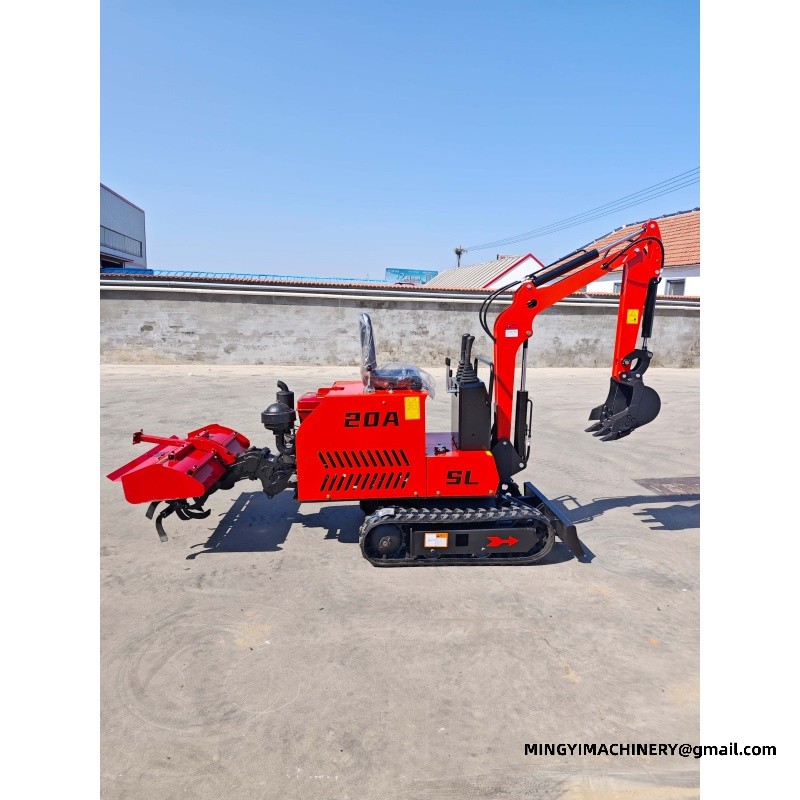
Hydraulic circuits on a Modification of Excavator to Rotary Plough Auxiliary hydraulic lines are what let a machine drive a tool rather than only a bucket. This class of machine specified with the right circuits and flow runs a breaker or an auger without an add-on power pack bolted to the frame. Flow and pressure are matched to the tool, not to the machine size. Asking for the attachment list first means the unit in daily use leaves the factory with circuits that suit the heaviest tool the buyer intends to run. Quick coupler practice on Modification of Excavator to Rotary Plough A quick coupler is the single option that changes how a machine is used day to day. Fitted to a machine of this size, it turns an attachment change from a two-person workshop job into a task the operator does alone in minutes. Couplers are specified early because they affect the arm and the hydraulic kit. Adding one to the equipment on site after delivery means new pins, new hoses and a fitment session; adding it at build time is a line on the sheet. Noise, dust and working near occupied buildings Work near housing or occupied premises brings constraints that open sites do not. Start times, exhaust condition and how often the machine itself needs to reverse are the practical limits that neighbours notice. Enclosure and machine condition both reduce noise. The model in question with intact panels, sound mounts and a maintained exhaust is measurably quieter than the same machine with loose guards, and the difference matters on restricted sites. Track choice for Modification of Excavator to Rotary Plough Rubber tracks suit paved and landscaped ground because they spread the machine weight and leave the surface intact. Steel tracks with rubber blocks are specified where the ground is rougher or the working day is longer, and the choice can be made per machine rather than accepted as a factory default. Undercarriage selection is a ground question, not a preference question. The machine in that duty running on finished paving needs rubber; the same machine on demolition rubble or rock wears rubber quickly, so steel with rubber blocks becomes the better answer over a full season. Acceptance checks when a Modification of Excavator to Rotary Plough arrives A function check before the machine goes to work is worth the hour. Running through the controls, the travel and the attachment circuit on the unit on the job confirms it is set up as specified and ready for the site. Documentation should arrive with the machine. Parts list, service schedule and any certificates for a machine built for the work are what the workshop needs later, and they are much easier to obtain at delivery than in month six. Working on slopes and uneven ground with the equipment in service Slope work is a stability question before it is a traction question. Knowing the gradient this class of machine is rated for, and working across rather than straight up where the ground allows, removes most of the risk. Planning the direction of travel helps. Working so that the unit in daily use is stable under load and not required to turn on a slope is a decision made before the job starts, not a correction made during it. Working a machine of this size in confined spaces Confined sites are decided by dimensions. Overall width, tail swing and the space needed to work the arm are what let the equipment on site operate inside a building, between walls or in a courtyard. Clearance above matters as much as around. Door heights, pipework and overhead services set the limit for the machine itself indoors, and measuring them first avoids a machine that arrives and cannot be used. Interior and light demolition with the model in question Breaking out a floor slab, a wall footing or a concrete step is routine work for the machine in that duty with a breaker. The machine is small enough to work inside and heavy enough to run the tool at a practical rate. Dust, debris clearance and floor loading all argue for a compact machine indoors. The unit on the job spreads its weight over a wider track footprint than a wheeled machine of similar capacity. Specifying a machine built for the work against a job list The practical way to specify is to write the job list first: the narrowest access, the deepest trench, the heaviest tool and the surfaces the machine must cross. The equipment in service is then matched to those four numbers. Useful information to send with an enquiry includes working width, required digging depth, ground conditions and the attachment set. Those four items let the factory specify this class of machine that fits rather than a generic build. Running the unit in daily use in a rental fleet Rental fleets buy for utilisation, not for a single job. A machine of this size with a quick coupler and a common attachment standard is hired more often because it suits more of the calls that come in. Fleet buyers also weigh transport. The equipment on site that a customer can tow on a normal licence and a standard trailer is a hire that does not need a delivery truck, which changes how often it goes out. Getting the machine itself through a narrow gap The first question on most job lists is whether the machine can reach the work at all. The model in question is chosen against the narrowest point on the route - a garden gate, a doorway, a gap between two walls - because a machine that arrives and then cannot pass loses a day, not an hour. Access decides the machine before output does. With the machine in that duty the limiting dimension is usually the widest point on the way in, so measuring the gate, the corridor and the turning space first saves a wasted delivery and a second visit. Specification data for the unit on the job Where a machine built for the work is being specified for a job list, the table below gives the factory figures that matter most: what the machine weighs, how deep and how far it works, and what it measures on a trailer. These are the reference figures for the equipment in service. MINGYI confirms the final build sheet, including engine and attachment choices, against the destination and the job list before production. The useful comparison is demand per working hour, not demand per machine. This class of machine that works more hours a year spreads its standing takes over more output, which is why utilisation usually matters more than the invoice figure. Downtime is the hidden line item. The unit in daily use waiting on a part earns nothing while it stands, so parts availability and service access belong in the plan as much as fuel does.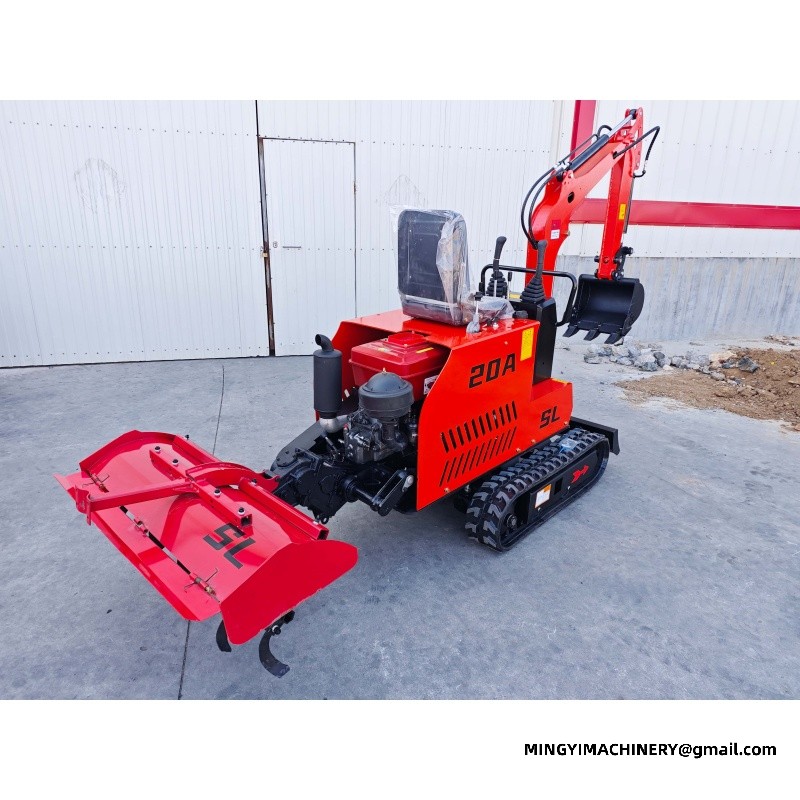
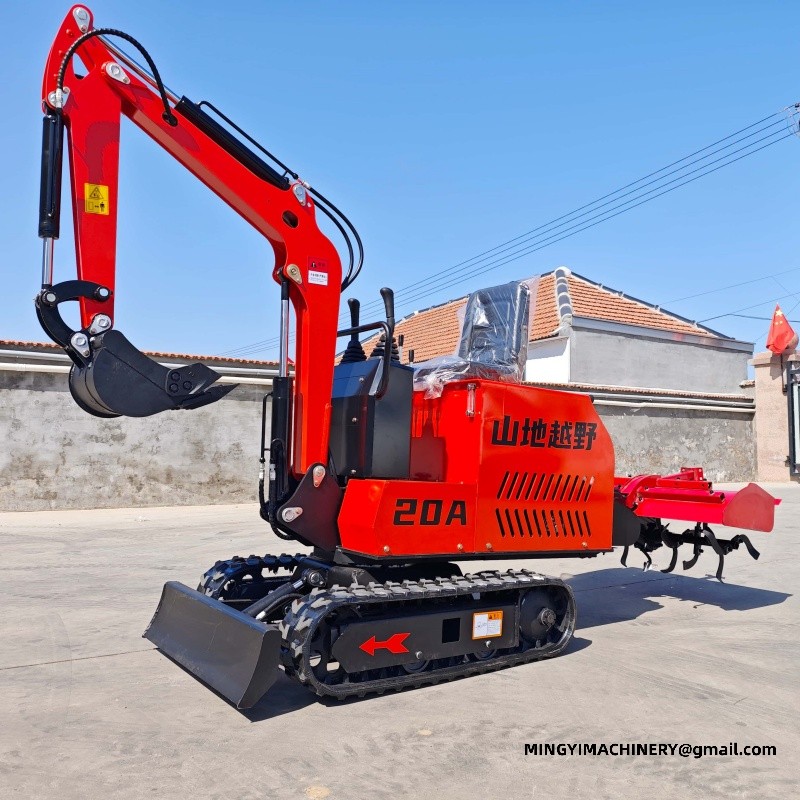
Reference specification — mini excavator range 20-1W 30-1W 15L 30-2L Operating weight 1800 kg (3968.32 lb) 2900 kg (6393.41 lb) 1400 kg (3086.47 lb) 2400 kg (5291 lb) Transport size (L×W×H) 2550 × 1100 × 2200 mm 3000 × 1250 × 2780 mm 2200 × 930 × 2250 mm 2800 × 1500 × 2500 mm Max digging depth 1800 mm (70.87 in) 2200 mm (86.61 in) 1700 mm (66.93 in) 2200 mm (86.61 in) Max digging height 2820 mm (111.02 in) 3400 mm (133.86 in) 2750 mm (108.27 in) 2900 mm (114.17 in) Max dumping height 2050 mm (80.71 in) 2400 mm (94.49 in) 1960 mm (77.17 in) 2100 mm (82.68 in) Max digging radius 3050 mm (120.08 in) 4000 mm (157.48 in) 2900 mm (114.17 in) 3330 mm (131.1 in) Max digging distance 2300 mm (90.55 in) 2800 mm (110.24 in) 2300 mm (90.55 in) 2700 mm (106.3 in) Minimum turning radius 1450 mm (57.09 in) 2000 mm (78.74 in) 1450 mm (57.09 in) 1555 mm (61.22 in) Travel speed 5 km/h (3.11 mph) 5 km/h (3.11 mph) 3 km/h (1.86 mph) 7 km/h (4.35 mph) Gradeability 30° 30° 30° 30° Fuel consumption 2-3 L/h (0.528—0.793 gal) 2-3 L/h (0.528—0.793 gal) 1-1.3 L/h (0.264—0.343 gal) 2-3 L/h (0.528—0.793 gal) Fuel tank capacity 16 L (4.23 gal) 16 L (4.23 gal) 10 L (2.64 gal) 16 L (4.23 gal) Hydraulic oil tank 18 L (4.76 gal) 20 L (5.28 gal) 16 L (4.23 gal) 18 L (4.76 gal) Dozer blade lift height 180 mm (7.09 in) 420 mm (16.54 in) 180 mm (7.09 in) 230 mm (9.06 in) Dozer blade drop depth 210 mm (8.27 in) 210 mm (8.27 in) 210 mm (8.27 in) 280 mm (11.02 in)
Q. Can a mini excavator be converted to a rotary plough?
A. Yes. A compact crawler machine can be set up with a rotary plough for soil preparation, and MINGYI will match the attachment to the machine's hydraulic circuit when the order is placed. That is why the tooling list needs to be settled before the machine is built.
Q. What work does a converted machine suit?
A. Orchard, terrace, greenhouse and nursery ground where a wheeled tractor cannot be driven or cannot turn. The crawler base spreads the machine weight and holds traction on soft and sloped ground that a tractor either sinks into or cannot climb.
Q. Can the machine still be used for digging?
A. Yes, if it is ordered with a quick coupler, because the plough can then be exchanged for a bucket set on site. Contractors who need both functions order the coupler and the full tooling list together rather than adding to the machine later.
Wear items and spares worth holding for a machine of this size
A spares list should follow the duty cycle. The equipment on site working every day in abrasive dust consumes filters and cutting edges far faster than the same machine used once a week, and the shelf should be stocked for the harder case.
Moving the machine itself between sites
Travel time is not working time, and it should be planned as its own item. The hours spent moving the model in question between jobs are hours not worked, and a trailer that matches the machine reduces them every single trip.
Documents that travel with the machine in that duty
Keeping the documents together is part of ownership. The manual, the service record and the build sheet for the unit on the job belong in one folder, and the machine is easier to sell later when that folder is complete.
E-mail : sales@mingycn.com
LINE ( ID ): mingyicn
Visibility and blind spots around Modification of Excavator to Rotary Plough
Mirrors, cameras and a signal person cover what the seat cannot. Walk the route before the first load and mark the corners where sight is lost.
Glass, wipers and mirrors are safety items rather than comfort items, and they belong on the daily walk-around with the lights and the horn.
Reverse alarms and beacons fail quietly, and testing them takes a minute whenever the machine changes site.
Related pages
Modification of Mini-Miner to Rotary Ploughing Machine · mini digger for trenching · mini excavator wholesale supply · PRODUCTS









