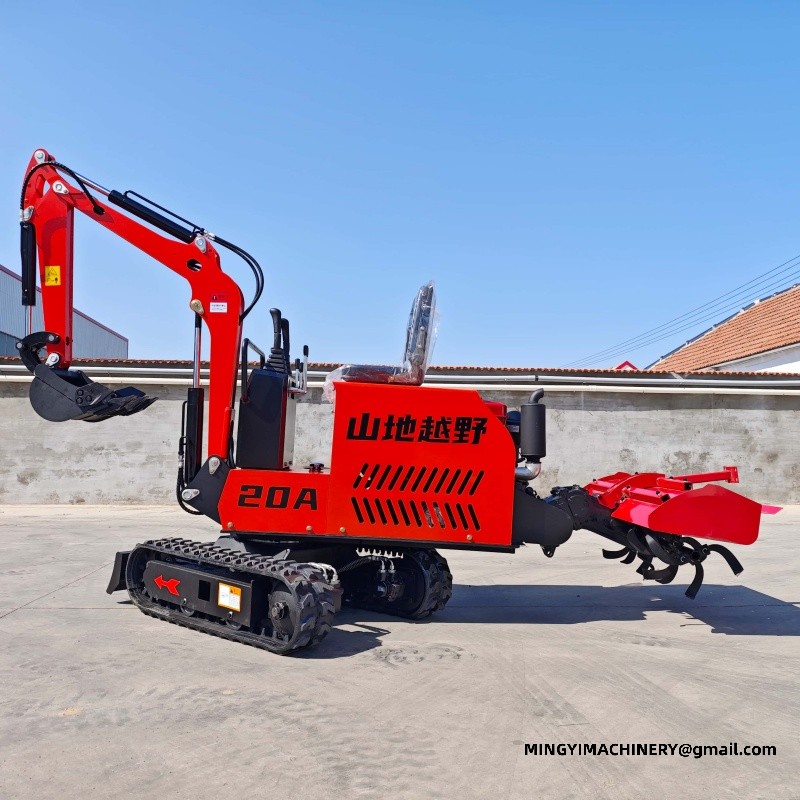
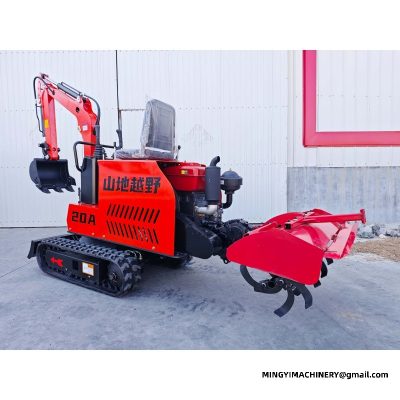
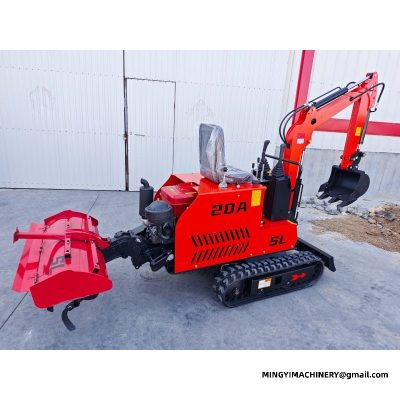
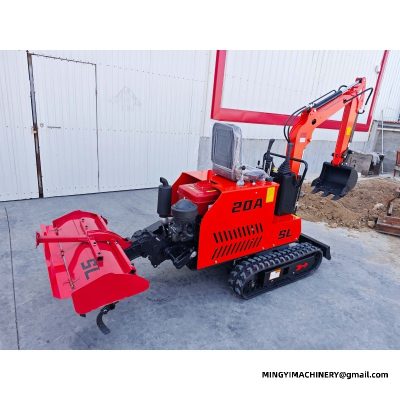
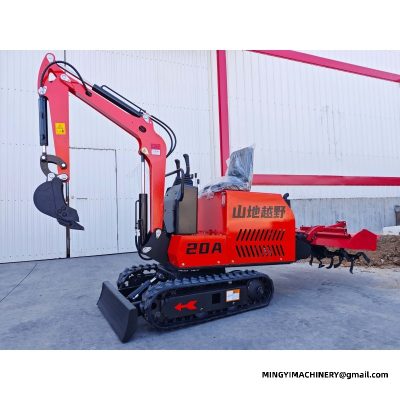
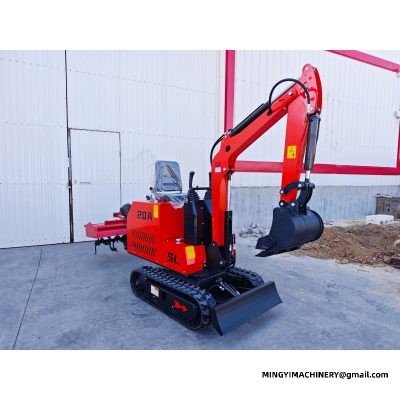
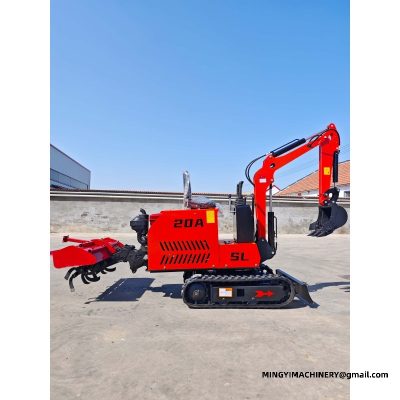
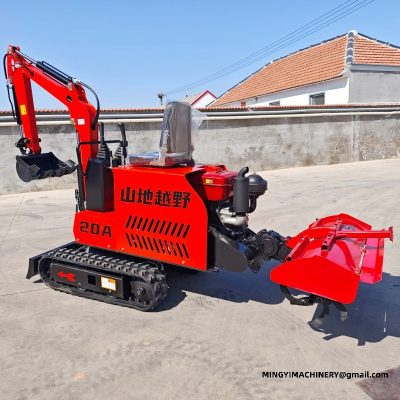
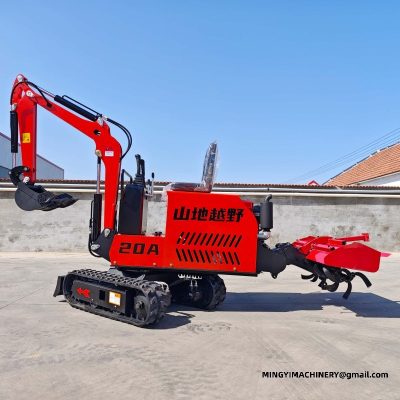
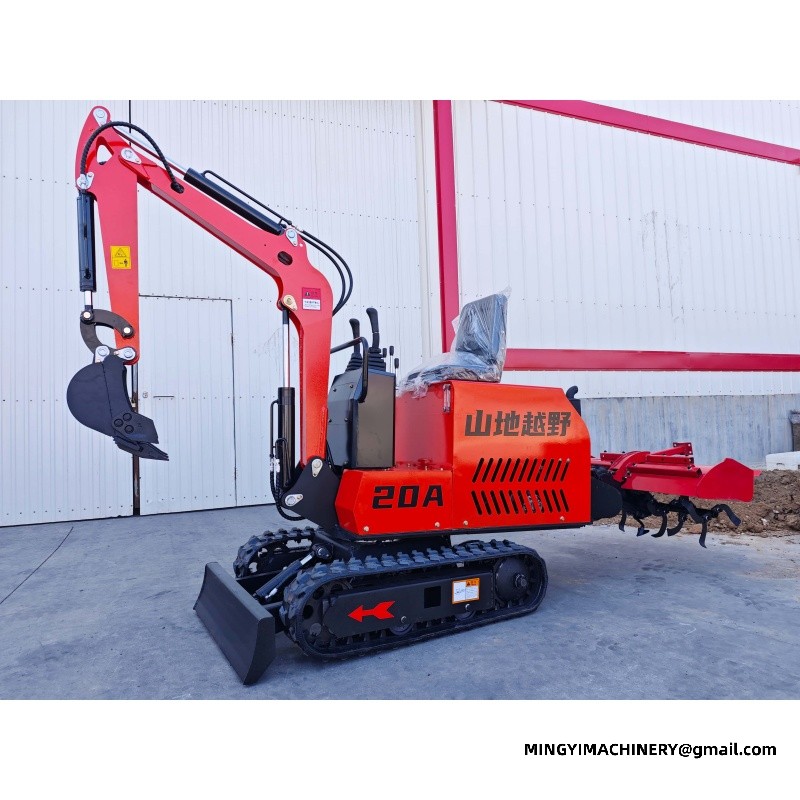
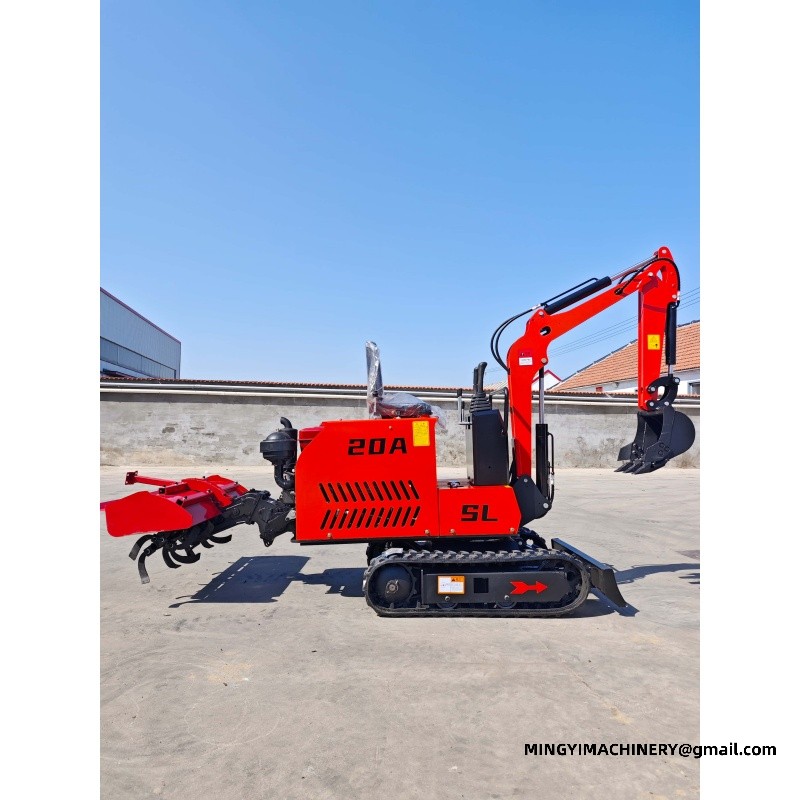
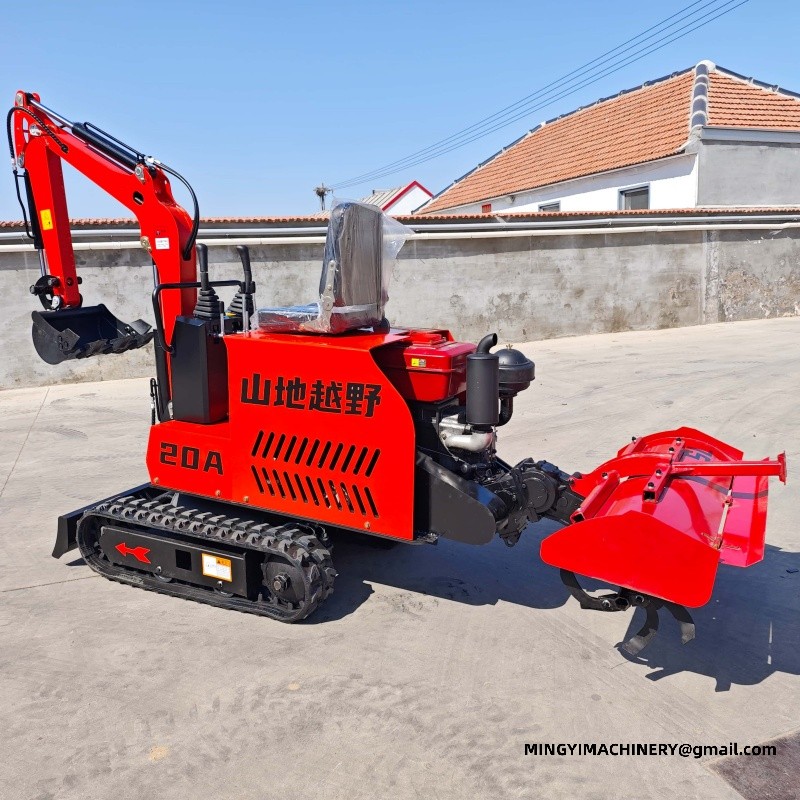
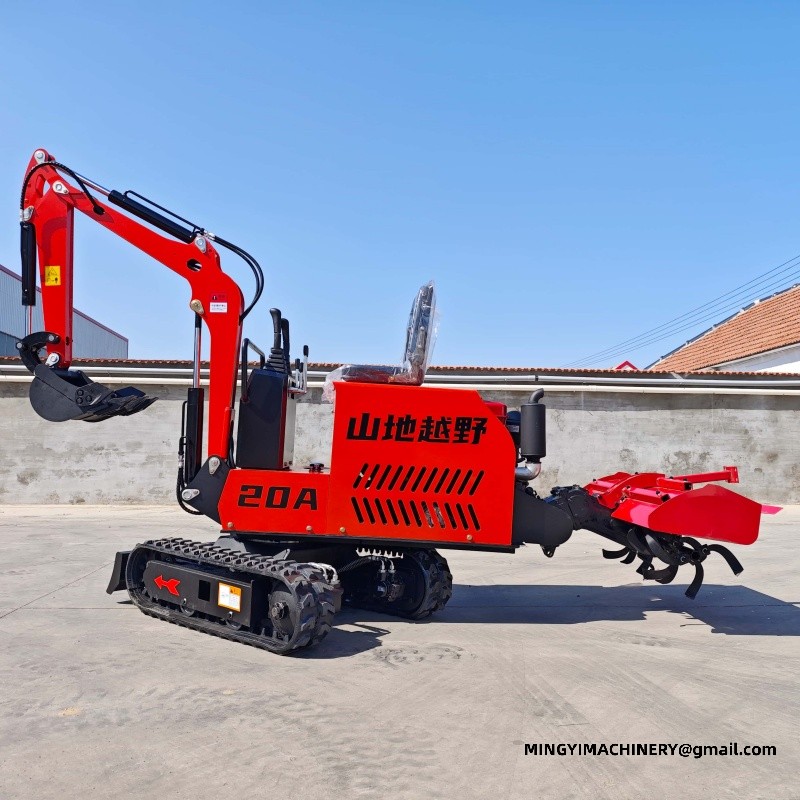
A compact digger already carries three of the things a ploughing machine needs: a diesel engine, a tracked undercarriage and hydraulic power to an attachment mount. Fitting a rotary plough to that mount turns the digger into a soil-preparation machine as well.
MINGYI supplies the attachment and the machine configuration for this conversion.
Practical advantages of the conversion
One machine then covers the drainage and the cultivation on the same ground, which is how small plots, orchards and terraces are usually managed. The owner avoids buying and maintaining a second engine, a second undercarriage and a second transport arrangement.
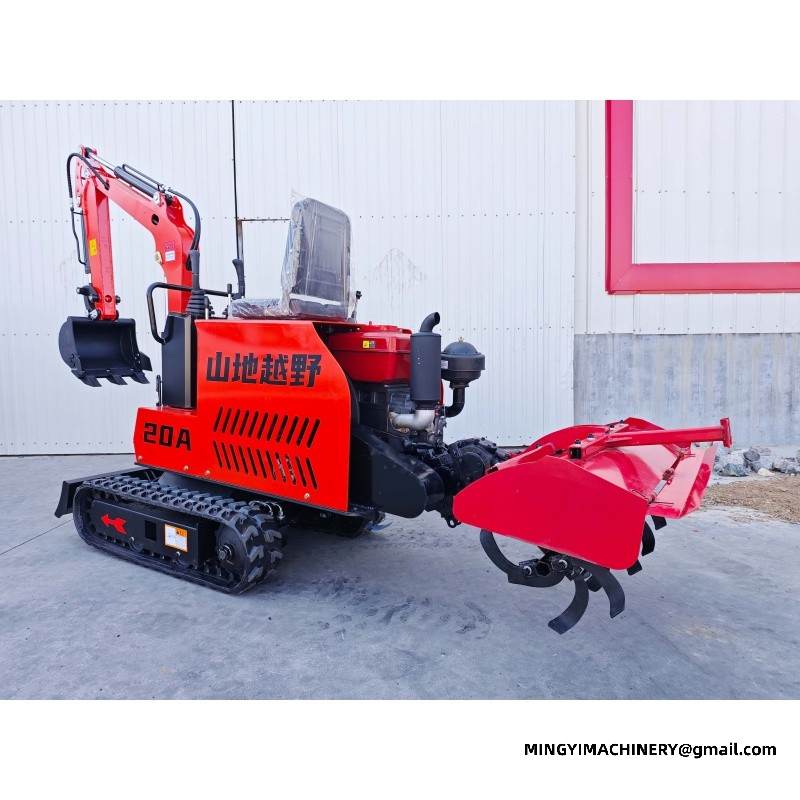
The tracked undercarriage is the decisive factor. On the wet, soft and sloping ground where these plots sit, a tracked machine keeps grip where a wheeled implement slips.
Returning to digging work
The plough is fitted in place of the digging tool, so the machine can be returned to excavation, trenching, ditching and breaking whenever those jobs come up. Nothing about the conversion commits the machine permanently to cultivation.
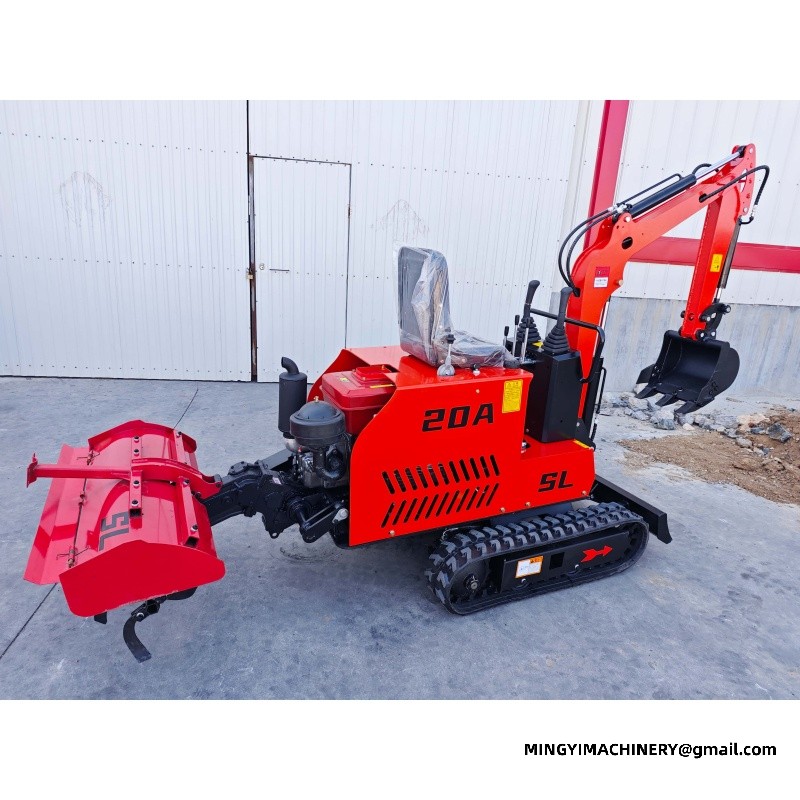
Conversion summary
• Uses the digger’s engine, traction and hydraulics
• Cultivation and drainage covered by one machine
• Tool change returns the machine to digging
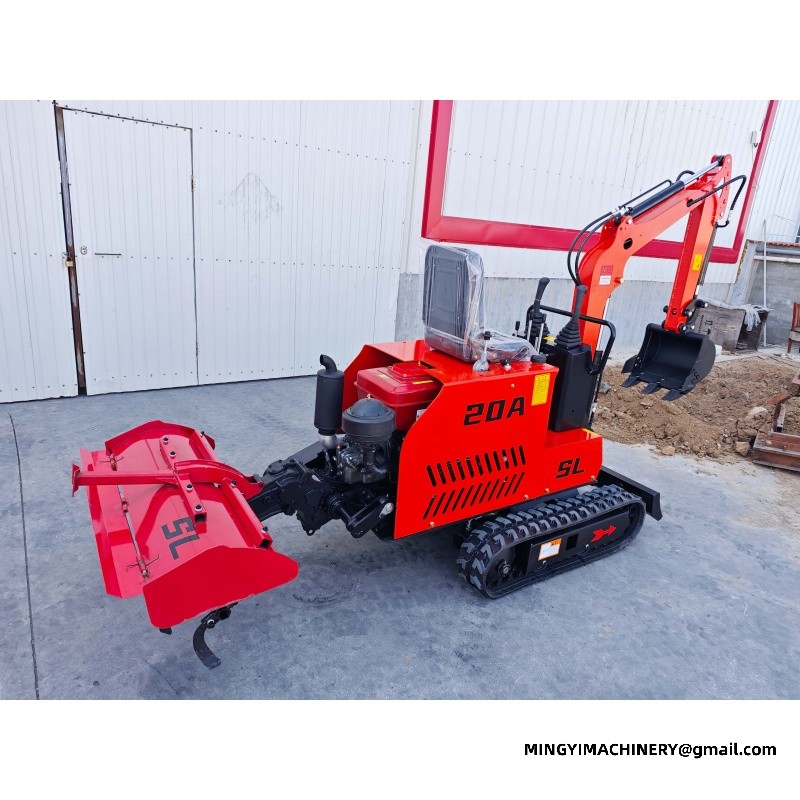
• Effective traction on soft and sloping ground
• Compact size for small plots and orchard rows
Tell us the digger model and the soil work you need and we will confirm the plough specification and fitment.
Daily checks and maintenance on Modification of Mini-Miner to Rotary Ploughing Machine Daily maintenance on this class of machine is a short list: engine oil level, coolant, track tension, hydraulic oil level and a look at the hoses. Ten minutes at the start of the shift prevents most of the failures that stop a machine. Greasing is the second item. The slew ring, the boom and arm pins and the bucket linkage on the unit in daily use take grease daily in dusty work, and the intervals shorten further when the machine is used in water or mud. Working a Modification of Mini-Miner to Rotary Ploughing Machine through the seasons Seasonal planning smooths the workload. Machines that are busy for a few months and idle for the rest benefit from a service slot in the quiet period, and a machine of this size prepared in the off-season starts the busy months reliably. Heat and dust are as limiting as rain. Air intake condition and cooling cleanliness decide how the equipment on site behaves in a dry season, and both are checked in a minute rather than repaired later. Matching Modification of Mini-Miner to Rotary Ploughing Machine to ground conditions Hard and abrasive ground reverses the specification. On rock, demolition rubble or sharp gravel, steel tracks with rubber blocks on the machine itself survive conditions that cut a rubber belt quickly. Mixed sites are common and argue for a compromise specification. Most buyers choose rubber for the model in question and accept the wear, unless the majority of the work is on material that will damage it. Municipal and public works with Modification of Mini-Miner to Rotary Ploughing Machine Drainage repair, tree planting, footway reconstruction and cemetery work are all within the range of the machine in that duty. The jobs are small individually and continuous across the year. Noise and surface protection matter on public work. The unit on the job on rubber tracks across paving, with a sealed cab for the operator, suits the conditions better than a larger tracked machine. Hiring versus owning a Modification of Mini-Miner to Rotary Ploughing Machine The choice follows the hours. Work that fills a few weeks a year is usually better hired, while a machine built for the work that would be on site most weeks starts to justify ownership once the transport and booking time is counted. Ownership brings obligations that hiring does not. Storage, servicing, insurance and an operator are the items to set against the hire rate before deciding which way the equipment in service should be supplied. Trailering and moving this class of machine Transport weight and width decide whether a machine needs a specialist haulier. The unit in daily use sized to travel on a standard plant trailer behind a suitable vehicle moves with the crew rather than on a scheduled low loader. Detachable components reduce transport length. A machine of this size built with a removable arm section or a folding step fits a shorter trailer and may avoid an oversize movement permit. Export packing and shipping of the equipment on site Export documentation, decals and paint are settled before packing. Asking for them with the model in question order avoids a second handling session and keeps the machine on the booked vessel. Buyers who import regularly plan the spare parts with the machine. The machine itself ordered with a wearing-parts kit arrives ready to work rather than ready to wait for the first service interval. Noise, dust and working near occupied buildings Work near housing or occupied premises brings constraints that open sites do not. Start times, exhaust condition and how often the machine in that duty needs to reverse are the practical limits that neighbours notice. Dust control is often part of the same conversation. Water, timing and work sequence reduce what leaves the site, and agreeing them in advance keeps the unit on the job working rather than stopped after a complaint. Engine options behind a machine built for the work Power unit selection is settled against the service network the buyer already uses. MINGYI offers Kubota D722, Kubota D902, YANMAR, Changchai, Laidong, Runtong, YARMAX, Youpu 2V80 and Youpu 195, so a fleet running one brand of engine can keep the same filters, the same parts supplier and the same mechanic. Engine choice is also an emissions and documentation question for some markets. Listing the available units with the equipment in service enquiry lets the factory confirm what can be supplied and documented for the destination country. Boom configuration for this class of machine Extended and offset boom configurations change reach and working range. The unit in daily use with a longer arm reaches further but lifts less at full extension, so the specification is set against the deepest and furthest point on the job list. Detachable boom sections are used where transport length matters. A machine of this size that has to travel on a standard trailer can be built so the arm comes off for the road and goes back on at the site. Operator technique for the equipment on site The second habit is tool discipline. Running the machine itself with the right bucket width for the trench means less spoil, less reinstatement and a cleaner job than a wide bucket and a lot of trimming. Stability is the third. The model in question working across the tracks rather than over the corners keeps the machine steady and the undercarriage loaded evenly, which shows up as track life at the end of the season. Getting the machine in that duty through a narrow gap The first question on most job lists is whether the machine can reach the work at all. The unit on the job is chosen against the narrowest point on the route - a garden gate, a doorway, a gap between two walls - because a machine that arrives and then cannot pass loses a day, not an hour. Contractors who buy a machine built for the work normally have one job in mind that nothing else reaches. The purchase order follows the access measurement, not the other way round, and the build sheet is then settled around it. Specification data for the equipment in service The figures below are the factory figures for the models most often matched to this class of machine. They are the numbers to check against the site: the depth the work needs, the reach from one position, and the width of the narrowest point on the route in. Figures are factory figures and are confirmed on the build sheet for the unit in daily use. Where a job sits between two models, the larger machine usually takes less time than the smaller one spends on rework. Service trenches are the most common reason a machine of this size is hired. Water, sewage, cable and gas runs are narrow, shallow and often close to existing services, which is exactly the work a full-size machine cannot do safely. Depth control matters more on service work than speed. The equipment on site working beside live services is chosen because it can be placed precisely and stopped instantly, which is what the job actually requires.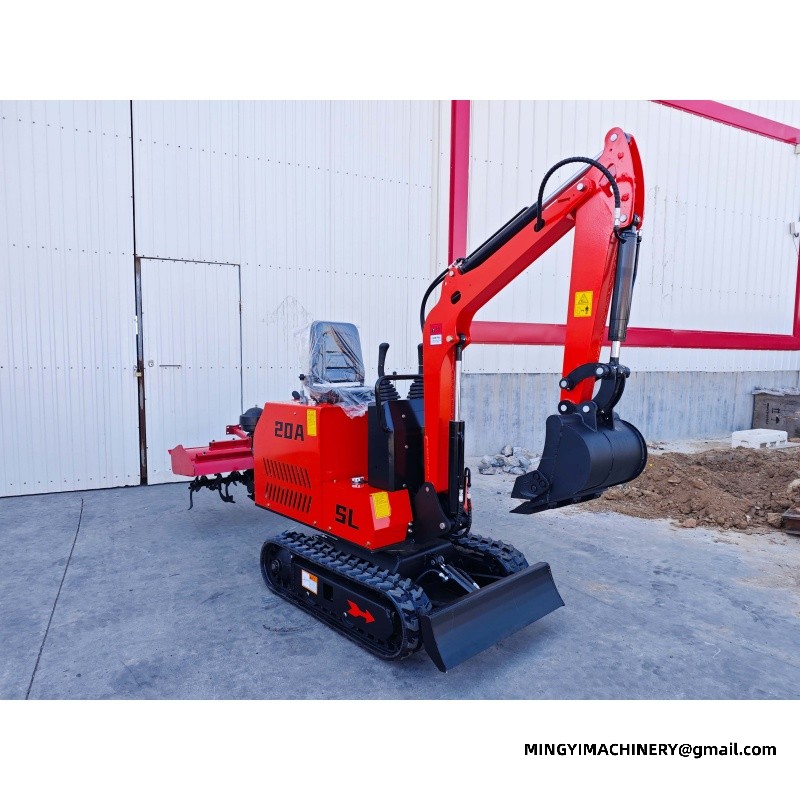
Reference specification — mini excavator range 12L 15L 20-2L 30-2L Operating weight 1200 kg (2645.55 lb) 1400 kg (3086.47 lb) 1900 kg (4188.78 lb) 2400 kg (5291 lb) Transport size (L×W×H) 2200 × 930 × 2250 mm 2200 × 930 × 2250 mm 2600 × 1300 × 2344 mm 2800 × 1500 × 2500 mm Max digging depth 1700 mm (66.93 in) 1700 mm (66.93 in) 2100 mm (82.68 in) 2200 mm (86.61 in) Max digging height 2600 mm (102.36 in) 2750 mm (108.27 in) 2880 mm (113.39 in) 2900 mm (114.17 in) Max dumping height 1800 mm (70.87 in) 1960 mm (77.17 in) 2100 mm (82.68 in) 2100 mm (82.68 in) Max digging radius 2900 mm (114.17 in) 2900 mm (114.17 in) 3215 mm (126.57 in) 3330 mm (131.1 in) Max digging distance 2300 mm (90.55 in) 2300 mm (90.55 in) 2460 mm (96.85 in) 2700 mm (106.3 in) Minimum turning radius 1450 mm (57.09 in) 1450 mm (57.09 in) 1587 mm (62.48 in) 1555 mm (61.22 in) Travel speed 3 km/h (1.86 mph) 3 km/h (1.86 mph) 5 km/h (3.11 mph) 7 km/h (4.35 mph) Gradeability 30° 30° 30° 30° Fuel consumption 1-1.3 L/h (0.264—0.343 gal) 1-1.3 L/h (0.264—0.343 gal) 2-3 L/h (0.528—0.793 gal) 2-3 L/h (0.528—0.793 gal) Fuel tank capacity 10 L (2.64 gal) 10 L (2.64 gal) 16 L (4.23 gal) 16 L (4.23 gal) Hydraulic oil tank 16 L (4.23 gal) 16 L (4.23 gal) 18 L (4.76 gal) 18 L (4.76 gal) Dozer blade lift height 180 mm (7.09 in) 180 mm (7.09 in) 180 mm (7.09 in) 230 mm (9.06 in) Dozer blade drop depth 210 mm (8.27 in) 210 mm (8.27 in) 210 mm (8.27 in) 280 mm (11.02 in)
Q. Can a mini excavator be set up as a plough machine?
A. Yes. A compact crawler machine can be built for soil preparation work with a plough attachment rather than excavation buckets, and MINGYI matches the attachment to the machine's hydraulics when the order is placed.
Q. Which ground suits this kind of machine?
A. Orchard rows, terraces, greenhouse ground and small plots where a wheeled tractor cannot be driven or cannot turn. The crawler base is what makes the machine usable on soft and sloped land.
Q. Can the machine do both jobs?
A. With a quick coupler, yes. The plough and the bucket set can be exchanged on site, so one machine covers soil preparation and excavation instead of two machines being needed for the same plot.
Moving the machine itself between sites
A machine that works on one site still has to reach the next. The overall dimensions and the operating weight of the model in question decide what trailer or truck is needed, and that decision belongs before the job is booked.
Documents that travel with the machine in that duty
A clear parts book saves more time than any other document. When the unit on the job needs a replacement, the illustration and the part number are what turn a phone call into a shipment instead of a description.
E-mail : sales@mingycn.com
LINE ( ID ): mingyicn
Heat and hydraulic temperature in Modification of Mini-Miner to Rotary Ploughing Machine
Continuous high-flow work in high ambient temperature is where a duty cycle helps, because a short pause every hour cools the system more than a long stop at midday.
Hoses age faster next to hot manifolds, so routing and clearance are checked at the same time as the oil level.
A temperature gauge that reads differently from week to week is itself a fault, and it is worth checking before the season turns.
Lifting, tie-down and transport securing of Modification of Mini-Miner to Rotary Ploughing Machine
The rated capacity of the crane and the slings is checked against the shipping weight of the machine rather than its working weight.
Related pages
mini digger for trenching · mini excavator for municipal utilities · mini excavator order process · PRODUCTS









