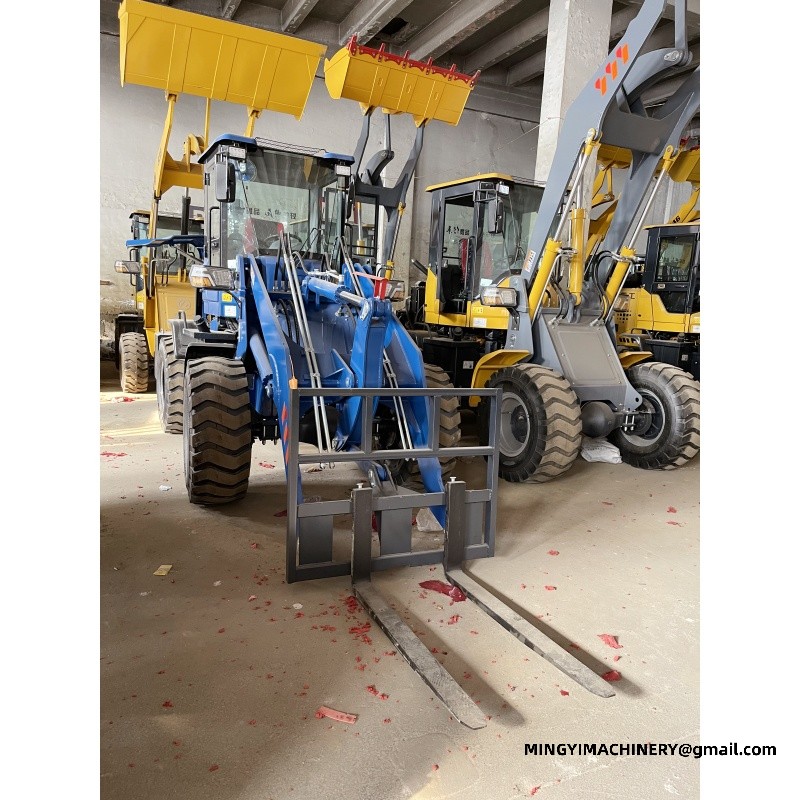
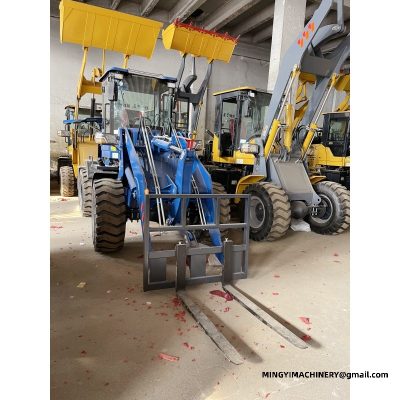
Three frame tiers, twenty-one documented builds, one parts package per tier: that is the whole wheel loader fork attachment range in a line. The tiers separate on boom section and hinge steel rather than on paint — 25 mm boom wall and 25 mm cross-member at the bottom, 25 mm and 25 mm on the heavier build — and the builds within a tier share cylinders, pumps and attachments. Buckets run 0.38 m³ to 0.38 m³ and dump heights 3.2 m to 3.2 m. Here is how to place yourself on that ladder.
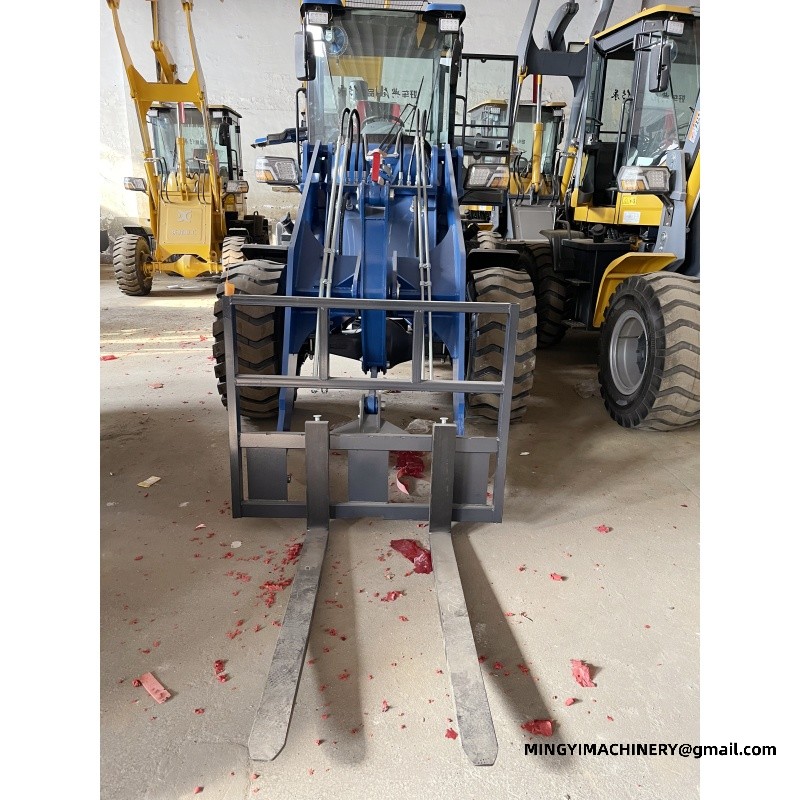
Breakout happens when the bucket is driven into the face and lifted, and it loads the boom in bending. The figures that resist it are wall 25 mm, width 370 mm, and the spacing between the two arms, 890 mm. A wider spacing spreads the load across the pins instead of concentrating it.
Length works against you here. A 2.3 m arm gives reach and height and multiplies the bending moment at the same time, which is why long-arm builds carry thicker walls. On the light-duty 3.8 m small-frame wheel-side reduction wheel loader the same comparison is 2.61 m of length against 25 mm of wall. Where the material is hard to break out, the shorter, thicker combination is usually the better machine.
Two loaders can carry the same bucket and behave nothing alike, and the boom is usually why. Compare the light-duty 3.5 m small-frame wheel-side reduction wheel loader with the heavy-duty 3.8 m medium-frame wheel-side reduction wheel loader: bucket 0.38 m³ against 0.65 m³, but boom length 2.62 m against 2.9 m and section width 370 mm against 500 mm. The longer arm reaches further and dumps higher; the wider section survives being levered sideways. Both matter, and neither appears in a headline specification.
Wall thickness is the figure that separates a boom engineered for the frame from one merely bolted to it. The light-duty 3.5 m small-frame wheel-side reduction wheel loader runs 25 mm; the heavy-duty 3.8 m medium-frame wheel-side reduction wheel loader runs 30 mm. Centre distance — 890 mm against 920 mm — completes the picture, because pin loads fall as spacing rises. If your work involves breaking out from a stockpile face rather than shovelling loose stock, ask for those three numbers before you ask about bucket volume.
Operators get blamed for slow cycles that were decided in the frame shop. Where the lift is long, the pump and the cylinders set the pace: this build runs 40 pump (490 engine); 1045 pump (4102 turbo engine) with centre cylinder 45 / side cylinder 40. Where the run between face and truck is long, travel matters more, and that is the 316 pump and the 4 m wheelbase. Where the heap is packed, breakout matters most, and breakout comes from boom wall, 25 mm, working against bucket width.
Compare two builds on the same heap and the difference shows up as a few seconds a pass. The light-duty 4.2 m small-frame wheel-side reduction wheel loader carries 0.38 m³ against 0.38 m³ on the light-duty 3.2 m low-profile wheel loader, and lifts to 4.2 m against 3.2 m. Bigger is not automatically faster: a bucket that fills completely in two passes beats one that fills partly in three, and the frame that stays tight keeps doing it in month thirty.
| Sample build from the range — heavy-duty 3.5 m medium-frame wheel-side reduction wheel loader | |
|---|---|
| Bucket capacity | 0.65 m³ |
| Dump height | 3.5 m |
| Track width | 1.6 m |
| Boom arm thickness | 30 mm |
| Boom arm width | 500 mm |
| Boom arm length | 3.15 m |
| Boom arm centre distance | 920 mm |
| Cross-member thickness | 45 mm |
| Front hinge plate thickness | 45 mm |
| Rear hinge plate thickness | 30 mm |
| Rear frame section | 300 mm high x 800 mm wide |
| Hydraulic cylinders | centre cylinder 60 / side cylinder 50 |
| Fuel tank | 70 L (75# large tank) |
| Battery | 80 Ah |
| Front wheel to counterweight | 4.55 m |
| Radiator | 4105 core |
| Work pump | 2063 pump |
| Travel pump | 25 pump |
Bucket capacity decides how many passes you make; dump height decides whether the pass is possible at all. The light-duty 3.2 m small-frame wheel-side reduction wheel loader clears 3.2 m; the light-duty 3.2 m low-profile wheel loader clears 3.2 m. Measure the receiving body at the front board rather than the side, because side boards sit lower and a machine that clears the side can still clip the front when it slews under load.
That single measurement eliminates most of the range before anything else is discussed. A low pan mixer or a one-ton site truck is served by 3.2 m; a body-up site tipper needs more; a crusher feed hopper or a high-board highway truck needs 3.2 m. Get it wrong and no amount of bucket volume, engine power or pump flow rescues the machine — it simply cannot put material where it has to go.
Farm work is governed by access and by the height of the things being filled. The light-duty 3.5 m small-frame wheel-side reduction wheel loader carries 0.38 m³ to 3.5 m on a 1.5 m (wheel-side reduction axle); 1.45 m (Isuzu axle) track with a 4 m footprint; the heavy-duty 3.8 m medium-frame wheel-side reduction wheel loader carries 0.65 m³ to 3.8 m on 1.6 m with 4.55 m. Gate widths, shed doors and feed-wagon sides are the constraints, and they are all fixed dimensions.
Attachments are where a farm loader earns its second life. Forks for bagged feed and pallets, a bale spear, a grapple for silage, a snow tool for the winter lane. They specification against the boom section, so check 370 mm on the light-duty 3.5 m small-frame wheel-side reduction wheel loader against 500 mm on the heavy-duty 3.8 m medium-frame wheel-side reduction wheel loader before ordering, and specify the hydraulic circuit at build time if any of them is hydraulically actuated.
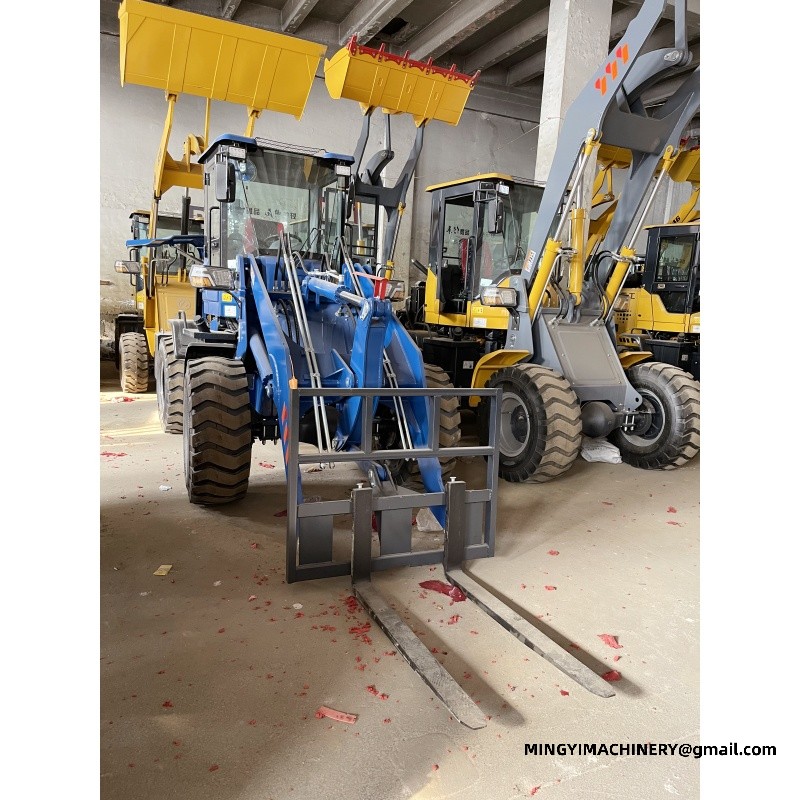
Track width decides two things at once: whether the machine stays upright on a slope, and whether it fits through what you need it to fit through. This build runs 1.5 m (wheel-side reduction axle); 1.45 m (Isuzu axle), against 1.6 m on the heavy-duty 3.8 m medium-frame wheel-side reduction wheel loader. Wider is more stable and needs more room. The choice is made by your narrowest gate, not by your widest heap.
The axle behind the track matters as much as the number. A wheel-side reduction axle puts the final reduction at the hub, which lowers the load on the half-shafts and suits soft, rutted or sandy ground. The alternative pattern suits hard, level surfaces and runs cooler at road speed. Where a build offers both, the hub-reduction figure in 1.5 m (wheel-side reduction axle); 1.45 m (Isuzu axle) is the one for quarry floors and unmade haul roads.
Frames do not usually break; they go loose, and looseness starts at the pins. The parts that govern it are the rear hinge plate, 20 mm, the cross-member behind it, 25 mm, and the rear frame section, 280 mm high x 800 mm wide. Buy on those three and the machine will still feel tight in year five.
Duty decides how long that takes. A machine loading twenty trucks a day ages differently from one moving material for two hours. On the heavy-duty 4.5 m small-frame wheel-side reduction wheel loader the same three figures are 20 mm, 30 mm and 280 mm high x 800 mm wide; choosing between them is choosing how much duty the frame was built for, and it is the decision that outlasts every other option on the order.
Export loading is a dimension problem. Rear frame width is the governing figure and it stays in a narrow band across this range — 280 mm high x 800 mm wide on the light-duty 4.2 m small-frame wheel-side reduction wheel loader, 300 mm high x 800 mm wide on the heavy-duty 3.8 m medium-frame wheel-side reduction wheel loader — so two to three units load in a single forty-foot container with the booms and counterweights packed alongside.
Commissioning is the part buyers under-plan. Before the first start: torque the hinge pins, fill the 64.7 L (75# small tank) tank and the 4100 core (490 engine); 4105 core (4102T engine) circuit, check the 40 pump (490 engine); 1045 pump (4102 turbo engine) and 316 pump connections, and charge or replace a battery that has sat through a voyage. Then check the five build figures — boom wall, boom width, front and rear hinge plates, cross-member — against the published table, because that is the one moment when a discrepancy is simple to fix.
How is the battery specified on a wheel loader fork attachment?
60 Ah (490 engine); 80 Ah (4102 turbo engine) on the light-duty 3.2 m small-frame wheel-side reduction wheel loader, matched to the engine it has to crank. The higher capacity belongs to the turbo option and matters in cold climates.
Which wheel loader fork attachment build suits farm work?
The lighter one, for access: a 0.4 m³ bucket at 4.5 m, 1.5 m (wheel-side reduction axle); 1.45 m (Isuzu axle) track and a 4.25 m footprint that turns between sheds. Gate and door widths decide first.
How many hours a day can a wheel loader fork attachment run?
As many as the cooling and fuel allow: a 54 L (50# tank) tank on the light-duty 3.2 m low-profile wheel loader and a 4100 core (490 engine); 4105 core (4102T engine) radiator. In dusty work the radiator, not the tank, is usually what sets the limit.
What should I check before a wheel loader fork attachment works a ramp?
Traction and cooling. A 1.5 m (wheel-side reduction axle); 1.45 m (Isuzu axle) track with wheel-side reduction holds on a ramp where an Isuzu-pattern axle would spin, and the 4100 core (490 engine); 4105 core (4102T engine) radiator keeps working at low speed.
How much reach does the boom of a wheel loader fork attachment give?
Boom length is 2.3 m on the light-duty 3.2 m low-profile wheel loader and 2.3 m on the light-duty 3.2 m small-frame wheel-side reduction wheel loader. Length buys reach and takes stability, so match it to the height you actually have to clear.
How does a wheel loader fork attachment differ from a skid steer?
Articulated steering and a 4.1 m front-to-counterweight length give the loader reach and a smoother ride on rough ground; a skid steer turns in its own length but carries less, higher effort per tonne moved.
How wide is a wheel loader fork attachment?
Track width is 1.5 m (wheel-side reduction axle); 1.45 m (Isuzu axle) on the heavy-duty 4.5 m small-frame wheel-side reduction wheel loader and 1.6 m on the heavy-duty 3.5 m medium-frame wheel-side reduction wheel loader. Check it against the narrowest gate, door or aisle before anything else on the sheet.
Models, options and container plans are stated per order against the actual mix. Send the application, the material and the receiving body height, and we will specify the wheel loader fork attachment — axle, radiator, bucket and third circuit — in one pass.
Cold weather and winter care for Wheel Loader Fork Attachment: Matching Forks to the Boom Section
A cold start is easier when the machine is prepared the night before. The routine that keeps Wheel Loader Fork Attachment: Matching Forks to the Boom Section working through winter is mostly a matter of fuel, battery and patience in the first ten minutes of the day.
Packing, loading and shipment of Wheel Loader Fork Attachment: Matching Forks to the Boom Section
The paperwork matters as much as the packing. Serial numbers, dimensions and weights recorded for Wheel Loader Fork Attachment: Matching Forks to the Boom Section at loading are the same figures the destination needs, and a mismatch here loses more days than the voyage itself.
Planning the season around Wheel Loader Fork Attachment: Matching Forks to the Boom Section
Downtime is simplest when it is planned. Booking the service for Wheel Loader Fork Attachment: Matching Forks to the Boom Section in the quiet part of the season takes nothing from the schedule, while the same work in the busy weeks gives up a day of output every time.
Contact MINGYI Machinery for the current wheel loader lineup, configuration options and a formal specification for your market. E-mail: sales@mingycn.com | LINE (ID): mingyicn
Wheel Loader Snow Blower: Hydraulic Circuits and Winter Duty · Wheel Loader Snow Blower: Specifying the Third Circuit · Front End Loader Manufacturer: Weld and Plate Records · Loaders









