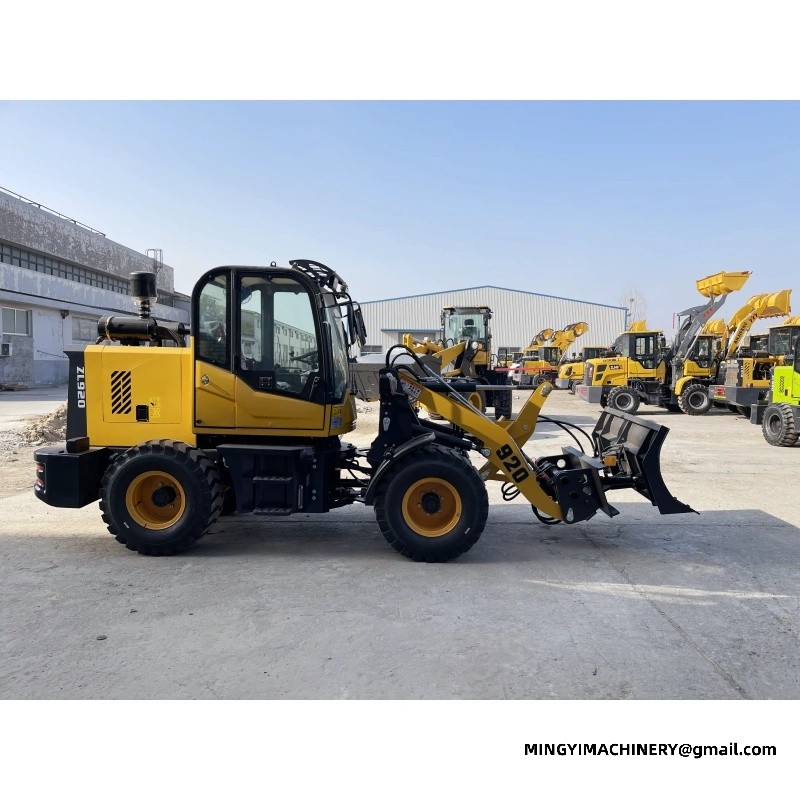
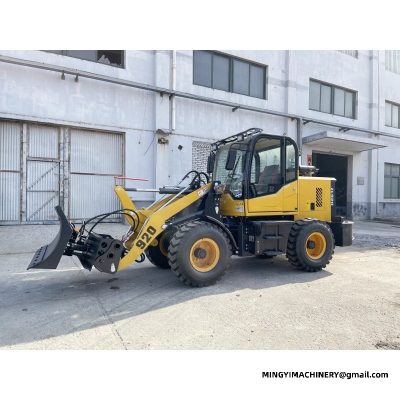
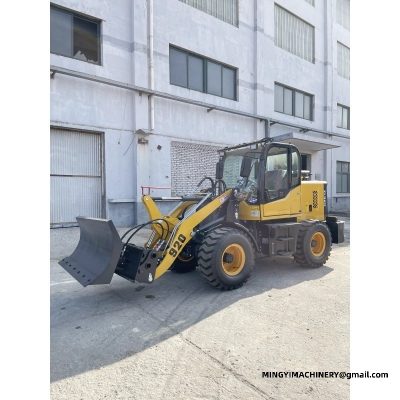
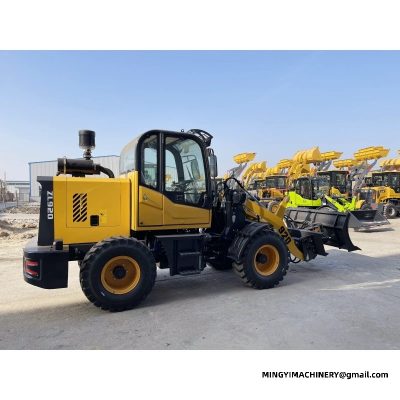
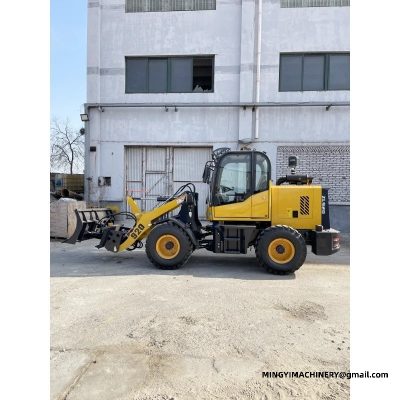
Three frame tiers, twenty-one documented builds, one parts package per tier: that is the whole wheel loader range in a line. The tiers separate on boom section and hinge steel rather than on paint — 25 mm boom wall and 30 mm cross-member at the bottom, 30 mm and 45 mm on the heavier build — and the builds within a tier share cylinders, pumps and attachments. Buckets run 0.4 m³ to 0.52 m³ and dump heights 4.2 m to 3.5 m. Here is how to place yourself on that ladder.
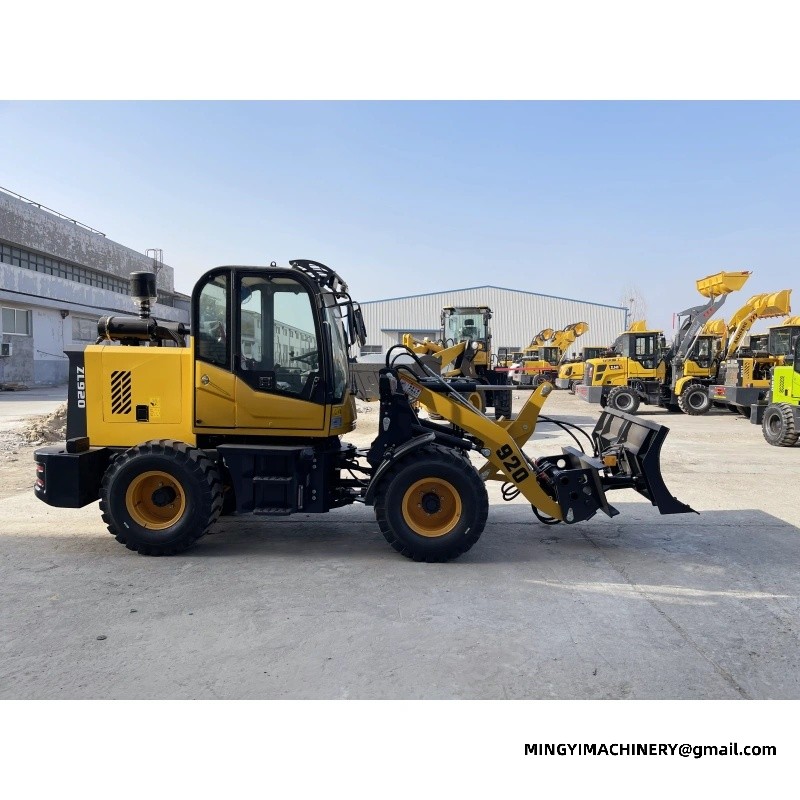
The boom is the part that turns engine power into a loaded bucket at height, and four figures describe it. Length runs 2.3 m on the light-duty 3.2 m small-frame wheel-side reduction wheel loader against 3.15 m on the heavy-duty 4.2 m small-frame wheel-side reduction wheel loader; wall thickness 25 mm against 25 mm; section width 370 mm against 500 mm; and the mount spacing — boom centre distance — 890 mm against 890 mm. Read together, those four numbers tell you more about how a machine will behave than bucket capacity ever will.
Length buys reach and takes stability, because every extra millimetre moves the load centre further from the front axle. Wall thickness resists bending; section width resists twisting. Centre distance is the one most buyers never ask about, and it is the one that decides whether the arm takes a side load cleanly or twists the pins — which matters the moment an operator digs one corner of the bucket into a heap instead of squaring up to it. On the light-duty 3.2 m small-frame wheel-side reduction wheel loader the combination of a 2.3 m arm, a 25 mm wall and a 890 mm spacing is matched to a 0.38 m³ bucket, and that match is what keeps the frame tight over a full season.
Put the two builds side by side and read four rows only. Bucket: 0.3 m³ against 0.52 m³. Dump height: 2.4 m against 4.2 m. Hinge steel: 16 mm and 16 mm against 45 mm and 30 mm. Cross-member: 16 mm against 45 mm.
Those four decide what the machine can carry, where it can put it, and how long the frame lasts doing it. Everything else on a specification sheet — paint, cab trim, lighting package — is cosmetic next to them. The pumps, 32 pump against 2063 pump, are the fifth row and matter only if the work is hydraulic rather than loading.
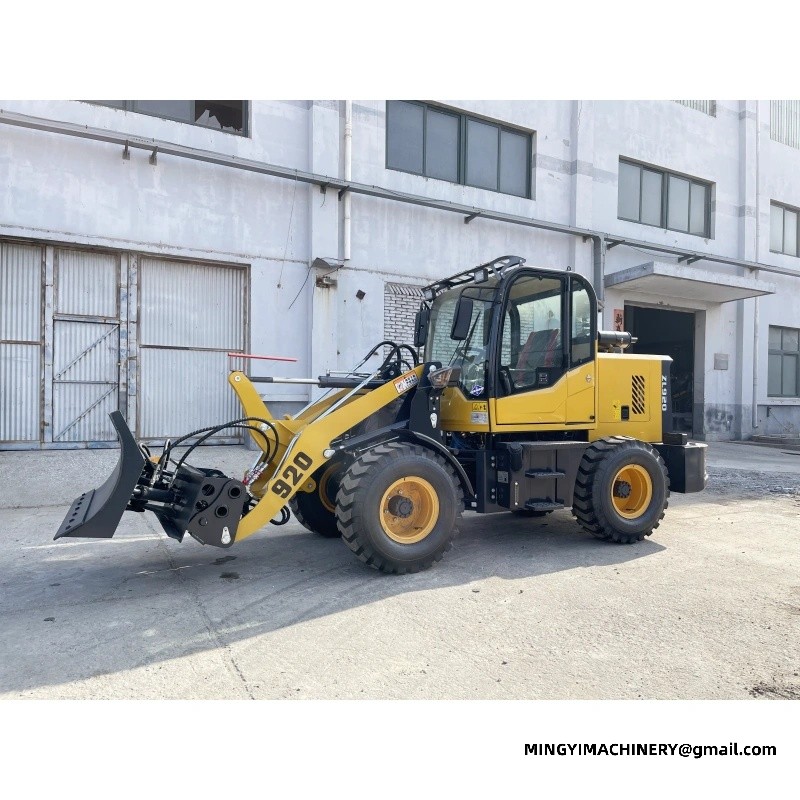
Radiator size follows the engine, not the frame. The light-duty 3.2 m small-frame wheel-side reduction wheel loader lists 4100 core (490 engine); 4105 core (4102T engine); the light-duty 3.5 m medium-frame wheel-side reduction wheel loader lists 4105 core. Where two engine options exist on one build, the cores differ — a 4100 core on the 490 engine and a 4105 on the 4102 turbo — and the taller, raised core is the one to specify wherever dust, chaff or dry sand blankets a standard radiator part-way through a shift.
Overheating is the single most common cause of a loader losing days rather than hours. It presents as power loss, then as a shift cut short, then as a head gasket. Choosing the raised core takes almost nothing at order time and cannot be retrofitted easily later. Pair that with the electrical package — 60 Ah (490 engine); 80 Ah (4102 turbo engine) on the light-duty 3.2 m small-frame wheel-side reduction wheel loader, 80 Ah on the light-duty 3.5 m medium-frame wheel-side reduction wheel loader — and note that a battery specified for a naturally aspirated engine is often marginal for a turbo one in cold climates.
| Sample build from the range — light-duty 3.2 m low-profile wheel loader | |
|---|---|
| Bucket capacity | 0.38 m³ |
| Dump height | 3.2 m |
| Track width | 1.5 m (wheel-side reduction axle); 1.45 m (Isuzu axle) |
| Boom arm thickness | 25 mm |
| Boom arm width | 370 mm |
| Boom arm length | 2.3 m |
| Boom arm centre distance | 890 mm |
| Cross-member thickness | 25 mm |
| Front hinge plate thickness | 25 mm |
| Rear hinge plate thickness | 14 mm |
| Rear frame section | 230 mm high x 800 mm wide |
| Hydraulic cylinders | centre cylinder 45 / side cylinder 40 |
| Fuel tank | 54 L (50# tank) |
| Battery | 60 Ah (490 engine); 80 Ah (4102 turbo engine) |
| Front wheel to counterweight | 4 m |
| Radiator | 4100 core (490 engine); 4105 core (4102T engine) |
| Work pump | 40 pump (490 engine); 1045 pump (4102 turbo engine) |
| Travel pump | 316 pump |
Tank size is a shift-planning figure. The light-duty 3.2 m small-frame wheel-side reduction wheel loader carries 64.7 L (75# small tank); the light-duty 3.5 m medium-frame wheel-side reduction wheel loader carries 70 L (75# large tank). Both are sized for a full working day at operating throttle without a mid-shift refuel, which matters on sites where the bowser is a ten-minute round trip away and on farms where refuelling means driving back to the yard.
The number to combine it with is cooling: 4100 core (490 engine); 4105 core (4102T engine) on the light-duty 3.2 m small-frame wheel-side reduction wheel loader, 4105 core on the light-duty 3.5 m medium-frame wheel-side reduction wheel loader. A machine that runs out of coolant capacity is stopped in the middle of a shift wherever it happens to be; a machine that runs low on fuel is stopped somewhere you chose. If the site has no refuelling point, the difference between the two tank sizes is a daily ten minutes, and over a season it is a working week.
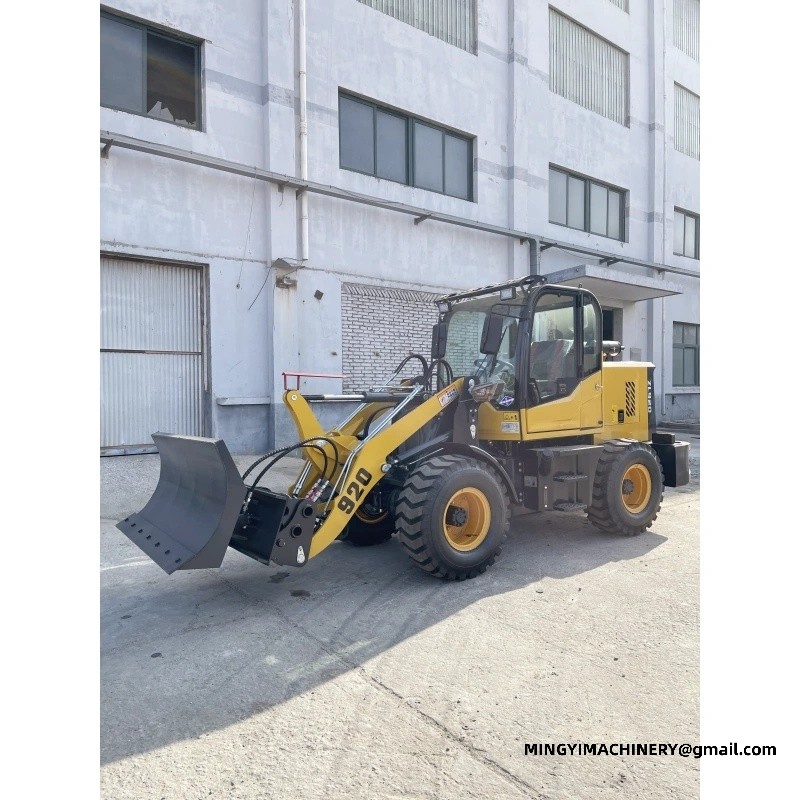
Hinge plates carry the pin loads that the boom and the steering articulation put into the frame, and they are where a loader shows its age first. The light-duty 3.2 m small-frame wheel-side reduction wheel loader runs 25 mm front plates and 14 mm rear plates over a 25 mm cross-member; the light-duty 3.5 m medium-frame wheel-side reduction wheel loader runs 45 mm and 30 mm over 45 mm. Rear frame sections follow at 280 mm high x 800 mm wide and 300 mm high x 800 mm wide respectively.
The rear plate is the more telling of the two. Articulated steering loads the rear hinge every time the machine turns under load, and reversing out of a face with a full bucket doubles it. A 14 mm rear plate with a 25 mm cross-member is a light-duty specification; 30 mm over 45 mm is a heavy-duty one. Put those alongside the 0.38 m³ and 0.52 m³ buckets and the specification difference between the two builds stops looking arbitrary — it is steel.
Shipping is a dimensions problem before it is a freight problem. Front wheel to counterweight is 3.8 m on this build and 4 m on the light-duty 3.2 m low-profile wheel loader; track is 1.5 m (wheel-side reduction axle); 1.45 m (Isuzu axle). Those two figures, plus the bucket, decide how many units fit a container and whether the machine travels assembled.
Dump height matters here for a reason that surprises people: a machine shipped with the arm raised will not fit under a container door. At 3.2 m of lift height the arm has to be strapped down, and the securing points are on the frame — the 280 mm high x 800 mm wide rear section and the cross-member behind it, not the cylinders.
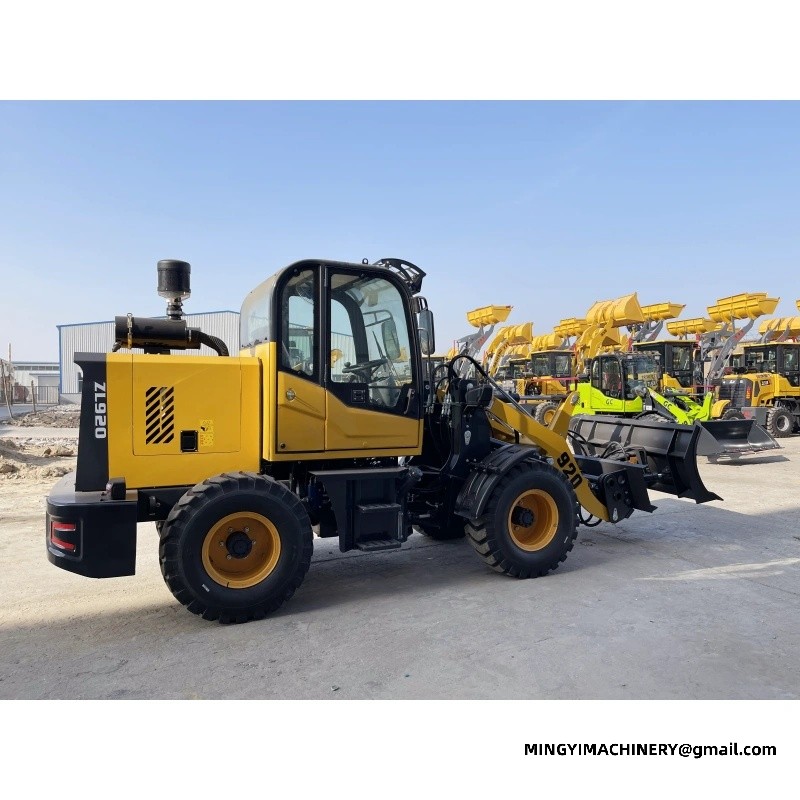
A site loader spends its life doing the same cycle, and the cycle punishes three components: the rear hinge, the cooling pack and the tyres. On the light-duty 3.2 m low-profile wheel loader the rear hinge is 14 mm over a 25 mm cross-member; on the light-duty 4.2 m medium-frame wheel-side reduction wheel loader it is 30 mm over 45 mm. Which of those you need depends on how often the machine turns under load.
Cycle time is the economics. A 0.38 m³ bucket at 3.2 m on a 2.3 m arm loaded by centre cylinder 45 / side cylinder 40 cylinders is quick in a tight site; a 0.52 m³ bucket at 4.2 m on a 2.9 m arm with centre cylinder 60 / side cylinder 50 is quicker where there is room to work. Neither is universally faster, and any supplier who claims otherwise is describing a different site from yours.
The commercial logic of a family-built range is parts commonality. Within a frame family the centre cylinder 45 / side cylinder 40 cylinder set, the 40 pump (490 engine); 1045 pump (4102 turbo engine) work pump and the 316 pump travel pump are shared, and the boom section — 370 mm on the light-duty 3.2 m low-profile wheel loader — is the same, so attachments interchange. Across families, as between the light-duty 3.2 m low-profile wheel loader and the light-duty 3.8 m medium-frame wheel-side reduction wheel loader, the cylinder set moves to centre cylinder 60 / side cylinder 50 and the section to 430 mm.
For a distributor that translates into a small, fast-moving inventory: one seal kit per cylinder family, one pump pair per family, pins and bushes per boom section, and cutting edges per bucket. Add the model-specific items — the 25 mm or 45 mm cross-member is not a wear part and does not need stocking — and the whole range is supported from a shelf that fits in a container.
How is the battery specified on a wheel loader?
60 Ah (490 engine); 80 Ah (4102 turbo engine) on the light-duty 3.2 m low-profile wheel loader, matched to the engine it has to crank. The higher capacity belongs to the turbo option and matters in cold climates.
Why does boom centre distance matter on a wheel loader?
It sets how side loads travel into the frame: 890 mm on the heavy-duty 4.2 m small-frame wheel-side reduction wheel loader against 900 mm on the light-duty 3.8 m medium-frame wheel-side reduction wheel loader. Wider spacing lets the cylinders work through a better lever.
How does a wheel loader cope with dust?
Specify the raised core: 4100 core (490 engine); 4105 core (4102T engine) on the light-duty 3.2 m small-frame wheel-side reduction wheel loader against 4105 core on the light-duty 4.5 m medium-frame wheel-side reduction wheel loader, and blow the fins out at the end of every shift in fines or grain.
How is a wheel loader prepared for export?
Knock-down: booms and counterweights packed loose, tanks removed, batteries boxed and disconnected. Rear frame sections stay between 280 mm high x 800 mm wide and 300 mm high x 800 mm wide.
What is the largest wheel loader in the range?
The medium-frame heavy builds: a 0.52 m³ bucket at 4.2 m on a 2.9 m boom with centre cylinder 60 / side cylinder 50 cylinders.
How are the pumps specified on a wheel loader?
Lift and travel are separate circuits: a 40 pump (490 engine); 1045 pump (4102 turbo engine) work pump with a 316 pump travel pump, so a loaded climb does not take flow away from the boom.
Is the wheel-side reduction axle worth specifying on a wheel loader?
If the ground is soft, rutted or sloped, yes: a 1.5 m (wheel-side reduction axle); 1.45 m (Isuzu axle) track with hub reduction keeps traction where a faster axle would spin. On hard, level ground it is not needed.
Every wheel loader in this range ships with the same five recorded figures — boom wall, boom width, front hinge, rear hinge and cross-member — checked against the published table before it leaves the factory. Ask for that record on any unit you are stated.
Later additions and retrofits on Wheel Loader: Sizing, Boom Geometry and Frame Selection
An added function should pay for itself quickly. Whether Wheel Loader: Sizing, Boom Geometry and Frame Selection gains a different bucket, a hydraulic service or a protection package, the test is the number of days a year it is actually used.
Pre-delivery inspection before Wheel Loader: Sizing, Boom Geometry and Frame Selection leaves the shop
What the customer sees on arrival is decided before departure. The walk-around given to Wheel Loader: Sizing, Boom Geometry and Frame Selection covers the same points the operator will check on day one, so there are no surprises when the crate is opened at the destination.
Contact MINGYI Machinery for the current wheel loader lineup, configuration options and a formal specification for your market. E-mail: sales@mingycn.com | LINE (ID): mingyicn
Front End Loader: Frame Tiers, Attachments and Duty Selection · Hydraulic Wheel Loader: Cylinders, Pumps and Circuit Options · Wheel Loader for Agriculture: Silage, Manure and Grain · Loaders









