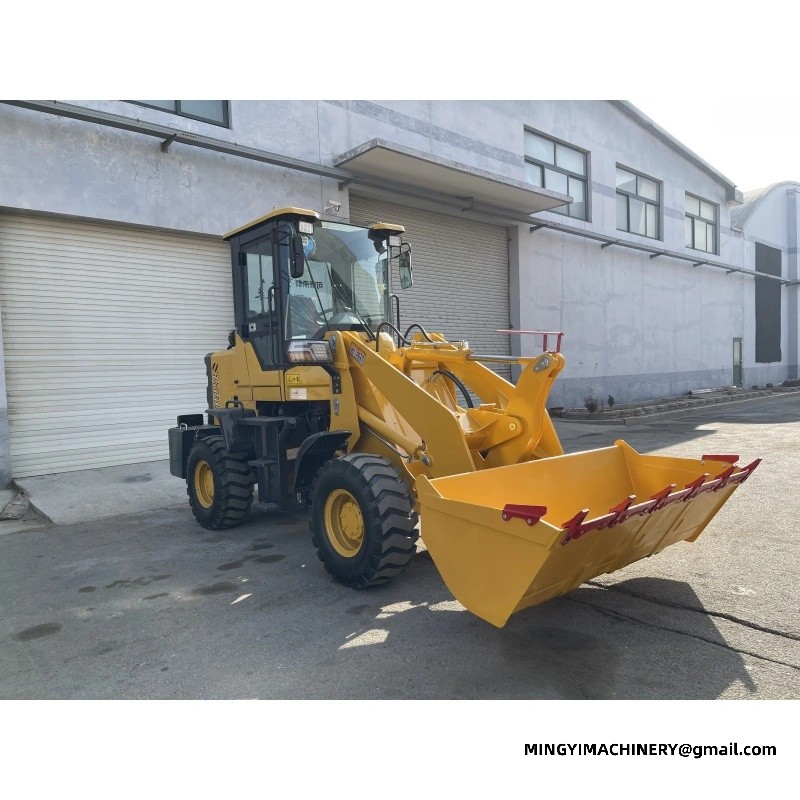
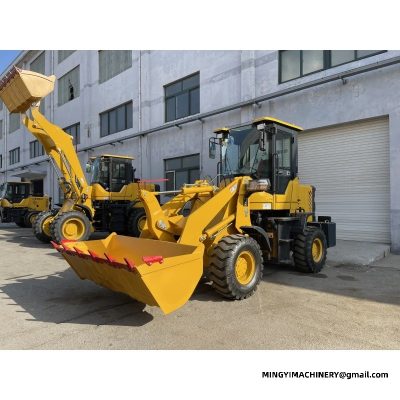
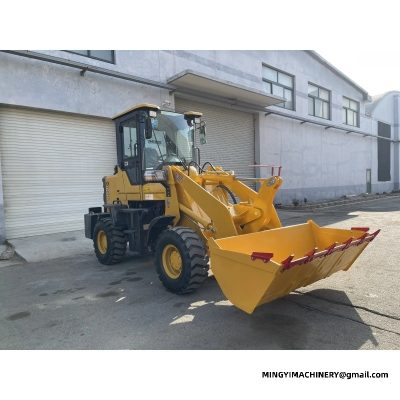
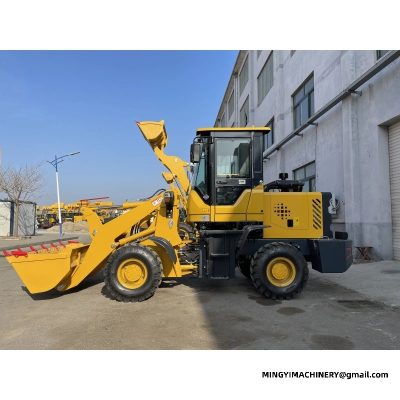
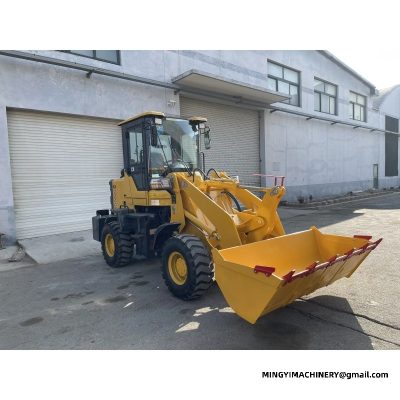
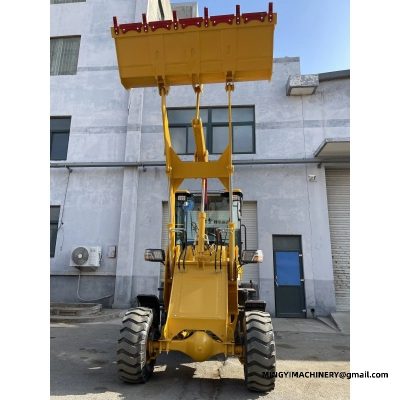
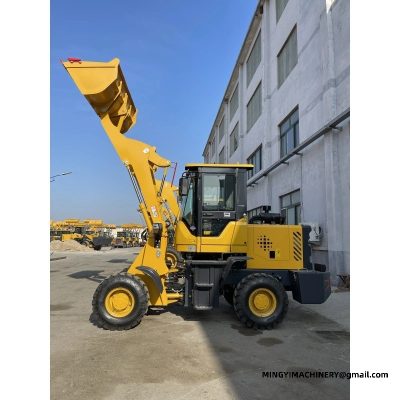
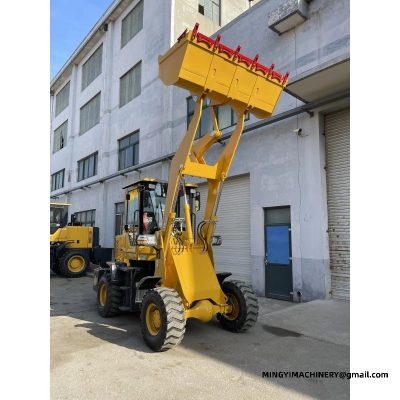
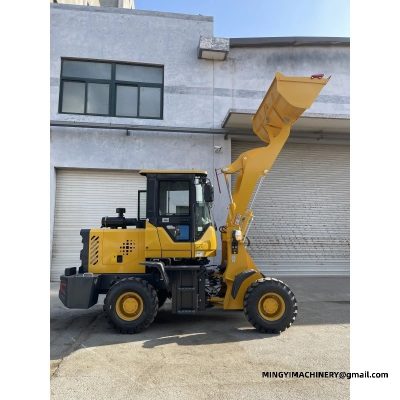
The specification gap between two front end loader builds is usually steel, and the steel is in four places. Boom wall: 30 mm against 30 mm. Front hinge plate: 45 mm against 45 mm. Rear hinge plate: 30 mm against 30 mm. Cross-member: 45 mm against 45 mm. Everything else — the 0.65 m³ bucket against the 0.65 m³ bucket, the centre cylinder 60 / side cylinder 50 cylinder set against centre cylinder 60 / side cylinder 50 — follows from those four. This page goes through each in turn, then through the cooling, axle and delivery questions that decide the rest.
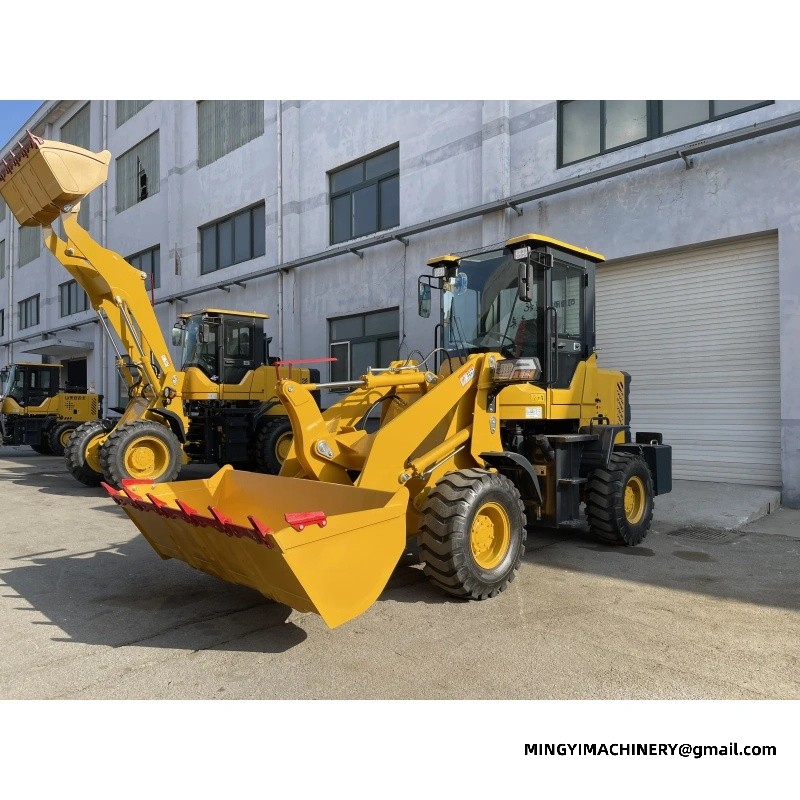
A bucket that fills completely every pass beats a larger one that fills partly, because a partly filled bucket is carrying air at the same effort as material. On a dense face, 0.4 m³ will fill where 0.65 m³ might not, and the smaller machine finishes the job first while putting less load into the 30 mm hinge.
There is also the question of what the load does to the machine in motion. Carrying a full bucket across rough ground loads the front axle, the hinge and the boom all at once. At 4.1 m front wheel to counterweight and 1.5 m (wheel-side reduction axle); 1.45 m (Isuzu axle) of track, the shorter machine with the right bucket is more stable as well as quicker, and stability is what keeps a cycle time consistent rather than occasionally fast.
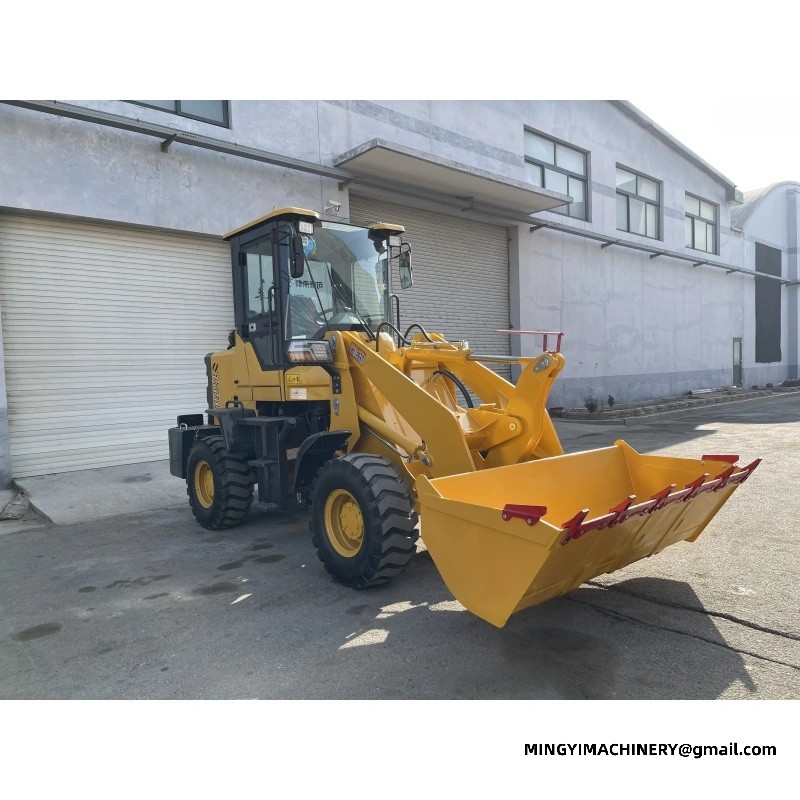
Operators get blamed for slow cycles that were decided in the frame shop. Where the lift is long, the pump and the cylinders set the pace: this build runs 40 pump (490 engine); 1045 pump (4102 turbo engine) with centre cylinder 45 / side cylinder 45. Where the run between face and truck is long, travel matters more, and that is the 316 pump and the 4.2 m wheelbase. Where the heap is packed, breakout matters most, and breakout comes from boom wall, 25 mm, working against bucket width.
Compare two builds on the same heap and the difference shows up as a few seconds a pass. The heavy-duty 4.2 m medium-frame wheel-side reduction wheel loader carries 0.65 m³ against 0.4 m³ on the heavy-duty 3.8 m small-frame wheel-side reduction wheel loader, and lifts to 4.2 m against 3.8 m. Bigger is not automatically faster: a bucket that fills completely in two passes beats one that fills partly in three, and the frame that stays tight keeps doing it in month thirty.
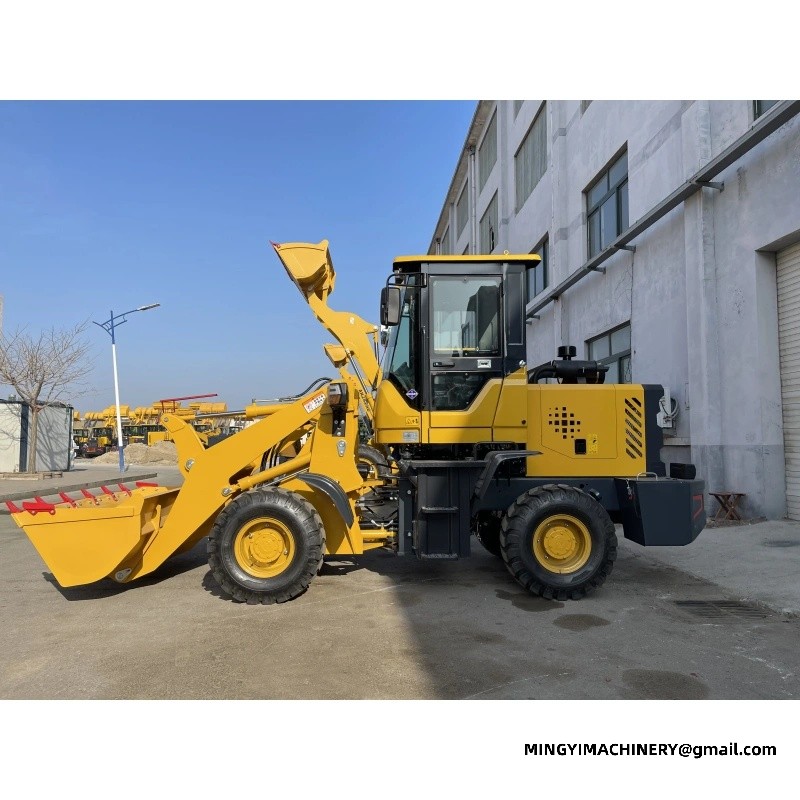
Every loader purchase starts with the thing being loaded into. On this range the choice runs from 3.5 m on the heavy-duty 3.5 m small-frame wheel-side reduction wheel loader to 4.5 m on the heavy-duty 4.5 m medium-frame wheel-side reduction wheel loader, and the gap between those two figures is the gap between a machine that feeds a small mixer and one that feeds a highway truck.
Take the measurement at the highest point the bucket must clear, on the near side, with the truck loaded — a suspension that settles under load lowers the board. Then add allowance for the operator's approach angle. The heavy-duty 3.5 m small-frame wheel-side reduction wheel loader at 3.5 m with a 0.4 m³ bucket and a 2.62 m arm is a compact answer; the heavy-duty 4.5 m medium-frame wheel-side reduction wheel loader at 4.5 m with 0.65 m³ and a 3.35 m arm is the answer where the board is high.
| Reference specification — heavy-duty 3.8 m medium-frame wheel-side reduction wheel loader | |
|---|---|
| Bucket capacity | 0.65 m³ |
| Dump height | 3.8 m |
| Track width | 1.6 m |
| Boom arm thickness | 30 mm |
| Boom arm width | 500 mm |
| Boom arm length | 2.9 m |
| Boom arm centre distance | 920 mm |
| Cross-member thickness | 45 mm |
| Front hinge plate thickness | 45 mm |
| Rear hinge plate thickness | 30 mm |
| Rear frame section | 300 mm high x 800 mm wide |
| Hydraulic cylinders | centre cylinder 60 / side cylinder 50 |
| Fuel tank | 70 L (75# large tank) |
| Battery | 80 Ah |
| Front wheel to counterweight | 4.55 m |
| Radiator | 4105 core |
| Work pump | 2063 pump |
| Travel pump | 25 pump |
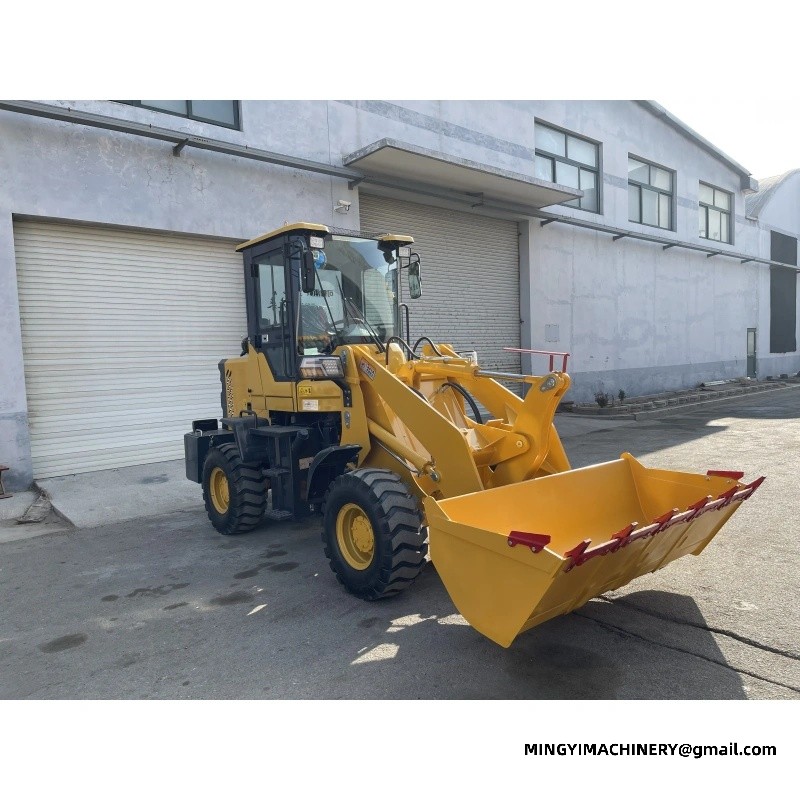
Three things stop a loader mid-shift, and two of them are in the specification. Fuel is the first: 30.8 L (48# large tank, 20.5/70-16 tyres); 24.6 L (48# small tank, 8.25-16 tyres) on the standard 2.8 m low-profile wheel loader. Cooling is the second: 4100 core, and it is the one that announces itself as a gradual loss of power rather than a stoppage, so it gets ignored until the machine is derating every afternoon.
The third is electrical, and it is specified as well: 45 Ah (24 V). Cranking capacity falls with temperature, so a battery that starts a warm engine happily can fail the same engine at dawn in winter. Where the build offers two ratings, the higher one belongs to the turbo option and is worth specifying for cold climates or for machines that start cold and stop often.
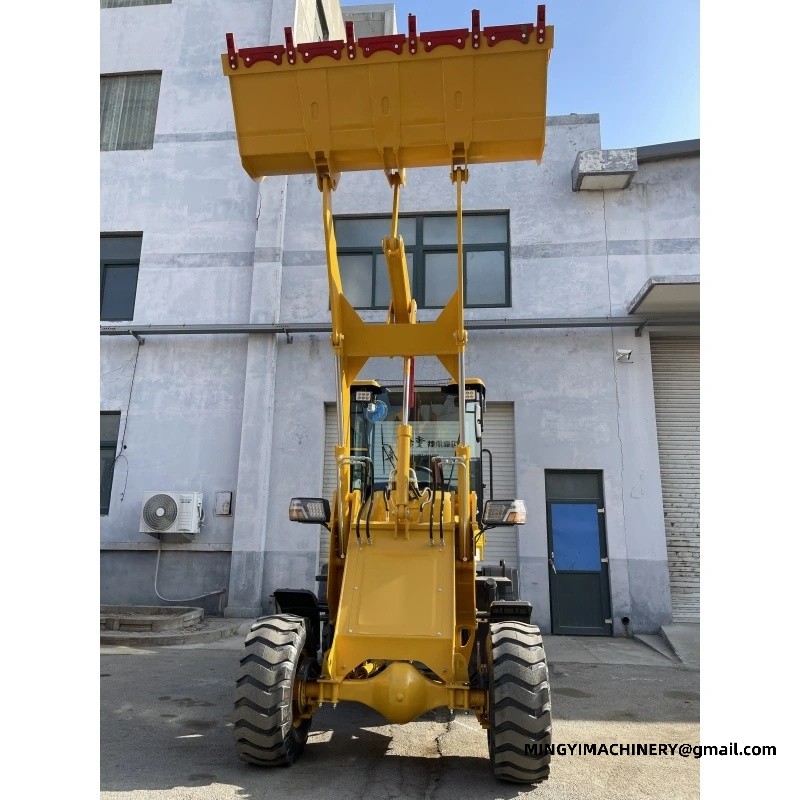
Hold the parts that stop the machine and cannot be improvised: hoses and seals for the centre cylinder 45 / side cylinder 40, a belt set, filters, and a battery to the 60 Ah (490 engine); 80 Ah (4102 turbo engine) rating. Do not hold the parts that are welded in — hinge plates at 30 mm and 20 mm, the 30 mm cross-member. Those are a repair, not a spare, and they are the same steel on every machine in the family.
The pump is the judgement call. 40 pump (490 engine); 1045 pump (4102 turbo engine) is a stocked item and a week of downtime if it is not; the 316 pump fails less often and is the one most fleets choose to order rather than hold. Decide on that by distance from the supplier, not by the effort of the part.
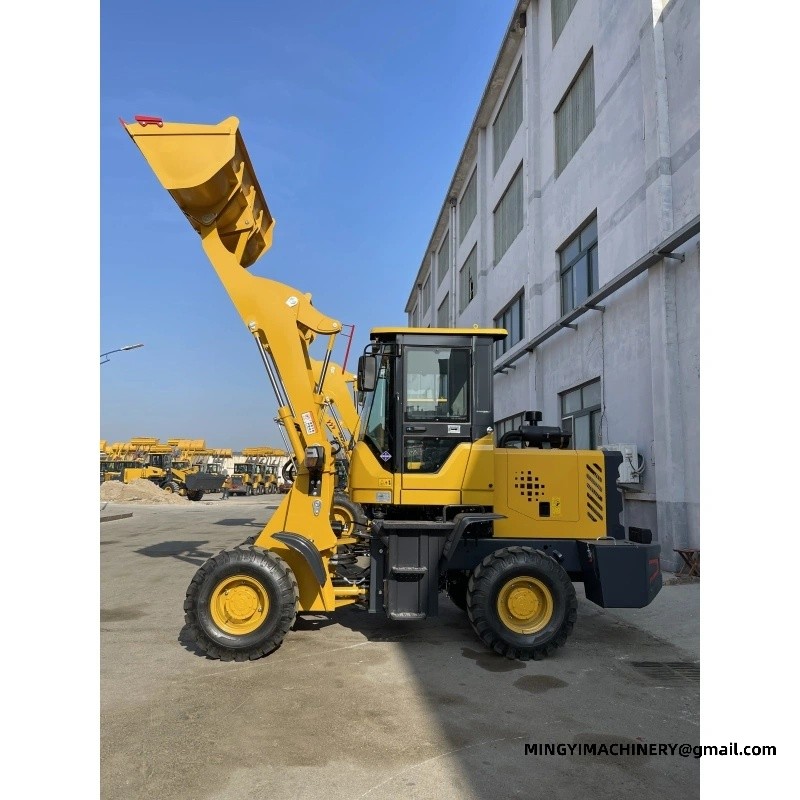
A specification is only as good as the figures on it. Before comparing numbers between suppliers, make sure the same figures appear on both: bucket 0.4 m³, dump height 3.2 m, boom section 430 mm over 25 mm of wall, hinge plates 30 mm front and 20 mm rear, cross-member 30 mm. If a sheet will not give you those five, it is not a specification, it is a description.
The second thing a sheet should let you check is which engine the figures belong to. Where a build offers two engines, the pump and radiator change with it: this one lists 40 pump (490 engine); 1045 pump (4102 turbo engine) and 4100 core (490 engine); 4105 core (4102T engine). Asking for the build by engine, not by model name, is the single change that prevents most delivery disputes.
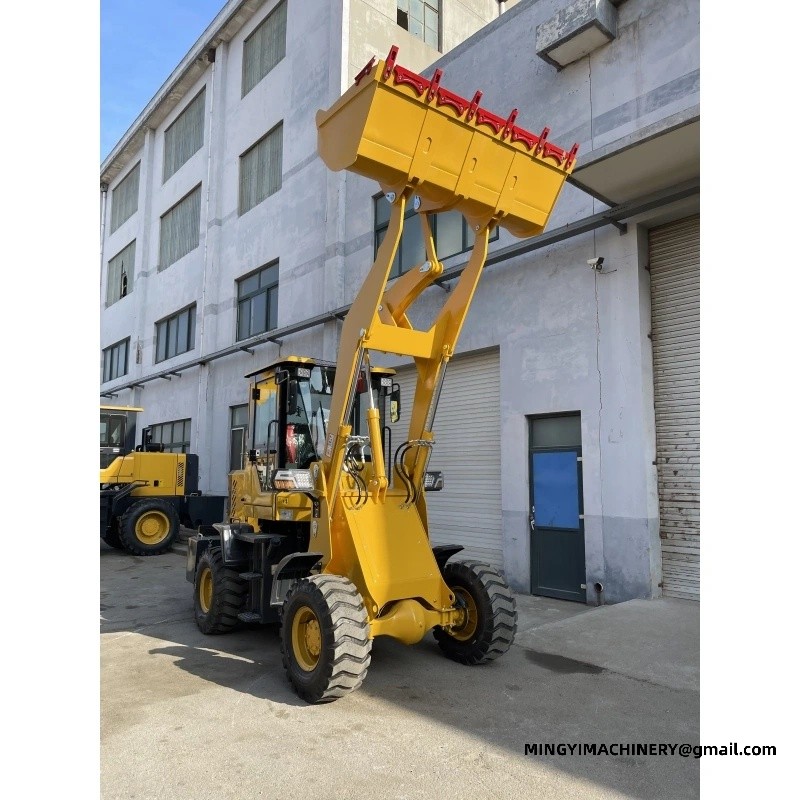
A rebuild is worth doing when the frame is sound and the running gear is not. Check the hinge plates, 16 mm and 16 mm, and the cross-member, 16 mm, for movement and cracking. If those are tight, cylinders centre cylinder 45 / side cylinder 40, pump 32 pump and radiator 4100 core are all replaceable items and the machine has years left.
If the frame has gone, it has gone: re-machining pin bores restores geometry for a while and never for long, because the 200 mm high x 750 mm wide section has been flexing the whole time. That is the point to compare against a new build rather than a repair, and it is why the plate figures are worth reading at purchase rather than at disposal.
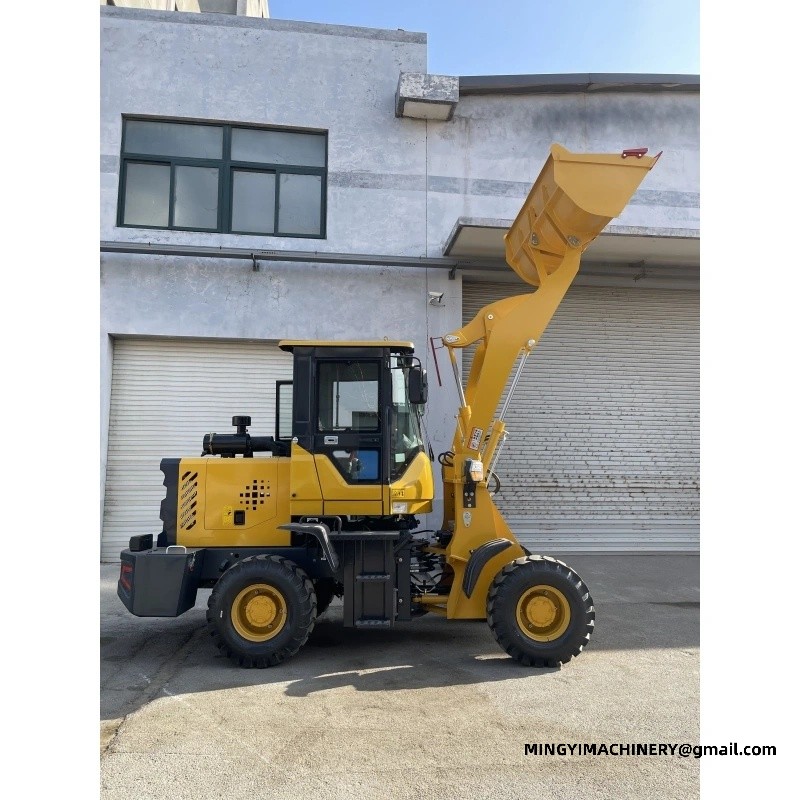
Machines ship knock-down, and rear frame width is what decides how many fit a box. Across the range that figure stays between 280 mm high x 800 mm wide and 300 mm high x 800 mm wide, which allows two to three units in a forty-foot container with booms and counterweights packed loose, tanks removed and batteries boxed disconnected.
Plan the container around the model mix rather than around a unit count. A pair of the heavy-duty 3.5 m small-frame wheel-side reduction wheel loader with its 4.1 m footprint loads differently from the heavy-duty 4.2 m medium-frame wheel-side reduction wheel loader at 4.55 m, and a mixed order can often be arranged to use the space better than a uniform one. Container plans are stated per order against the actual mix.
Why does boom centre distance matter on a front end loader?
It sets how side loads travel into the frame: 890 mm on the heavy-duty 3.2 m low-profile wheel loader against 890 mm on the heavy-duty 3.8 m small-frame wheel-side reduction wheel loader. Wider spacing lets the cylinders work through a better lever.
How do I choose the right dump height for a front end loader?
Measure the receiving body at the front board rather than the side: 3.8 m on the heavy-duty 3.8 m medium-frame wheel-side reduction wheel loader, 4.2 m on the heavy-duty 4.2 m medium-frame wheel-side reduction wheel loader. Clearance decides whether the pass is possible at all.
Which front end loader build suits farm work?
The lighter one, for access: a 0.4 m³ bucket at 3.5 m, 1.5 m (wheel-side reduction axle); 1.45 m (Isuzu axle) track and a 4.1 m footprint that turns between sheds. Gate and door widths decide first.
Can one spares kit cover a mixed front end loader fleet?
Within a frame family, largely yes: the centre cylinder 60 / side cylinder 50 cylinder set and the 2063 pump and 25 pump pumps are shared. Across families the cylinder set changes to centre cylinder 60 / side cylinder 50.
Which front end loader build suits site work?
The heavier one, because dump height and hinge steel govern the day: 0.65 m³ at 3.8 m with 30 mm rear hinge plates and a 45 mm cross-member.
Can a front end loader be used for snow clearance?
Yes, with a snow tool specified against the boom section — 500 mm on the heavy-duty 3.8 m medium-frame wheel-side reduction wheel loader — and the third circuit ordered if the tool is hydraulically actuated.
How do I verify the build of a front end loader on delivery?
Five figures against the published table: boom wall 25 mm, boom width 430 mm, front hinge 30 mm, rear hinge 20 mm and cross-member 30 mm.
The short version for any front end loader: fix the dump height first, check the track against your narrowest opening second, and read the rear hinge plate — 30 mm on the heavy-duty 3.8 m medium-frame wheel-side reduction wheel loader, 30 mm on the heavy-duty 4.2 m medium-frame wheel-side reduction wheel loader — third. Everything else on the sheet is detail.
Hot, humid and dusty conditions around Front End Loader: Frame Tiers, Attachments and Duty Selection
Heat and dust shorten service intervals rather than machine life. In these conditions the filters on Front End Loader: Frame Tiers, Attachments and Duty Selection need attention more often, and the cooling surfaces need to be kept clear to hold the working temperature.
A second operator for Front End Loader: Frame Tiers, Attachments and Duty Selection
A machine that only one person can use is a single point of failure. Training a second operator on Front End Loader: Frame Tiers, Attachments and Duty Selection takes a day and removes the dependency that otherwise governs holidays, illness and busy weeks.
Fuel, oil and fluid quality for Front End Loader: Frame Tiers, Attachments and Duty Selection
Contamination is easier to prevent than to cure. Keeping the filler caps sealed, the funnels clean and the containers closed around Front End Loader: Frame Tiers, Attachments and Duty Selection is unglamorous work that shows up as reliability later.
Packing, loading and shipment of Front End Loader: Frame Tiers, Attachments and Duty Selection
Container loading is a planning exercise. The overall dimensions and the operating weight of Front End Loader: Frame Tiers, Attachments and Duty Selection decide whether it ships whole, partly disassembled or with the attachment removed, and that decision is made before the booking.
Contact MINGYI Machinery for the current wheel loader lineup, configuration options and a formal specification for your market. E-mail: sales@mingycn.com | LINE (ID): mingyicn
Hydraulic Wheel Loader: Cylinders, Pumps and Circuit Options · Compact Wheel Loader: Access, Track Width and Small-Frame Builds · Wheel Loader for Construction Site: Tipper Clearance Checks · Loaders









