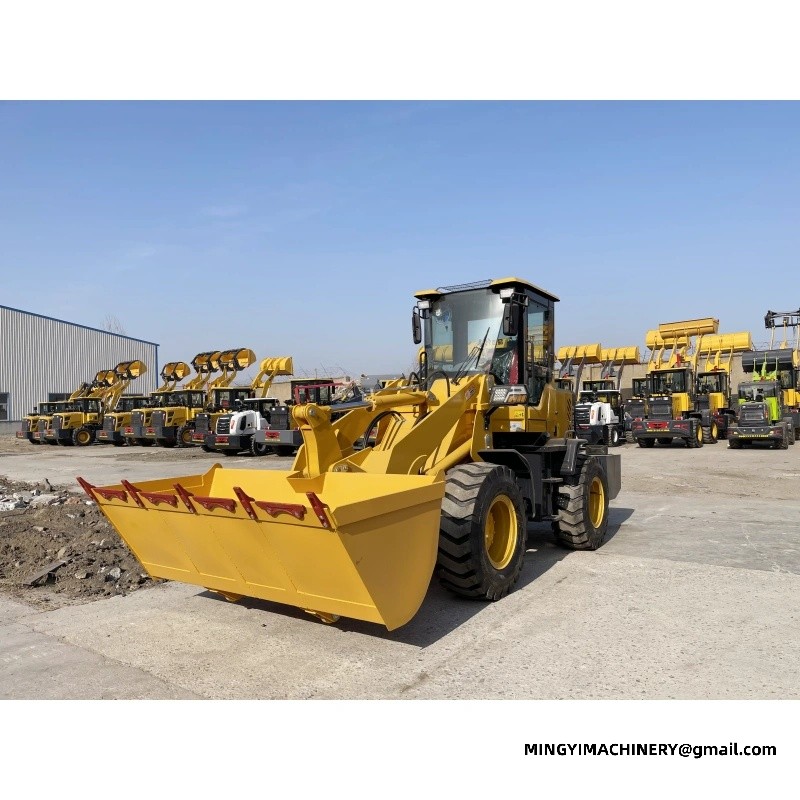
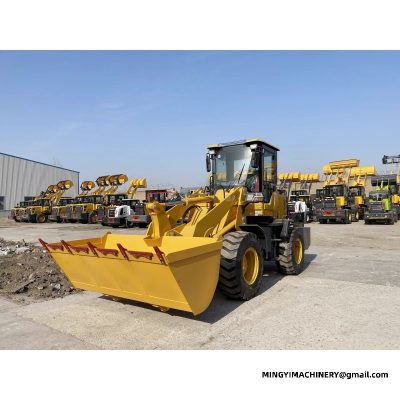
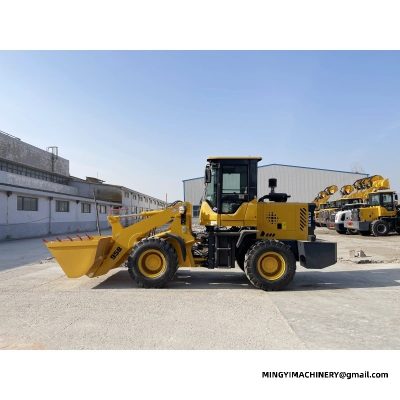
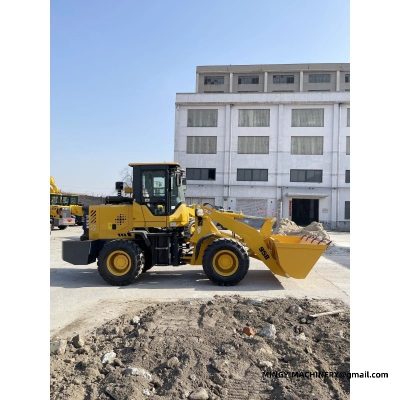
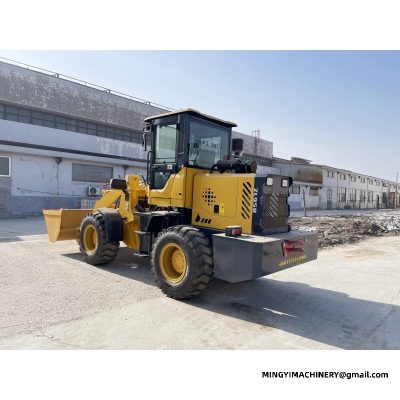
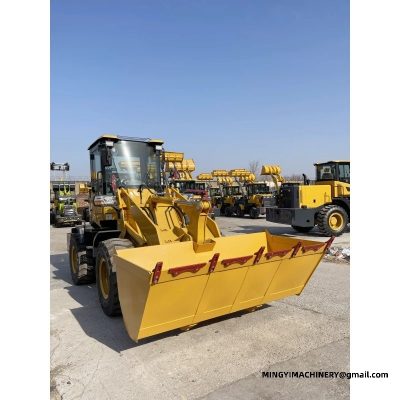
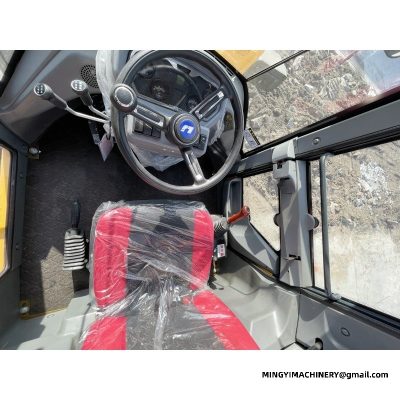
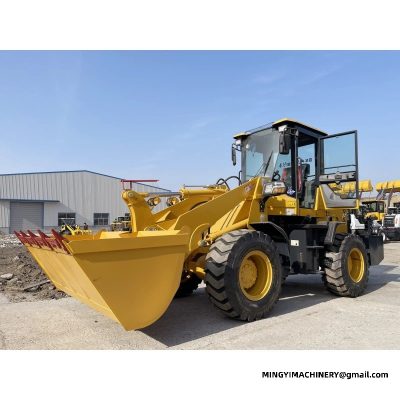
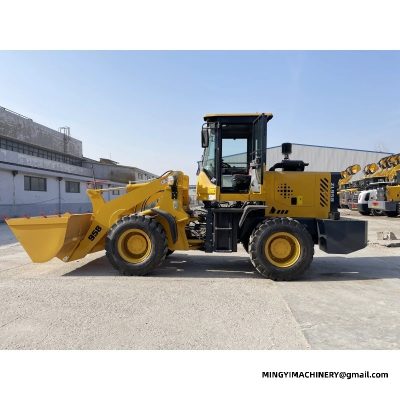
A wheel loader manufacturer is a frame, a boom and a counterweight arranged around one job: moving material from a heap into something that has to carry it away. Every figure on the sheet serves that job or is decoration. Bucket capacity decides how many passes; dump height decides whether the pass is possible; hinge steel decides whether the machine is still tight in year three. Here the buckets run 0.65 m³ to 0.3 m³ and the dump heights 4.5 m to 2.8 m, with front hinge plates of 16 mm and rear plates of 16 mm on the heavier build. Below: how to read them, and what to specify.
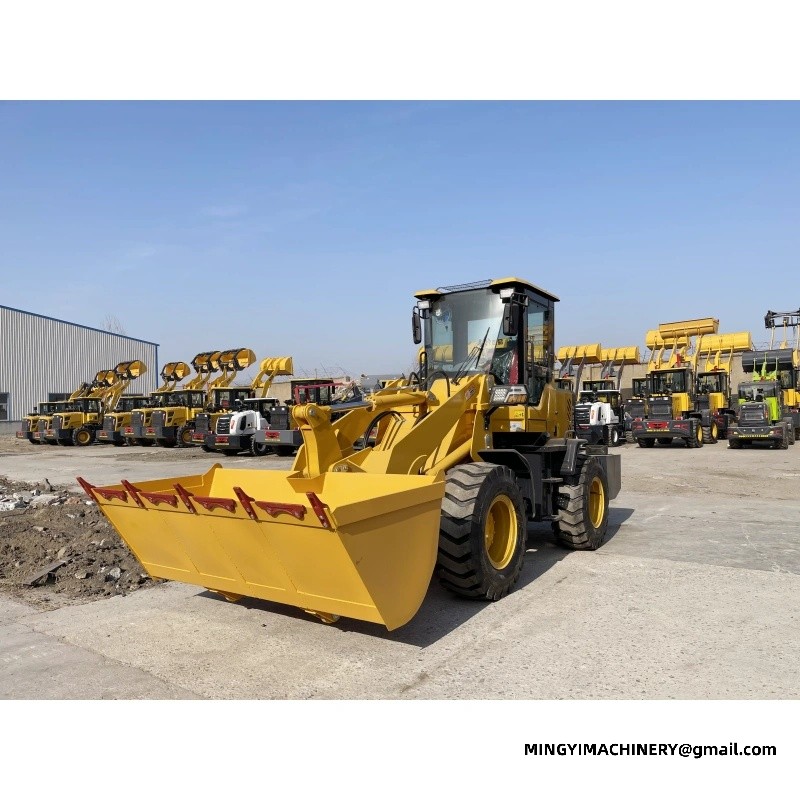
An attachment is only as useful as the hydraulics behind it. This build runs centre cylinder 45 / side cylinder 45 fed by a 40 pump (490 engine); 1045 pump (4102 turbo engine), and those two figures set the force available at the boom and the speed at which it arrives. A grapple, a fork carriage or a snow blower all ask for more flow than a bucket does.
The centre cylinder does the lifting and the side cylinders do the tilting, and they are specified together for a reason. On the heavy-duty 4.2 m small-frame wheel-side reduction wheel loader the pair is centre cylinder 45 / side cylinder 45. If an attachment needs a third service, the question to ask is whether the pump has the flow to run it without starving the lift circuit, because a machine that lifts slowly with a grapple on is not a machine with a grapple problem. It has a 40 pump (490 engine); 1045 pump (4102 turbo engine) problem.
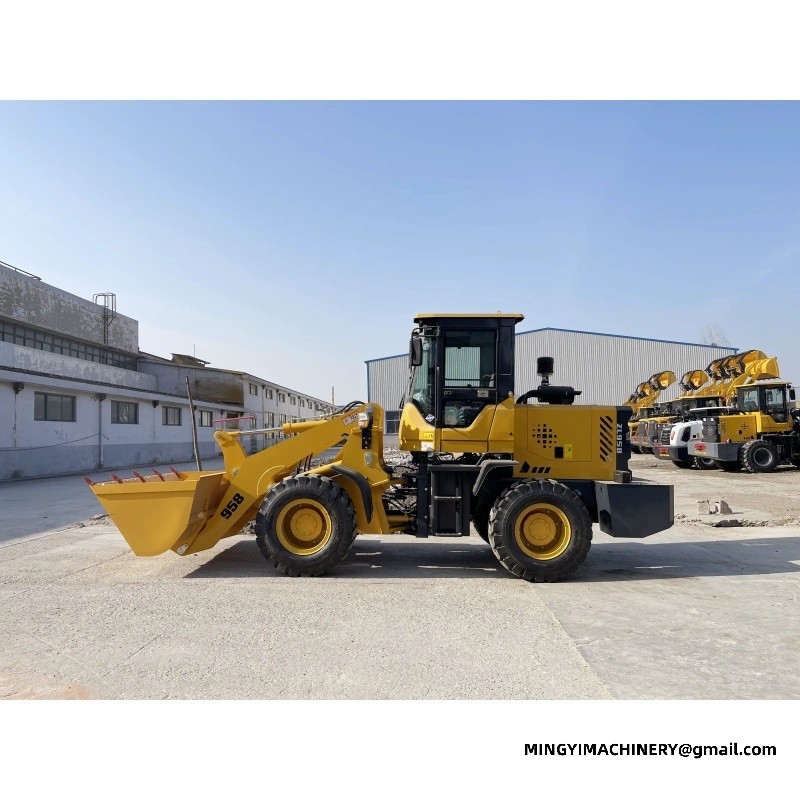
The two axle options on this range are differentiated by track: 1.2 m (Isuzu axle); 1.3 m (wheel-side reduction axle) on the standard 2.8 m low-profile wheel loader, 1.6 m on the light-duty 3.5 m medium-frame wheel-side reduction wheel loader. Behind the number is a different reduction layout. The Isuzu-pattern bridge is lighter, faster on hard ground and simpler to service. The wheel-side reduction bridge puts the final drive at the hub, which lowers the load on the shafts and raises the torque available at the tyre.
Choose by surface and gradient. On compacted hardstanding and long haul roads the Isuzu-pattern axle is the better machine; on a soft lane, a loading ramp or an uncompacted stockyard, hub reduction is what keeps the machine moving when a wheel would otherwise spin. Track width interacts with it: 1.2 m (Isuzu axle); 1.3 m (wheel-side reduction axle) on the standard 2.8 m low-profile wheel loader and 1.6 m on the light-duty 3.5 m medium-frame wheel-side reduction wheel loader are the figures to check against your narrowest gate, door or aisle before anything else on the sheet.
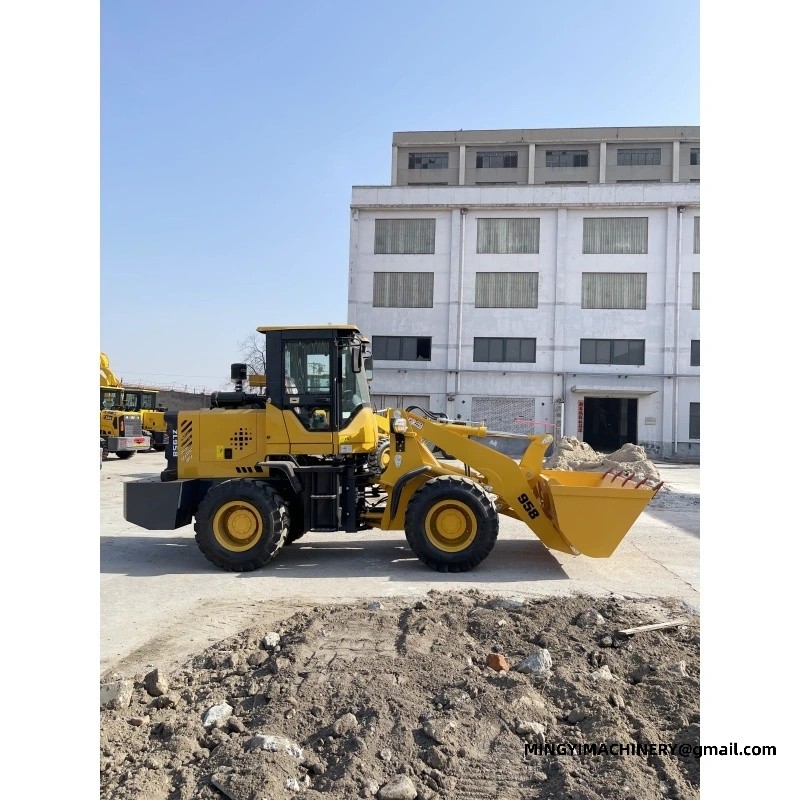
Bucket capacity decides how many passes you make; dump height decides whether the pass is possible at all. The heavy-duty 3.2 m low-profile wheel loader clears 3.2 m; the light-duty 3.5 m medium-frame wheel-side reduction wheel loader clears 3.5 m. Measure the receiving body at the front board rather than the side, because side boards sit lower and a machine that clears the side can still clip the front when it slews under load.
That single measurement eliminates most of the range before anything else is discussed. A low pan mixer or a one-ton site truck is served by 3.2 m; a body-up site tipper needs more; a crusher feed hopper or a high-board highway truck needs 3.5 m. Get it wrong and no amount of bucket volume, engine power or pump flow rescues the machine — it simply cannot put material where it has to go.
| Published build data — heavy-duty 3.2 m low-profile wheel loader | |
|---|---|
| Bucket capacity | 0.4 m³ |
| Dump height | 3.2 m |
| Track width | 1.5 m (wheel-side reduction axle); 1.45 m (Isuzu axle) |
| Boom arm thickness | 25 mm |
| Boom arm width | 430 mm |
| Boom arm length | 2.3 m |
| Boom arm centre distance | 890 mm |
| Cross-member thickness | 30 mm |
| Front hinge plate thickness | 30 mm |
| Rear hinge plate thickness | 20 mm |
| Rear frame section | 230 mm high x 800 mm wide |
| Hydraulic cylinders | centre cylinder 45 / side cylinder 45 |
| Fuel tank | 54 L (50# tank) |
| Battery | 60 Ah (490 engine); 80 Ah (4102 turbo engine) |
| Front wheel to counterweight | 4.1 m |
| Radiator | 4100 core (490 engine); 4105 core (4102T engine) |
| Work pump | 40 pump (490 engine); 1045 pump (4102 turbo engine) |
| Travel pump | 316 pump |
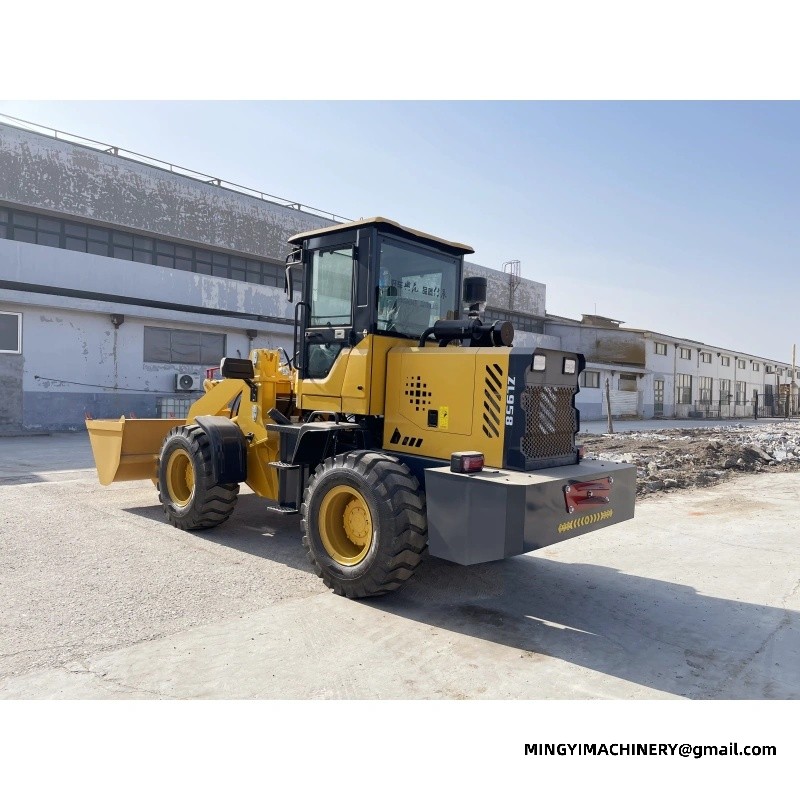
The distance from the front wheel to the rear of the counterweight is a stability specification dressed as a dimension. On the standard 2.8 m low-profile wheel loader it is 3.5 m working with a 0.3 m³ bucket at 2.8 m; on the heavy-duty 3.5 m small-frame wheel-side reduction wheel loader it is 4.1 m with 0.4 m³ at 3.5 m. Longer means more counterweight leverage, which is what lets a machine carry a full bucket high without lifting the rear wheels.
Longer also means a bigger turning circle, and that is the trade. In an open pit or a wide yard the 4.1 m machine with its 1.5 m (wheel-side reduction axle); 1.45 m (Isuzu axle) track is plainly the better tool. In a livestock shed, a nursery or an indoor renovation job, the 3.5 m machine on 1.2 m (Isuzu axle); 1.3 m (wheel-side reduction axle) will do work the other cannot start. Measure first; the specification only tells you what you are choosing between.
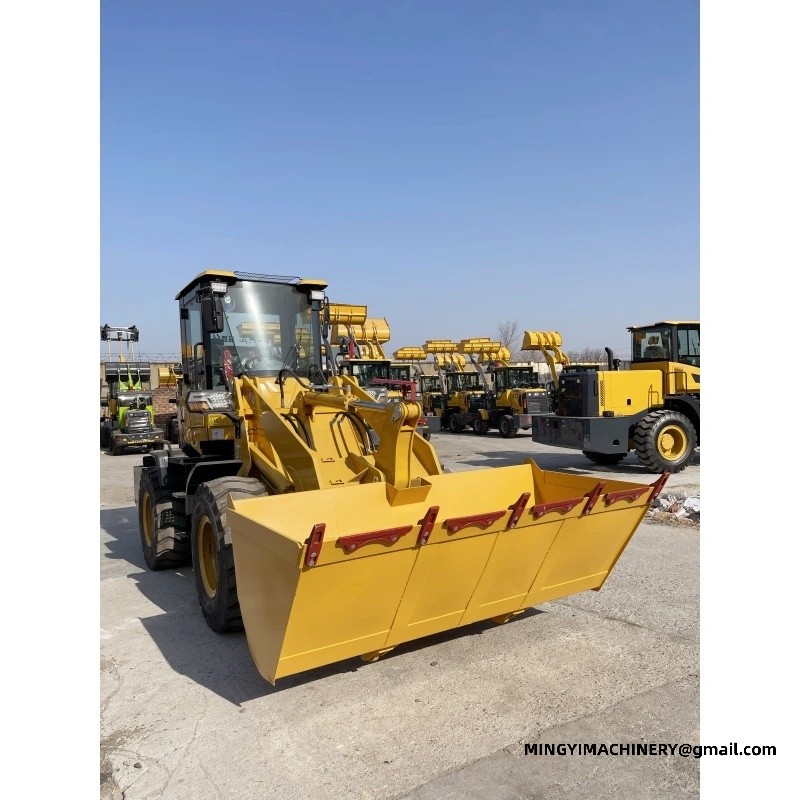
Breakout force is advertised; what you feel in the cab is the combination behind it. On the standard 2.8 m low-profile wheel loader that is a centre cylinder 45 / side cylinder 40 cylinder set on a 2.05 m boom with a 680 mm centre distance, lifting a 0.3 m³ bucket to 2.8 m. On the heavy-duty 3.2 m small-frame wheel-side reduction wheel loader it is centre cylinder 45 / side cylinder 45 on a 2.3 m arm with 890 mm spacing, lifting 0.4 m³ to 3.2 m.
Heat is the failure mode nobody plans for. A pump working at the top of its flow all shift, in dust, at altitude, will cook its oil — and the 32 pump on the standard 2.8 m low-profile wheel loader and the 40 pump (490 engine); 1045 pump (4102 turbo engine) on the heavy-duty 3.2 m small-frame wheel-side reduction wheel loader were each sized against their own cylinder volumes and duty. The matching travel pumps, 316 pump and 316 pump, keep drive independent so a loaded climb does not stall the boom. Specify the third circuit at order time if a hydraulic tool is in the plan; plumbing added later is the most common source of leaks we see in the field.
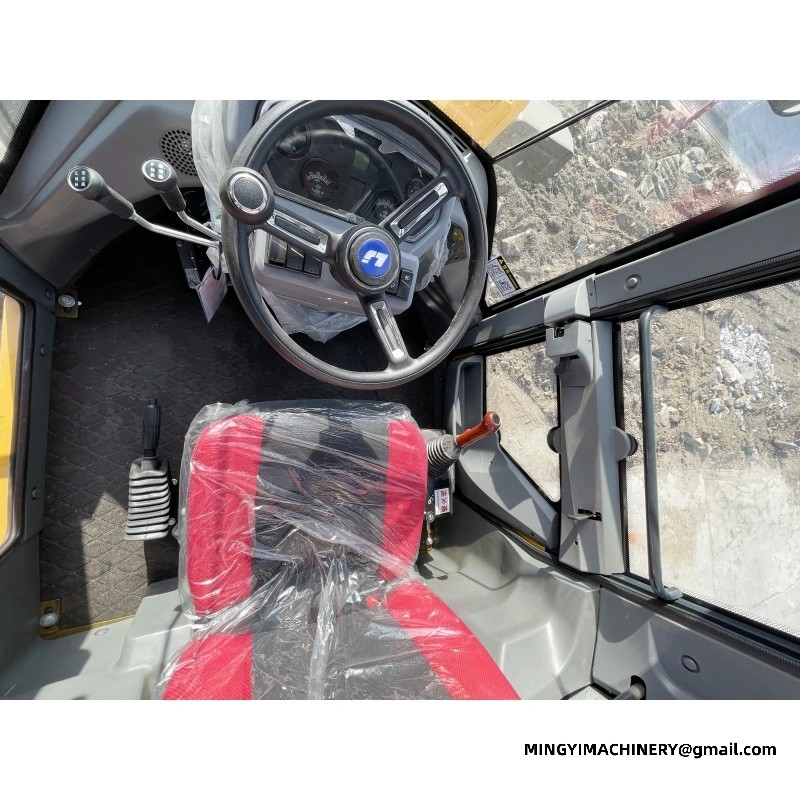
A loader that is greased, cool and clean will run for years on its original frame. The components that need attention are the articulation — 30 mm and 20 mm hinge plates on the heavy-duty 3.2 m small-frame wheel-side reduction wheel loader — the boom mounts at 890 mm, and the cooling pack, 4100 core (490 engine); 4105 core (4102T engine).
Set the intervals by duty, not by calendar. A machine working a dusty stockyard needs its core blown out daily; the same machine on a farm needs it monthly. A machine loading a face needs its pins greased every shift; one moving pallets needs it weekly. The specification tells you what to check — centre cylinder 45 / side cylinder 45 cylinders, 40 pump (490 engine); 1045 pump (4102 turbo engine) and 316 pump on the heavy-duty 3.2 m small-frame wheel-side reduction wheel loader, centre cylinder 45 / side cylinder 45, 40 pump (490 engine); 1045 pump (4102 turbo engine) and 316 pump on the heavy-duty 3.2 m low-profile wheel loader — and the duty tells you how often.
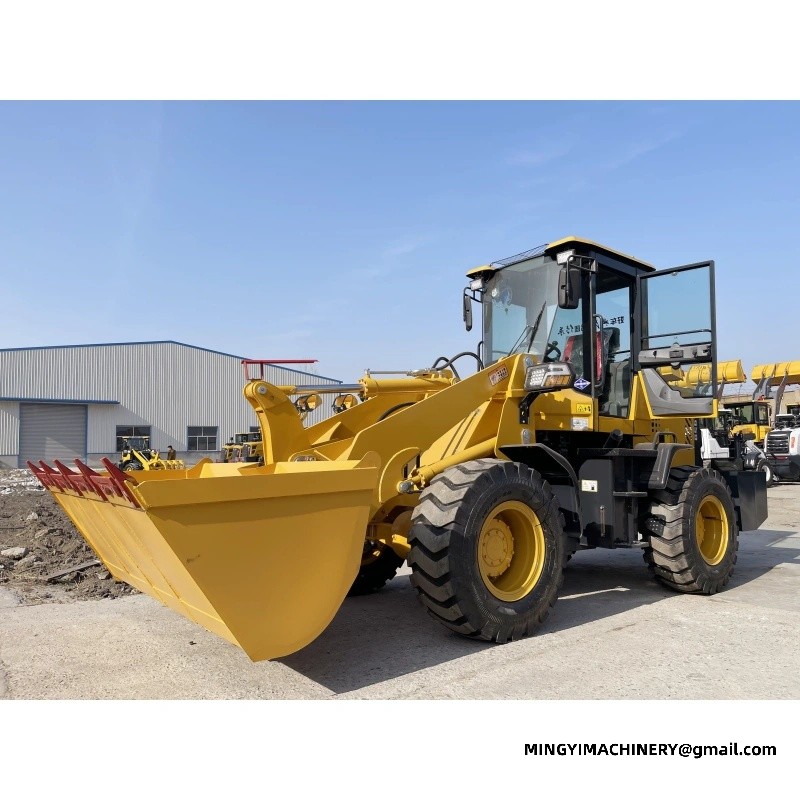
Over a full season, the differences that matter are not the ones on the sales sheet. Two machines, the standard 2.8 m low-profile wheel loader with 0.3 m³ at 2.8 m and the heavy-duty 3.2 m low-profile wheel loader with 0.4 m³ at 3.2 m, will differ in fuel by less than they differ in uptime, and they will differ in uptime mostly because of the cooling package — 4100 core against 4100 core (490 engine); 4105 core (4102T engine) — and the frame — 16 mm against 20 mm.
plan on the duty, then check the specification supports it. A light build in a quarry is a false economy; a heavy build on a farm is money spent for nothing. Where the duty is mixed, buy the frame for the hardest week of the year and the bucket for the average one — buckets are simple, frames are not, and the 32 pump and 316 pump on the standard 2.8 m low-profile wheel loader will run either.
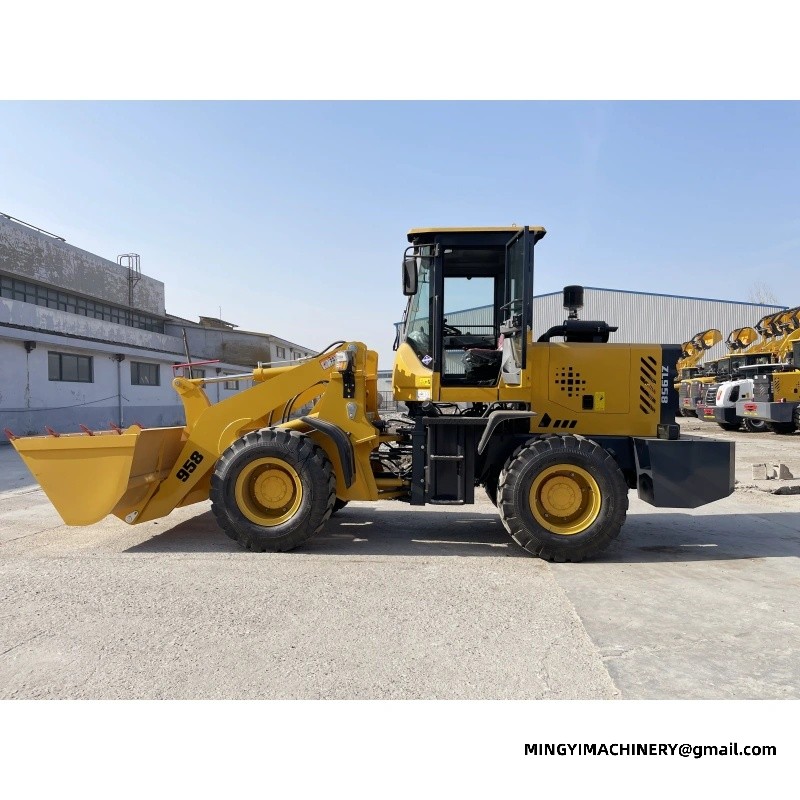
A boom that lifts slowly is usually a flow question, not a force question. The cylinders on this build are centre cylinder 45 / side cylinder 45 and the pump is 40 pump (490 engine); 1045 pump (4102 turbo engine); if lift is slow but breakout is normal, look at flow before looking at the cylinders. If breakout is weak as well, look at pressure.
Before either, rule out the simple causes: a blocked return filter, a low oil level, a suction leak, or a relief valve that has been tampered with to make a weak machine feel strong. Raising relief pressure above the setting the 25 mm wall and 30 mm cross-member were specified for is how frames get bent, and it is the most common fault found on machines that arrived second-hand.
Which axle should a wheel loader manufacturer be built with?
Match it to the ground. Track runs 1.5 m (wheel-side reduction axle); 1.45 m (Isuzu axle) on the heavy-duty 3.8 m small-frame wheel-side reduction wheel loader and 1.6 m on the light-duty 3.5 m medium-frame wheel-side reduction wheel loader; wheel-side reduction for soft or rutted surfaces, the Isuzu-pattern axle for hard, level ground.
What does the cross-member figure tell me about a wheel loader manufacturer?
How well the frame resists the twisting that articulation puts into it: 30 mm on the heavy-duty 3.2 m low-profile wheel loader against 30 mm on the heavy-duty 3.2 m small-frame wheel-side reduction wheel loader. It is the clearest marker of build class.
How does a wheel loader manufacturer cope with dust?
Specify the raised core: 4105 core on the light-duty 3.5 m medium-frame wheel-side reduction wheel loader against 4105 core on the heavy-duty 4.5 m medium-frame wheel-side reduction wheel loader, and blow the fins out at the end of every shift in fines or grain.
What engine options are offered on a wheel loader manufacturer?
Where two are offered, cooling and electrics change with them: 4105 core radiator and 80 Ah battery on the light-duty 3.5 m medium-frame wheel-side reduction wheel loader, with the raised core belonging to the turbo option.
What does a wheel loader manufacturer need to run a grapple?
A grapple sized to the 430 mm boom section and a hydraulic third circuit. The 2063 pump work pump is specified per build, so order the circuit with the machine.
Can a wheel loader manufacturer run a hydraulic attachment?
Yes, provided the third circuit is ordered with the machine. The 40 pump (490 engine); 1045 pump (4102 turbo engine) work pump and 316 pump travel pump are specified per build, and plumbing added later is the usual source of leaks.
How wide is a wheel loader manufacturer?
Track width is 1.5 m (wheel-side reduction axle); 1.45 m (Isuzu axle) on the heavy-duty 3.8 m small-frame wheel-side reduction wheel loader and 1.6 m on the light-duty 3.5 m medium-frame wheel-side reduction wheel loader. Check it against the narrowest gate, door or aisle before anything else on the sheet.
Specifications are built per order: machine, attachments, spares box and container plan together. Because rear frame sections stay between 300 mm high x 800 mm wide and 200 mm high x 750 mm wide across the wheel loader manufacturer range, two to three units ship in one forty-foot box.
Contact MINGYI Machinery for the current wheel loader lineup, configuration options and a formal specification for your market. E-mail: sales@mingycn.com | LINE (ID): mingyicn
Wheel Loader Supplier: Spares, Lead Times and Container Plans · China Wheel Loader Factory: Builds, QC and Export Loading · China Wheel Loader Factory Supplier: Steady Supply Planning · Loaders









