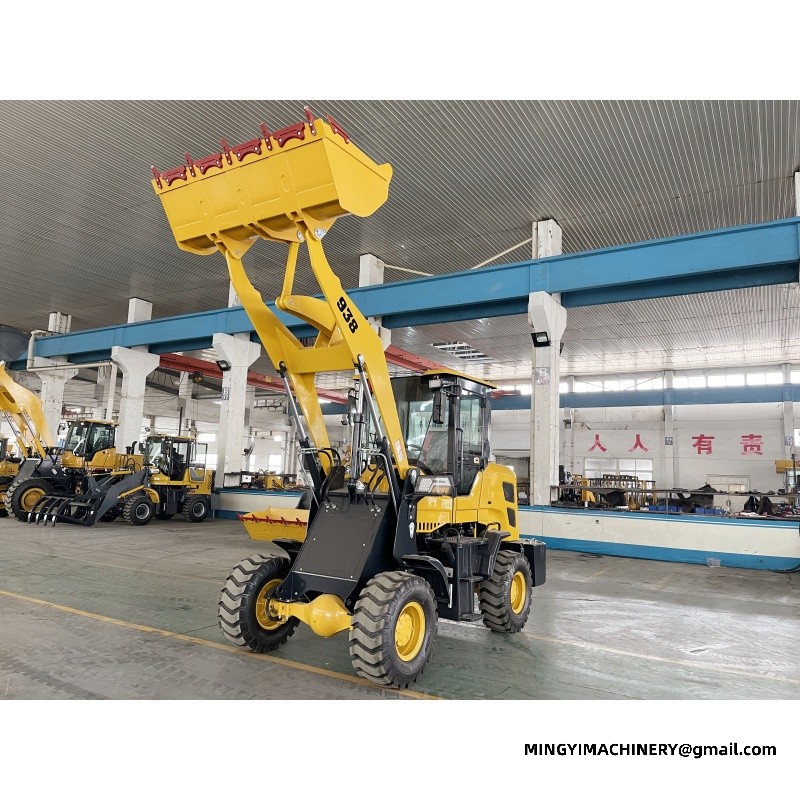
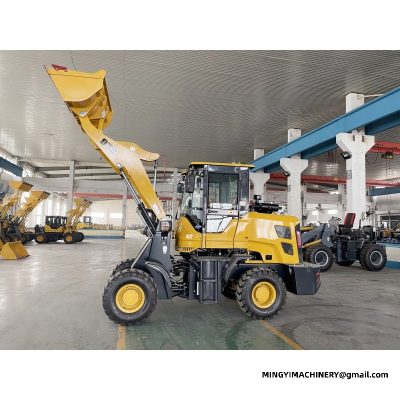
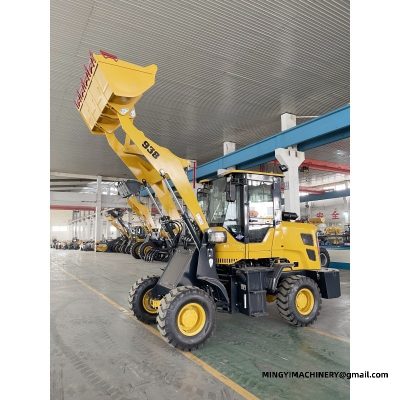
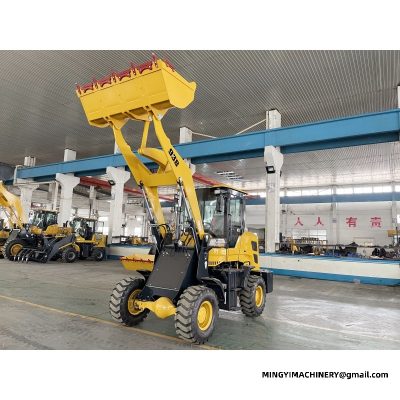
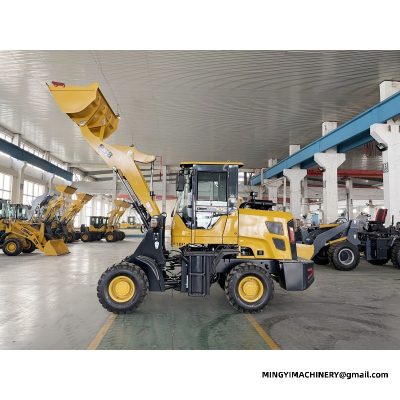
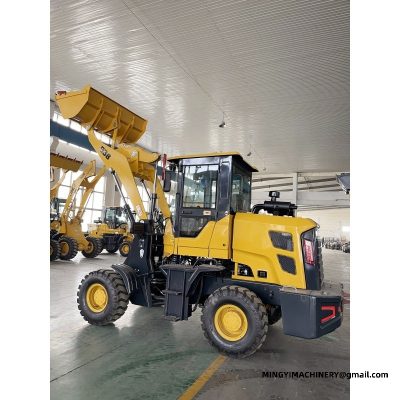
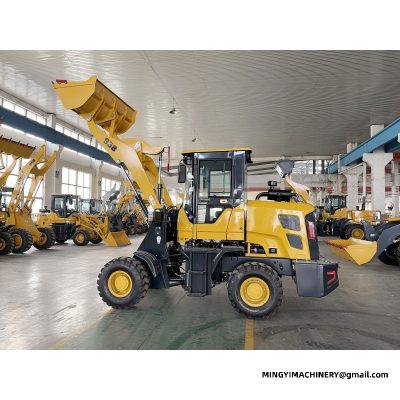
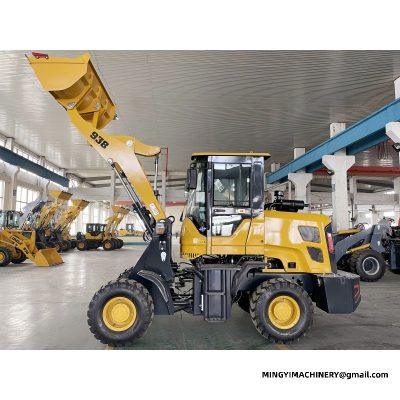
The first month tells you whether a wheel loader for aggregate yard was specified correctly. Cooling holds or it does not. The bucket matches the material or it does not. The pins stay tight or they start to move. All three are visible in the first few weeks and all three trace back to rows on the sheet: 4100 core, 0.3 m³ and 16 mm respectively. This page orders those rows by how soon they show up, using the standard 2.8 m low-profile wheel loader and the heavy-duty 3.2 m low-profile wheel loader as the worked examples.
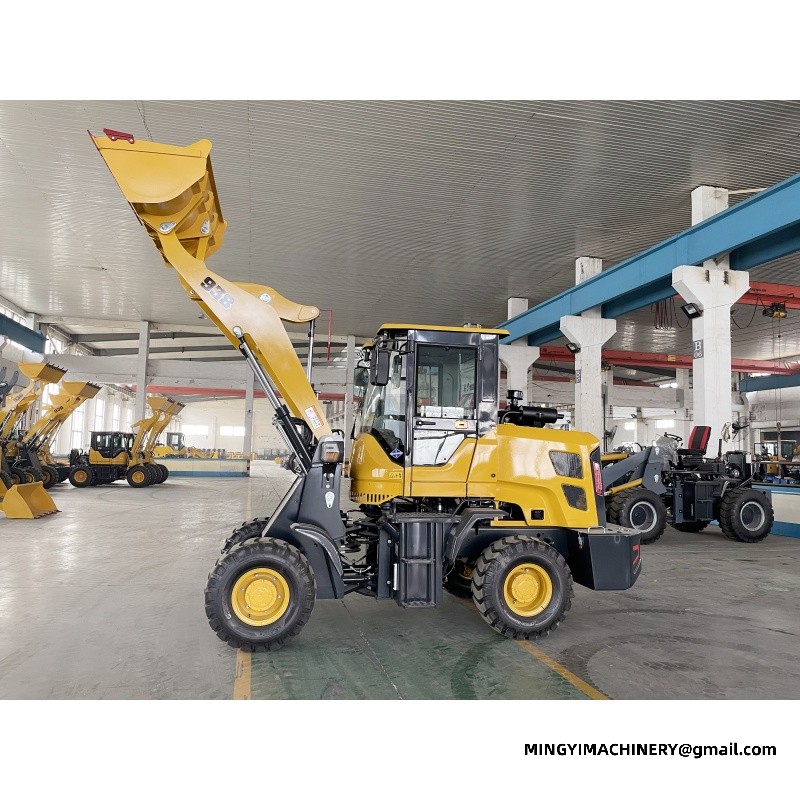
A bucket that fills completely every pass beats a larger one that fills partly, because a partly filled bucket is carrying air at the same effort as material. On a dense face, 0.4 m³ will fill where 0.4 m³ might not, and the smaller machine finishes the job first while putting less load into the 30 mm hinge.
There is also the question of what the load does to the machine in motion. Carrying a full bucket across rough ground loads the front axle, the hinge and the boom all at once. At 4.1 m front wheel to counterweight and 1.5 m (wheel-side reduction axle); 1.45 m (Isuzu axle) of track, the shorter machine with the right bucket is more stable as well as quicker, and stability is what keeps a cycle time consistent rather than occasionally fast.
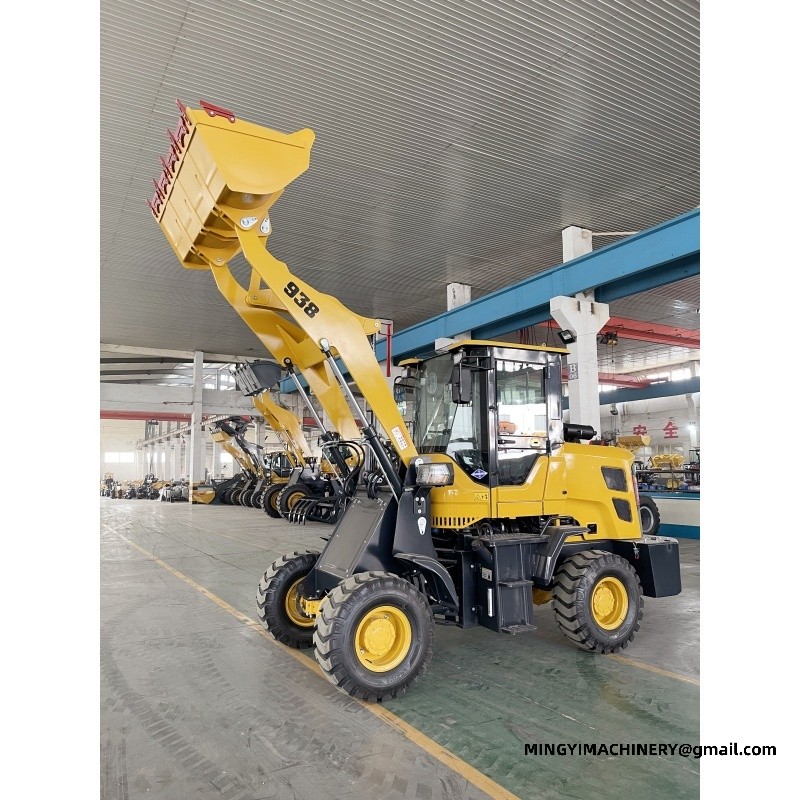
Capacity is bought and rarely used. If the receiving bodies sit below 3.5 m and the material is dense, a 0.4 m³ bucket that fills completely is faster than a 0.4 m³ bucket that fills to two-thirds, and it puts less into the hinge plates doing it.
Size matters twice more. A shorter machine, 4.1 m front wheel to counterweight against 4.1 m, works a tighter bay and turns inside its own length. A narrower one, 1.5 m (wheel-side reduction axle); 1.45 m (Isuzu axle) against 1.5 m (wheel-side reduction axle); 1.45 m (Isuzu axle), passes gates the other cannot. Where the work is confined, buy on dimensions and let capacity follow.
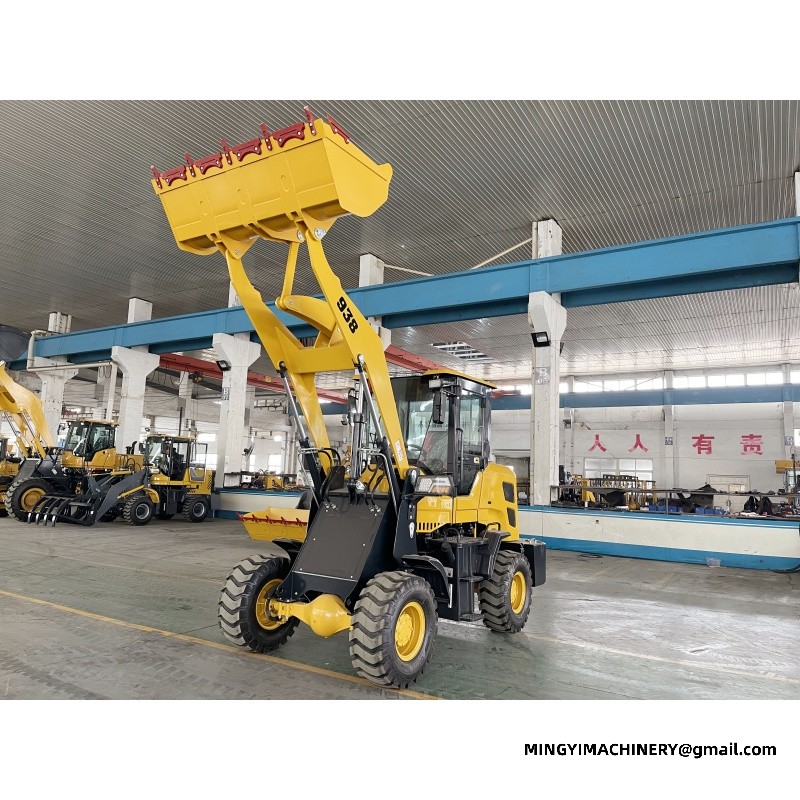
Cold cranking is the one specification that is easy to ignore and impossible to work around at five in the morning. This build is specified with 60 Ah (490 engine); 80 Ah (4102 turbo engine), matched to the engine it has to turn. Capacity in ampere-hours is only half the story; the other half is whether the rating is honest at low temperature, which is why the figure should be read together with the engine option.
Where two engines are offered, the turbo option asks for more from the battery and gets it: the higher rating in 60 Ah (490 engine); 80 Ah (4102 turbo engine) belongs to that build. If the machine will start cold, stop often, or run a short-haul duty with many restarts, specify the higher capacity at the order stage rather than discovering the limit in January.
| Sample build from the range — heavy-duty 4.2 m small-frame wheel-side reduction wheel loader | |
|---|---|
| Bucket capacity | 0.4 m³ |
| Dump height | 4.2 m |
| Track width | 1.5 m (wheel-side reduction axle); 1.45 m (Isuzu axle) |
| Boom arm thickness | 25 mm |
| Boom arm width | 500 mm |
| Boom arm length | 3.15 m |
| Boom arm centre distance | 890 mm |
| Cross-member thickness | 30 mm |
| Front hinge plate thickness | 30 mm |
| Rear hinge plate thickness | 20 mm |
| Rear frame section | 280 mm high x 800 mm wide |
| Hydraulic cylinders | centre cylinder 45 / side cylinder 45 |
| Fuel tank | 64.7 L (75# small tank) |
| Battery | 60 Ah (490 engine); 80 Ah (4102 turbo engine) |
| Front wheel to counterweight | 4.25 m |
| Radiator | 4100 core (490 engine); 4105 core (4102T engine) |
| Work pump | 40 pump (490 engine); 1045 pump (4102 turbo engine) |
| Travel pump | 316 pump |
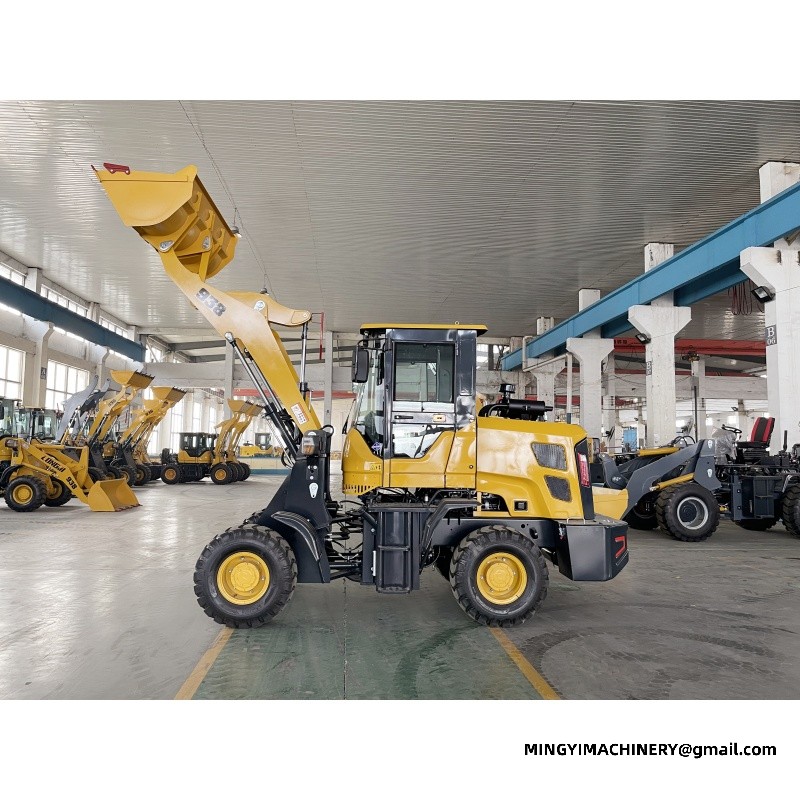
On builds with two engine options the cooling package changes with the engine, which is why the radiator line in the table reads as a pair: 4100 core on the standard 2.8 m low-profile wheel loader and 4100 core (490 engine); 4105 core (4102T engine) on the heavy-duty 3.2 m low-profile wheel loader. The 4100 core serves the 490 engine; the 4105 raised core serves the 4102 turbo. The raised core is not a marketing variant — it is more core area in the same footprint, and it is the difference between finishing a dusty shift and stopping at noon to blow out the fins.
Where the machine will work is the deciding factor. Grain handling, lime, cement raw meal, crushing and screening all load a radiator with fine material; road building on a wet day does not. If the application is dusty, specify the raised core and a reversible fan if offered. Then check the rest of the package matches: 30.8 L (48# large tank, 20.5/70-16 tyres); 24.6 L (48# small tank, 8.25-16 tyres) fuel on the standard 2.8 m low-profile wheel loader against 54 L (50# tank) on the heavy-duty 3.2 m low-profile wheel loader, and the battery at 45 Ah (24 V) against 60 Ah (490 engine); 80 Ah (4102 turbo engine).
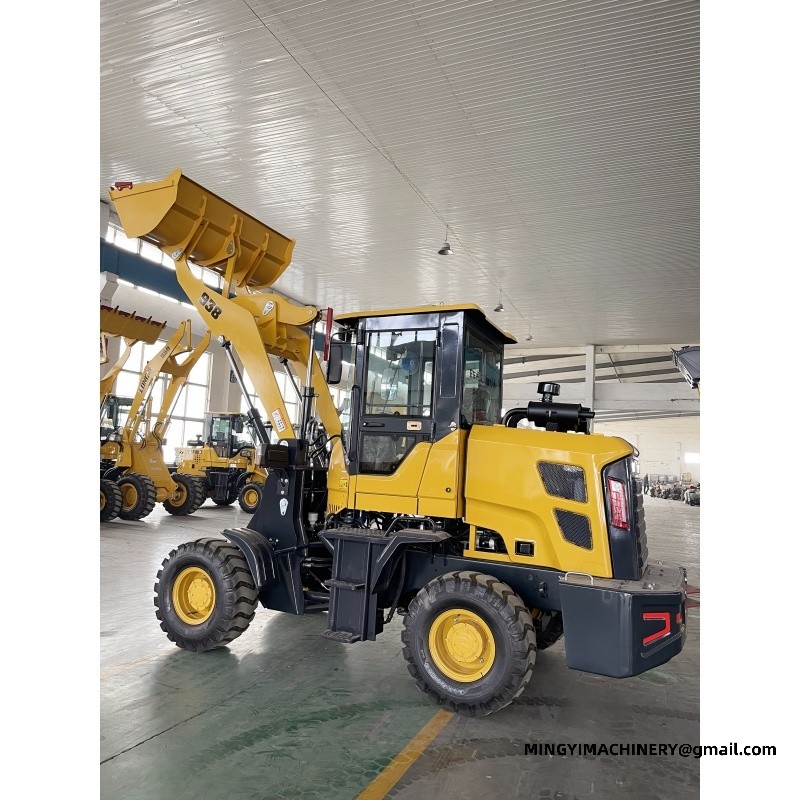
Farm work is governed by access and by the height of the things being filled. The standard 2.8 m low-profile wheel loader carries 0.3 m³ to 2.8 m on a 1.2 m (Isuzu axle); 1.3 m (wheel-side reduction axle) track with a 3.5 m footprint; the heavy-duty 3.2 m low-profile wheel loader carries 0.4 m³ to 3.2 m on 1.5 m (wheel-side reduction axle); 1.45 m (Isuzu axle) with 4.1 m. Gate widths, shed doors and feed-wagon sides are the constraints, and they are all fixed dimensions.
Attachments are where a farm loader earns its second life. Forks for bagged feed and pallets, a bale spear, a grapple for silage, a snow tool for the winter lane. They specification against the boom section, so check 300 mm on the standard 2.8 m low-profile wheel loader against 430 mm on the heavy-duty 3.2 m low-profile wheel loader before ordering, and specify the hydraulic circuit at build time if any of them is hydraulically actuated.
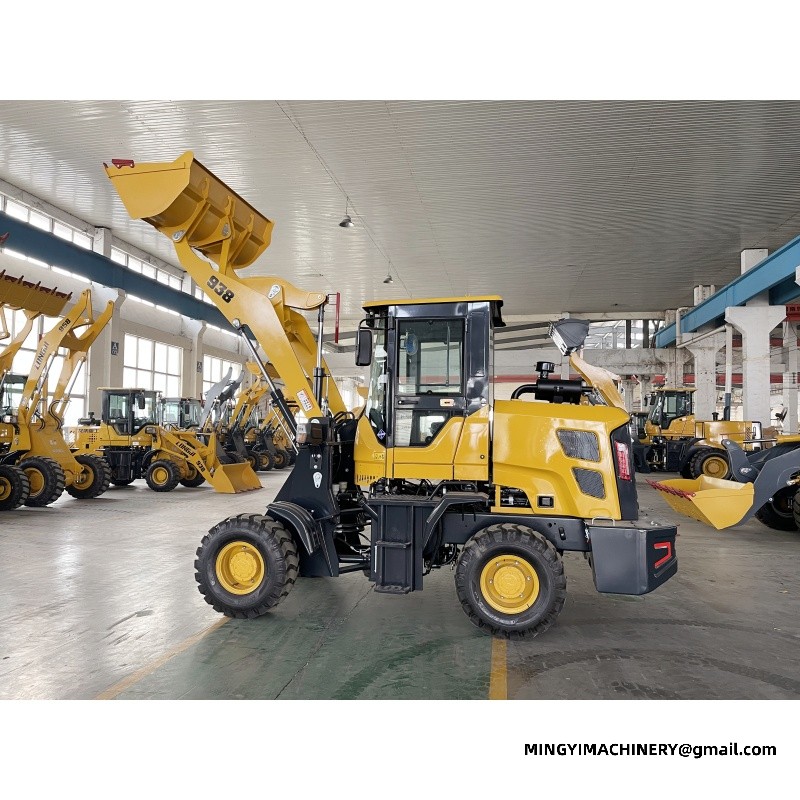
Fuel capacity on this range is specified per frame rather than per model: 30.8 L (48# large tank, 20.5/70-16 tyres); 24.6 L (48# small tank, 8.25-16 tyres) on the standard 2.8 m low-profile wheel loader and 54 L (50# tank) on the heavy-duty 3.2 m low-profile wheel loader. Both are intended to cover a full shift at working throttle, and both assume the machine is not idling for hours between loads — idling is where a "full day" tank becomes a half-day tank.
Plan refuelling around the tank, not around the clock. On the standard 2.8 m low-profile wheel loader with 30.8 L (48# large tank, 20.5/70-16 tyres); 24.6 L (48# small tank, 8.25-16 tyres) and a 0.3 m³ bucket at 2.8 m, a day of continuous loading will run the tank down; on the heavy-duty 3.2 m low-profile wheel loader with 54 L (50# tank) and 0.4 m³ at 3.2 m, the same day leaves allowance. Where a site has no bowser, that allowance is the difference between finishing at four and stopping at two.
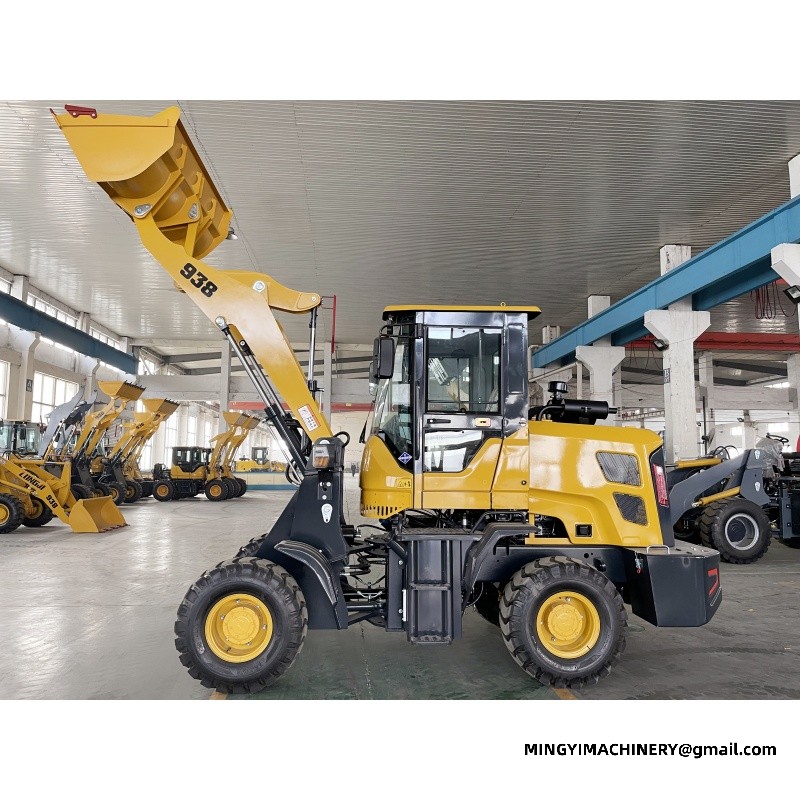
An articulated loader turns by bending in the middle, and the hinge is where that bending happens. Front plate 16 mm, rear plate 16 mm. The front is the thicker of the two on every build in the range, because it carries the boom and the payload directly, while the rear carries the engine and the counterweight through every steering movement and is sized for the twisting those movements produce rather than for the weight alone.
Pin wear is how hinges fail, and it shows up as a machine that wanders and a steering that feels vague. The cross-member is what prevents it: 16 mm holding the two sides of the frame at a fixed distance so the pins stay square. Compare 45 mm on the light-duty 3.8 m medium-frame wheel-side reduction wheel loader and the difference in plate thickness starts to make sense — they are specified together, not separately.
Parts are matched to a build, and the build is identified by its hydraulics and its engine long before its name. Specification centre cylinder 45 / side cylinder 40 and 32 pump and the pump is identified; specification 4100 core and the engine is identified; specification 45 Ah (24 V) and the electrical specification is identified.
Frame parts are identified by the steel: 16 mm front plate, 16 mm rear plate, 16 mm cross-member, 200 mm high x 750 mm wide rear section. Sending those four with an enquiry removes the usual round of photographs and gets the right part on the first shipment.
Before specifying anything else, measure the tallest body the loader will ever have to clear, at the front board, loaded, on the worst ground on site. That number decides the machine. The heavy-duty 3.8 m small-frame wheel-side reduction wheel loader in this comparison dumps at 3.8 m; the heavy-duty 3.8 m small-frame wheel-side reduction wheel loader at 3.8 m. The difference looks small on paper and is decisive at the face, because a loader that cannot clear the board cannot be worked around.
Once the height is settled, capacity sets the number of passes. 0.4 m³ on the heavy-duty 3.2 m low-profile wheel loader against 0.4 m³ on the heavy-duty 3.8 m small-frame wheel-side reduction wheel loader. Multiply by your material weight per cubic metre and check it against what the chassis is carrying, not what the bucket holds — the frame, at 30 mm across the member, is the limit that arrives first.
What do I check the day a wheel loader for aggregate yard is delivered?
Bucket 0.4 m³, lift 3.8 m, cylinders centre cylinder 45 / side cylinder 45, track 1.5 m (wheel-side reduction axle); 1.45 m (Isuzu axle) and length 4.2 m. Photograph all five; they settle any later question about what was ordered.
How much clearance do I need over a truck board?
Dump height is measured at the bucket edge, so subtract the crest of the material. The heavy-duty 3.2 m low-profile wheel loader gives 3.2 m and the heavy-duty 3.8 m small-frame wheel-side reduction wheel loader gives 3.8 m; the board has to sit under the lower of the two with allowance.
Should I go up a bucket size on a wheel loader for aggregate yard?
Only if the material is light enough to fill it. 0.4 m³ against 0.52 m³ looks like a gain on paper and is a loss on dense material, and the extra weight lands on the hinge.
What should I check before running a grapple on a wheel loader for aggregate yard?
Side load. A grapple levers the arm in a way a bucket does not, so the 20 mm wall and 300 mm section matter more than capacity. The hinge plates at 16 mm take the reaction.
How is a wheel loader for aggregate yard transported between sites?
On a low-loader, arm strapped down, secured to the frame rather than the cylinders. Front wheel to counterweight is 4.1 m and track is 1.5 m (wheel-side reduction axle); 1.45 m (Isuzu axle), which is what the haulier needs.
How is dump height on a wheel loader for aggregate yard measured?
At the bucket edge, arm at full lift, machine level. The heavy-duty 3.2 m low-profile wheel loader publishes 3.2 m and the light-duty 3.5 m medium-frame wheel-side reduction wheel loader publishes 3.5 m, measured the same way, so the two can be compared directly.
Can I order the same wheel loader for aggregate yard build again next year?
Yes, if the order is written by figures rather than by name: bucket 0.4 m³, lift 4.2 m, cylinders centre cylinder 45 / side cylinder 45, pump 40 pump (490 engine); 1045 pump (4102 turbo engine). Names change; rows do not.
Those are the rows that decide how a wheel loader for aggregate yard behaves once it is working. The full table for every build in the range is available on request, along with the engine options that change the pump, radiator and battery figures stated here.
Contact MINGYI Machinery for the current wheel loader lineup, configuration options and a formal specification for your market. E-mail: sales@mingycn.com | LINE (ID): mingyicn
OEM Wheel Loader Manufacturer: Build Consistency by Order · China Wheel Loader Factory Supplier: Container and Spares Plan · Hydraulic Wheel Loader Log Grapple: Circuit and Cylinders · Wheel Loader









