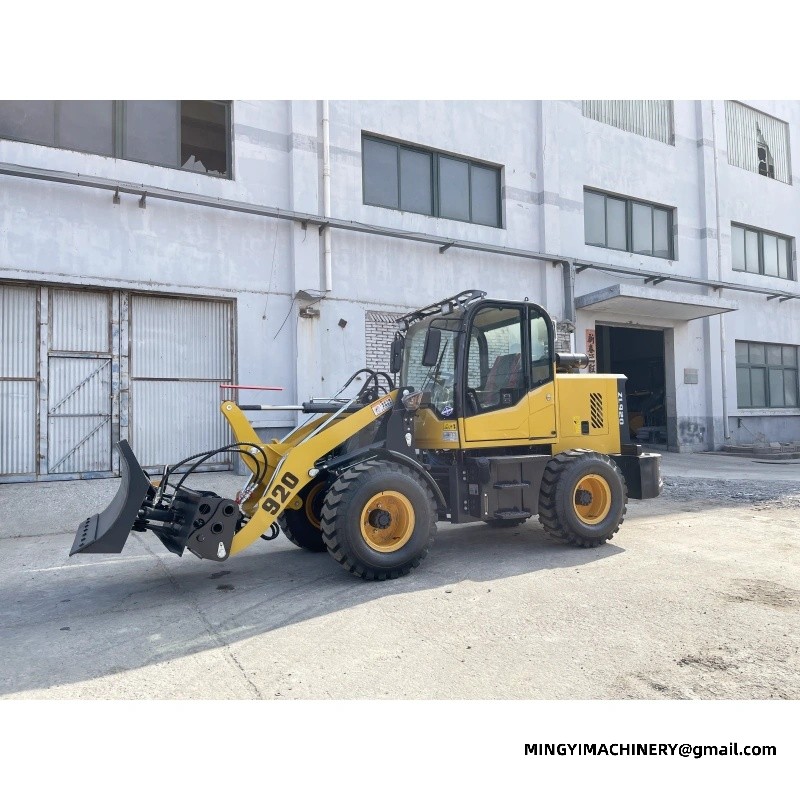
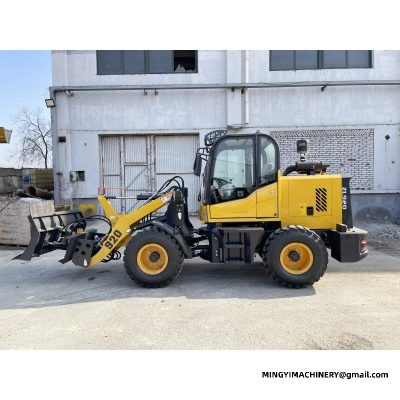
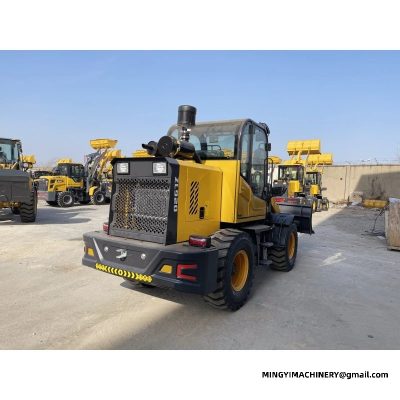
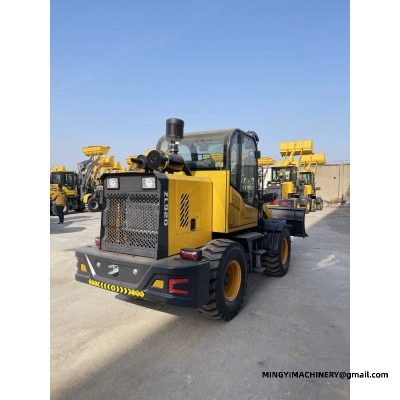
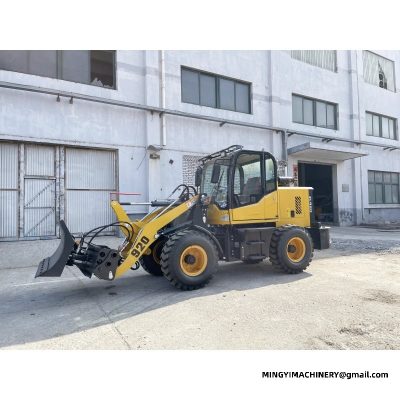
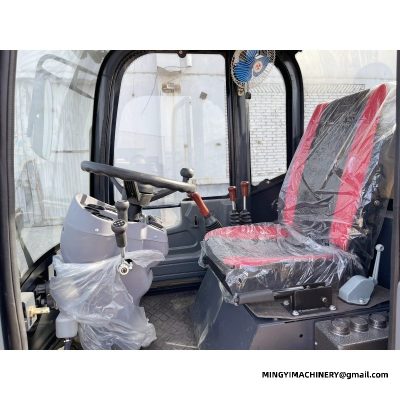
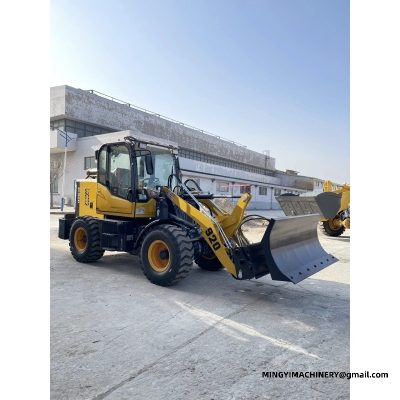
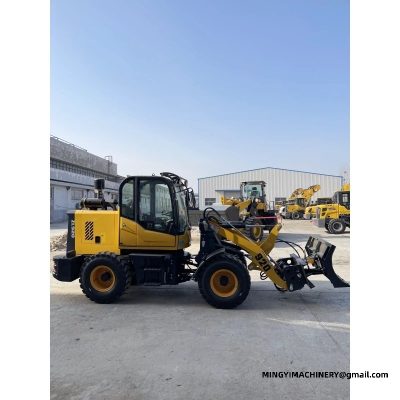
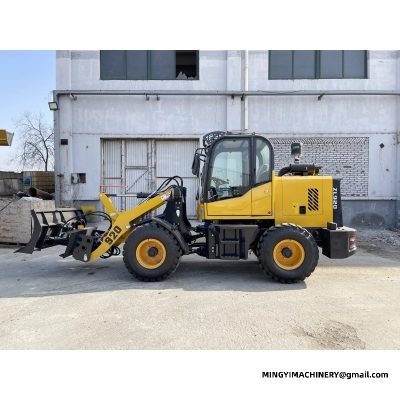
Fleet buyers read a wheel loader series sheet differently from owner-operators. Fleets care whether the next machine matches the last one: same 32 pump pump, same 4100 core radiator, same 45 Ah (24 V) battery, because that is what keeps one spares bin covering ten machines. Owner-operators care whether this one machine fits the job. This page is written to serve both, comparing the standard 2.4 m low-profile wheel loader and the light-duty 3.2 m low-profile wheel loader row by row, and saying plainly which rows matter for which kind of buyer.
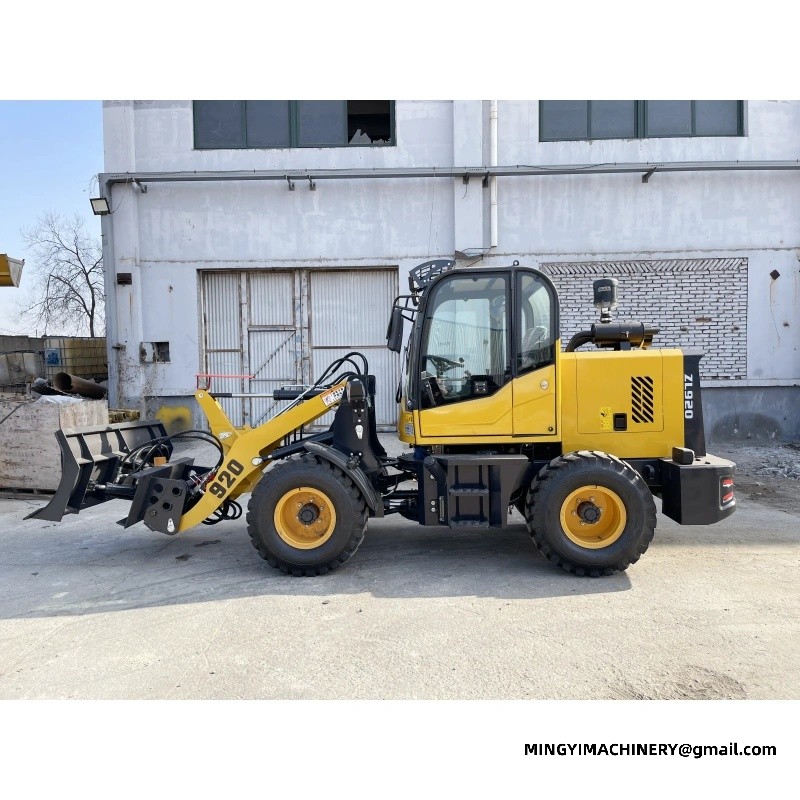
The standard bucket on this build is 0.38 m³, and it is the right tool for loose material moved from a heap to a body. Everything else is a compromise in one direction or another: forks give precision and lose volume, grapples give grip and lose speed, a snow blower gives reach and needs flow the bucket never asked for.
What makes attachments practical is whether the machine can lift them. Boom wall 25 mm and section 370 mm decide how much side load the arm takes, and the hinge plates — 25 mm at the front, 14 mm at the rear — decide how long the frame takes it. A grapple hanging off the end of a long arm is a side load the bucket never produces.
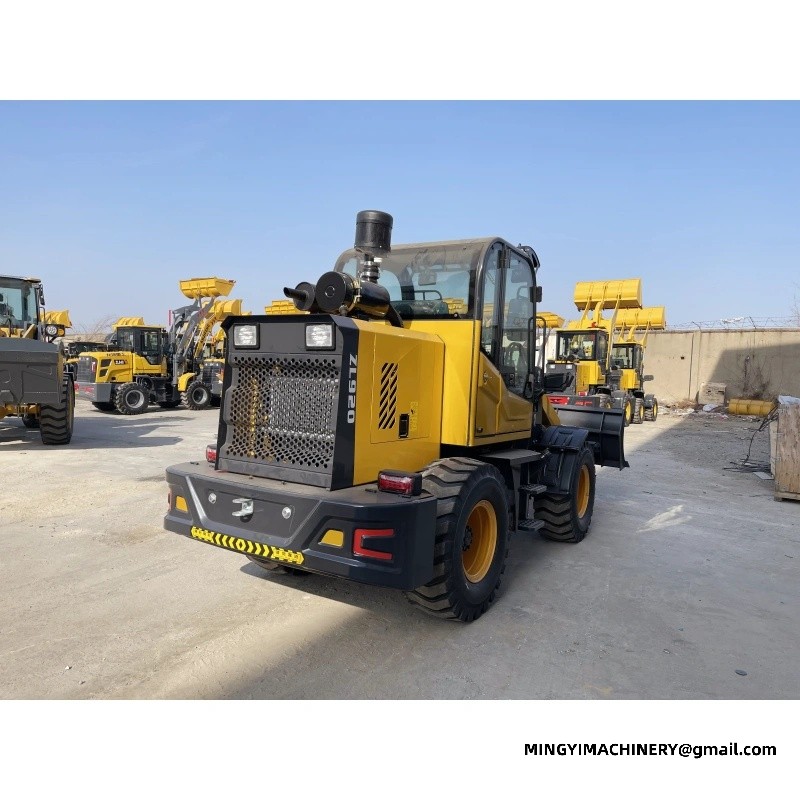
Capacity is bought and rarely used. If the receiving bodies sit below 4.2 m and the material is dense, a 0.38 m³ bucket that fills completely is faster than a 0.38 m³ bucket that fills to two-thirds, and it puts less into the hinge plates doing it.
Size matters twice more. A shorter machine, 4.1 m front wheel to counterweight against 3.8 m, works a tighter bay and turns inside its own length. A narrower one, 1.5 m (wheel-side reduction axle); 1.45 m (Isuzu axle) against 1.5 m (wheel-side reduction axle); 1.45 m (Isuzu axle), passes gates the other cannot. Where the work is confined, buy on dimensions and let capacity follow.
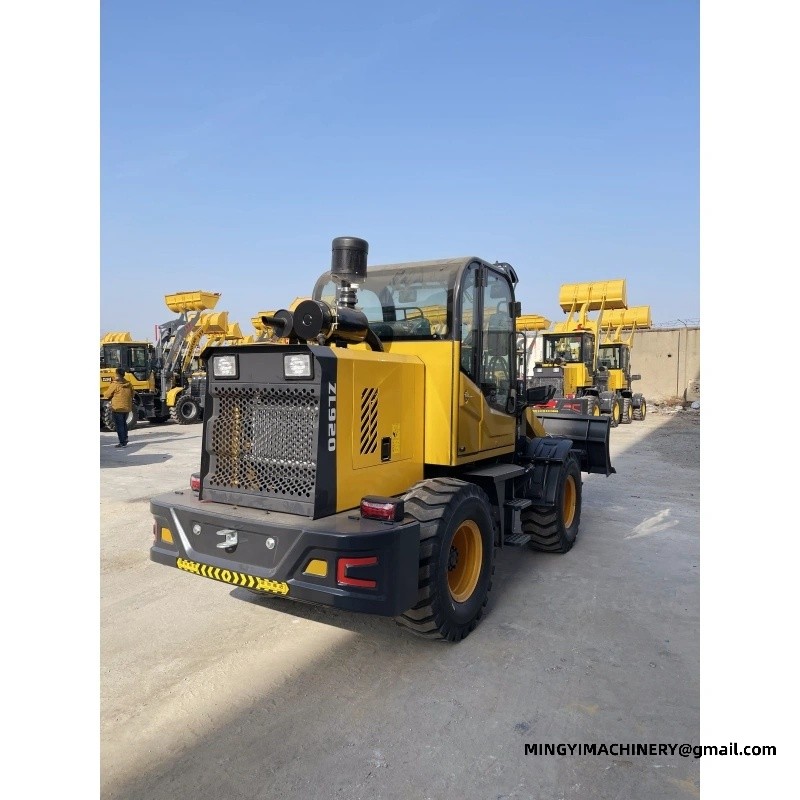
Electrical specification is short but consequential. The standard 2.4 m low-profile wheel loader lists 45 Ah (24 V); the light-duty 3.2 m low-profile wheel loader lists 60 Ah (490 engine); 80 Ah (4102 turbo engine). Where a build offers two engines, the higher capacity belongs to the turbo — more compression to turn, more glow-plug load, and in a cold market that difference is the whole of a morning.
Beyond the battery, specify an isolator switch and confirm the alternator output matches the load you intend to add. Work lights, a beacon, a reversing alarm and a hydraulic third-circuit solenoid all draw from the same pack, and the 32 pump driven hydraulics on the standard 2.4 m low-profile wheel loader do not reduce that draw. On the light-duty 3.2 m low-profile wheel loader the same applies with 40 pump (490 engine); 1045 pump (4102 turbo engine). If the machine will sit for more than a month before commissioning, specify the isolator and a maintenance charge interval.
| Specification extract — light-duty 3.5 m small-frame wheel-side reduction wheel loader | |
|---|---|
| Bucket capacity | 0.38 m³ |
| Dump height | 3.5 m |
| Track width | 1.5 m (wheel-side reduction axle); 1.45 m (Isuzu axle) |
| Boom arm thickness | 25 mm |
| Boom arm width | 370 mm |
| Boom arm length | 2.62 m |
| Boom arm centre distance | 890 mm |
| Cross-member thickness | 25 mm |
| Front hinge plate thickness | 25 mm |
| Rear hinge plate thickness | 14 mm |
| Rear frame section | 280 mm high x 800 mm wide |
| Hydraulic cylinders | centre cylinder 45 / side cylinder 40 |
| Fuel tank | 64.7 L (75# small tank) |
| Battery | 60 Ah (490 engine); 80 Ah (4102 turbo engine) |
| Front wheel to counterweight | 4 m |
| Radiator | 4100 core (490 engine); 4105 core (4102T engine) |
| Work pump | 40 pump (490 engine); 1045 pump (4102 turbo engine) |
| Travel pump | 316 pump |
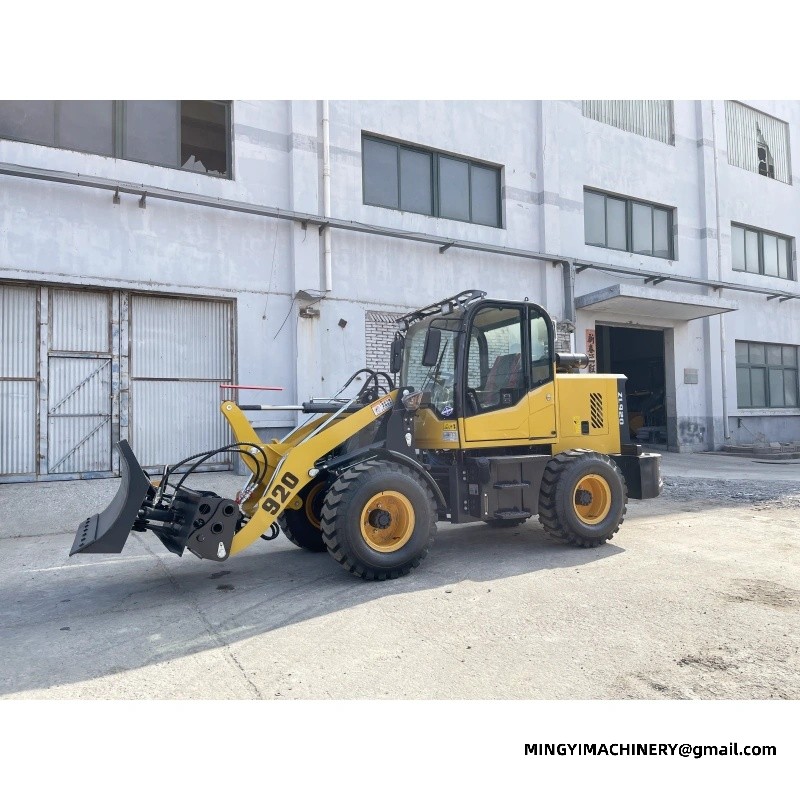
An agricultural loader is a small machine doing varied work, and the specification that matters is the one that lets it into the buildings. Track width 1.2 m (Isuzu axle); 1.3 m (wheel-side reduction axle) on the standard 2.4 m low-profile wheel loader against 1.6 m on the heavy-duty 3.5 m medium-frame wheel-side reduction wheel loader, footprint 3.5 m against 4.55 m, and dump height 2.4 m against 3.5 m for the wagon or hopper it fills.
Duty is seasonal and mostly light, which is why the light builds exist: a 0.3 m³ bucket with 16 mm cross-member and 16 mm rear hinge plates is correctly specified for silage, bagged goods and yard scraping. Where the machine also does heavy work — muck-out with a loaded bucket, or winter snow clearing — step to the heavier build with 45 mm and 30 mm. Over-specifying takes money once; under-specifying takes a frame.
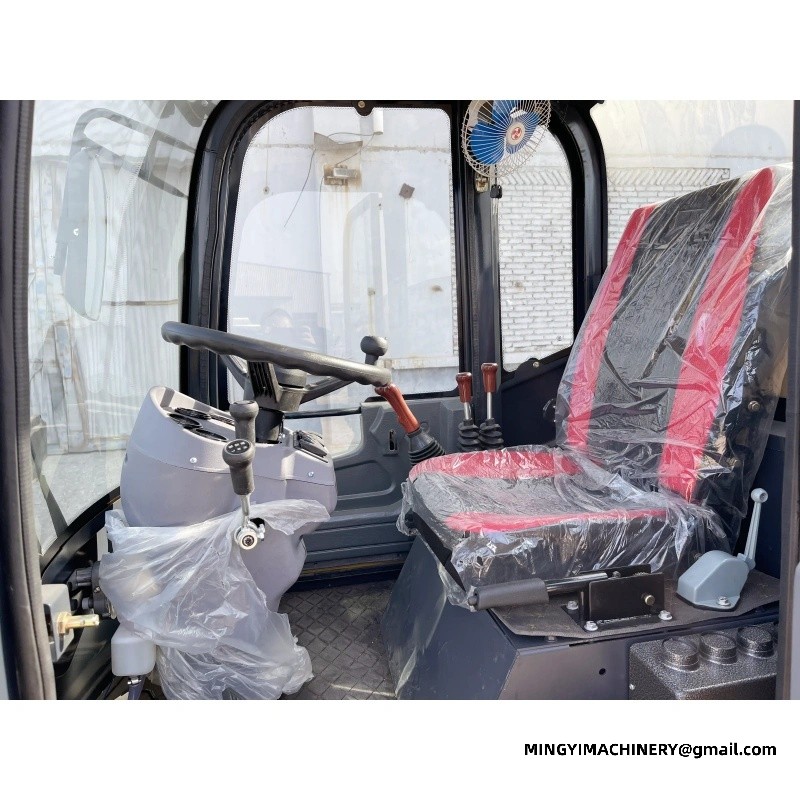
Two dimensions decide whether a loader is usable on a given site: the 3.5 m front-to-counterweight length of the standard 2.4 m low-profile wheel loader against the 4 m of the light-duty 3.2 m low-profile wheel loader, and track width at 1.2 m (Isuzu axle); 1.3 m (wheel-side reduction axle) against 1.5 m (wheel-side reduction axle); 1.45 m (Isuzu axle). Everything else on the sheet — engine, pump, cylinder bore — matters only after the machine fits.
The pairing matters too. A 0.3 m³ bucket lifted to 2.4 m on a 3.5 m footprint is a different machine in practice from a 0.38 m³ bucket at 3.2 m on 4 m, even where the track figures are close. Where access is tight, take the shorter machine and accept the extra pass; where the ground is open, take the longer one and take the stability it buys with the 14 mm rear hinge plate.
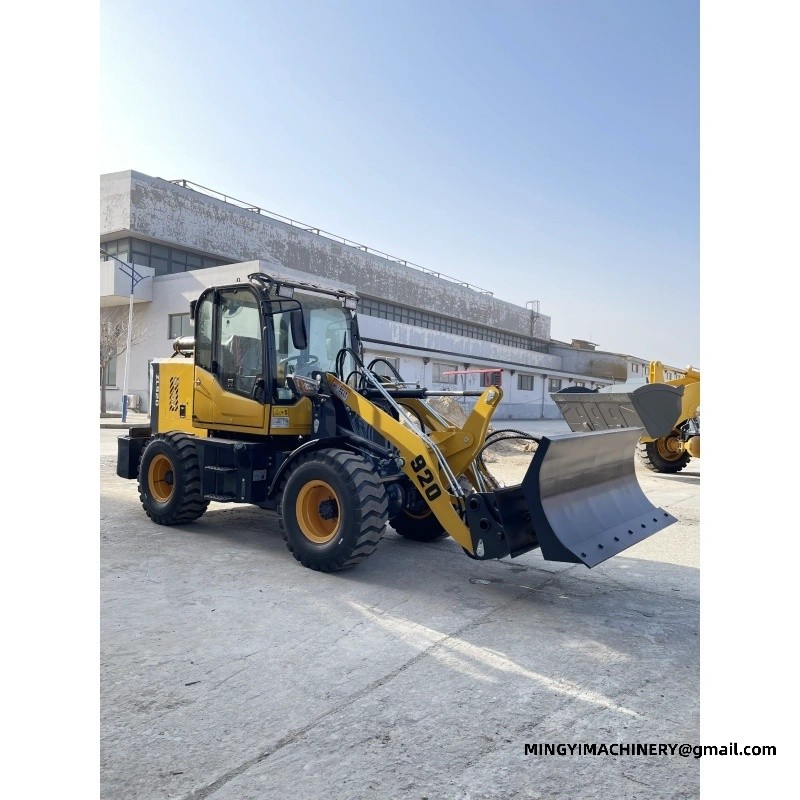
Fuel is visible and downtime is not, which is why fleets optimise the wrong one. A machine with a 54 L (50# tank) tank works a full shift without a refuel stop; that is worth a fraction of what a single day lost to a failed pump takes, and the pump is identified on the sheet as 40 pump (490 engine); 1045 pump (4102 turbo engine).
The parts worth specifying against downtime are the ones that cannot be improvised: the battery rating, 60 Ah (490 engine); 80 Ah (4102 turbo engine), the radiator, 4100 core (490 engine); 4105 core (4102T engine), and the cylinders, centre cylinder 45 / side cylinder 40. All three are simple at build and lengthy in a field, and all three are listed. Read them as an availability decision rather than as a comfort one.
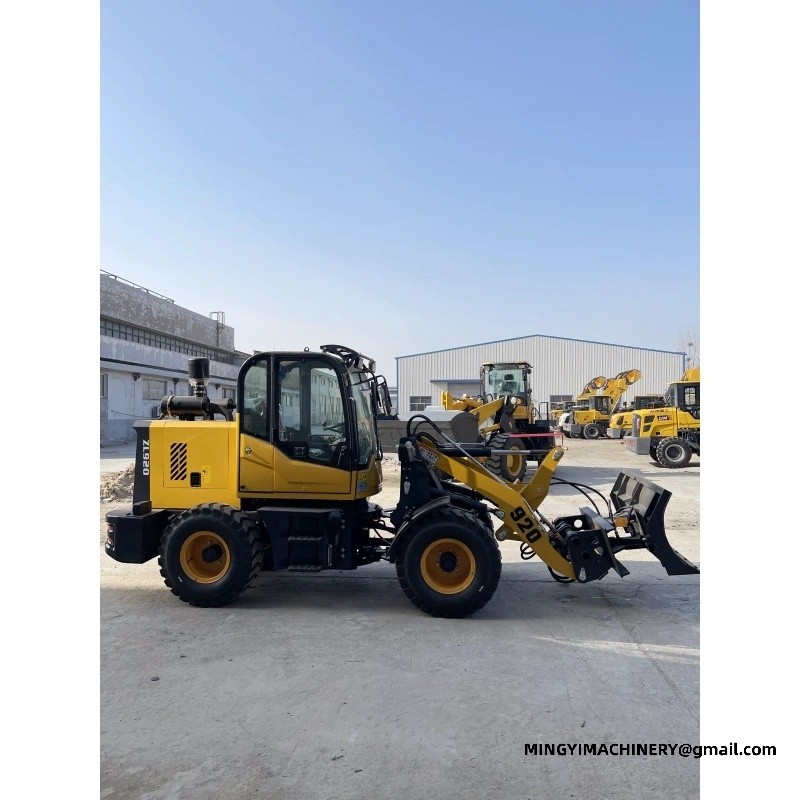
Some choices can be made after delivery and some cannot. Steel cannot: hinge plates at 25 mm and 14 mm, a 25 mm cross-member and a 280 mm high x 800 mm wide rear frame are decided when the frame is welded. Hydraulics mostly can: this build runs centre cylinder 45 / side cylinder 40 on a 40 pump (490 engine); 1045 pump (4102 turbo engine), and adding a service later is possible even if it is never as tidy as specifying it first.
The engine is the other early decision, because it drags three figures with it. Where two engines are offered, battery, radiator and pump all change: 60 Ah (490 engine); 80 Ah (4102 turbo engine), 4100 core (490 engine); 4105 core (4102T engine), 40 pump (490 engine); 1045 pump (4102 turbo engine). Choosing the engine late means choosing all three late, and usually accepting whatever is in stock.
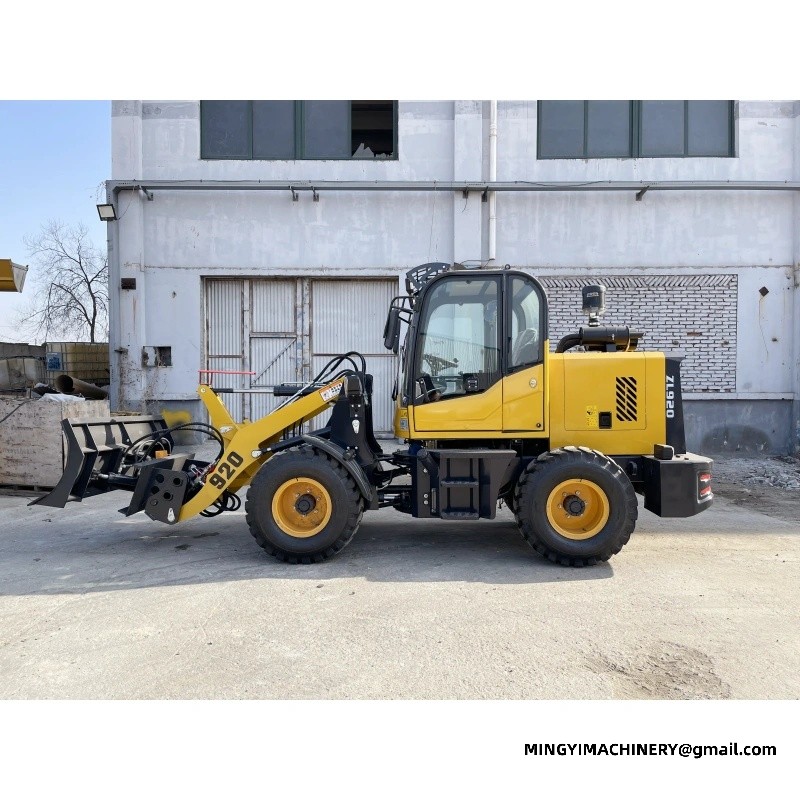
A site loader spends its life doing the same cycle, and the cycle punishes three components: the rear hinge, the cooling pack and the tyres. On the standard 2.4 m low-profile wheel loader the rear hinge is 16 mm over a 16 mm cross-member; on the light-duty 3.2 m low-profile wheel loader it is 14 mm over 25 mm. Which of those you need depends on how often the machine turns under load.
Cycle time is the economics. A 0.3 m³ bucket at 2.4 m on a 1.85 m arm loaded by centre cylinder 40 / side cylinder 40 cylinders is quick in a tight site; a 0.38 m³ bucket at 3.2 m on a 2.3 m arm with centre cylinder 45 / side cylinder 40 is quicker where there is room to work. Neither is universally faster, and any supplier who claims otherwise is describing a different site from yours.
Will a wheel loader series ship assembled in a container?
It depends on the longest dimension, 3.5 m from front wheel to counterweight, and on track, 1.2 m (Isuzu axle); 1.3 m (wheel-side reduction axle). The bucket usually comes off; the arm must be lowered to clear the door.
How does wet ground change how a wheel loader series is used?
Rolling resistance rises, so wheel spin and driveline load rise with it. Track is 1.5 m (wheel-side reduction axle); 1.45 m (Isuzu axle), and the hub-reduction option is the one for soft ground.
How often will a wheel loader series need refuelling?
The tank is 30.8 L (48# large tank, 20.5/70-16 tyres); 24.6 L (48# small tank, 8.25-16 tyres), sized for a full shift at working throttle without a mid-day stop. Machines on short cycles with a lot of idling will use more than the figure suggests.
How should a wheel loader series be stored for a season?
Isolate the battery, which is rated 60 Ah (490 engine); 80 Ah (4102 turbo engine), grease the pins, and protect the cylinder rods on the centre cylinder 45 / side cylinder 40. Machines stored outside suffer at the pins and the electrics.
What is involved in changing attachments on a wheel loader series?
Mechanical mounting plus hydraulics. The cylinders are centre cylinder 45 / side cylinder 40 and the pump is 40 pump (490 engine); 1045 pump (4102 turbo engine); flow, not force, is usually what limits an added service.
Which tyre fitment does a wheel loader series use?
It follows the tank and axle specification: 54 L (50# tank) on this build. The larger fitment goes with the larger tank and the heavier duty.
How much does material weight matter on a wheel loader series?
It sets the real limit, not the bucket. Volume is 0.3 m³; what the frame takes is set by the 16 mm cross-member and the 200 mm high x 750 mm wide rear section behind it.
Two builds, standard 2.4 m low-profile wheel loader and light-duty 3.2 m low-profile wheel loader, have carried the comparisons on this page. The same rows can be produced for any machine in the range, and for the engine options that change the pump, radiator and battery with them.
Fuel, oil and fluid quality for Wheel Loader Series: Matching a Build to Daily Work
Fluid quality is a storage problem before it is a machine problem. Water and sediment in a drum will find the injection system of Wheel Loader Series: Matching a Build to Daily Work eventually, and a settling period is nothing compared with a pump.
Moving Wheel Loader Series: Matching a Build to Daily Work between sites
Securing the load is not optional. Lashing Wheel Loader Series: Matching a Build to Daily Work at the points intended for it, checking the tension before the vehicle moves and rechecking after the first kilometres is standard practice rather than extra care.
Planning the season around Wheel Loader Series: Matching a Build to Daily Work
Seasonal work rewards a machine that can change duty. Through the year Wheel Loader Series: Matching a Build to Daily Work may move from one task to another, and the attachment list should be chosen for the whole year rather than for the first job.
Reading the early symptoms on Wheel Loader Series: Matching a Build to Daily Work
Operators notice things first because they hear the machine every day. Encouraging the person on Wheel Loader Series: Matching a Build to Daily Work to report small changes, and acting on them, is the most effective maintenance programme there is.
Contact MINGYI Machinery for the current wheel loader lineup, configuration options and a formal specification for your market. E-mail: sales@mingycn.com | LINE (ID): mingyicn
Wheel Loader: The Checks Before First Start · Front End Loader: Attachment Changes and Hydraulics · Wheel Loader for Agriculture: Silage, Grain and Yard Work · Wheel Loader









