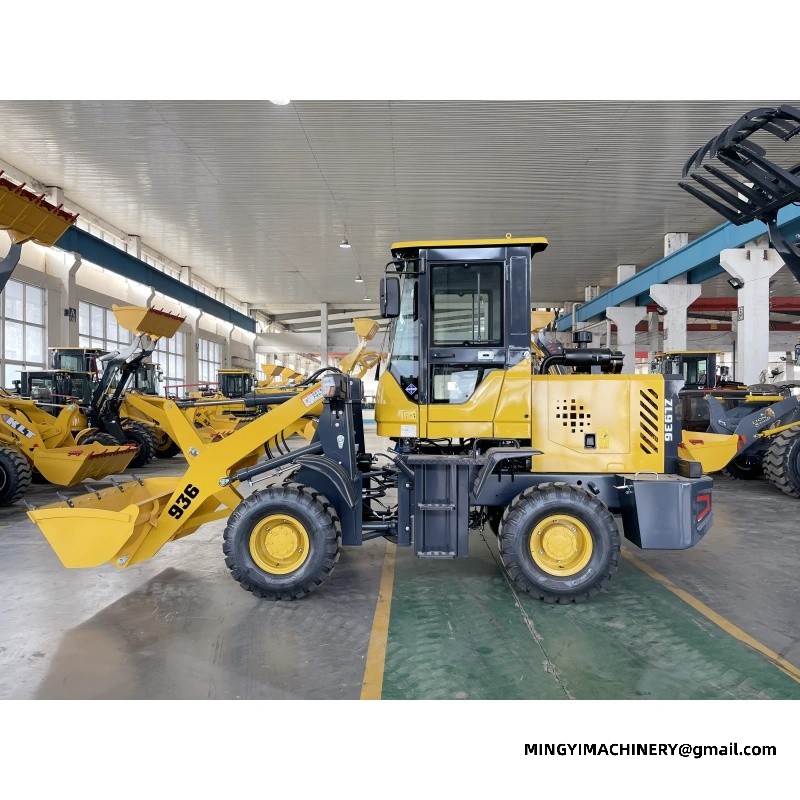
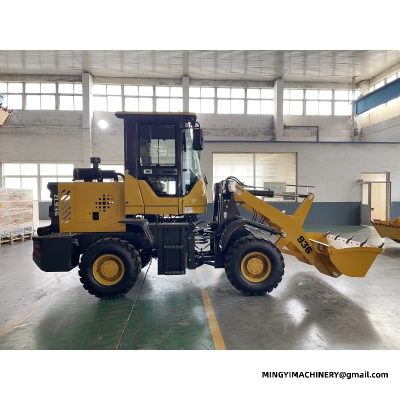
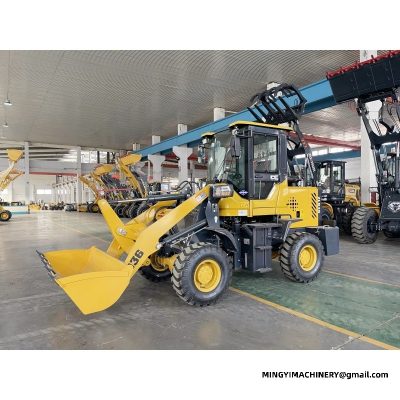
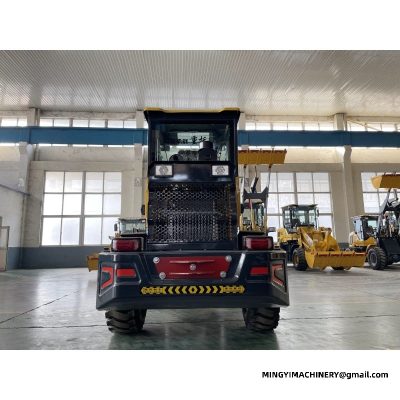
What separates a wheel loader for agriculture that is still tight at year five from one that is loose at year two is visible on the specification sheet, if you know which row to read. It is not the engine and it is not the bucket. It is the rear hinge plate — 14 mm on the light-duty 3.8 m small-frame wheel-side reduction wheel loader against 20 mm on the light-duty 4.2 m small-frame wheel-side reduction wheel loader — and the cross-member behind it, 25 mm against 25 mm. Add the boom wall, 25 mm against 25 mm, and you have the frame story. The rest of this page covers the hydraulic, cooling, axle and delivery decisions that follow.
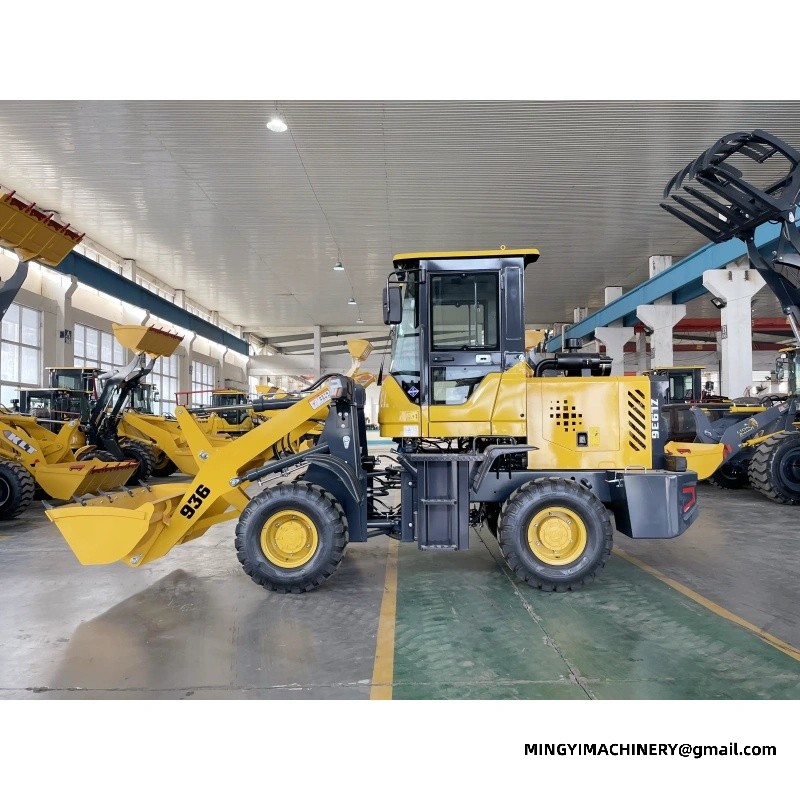
The bucket figures in the table are engineering capacities: 0.38 m³ on the light-duty 4.2 m small-frame wheel-side reduction wheel loader, 0.65 m³ on the heavy-duty 3.8 m medium-frame wheel-side reduction wheel loader. They assume a material density, and the machine is stable with them at full lift because the counterweight and the 4.1 m or 4.55 m footprint were sized around that density.
Change the material and you change the limit, not the machine. Light material — grain, woodchip, compost, snow — lets you run a larger bucket and a higher cycle. Heavy material — wet sand, crushed stone, ore — means the 0.65 m³ bucket needs the 30 mm rear hinge plate and 45 mm cross-member behind it, and the 0.38 m³ bucket on the lighter frame is the honest specification for the lighter material. Tell the factory what you are moving and let them match the bucket to it.
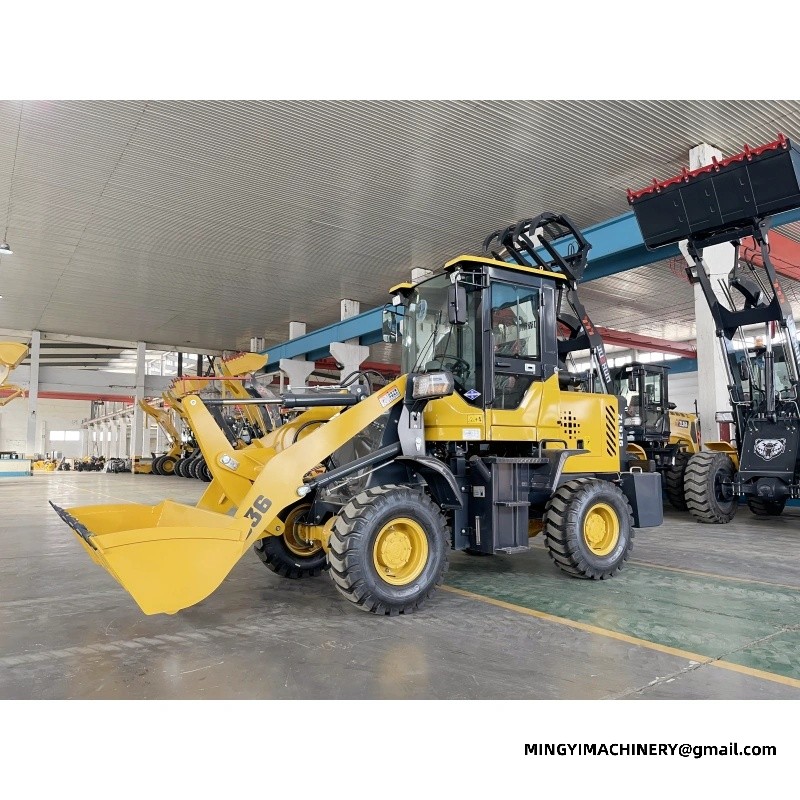
Radiator size follows the engine, not the frame. The light-duty 4.2 m small-frame wheel-side reduction wheel loader lists 4100 core (490 engine); 4105 core (4102T engine); the heavy-duty 4.5 m medium-frame wheel-side reduction wheel loader lists 4105 core. Where two engine options exist on one build, the cores differ — a 4100 core on the 490 engine and a 4105 on the 4102 turbo — and the taller, raised core is the one to specify wherever dust, chaff or dry sand blankets a standard radiator part-way through a shift.
Overheating is the single most common cause of a loader losing days rather than hours. It presents as power loss, then as a shift cut short, then as a head gasket. Choosing the raised core takes almost nothing at order time and cannot be retrofitted easily later. Pair that with the electrical package — 60 Ah (490 engine); 80 Ah (4102 turbo engine) on the light-duty 4.2 m small-frame wheel-side reduction wheel loader, 80 Ah on the heavy-duty 4.5 m medium-frame wheel-side reduction wheel loader — and note that a battery specified for a naturally aspirated engine is often marginal for a turbo one in cold climates.
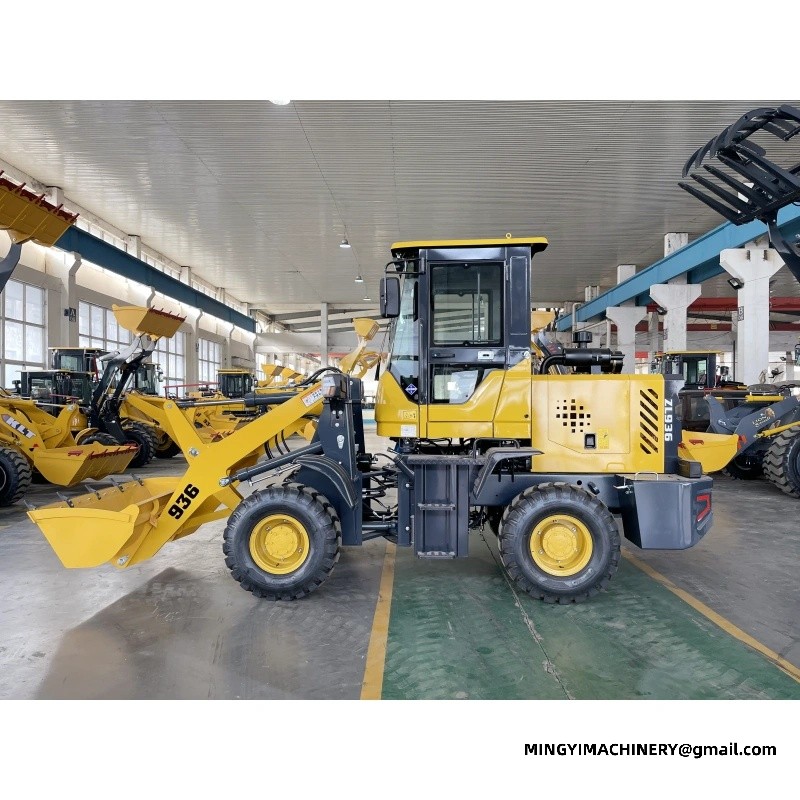
The most lengthy mistake in buying a loader is specifying capacity first. The light-duty 3.8 m small-frame wheel-side reduction wheel loader and the light-duty 4.2 m small-frame wheel-side reduction wheel loader differ by 3.8 m against 4.2 m of clearance, and that difference decides which bodies each can fill. Capacity only decides how many passes it takes once clearance exists.
Where clearance is marginal, look at the boom rather than the machine: the light-duty 3.8 m small-frame wheel-side reduction wheel loader works a 2.61 m arm from a 890 mm centre distance, the light-duty 4.2 m small-frame wheel-side reduction wheel loader a 3.15 m arm from 890 mm. A longer arm on a lighter frame buys height at the effort of stability, so match the arm to the counterweight — 4.1 m against 4.1 m — and not to a brochure figure.
| Specification extract — heavy-duty 3.8 m medium-frame wheel-side reduction wheel loader | |
|---|---|
| Bucket capacity | 0.65 m³ |
| Dump height | 3.8 m |
| Track width | 1.6 m |
| Boom arm thickness | 30 mm |
| Boom arm width | 500 mm |
| Boom arm length | 2.9 m |
| Boom arm centre distance | 920 mm |
| Cross-member thickness | 45 mm |
| Front hinge plate thickness | 45 mm |
| Rear hinge plate thickness | 30 mm |
| Rear frame section | 300 mm high x 800 mm wide |
| Hydraulic cylinders | centre cylinder 60 / side cylinder 50 |
| Fuel tank | 70 L (75# large tank) |
| Battery | 80 Ah |
| Front wheel to counterweight | 4.55 m |
| Radiator | 4105 core |
| Work pump | 2063 pump |
| Travel pump | 25 pump |
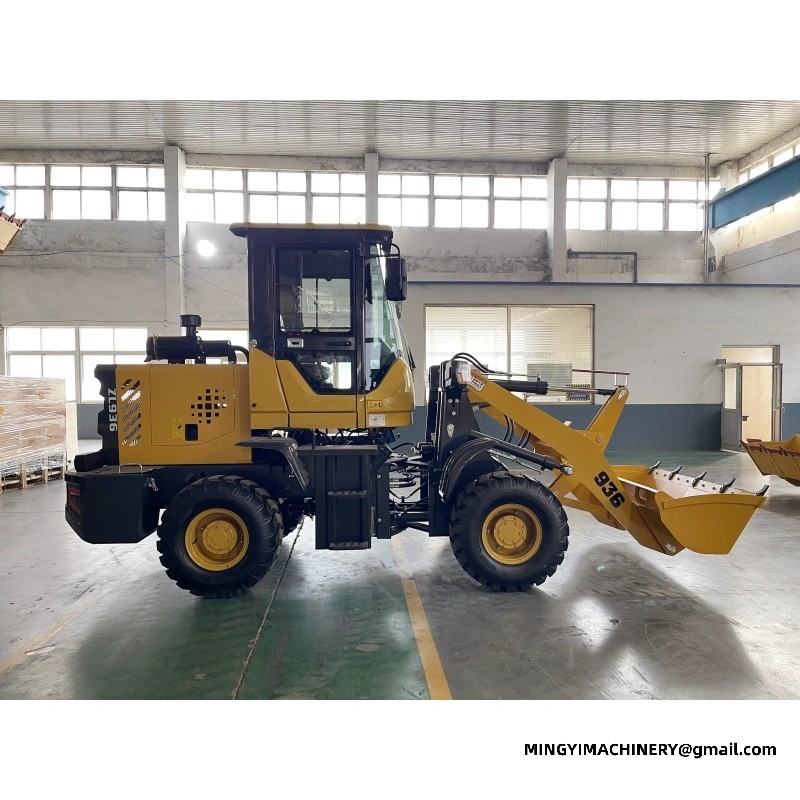
Soft ground punishes driveline parts before it punishes the frame. Sand, clay and loose overburden all increase rolling resistance, which increases torque at the hub, which is exactly where a non-reduction axle is weakest. Where the specification lists two track figures, as it does here at 1.2 m (Isuzu axle); 1.3 m (wheel-side reduction axle), the wider one belongs to the hub-reduction axle and is the specification for that ground.
Hard ground is the opposite case. On concrete, compacted hardstand or a paved yard, rolling resistance is low and sustained travel speed is high, so heat rather than torque becomes the limit. The heavy-duty 4.5 m medium-frame wheel-side reduction wheel loader lists 1.6 m, and the narrower figure there is the one for hard standing. Matching axle to surface takes nothing at the order stage and saves a driveline later.
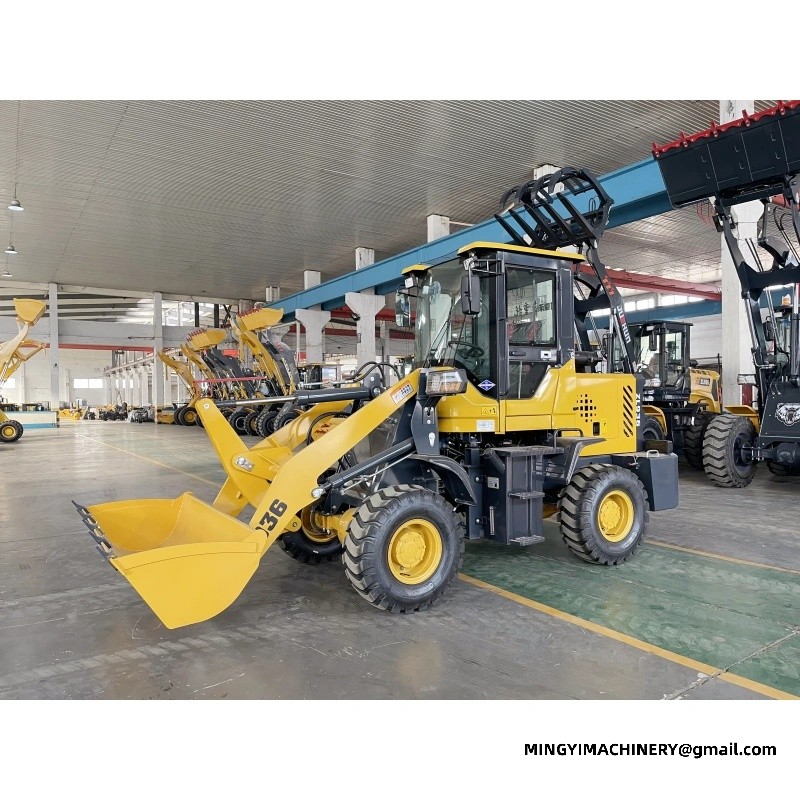
A loader that is greased, cool and clean will run for years on its original frame. The components that need attention are the articulation — 25 mm and 20 mm hinge plates on the light-duty 4.2 m small-frame wheel-side reduction wheel loader — the boom mounts at 890 mm, and the cooling pack, 4100 core (490 engine); 4105 core (4102T engine).
Set the intervals by duty, not by calendar. A machine working a dusty stockyard needs its core blown out daily; the same machine on a farm needs it monthly. A machine loading a face needs its pins greased every shift; one moving pallets needs it weekly. The specification tells you what to check — centre cylinder 45 / side cylinder 40 cylinders, 40 pump (490 engine); 1045 pump (4102 turbo engine) and 316 pump on the light-duty 4.2 m small-frame wheel-side reduction wheel loader, centre cylinder 60 / side cylinder 50, 2063 pump and 25 pump on the heavy-duty 4.5 m medium-frame wheel-side reduction wheel loader — and the duty tells you how often.
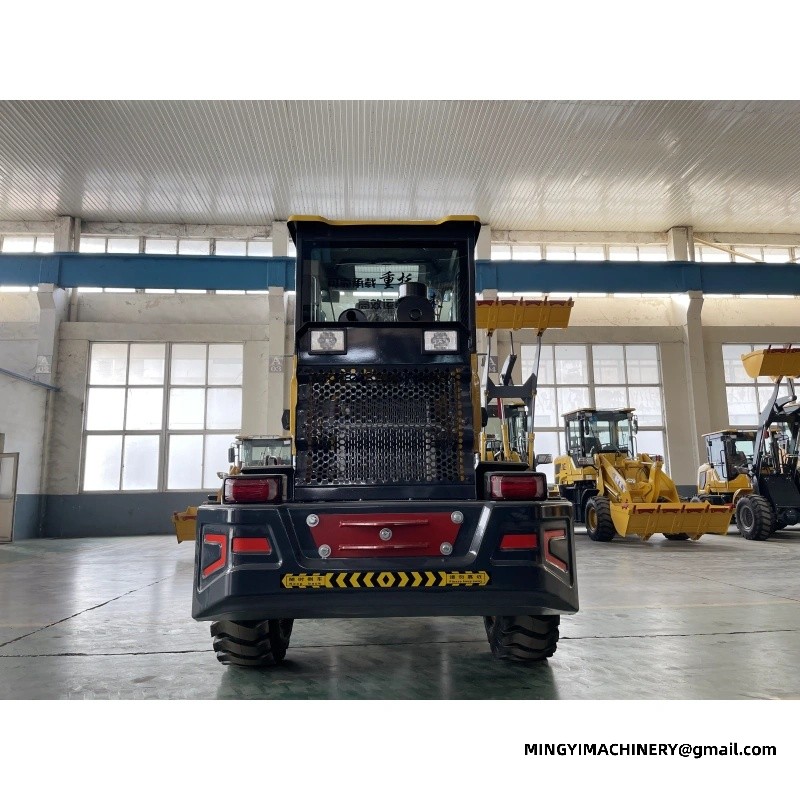
Hold the parts that stop the machine and cannot be improvised: hoses and seals for the centre cylinder 60 / side cylinder 50, a belt set, filters, and a battery to the 80 Ah rating. Do not hold the parts that are welded in — hinge plates at 45 mm and 30 mm, the 45 mm cross-member. Those are a repair, not a spare, and they are the same steel on every machine in the family.
The pump is the judgement call. 2063 pump is a stocked item and a week of downtime if it is not; the 25 pump fails less often and is the one most fleets choose to order rather than hold. Decide on that by distance from the supplier, not by the effort of the part.
A starter spares box for the light-duty 4.2 m small-frame wheel-side reduction wheel loader is short: filters to match the 4100 core (490 engine); 4105 core (4102T engine) cooling package and the engine, a hose set for the centre cylinder 45 / side cylinder 40 cylinders, a pin and bush kit for the 890 mm boom mounts, and a cutting edge. On the heavy-duty 4.2 m medium-frame wheel-side reduction wheel loader the same list applies with centre cylinder 60 / side cylinder 50, 960 mm and the 4105 core package.
Beyond that, stock by consequence. A failed hose stops the machine for a day; a failed pump stops it for a week; a failed hinge plate stops it for a season. Filters and hoses are simple and universal enough to keep on site. Pumps — 40 pump (490 engine); 1045 pump (4102 turbo engine) and 316 pump on the light-duty 4.2 m small-frame wheel-side reduction wheel loader, 2063 pump and 25 pump on the heavy-duty 4.2 m medium-frame wheel-side reduction wheel loader — are worth one spare per fleet, not per machine.
A loader standing idle while a truck reverses is the most common waste on a site, and it is usually a layout problem rather than a machine problem. What the machine contributes is turn radius and visibility, and both come out of the dimensions: 4.1 m from front wheel to counterweight, 1.5 m (wheel-side reduction axle); 1.45 m (Isuzu axle) of track, and a rear frame section of 280 mm high x 800 mm wide. A shorter machine turns inside its own length and works a tighter bay.
The other half is dump geometry. With 4.2 m of clearance and a 3.15 m arm, the light-duty 4.2 m small-frame wheel-side reduction wheel loader can stand back from the body and still place material where the driver wants it, which is safer than crowding the board. The heavy-duty 4.2 m medium-frame wheel-side reduction wheel loader reaches 4.2 m with a 3.16 m arm; on a narrow bay the shorter of the two may be the faster machine even if it holds less.
Do attachments interchange across the wheel loader for agriculture range?
Within a frame family, yes, because the boom section matches. Across families, no: a 300 mm section on the standard 2.8 m low-profile wheel loader is not the 370 mm section on the light-duty 3.8 m small-frame wheel-side reduction wheel loader.
Which axle should a wheel loader for agriculture be built with?
Match it to the ground. Track runs 1.6 m on the heavy-duty 3.8 m medium-frame wheel-side reduction wheel loader and 1.6 m on the heavy-duty 4.5 m medium-frame wheel-side reduction wheel loader; wheel-side reduction for soft or rutted surfaces, the Isuzu-pattern axle for hard, level ground.
What bucket capacity should a wheel loader for agriculture be specified with?
Match it to the material and to the body being filled: 0.38 m³ on the light-duty 4.2 m small-frame wheel-side reduction wheel loader against 0.65 m³ on the heavy-duty 3.8 m medium-frame wheel-side reduction wheel loader. Heavy material limits volume before the frame does.
Can a wheel loader for agriculture be built with a non-standard bucket?
Yes, provided the volume suits the frame: the 0.38 m³ bucket on the light-duty 3.8 m small-frame wheel-side reduction wheel loader and the 0.65 m³ bucket on the heavy-duty 4.5 m medium-frame wheel-side reduction wheel loader are the engineered sizes, and heavier material means a smaller bucket.
How do I choose the right dump height for a wheel loader for agriculture?
Measure the receiving body at the front board rather than the side: 3.8 m on the light-duty 3.8 m small-frame wheel-side reduction wheel loader, 4.5 m on the heavy-duty 4.5 m medium-frame wheel-side reduction wheel loader. Clearance decides whether the pass is possible at all.
What should I check before a wheel loader for agriculture works a ramp?
Traction and cooling. A 1.6 m track with wheel-side reduction holds on a ramp where an Isuzu-pattern axle would spin, and the 4105 core radiator keeps working at low speed.
What is the smallest wheel loader for agriculture in the range?
The entry low-profile builds: a 0.38 m³ bucket at 4.2 m, 1.5 m (wheel-side reduction axle); 1.45 m (Isuzu axle) track and a 4.1 m front-to-counterweight length for indoor and nursery work.
Machines ship knock-down with booms and counterweights packed loose, tanks removed and batteries boxed. Allow a day per unit to commission: torque the pins, fill the 64.7 L (75# small tank) tank and the 4100 core (490 engine); 4105 core (4102T engine) circuit, and check the build figures against the table.
Pre-delivery inspection before Wheel Loader for Agriculture: Silage, Grain and Yard Work leaves the shop
The last hour before packing is the best time to find a fault. Running Wheel Loader for Agriculture: Silage, Grain and Yard Work through its full working cycle, checking for leaks under load and confirming that the controls match the specification avoids a conversation across time zones later.
Keeping a service record for Wheel Loader for Agriculture: Silage, Grain and Yard Work
The record should follow the machine, not the owner. When Wheel Loader for Agriculture: Silage, Grain and Yard Work changes hands the service history travels with it, and a complete folder is often the difference between a quick sale and a long one.
Contact MINGYI Machinery for the current wheel loader lineup, configuration options and a formal specification for your market. E-mail: sales@mingycn.com | LINE (ID): mingyicn
Wheel Loader for Construction Site: Tipper Clearance and Cycle Time · Wheel Loader for Material Handling: Pallet, Bagged and Bulk Load Duty · Wheel Loader Factory China: Packing, Loading and Voyage · Loaders









