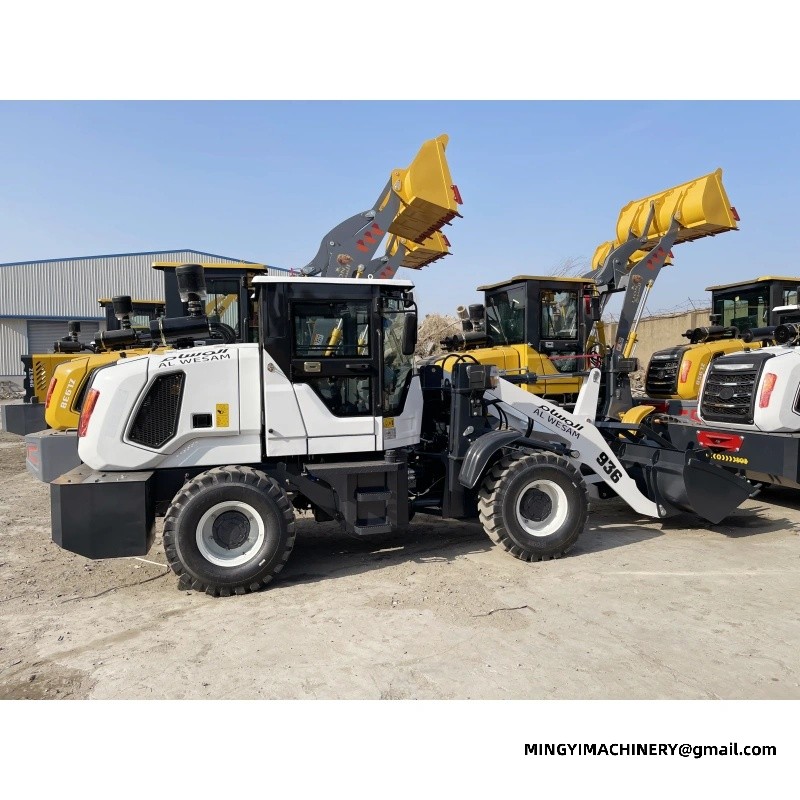
There are two ways to buy a wheel loader for construction site: from the brochure, or from the numbers that decide whether it works. This page is the second. Bucket 0.52 m³ to 0.52 m³. Dump height 3.5 m to 3.8 m. Boom 2.63 m long, 430 mm wide and 30 mm thick on the lighter build; 2.9 m, 430 mm and 30 mm on the heavier one. Cylinders centre cylinder 60 / side cylinder 50 against centre cylinder 60 / side cylinder 50, pumps 2063 pump against 2063 pump, radiators 4105 core against 4105 core. Each figure is explained below in terms of what it does on site.
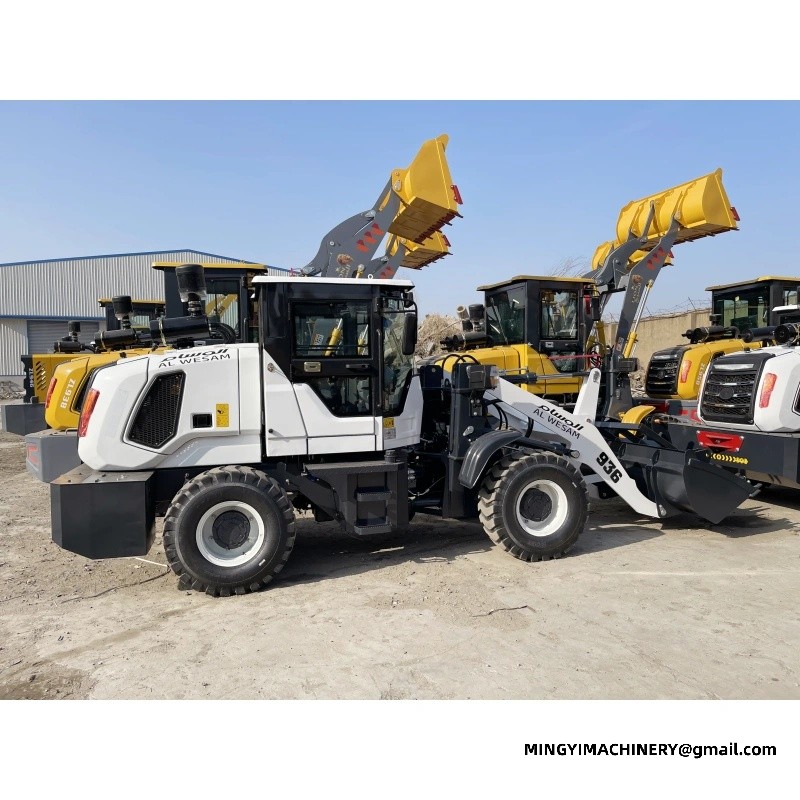
Put the two builds side by side and read four rows only. Bucket: 0.52 m³ against 0.52 m³. Dump height: 3.5 m against 4.2 m. Hinge steel: 45 mm and 30 mm against 45 mm and 30 mm. Cross-member: 45 mm against 45 mm.
Those four decide what the machine can carry, where it can put it, and how long the frame lasts doing it. Everything else on a specification sheet — paint, cab trim, lighting package — is cosmetic next to them. The pumps, 2063 pump against 2063 pump, are the fifth row and matter only if the work is hydraulic rather than loading.
On builds with two engine options the cooling package changes with the engine, which is why the radiator line in the table reads as a pair: 4100 core (490 engine); 4105 core (4102T engine) on the light-duty 3.2 m small-frame wheel-side reduction wheel loader and 4105 core on the light-duty 4.5 m medium-frame wheel-side reduction wheel loader. The 4100 core serves the 490 engine; the 4105 raised core serves the 4102 turbo. The raised core is not a marketing variant — it is more core area in the same footprint, and it is the difference between finishing a dusty shift and stopping at noon to blow out the fins.
Where the machine will work is the deciding factor. Grain handling, lime, cement raw meal, crushing and screening all load a radiator with fine material; road building on a wet day does not. If the application is dusty, specify the raised core and a reversible fan if offered. Then check the rest of the package matches: 64.7 L (75# small tank) fuel on the light-duty 3.2 m small-frame wheel-side reduction wheel loader against 70 L (75# large tank) on the light-duty 4.5 m medium-frame wheel-side reduction wheel loader, and the battery at 60 Ah (490 engine); 80 Ah (4102 turbo engine) against 80 Ah.
Work out how many passes fill the body, then work backwards. A body that takes four passes from a 0.38 m³ bucket will take three from 0.38 m³, but only if the machine can clear the board, and that is the part people get wrong. The light-duty 3.5 m small-frame wheel-side reduction wheel loader reaches 3.5 m; the light-duty 3.2 m low-profile wheel loader reaches 3.2 m. If the board sits between those two figures, the capacity comparison is academic.
The second check is whether the machine can dump without striking. Dump height is measured at the bucket edge with the arm at full lift, so the clearance you actually have is that figure less the height of the material crest. On the light-duty 3.5 m small-frame wheel-side reduction wheel loader the arm is 2.62 m and the spacing between the arms is 890 mm; a longer arm with a wider spacing tips a bucket cleanly instead of rolling it off the corner.
| Sample build from the range — light-duty 3.2 m small-frame wheel-side reduction wheel loader | |
|---|---|
| Bucket capacity | 0.38 m³ |
| Dump height | 3.2 m |
| Track width | 1.5 m (wheel-side reduction axle); 1.45 m (Isuzu axle) |
| Boom arm thickness | 25 mm |
| Boom arm width | 370 mm |
| Boom arm length | 2.3 m |
| Boom arm centre distance | 890 mm |
| Cross-member thickness | 25 mm |
| Front hinge plate thickness | 25 mm |
| Rear hinge plate thickness | 14 mm |
| Rear frame section | 280 mm high x 800 mm wide |
| Hydraulic cylinders | centre cylinder 45 / side cylinder 40 |
| Fuel tank | 64.7 L (75# small tank) |
| Battery | 60 Ah (490 engine); 80 Ah (4102 turbo engine) |
| Front wheel to counterweight | 3.8 m |
| Radiator | 4100 core (490 engine); 4105 core (4102T engine) |
| Work pump | 40 pump (490 engine); 1045 pump (4102 turbo engine) |
| Travel pump | 316 pump |
Farm work is governed by access and by the height of the things being filled. The light-duty 3.2 m small-frame wheel-side reduction wheel loader carries 0.38 m³ to 3.2 m on a 1.5 m (wheel-side reduction axle); 1.45 m (Isuzu axle) track with a 3.8 m footprint; the light-duty 3.5 m medium-frame wheel-side reduction wheel loader carries 0.52 m³ to 3.5 m on 1.6 m with 4.3 m. Gate widths, shed doors and feed-wagon sides are the constraints, and they are all fixed dimensions.
Attachments are where a farm loader earns its second life. Forks for bagged feed and pallets, a bale spear, a grapple for silage, a snow tool for the winter lane. They specification against the boom section, so check 370 mm on the light-duty 3.2 m small-frame wheel-side reduction wheel loader against 430 mm on the light-duty 3.5 m medium-frame wheel-side reduction wheel loader before ordering, and specify the hydraulic circuit at build time if any of them is hydraulically actuated.
Front-wheel-to-counterweight length is the figure that decides whether a machine fits your site: 4.3 m on the light-duty 4.2 m medium-frame wheel-side reduction wheel loader against 4.7 m on the light-duty 4.5 m medium-frame wheel-side reduction wheel loader. Track width is the second: 1.6 m against 1.6 m. Together they set the turning circle and the narrowest gap the machine will pass, and they are the two numbers least likely to be stated in a sales conversation.
Access is a hard constraint and it fails silently. A loader that cannot turn in a shed is a loader that cannot work in that shed, whatever its bucket capacity. Compare 4.3 m at 1.6 m on the light-duty 4.2 m medium-frame wheel-side reduction wheel loader with 4.7 m at 1.6 m on the light-duty 4.5 m medium-frame wheel-side reduction wheel loader, measure your tightest turn and your narrowest doorway, and buy the machine that passes. Where the gap is marginal, the 4.3 m machine with its 0.52 m³ bucket will earn more than the 4.7 m one with 0.52 m³.
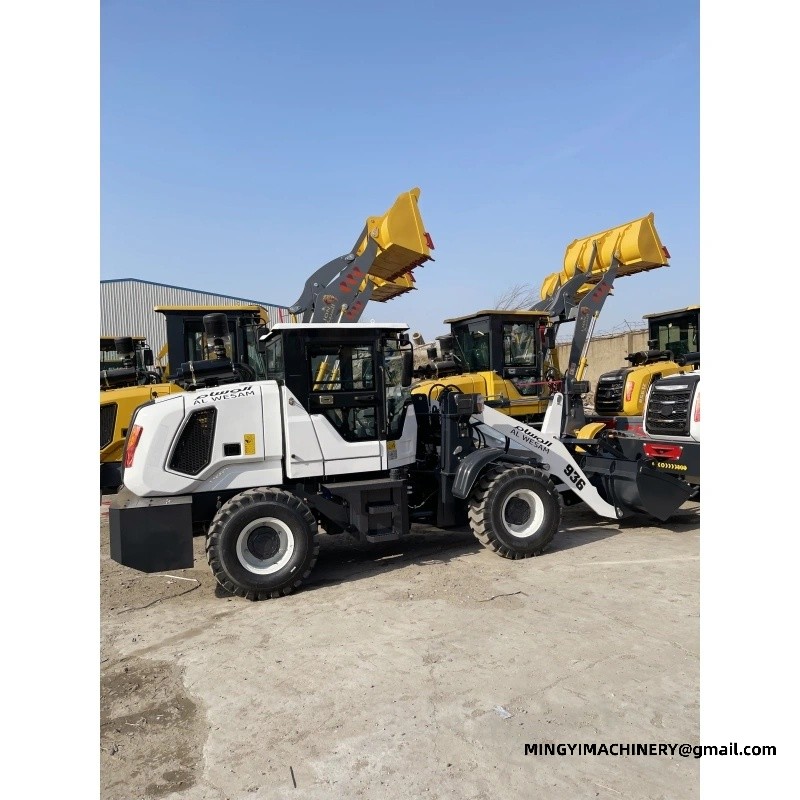
Frames do not usually fail at the boom. They fail at the hinge plates and the cross-member that ties them together, because that is where the articulated joint concentrates every steering and breakout load. On the light-duty 3.2 m low-profile wheel loader those figures are 25 mm front, 14 mm rear and 25 mm across; on the light-duty 3.8 m medium-frame wheel-side reduction wheel loader they are 45 mm, 30 mm and 45 mm. The rear frame sections are 230 mm high x 800 mm wide and 280 mm high x 800 mm wide.
Why the rear plate is the one to watch even though it is the thinner of the two: the front hinge sees the boom loads, which are predictable and largely vertical; the rear sees articulation loads, which are sideways, repeated and often shock-loaded when an operator turns while breaking out. A machine specified with a 30 mm rear plate and a 45 mm cross-member will still be tight at year three in reverse-loading cycles where a 14 mm plate has started to ovalise its pin bores. If your fleet keeps machines past warranty, this is the row of the table to read twice.
Breakout force is advertised; what you feel in the cab is the combination behind it. On the light-duty 3.2 m small-frame wheel-side reduction wheel loader that is a centre cylinder 45 / side cylinder 40 cylinder set on a 2.3 m boom with a 890 mm centre distance, lifting a 0.38 m³ bucket to 3.2 m. On the light-duty 4.2 m medium-frame wheel-side reduction wheel loader it is centre cylinder 60 / side cylinder 50 on a 2.9 m arm with 900 mm spacing, lifting 0.52 m³ to 4.2 m.
Heat is the failure mode nobody plans for. A pump working at the top of its flow all shift, in dust, at altitude, will cook its oil — and the 40 pump (490 engine); 1045 pump (4102 turbo engine) on the light-duty 3.2 m small-frame wheel-side reduction wheel loader and the 2063 pump on the light-duty 4.2 m medium-frame wheel-side reduction wheel loader were each sized against their own cylinder volumes and duty. The matching travel pumps, 316 pump and 25 pump, keep drive independent so a loaded climb does not stall the boom. Specify the third circuit at order time if a hydraulic tool is in the plan; plumbing added later is the most common source of leaks we see in the field.
A radiator does not fail; it gets blocked. On this build the core is 4100 core, and in dusty or chaff-heavy work it needs cleaning from the clean side outwards, in the reverse direction to normal airflow, because pushing debris further into the fins makes the blockage permanent.
Watch the cap and the seat while you are there. A system that loses pressure boils at a lower temperature, and the symptom is intermittent overheating under load that disappears on the level - - which is routinely misdiagnosed as a pump problem. The pump is 32 pump; the travel circuit is 316 pump; neither produces that symptom. A cap does.
What engine options are offered on a wheel loader for construction site?
Where two are offered, cooling and electrics change with them: 4100 core (490 engine); 4105 core (4102T engine) radiator and 60 Ah (490 engine); 80 Ah (4102 turbo engine) battery on the light-duty 3.5 m small-frame wheel-side reduction wheel loader, with the raised core belonging to the turbo option.
What is the fuel tank capacity of a wheel loader for construction site?
30.8 L (48# large tank, 20.5/70-16 tyres); 24.6 L (48# small tank, 8.25-16 tyres) on the standard 2.4 m low-profile wheel loader and 70 L (75# large tank) on the light-duty 3.8 m medium-frame wheel-side reduction wheel loader, both sized for a full shift at working throttle without a mid-day refuel.
Can one spares kit cover a mixed wheel loader for construction site fleet?
Within a frame family, largely yes: the centre cylinder 45 / side cylinder 40 cylinder set and the 40 pump (490 engine); 1045 pump (4102 turbo engine) and 316 pump pumps are shared. Across families the cylinder set changes to centre cylinder 60 / side cylinder 50.
How are the pumps specified on a wheel loader for construction site?
Lift and travel are separate circuits: a 2063 pump work pump with a 25 pump travel pump, so a loaded climb does not take flow away from the boom.
How many units of a wheel loader for construction site fit one container?
Two to three, loaded knock-down. Rear frame sections stay between 280 mm high x 800 mm wide and 300 mm high x 800 mm wide across the range, so a forty-foot box takes a mixed pair or trio.
How does a wheel loader for construction site differ from a skid steer?
Articulated steering and a 3.8 m front-to-counterweight length give the loader reach and a smoother ride on rough ground; a skid steer turns in its own length but carries less, higher effort per tonne moved.
What spares should I keep for a wheel loader for construction site?
Filters, a hose set for the centre cylinder 40 / side cylinder 40 cylinders, pins and bushes for the 680 mm boom mounts and a cutting edge. One pump per fleet is usually enough.
Every wheel loader for construction site in this range ships with the same five recorded figures — boom wall, boom width, front hinge, rear hinge and cross-member — checked against the published table before it leaves the factory. Ask for that record on any unit you are stated.
Contact MINGYI Machinery for the current wheel loader lineup, configuration options and a formal specification for your market. E-mail: sales@mingycn.com | LINE (ID): mingyicn
Wheel Loader for Material Handling: Pallet, Bagged and Bulk Load Duty · Wheel Loader for Aggregate Yard: Stockpiles and Haul Cycles · Wheel Loader Supplier: Ordering the Same Build Twice · Loaders









