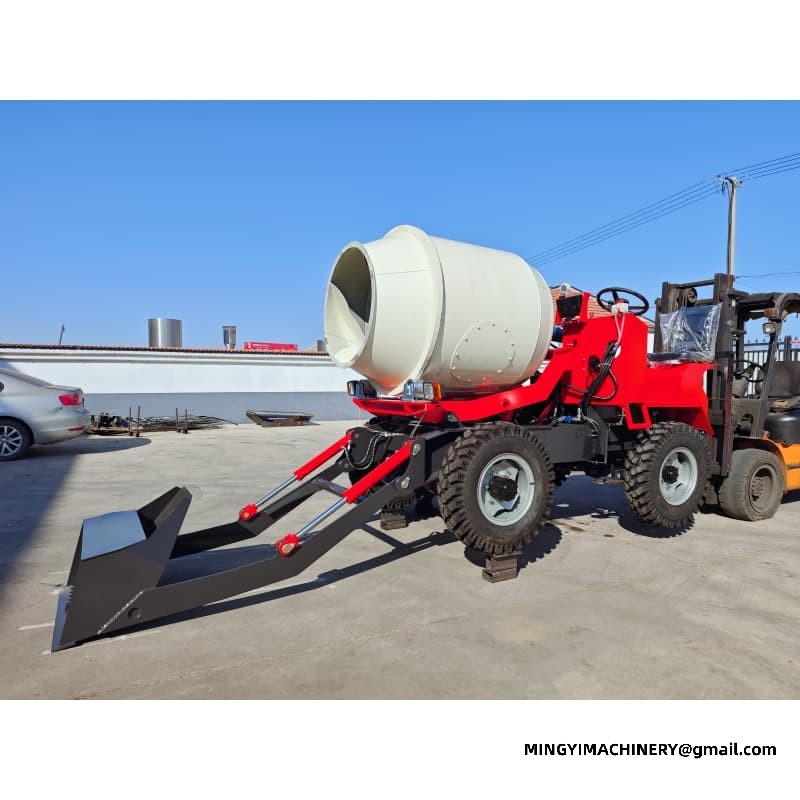
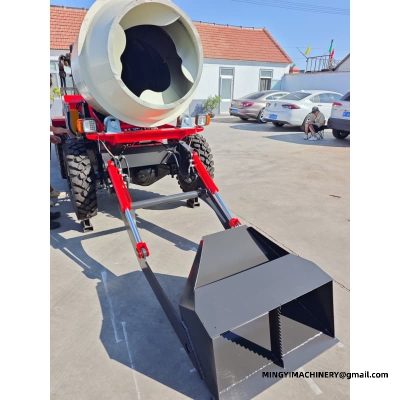
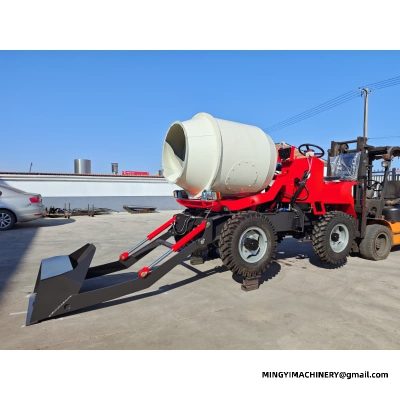
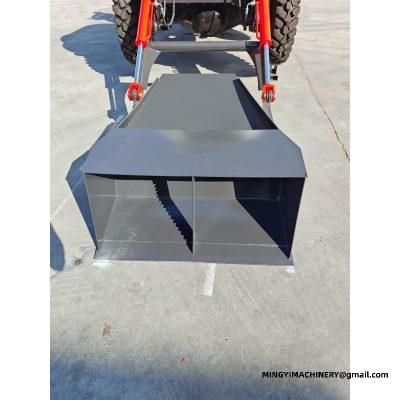
Low Cost Self Loading Concrete Mixer, Affordable Site Truck, Budget Digger
Every figure on the low effort self loading concrete mixer table earns its keep somewhere specific. The 0.8 m³ drum matters at the formwork; the 8.25-16 tyres matter halfway across a wet site; the 25 hp single-cylinder diesel matters at the fuel bowser and at the mechanic who knows it by heart. This page connects each published number to the moment on canal work a crew actually feels it.
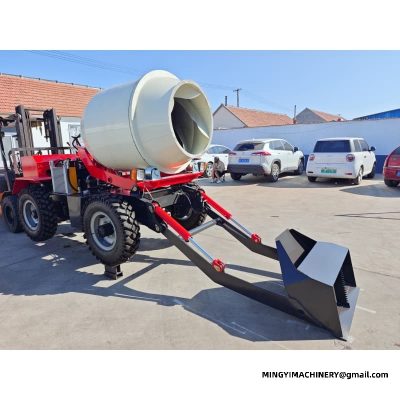
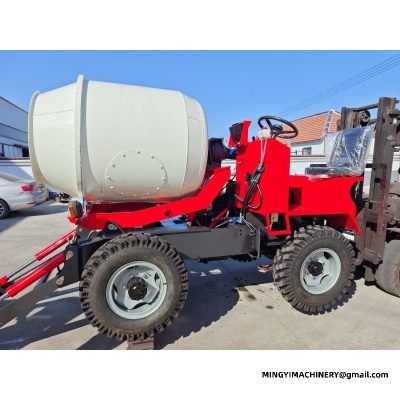
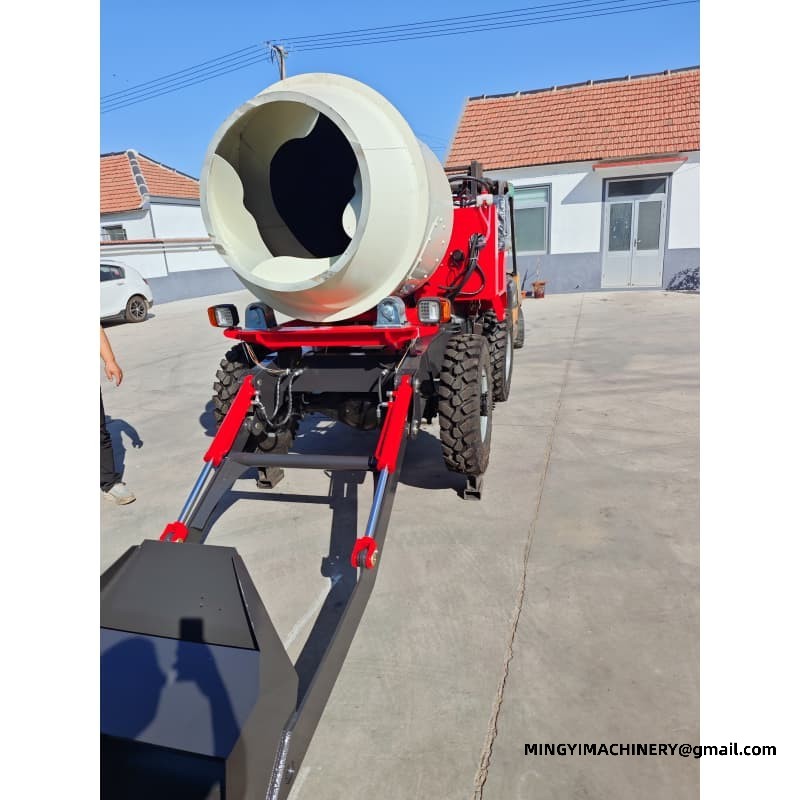
0.8 m³ is not a big drum by transit-mixer standards, and that is the point. Batches this size stay workable from drum to formwork without additives or rush, on canal work, where the distance from mixing point to pour is measured in metres rather than kilometres.
Crews that log batches for a week know their true rate, and the log is worth more than any brochure promise. The machine's contribution is regularity: the drum turns at the same speed whether it is the first batch of the morning or the fortieth, on canal work.
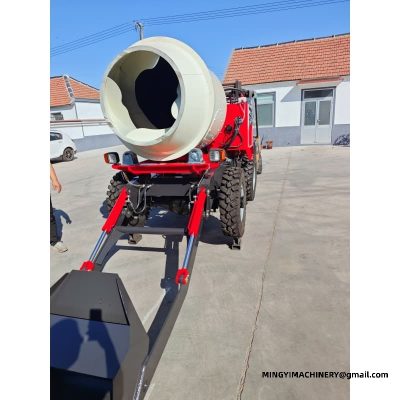
The width is the number that opens the most doors. At 1,600 mm the machine goes through standard double gates and between formwork lines that stop wider equipment, and it does so with a full drum because the drum sits inside the envelope, not above it.
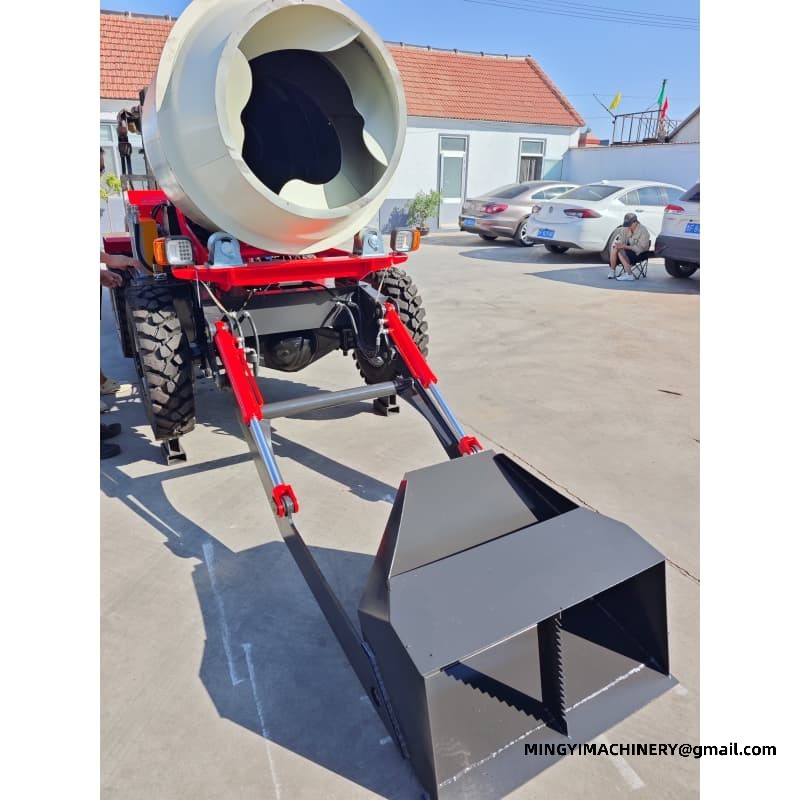
Shovel-up travel is the one posture that moves weight forward sharply. The operator carries the shovel low and the drum level, on canal work, and the machine handles exactly as the geometry promises.
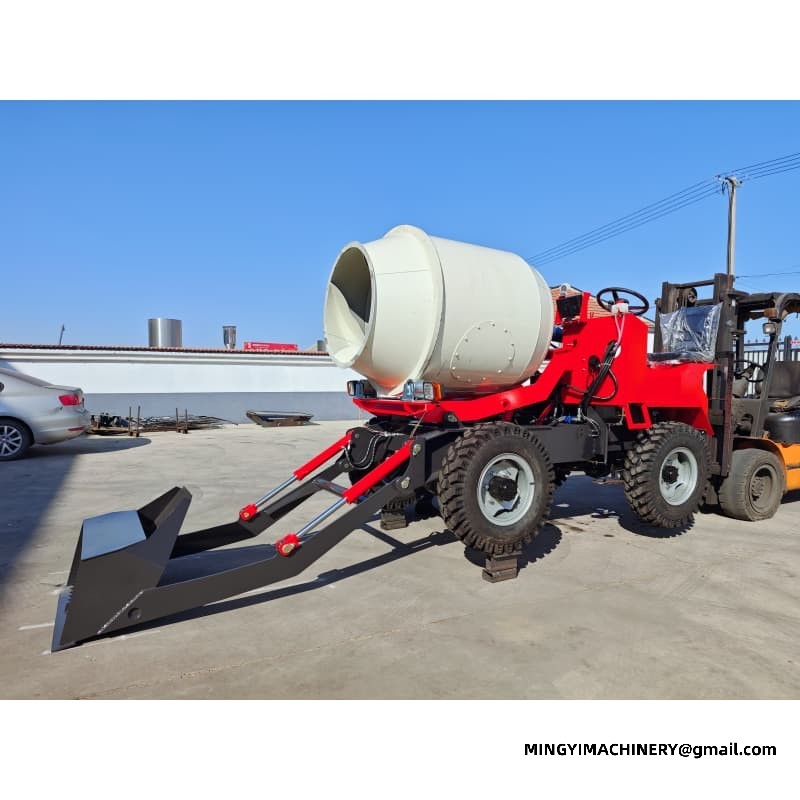
Discharge lands where the operator aims it. That single fact shapes the whole workflow on canal work: the drum pours into a barrow, a bucket or straight to formwork, and the crew never moves concrete twice.
Concrete waits for nobody. The drum must be washed before the residue stiffens, and on a self-loader the routine is simple: rinse the drum, spin it with clean water, dump the wash-out away from the stockpile, and leave the blades clean for the next batch.
| Specification extract — 0.8 m³ 4WD self-loading concrete mixer | |
|---|---|
| Rated load | 1,500 kg |
| Rated capacity | 0.8 m³ |
| Overall dimensions (L x W x H) | 3,500 x 1,600 x 2,200 mm |
| Front tyre size | 8.25-16 |
| Rear tyre size | 7.50-16 |
| Minimum ground clearance | 204 mm |
| Steering angle | 28° |
| Turning dimension (outer tyre) | 2,464 mm |
| Maximum travel speed | 24 km/h |
| Transmission | 4WD |
| Gears | 3 forward / 1 reverse + travel gear |
| Front axle | 130 drive axle |
| Rear axle | 212 selectable 4WD steering axle |
| Engine | single-cylinder diesel / 25 hp |
| Steering | hydraulic power steering |
Read the ground before the first trip of the day on canal work. A route that crossed easily yesterday may have a new trench, a spoil heap or a flooded patch overnight, and 204 mm gives the operator a plain number to judge it against.
Watch the rears on rough going — steering axles take sideways knocks that fronts never see. A five-minute look at both pairs after the first day on new ground on canal work catches the stones and the cuts before they become failures.
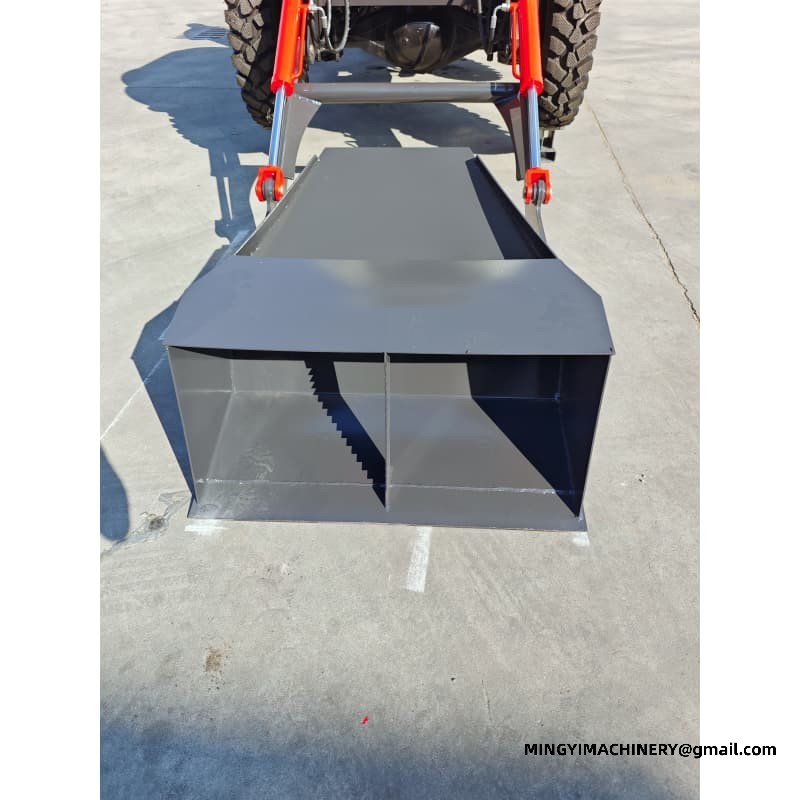
On canal work, that single-operator loop is the economic argument. Labour is the biggest recurring effort on small concrete work, and the shovel removes most of it. Cement, water and aggregate are the only inputs the crew still handles by hand.
The discipline that keeps it healthy: scoop shallow, drop into the drum rather than onto its rim, and keep the shovel clean before park-up. Operators who treat it gently on canal work get years from it; operators who use it as a dozer replace pins and bushings far sooner.
Read the two clusters against your site, not against the brochure. The figure that decides the sale is usually the smallest one: turning circle, clearance or width, whichever your worst gateway on canal work happens to be. The big numbers sell the machine; the small ones qualify it.
The 130 front drive axle and 212 rear steering axle are named because they are standard agricultural patterns, and that naming is part of the durability case. Bearings, seals, hubs and crown wheels for both exist wherever tractors are sold.
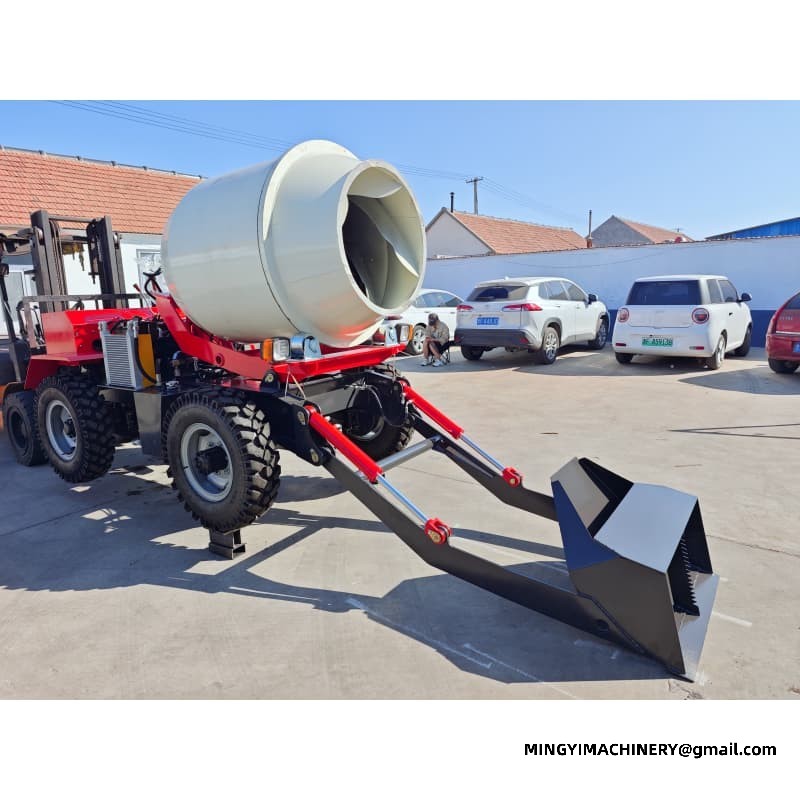
The machine itself copes well — the single-cylinder diesel is air-cooled territory and dust, not heat, is its enemy. Filter checks are the hot-season habit that matters on canal work.
Starting aids the operator more than the engine: warm the hydraulics, cycle the drum gently, and let the first batch of the morning be the test batch. Machines wintered properly start on canal work without drama.
Let the first day end early, clean and unhurried. Operators trained calmly on canal work keep the habits; operators trained in a rush learn shortcuts instead.
Write them on the machine, not in the office. The habits that survive are the ones the operator sees at the start of every shift.
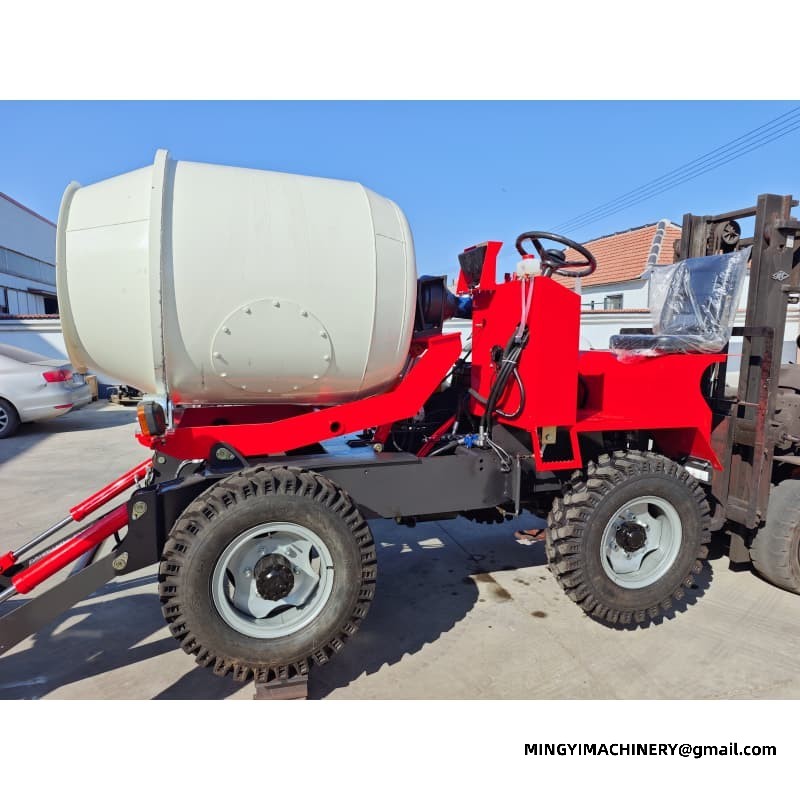
Power steering also matters at the end of a shift. A loaded machine manoeuvring all day on a manual system tires the operator into mistakes; the hydraulic system keeps the last batch as controlled as the first.
Steering effort drops to nothing at crawl speed, which is precisely when a loaded machine needs precision. The 28° rear steer responds proportionally, so the wheel's first inch means a small correction and the last inch means the full lock.
The front tyres are 8.25-16 and carry the drive under a full drum; the rears are 7.50-16 and steer. The heavier front fitment matches the heavier front duty — drive torque plus a loaded drum sitting between the axles.
Wheel nuts loosen on rough ground — the check is part of the daily walk-round for a reason. A wheel coming off under a full drum is the kind of event that ends careers and machines.
Write the survey down and compare it with the published envelope before committing. Crews that skip this step discover the constraint with a full drum aboard, on canal work — the lengthy way to learn a number.
The survey is not paperwork; it is the first batch. Measure the gate, the turn and the ground while the machine is still on the truck, and the 2,464 mm turning circle and 204 mm clearance become numbers you have already checked rather than surprises you meet with a full drum.
The machine sits squarely in that second case. Small, repeated pours, distant supply, awkward access — work where a transit mixer either refuses the job or charges for the wasted capacity of a part-load.
Every batch has three takes: materials, fuel and labour. The machine attacks the third hardest — one operator replaces the barrow chain — and holds the second down with a single-cylinder diesel that sips fuel between cycles. Materials effort what they effort anywhere; the difference is made in labour and logistics.
The rules are short: slow through turns, gentle on the stops, drum level in transit and nobody riding on a machine built for one. Every accident report on mixers of this class starts with one of those rules broken.
Reversing into position is the other hazard moment. A spotter behind the machine during the approach, every time, closes the last gap in the loop.
Wet seasons ask for drier batches and firmer ground; dry seasons ask for the opposite, plus shaded stockpiles so the mix does not start hot. The machine adapts through its recipe and its route, and neither asks anything of the drum but consistent turning.
The machine's natural work is the small structural pour — bases, posts, beams, ties — and the non-structural one beside it: paths, kerbs, patching, linings. Both consume 0.8 m³ per batch in quantities the drum and the crew handle naturally.
Can the low effort self loading concrete mixer cross a small culvert or slab on site?
If the structure is engineered for the machine's axle loading, yes. Unverified culverts, covers and basements deserve a check before the wheels arrive, not after.
Why does my low effort self loading concrete mixer drum hold less than it used to?
Almost always a hardened heel of paste inside the drum, built up by late wash-outs. Chip it out, return to daily rinsing, and the full 0.8 m³ comes back.
Can the low effort self loading concrete mixer work at night?
With site lighting, yes — the workflow does not change. The operator's visibility of the shovel arc and the discharge zone is the item to solve, not the machine.
Are low effort self loading concrete mixer parts available in my country?
The engine and axle pattern uses parts stocked wherever single-cylinder agricultural machinery sells, and the supplier supports the machine-specific items — drum blades, shovel pins, hydraulic parts — by shipment.
Does the low effort self loading concrete mixer really load itself?
Yes. A front shovel scoops aggregate and sand from the stockpile and lifts it into the drum — no separate loader and no barrow chain. One operator runs load, mix, travel and discharge.
What spares should I buy with a low effort self loading concrete mixer?
Filters for engine and hydraulics, belts, hose clamps, drum blades, shovel pins and bushings, and lamp bulbs — the small parts that stop work on canal work when unstocked.
How do I check quality without a lab when using a low effort self loading concrete mixer?
Slump by eye against an agreed target, batch weight against the recipe, and a chalkboard record of what each pour received. Structural work still deserves proper cube tests.
When does a low effort self loading concrete mixer stop making sense?
Where ready-mix is close and pours are large, where access is narrower than the machine, or where work happens at height or reach no wheeled mixer can serve. Other tools win those.
The figures above answer the questions buyers ask most; the daily habits answer the rest. Between them, they describe a machine that is deliberately simple and deliberately durable.
Cold weather and winter care for the concrete mixer
Starting is only the first problem. Until this class of machine reaches working temperature the hydraulic response is slower and the seals are stiffer, and warming the machine before asking for full output avoids unnecessary strain.
Hot, humid and dusty conditions around the unit in daily use
Dust is the enemy of every rotating joint. Keeping the radiator and the air intake of a machine of this size clean, and cleaning them before they are blocked rather than after, is what separates a machine that lasts from one that overheats.
Handover and getting familiar with the equipment on site
A good handover covers the awkward cases, not just the easy ones. Starting the machine itself on a slope, turning in a confined space and recovering from soft ground are the situations an operator should meet first with someone beside them.
Planning the season around the model in question
Workload is rarely even across the year, and the machine should be specified for the busy weeks. The machine in that duty sized only for the average month will be the limiting factor exactly when the work is worth the most.
Moving the unit on the job between sites
Travel time is not working time, and it should be planned as its own item. The hours spent moving a machine built for the work between jobs are hours not worked, and a trailer that matches the machine reduces them every single trip.
Later additions and retrofits on the equipment in service
An added function should pay for itself quickly. Whether the concrete mixer gains a different bucket, a hydraulic service or a protection package, the test is the number of days a year it is actually used.
Contact MINGYI Machinery for the current self-loading concrete mixer specification, export packing and a formal specification for your market. E-mail: sales@mingycn.com | LINE (ID): mingyicn
Small Capacity Self Loading Mixer: Why 0.8 m³ Fits the Pour · Easy Operation Self Loader: One Operator, Full Cycle · Custom 4x4 Off Road Dumper for mining and quarry work · Mini Self-Loading Concrete Mixer









