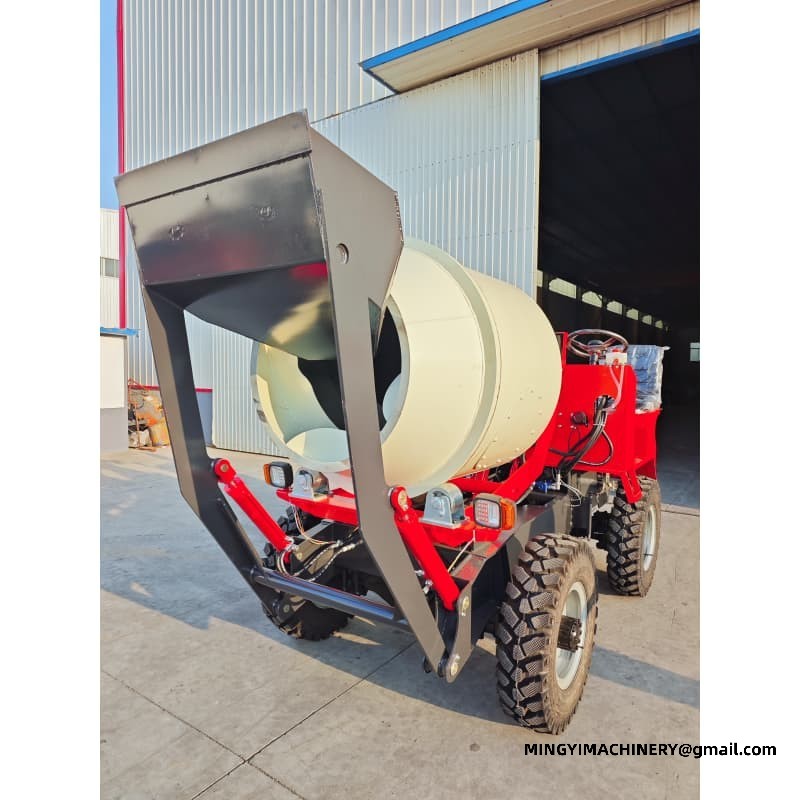
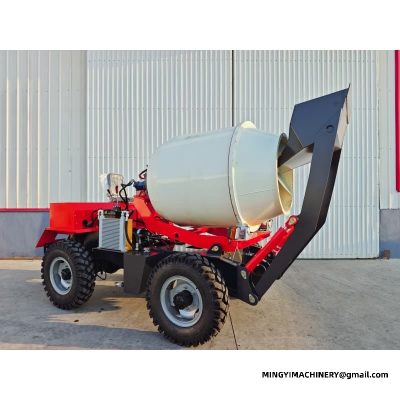
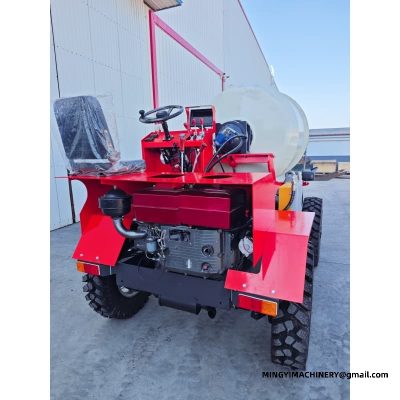
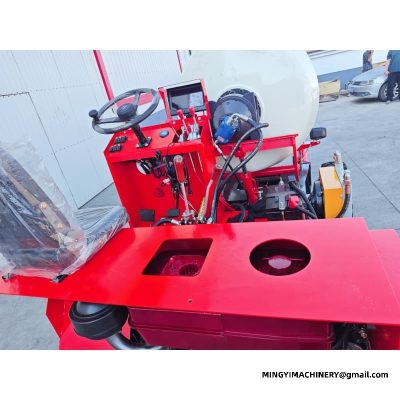
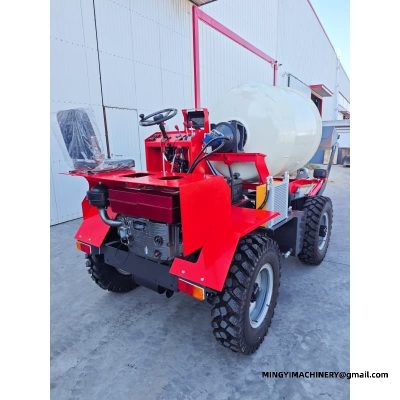
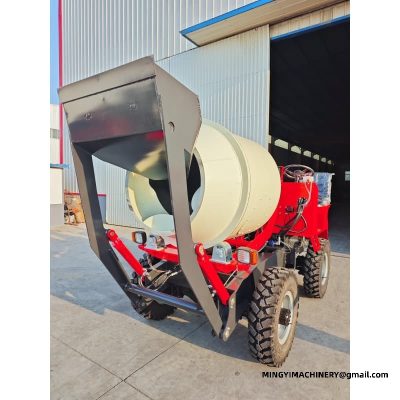
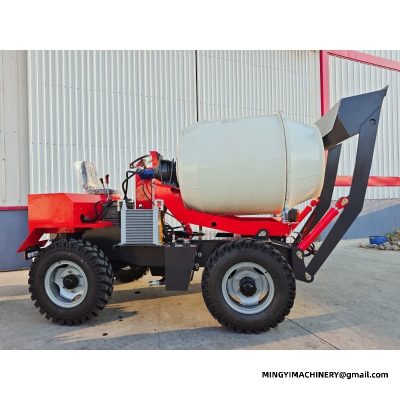
Easy Operation Self Loader, One-Man Concrete Mixer, Single Operator Truck
One operator, one drum, one shovel — that is the whole machine. Conventional site concreting splits the job across a loader, a mixer and a barrow chain; the easy operation self loader folds it into a single 25 hp 4WD chassis. This page works through what the published specification means in practice in orchard pathways, starting with the shovel and ending at the discharge.
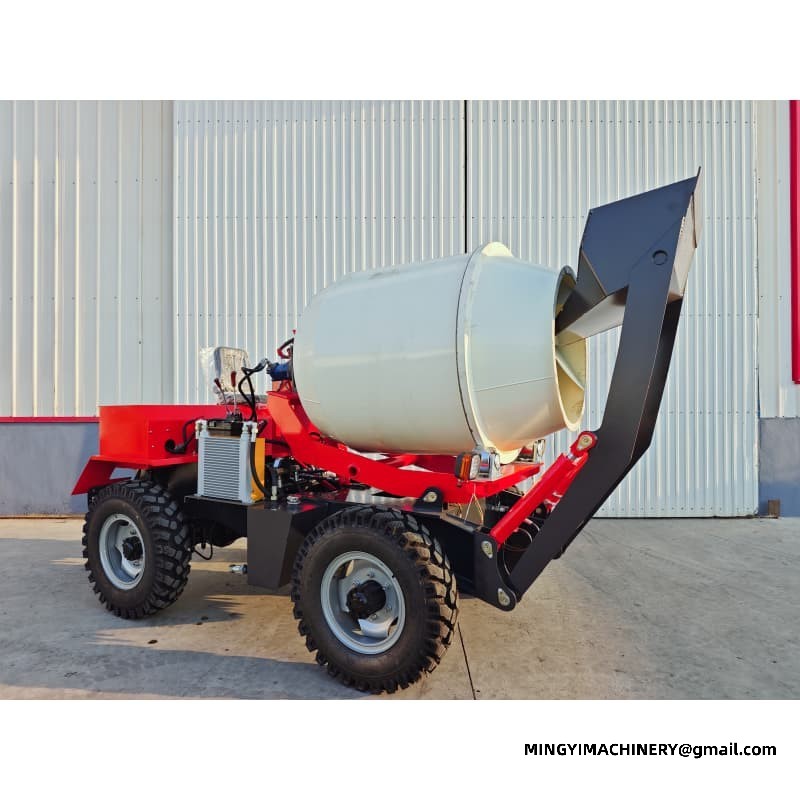
The machine sits squarely in that second case. Small, repeated pours, distant supply, awkward access — work where a transit mixer either refuses the job or charges for the wasted capacity of a part-load.
Crews that specification work this way stop comparing the machine with a bigger drum and start comparing it with the wages of the people it replaces. Over a season, the comparison is not close.
Many fleets run both: transit for the big slabs near town, self-loader for the long tail of small work everywhere else. The two machines rarely compete for the same batch.
Plant-and-pump is a different scale of project: continuous output, trained crews, real setup effort. The self-loading mixer serves the segment below it — work too small to amortise a pump mobilisation, too far for plant supply, too continuous for hand mixing.
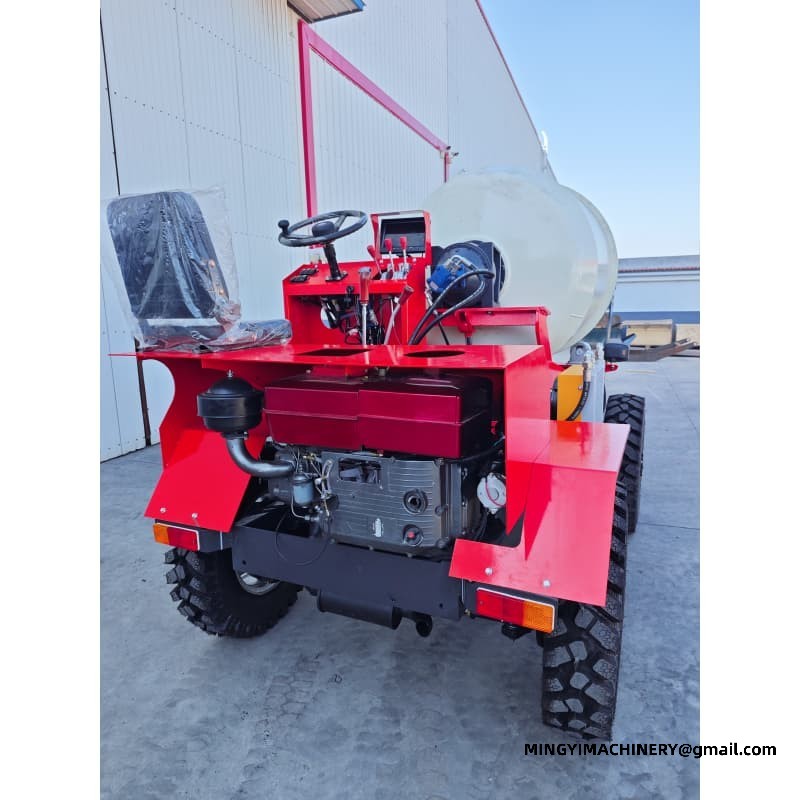
Load, mix, drive, discharge, return — one person runs the entire loop, and the controls are arranged so the sequence needs no second pair of hands. On small crews that is not a luxury; it is the difference between pouring today and waiting for a bigger gang.
One operator also means one accountable person for the wash-out, the fuel and the walk-round. Fleets that name the operator on the board each morning in orchard pathways report fewer unexplained faults and fewer Friday-night short cuts.
| Published build data — 0.8 m³ 4WD self-loading concrete mixer | |
|---|---|
| Rated load | 1,500 kg |
| Rated capacity | 0.8 m³ |
| Overall dimensions (L x W x H) | 3,500 x 1,600 x 2,200 mm |
| Front tyre size | 8.25-16 |
| Rear tyre size | 7.50-16 |
| Minimum ground clearance | 204 mm |
| Steering angle | 28° |
| Turning dimension (outer tyre) | 2,464 mm |
| Maximum travel speed | 24 km/h |
| Transmission | 4WD |
| Gears | 3 forward / 1 reverse + travel gear |
| Front axle | 130 drive axle |
| Rear axle | 212 selectable 4WD steering axle |
| Engine | single-cylinder diesel / 25 hp |
| Steering | hydraulic power steering |
plan service against hours too. Oil, filters and greasing key off the meter, and a machine worked hard in a season reaches its first major check sooner than a machine worked occasionally. The meter tells the truth either way.
Cut the waiting, not the machine. Sequence the day by geography and recipe, keep inputs stocked, and the same 3,500 x 1,600 x 2,200 mm chassis turns a low-utilisation week into a working one without spending a coin on capacity.
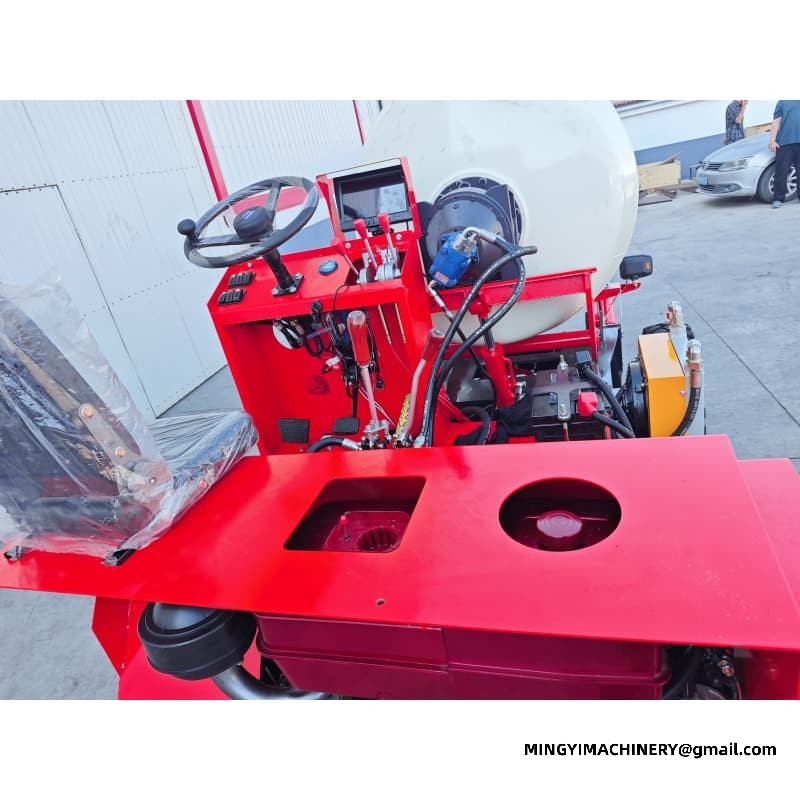
Write the survey down and compare it with the published envelope before committing. Crews that skip this step discover the constraint with a full drum aboard, in orchard pathways — the lengthy way to learn a number.
Mark the discharge point before the pour, not during it. A standing spot within barrow reach of the formwork is worth more than a tidy spot metres away, because the last metres are where batches lose their workability.
On a well-run machine the chassis and drum outlast several sets of consumables: shovel pins and bushings, drum blades, tyres, belts, hoses and filters are the renewal cycle. The single-cylinder diesel is the long-life heart, and its overhaul parts are stocked wherever single-cylinder diesels are common.
Add the intangible line while doing the sums: the pours won because the crew could promise concrete on a date. Plant that wins work is plant whose hourly effort stops mattering in orchard pathways.
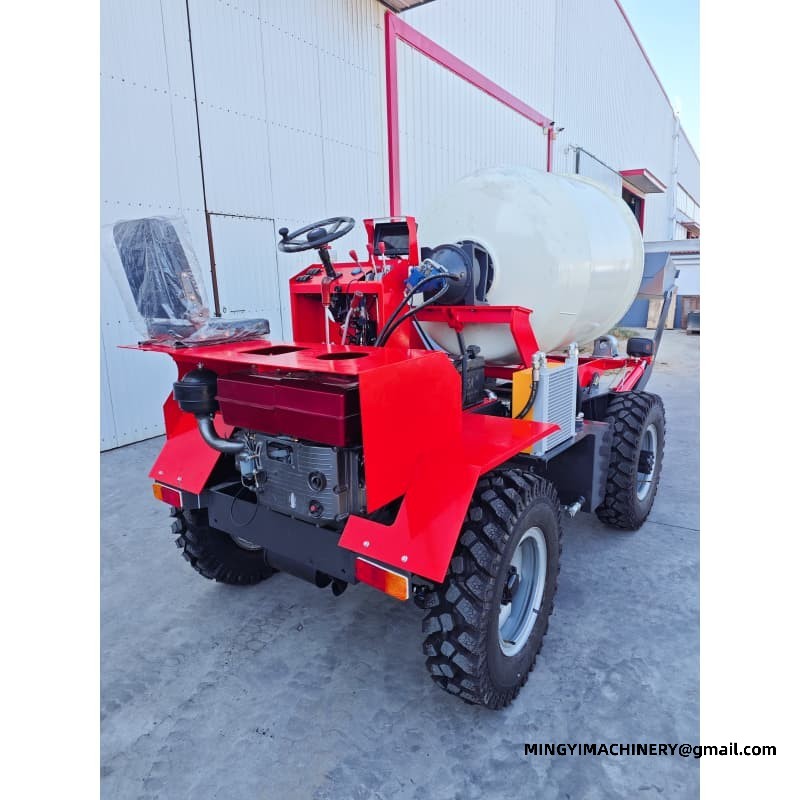
Fix the mix design for path and drainage concrete once, write it down, measure the water, count the scoops, time the drum — and the batches in orchard pathways will be more consistent than most hand-mixed concrete has ever been.
Water is where site-mixed concrete usually dies. Extra water makes a stiff mix easy and weak; the drum will happily hide the sin until the cube test does not. A measured water container and a workability target agreed with the crew solve most of it.
The arithmetic is simple enough for a whiteboard — batches per bay, cycles per hour, and the standing spot for each. Ten minutes of planning in orchard pathways buys a full day of continuous placement.
Sequence the day by geography rather than by trade. Batching for two crews at opposite ends of a site doubles travel; batching for neighbours, one after another, keeps the hauls short and the drum earning.
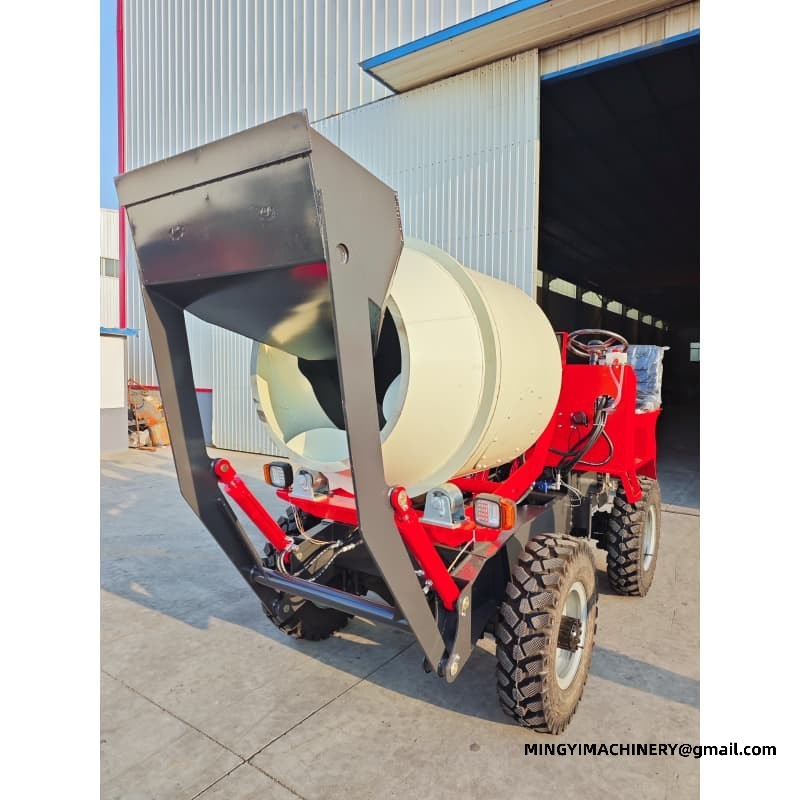
The machine itself copes well — the single-cylinder diesel is air-cooled territory and dust, not heat, is its enemy. Filter checks are the hot-season habit that matters in orchard pathways.
Rain turns routes into the machine's worst case: 204 mm of clearance and agricultural tyres carry a full drum across wet ground only as well as the ground allows. Fill the ruts, gravel the standing spots, and plan pours away from the day's worst weather rather than through it.
Wet seasons ask for drier batches and firmer ground; dry seasons ask for the opposite, plus shaded stockpiles so the mix does not start hot. The machine adapts through its recipe and its route, and neither asks anything of the drum but consistent turning.
The work it should refuse is the continuous slab and the high-volume pour, where plant supply wins outright. Saying so is the service, and the customer who hears it trusts the next recommendation more, not less.
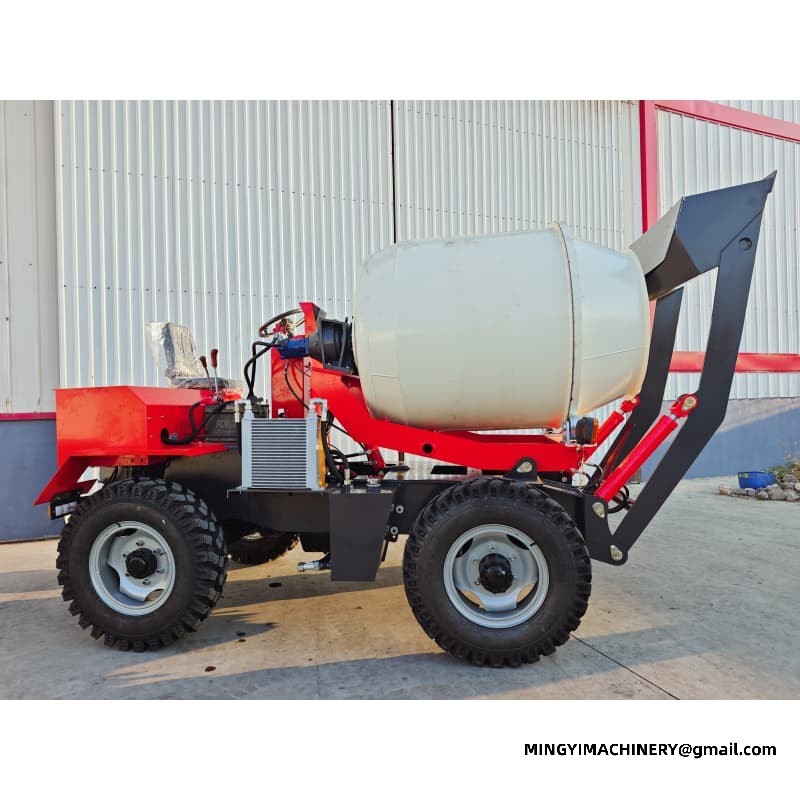
24 km/h is not fast and should not be. The machine carries 1,500 kg of wet concrete high on a short wheelbase, and the gearing keeps those loads sedate. Crews that respect the speed keep the concrete in the drum and the machine on its wheels.
Because discharge happens over the front, the natural approach is to back in: reverse toward the formwork, stop square, tip, and drive away forward without a second manoeuvre. One reverse gear is all this needs, and the 28° rear steer makes the approach line easy to correct.
The height figure hides a detail worth checking on hire fleets and after modifications: the envelope assumes the shovel down and the drum level. A raised shovel adds materially to the length, and crews loading onto trailers should measure in travel order.
At 3,500 x 1,600 x 2,200 mm, the machine loads onto a tag trailer behind a light truck or ships one per small container. For plant hire fleets and export buyers that footprint is money: no escort, no low-loader, no special port handling.
Read the two clusters against your site, not against the brochure. The figure that decides the sale is usually the smallest one: turning circle, clearance or width, whichever your worst gateway in orchard pathways happens to be. The big numbers sell the machine; the small ones qualify it.
A line worth pausing on is the gear set — 3 forward, 1 reverse and a travel gear — because it tells you how the machine splits slow, strong work from the road run between sites. The travel gear is not for the load; it is for the empty road, and the distinction keeps the box alive.
In orchard pathways, that single-operator loop is the economic argument. Labour is the biggest recurring effort on small concrete work, and the shovel removes most of it. Cement, water and aggregate are the only inputs the crew still handles by hand.
Inspection is a two-minute weekly job: pins, teeth or cutting edge, and the two hoses that flex with every lift. Caught early, a weeping fitting or a worn bushing is a teatime repair; left alone, it becomes a pour-day stoppage in orchard pathways.
How do I get a specification for the easy operation self loader?
E-mail sales@mingycn.com or add LINE (ID): mingyicn with your market and intended work; the reply covers the specification, optional items and freight to your port.
Can two easy operation self loader machines work one pour?
Yes, with separated standing spots and staggered cycles — it is the standard answer for pours that outrun one drum but still sit below plant scale.
How many people does it take to run the easy operation self loader?
One. Load, mix, drive and discharge are all run from the seat; the crew handles only cement bags, the water measure and, at some pours, a barrow at the discharge end.
How many batches an hour can a easy operation self loader do?
Whatever the cycle allows: load, mix, travel, discharge, return. Short hauls keep the drum busy; long carries make travel the constraint. Plan pours around the cycle, not the clock.
Does the easy operation self loader really load itself?
Yes. A front shovel scoops aggregate and sand from the stockpile and lifts it into the drum — no separate loader and no barrow chain. One operator runs load, mix, travel and discharge.
Does the easy operation self loader have power steering?
Yes — hydraulic power steering, working with the 28° rear-axle steer. The wheel stays light under a full drum and predictable at crawl speed.
Can the easy operation self loader be towed behind a pickup?
On a braked tag trailer rated for the machine's weight, yes — the 3,500 x 1,600 x 2,200 mm footprint was drawn for it. Lash at the chassis, chock the wheels, fold the shovel to travel order.
How much water should a easy operation self loader batch take?
Whatever the mix design specifies — measured, not splashed. Extra water makes a stiff mix easy and weak; a marked container beside the controls solves most site water discipline.
Nothing on this page is complicated, and that is the point: a 0.8 m³ drum, a shovel, four driven wheels and a routine. Crews that keep the routine keep the machine earning in orchard pathways for years.
Packing, loading and shipment of the concrete mixer
Container loading is a planning exercise. The overall dimensions and the operating weight of this class of machine decide whether it ships whole, partly disassembled or with the attachment removed, and that decision is made before the booking.
Planning the season around the unit in daily use
Downtime is simplest when it is planned. Booking the service for a machine of this size in the quiet part of the season takes nothing from the schedule, while the same work in the busy weeks gives up a day of output every time.
Moving the equipment on site between sites
Securing the load is not optional. Lashing the machine itself at the points intended for it, checking the tension before the vehicle moves and rechecking after the first kilometres is standard practice rather than extra care.
Storage and long idle periods for the model in question
The battery and the fuel are the first things to suffer in storage. Preparing the machine in that duty properly at the start of the idle period avoids the flat battery and the contaminated tank that greet an unprepared machine.
Fuel, oil and fluid quality for the unit on the job
Contamination is easier to prevent than to cure. Keeping the filler caps sealed, the funnels clean and the containers closed around a machine built for the work is unglamorous work that shows up as reliability later.
Reading the early symptoms on the equipment in service
Machines rarely fail without warning. A change in sound, a slower function or a new leak on the concrete mixer is the machine saying something early, and listening then takes a fraction of the time that waiting does.
Contact MINGYI Machinery for the current self-loading concrete mixer specification, export packing and a formal specification for your market. E-mail: sales@mingycn.com | LINE (ID): mingyicn
Heavy Duty Duty Cycle: What a Self Loading Cement Truck Carries · Electric Start Diesel Concrete Mixer: Key Start, No Drama · site dumper Middle East with hydraulic tipping body · Mini Self-Loading Concrete Mixer









