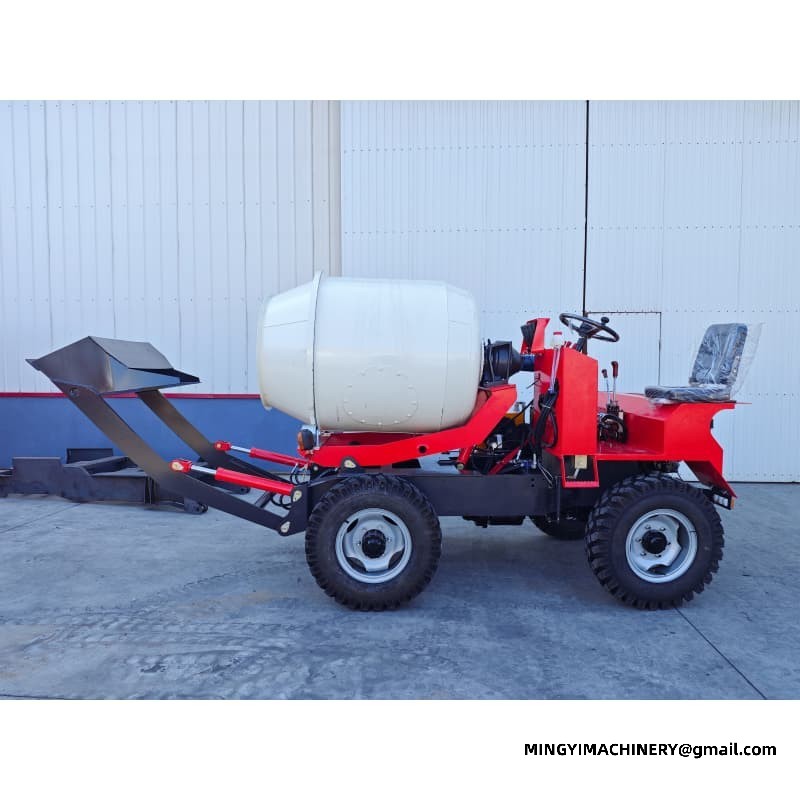
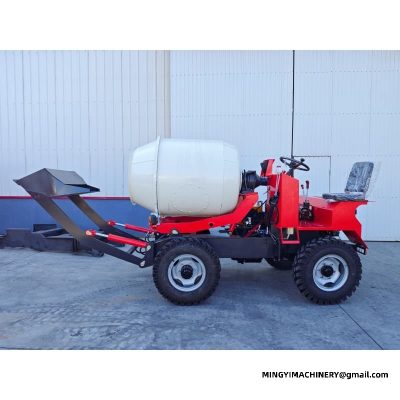
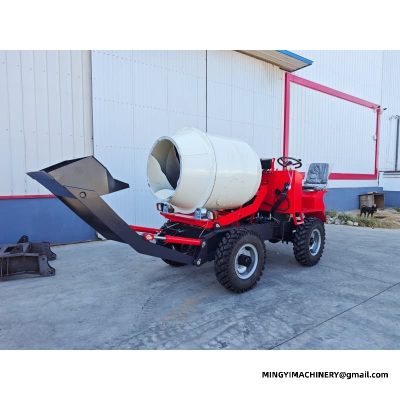
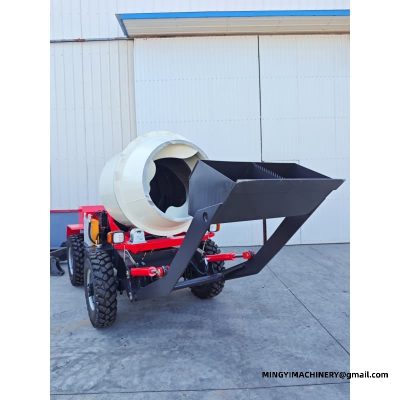
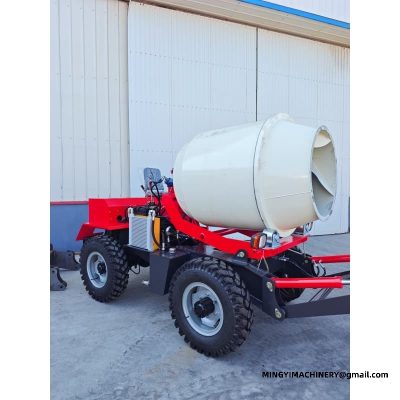
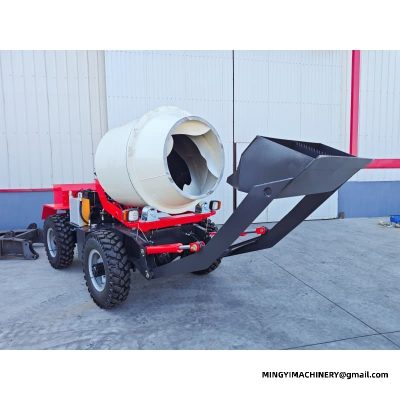
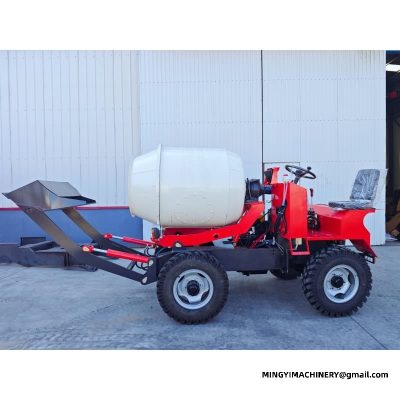
The published table on a electric start diesel concrete mixer is short, and every line on it is a decision. 0.8 m³ capacity, 1,500 kg rated load, 3,500 x 1,600 x 2,200 mm overall, 4WD through a 130 axle with a 212 steering axle behind. This page takes those lines one at a time and reads them the way a crew meets them: loading, mixing, hauling and discharging on village projects.
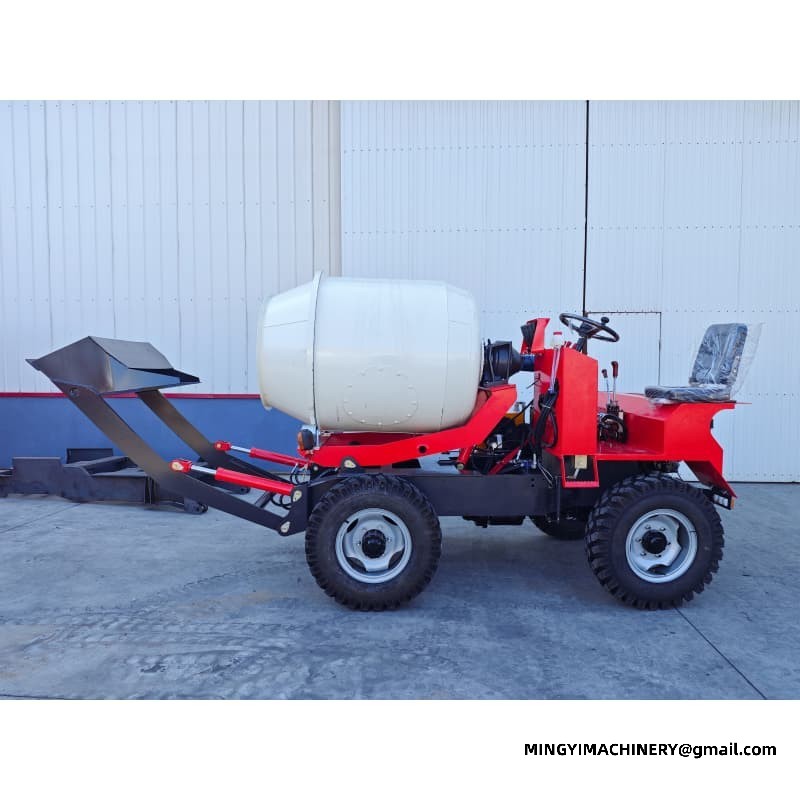
At 1,600 mm wide the machine threads standard double gates with room for its mirrors, which is the whole reason the envelope was drawn that way. Estate lanes, compound doors, orchard rows and basement entries all accept it where ordinary site trucks stop at the street.
The steering angle is the narrow-site ally: with the rear axle steering through 28°, the machine pivots into gaps its wheelbase alone could not enter, and the operator learns to account for the tail swinging outward.
On village projects, the single-operator loop is the productivity claim that matters. The machine replaces the barrow chain, the hoist and the arguments about whose turn it is to mix, and it does so with the shovel and the drum doing what two labourers used to do.
The loop also teaches pace. A new operator charges; an experienced one settles into the rhythm the cycle actually allows, and by the second week the experienced operator is ahead — fewer spills, fewer re-batches, on village projects, no injuries.
The machines that age well are washed and greased on schedule; the machines that age badly are the ones where wash-out slipped and dust won. Nothing exotic — just the daily five minutes, kept.
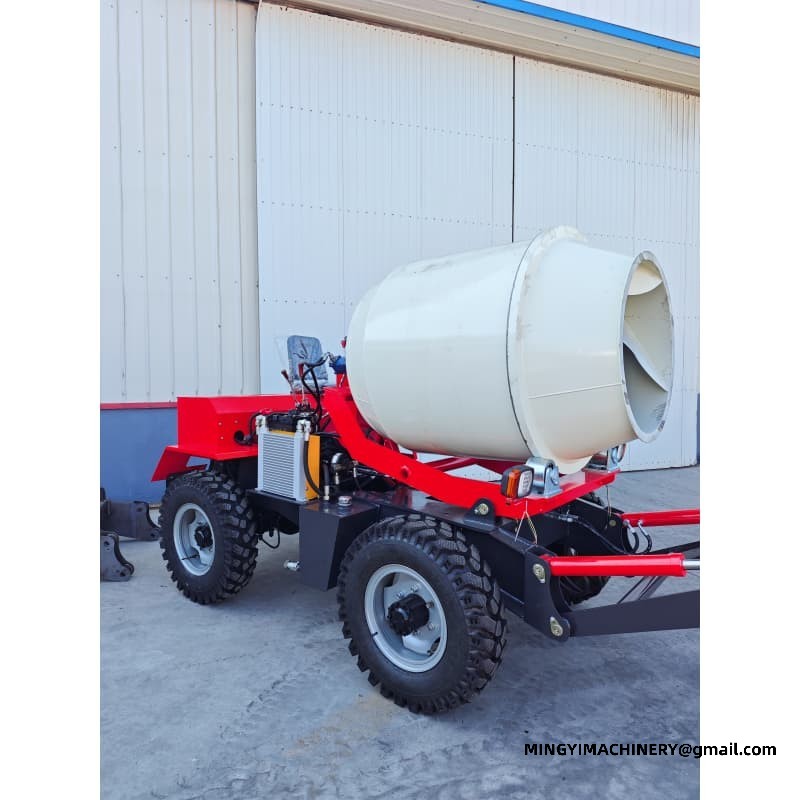
The drum's wear line is the inspection that predicts the machine's remaining economic life better than any other: a drum true to its blades and clean at the seam is a machine that has been loved, whatever its hours.
| Reference specification — 0.8 m³ 4WD self-loading concrete mixer | |
|---|---|
| Rated load | 1,500 kg |
| Rated capacity | 0.8 m³ |
| Overall dimensions (L x W x H) | 3,500 x 1,600 x 2,200 mm |
| Front tyre size | 8.25-16 |
| Rear tyre size | 7.50-16 |
| Minimum ground clearance | 204 mm |
| Steering angle | 28° |
| Turning dimension (outer tyre) | 2,464 mm |
| Maximum travel speed | 24 km/h |
| Transmission | 4WD |
| Gears | 3 forward / 1 reverse + travel gear |
| Front axle | 130 drive axle |
| Rear axle | 212 selectable 4WD steering axle |
| Engine | single-cylinder diesel / 25 hp |
| Steering | hydraulic power steering |
Fix the mix design for small structural and paving concrete once, write it down, measure the water, count the scoops, time the drum — and the batches on village projects will be more consistent than most hand-mixed concrete has ever been.
Where a sloped or awkward pour tempts the crew to loosen the mix, the better answer is placement help — a shorter chute position, a barrow stage, a wetter-but-specified mix designed for the job — not an unmeasured splash from the hose.
Read the two clusters against your site, not against the brochure. The figure that decides the sale is usually the smallest one: turning circle, clearance or width, whichever your worst gateway on village projects happens to be. The big numbers sell the machine; the small ones qualify it.
Read the rated load and the rated capacity together, never one without the other. The 1,500 kg rating is what the chassis and tyres are built to carry; the 0.8 m³ is what the drum actually holds per cycle, and the honest pour lives in the gap between the two.
The rules are short: slow through turns, gentle on the stops, drum level in transit and nobody riding on a machine built for one. Every accident report on mixers of this class starts with one of those rules broken.
End-of-shift safety is part of the same discipline: shovel down, drum rinsed, keys out, parking brake set, and the machine parked where tomorrow's first light will show it to everyone. Most site strikes happen to parked plant, not working plant.
24 km/h is not fast and should not be. The machine carries 1,500 kg of wet concrete high on a short wheelbase, and the gearing keeps those loads sedate. Crews that respect the speed keep the concrete in the drum and the machine on its wheels.
Reverse also serves the stockpile: backing toward the pile with the shovel leading keeps the loading line short and the machine's nose pointed at the next haul. Operators who plan their turnarounds move more concrete per hour than operators who rush.
A supplier worth keeping answers the cycle question — 0.8 m³ per batch, travel time, placing rate — rather than quoting a discount. The relationship that outlasts the warranty is the one built on specification and parts, not on specification alone.
Report faults honestly and in time. A small hydraulic weep described in a photograph reaches the right seal before it becomes a failed hose on a pour day, and crews that communicate get parts that fit the first time.
Let the first day end early, clean and unhurried. Operators trained calmly on village projects keep the habits; operators trained in a rush learn shortcuts instead.
Where the machine changes hands, the handover is a two-minute conversation with a written line: hours run, fuel state, anything odd heard or felt, wash-out done or not. The drum heel that one shift leaves is the next shift's complaint unless the note exists.
Keep the pairs matched left to right and the pressures even, because uneven fronts put the machine slightly out of square and the steering fights it all day. Tyres are the simplest component to treat well and the most lengthy to ignore.
Both sizes are simple where the machines sell, which is deliberate: a mixer stranded on tyres nobody stocks is a hire fleet's worst week. The sizes were chosen for availability first and performance second.
Power steering also matters at the end of a shift. A loaded machine manoeuvring all day on a manual system tires the operator into mistakes; the hydraulic system keeps the last batch as controlled as the first.
Measure the narrowest point on the route before the machine arrives on village projects — the figure turns an access argument into a five-second check. Crews that skip the measurement discover the constraint with a full drum aboard, which is the lengthy way.
25 hp is modest by highway standards and exactly right for this duty. The machine's work is short, heavy efforts — loading, climbing, tipping — and a small diesel spends most of its day loafing between them, which is where fuel economy and engine life both come from.
Starting is electric from a key, with a decompression lever as the manual fallback. Cold mornings ask for the lever and a little patience; the engine itself asks for nothing more than clean fuel and a serviced air filter.
The machine sits squarely in that second case. Small, repeated pours, distant supply, awkward access — work where a transit mixer either refuses the job or charges for the wasted capacity of a part-load.
Depreciation favours the machine too, because the 3,500 x 1,600 x 2,200 mm envelope keeps transport takes between jobs near nothing. The biggest single effort of plant is often moving it; this one rides a tag trailer behind a pickup.
Ask for photographs of the actual unit and its serial plate, not brochure images. The machine is simple enough that a five-minute video call at handover — controls, drum, shovel, axles — answers more than a week of messages.
Check the machine against its own plate on arrival — serial number, axle stamps, drum casting — and photograph everything before signing the carrier's release. Transit claims have deadlines, and they are shorter than anyone expects.
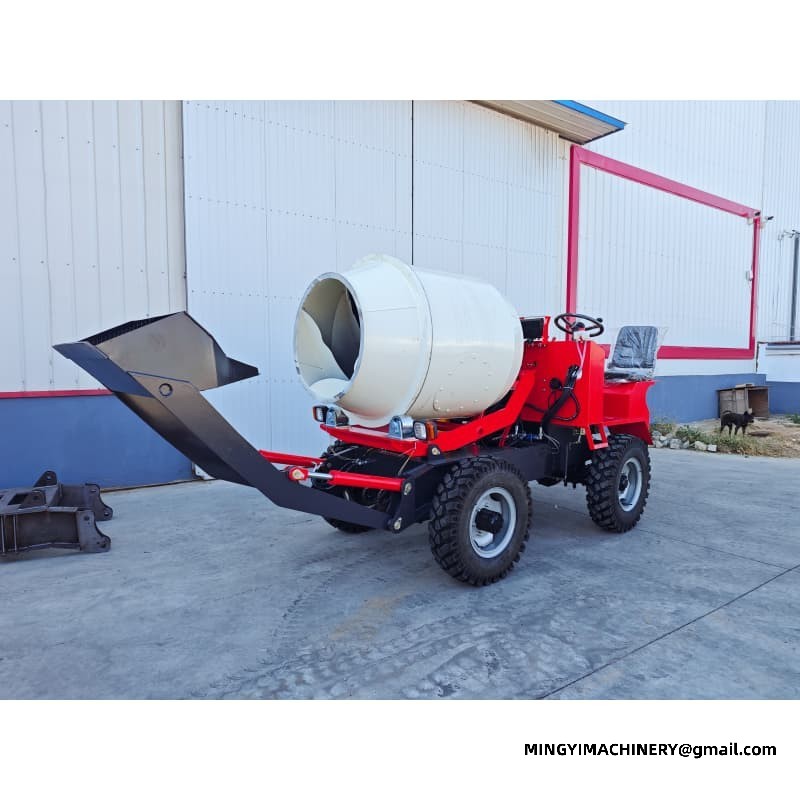
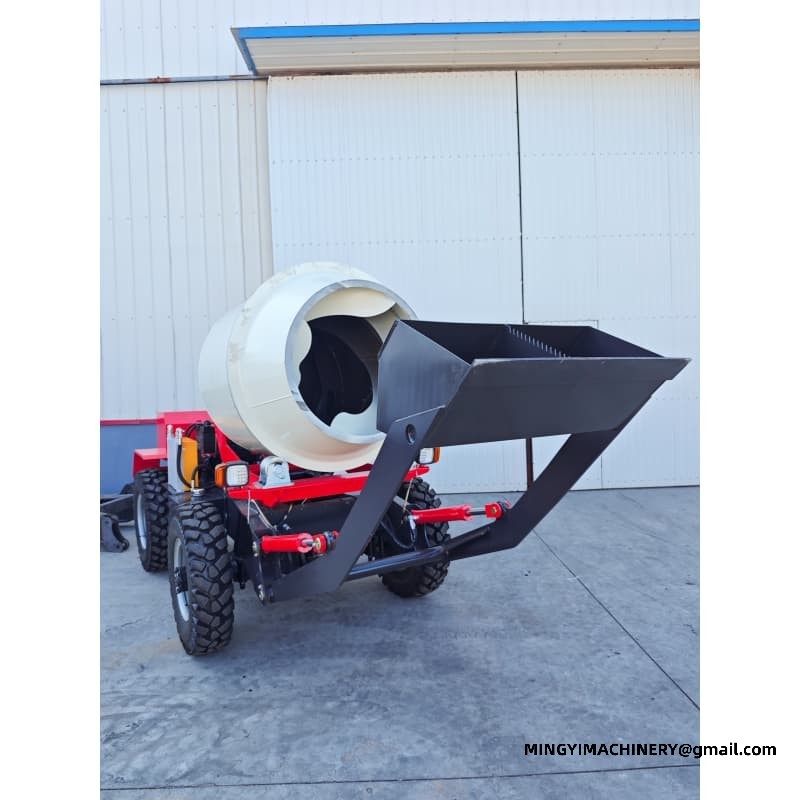
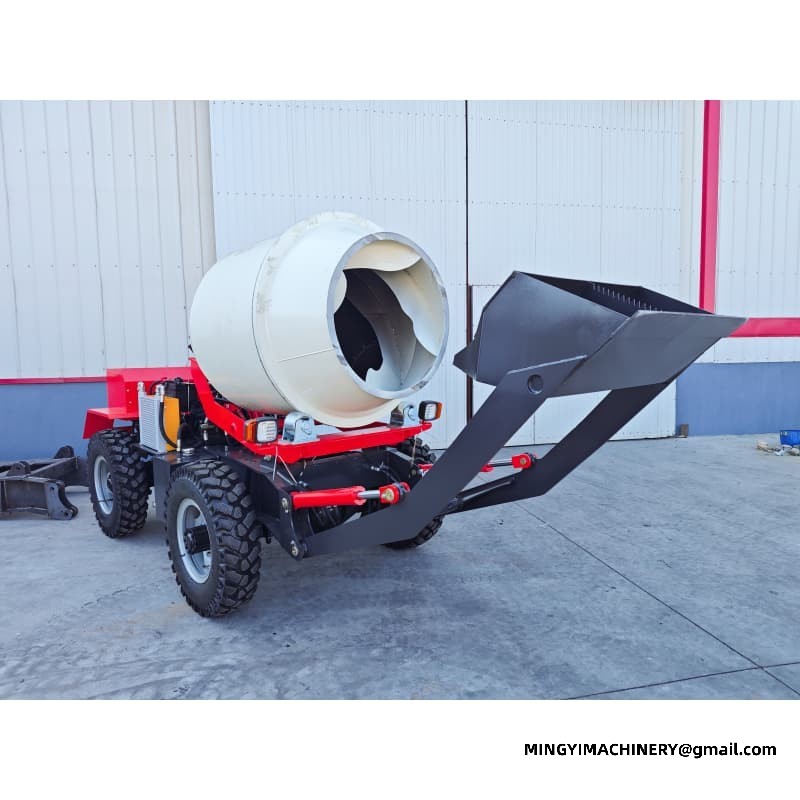
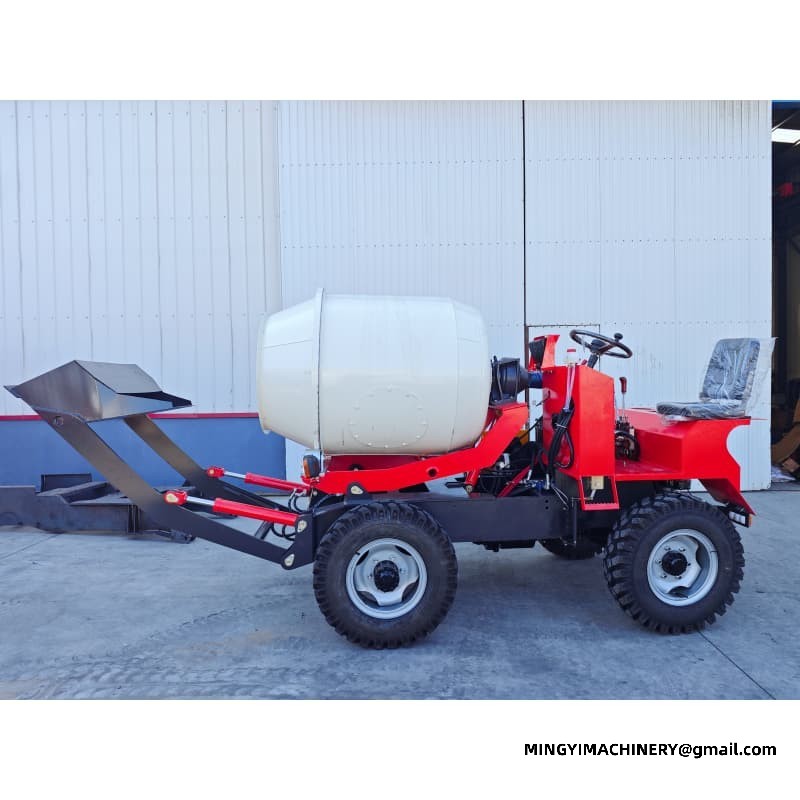
The shovel's geometry deserves a sentence of its own: it loads from in front of the drum, so the machine stands facing its stockpile and drives away facing the pour. No reversing into position, no second alignment, and the whole cycle on village projects keeps one direction of travel.
The shovel reaches a pile close to the front wheels, so the stockpile layout decides how fast a batch assembles. Keep aggregate and sand within a shovel's reach of the machine's standing position and the drum fills in seconds rather than minutes.
What strength concrete can a electric start diesel concrete mixer produce?
Whatever a correct recipe of good materials produces in a well-mixed drum — the machine's uniformity is the point. Structural mix designs come from the engineer, not from the machine.
How is the electric start diesel concrete mixer drum driven?
Hydraulically, from the same circuit as the steering and shovel. Rotation one way mixes; reverse with the drum tipped discharges over the front.
How long does a electric start diesel concrete mixer last?
With the daily wash-out kept and greasing on schedule, the chassis and drum outlast several sets of consumables, and the single-cylinder engine overhauls on parts stocked in most agricultural towns.
Can the electric start diesel concrete mixer run on finished slabs without damaging them?
Fresh slabs take wheel loads only when cured enough — protect with boards or route around, the same as any plant. The agricultural tyres are kinder than steel tracks but not kind to green concrete.
Can a electric start diesel concrete mixer place concrete around dense rebar?
Yes — the discharge lands where the operator aims it, and a spotter with a shovel and vibrator works the concrete in. Tight rebar changes the placing crew's job, not the machine's.
Does a electric start diesel concrete mixer hold its value?
Well-kept machines resell quickly to small contractors. Hours and a service book carry more weight at resale than appearance.
What spares should I buy with a electric start diesel concrete mixer?
Filters for engine and hydraulics, belts, hose clamps, drum blades, shovel pins and bushings, and lamp bulbs — the small parts that stop work on village projects when unstocked.
Does a electric start diesel concrete mixer waste concrete?
Less than scheduled supply does. Batching stops when the pour stops, so there are no returned-load charges — the effort control hides in batching to demand.
Small pours, distant sites and awkward access are exactly where this machine was drawn to work. Where the job matches that shape, the published table is all the sales argument needed.
Packing, loading and shipment of Electric Start Diesel Concrete Mixer: Key Start, No Drama
Export packing is part of the machine, not an afterthought. Electric Start Diesel Concrete Mixer: Key Start, No Drama is blocked and braced inside the container so that it arrives in the same condition it left, and the load plan is decided by the dimensions rather than by what fits loosely.
Commissioning Electric Start Diesel Concrete Mixer: Key Start, No Drama on site
Commissioning is where the specification meets the ground. The settings chosen for Electric Start Diesel Concrete Mixer: Key Start, No Drama are confirmed against the actual site, and the working pattern is adjusted before the machine is asked for a full day.
Planning the season around Electric Start Diesel Concrete Mixer: Key Start, No Drama
The calendar decides more than the specification does. Planning when Electric Start Diesel Concrete Mixer: Key Start, No Drama will be working, when it will be serviced and when it can be spared keeps the maintenance out of the weeks that matter.
Wear items and spares worth holding for Electric Start Diesel Concrete Mixer: Key Start, No Drama
Wear items are predictable once the machine has settled in. After the first service interval the pattern on Electric Start Diesel Concrete Mixer: Key Start, No Drama is visible, and the parts that were replaced become the parts that are kept.
Contact MINGYI Machinery for the current self-loading concrete mixer specification, export packing and a formal specification for your market. E-mail: sales@mingycn.com | LINE (ID): mingyicn
Tunnel Self Loading Concrete Truck: 2,200 mm of Height · Farm and Plantation Concrete Mixer: Posts, Sheds and Paths · off road dump truck Australia with hydraulic tipping body · Mini Self-Loading Concrete Mixer









