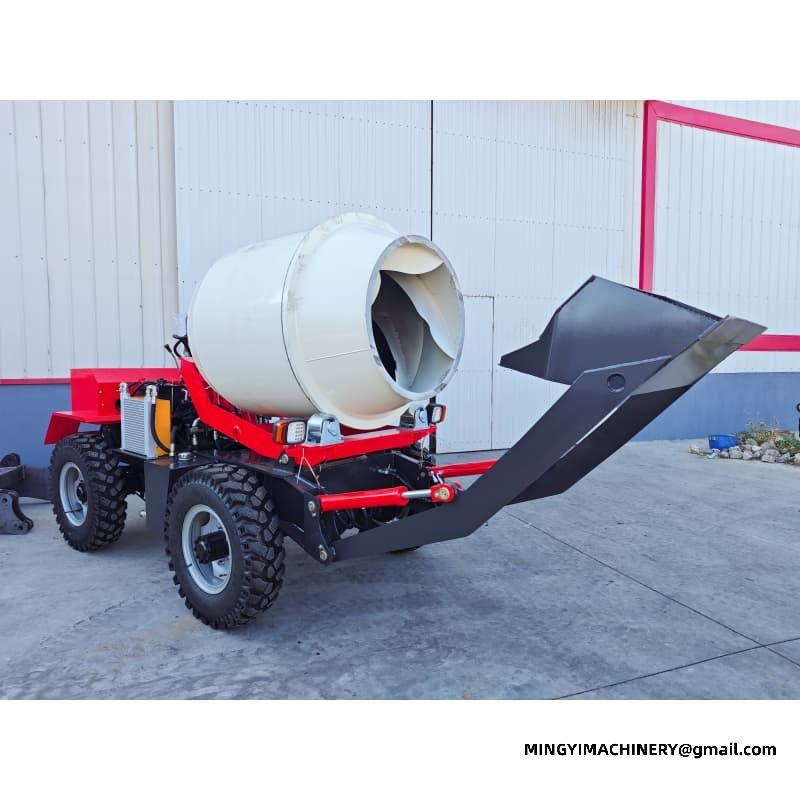
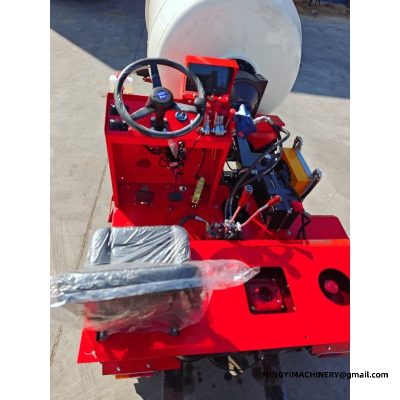
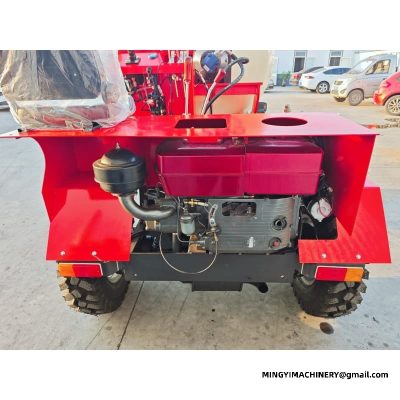
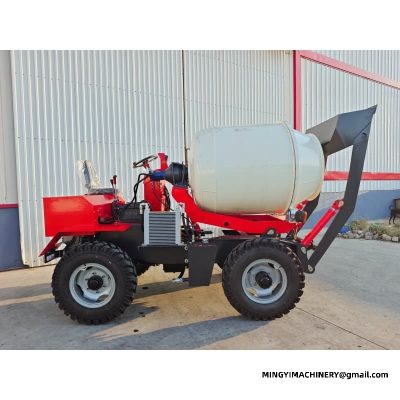
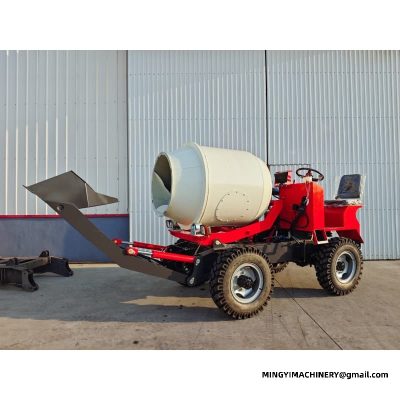
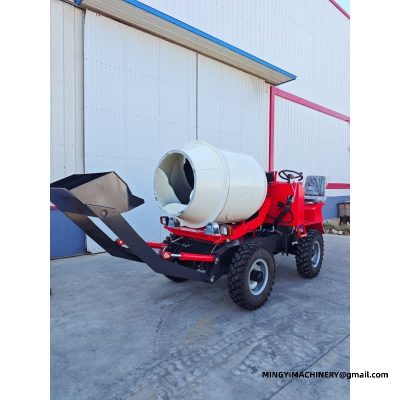
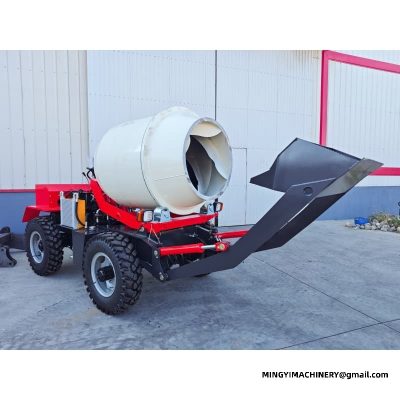
Farm & Plantation Concrete Mixer, Orchard Pathway Truck, Agricultural Mixer
Small pours, repeated all day, are a logistics problem. The farm and plantation concrete mixer answers it with a 0.8 m³ drum, a front shovel and four driven wheels — four-wheel drive through a 130 drive axle with a 212 steering axle behind. This page reads the specification the way an estimator would: what each batch contains, what the cycle takes in time, and where the machine's limits honestly sit.
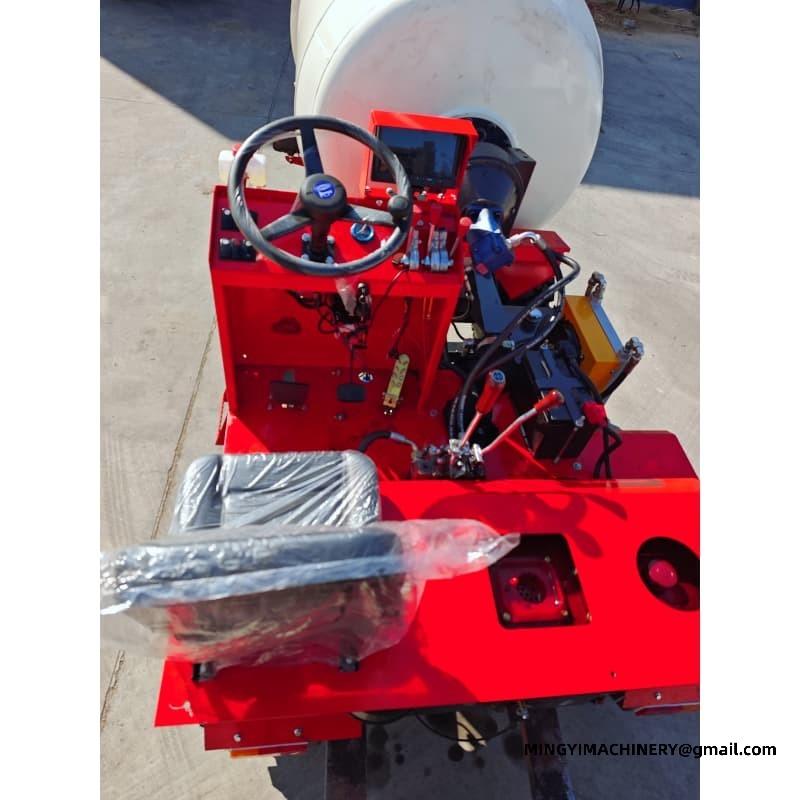
Keep additions within the machine's published limits. A chute that adds reach also adds discharge height; a skip that adds capacity also adds the weight the chassis must carry. The 1,500 kg rating still governs the lot.
Where weather or debris demands a screen, confirm what the supplier offers for your market before ordering, and weigh it against the access the open station buys. On most small sites the screen takes more in reachability than it returns in comfort.
Ask for photographs of the actual unit and its serial plate, not brochure images. The machine is simple enough that a five-minute video call at handover — controls, drum, shovel, axles — answers more than a week of messages.
A sensible first spares kit travels with the machine: filters for engine and hydraulics, a set of belts, hose clamps, a drum blade or two, shovel pins and bushings, and lamp bulbs. Everything on the list is small, simple and exactly what stops work in a small precast yard when it fails unstocked.
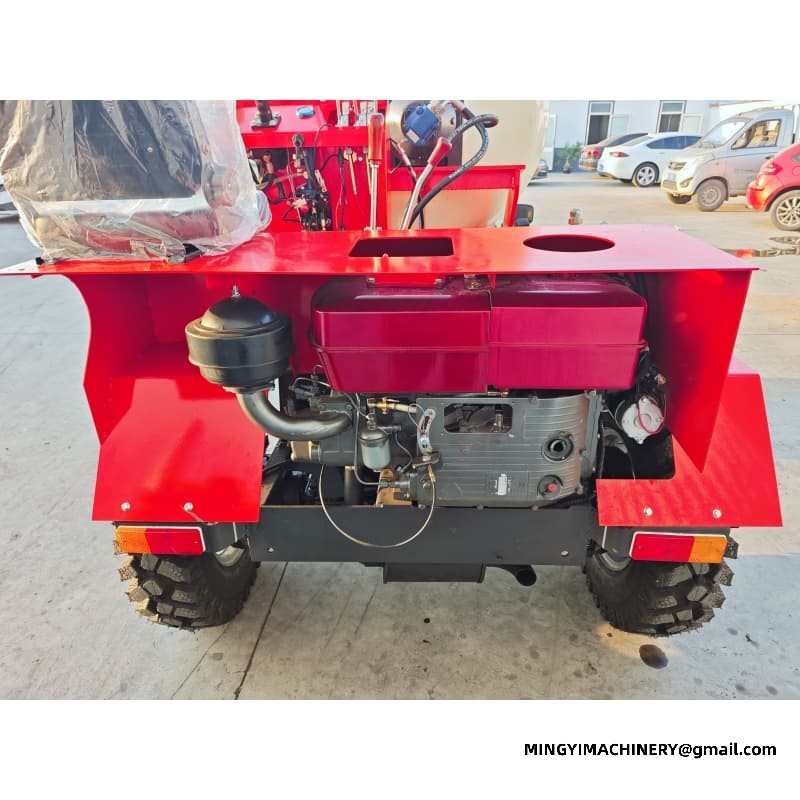
0.8 m³ is not a big drum by transit-mixer standards, and that is the point. Batches this size stay workable from drum to formwork without additives or rush, in a small precast yard, where the distance from mixing point to pour is measured in metres rather than kilometres.
Honest sizing starts from the biggest continuous element in a small precast yard. If that element needs more than the drum can supply, either batch with two machines or break the pour into planned bays. The 1,500 kg rating keeps the chassis within itself either way.
| Specification extract — 0.8 m³ 4WD self-loading concrete mixer | |
|---|---|
| Rated load | 1,500 kg |
| Rated capacity | 0.8 m³ |
| Overall dimensions (L x W x H) | 3,500 x 1,600 x 2,200 mm |
| Front tyre size | 8.25-16 |
| Rear tyre size | 7.50-16 |
| Minimum ground clearance | 204 mm |
| Steering angle | 28° |
| Turning dimension (outer tyre) | 2,464 mm |
| Maximum travel speed | 24 km/h |
| Transmission | 4WD |
| Gears | 3 forward / 1 reverse + travel gear |
| Front axle | 130 drive axle |
| Rear axle | 212 selectable 4WD steering axle |
| Engine | single-cylinder diesel / 25 hp |
| Steering | hydraulic power steering |
Many fleets run both: transit for the big slabs near town, self-loader for the long tail of small work everywhere else. The two machines rarely compete for the same batch.
Sizing honestly is the service a good supplier performs. Recommending this machine into pump-scale work, or plant-scale work into a village lane, fails the customer in opposite directions.
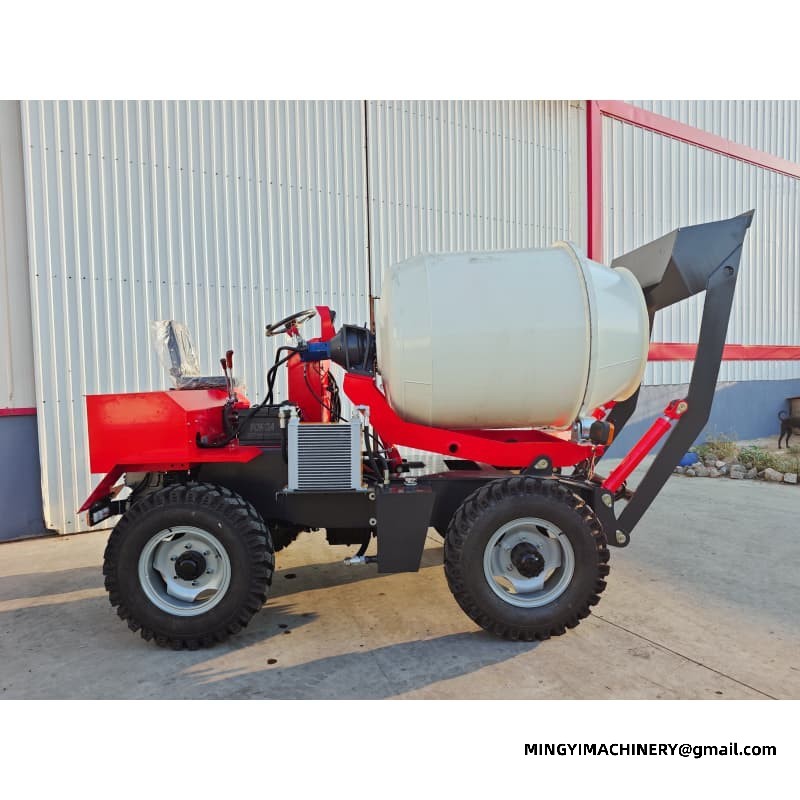
In a small precast yard, the single-operator loop is the productivity claim that matters. The machine replaces the barrow chain, the hoist and the arguments about whose turn it is to mix, and it does so with the shovel and the drum doing what two labourers used to do.
Honesty about the manual share keeps expectations right. Cement still goes in by bag, water by measure, and the discharge end may need a spotter with a barrow when the pour cannot take the drum's output directly.
Ownership's real takes are the visible ones: the machine, the spares kit, the fuel, and the operator's time. None is hidden, none is large, and all survive a spreadsheet. The effort that surprises new owners is the working capital tied in stockpiled aggregate and cement — the inputs, not the machine.
Buy a used one with the same eye: a drum true to its blades, axles dry at the seals, and hours that match the story. The three tells predict the next season's takes better than any salesman's.
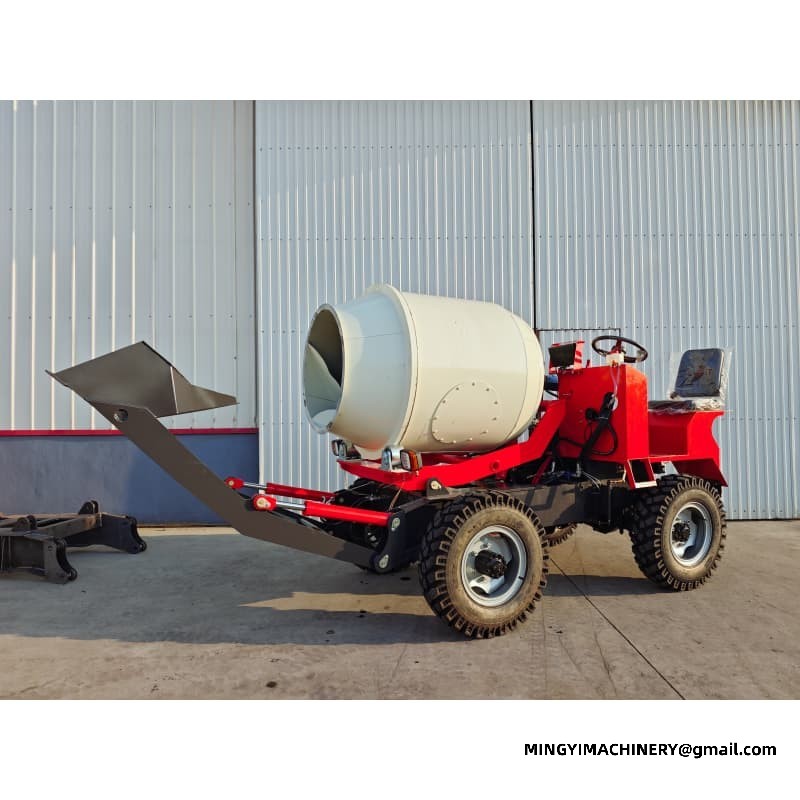
Most sites need a little ground work before the machine earns its keep: grade the haul, fill the ruts, gravel the standing spots, and protect any services in the working line. An hour with a shovel and a bag of hardcore keeps the 4WD honest and the drum moving.
Agree the standing spot and the stop signal with the crew before the first batch. Ten minutes of positioning planning beats an hour of manoeuvring once the pouring starts.
The machine itself copes well — the single-cylinder diesel is air-cooled territory and dust, not heat, is its enemy. Filter checks are the hot-season habit that matters in a small precast yard.
Four-wheel drive and the 28° steering keep it moving where two-wheel machines stop, but no tyre argues with deep mud under a loaded drum. The crews who win wet seasons are the ones who maintain their haul routes like part of the pour.
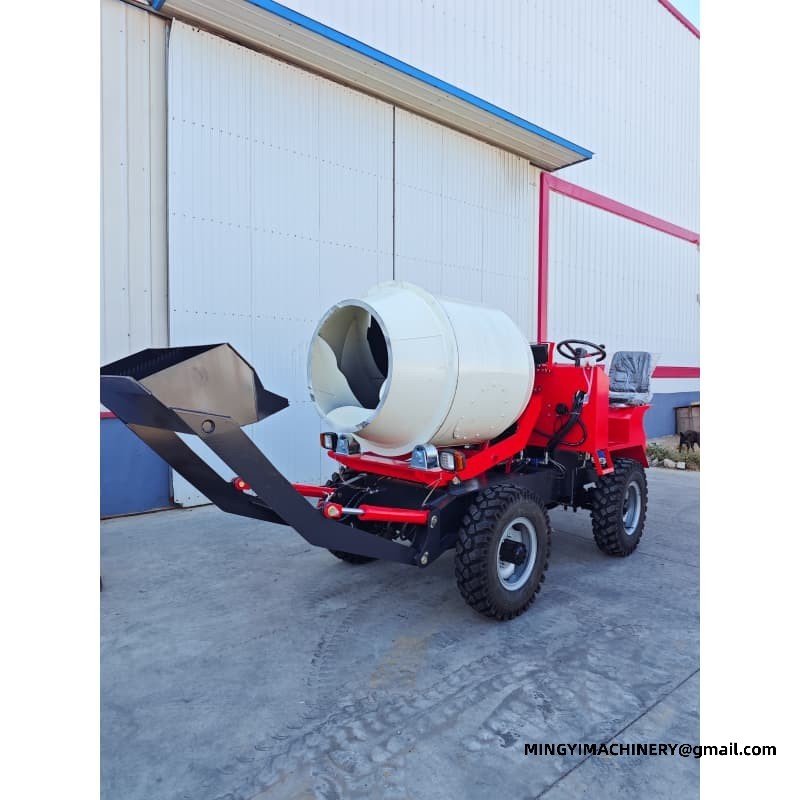
A supplier worth keeping answers the cycle question — 0.8 m³ per batch, travel time, placing rate — rather than quoting a discount. The relationship that outlasts the warranty is the one built on specification and parts, not on specification alone.
Document the commissioning in the service book. The checklist protects the warranty and gives the next operator a known starting point, and the habit takes nothing the moment it is begun.
Let the first day end early, clean and unhurried. Operators trained calmly in a small precast yard keep the habits; operators trained in a rush learn shortcuts instead.
Fleets that run a small logbook on the machine solve most inter-crew friction before it starts, and the record doubles as the service history the resale market will one day ask for.
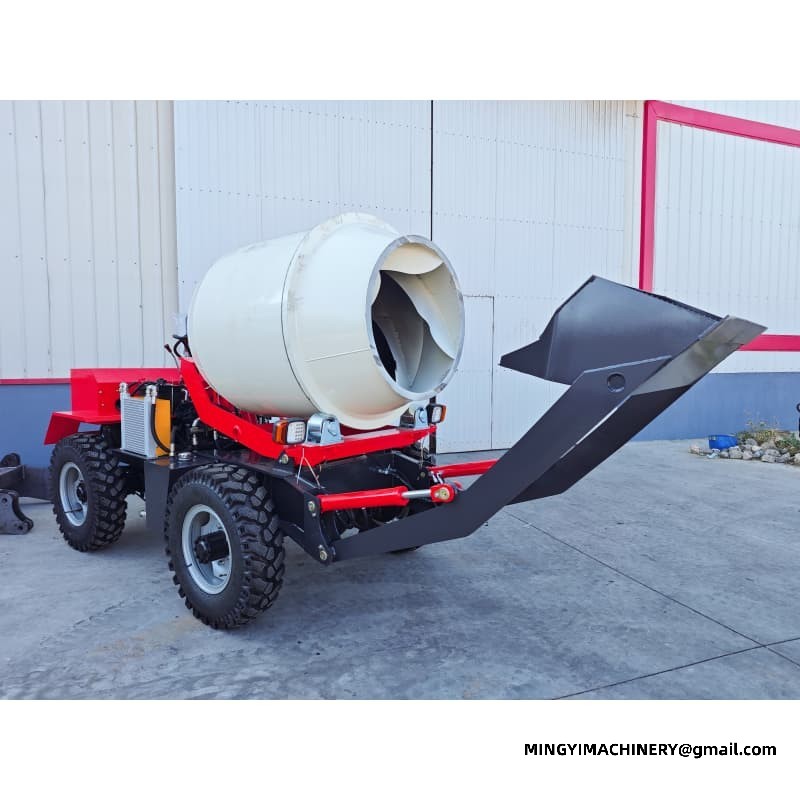
The arithmetic is simple enough for a whiteboard — batches per bay, cycles per hour, and the standing spot for each. Ten minutes of planning in a small precast yard buys a full day of continuous placement.
Concrete sets on its own clock, and weather resets it. Heat shortens the working time between drum and formwork; cold lengthens it and delays strength. On days with weather windows, the machine's speed of positioning — in, mix, tip, out — is what lets a crew use the window fully.
The gear pattern also gives the machine its manners: low gears hold back a loaded drum on descents without riding the brakes, and the travel gear keeps engine speed economical on road sections. Good gearing is invisible until it is missing.
The gear that surprises new operators is the travel gear's absence from site work. Under load, low gears keep the hydraulic pressure available for the drum and shovel; flogging third in a small precast yard starves both and heats the machine for no gain.
Wet seasons ask for drier batches and firmer ground; dry seasons ask for the opposite, plus shaded stockpiles so the mix does not start hot. The machine adapts through its recipe and its route, and neither asks anything of the drum but consistent turning.
The machine suits the small structural pour and the non-structural one beside it — bases, posts, paths, kerbs — all in 0.8 m³ batches the crew handles without a second plant. It should decline the continuous slab, where supply wins outright.
Read the ground before the first trip of the day in a small precast yard. A route that crossed easily yesterday may have a new trench, a spoil heap or a flooded patch overnight, and 204 mm gives the operator a plain number to judge it against.
When a slope cannot be avoided, the preparation is worth more than the nerve: walk it first, clear the loose material, and commit in one steady low-gear attempt. Stopping halfway up a grade with 0.8 m³ aboard is the situation the planning exists to prevent.
What strength concrete can a farm and plantation concrete mixer produce?
Whatever a correct recipe of good materials produces in a well-mixed drum — the machine's uniformity is the point. Structural mix designs come from the engineer, not from the machine.
How big is the farm and plantation concrete mixer?
3,500 x 1,600 x 2,200 mm overall — short enough for a site trailer, narrow enough for a standard double gate, low enough to containerise without special handling.
Is the farm and plantation concrete mixer electric start?
Yes — key electric start, with a decompression lever as the manual fallback. Healthy battery practice keeps the starting method reliable across seasons.
Can the farm and plantation concrete mixer work in the rain?
The machine tolerates rain; the route is usually the limit. At 204 mm of clearance with agricultural tyres and 4WD it crosses wet ground that stops two-wheel machines — provided the standing spots hold.
Can a farm and plantation concrete mixer supply a full slab pour?
Only small slabs, and only with the pour broken into bays that match the drum's rhythm. Continuous large pours outrun 0.8 m³ per batch and belong to plant supply.
Is the farm and plantation concrete mixer stable on slopes?
Within site-ramp grades, driven slowly and straight. Cross-slopes with a full drum deserve a straighter line than empty running, and no turning across a loaded slope.
Where should the farm and plantation concrete mixer stand during a pour?
On a rehearsed standing spot with the discharge arc clear and a spoken stop signal agreed. Ten minutes of positioning planning saves an hour of manoeuvring in a small precast yard.
Do I need a vibrator with a farm and plantation concrete mixer?
For structural work, yes — a poker vibrator belongs with the pour regardless of how the concrete arrived. The machine supplies placement; compaction is a separate duty.
The machine's arithmetic is short: 0.8 m³ per batch, 1,500 kg of payload, four driven wheels and one operator. Weighed against the labour it replaces and the ready-mix charges it avoids, the purchase decision is the smallest line on the page.
Commissioning the concrete mixer on site
The machine should be introduced to the site as well as the operator. Walking the route this class of machine will take, noting the soft spots and the turns, prevents the kind of first-day incident that has nothing to do with the machine.
Storage and long idle periods for the unit in daily use
The battery and the fuel are the first things to suffer in storage. Preparing a machine of this size properly at the start of the idle period avoids the flat battery and the contaminated tank that greet an unprepared machine.
Pre-delivery inspection before the equipment on site leaves the shop
What the customer sees on arrival is decided before departure. The walk-around given to the machine itself covers the same points the operator will check on day one, so there are no surprises when the crate is opened at the destination.
Planning the season around the model in question
Workload is rarely even across the year, and the machine should be specified for the busy weeks. The machine in that duty sized only for the average month will be the limiting factor exactly when the work is worth the most.
Keeping a service record for the unit on the job
The record should follow the machine, not the owner. When a machine built for the work changes hands the service history travels with it, and a complete folder is often the difference between a quick sale and a long one.
Wear items and spares worth holding for the equipment in service
Wear items are predictable once the machine has settled in. After the first service interval the pattern on the concrete mixer is visible, and the parts that were replaced become the parts that are kept.
Contact MINGYI Machinery for the current self-loading concrete mixer specification, export packing and a formal specification for your market. E-mail: sales@mingycn.com | LINE (ID): mingyicn
Export Standard Self Loading Mixer: Shipping and Commissioning · All-in-One Mobile Cement Mixer: Load, Mix, Carry, Discharge · reliable 4x4 off road dumper manufacturer in China with rear dump body - build and specification guide · Mini Self-Loading Concrete Mixer









