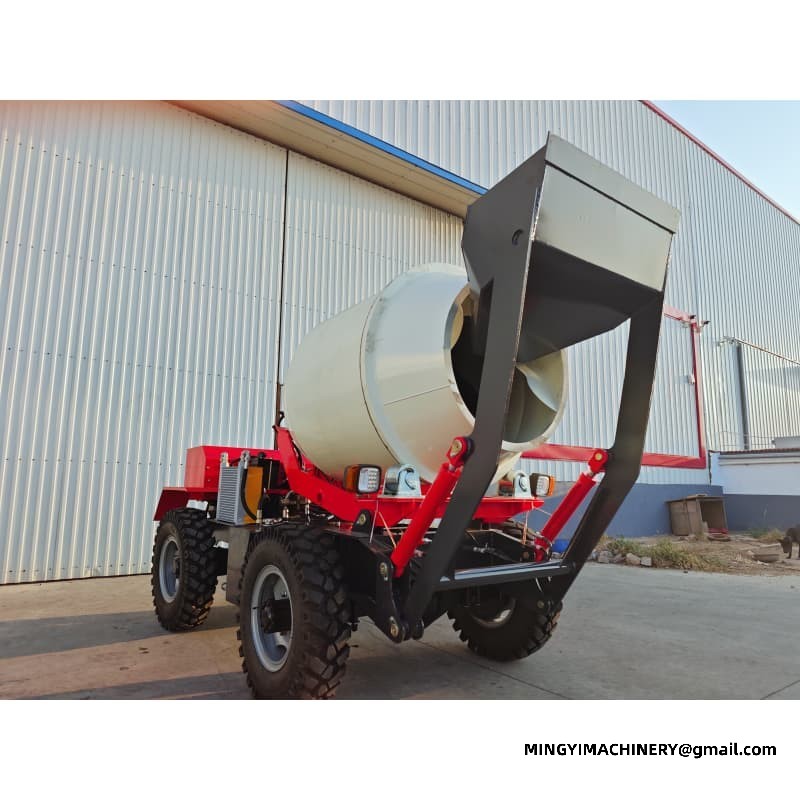
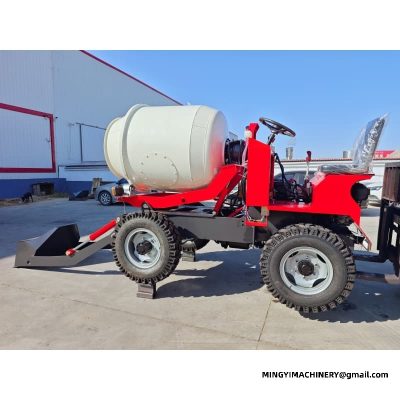
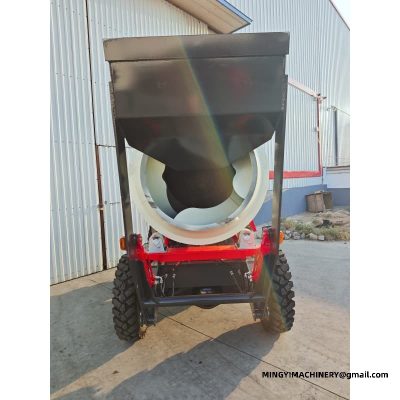
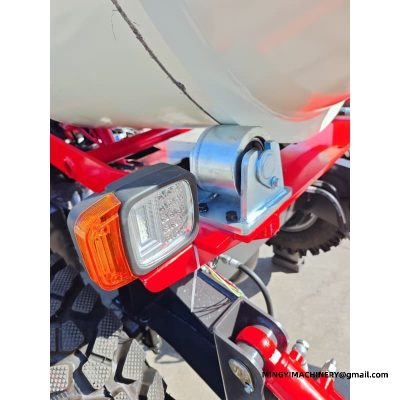
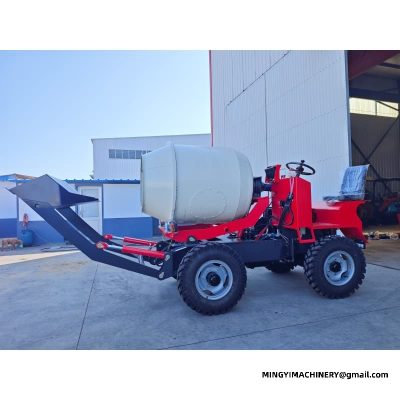
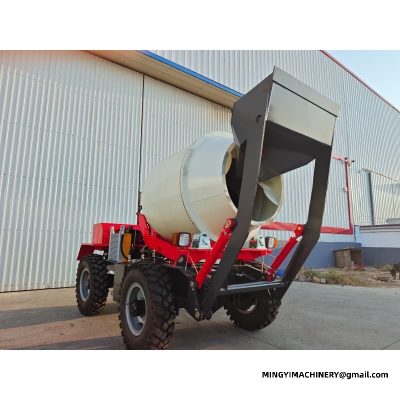
Export Standard Self Loading Mixer, CE Certified Concrete Truck, CKD Assembly
Buy the drum for the pour, the chassis for the ground. The two halves of a export standard self loading mixer spec sheet answer different questions: 0.8 m³ and 1,500 kg describe what a batch is; the 4WD transmission, 204 mm of clearance and 28° of steering angle describe where that batch can travel. This page reads both halves on a building site.
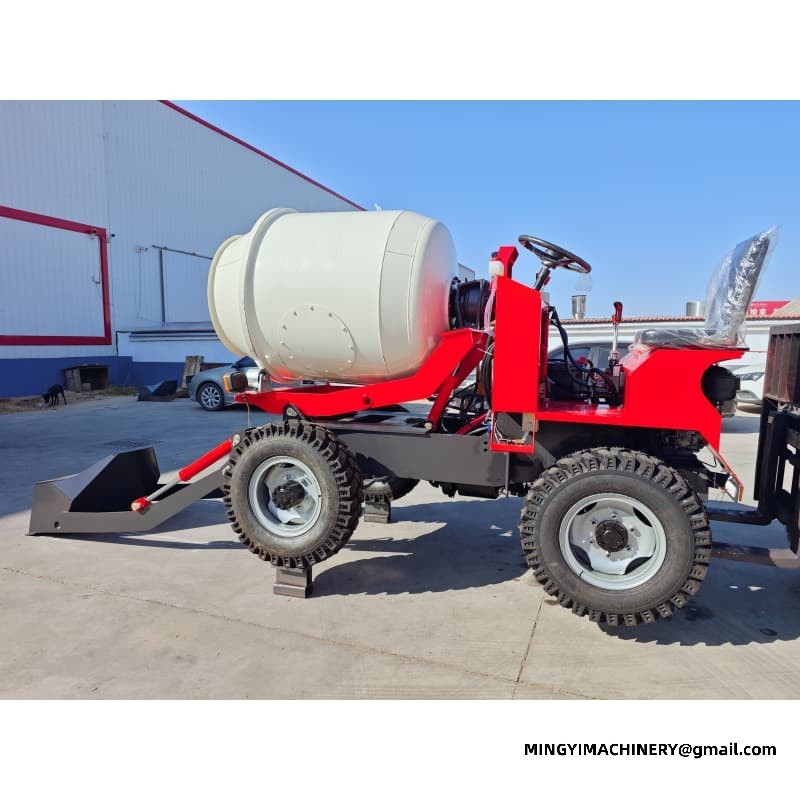
Measure the narrow gate before delivery on a building site — width, height bar, and the turn immediately inside it. The 2,464 mm turning circle handles the inside turn; the measurement turns hope into a plan.
Height bars and door heads deserve the same measurement as the width — the 2,200 mm envelope is honest, but site structures sag, and a taped height stick at the gateway settles the question in ten seconds.
Keep additions within the machine's published limits. A chute that adds reach also adds discharge height; a skip that adds capacity also adds the weight the chassis must carry. The 1,500 kg rating still governs the lot.
The caution is the same as for every small machine: extra structure changes the load case the 3,500 x 1,600 x 2,200 mm envelope was drawn for. A raised cab, a heavy counterweight or a wide attachment redistributes stress the chassis never agreed to carry, and the fault shows up later, elsewhere.
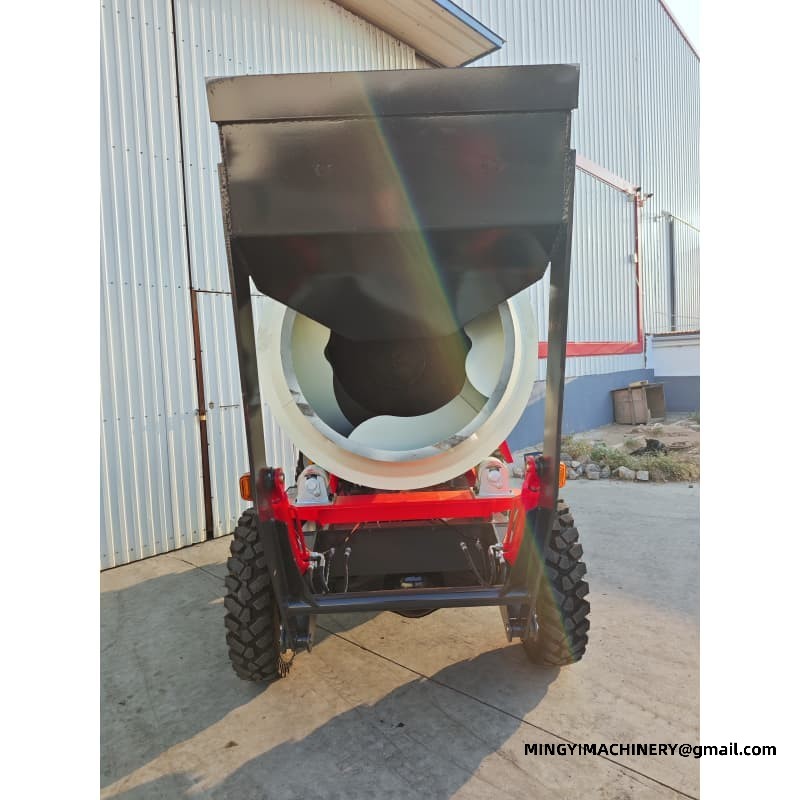
25 hp is modest by highway standards and exactly right for this duty. The machine's work is short, heavy efforts — loading, climbing, tipping — and a small diesel spends most of its day loafing between them, which is where fuel economy and engine life both come from.
Daily care is a two-minute walk-round: oil, fuel, air restriction, belt, and a check that the radiator front is not blinded by dust. Machines worked in dry conditions on a building site need that filter check more often than the book says.
| Reference specification — 0.8 m³ 4WD self-loading concrete mixer | |
|---|---|
| Rated load | 1,500 kg |
| Rated capacity | 0.8 m³ |
| Overall dimensions (L x W x H) | 3,500 x 1,600 x 2,200 mm |
| Front tyre size | 8.25-16 |
| Rear tyre size | 7.50-16 |
| Minimum ground clearance | 204 mm |
| Steering angle | 28° |
| Turning dimension (outer tyre) | 2,464 mm |
| Maximum travel speed | 24 km/h |
| Transmission | 4WD |
| Gears | 3 forward / 1 reverse + travel gear |
| Front axle | 130 drive axle |
| Rear axle | 212 selectable 4WD steering axle |
| Engine | single-cylinder diesel / 25 hp |
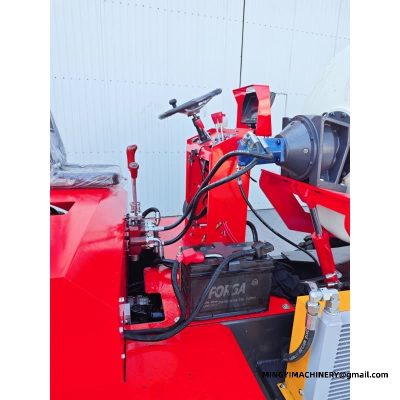
| Steering | hydraulic power steering |
On a building site, the difference shows on the first wet morning. A two-wheel-drive machine spins and needs towing; this one keeps moving under its own traction with a full 1,500 kg in the drum circuit. Traction is capacity — a mixer that cannot reach the pour has none.
Selectable rear drive means the operator runs two-wheel steering on hard standing and engages full 4WD when the ground degrades. The machine spends most of its life in the lighter mode and keeps the heavy mode for the mornings it is needed.
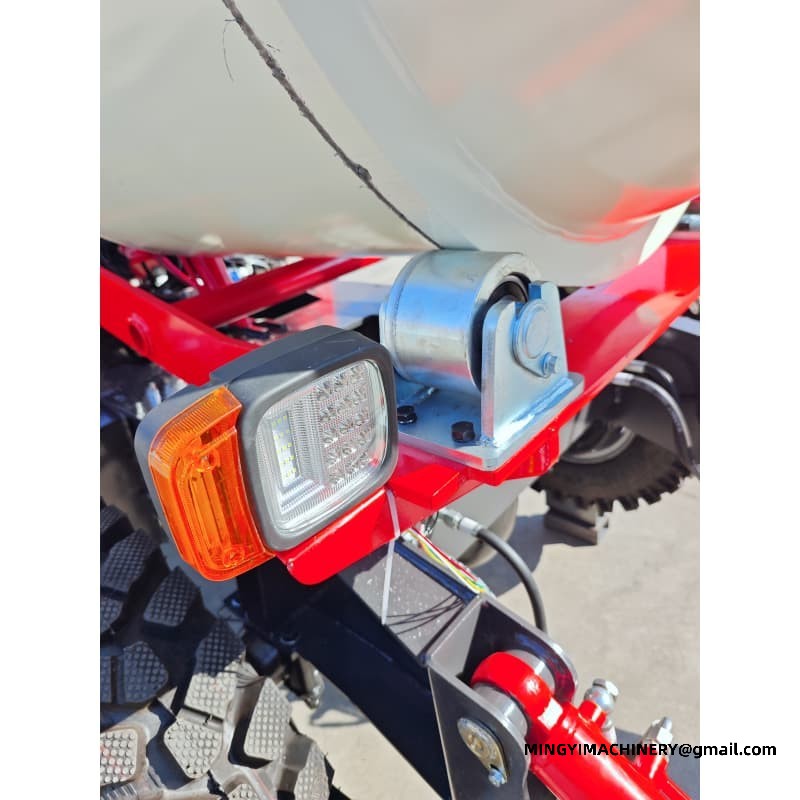
The design is deliberately conventional. Open-centre hydraulics of this pattern are understood by every agricultural mechanic, and hoses, seals and spool valves are stock items almost everywhere the machines are sold.
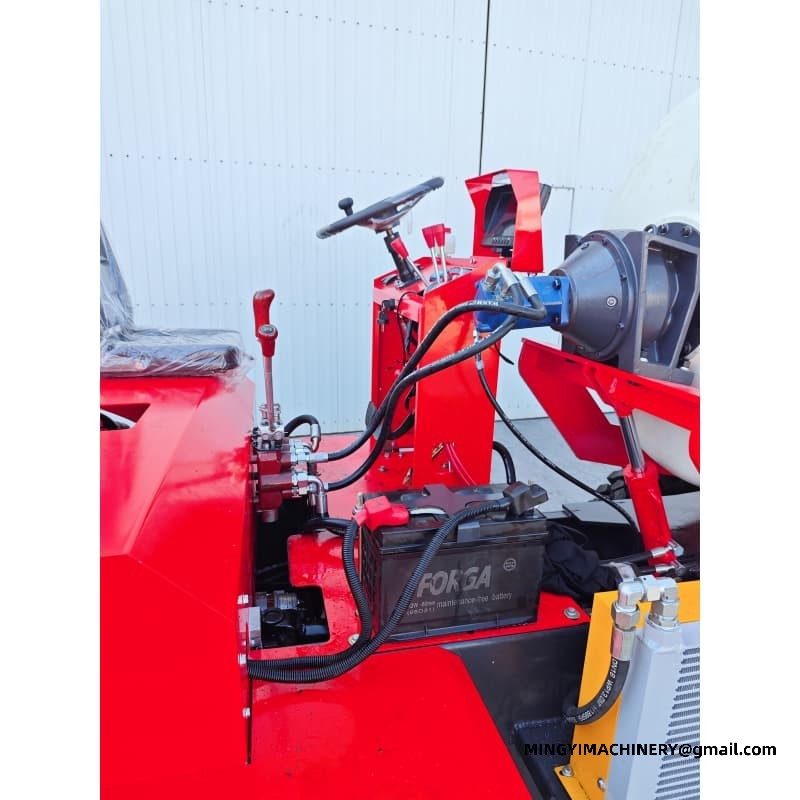
Because the three consumers share one pump, they also share priorities: steering wins, then the drum, then the shovel. The machine is plumbed so that this happens naturally, and the operator notices it only as smoothness under combined loads.
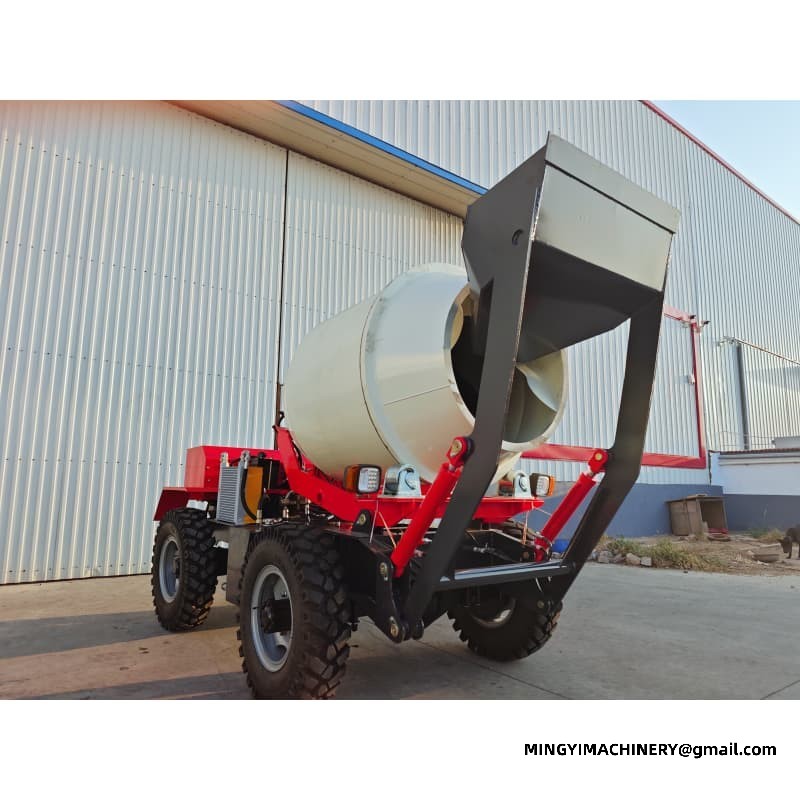
The shovel's geometry deserves a sentence of its own: it loads from in front of the drum, so the machine stands facing its stockpile and drives away facing the pour. No reversing into position, no second alignment, and the whole cycle on a building site keeps one direction of travel.
On sites that move the pile daily, a plate or a spreader keeps the loading face flat, and the shovel thanks you for it. Flat faces give full scoops; full scoops give predictable batches and a drum that reaches 0.8 m³ without a second bite.
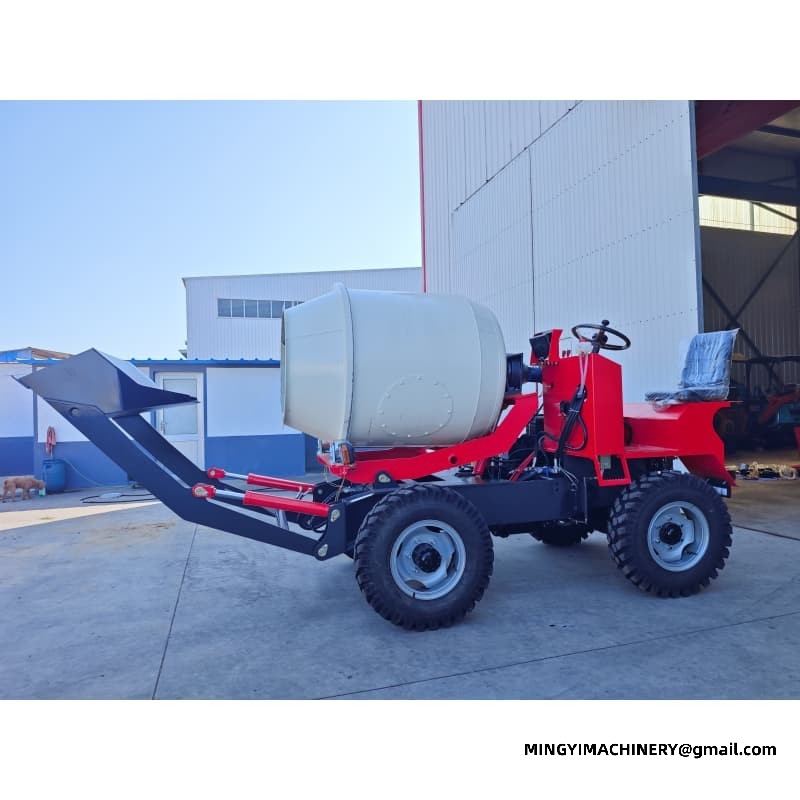
On larger sites the profile widens: an operator plus a spotter at the discharge, plus whoever feeds the cement and measures the water. The machine still needs one trained person; it simply stops needing a barrow chain behind them.
For hire fleets, the machine is a starter asset: simple controls, one operator, a specification that fits on a single page and a resale market that is quick. The paperwork is as gentle as the machine — one service book, one engine pattern, one set of tyres to keep in stock.
The arithmetic is simple enough for a whiteboard — batches per bay, cycles per hour, and the standing spot for each. Ten minutes of planning on a building site buys a full day of continuous placement.
On a building site, the practical habit is to batch slightly smaller in heat, slightly larger in cold, and never to batch ahead of the formwork by more than one drum. The machine makes that kind of just-in-time batching possible; the pour plan should use it.
Let the first day end early, clean and unhurried. Operators trained calmly on a building site keep the habits; operators trained in a rush learn shortcuts instead.
One entry per shift is enough for the log — hours, batches, anything heard, wash-out done. The discipline takes a pencil's worth of effort and returns a machine whose history answers questions before they are asked on a building site.
The discipline that varies by season is the survey: on a building site, the ground that holds in March may not hold in November, and the turning circle decides nothing if the approach has turned to mud.
The machine's natural work is the small structural pour — bases, posts, beams, ties — and the non-structural one beside it: paths, kerbs, patching, linings. Both consume 0.8 m³ per batch in quantities the drum and the crew handle naturally.
A supplier worth keeping answers the cycle question — 0.8 m³ per batch, travel time, placing rate — rather than quoting a discount. The relationship that outlasts the warranty is the one built on specification and parts, not on specification alone.
Keep the order history with the parts book. The second order — a blade, a seal, a hose — placed a year later is a two-minute email when the references are at hand, and a half-day search when they are not.
Power steering also matters at the end of a shift. A loaded machine manoeuvring all day on a manual system tires the operator into mistakes; the hydraulic system keeps the last batch as controlled as the first.
2,464 mm is measured at the outer tyre, so walls and posts at body height are the real constraint — the machine's shoulders swing wider than its tyres. Crews that remember this stop clipping mirrors and handrails on a building site.
0.8 m³ is not a big drum by transit-mixer standards, and that is the point. Batches this size stay workable from drum to formwork without additives or rush, on a building site, where the distance from mixing point to pour is measured in metres rather than kilometres.
Where a pour sits between the two — big for one machine, small for a plant — the answer is scheduling rather than hardware: bays, joints and timing turn a 0.8 m³ drum into a continuous supply. The 1,500 kg chassis makes the repeated trips practical in fuel and in wear.
204 mm also sets the maintenance floor: axle drain plugs, the gearbox sump and the hydraulic filter all live above that line, and none of them wants to meet a rock. The clearance is a working figure, not a styling choice.
Front tyres are 8.25-16, rears are 7.50-16 — agricultural-pattern tyres with a tread that grips soft ground and shrugs off stones. Combined with four-wheel drive they carry a full drum across ground that stops two-wheel-drive machines.
The export standard self loading mixer battery keeps going flat — why?
Short runs without charging time, or parasitic drain while parked. Run the machine long enough after starts to replace what the starter used, and disconnect or top up during idle weeks.
How much concrete does the export standard self loading mixer mix per batch?
The drum mixes 0.8 m³ per batch, and the chassis carries 1,500 kg while doing it. Batch size and payload were drawn to match, so a full drum never overloads the machine.
Can the export standard self loading mixer carry aggregate without mixing?
Yes, within the 1,500 kg payload — moving sand and gravel between stockpile and mixer is a common secondary use, discharged by tipping the drum.
Is the export standard self loading mixer fuel-hungry?
No. A 25 hp diesel works in short heavy efforts and loafs between them, which is where its economy comes from. Idle time, not work, wastes its fuel.
What ground can the export standard self loading mixer cross?
Prepared site ground, gravel, compacted fill and firm grass, at 204 mm of clearance with agricultural tyres and 4WD. Deep mud and boulder fields are the honest limits.
What paperwork comes with a export standard self loading mixer shipment?
Commercial invoice, packing list, and the shipping documents your market requires — confirm the exact set at specification so customs clears without surprises.
export standard self loading mixer or a small hand-fed drum mixer?
The self-loader replaces the shovel line feeding a hand mixer and hauls the batch to the pour under its own power — one operator does the work of a barrow chain.
How much water should a export standard self loading mixer batch take?
Whatever the mix design specifies — measured, not splashed. Extra water makes a stiff mix easy and weak; a marked container beside the controls solves most site water discipline.
A mixer that reaches the pour, mixes to a recipe and washes out on time is a mixer that earns for a decade. The habits in this page effort minutes a day; the machine they protect takes far more to neglect.
Fuel, oil and fluid quality for Export Standard Self Loading Mixer: Shipping and Commissioning
The specification for oil is written for a reason. Using the grade and the change interval set for Export Standard Self Loading Mixer: Shipping and Commissioning keeps the engine and the hydraulic system inside the range they were designed for.
Cold weather and winter care for Export Standard Self Loading Mixer: Shipping and Commissioning
Winter is hard on rubber and on seals as much as on the engine. Parking Export Standard Self Loading Mixer: Shipping and Commissioning under cover, keeping the tracks or tyres off standing water and checking the hoses for cracking are all part of the season.
Commissioning Export Standard Self Loading Mixer: Shipping and Commissioning on site
The machine should be introduced to the site as well as the operator. Walking the route Export Standard Self Loading Mixer: Shipping and Commissioning will take, noting the soft spots and the turns, prevents the kind of first-day incident that has nothing to do with the machine.
Later additions and retrofits on Export Standard Self Loading Mixer: Shipping and Commissioning
Most additions are easier to plan than to add. Hydraulic services, mounting brackets and electrical capacity on Export Standard Self Loading Mixer: Shipping and Commissioning are build items, and deciding them at the specification stage is far easier than doing it later.
Keeping a service record for Export Standard Self Loading Mixer: Shipping and Commissioning
Patterns show up in the record before they show up in the machine. Rising oil consumption or a filter that keeps blocking on Export Standard Self Loading Mixer: Shipping and Commissioning is obvious on paper long before it becomes a failure on site.
Contact MINGYI Machinery for the current self-loading concrete mixer specification, export packing and a formal specification for your market. E-mail: sales@mingycn.com | LINE (ID): mingyicn
All-in-One Mobile Cement Mixer: Load, Mix, Carry, Discharge · 0.8m3 Self Loading Concrete Mixer: Batch by Batch · articulated dump truck supplier for export markets · Mini Self-Loading Concrete Mixer









