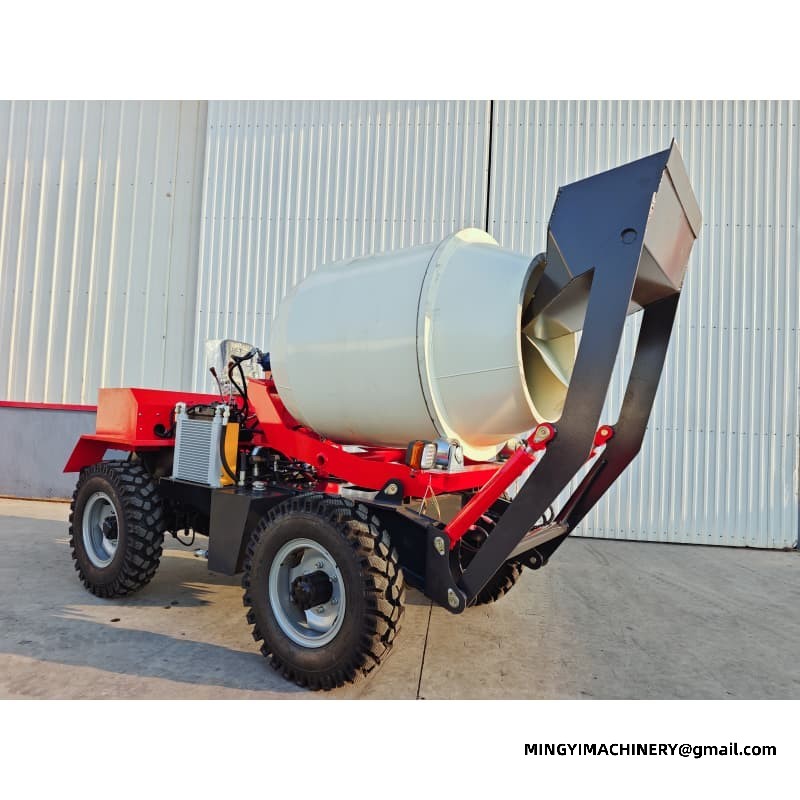
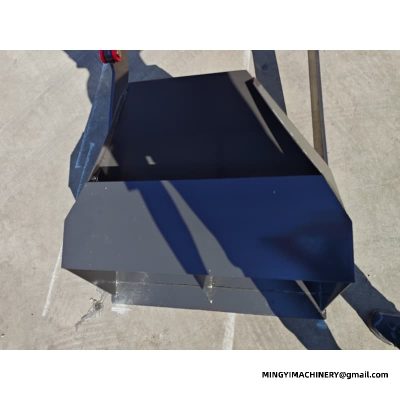
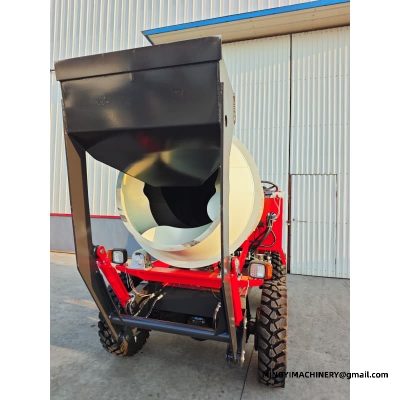
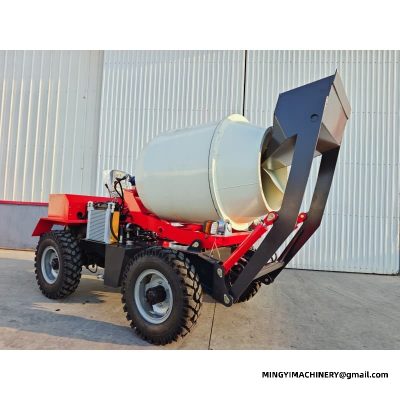
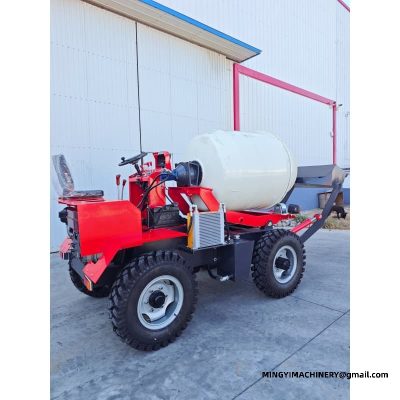
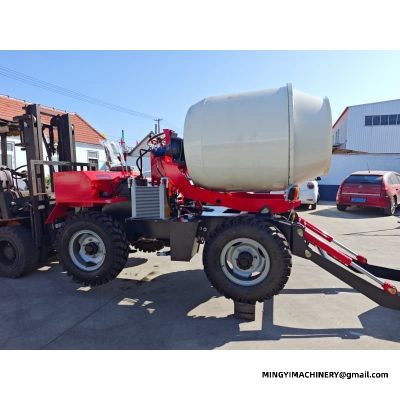
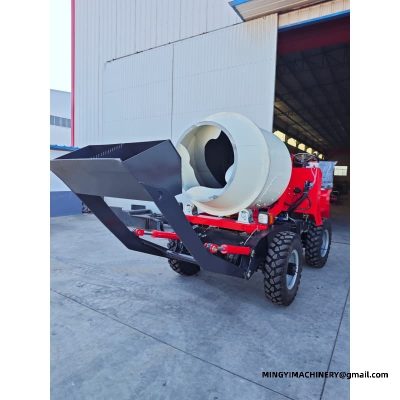
0.8m3 Self Loading Concrete Mixer, 0.8 Cubic Meter Self Loader, 0.8m³ Mixer
A self-loading mixer is bought for the distance between the aggregate pile and the pour. The 0.8 m³ drum, the 1,500 kg payload and the front shovel that feeds them answer one question — who mixes, and who carries? This page reads the published table as a 0.8m3 self loading concrete mixer buyer meets it on rural road work: capacity first, then the drive and steering that decide where the machine can actually stand.
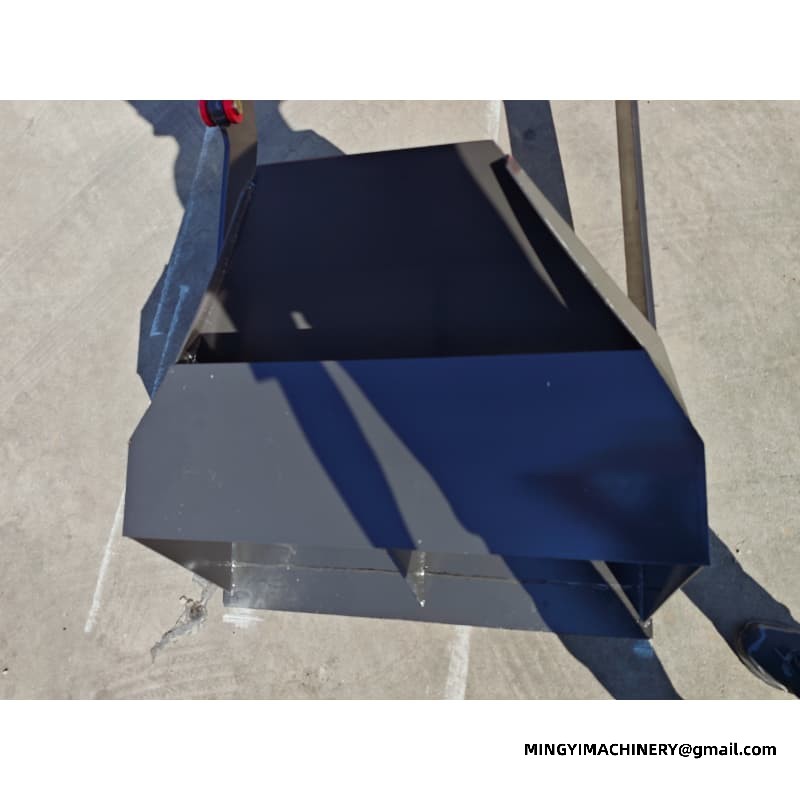
The machine sits squarely in that second case. Small, repeated pours, distant supply, awkward access — work where a transit mixer either refuses the job or charges for the wasted capacity of a part-load.
Crews converting from hand-mixing should expect the savings to arrive in two waves: the obvious one in labour, the quieter one in rework, because batches mixed to a recipe need less patching, less remedial finishing and fewer disputes on rural road work.
The drum wash-out belongs here too — it is listed in the drum section but it is a daily item, not a weekly one. A machine parked clean on rural road work is a machine that starts the next morning without arguments.
Give the walk-round a fixed order and it becomes muscle memory — same start point, same direction, same finish at the drum. Crews that improvise the order skip items; crews that keep the order on rural road work catch everything, every day.
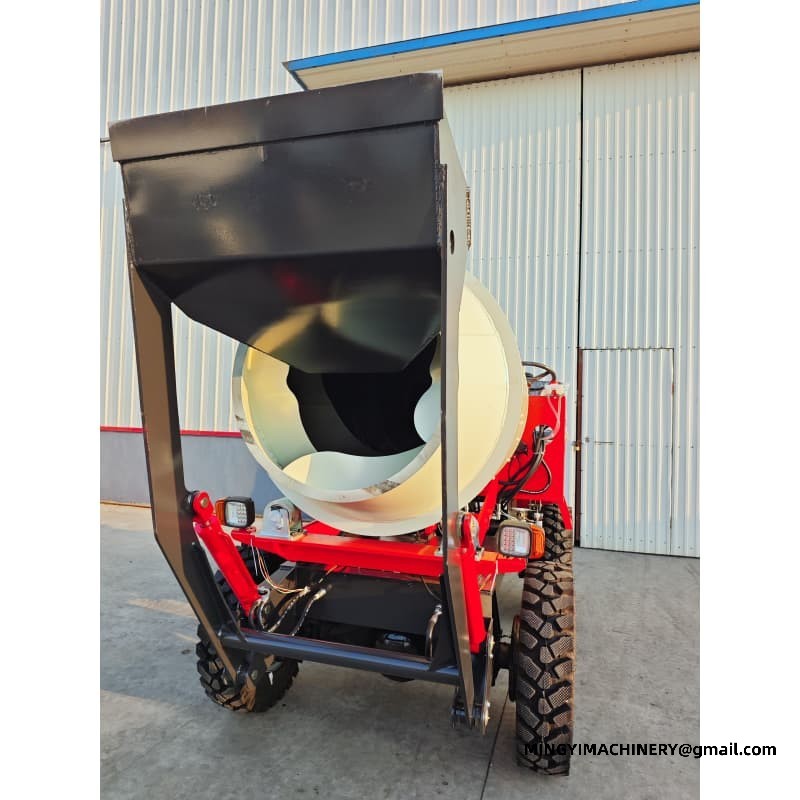
On rural road work, the single-operator loop is the productivity claim that matters. The machine replaces the barrow chain, the hoist and the arguments about whose turn it is to mix, and it does so with the shovel and the drum doing what two labourers used to do.
Those manual moments are short and scheduled, which is why one operator can absorb them. What the machine removes is the continuous heavy labour — shovelling aggregate, turning a drum by handle, barrowing every litre on rural road work.
| Specification extract — 0.8 m³ 4WD self-loading concrete mixer | |
|---|---|
| Rated load | 1,500 kg |
| Rated capacity | 0.8 m³ |
| Overall dimensions (L x W x H) | 3,500 x 1,600 x 2,200 mm |
| Front tyre size | 8.25-16 |
| Rear tyre size | 7.50-16 |
| Minimum ground clearance | 204 mm |
| Steering angle | 28° |
| Turning dimension (outer tyre) | 2,464 mm |
| Maximum travel speed | 24 km/h |
| Transmission | 4WD |
| Gears | 3 forward / 1 reverse + travel gear |
| Front axle | 130 drive axle |
| Rear axle | 212 selectable 4WD steering axle |
| Engine | single-cylinder diesel / 25 hp |
| Steering | hydraulic power steering |
The height figure hides a detail worth checking on hire fleets and after modifications: the envelope assumes the shovel down and the drum level. A raised shovel adds materially to the length, and crews loading onto trailers should measure in travel order.
The frame carries 1,500 kg of payload over a short, wide stance, with the drum mounted low and between the axles rather than overhanging. That geometry is why a machine this size can carry wet concrete at all: the load stays inside the wheelbase where the chassis was drawn to take it.
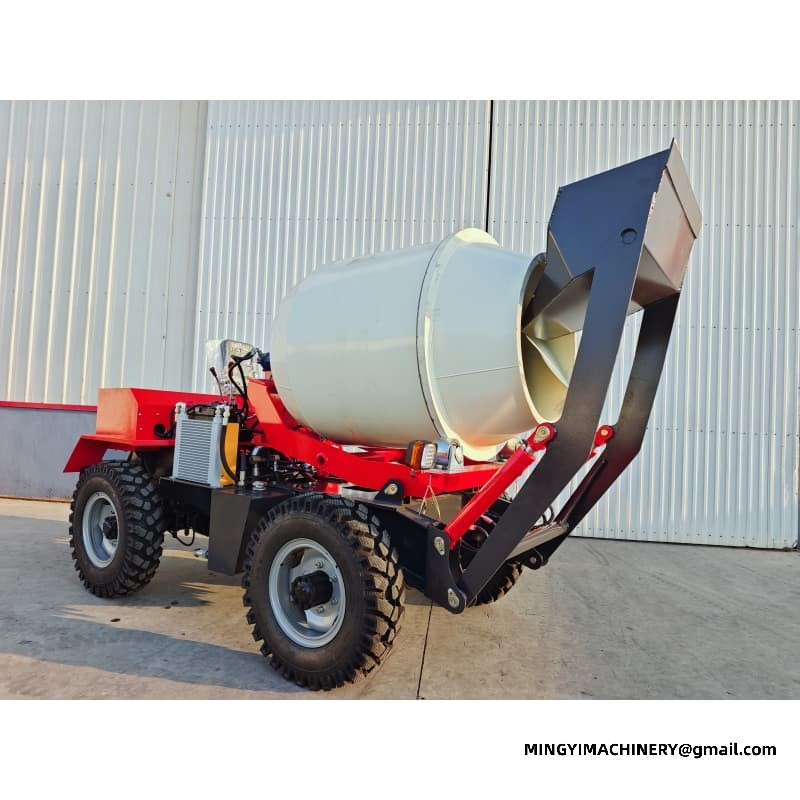
25 hp is modest by highway standards and exactly right for this duty. The machine's work is short, heavy efforts — loading, climbing, tipping — and a small diesel spends most of its day loafing between them, which is where fuel economy and engine life both come from.
Oil changes by the hour meter, not by the calendar — a machine that idles through wet weeks still accumulates hours on the oil. Operators who log the meter at each change on rural road work never guess when the next one is due.
On rural road work, the difference shows on the first wet morning. A two-wheel-drive machine spins and needs towing; this one keeps moving under its own traction with a full 1,500 kg in the drum circuit. Traction is capacity — a mixer that cannot reach the pour has none.
A 28° steering angle on the rear axle turns the machine inside a 2,464 mm circle measured at the outer tyre. Village lanes, orchard rows, basement ramps and gateways all live inside that radius.
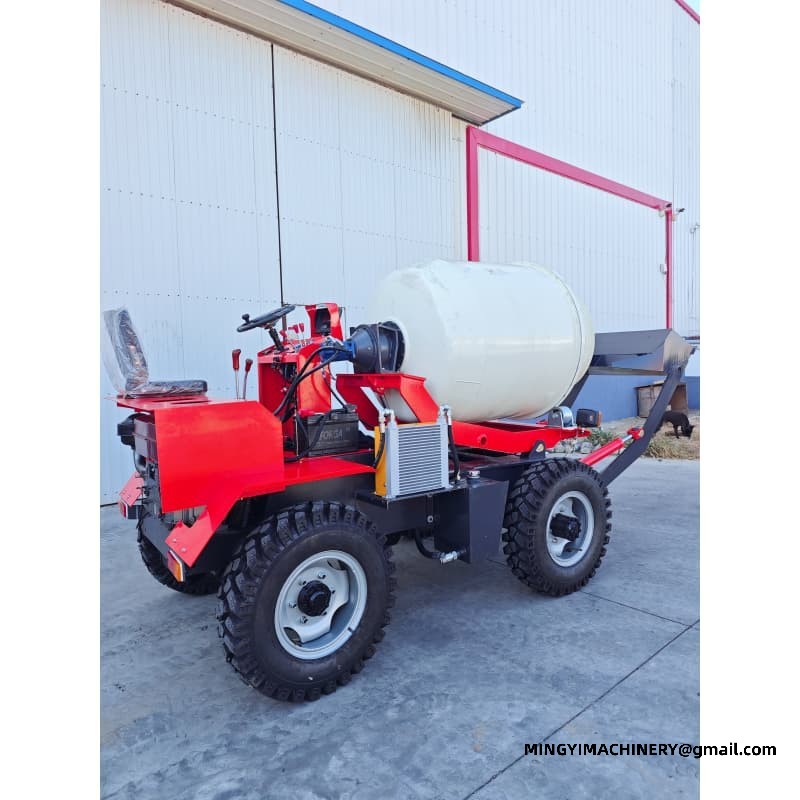
Fix the mix design for culvert, kerb and patching concrete once, write it down, measure the water, count the scoops, time the drum — and the batches on rural road work will be more consistent than most hand-mixed concrete has ever been.
Small jobs rarely cube-test, but simple checks still work: slump by the side-collapse eye, batch weight against the recipe, and a note of what each pour received. Crews that keep a chalkboard of batches trace a weak patch to its cause instead of guessing.
The gear pattern also gives the machine its manners: low gears hold back a loaded drum on descents without riding the brakes, and the travel gear keeps engine speed economical on road sections. Good gearing is invisible until it is missing.
Because discharge happens over the front, the natural approach is to back in: reverse toward the formwork, stop square, tip, and drive away forward without a second manoeuvre. One reverse gear is all this needs, and the 28° rear steer makes the approach line easy to correct.
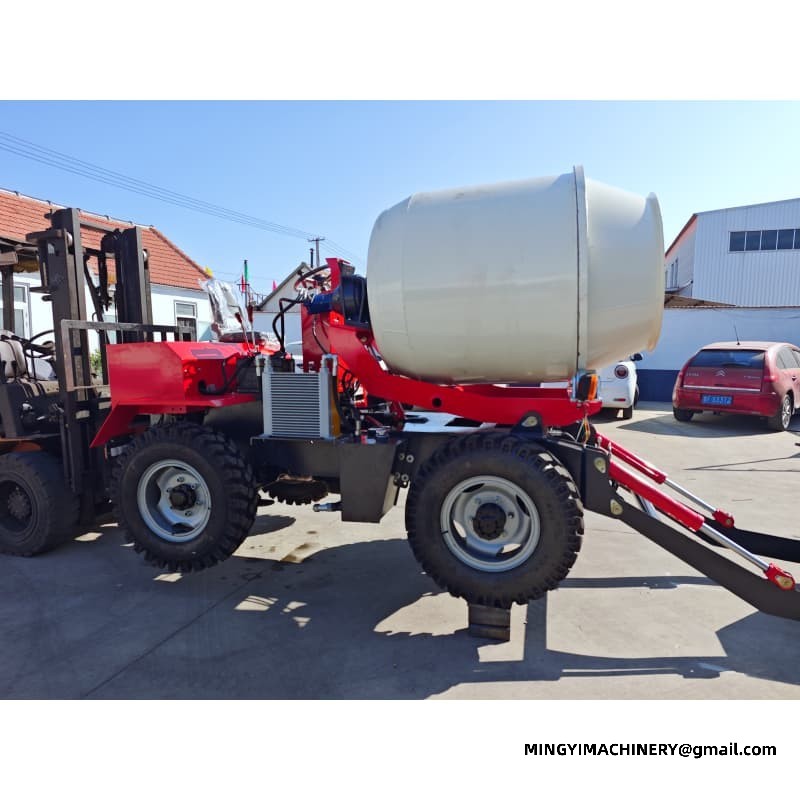
Power steering also matters at the end of a shift. A loaded machine manoeuvring all day on a manual system tires the operator into mistakes; the hydraulic system keeps the last batch as controlled as the first.
What the machine does — reach the pour under its own power, mix to a recipe, place culvert, kerb and patching concrete without a second handling — it does inside those limits, and crews that learn the limits plan around them instead of against them.
The discipline that varies by season is the survey: on rural road work, the ground that holds in March may not hold in November, and the turning circle decides nothing if the approach has turned to mud.
The work it should refuse is the continuous slab and the high-volume pour, where plant supply wins outright. Saying so is the service, and the customer who hears it trusts the next recommendation more, not less.
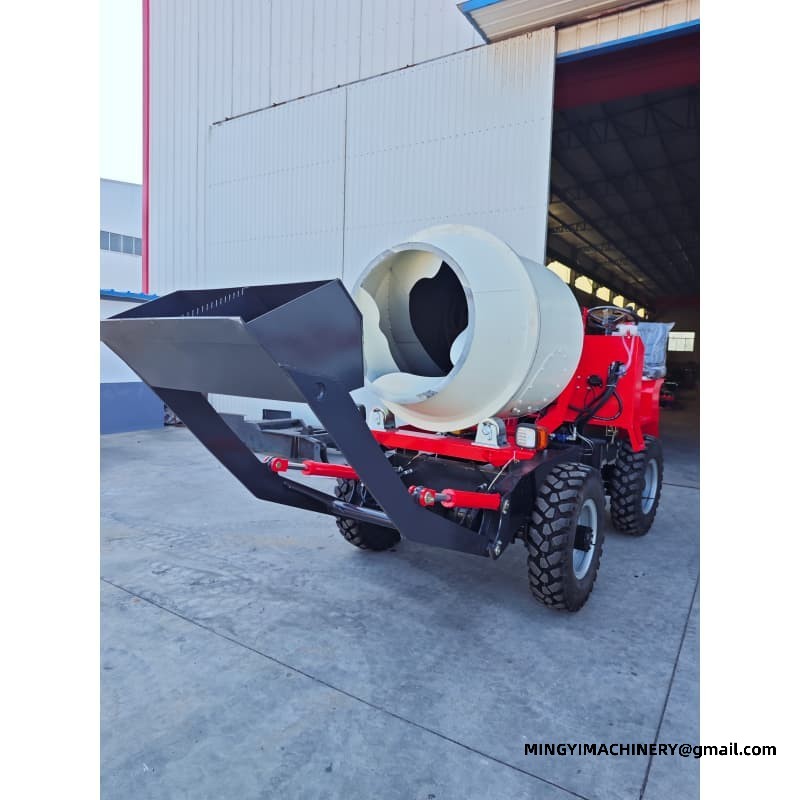
Ask for photographs of the actual unit and its serial plate, not brochure images. The machine is simple enough that a five-minute video call at handover — controls, drum, shovel, axles — answers more than a week of messages.
Order the spares kit against the parts manual's own numbers and file the correspondence with the manual. When the second order goes in a year later on rural road work, the reference numbers make it a two-minute email.
Many fleets run both: transit for the big slabs near town, self-loader for the long tail of small work everywhere else. The two machines rarely compete for the same batch.
Between those poles sits the question worth asking any supplier: what does this pour actually consume per hour? A supplier who answers with the cycle arithmetic — 0.8 m³ per batch, travel time, placing rate — is a supplier worth keeping.
Put the two figures side by side and the machine's day writes itself: 0.8 m³ mixed, 1,500 kg carried, repeated until the pour is fed. Nothing in the specification is bigger than the job needs, and nothing the job needs is missing from the specification.
Output is decided by the cycle, not the drum. Loading the shovel, mixing, travelling and discharging repeat, and the slowest of the four sets the rate. With 0.8 m³ per batch and a short haul, the drum rarely waits; with a long carry at 24 km/h, travel becomes the constraint and the arithmetic changes.
Because rotation and tilt are hydraulic, the operator can hold a partial discharge — trickle into a barrow, stop, move, resume — which no hand-cranked drum offers. That control is worth as much as the 0.8 m³ itself on pours with fussy geometry.
The failure mode is improvisation — an extra scoop here, a splash of water there. Batches of culvert, kerb and patching concrete mixed by eye vary, and the variation shows up as strength scatter in the finished work. A written recipe taped beside the controls takes nothing and fixes most of it.
What axles does the 0.8m3 self loading concrete mixer run?
A 130 drive axle at the front and a 212 rear axle that steers and can be selected into four-wheel drive. The front pulls the load; the rear steers through a 28° angle.
How often should the 0.8m3 self loading concrete mixer air filter be cleaned?
Far more often than the book says in dry conditions. Check it daily by restriction indicator or torch; a blinded filter takes power on every shovel lift.
How close can the 0.8m3 self loading concrete mixer pour to an edge or trench?
The discharge reaches the edge; the wheels should not. Keep the standing spot back from any face, trench or excavation by more than the machine's allowance, and let the drum do the reaching.
What should I confirm before ordering a 0.8m3 self loading concrete mixer?
The specification against the published table — 0.8 m³ capacity, 1,500 kg load, 4WD, 25 hp engine, the 130 and 212 axles — plus what is standard versus optional in your build.
Can a 0.8m3 self loading concrete mixer place concrete around dense rebar?
Yes — the discharge lands where the operator aims it, and a spotter with a shovel and vibrator works the concrete in. Tight rebar changes the placing crew's job, not the machine's.
Can the 0.8m3 self loading concrete mixer charge a concrete bucket or skip?
Yes, where the skip sits within the discharge arc at %s height discipline allows. The drum pours into barrows, buckets or formwork without a second handling.
Does the 0.8m3 self loading concrete mixer need a driving licence?
Depends on your market's rules for site plant versus road use. Where it works inside private sites, site-operator rules apply; regular road travel changes the question.
How do I check quality without a lab when using a 0.8m3 self loading concrete mixer?
Slump by eye against an agreed target, batch weight against the recipe, and a chalkboard record of what each pour received. Structural work still deserves proper cube tests.
Worked on rural road work, the machine pays for itself in the batches it keeps on schedule and the crews it frees from barrow chains. The specification above is the whole story — short, honest and enough to size the decision.
Handover and getting familiar with 0.8m3 Self Loading Concrete Mixer: Batch by Batch
The first day with a new machine sets the pattern for the next five years. Handover for 0.8m3 Self Loading Concrete Mixer: Batch by Batch covers the control layout, the daily check points and the limits the operator needs to know before the first real load is lifted or carried.
Moving 0.8m3 Self Loading Concrete Mixer: Batch by Batch between sites
Securing the load is not optional. Lashing 0.8m3 Self Loading Concrete Mixer: Batch by Batch at the points intended for it, checking the tension before the vehicle moves and rechecking after the first kilometres is standard practice rather than extra care.
Later additions and retrofits on 0.8m3 Self Loading Concrete Mixer: Batch by Batch
Most additions are easier to plan than to add. Hydraulic services, mounting brackets and electrical capacity on 0.8m3 Self Loading Concrete Mixer: Batch by Batch are build items, and deciding them at the specification stage is far easier than doing it later.
Documents that travel with 0.8m3 Self Loading Concrete Mixer: Batch by Batch
Documentation should match the machine that was actually built. The sheet supplied with 0.8m3 Self Loading Concrete Mixer: Batch by Batch records the configuration as delivered, because the generic catalogue description is not what the customer needs when ordering a part.
Contact MINGYI Machinery for the current self-loading concrete mixer specification, export packing and a formal specification for your market. E-mail: sales@mingycn.com | LINE (ID): mingyicn
4WD Self Loading Concrete Mixer: 130 Axle, 212 Steering · 0.8m3 4WD Concrete Truck: Full Table, Honest Limits · custom built all terrain dump truck with hydraulic tipping body · Mini Self-Loading Concrete Mixer









