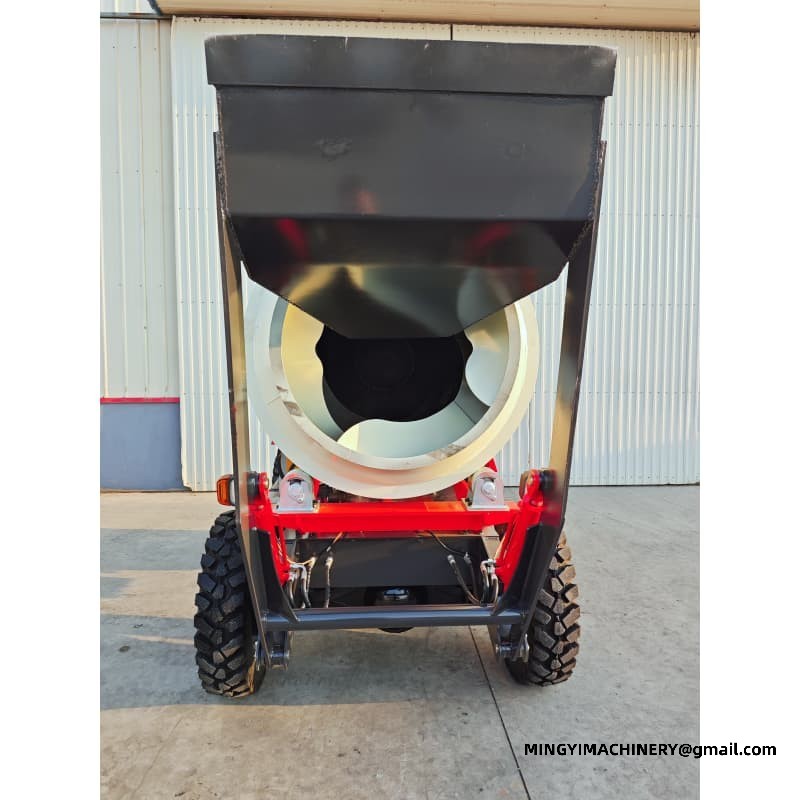
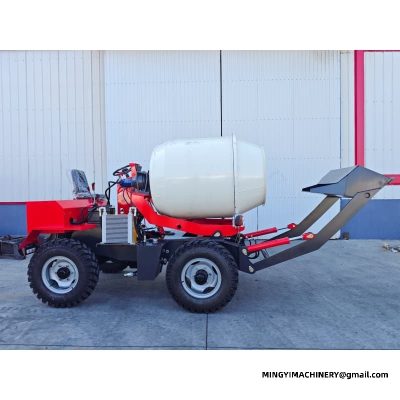
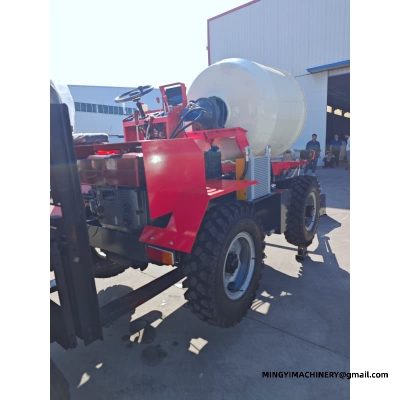
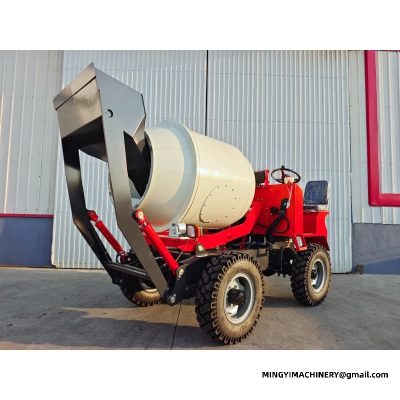
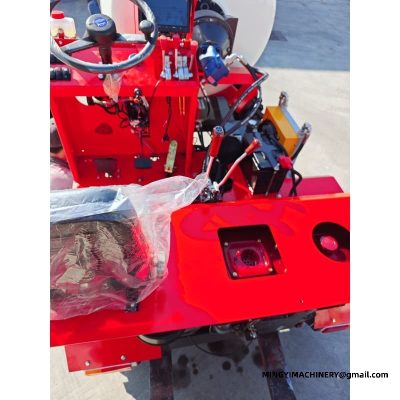
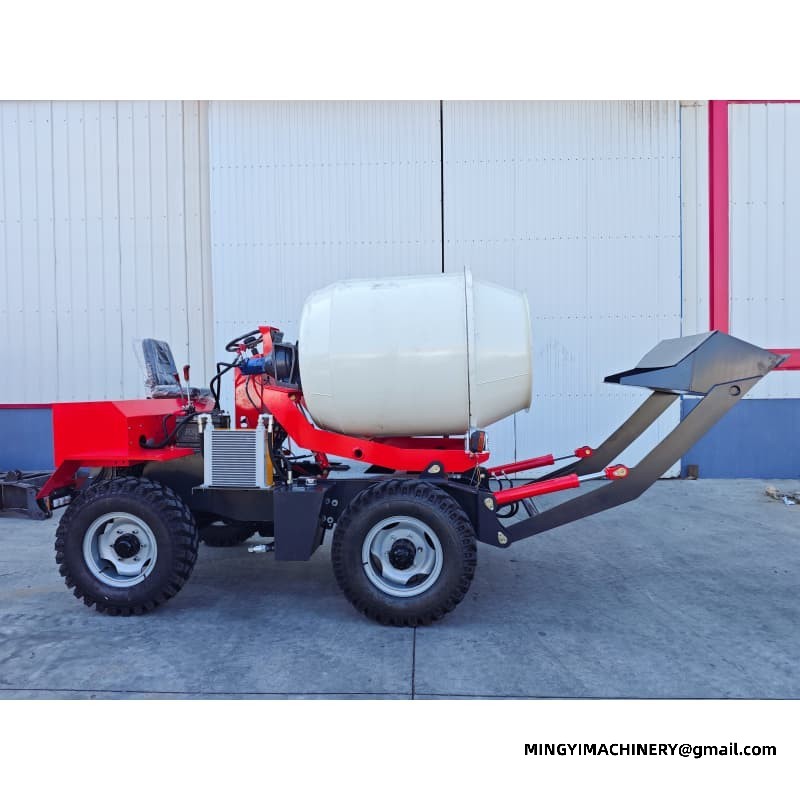
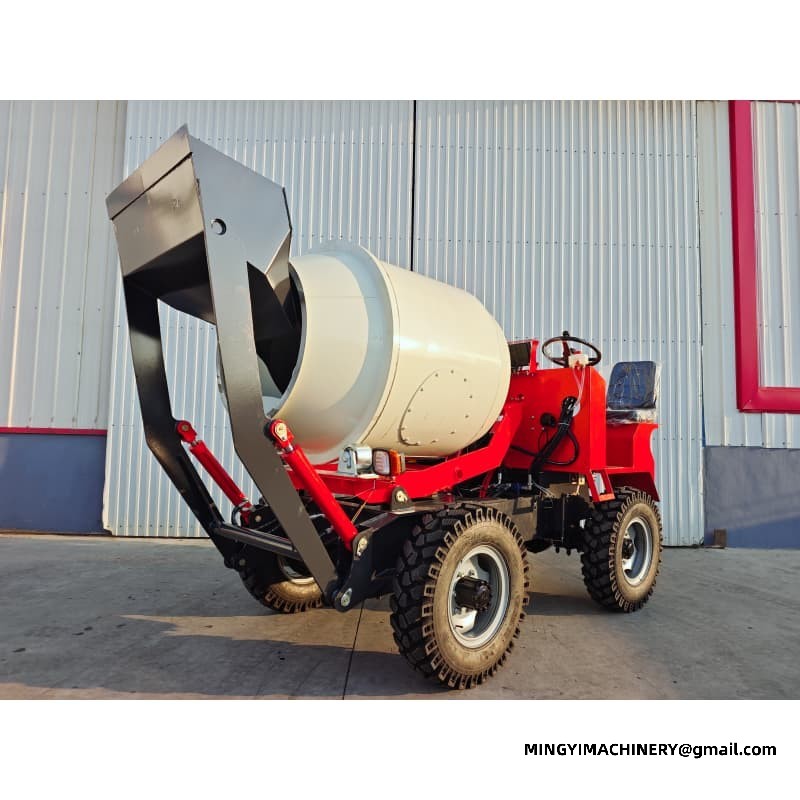
0.8m3 4WD Self Loading Concrete Truck, 0.8m³ 4x4 Concrete Mixer, Mini 4WD Loader
Concrete waits for nobody, and distance kills it. The 0.8m3 4wd self loading concrete truck self-loading mixer exists for pours that happen too far from a batching plant for ready-mix to answer — on plantation work setting posts and small bases far from any plant. At 0.8 m³ per batch and 24 km/h of travel speed, the machine keeps the supply chain inside the site gate, and this page explains the published figures that make that work.
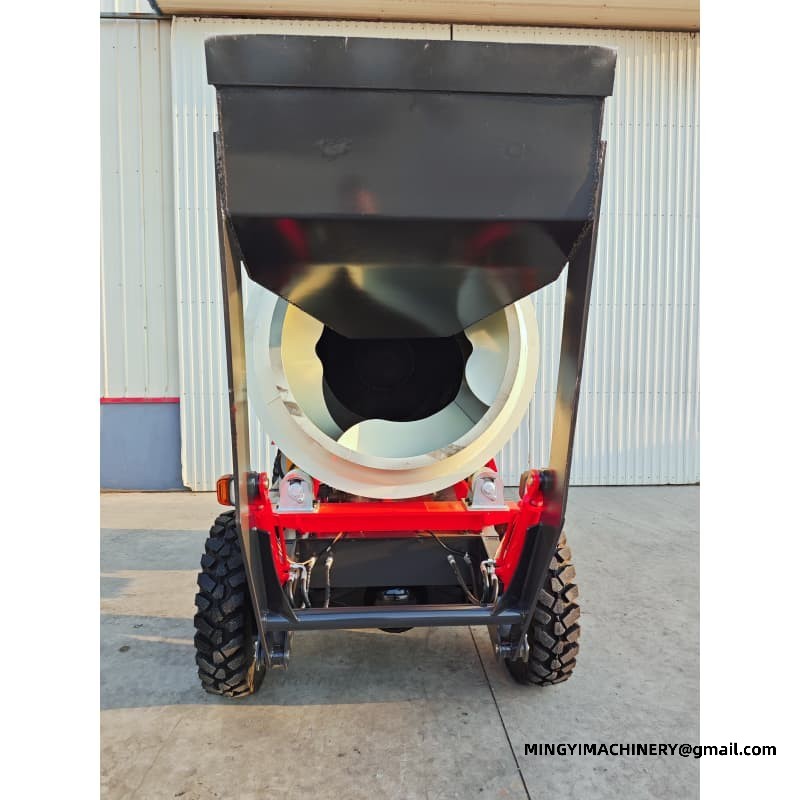
The comparison also holds when ready-mix is available but the pour is small: a part-load minimum pays for concrete nobody placed, while a drum batches exactly what the formwork needs and stops when it stops.
Every batch has three takes: materials, fuel and labour. The machine attacks the third hardest — one operator replaces the barrow chain — and holds the second down with a single-cylinder diesel that sips fuel between cycles. Materials effort what they effort anywhere; the difference is made in labour and logistics.
Put the two figures side by side and the machine's day writes itself: 0.8 m³ mixed, 1,500 kg carried, repeated until the pour is fed. Nothing in the specification is bigger than the job needs, and nothing the job needs is missing from the specification.
The practical advice is to plan pours around the cycle rather than around the clock. A crew that knows each batch of post-hole and shed-base concrete takes a predictable interval can keep formwork continuously fed, which matters more on cold joints than raw volume ever does.
Ownership's real takes are the visible ones: the machine, the spares kit, the fuel, and the operator's time. None is hidden, none is large, and all survive a spreadsheet. The effort that surprises new owners is the working capital tied in stockpiled aggregate and cement — the inputs, not the machine.
Ownership's quiet effort is the inputs — cement, aggregate, water — that must be on hand before the drum can turn. plan them with the machine from day one, because an idle drum takes money while it earns nothing.
| Published build data — 0.8 m³ 4WD self-loading concrete mixer | |
|---|---|
| Rated load | 1,500 kg |
| Rated capacity | 0.8 m³ |
| Overall dimensions (L x W x H) | 3,500 x 1,600 x 2,200 mm |
| Front tyre size | 8.25-16 |
| Rear tyre size | 7.50-16 |
| Minimum ground clearance | 204 mm |
| Steering angle | 28° |
| Turning dimension (outer tyre) | 2,464 mm |
| Maximum travel speed | 24 km/h |
| Transmission | 4WD |
| Gears | 3 forward / 1 reverse + travel gear |
| Front axle | 130 drive axle |
| Rear axle | 212 selectable 4WD steering axle |
| Engine | single-cylinder diesel / 25 hp |
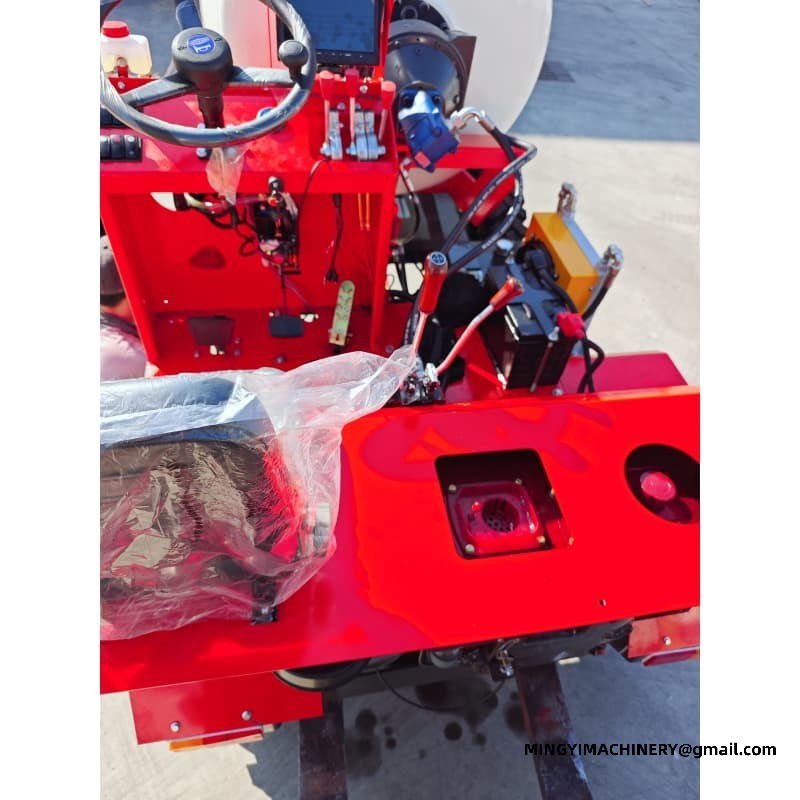
| Steering | hydraulic power steering |
204 mm also sets the maintenance floor: axle drain plugs, the gearbox sump and the hydraulic filter all live above that line, and none of them wants to meet a rock. The clearance is a working figure, not a styling choice.
Pressure discipline matters on soft ground. Tyres run too hard cut into wet surfaces and lose the footprint that floats the machine; run at correct pressure, the four contact patches plus 1,500 kg of payload stay within what most prepared sites bear.
plan service against hours too. Oil, filters and greasing key off the meter, and a machine worked hard in a season reaches its first major check sooner than a machine worked occasionally. The meter tells the truth either way.
The hour meter is the honest tally, not the calendar. A drum that cycles every few minutes in a short shift earns more than a machine that waits between batches, and the meter says which one yours was.
The design is deliberately conventional. Open-centre hydraulics of this pattern are understood by every agricultural mechanic, and hoses, seals and spool valves are stock items almost everywhere the machines are sold.
Oil changes on schedule effort little; contamination failures effort a week. The machines that last are the ones whose operators wipe every filler cap before opening it, every time.
Fix the mix design for post-hole and shed-base concrete once, write it down, measure the water, count the scoops, time the drum — and the batches on plantation work will be more consistent than most hand-mixed concrete has ever been.
Keep a few cubes from the important pours even on small jobs — a shoebox-sized mortar tin makes a serviceable mould in a pinch, and six months later the evidence settles every argument about the batch.
On larger sites the profile widens: an operator plus a spotter at the discharge, plus whoever feeds the cement and measures the water. The machine still needs one trained person; it simply stops needing a barrow chain behind them.
Fleets that standardise on a small number of such machines report lower training overhead and fewer breakdown escalations than mixed fleets of larger, more complex plant. The simplicity is the business case, not a compromise.
Rural road work, irrigation canals, farm buildings, village housing and small precast all sit inside that band. Each needs post-hole and shed-base concrete in quantities a plant would refuse and a shovel alone would take all day to supply.
On compact projects the mixer becomes shared infrastructure: it serves the foundation crew in the morning, the masonry crew after lunch, and the patching gang at day's end. Ownership of the machine matters less than the batching discipline each crew inherits.
Report faults honestly and in time. A small hydraulic weep described in a photograph reaches the right seal before it becomes a failed hose on a pour day, and crews that communicate get parts that fit the first time.
Document the commissioning in the service book. The checklist protects the warranty and gives the next operator a known starting point, and the habit takes nothing the moment it is begun.
The shovel's geometry deserves a sentence of its own: it loads from in front of the drum, so the machine stands facing its stockpile and drives away facing the pour. No reversing into position, no second alignment, and the whole cycle on plantation work keeps one direction of travel.
Inspection is a two-minute weekly job: pins, teeth or cutting edge, and the two hoses that flex with every lift. Caught early, a weeping fitting or a worn bushing is a teatime repair; left alone, it becomes a pour-day stoppage on plantation work.
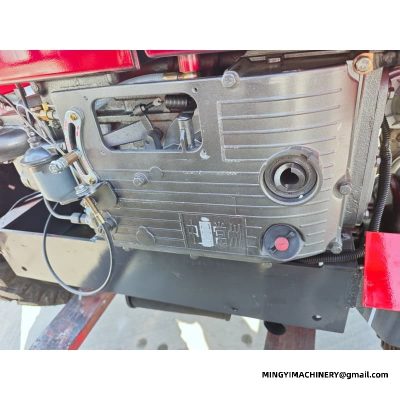
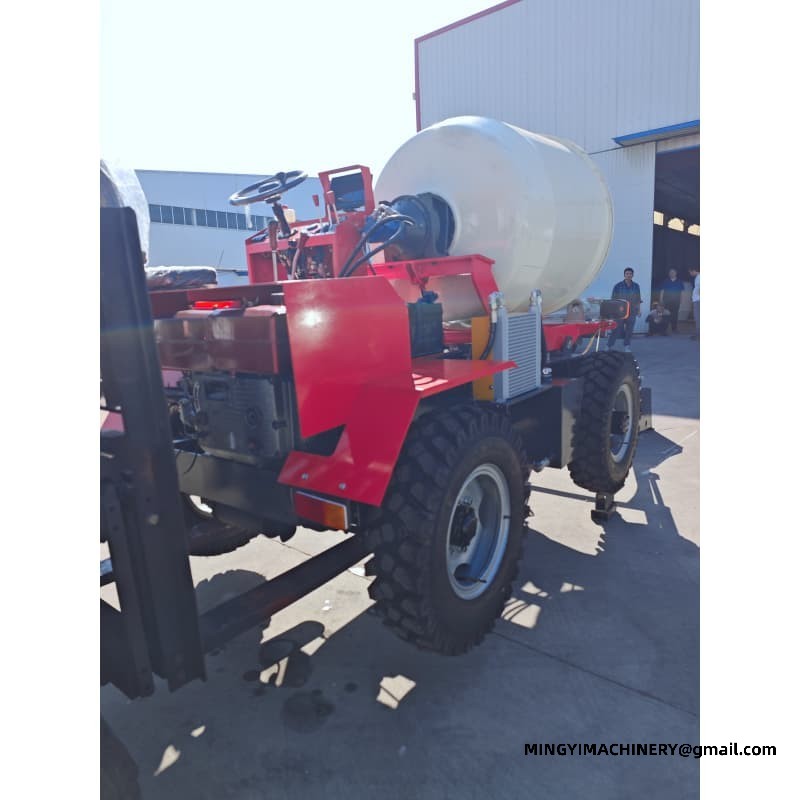
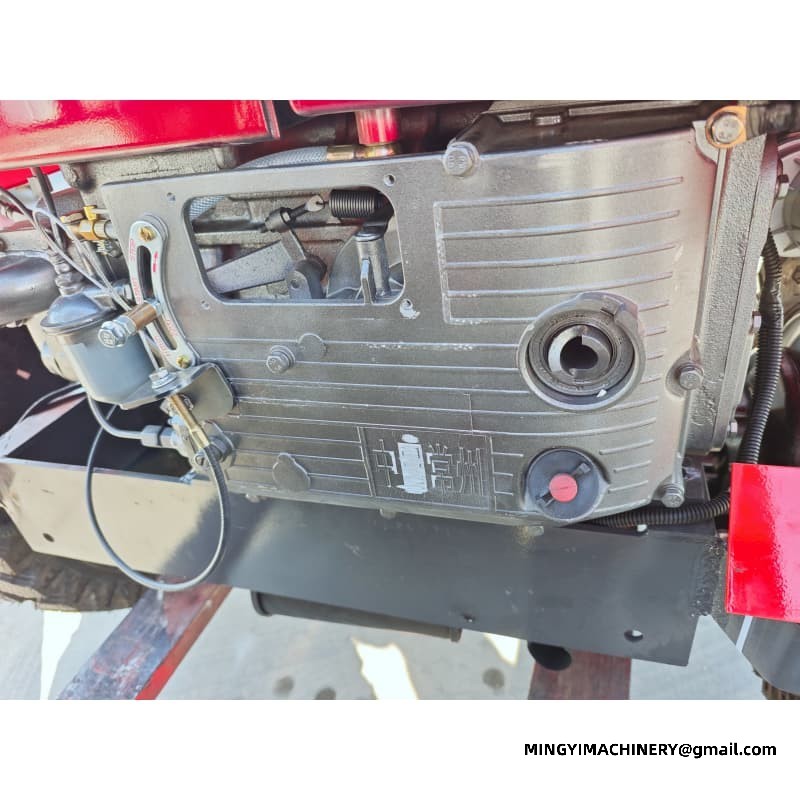
The engine line — single-cylinder diesel, 25 hp — is a maintainability statement more than a performance one. Single-cylinder diesel of this pattern is serviced anywhere, started by a mechanic who has seen one before, and rebuilt on a bench. A higher number would not help a machine that works where dealerships are days away.
The 130 front drive axle and 212 rear steering axle are named because they are standard agricultural patterns, and that naming is part of the durability case. Bearings, seals, hubs and crown wheels for both exist wherever tractors are sold.
Agree the acceptance test before the deposit: drum turns both ways, shovel lifts and holds, steering reaches full lock, and the machine travels in every gear. Thirty minutes at handover prevents the kind of dispute that outlives the purchase.
A short commissioning routine protects the warranty and the pour schedule alike. Most early faults reported on exported machines trace to skipped first-service basics rather than to the machine itself.
The height figure hides a detail worth checking on hire fleets and after modifications: the envelope assumes the shovel down and the drum level. A raised shovel adds materially to the length, and crews loading onto trailers should measure in travel order.
Shovel-up travel is the one posture that moves weight forward sharply. The operator carries the shovel low and the drum level, on plantation work, and the machine handles exactly as the geometry promises.
What engine does the 0.8m3 4wd self loading concrete truck use?
A single-cylinder diesel rated at 25 hp. It drives the transmission, drum and hydraulics, and it services with filters and oil a general mechanic already stocks.
Is the 0.8m3 4wd self loading concrete truck suitable for farm work?
Very much — post holes, shed bases, paths and small structures on plantation work are exactly the small, distant batches the machine was drawn for.
What should I check on day one with a 0.8m3 4wd self loading concrete truck?
Fluids, tyre pressures, drum rotation both directions, shovel lift, steering full lock, and the wash-out routine before the first batch sets. The commissioning checklist in the manual covers each.
What gears does the 0.8m3 4wd self loading concrete truck have?
Three forward, one reverse, plus a travel gear for road moves between sites. First and second cover loading and hauling on plantation work.
A 0.8m3 4wd self loading concrete truck hydraulic hose burst mid-pour — what now?
Contain the spill, replace with the correct rating, and refill with clean filtered oil. This is exactly why hoses and clamps belong in the spares kit that travels with the machine.
Can I inspect my 0.8m3 4wd self loading concrete truck before it ships?
Ask for photographs and a running video of your actual unit with its serial plate, or a third-party pre-shipment inspection. Suppliers who refuse the request are answering it.
Is a 0.8m3 4wd self loading concrete truck the same as a pan mixer?
No. A pan mixer blends in a stationary vertical pan; this machine mixes in a rotating drum and carries the batch to the point of placement. For dispersed small pours, the drum type wins.
Is the 0.8m3 4wd self loading concrete truck suitable for plant-hire fleets?
It is a natural hire asset: simple controls, single-operator working, and a specification small fleets can describe to any customer in one page.
Batched to demand, placed under its own power and maintained in five minutes a day, the machine replaces the small-plant overhead that most small pours never needed in the first place.
Pre-delivery inspection before the concrete mixer leaves the shop
Inspection is a list, not a glance. Before this class of machine is released the fluid levels, belt tension, electrical connections and safety decals are each ticked off, and anything that fails stays in the shop rather than travelling with the machine.
Handover and getting familiar with the unit in daily use
Familiarisation is not the same as reading the manual. Sitting on a machine of this size, working through the controls at low speed and learning where the machine balances takes an hour, and that hour is what keeps the first week uneventful.
Later additions and retrofits on the equipment on site
Retrofitting is limited by the base machine. Before anything is added to the machine itself the hydraulic flow, the mounting interface and the stability allowance have to be checked, because those limits are what decide what is sensible.
Fuel, oil and fluid quality for the model in question
Contamination is easier to prevent than to cure. Keeping the filler caps sealed, the funnels clean and the containers closed around the machine in that duty is unglamorous work that shows up as reliability later.
Documents that travel with the unit on the job
Documentation should match the machine that was actually built. The sheet supplied with a machine built for the work records the configuration as delivered, because the generic catalogue description is not what the customer needs when ordering a part.
Packing, loading and shipment of the equipment in service
Export packing is part of the machine, not an afterthought. The concrete mixer is blocked and braced inside the container so that it arrives in the same condition it left, and the load plan is decided by the dimensions rather than by what fits loosely.
Contact MINGYI Machinery for the current self-loading concrete mixer specification, export packing and a formal specification for your market. E-mail: sales@mingycn.com | LINE (ID): mingyicn
Small Diesel 0.8m3 Concrete Mixer: litres, Filters and Life · 0.8m3 Rough Terrain Mixer: Ground Rules Before the Pour · durable off road cargo transporter with hydraulic tipping body · Mini Self-Loading Concrete Mixer









