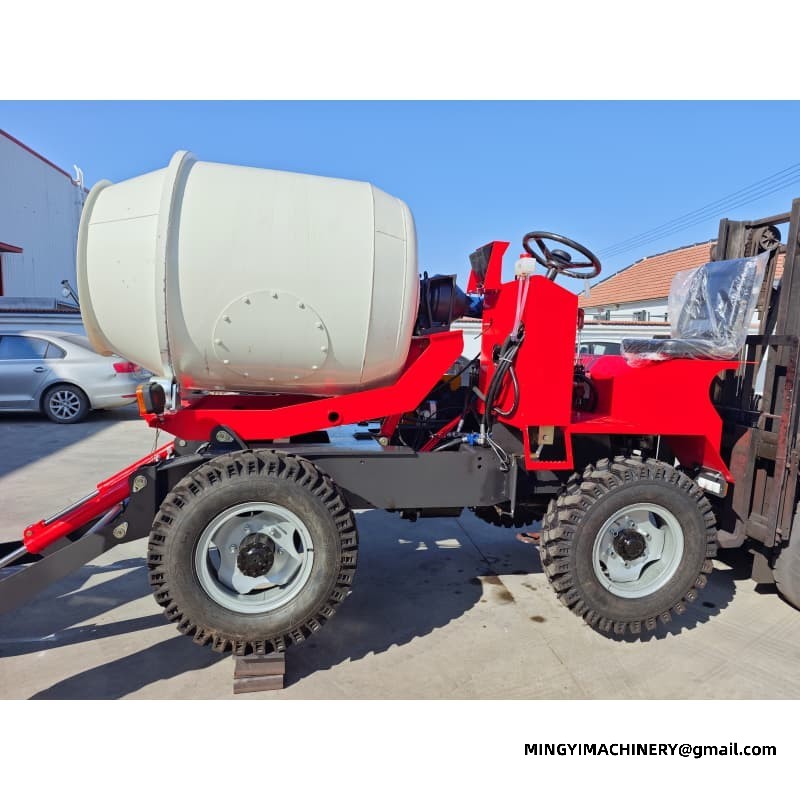
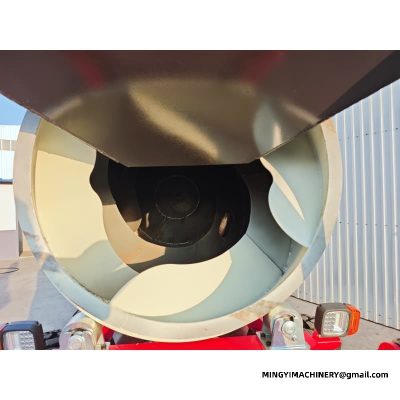
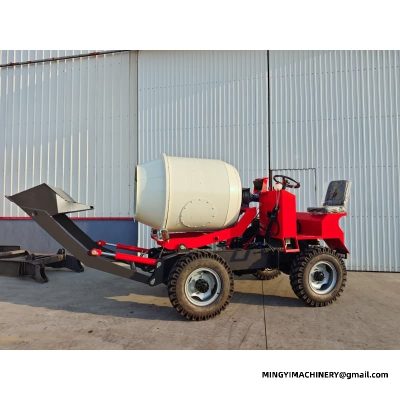
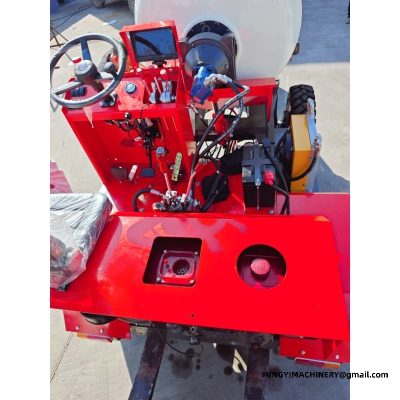
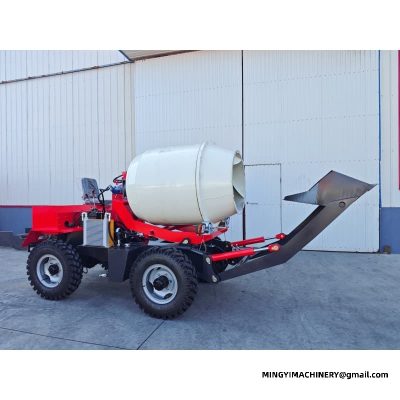
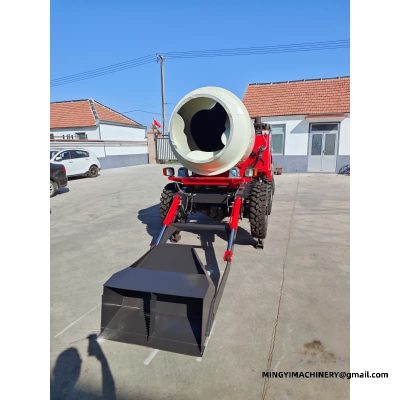
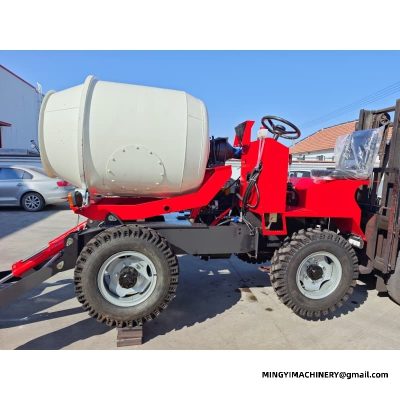
Small Diesel 0.8m3 Concrete Mixer, Diesel Powered 0.8m³ Self Loader, Diesel Mixer
The published table on a small diesel 0.8m3 concrete mixer is short, and every line on it is a decision. 0.8 m³ capacity, 1,500 kg rated load, 3,500 x 1,600 x 2,200 mm overall, 4WD through a 130 axle with a 212 steering axle behind. This page takes those lines one at a time and reads them the way a crew meets them: loading, mixing, hauling and discharging in orchard pathways.
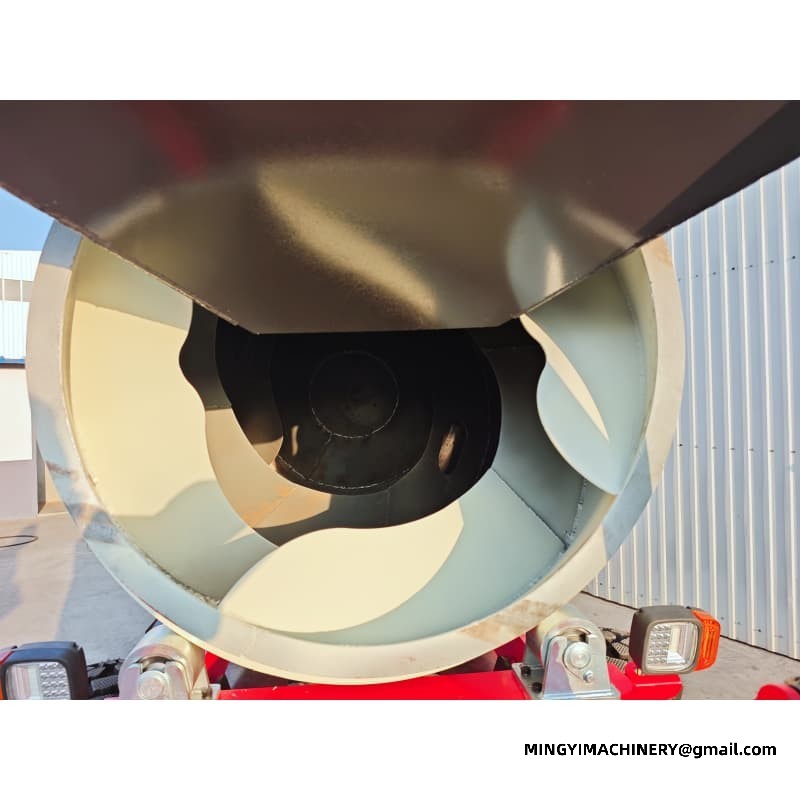
Keep additions within the machine's published limits. A chute that adds reach also adds discharge height; a skip that adds capacity also adds the weight the chassis must carry. The 1,500 kg rating still governs the lot.
If the job genuinely needs more machine, the answer is a larger model, not a modified small one. The published figures describe a 1,500 kg machine; they do not describe one that has been altered, and no safety judgement survives the alteration.
The comparison also holds when ready-mix is available but the pour is small: a part-load minimum pays for concrete nobody placed, while a drum batches exactly what the formwork needs and stops when it stops.
Crews that specification work this way stop comparing the machine with a bigger drum and start comparing it with the wages of the people it replaces. Over a season, the comparison is not close.
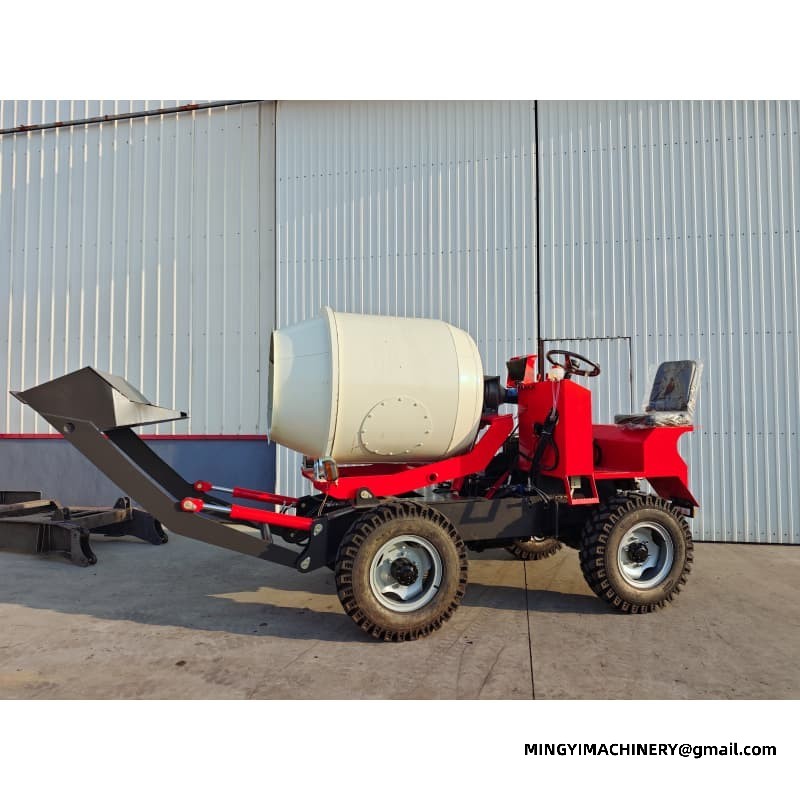
Agree the acceptance test before the deposit: drum turns both ways, shovel lifts and holds, steering reaches full lock, and the machine travels in every gear. Thirty minutes at handover prevents the kind of dispute that outlives the purchase.
Check the machine against its own plate on arrival — serial number, axle stamps, drum casting — and photograph everything before signing the carrier's release. Transit claims have deadlines, and they are shorter than anyone expects.
| Specification extract — 0.8 m³ 4WD self-loading concrete mixer | |
|---|---|
| Rated load | 1,500 kg |
| Rated capacity | 0.8 m³ |
| Overall dimensions (L x W x H) | 3,500 x 1,600 x 2,200 mm |
| Front tyre size | 8.25-16 |
| Rear tyre size | 7.50-16 |
| Minimum ground clearance | 204 mm |
| Steering angle | 28° |
| Turning dimension (outer tyre) | 2,464 mm |
| Maximum travel speed | 24 km/h |
| Transmission | 4WD |
| Gears | 3 forward / 1 reverse + travel gear |
| Front axle | 130 drive axle |
| Rear axle | 212 selectable 4WD steering axle |
| Engine | single-cylinder diesel / 25 hp |
| Steering | hydraulic power steering |
The drum wash-out belongs here too — it is listed in the drum section but it is a daily item, not a weekly one. A machine parked clean in orchard pathways is a machine that starts the next morning without arguments.
Weekly: grease the shovel pins and the steering linkage, check belt tension, inspect hoses for chafe where the shovel flexes them. Monthly: engine and hydraulic oil sampling or change by the book, drum blade inspection, and a torque check on the wheel nuts and shovel mounting.
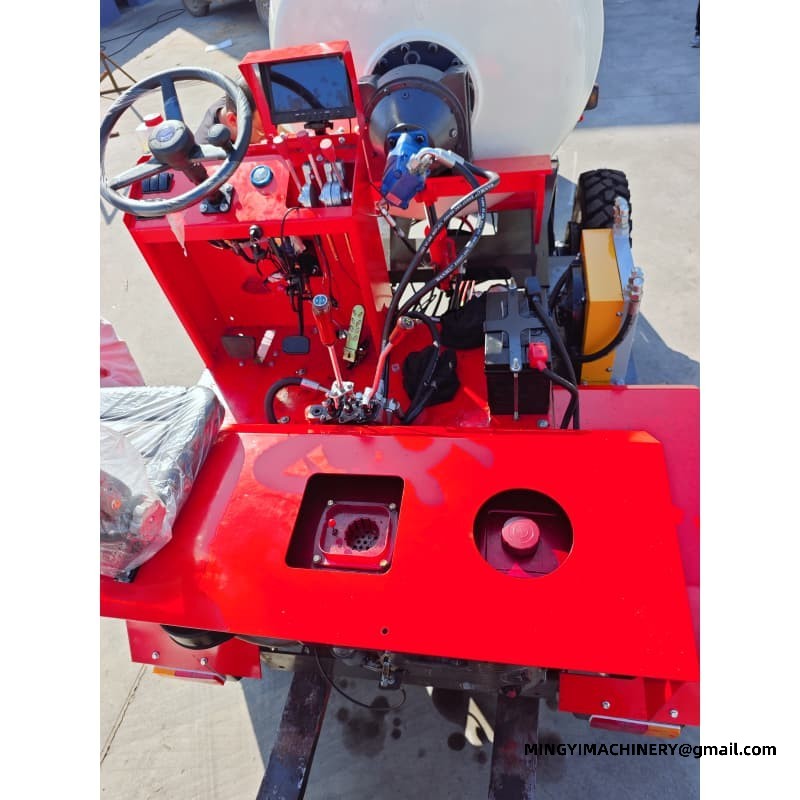
The height figure hides a detail worth checking on hire fleets and after modifications: the envelope assumes the shovel down and the drum level. A raised shovel adds materially to the length, and crews loading onto trailers should measure in travel order.
The frame's load path is short and visible: drum to subframe to chassis rails to axles, with no outriggers and no overhang to manage. That simplicity is why the machine tolerates rough hauls in orchard pathways and why its frame rarely fatigues.
plan the inputs with the machine, not after it. A drum that sits idle because the cement ran out is a drum that takes money while earning none, and the discipline of stocking ahead is part of owning well.
The machine's resale case is its simplicity: a buyer can see the drum, the axles and the engine in a walk-round, and the service book tells the rest. Machines with records, straight shovels and clean drums sell within days in most markets.
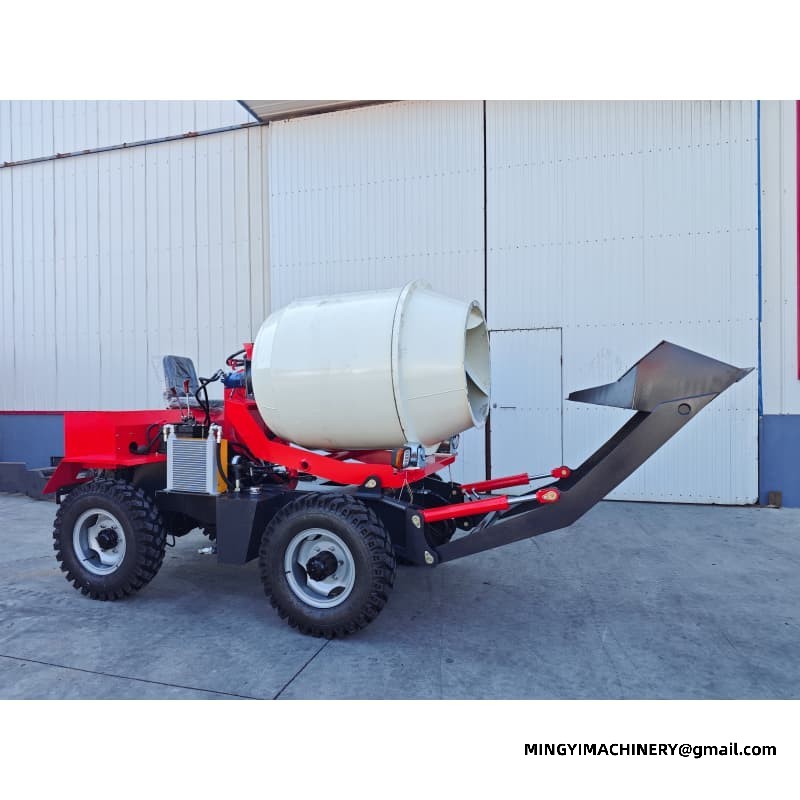
The design is deliberately conventional. Open-centre hydraulics of this pattern are understood by every agricultural mechanic, and hoses, seals and spool valves are stock items almost everywhere the machines are sold.
Keep the filler breather and the reservoir cap clean enough to eat from. On dusty sites in orchard pathways, more hydraulic systems are killed by a dirty funnel than by a thousand hard hours.
The machines that age well are washed and greased on schedule; the machines that age badly are the ones where wash-out slipped and dust won. Nothing exotic — just the daily five minutes, kept.
Second owners buy the same habits the first owner had — the wash-out record, the greased pins, the straight shovel. Machines change hands quickly in this class precisely because so much of their condition is visible at a walk-round.
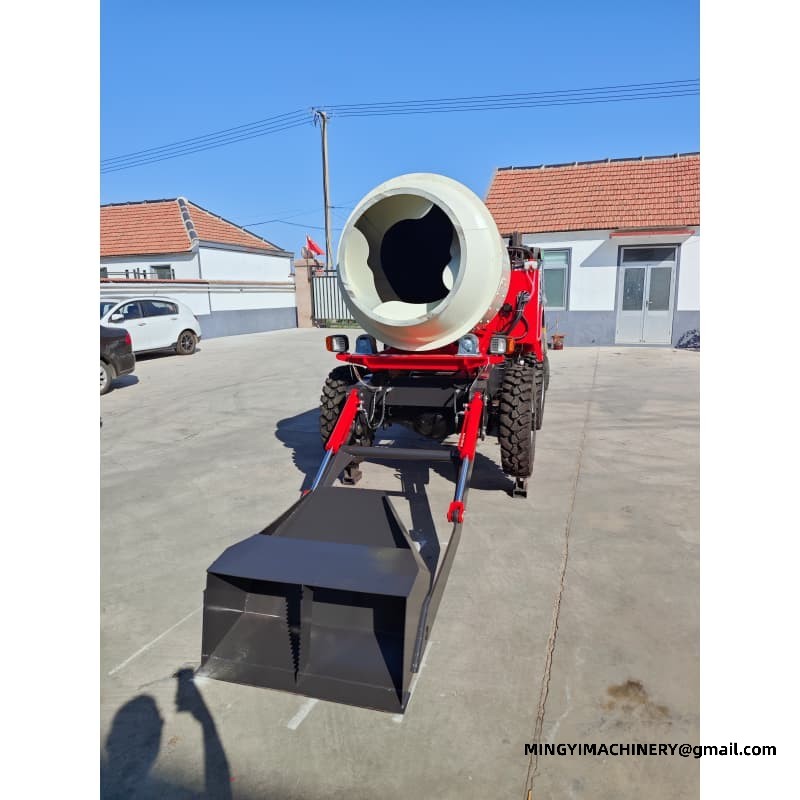
The first week should include one empty drum deliberately: let the new operator feel the 28° rear steer, the 2,464 mm circle and the stopping distance without a live load aboard. Familiarity earned empty arrives safely loaded.
Measured water, counted scoops, timed drum, slow turns, low shovel in transit, wash-out before the break. Six habits cover nearly all of the machine's reliability and every one of its safety rules.
Keep the pairs matched left to right and the pressures even, because uneven fronts put the machine slightly out of square and the steering fights it all day. Tyres are the simplest component to treat well and the most lengthy to ignore.
Catch the patterns early and the fix is pressure, route or habit. Catch them late and the fix is four new tyres plus the downtime to fit them.
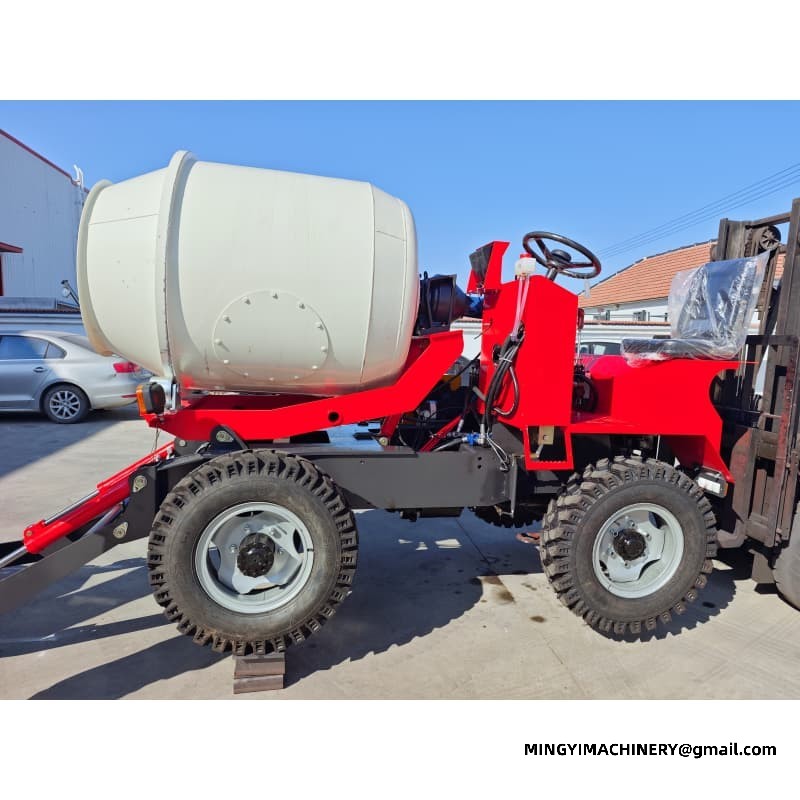
Put the two figures side by side and the machine's day writes itself: 0.8 m³ mixed, 1,500 kg carried, repeated until the pour is fed. Nothing in the specification is bigger than the job needs, and nothing the job needs is missing from the specification.
Crews that log batches for a week know their true rate, and the log is worth more than any brochure promise. The machine's contribution is regularity: the drum turns at the same speed whether it is the first batch of the morning or the fortieth, in orchard pathways.
The discipline that varies by season is the survey: in orchard pathways, the ground that holds in March may not hold in November, and the turning circle decides nothing if the approach has turned to mud.
The machine suits the small structural pour and the non-structural one beside it — bases, posts, paths, kerbs — all in 0.8 m³ batches the crew handles without a second plant. It should decline the continuous slab, where supply wins outright.
Steering effort drops to nothing at crawl speed, which is precisely when a loaded machine needs precision. The 28° rear steer responds proportionally, so the wheel's first inch means a small correction and the last inch means the full lock.
2,464 mm at the outer tyre is the figure that decides where the machine can work. It turns inside estate gateways, between fence posts, along canal towpaths and through basement ramps that stop ordinary site trucks.
The engine line — single-cylinder diesel, 25 hp — is a maintainability statement more than a performance one. Single-cylinder diesel of this pattern is serviced anywhere, started by a mechanic who has seen one before, and rebuilt on a bench. A higher number would not help a machine that works where dealerships are days away.
List the axle numbers on the same sheet as the engine numbers. A machine whose running gear is stocked regionally is a machine that spends its life working instead of waiting, and the difference shows up in the uptime over a season in orchard pathways.
The shovel reaches a pile close to the front wheels, so the stockpile layout decides how fast a batch assembles. Keep aggregate and sand within a shovel's reach of the machine's standing position and the drum fills in seconds rather than minutes.
A tidy pile also protects the mix. Contamination from ground spoil is the usual cause of weak batches on sites that store material directly on soil; a hardened standing area takes little and keeps path and drainage concrete honest from the first scoop.
What hydraulic oil does the small diesel 0.8m3 concrete mixer take?
The grade specified in the manual, kept clean and changed by the hour meter. Wipe every filler cap before opening it — dust, not hours, kills most site hydraulics.
Does the small diesel 0.8m3 concrete mixer come with a manual?
Ask for the operator and parts manuals with the machine, in your language where available, and check the parts references match what you will be ordering later.
My small diesel 0.8m3 concrete mixer steering whines when cold — is that normal?
It is the sound of thick hydraulic oil, not a fault. Warm the circuit with light cycling before the first shovel lift; persistent noise when warm, however, needs a hose or suction check.
How often do small diesel 0.8m3 concrete mixer shovel pins need greasing?
Weekly under normal work, daily in dust or mud. Grease is simple; the pins and bushings it protects are the shovel's whole wearing life.
How much does a small diesel 0.8m3 concrete mixer effort?
Specification depends on market, options and freight, so it is stated rather than published. E-mail sales@mingycn.com or LINE (ID): mingyicnfor a formal specification for your port.
What tyre pressures should a small diesel 0.8m3 concrete mixer run?
The pressures in the manual, kept even left to right. Too hard cuts into wet ground and shrinks the footprint; too soft overheats the sidewall under a full drum.
How is visibility from the small diesel 0.8m3 concrete mixer seat?
The open station sees the shovel, the drum lip and the discharge point directly — no camera dependence. A spotter still covers the reversing approach at busy pours.
When does a small diesel 0.8m3 concrete mixer stop making sense?
Where ready-mix is close and pours are large, where access is narrower than the machine, or where work happens at height or reach no wheeled mixer can serve. Other tools win those.
Small pours, distant sites and awkward access are exactly where this machine was drawn to work. Where the job matches that shape, the published table is all the sales argument needed.
Fuel, oil and fluid quality for Small Diesel 0.8m3 Concrete Mixer: litres, Filters and Life
Fluid quality is a storage problem before it is a machine problem. Water and sediment in a drum will find the injection system of Small Diesel 0.8m3 Concrete Mixer: litres, Filters and Life eventually, and a settling period is nothing compared with a pump.
Planning the season around Small Diesel 0.8m3 Concrete Mixer: litres, Filters and Life
Workload is rarely even across the year, and the machine should be specified for the busy weeks. A Small Diesel 0.8m3 Concrete Mixer: litres, Filters and Life sized only for the average month will be the limiting factor exactly when the work is worth the most.
Moving Small Diesel 0.8m3 Concrete Mixer: litres, Filters and Life between sites
Travel time is not working time, and it should be planned as its own item. The hours spent moving Small Diesel 0.8m3 Concrete Mixer: litres, Filters and Life between jobs are hours not worked, and a trailer that matches the machine reduces them every single trip.
Reading the early symptoms on Small Diesel 0.8m3 Concrete Mixer: litres, Filters and Life
The symptom is usually not at the fault. A hydraulic function that has become sluggish on Small Diesel 0.8m3 Concrete Mixer: litres, Filters and Life may point to a filter, a relief setting or a pump, and starting with the simple checks avoids the wrong guess.
Storage and long idle periods for Small Diesel 0.8m3 Concrete Mixer: litres, Filters and Life
The battery and the fuel are the first things to suffer in storage. Preparing Small Diesel 0.8m3 Concrete Mixer: litres, Filters and Life properly at the start of the idle period avoids the flat battery and the contaminated tank that greet an unprepared machine.
Contact MINGYI Machinery for the current self-loading concrete mixer specification, export packing and a formal specification for your market. E-mail: sales@mingycn.com | LINE (ID): mingyicn
0.8m3 Rough Terrain Mixer: Ground Rules Before the Pour · Front Loading 0.8m3 Concrete Mixer: Shovel Discipline · 4x4 off road dumper working on site with hydraulic tipping body · Mini Self-Loading Concrete Mixer









