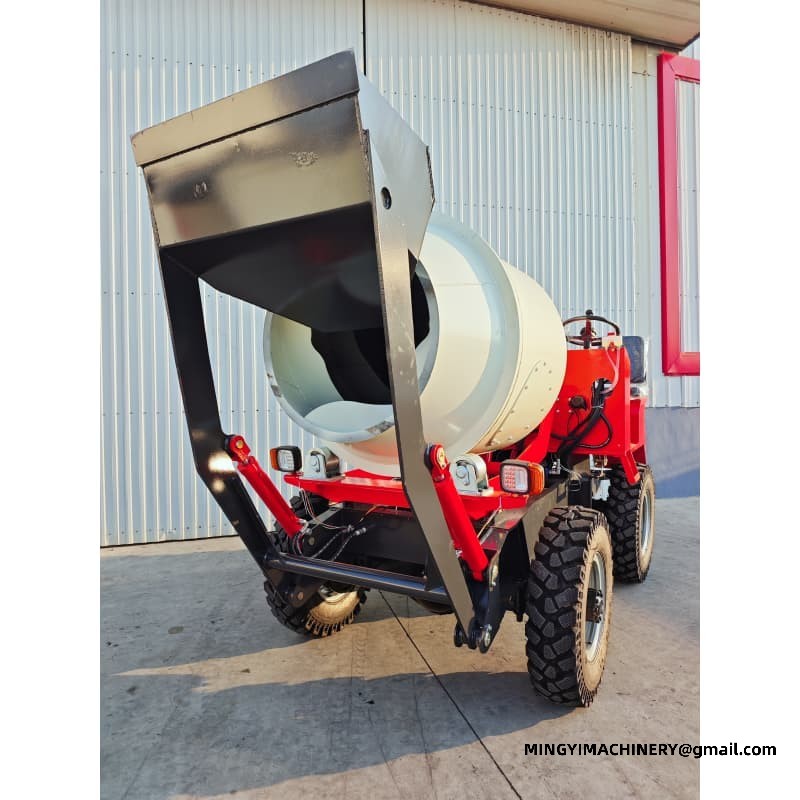
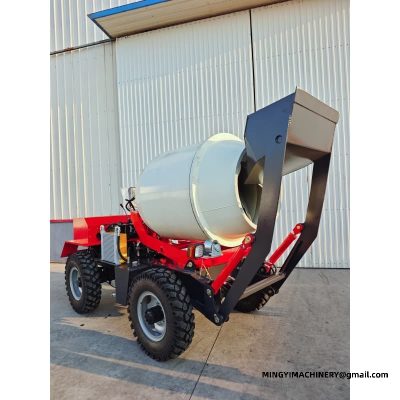
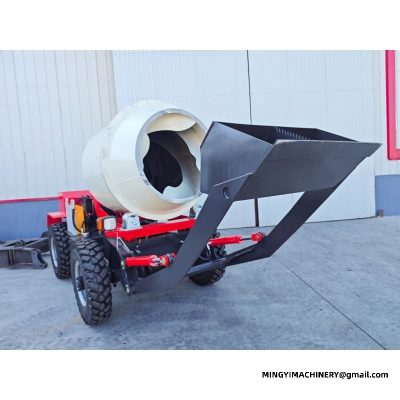
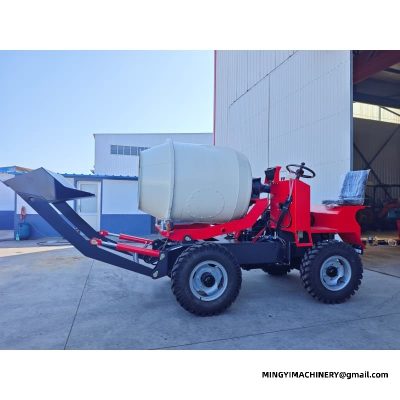
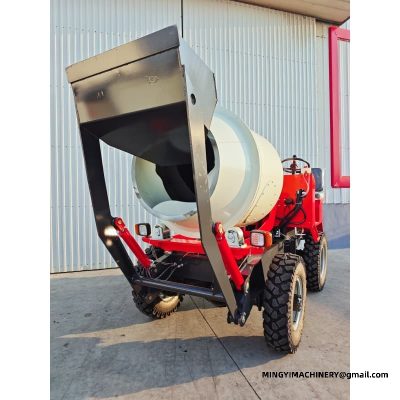
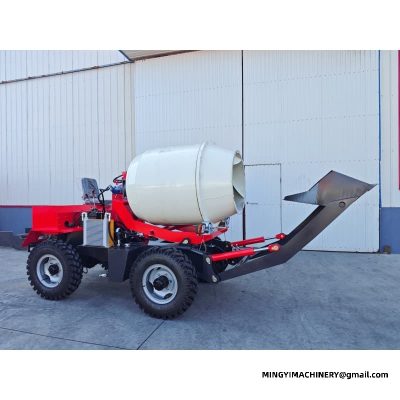
Front Loading 0.8m3 Concrete Mixer, Shovel Feeding 0.8m³ Mixer, Front Loader Truck
Small pours, repeated all day, are a logistics problem. The front loading 0.8m3 concrete mixer answers it with a 0.8 m³ drum, a front shovel and four driven wheels — four-wheel drive through a 130 drive axle with a 212 steering axle behind. This page reads the specification the way an estimator would: what each batch contains, what the cycle takes in time, and where the machine's limits honestly sit.
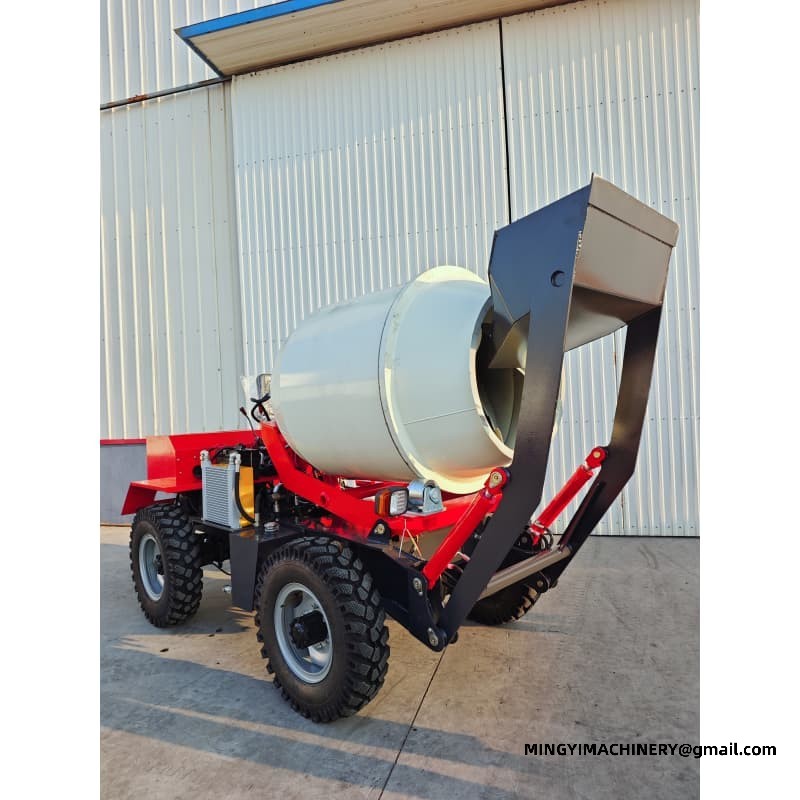
Put the two figures side by side and the machine's day writes itself: 0.8 m³ mixed, 1,500 kg carried, repeated until the pour is fed. Nothing in the specification is bigger than the job needs, and nothing the job needs is missing from the specification.
Small structural work — columns, bases, tie beams, garden retaining walls — consumes concrete in units close to 0.8 m³, which is why the drum size and the common pour size match so well. Large slabs are a different animal and want continuous supply; a single machine cannot hold that rhythm alone.
On village projects, the single-operator loop is the productivity claim that matters. The machine replaces the barrow chain, the hoist and the arguments about whose turn it is to mix, and it does so with the shovel and the drum doing what two labourers used to do.
Cement storage is the manual task that deserves organisation: a dry raised platform, bags rotated oldest-first, and a knife that lives with the machine. Damp cement is the raw material no drum can rescue.
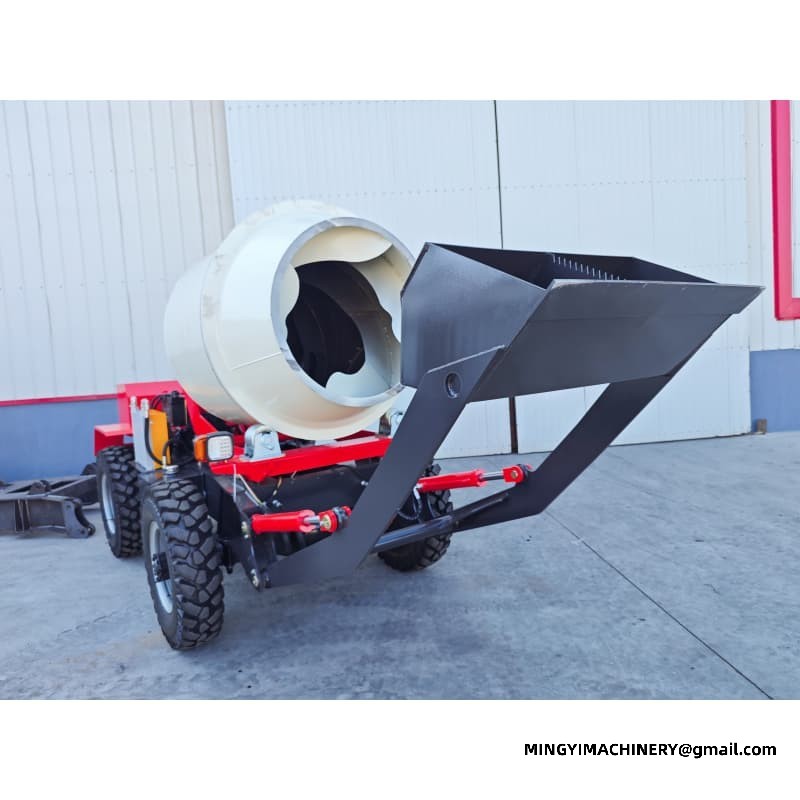
204 mm also sets the maintenance floor: axle drain plugs, the gearbox sump and the hydraulic filter all live above that line, and none of them wants to meet a rock. The clearance is a working figure, not a styling choice.
Watch the rears on rough going — steering axles take sideways knocks that fronts never see. A five-minute look at both pairs after the first day on new ground on village projects catches the stones and the cuts before they become failures.
| Published build data — 0.8 m³ 4WD self-loading concrete mixer | |
|---|---|
| Rated load | 1,500 kg |
| Rated capacity | 0.8 m³ |
| Overall dimensions (L x W x H) | 3,500 x 1,600 x 2,200 mm |
| Front tyre size | 8.25-16 |
| Rear tyre size | 7.50-16 |
| Minimum ground clearance | 204 mm |
| Steering angle | 28° |
| Turning dimension (outer tyre) | 2,464 mm |
| Maximum travel speed | 24 km/h |
| Transmission | 4WD |
| Gears | 3 forward / 1 reverse + travel gear |
| Front axle | 130 drive axle |
| Rear axle | 212 selectable 4WD steering axle |
| Engine | single-cylinder diesel / 25 hp |
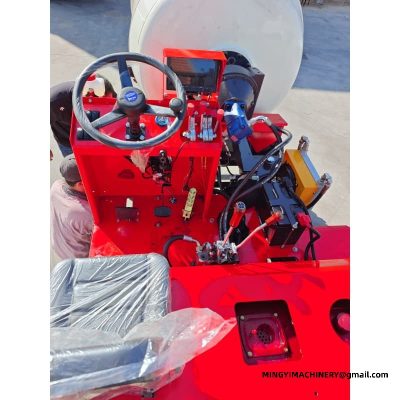
| Steering | hydraulic power steering |
plan service against hours too. Oil, filters and greasing key off the meter, and a machine worked hard in a season reaches its first major check sooner than a machine worked occasionally. The meter tells the truth either way.
Service against hours, not against weeks. Oil, filters and greasing key off the meter, and a machine worked hard in a season reaches its first major check sooner than one worked occasionally — the meter tells the truth either way.
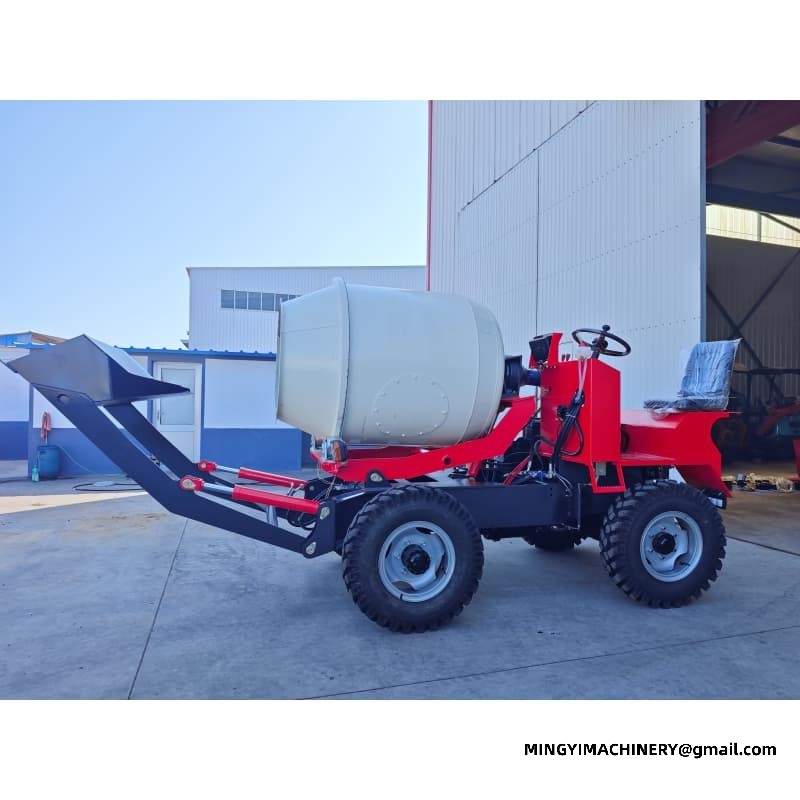
The design is deliberately conventional. Open-centre hydraulics of this pattern are understood by every agricultural mechanic, and hoses, seals and spool valves are stock items almost everywhere the machines are sold.
Hydraulic oil thickens in the cold, and a cold system asked to lift a shovel or spin a loaded drum answers slowly and wears quickly. The warm-up is short — a few minutes of light cycling — but skipping it is how seals, pumps and hoses are ruined in winter.
Board over exposed ducts and mark headroom limits. The machine crosses most ground on village projects; it crosses a buried cable only once, and the second time is a strike.
Stand the machine where the finishing crew already is, not where it would be convenient to park. A discharge point within barrow reach of the formwork is worth more than a flat, tidy spot fifty metres away, because the last metres are where hand-mixed batches lose their workability.
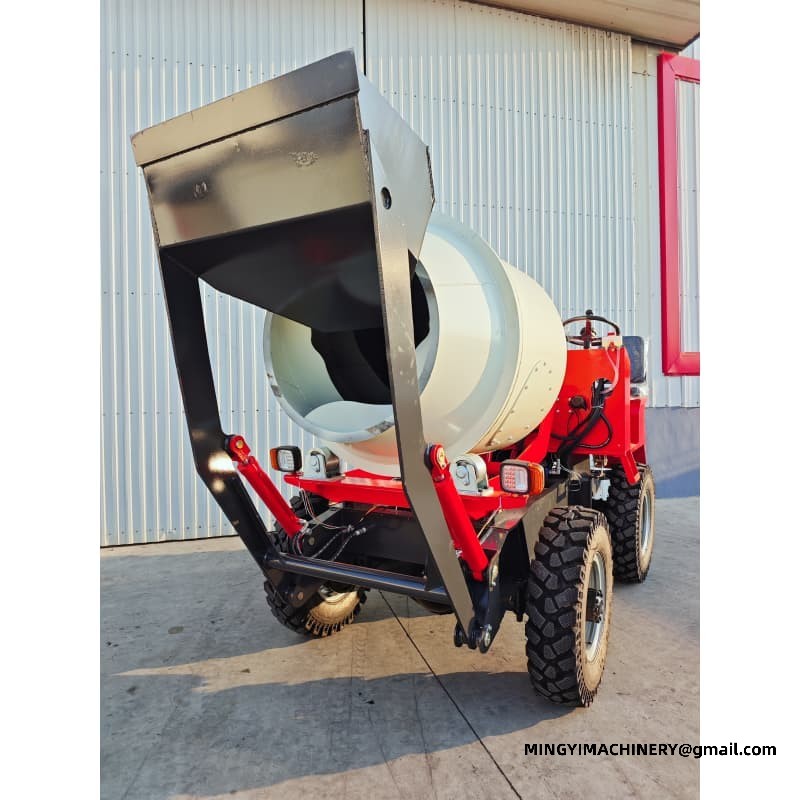
The shovel reaches a pile close to the front wheels, so the stockpile layout decides how fast a batch assembles. Keep aggregate and sand within a shovel's reach of the machine's standing position and the drum fills in seconds rather than minutes.
The shovel is sized for this class of machine. It handles sand, gravel and coarse aggregate freely, and it will lift bagged cement if the crew breaks bags in first. It is not a demolition tool, and forcing it into compacted or oversized material shortens a working day quickly.
Cement count, aggregate count, water measure, drum time — four numbers per mix design, and every crew member should be able to recite them. The machine's repeatability turns those four numbers into strength rather than into hope.
Where a sloped or awkward pour tempts the crew to loosen the mix, the better answer is placement help — a shorter chute position, a barrow stage, a wetter-but-specified mix designed for the job — not an unmeasured splash from the hose.
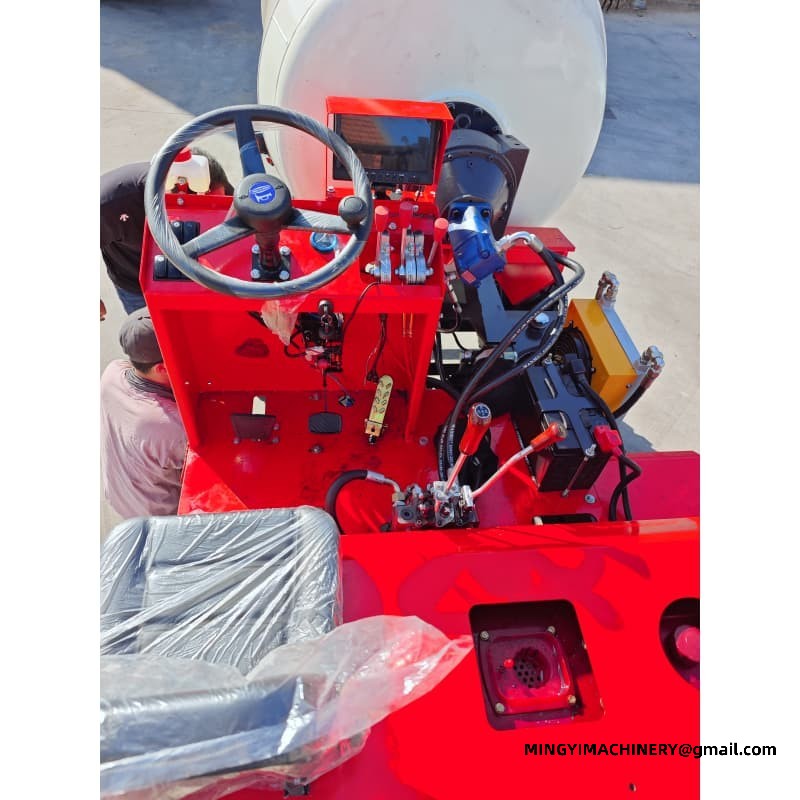
Seat position is part of the safety case: the open station puts the operator's eyes at drum height, with the shovel arc and the discharge point both in view. Machines that hide their own working parts invite the guesses that cause injuries.
Reversing into position is the other hazard moment. A spotter behind the machine during the approach, every time, closes the last gap in the loop.
Rural road work, irrigation canals, farm buildings, village housing and small precast all sit inside that band. Each needs small structural and paving concrete in quantities a plant would refuse and a shovel alone would take all day to supply.
On village projects, that sharing is where the machine pays for itself fastest. Three crews hand-mixing effort more in labour every week than the machine takes across a season, and they produce a less consistent batch while doing it.
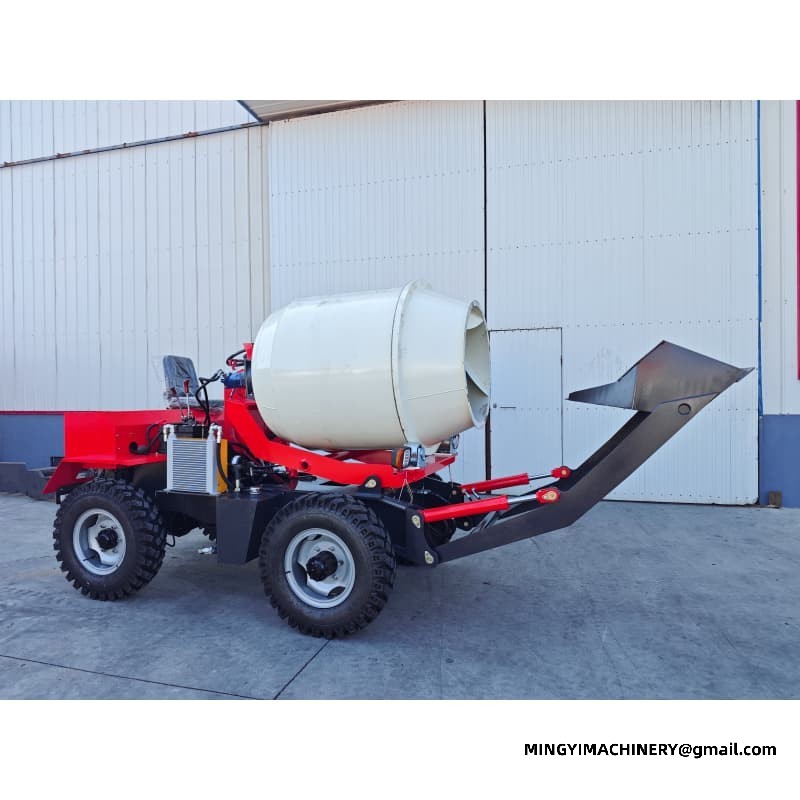
First gear is for loading position and the worst ground; second covers most site hauls; the travel gear belongs on the public road between sites. Reverse plus the steered rear axle does the positioning, because the shovel leads and the operator wants to back toward a pour with the drum already pointing at it.
The gear that surprises new operators is the travel gear's absence from site work. Under load, low gears keep the hydraulic pressure available for the drum and shovel; flogging third on village projects starves both and heats the machine for no gain.
At 3,500 x 1,600 x 2,200 mm, the machine loads onto a tag trailer behind a light truck or ships one per small container. For plant hire fleets and export buyers that footprint is money: no escort, no low-loader, no special port handling.
Tie it down at the chassis for transport, chock the wheels, and note that the shovel adds length when raised. The published envelope describes the machine in travel order; a few minutes of folding and lashing keeps it true.
On village projects, the difference shows on the first wet morning. A two-wheel-drive machine spins and needs towing; this one keeps moving under its own traction with a full 1,500 kg in the drum circuit. Traction is capacity — a mixer that cannot reach the pour has none.
Practise the turn once in an open area and the 28° rear steer becomes instinct: the rear follows a tighter path than the front, so obstacles at the inside of the turn deserve the operator's eye. A minute of practice prevents the only dent this machine commonly gets.
There is also a hybrid pattern worth naming: the self-loader feeds a static pump or a crane skip on bigger jobs, batching at the rate the placing crew sets. The machines are complements more often than competitors.
The hand-fed mixer still wins where volumes are tiny and access is narrower than 1,600 mm — but that allowance is narrow, and it closes every time wages rise.
How long do front loading 0.8m3 concrete mixer belts last?
By condition, not calendar: cracks, glazing or flutter say replace. A spare set travels in the first spares kit for good reason.
Are front loading 0.8m3 concrete mixer parts available in my country?
The engine and axle pattern uses parts stocked wherever single-cylinder agricultural machinery sells, and the supplier supports the machine-specific items — drum blades, shovel pins, hydraulic parts — by shipment.
Can the front loading 0.8m3 concrete mixer work in the rain?
The machine tolerates rain; the route is usually the limit. At 204 mm of clearance with agricultural tyres and 4WD it crosses wet ground that stops two-wheel machines — provided the standing spots hold.
Can a front loading 0.8m3 concrete mixer replace ready-mix concrete?
For small, repeated pours beyond a plant's economical radius, yes — batching on site avoids minimum-load charges and part-load waste. Large continuous pours still belong to ready-mix.
How is the front loading 0.8m3 concrete mixer shipped?
At 3,500 x 1,600 x 2,200 mm it loads into a standard container with lashing alone. On arrival, check drum and shovel for transit damage and run the drum empty before the first batch.
Does the front loading 0.8m3 concrete mixer have power steering?
Yes — hydraulic power steering, working with the 28° rear-axle steer. The wheel stays light under a full drum and predictable at crawl speed.
Can a front loading 0.8m3 concrete mixer work underground or in tunnels?
At 2,200 mm high it fits low-clearance work a transit mixer cannot enter. Enclosed spaces also require planned ventilation for the diesel exhaust — put it in the method statement.
What warranty does the front loading 0.8m3 concrete mixer carry?
Warranty terms are stated with the contract, so get them in writing — scope, duration and the parts-and-service arrangement for your market. Keep the commissioning checklist; it protects the claim.
The machine's arithmetic is short: 0.8 m³ per batch, 1,500 kg of payload, four driven wheels and one operator. Weighed against the labour it replaces and the ready-mix charges it avoids, the purchase decision is the smallest line on the page.
Hot, humid and dusty conditions around Front Loading 0.8m3 Concrete Mixer: Shovel Discipline
Tropical operation is a specification question as much as a maintenance one. The cooling capacity, the sealing and the corrosion protection fitted to Front Loading 0.8m3 Concrete Mixer: Shovel Discipline are what make the difference once the ambient temperature rises.
A second operator for Front Loading 0.8m3 Concrete Mixer: Shovel Discipline
Training is simpler than repair. An hour spent with a new operator on Front Loading 0.8m3 Concrete Mixer: Shovel Discipline, covering the limits and the awkward cases, is the least lengthy hour in the whole ownership.
Handover and getting familiar with Front Loading 0.8m3 Concrete Mixer: Shovel Discipline
A good handover covers the awkward cases, not just the easy ones. Starting Front Loading 0.8m3 Concrete Mixer: Shovel Discipline on a slope, turning in a confined space and recovering from soft ground are the situations an operator should meet first with someone beside them.
Reading the early symptoms on Front Loading 0.8m3 Concrete Mixer: Shovel Discipline
Operators notice things first because they hear the machine every day. Encouraging the person on Front Loading 0.8m3 Concrete Mixer: Shovel Discipline to report small changes, and acting on them, is the most effective maintenance programme there is.
Moving Front Loading 0.8m3 Concrete Mixer: Shovel Discipline between sites
Travel time is not working time, and it should be planned as its own item. The hours spent moving Front Loading 0.8m3 Concrete Mixer: Shovel Discipline between jobs are hours not worked, and a trailer that matches the machine reduces them every single trip.
Contact MINGYI Machinery for the current self-loading concrete mixer specification, export packing and a formal specification for your market. E-mail: sales@mingycn.com | LINE (ID): mingyicn
Hydraulic Tipping 0.8m3 Mixer: The Discharge Arc · Mini 0.8m3 Self Loading Truck: The Short Envelope · 4WD site dumper climbing slope with hydraulic tipping body · Mini Self-Loading Concrete Mixer









