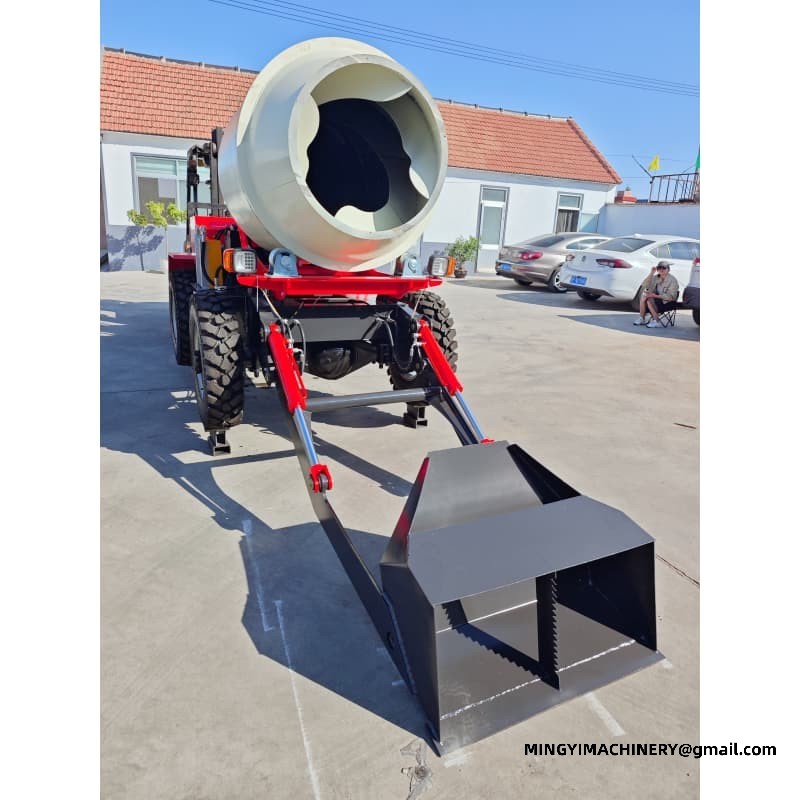
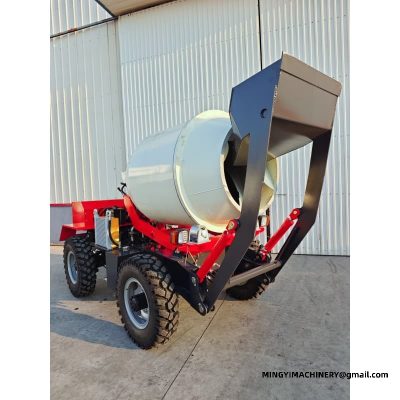
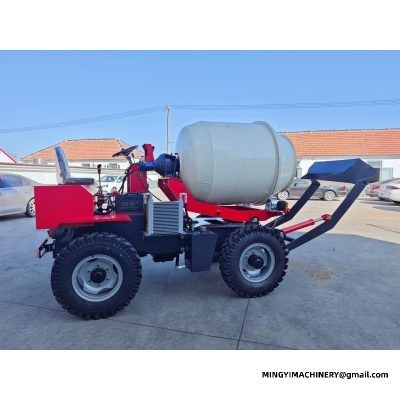
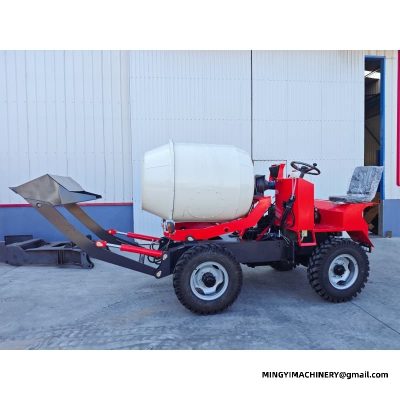
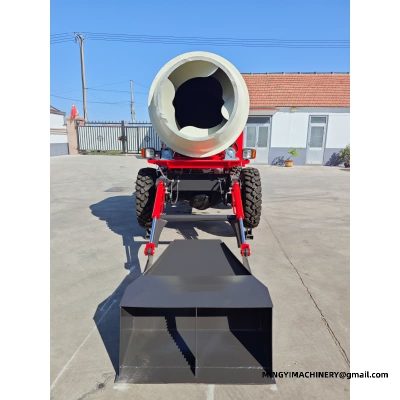
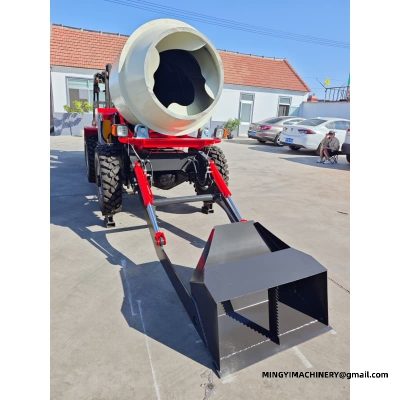
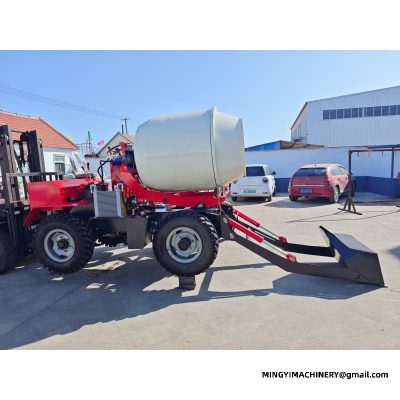
Hydraulic Tipping 0.8m3 Concrete Mixer, Self Discharging 0.8m³ Mixer, Tipping Drum
Buy the drum for the pour, the chassis for the ground. The two halves of a hydraulic tipping 0.8m3 concrete mixer spec sheet answer different questions: 0.8 m³ and 1,500 kg describe what a batch is; the 4WD transmission, 204 mm of clearance and 28° of steering angle describe where that batch can travel. This page reads both halves on pole lines.
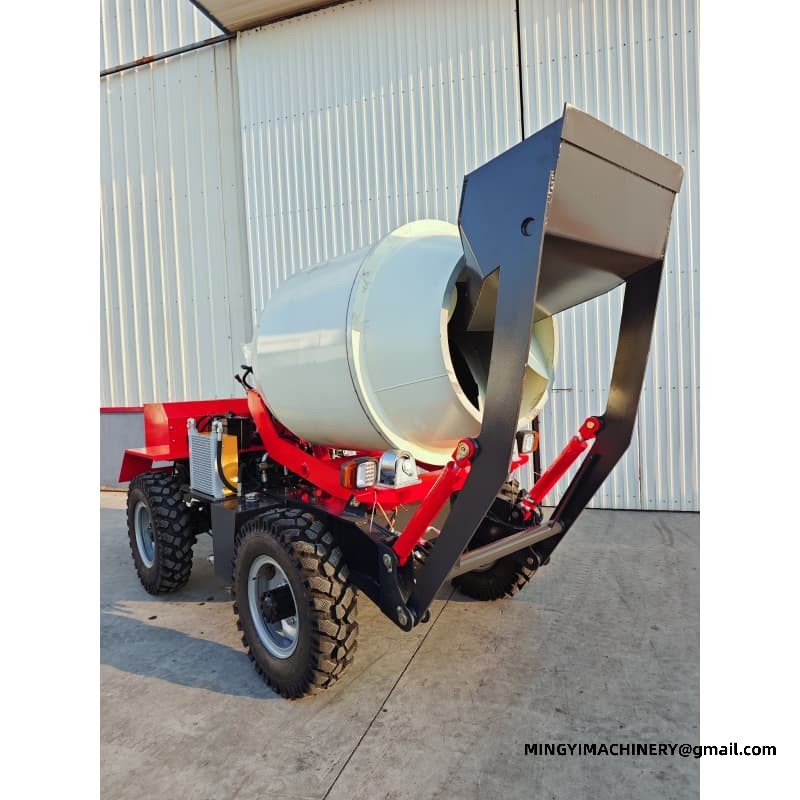
Measure the narrow gate before delivery on pole lines — width, height bar, and the turn immediately inside it. The 2,464 mm turning circle handles the inside turn; the measurement turns hope into a plan.
Underground work adds one duty: ventilation for the single-cylinder diesel. Diesel exhaust in an enclosed space is an engineering problem before it is a comfort problem, and forced airflow belongs in the method statement, not in the operator's discretion.
Put the two figures side by side and the machine's day writes itself: 0.8 m³ mixed, 1,500 kg carried, repeated until the pour is fed. Nothing in the specification is bigger than the job needs, and nothing the job needs is missing from the specification.
Honest sizing starts from the biggest continuous element on pole lines. If that element needs more than the drum can supply, either batch with two machines or break the pour into planned bays. The 1,500 kg rating keeps the chassis within itself either way.
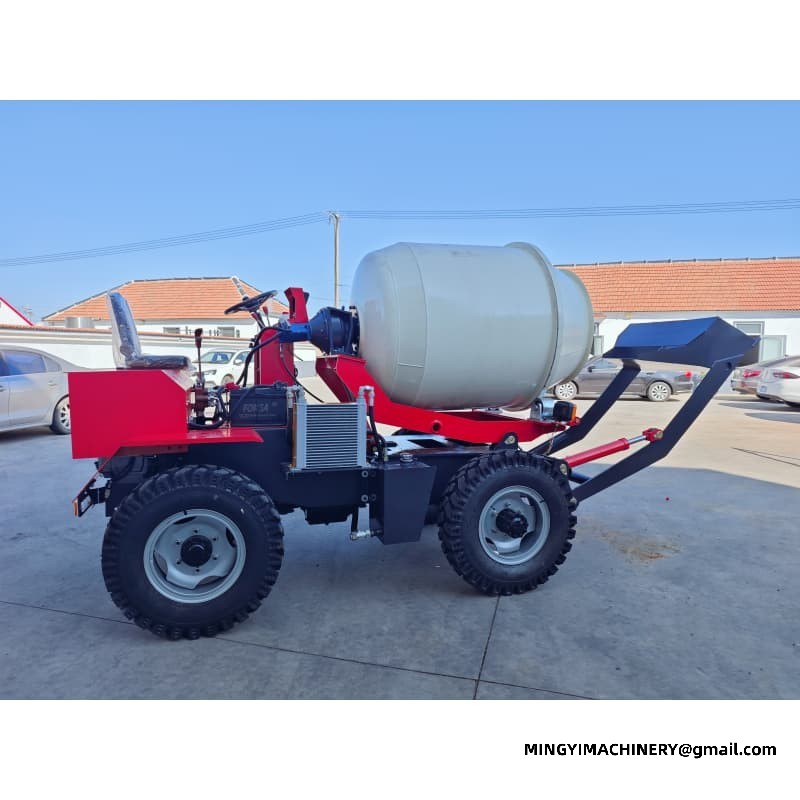
On pole lines, the single-operator loop is the productivity claim that matters. The machine replaces the barrow chain, the hoist and the arguments about whose turn it is to mix, and it does so with the shovel and the drum doing what two labourers used to do.
A single operator controls every input, which makes quality easier to police, not harder. One recipe, one water measure, one mixing time — and every batch of pole-setting concrete comes out the same because the same person made the same decisions each cycle.
| Specification extract — 0.8 m³ 4WD self-loading concrete mixer | |
|---|---|
| Rated load | 1,500 kg |
| Rated capacity | 0.8 m³ |
| Overall dimensions (L x W x H) | 3,500 x 1,600 x 2,200 mm |
| Front tyre size | 8.25-16 |
| Rear tyre size | 7.50-16 |
| Minimum ground clearance | 204 mm |
| Steering angle | 28° |
| Turning dimension (outer tyre) | 2,464 mm |
| Maximum travel speed | 24 km/h |
| Transmission | 4WD |
| Gears | 3 forward / 1 reverse + travel gear |
| Front axle | 130 drive axle |
| Rear axle | 212 selectable 4WD steering axle |
| Engine | single-cylinder diesel / 25 hp |
| Steering | hydraulic power steering |
Because rotation and tilt are hydraulic, the operator can hold a partial discharge — trickle into a barrow, stop, move, resume — which no hand-cranked drum offers. That control is worth as much as the 0.8 m³ itself on pours with fussy geometry.
Concrete waits for nobody. The drum must be washed before the residue stiffens, and on a self-loader the routine is simple: rinse the drum, spin it with clean water, dump the wash-out away from the stockpile, and leave the blades clean for the next batch.
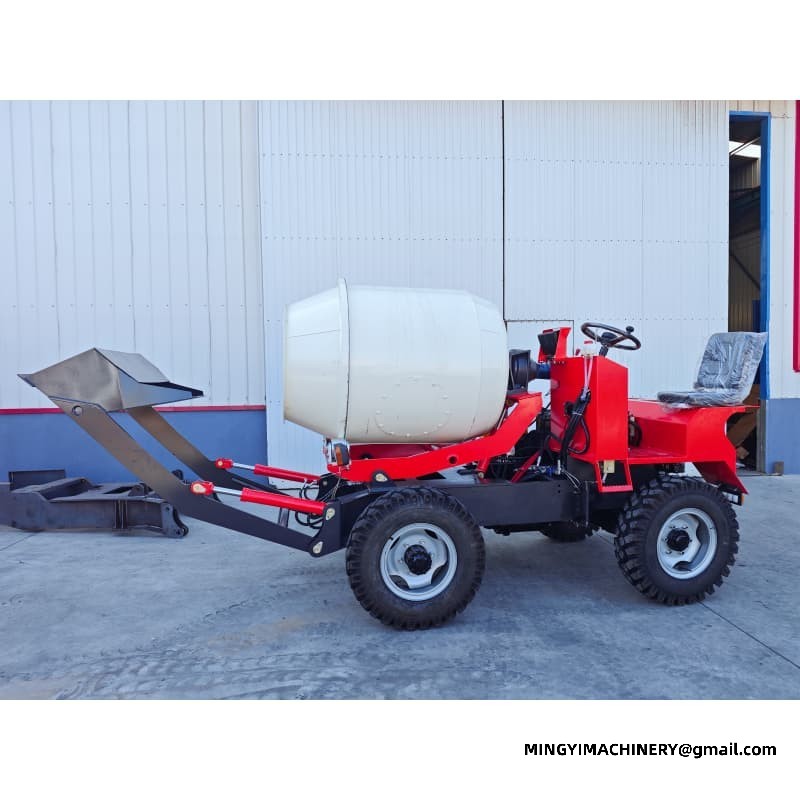
Single-cylinder engines also teach their operators. The rhythm of a healthy 25 hp unit — exhaust note, vibration, smoke colour — tells an attentive operator more than a dashboard of warning lamps, and small deviations get fixed small.
A single-cylinder diesel of this size burns a few litres an hour, runs on the same diesel as everything else on site, and services with filters and oil a general mechanic stocks. None of that is glamorous; all of it matters on pole lines, where the nearest dealer is a day away.
plan the inputs with the machine, not after it. A drum that sits idle because the cement ran out is a drum that takes money while earning none, and the discipline of stocking ahead is part of owning well.
Buy a used one with the same eye: a drum true to its blades, axles dry at the seals, and hours that match the story. The three tells predict the next season's takes better than any salesman's.
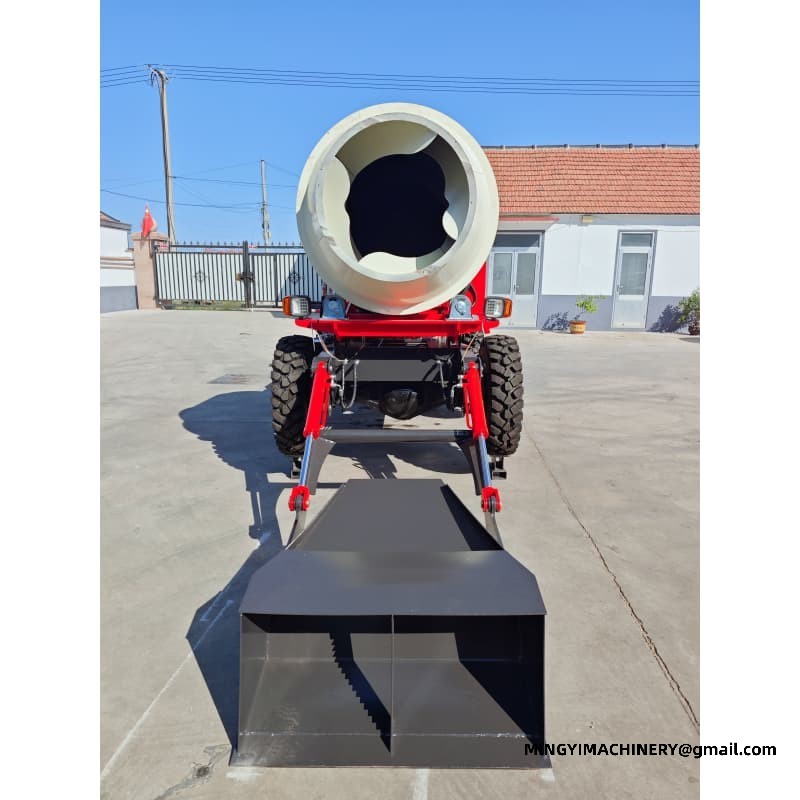
The machines that age well are washed and greased on schedule; the machines that age badly are the ones where wash-out slipped and dust won. Nothing exotic — just the daily five minutes, kept.
Spread across a working life, the machine's takes sort into three piles: purchase, consumables and labour saved. The third pile dwarfs the other two wherever hand-mixing was the alternative, which is why owners replace these machines with the same machine.
Build the plan around the standing spot rather than the drum: a machine that parks once and serves a bay from one position outserves a machine that shuttles. Positioning time is the only time the drum spends doing nothing.
Sequence the day by geography rather than by trade. Batching for two crews at opposite ends of a site doubles travel; batching for neighbours, one after another, keeps the hauls short and the drum earning.
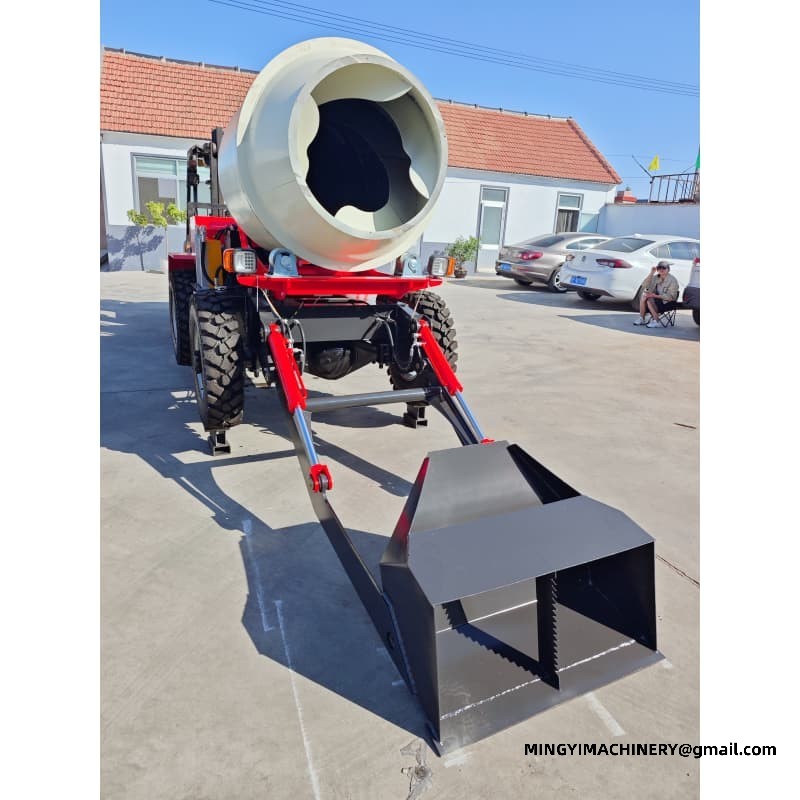
Rural road work, irrigation canals, farm buildings, village housing and small precast all sit inside that band. Each needs pole-setting concrete in quantities a plant would refuse and a shovel alone would take all day to supply.
A simple booking sheet settles the sharing question before it becomes an argument: which crew, which hours, which recipe. The machine serves whoever plans for it; it punishes whoever assumes it will be waiting, full and clean.
Keep the pairs matched left to right and the pressures even, because uneven fronts put the machine slightly out of square and the steering fights it all day. Tyres are the simplest component to treat well and the most lengthy to ignore.
Both sizes are common agricultural fittings, which means tubes, tyres and repairs exist in every market the machines serve. A spare front tyre and a puncture kit travel with many fleets; on remote work the kit is not optional.
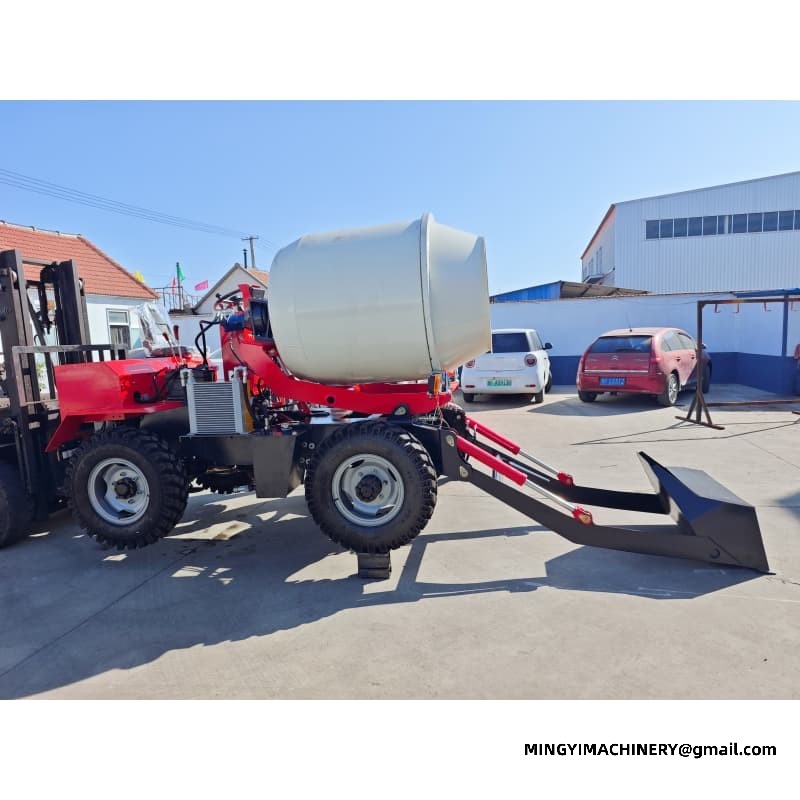
The engine line — single-cylinder diesel, 25 hp — is a maintainability statement more than a performance one. Single-cylinder diesel of this pattern is serviced anywhere, started by a mechanic who has seen one before, and rebuilt on a bench. A higher number would not help a machine that works where dealerships are days away.
Read the rated load and the rated capacity together, never one without the other. The 1,500 kg rating is what the chassis and tyres are built to carry; the 0.8 m³ is what the drum actually holds per cycle, and the honest pour lives in the gap between the two.
At 3,500 x 1,600 x 2,200 mm, the machine loads onto a tag trailer behind a light truck or ships one per small container. For plant hire fleets and export buyers that footprint is money: no escort, no low-loader, no special port handling.
Inside a container, the machine anchors to the floor at four points and the shovel secures against a hardwood block — the shipping agent's standard practice, and worth confirming in the packing photos before the container doors close on pole lines.
First gear is for loading position and the worst ground; second covers most site hauls; the travel gear belongs on the public road between sites. Reverse plus the steered rear axle does the positioning, because the shovel leads and the operator wants to back toward a pour with the drum already pointing at it.
Shift on the move only between close ratios; come to rest for anything involving the travel gear. The gearbox is simple and strong, and the abuse that kills gearboxes — ramming selectors under load — is entirely avoidable on pole lines.
There is also a hybrid pattern worth naming: the self-loader feeds a static pump or a crane skip on bigger jobs, batching at the rate the placing crew sets. The machines are complements more often than competitors.
The honest case for the hand mixer survives only at the very smallest scale — a two-man job, one batch an hour, concrete within barrow reach. One step past that, the self-loader's arithmetic takes over and does not give it back.
How big is the hydraulic tipping 0.8m3 concrete mixer?
3,500 x 1,600 x 2,200 mm overall — short enough for a site trailer, narrow enough for a standard double gate, low enough to containerise without special handling.
Is the hydraulic tipping 0.8m3 concrete mixer suitable for farm work?
Very much — post holes, shed bases, paths and small structures on pole lines are exactly the small, distant batches the machine was drawn for.
Can the hydraulic tipping 0.8m3 concrete mixer work in hot weather?
Yes — keep the air filter checked, shade the aggregate stockpile where possible, and batch slightly smaller so each load is placed inside the shortened working window.
My hydraulic tipping 0.8m3 concrete mixer steering whines when cold — is that normal?
It is the sound of thick hydraulic oil, not a fault. Warm the circuit with light cycling before the first shovel lift; persistent noise when warm, however, needs a hose or suction check.
Do I need a concrete pump with a hydraulic tipping 0.8m3 concrete mixer?
Usually not. The machine drives to the pour and discharges over the front on pole lines; a barrow stage covers the last few metres where wheels cannot stand.
Can the hydraulic tipping 0.8m3 concrete mixer drive on public roads?
It travels at 24 km/h in the road gear between sites. Registration and lighting requirements differ by market, so confirm local rules before regular road use.
How fast does the hydraulic tipping 0.8m3 concrete mixer travel?
Top speed is 24 km/h with three forward gears, one reverse and a separate travel gear. Site work stays in low gears; the travel gear exists for moving between jobs.
How do I check quality without a lab when using a hydraulic tipping 0.8m3 concrete mixer?
Slump by eye against an agreed target, batch weight against the recipe, and a chalkboard record of what each pour received. Structural work still deserves proper cube tests.
A mixer that reaches the pour, mixes to a recipe and washes out on time is a mixer that earns for a decade. The habits in this page effort minutes a day; the machine they protect takes far more to neglect.
Later additions and retrofits on Hydraulic Tipping 0.8m3 Mixer: The Discharge Arc
Later changes are easier when they were anticipated. Asking for the extra hydraulic circuit or the heavier mounting plate on Hydraulic Tipping 0.8m3 Mixer: The Discharge Arc at build time adds little and leaves the option open.
Fuel, oil and fluid quality for Hydraulic Tipping 0.8m3 Mixer: The Discharge Arc
Most engine trouble starts with what went into the tank. Clean fuel, stored properly and filtered before it reaches Hydraulic Tipping 0.8m3 Mixer: The Discharge Arc, prevents more downtime than any other single habit an owner can adopt.
Commissioning Hydraulic Tipping 0.8m3 Mixer: The Discharge Arc on site
Commissioning is where the specification meets the ground. The settings chosen for Hydraulic Tipping 0.8m3 Mixer: The Discharge Arc are confirmed against the actual site, and the working pattern is adjusted before the machine is asked for a full day.
Wear items and spares worth holding for Hydraulic Tipping 0.8m3 Mixer: The Discharge Arc
The parts that stop a machine are rarely the parts that are hardest to find. Filters, belts, seals and the ground engaging tools on Hydraulic Tipping 0.8m3 Mixer: The Discharge Arc are easy to hold and slow to replace, which is why they belong on the shelf rather than on an order.
Keeping a service record for Hydraulic Tipping 0.8m3 Mixer: The Discharge Arc
Patterns show up in the record before they show up in the machine. Rising oil consumption or a filter that keeps blocking on Hydraulic Tipping 0.8m3 Mixer: The Discharge Arc is obvious on paper long before it becomes a failure on site.
Contact MINGYI Machinery for the current self-loading concrete mixer specification, export packing and a formal specification for your market. E-mail: sales@mingycn.com | LINE (ID): mingyicn
Mini 0.8m3 Self Loading Truck: The Short Envelope · 0.8m3 Mobile Batching: Batching to Demand, Not to Schedule · off road cargo transporter muddy road with hydraulic tipping body · Mini Self-Loading Concrete Mixer









