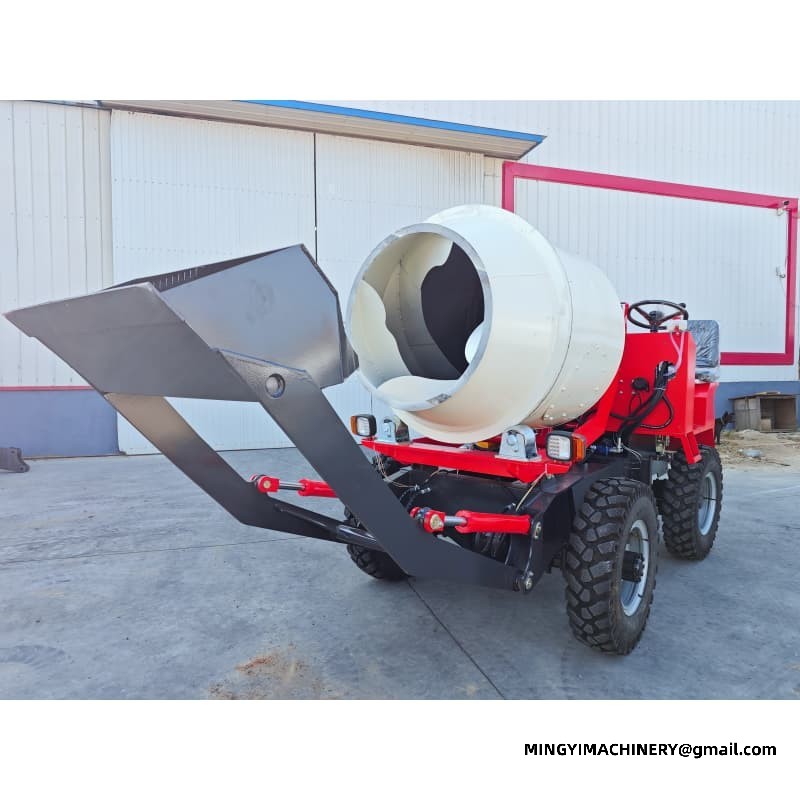
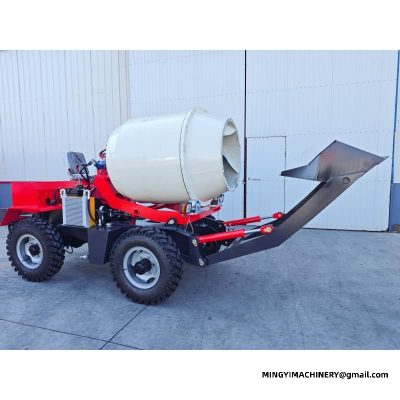
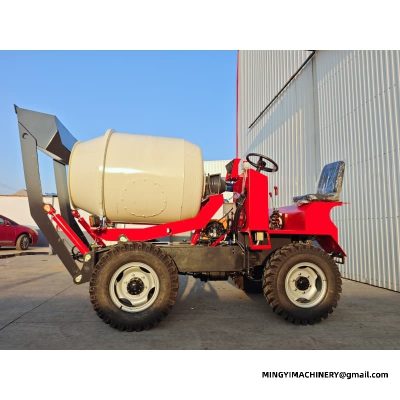
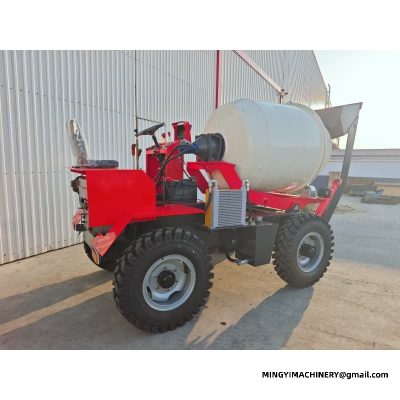
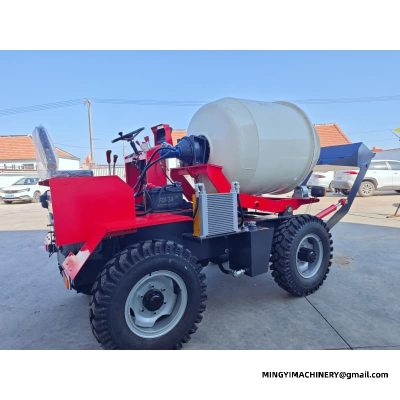
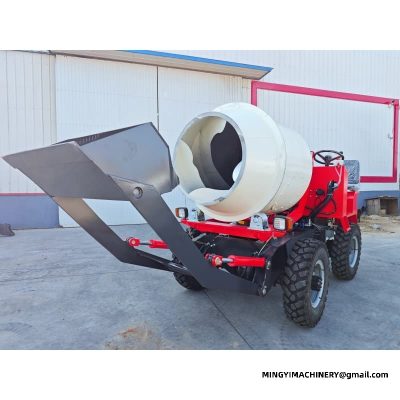
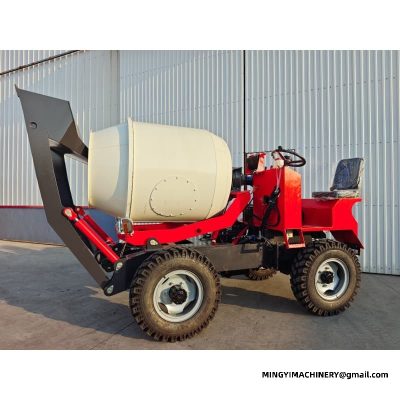
Concrete waits for nobody, and distance kills it. The heavy duty self loading cement truck self-loading mixer exists for pours that happen too far from a batching plant for ready-mix to answer — in tunnel work under clearance a transit mixer cannot enter. At 0.8 m³ per batch and 24 km/h of travel speed, the machine keeps the supply chain inside the site gate, and this page explains the published figures that make that work.
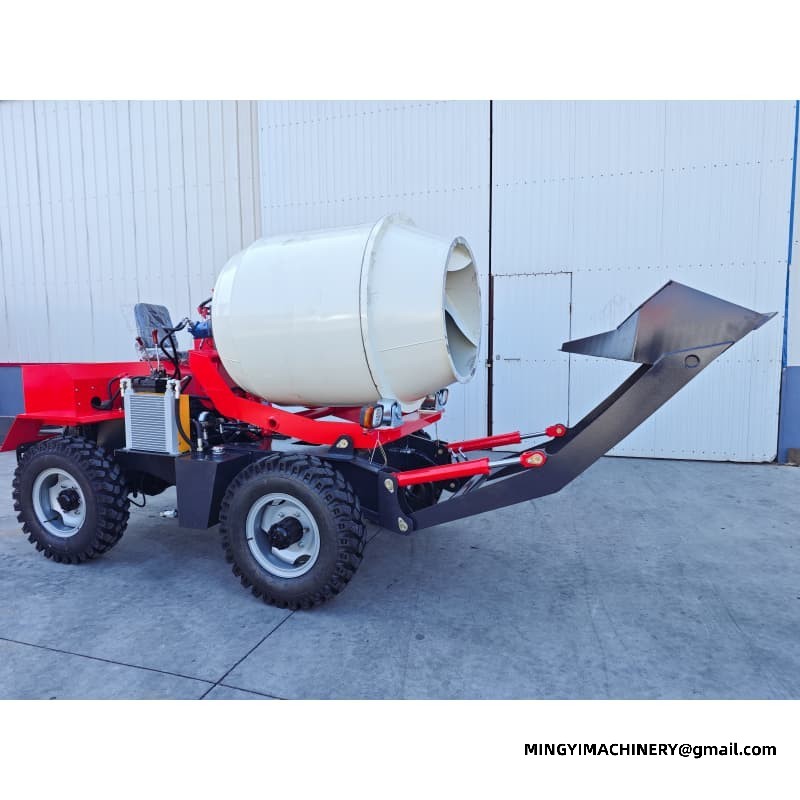
Ask for photographs of the actual unit and its serial plate, not brochure images. The machine is simple enough that a five-minute video call at handover — controls, drum, shovel, axles — answers more than a week of messages.
A short commissioning routine protects the warranty and the pour schedule alike. Most early faults reported on exported machines trace to skipped first-service basics rather than to the machine itself.
Engine oil and fuel, air restriction, hydraulic level, drum cleanliness, tyres and wheel nuts, lights and mirrors. That walk-round takes five minutes and catches nearly everything that becomes lengthy when missed.
Photographs belong in the record too — a picture of a fresh hose chafe or a worn pin settles the later argument about when it appeared. Phones make the habit free; the claim it strengthens is not small.
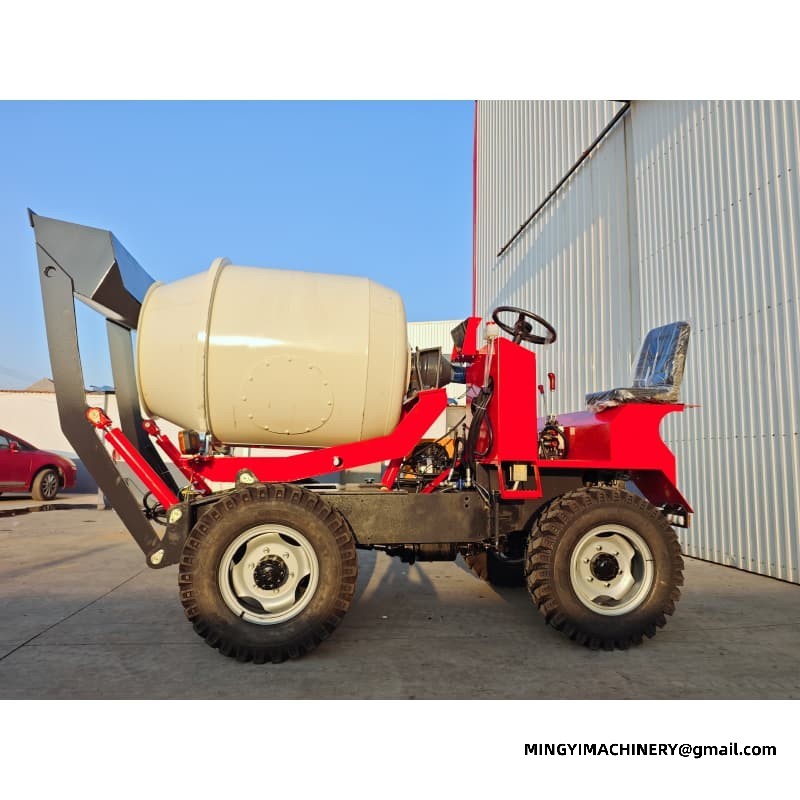
Read the ground before the first trip of the day in tunnel work. A route that crossed easily yesterday may have a new trench, a spoil heap or a flooded patch overnight, and 204 mm gives the operator a plain number to judge it against.
The rules that keep it upright are old ones: straight up, straight down, no turning across a loaded slope, and no sudden stops with 0.8 m³ of wet concrete shifting in the drum. None of them takes the crew any time worth measuring.
| Specification extract — 0.8 m³ 4WD self-loading concrete mixer | |
|---|---|
| Rated load | 1,500 kg |
| Rated capacity | 0.8 m³ |
| Overall dimensions (L x W x H) | 3,500 x 1,600 x 2,200 mm |
| Front tyre size | 8.25-16 |
| Rear tyre size | 7.50-16 |
| Minimum ground clearance | 204 mm |
| Steering angle | 28° |
| Turning dimension (outer tyre) | 2,464 mm |
| Maximum travel speed | 24 km/h |
| Transmission | 4WD |
| Gears | 3 forward / 1 reverse + travel gear |
| Front axle | 130 drive axle |
| Rear axle | 212 selectable 4WD steering axle |
| Engine | single-cylinder diesel / 25 hp |
| Steering | hydraulic power steering |
plan service against hours too. Oil, filters and greasing key off the meter, and a machine worked hard in a season reaches its first major check sooner than a machine worked occasionally. The meter tells the truth either way.
Where one machine cannot keep up, the answer is usually two at lower utilisation, not one pushed past its rhythm. Two machines serve two pours; one machine pushed past its cycle serves neither well and arrives at the next service early.
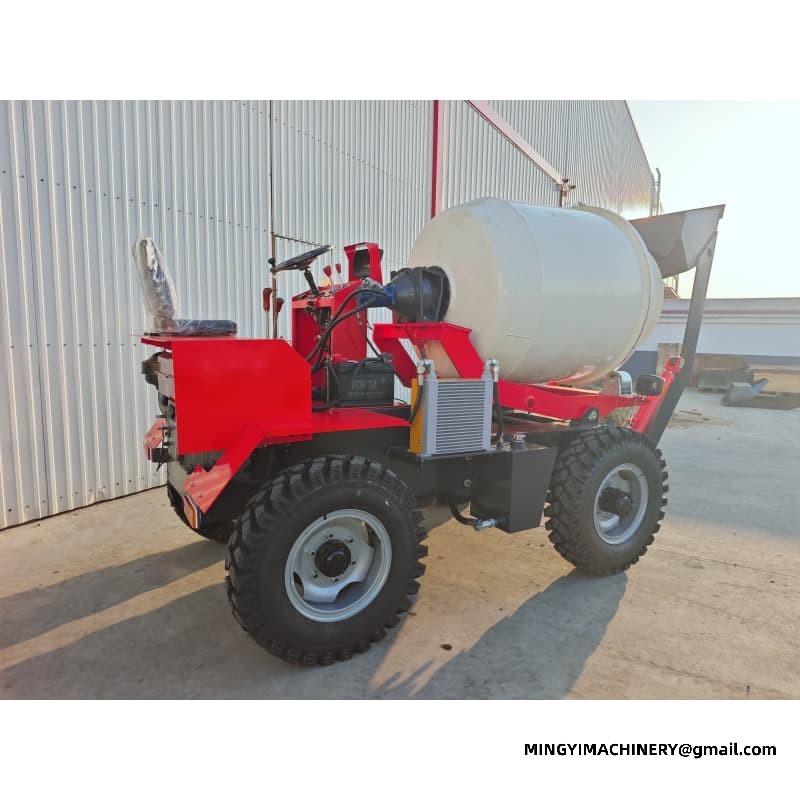
The hydraulic circuit drives the power steering, the drum rotation and the shovel hydraulics from one pump off the single-cylinder diesel. Three consumers, one source — which is why the engine's health and the oil's cleanliness are the same subject on this machine.
A spare suction hose and a couple of stocking joints in the spares box turn the most common cold-morning failure into a ten-minute fix. Hydraulics rarely fail without warning; they seep first, and the daily look catches the seep.
The arithmetic is simple enough for a whiteboard — batches per bay, cycles per hour, and the standing spot for each. Ten minutes of planning in tunnel work buys a full day of continuous placement.
Between crews, the drum's rinse cycle doubles as the handover boundary — the second crew starts from a clean drum and a known recipe, in tunnel work, and neither crew inherits the other's setting grout.
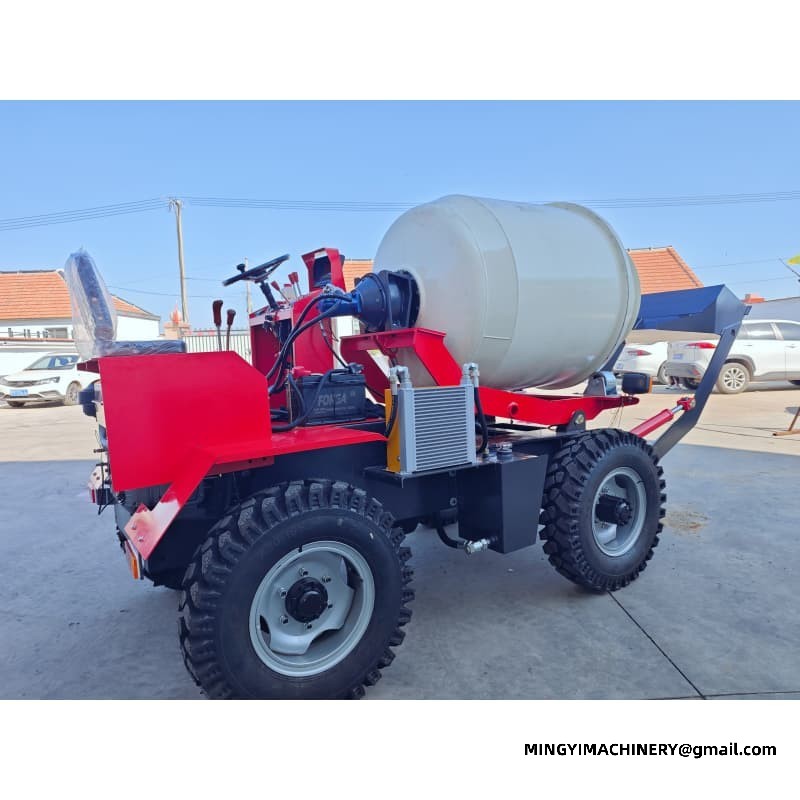
24 km/h is not fast and should not be. The machine carries 1,500 kg of wet concrete high on a short wheelbase, and the gearing keeps those loads sedate. Crews that respect the speed keep the concrete in the drum and the machine on its wheels.
Plan the standing spot before the first batch, not after. A machine that has rehearsed its approach discharges in a minute; a machine improvising each approach spends more time manoeuvring than mixing over a shift.
Let the first day end early, clean and unhurried. Operators trained calmly in tunnel work keep the habits; operators trained in a rush learn shortcuts instead.
Reinforce the habits with the machine itself: a marked water container lashed beside the seat, a laminate of the recipe in a sleeve on the splash board. Cues that live on the machine survive operator changes; cues in the site office do not.
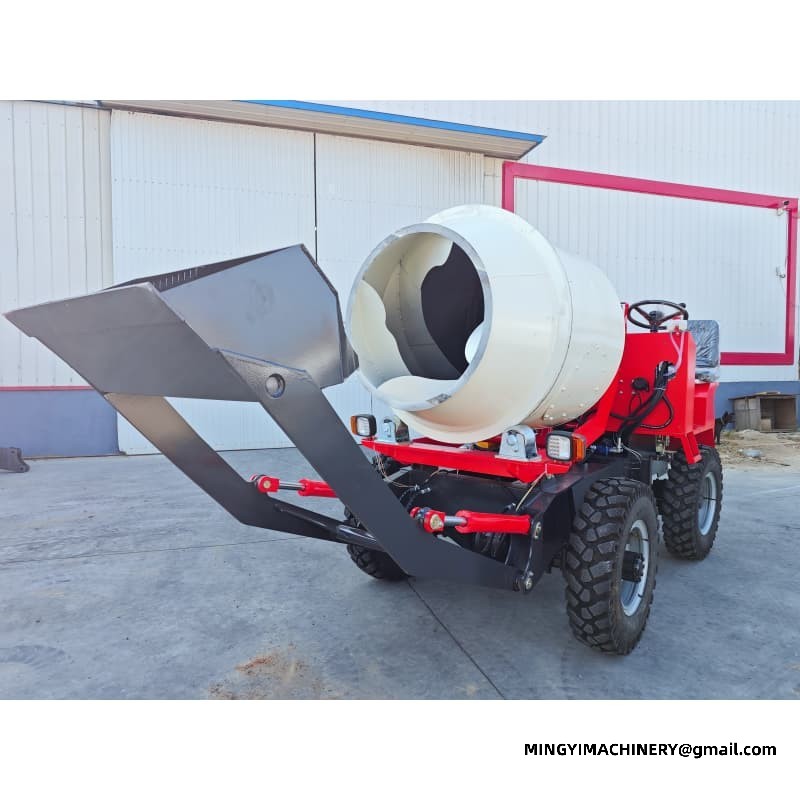
Power steering also matters at the end of a shift. A loaded machine manoeuvring all day on a manual system tires the operator into mistakes; the hydraulic system keeps the last batch as controlled as the first.
2,464 mm at the outer tyre is the figure that decides where the machine can work. It turns inside estate gateways, between fence posts, along canal towpaths and through basement ramps that stop ordinary site trucks.
The front tyres are 8.25-16 and carry the drive under a full drum; the rears are 7.50-16 and steer. The heavier front fitment matches the heavier front duty — drive torque plus a loaded drum sitting between the axles.
Valve extenders on the rear axles make pressure checks a standing job instead of a kneeling one, and the crews who fit them check more often. The best maintenance habit is the one made convenient.
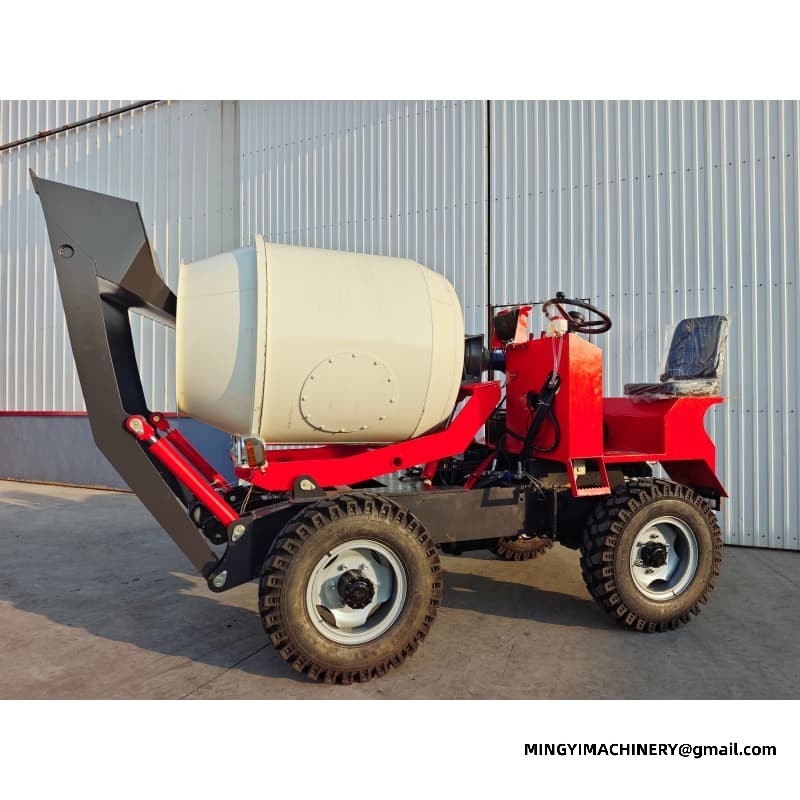
Ownership's real takes are the visible ones: the machine, the spares kit, the fuel, and the operator's time. None is hidden, none is large, and all survive a spreadsheet. The effort that surprises new owners is the working capital tied in stockpiled aggregate and cement — the inputs, not the machine.
plan the inputs with the machine, not after it. A drum that sits idle because the cement ran out is a drum that takes money while earning none, and the discipline of stocking ahead is part of owning well.
The height figure hides a detail worth checking on hire fleets and after modifications: the envelope assumes the shovel down and the drum level. A raised shovel adds materially to the length, and crews loading onto trailers should measure in travel order.
Tie it down at the chassis for transport, chock the wheels, and note that the shovel adds length when raised. The published envelope describes the machine in travel order; a few minutes of folding and lashing keeps it true.
Keep the parts book and the order history together. The second order, placed a year later for a blade or a seal, is a two-minute email when the reference numbers are at hand and a half-day search when they are not.
Commission the machine properly and write it down. The checklist protects the warranty and gives the next operator a known starting point, and the habit takes nothing the moment it begins.
Most sites need a little ground work before the machine earns its keep: grade the haul, fill the ruts, gravel the standing spots, and protect any services in the working line. An hour with a shovel and a bag of hardcore keeps the 4WD honest and the drum moving.
Board over exposed ducts and mark headroom limits. The machine crosses most ground in tunnel work; it crosses a buried cable only once, and the second time is a strike.
Discharge lands where the operator aims it. That single fact shapes the whole workflow in tunnel work: the drum pours into a barrow, a bucket or straight to formwork, and the crew never moves concrete twice.
Keep a dedicated bucket or bowl for the wash-out water and the routine stays tidy even on sites without drainage. The ten litres of sloppy grout that set inside a drum overnight effort a chisel day; the same grout washed out takes nothing.
How does the heavy duty self loading cement truck discharge the concrete?
The drum reverses and tips hydraulically, discharging over the front to a barrow, bucket or straight into formwork. The operator aims the pour from the seat.
How is a heavy duty self loading cement truck delivered and commissioned?
Containerised delivery, then a short commissioning: turn the engine by hand before first start, prime the hydraulics, and run the drum empty before the first batch.
What should I confirm before ordering a heavy duty self loading cement truck?
The specification against the published table — 0.8 m³ capacity, 1,500 kg load, 4WD, 25 hp engine, the 130 and 212 axles — plus what is standard versus optional in your build.
Does a heavy duty self loading cement truck hold its value?
Well-kept machines resell quickly to small contractors. Hours and a service book carry more weight at resale than appearance.
Can the heavy duty self loading cement truck use site sand and gravel straight from the ground?
From a clean stockpile on hardened standing, yes. Straight from contaminated ground, no — soil in the mix is the classic cause of weak site concrete.
How fast does the heavy duty self loading cement truck travel?
Top speed is 24 km/h with three forward gears, one reverse and a separate travel gear. Site work stays in low gears; the travel gear exists for moving between jobs.
How long does it take to train a heavy duty self loading cement truck operator?
A careful new operator works productively within a day. The controls are few; the judgement worth training is slopes, loads and the wash-out habit.
Why choose a heavy duty self loading cement truck over more labour?
Because wages recur weekly and the machine does not. One operator with the shovel-and-drum loop replaces a barrow chain, and the batches come out more consistent than hand mixing ever was.
Batched to demand, placed under its own power and maintained in five minutes a day, the machine replaces the small-plant overhead that most small pours never needed in the first place.
Wear items and spares worth holding for Heavy Duty Duty Cycle: What a Self Loading Cement Truck Carries
Holding spares is about downtime rather than the shelf itself. The question for Heavy Duty Duty Cycle: What a Self Loading Cement Truck Carries is not how large the part is but how long the machine sits while it is found, and a small shelf answers that better than a fast courier.
Storage and long idle periods for Heavy Duty Duty Cycle: What a Self Loading Cement Truck Carries
A stored machine should be brought back carefully. Before Heavy Duty Duty Cycle: What a Self Loading Cement Truck Carries returns to work the fluids, the brakes and the controls are checked, because months of standing change more than a weekend does.
Later additions and retrofits on Heavy Duty Duty Cycle: What a Self Loading Cement Truck Carries
Retrofitting is limited by the base machine. Before anything is added to Heavy Duty Duty Cycle: What a Self Loading Cement Truck Carries the hydraulic flow, the mounting interface and the stability allowance have to be checked, because those limits are what decide what is sensible.
Handover and getting familiar with Heavy Duty Duty Cycle: What a Self Loading Cement Truck Carries
A good handover covers the awkward cases, not just the easy ones. Starting Heavy Duty Duty Cycle: What a Self Loading Cement Truck Carries on a slope, turning in a confined space and recovering from soft ground are the situations an operator should meet first with someone beside them.
Keeping a service record for Heavy Duty Duty Cycle: What a Self Loading Cement Truck Carries
A written record is worth more than a good memory. Dates, hours and the parts fitted on Heavy Duty Duty Cycle: What a Self Loading Cement Truck Carries turn a guess about the next service into a fact, and they are the first thing a buyer asks to see.
Contact MINGYI Machinery for the current self-loading concrete mixer specification, export packing and a formal specification for your market. E-mail: sales@mingycn.com | LINE (ID): mingyicn
Electric Start Diesel Concrete Mixer: Key Start, No Drama · Tunnel Self Loading Concrete Truck: 2,200 mm of Height · articulated dumper South America with hydraulic tipping body · Mini Self-Loading Concrete Mixer









