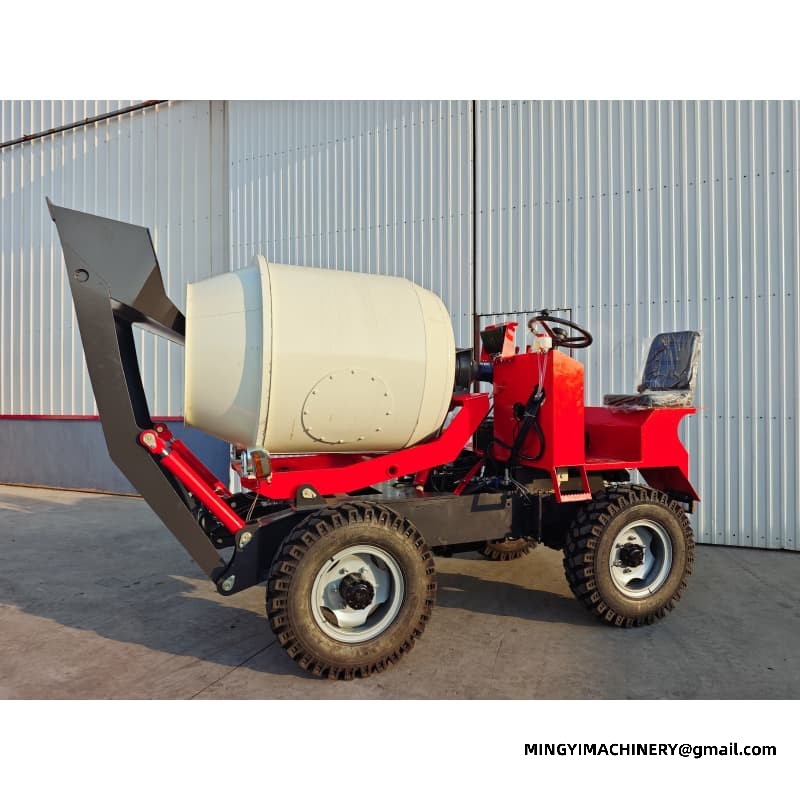
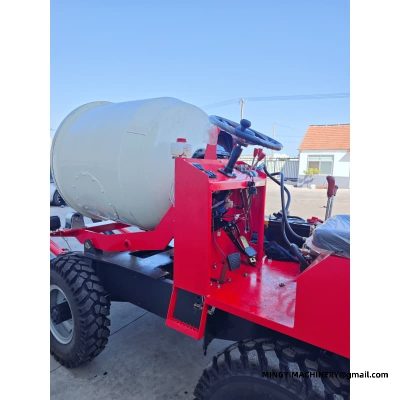
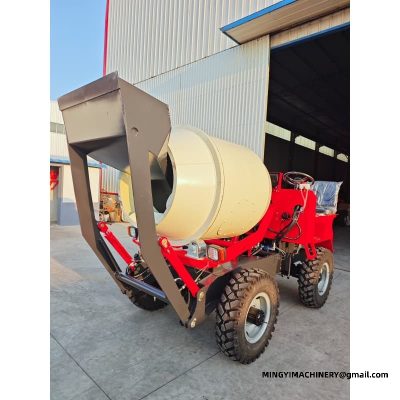
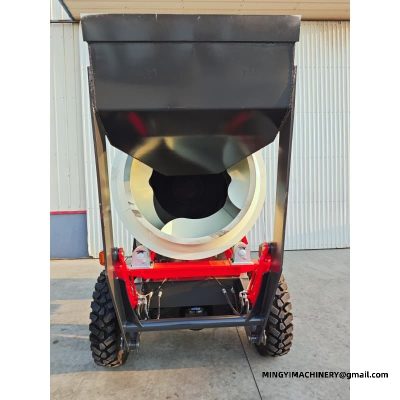
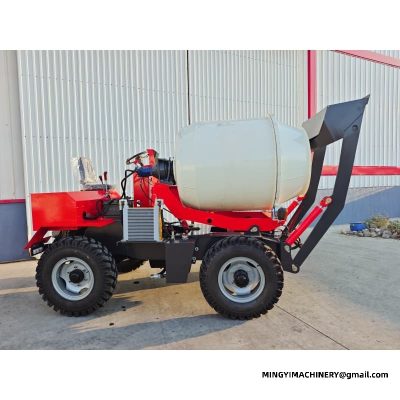
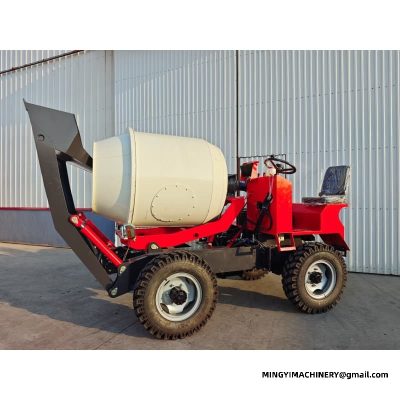
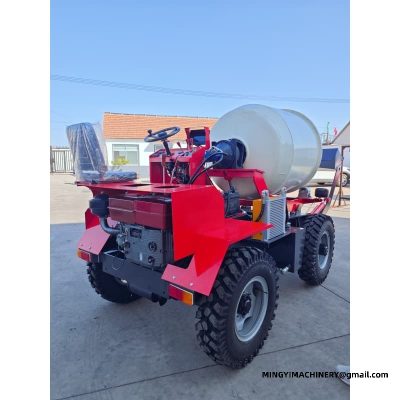
Small Capacity Self Loading Mixer, 1m3 / 1.5m3 Mixer Truck, Mini Transit Mixer
A self-loading mixer is bought for the distance between the aggregate pile and the pour. The 0.8 m³ drum, the 1,500 kg payload and the front shovel that feeds them answer one question — who mixes, and who carries? This page reads the published table as a small capacity self loading mixer buyer meets it on plantation work: capacity first, then the drive and steering that decide where the machine can actually stand.
Keep additions within the machine's published limits. A chute that adds reach also adds discharge height; a skip that adds capacity also adds the weight the chassis must carry. The 1,500 kg rating still governs the lot.
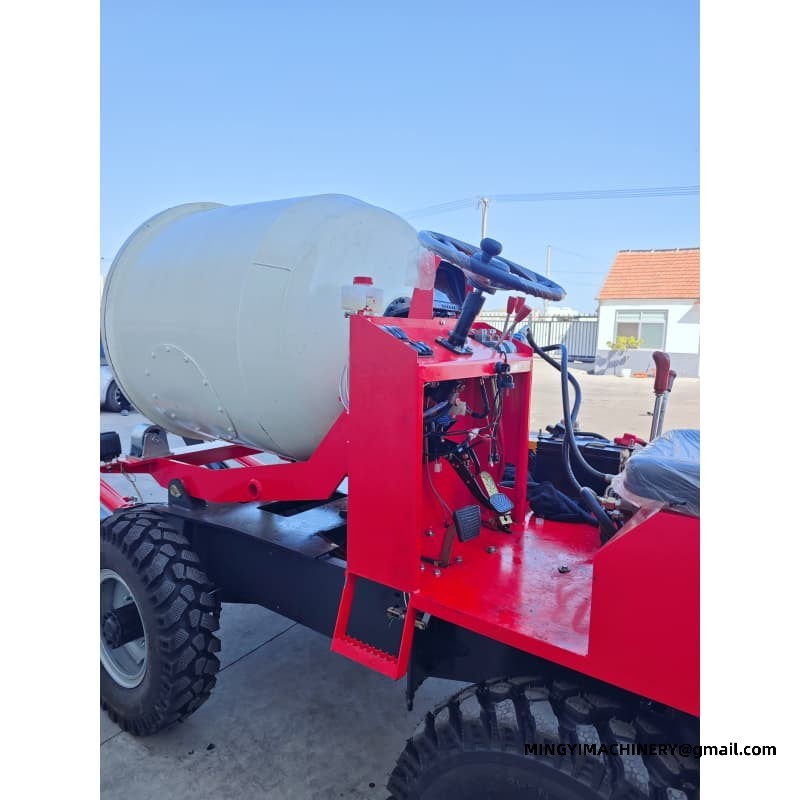
The open station is the machine's safety feature as much as its cab trade-off. Mirrors, a beacon and site lighting turn a fully visible operator into a fully visible machine, and on congested slabs that visibility is what prevents the near-misses closed cabs sometimes hide.
Many fleets run both: transit for the big slabs near town, self-loader for the long tail of small work everywhere else. The two machines rarely compete for the same batch.
The honest case for the hand mixer survives only at the very smallest scale — a two-man job, one batch an hour, concrete within barrow reach. One step past that, the self-loader's arithmetic takes over and does not give it back.
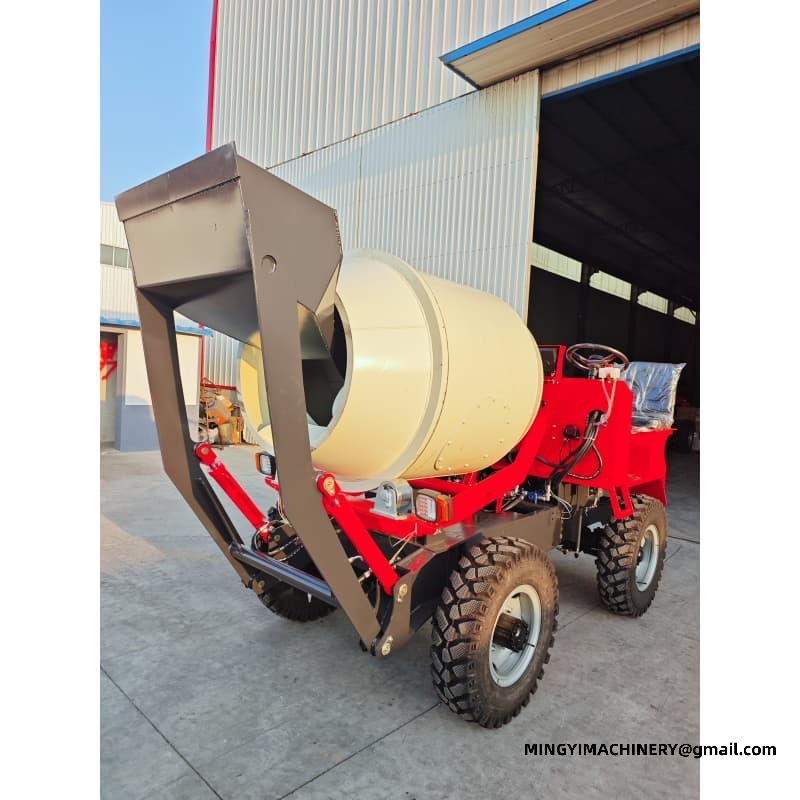
The width is the number that opens the most doors. At 1,600 mm the machine goes through standard double gates and between formwork lines that stop wider equipment, and it does so with a full drum because the drum sits inside the envelope, not above it.
The frame's load path is short and visible: drum to subframe to chassis rails to axles, with no outriggers and no overhang to manage. That simplicity is why the machine tolerates rough hauls on plantation work and why its frame rarely fatigues.
| Reference specification — 0.8 m³ 4WD self-loading concrete mixer | |
|---|---|
| Rated load | 1,500 kg |
| Rated capacity | 0.8 m³ |
| Overall dimensions (L x W x H) | 3,500 x 1,600 x 2,200 mm |
| Front tyre size | 8.25-16 |
| Rear tyre size | 7.50-16 |
| Minimum ground clearance | 204 mm |
| Steering angle | 28° |
| Turning dimension (outer tyre) | 2,464 mm |
| Maximum travel speed | 24 km/h |
| Transmission | 4WD |
| Gears | 3 forward / 1 reverse + travel gear |
| Front axle | 130 drive axle |
| Rear axle | 212 selectable 4WD steering axle |
| Engine | single-cylinder diesel / 25 hp |
| Steering | hydraulic power steering |
Discharge lands where the operator aims it. That single fact shapes the whole workflow on plantation work: the drum pours into a barrow, a bucket or straight to formwork, and the crew never moves concrete twice.
A drum cleaned daily lasts the machine's life; a drum cleaned weekly builds a heel of hardened paste that permanently cuts capacity below 0.8 m³ and unbalances the blades. The five minutes after the last pour are the simplest maintenance the machine ever gets.
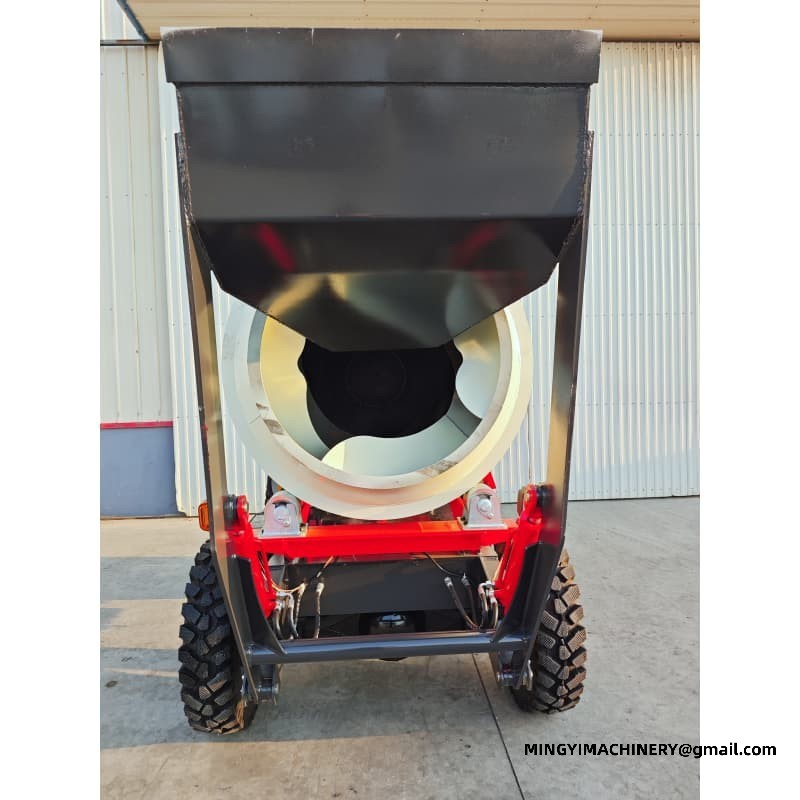
25 hp is modest by highway standards and exactly right for this duty. The machine's work is short, heavy efforts — loading, climbing, tipping — and a small diesel spends most of its day loafing between them, which is where fuel economy and engine life both come from.
Fuel quality is the one consumable worth policing. Dirty or wet diesel is the single biggest cause of injector trouble in engines of this pattern, and a simple water separator in the fuel line is simpler than one injector on plantation work.
plan service against hours too. Oil, filters and greasing key off the meter, and a machine worked hard in a season reaches its first major check sooner than a machine worked occasionally. The meter tells the truth either way.
Utilisation is the quiet number that decides payback. A machine used four hours a day beats an identical machine used one hour a day and parked the rest, and the difference is almost entirely waiting — for cement, for the finishers, for the next bay.
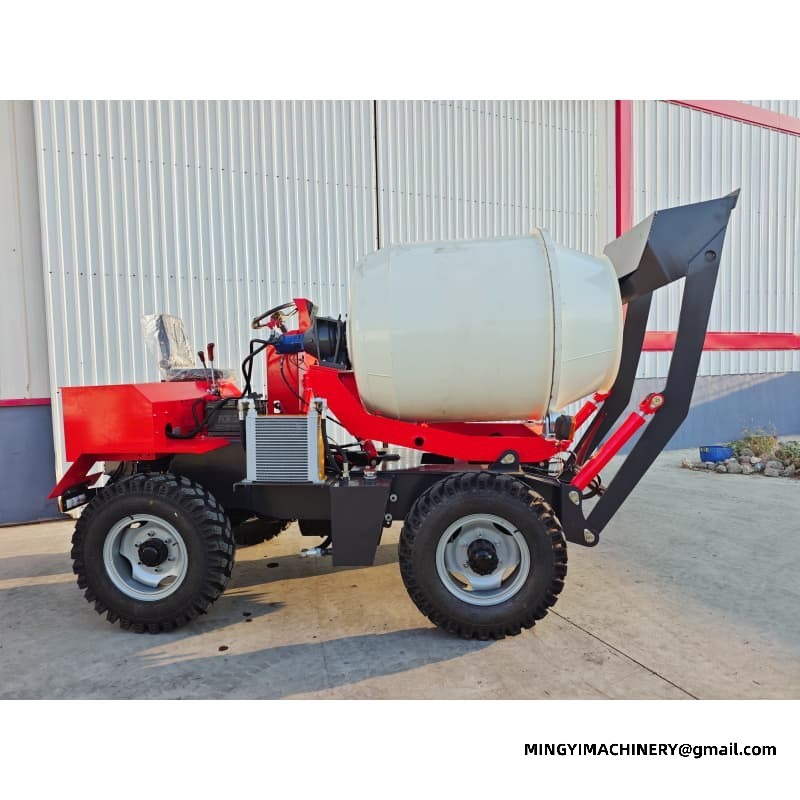
The hydraulic circuit drives the power steering, the drum rotation and the shovel hydraulics from one pump off the single-cylinder diesel. Three consumers, one source — which is why the engine's health and the oil's cleanliness are the same subject on this machine.
The tell is noise: a whining pump or juddering steering means the oil is not ready. Operators who warm the circuit before the first batch on plantation work hear the difference and save themselves a season of leaks.
On a well-run machine the chassis and drum outlast several sets of consumables: shovel pins and bushings, drum blades, tyres, belts, hoses and filters are the renewal cycle. The single-cylinder diesel is the long-life heart, and its overhaul parts are stocked wherever single-cylinder diesels are common.
The honest arithmetic counts wages not spent, ready-mix charges avoided and pours kept on schedule. Against those, the purchase decision is the smallest line on the page.
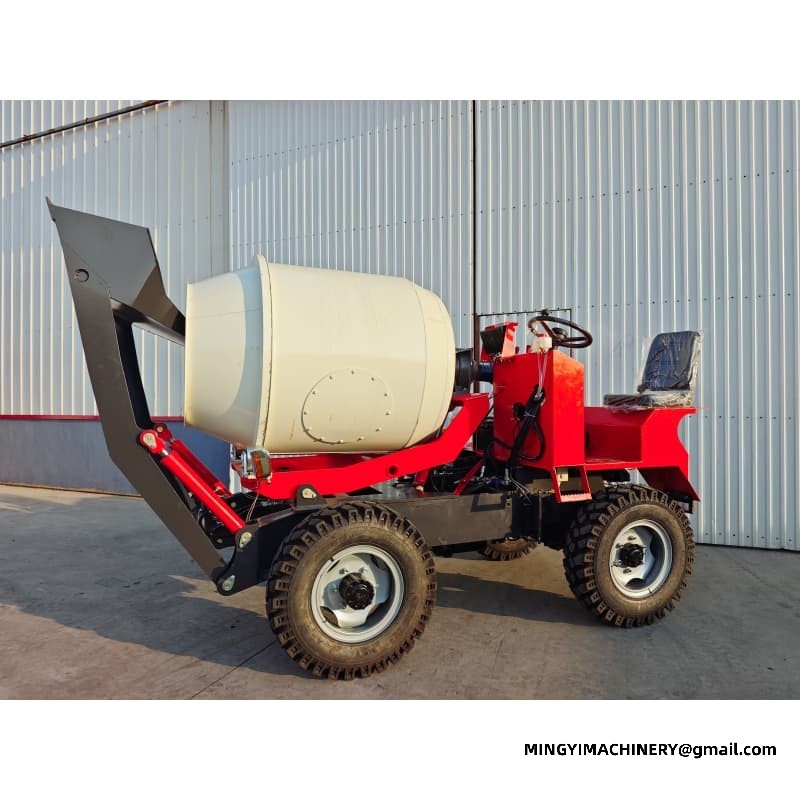
Read the two clusters against your site, not against the brochure. The figure that decides the sale is usually the smallest one: turning circle, clearance or width, whichever your worst gateway on plantation work happens to be. The big numbers sell the machine; the small ones qualify it.
List the axle numbers on the same sheet as the engine numbers. A machine whose running gear is stocked regionally is a machine that spends its life working instead of waiting, and the difference shows up in the uptime over a season on plantation work.
24 km/h is not fast and should not be. The machine carries 1,500 kg of wet concrete high on a short wheelbase, and the gearing keeps those loads sedate. Crews that respect the speed keep the concrete in the drum and the machine on its wheels.
Shift on the move only between close ratios; come to rest for anything involving the travel gear. The gearbox is simple and strong, and the abuse that kills gearboxes — ramming selectors under load — is entirely avoidable on plantation work.
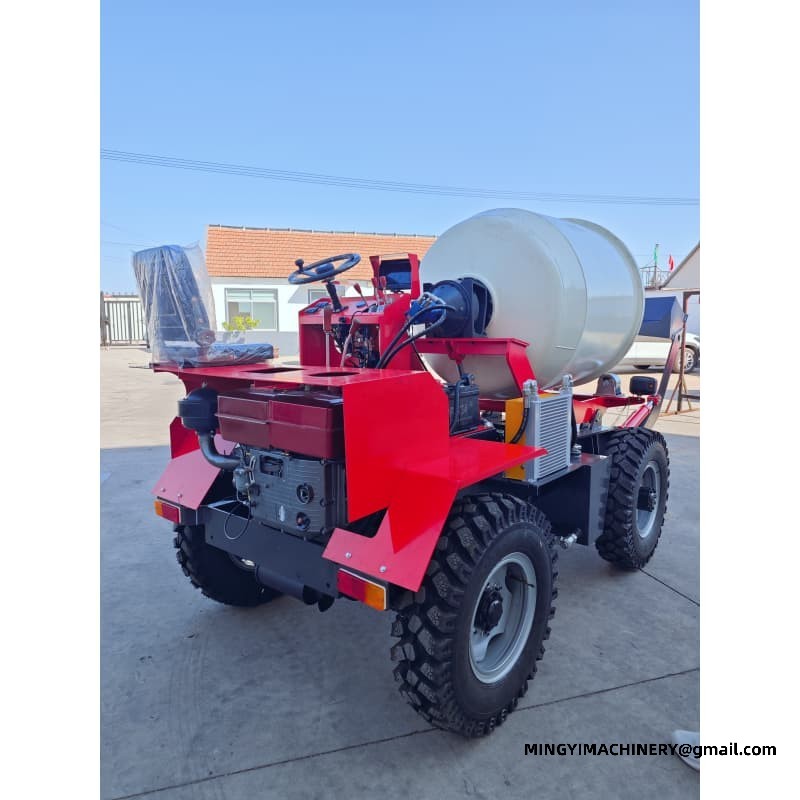
Read the ground before the first trip of the day on plantation work. A route that crossed easily yesterday may have a new trench, a spoil heap or a flooded patch overnight, and 204 mm gives the operator a plain number to judge it against.
A loaded drum raises the centre of gravity, and every slope question follows from that. The machine handles site ramps and graded ground at crawl speed in low gear; it is not a slope specialist, and cross-slopes with a full drum deserve a slower, straighter line than empty running.
Ask for photographs of the actual unit and its serial plate, not brochure images. The machine is simple enough that a five-minute video call at handover — controls, drum, shovel, axles — answers more than a week of messages.
At 3,500 x 1,600 x 2,200 mm the machine ships in a standard container without disassembly beyond lashing. On arrival: check the drum and shovel for transit damage, turn the engine by hand before first start, prime the hydraulic system, and run the drum empty before the first batch.
The machine itself copes well — the single-cylinder diesel is air-cooled territory and dust, not heat, is its enemy. Filter checks are the hot-season habit that matters on plantation work.
Antifreeze discipline applies to the engine year-round in cold markets, and the drum benefits from the same thinking: a wash-out that leaves water pooled in a low point will freeze, and ice in a drum is a morning's chiselling.
Fix the mix design for post-hole and shed-base concrete once, write it down, measure the water, count the scoops, time the drum — and the batches on plantation work will be more consistent than most hand-mixed concrete has ever been.
Cement count, aggregate count, water measure, drum time — four numbers per mix design, and every crew member should be able to recite them. The machine's repeatability turns those four numbers into strength rather than into hope.
Does the small capacity self loading mixer have a cab or canopy?
The machine is an open station by design — short, low and simple. Confirm with the supplier what weather protection options exist for your market before ordering.
Can the small capacity self loading mixer carry aggregate without mixing?
Yes, within the 1,500 kg payload — moving sand and gravel between stockpile and mixer is a common secondary use, discharged by tipping the drum.
Can I inspect my small capacity self loading mixer before it ships?
Ask for photographs and a running video of your actual unit with its serial plate, or a third-party pre-shipment inspection. Suppliers who refuse the request are answering it.
My small capacity self loading mixer steering whines when cold — is that normal?
It is the sound of thick hydraulic oil, not a fault. Warm the circuit with light cycling before the first shovel lift; persistent noise when warm, however, needs a hose or suction check.
Does the small capacity self loading mixer need a driving licence?
Depends on your market's rules for site plant versus road use. Where it works inside private sites, site-operator rules apply; regular road travel changes the question.
Where should the small capacity self loading mixer stand during a pour?
On a rehearsed standing spot with the discharge arc clear and a spoken stop signal agreed. Ten minutes of positioning planning saves an hour of manoeuvring on plantation work.
Is a bigger drum always better than a small capacity self loading mixer?
No. Bigger drums ride on bigger chassis that lose the gateway, the low height and the single-operator economy. Size the drum to the pour, not to the brochure.
How heavy is the small capacity self loading mixer?
The published table specifications 1,500 kg of rated load and the overall envelope; for the transport weight of your specific build, ask the supplier for the shipping specification in writing.
Worked on plantation work, the machine pays for itself in the batches it keeps on schedule and the crews it frees from barrow chains. The specification above is the whole story — short, honest and enough to size the decision.
Hot, humid and dusty conditions around Small Capacity Self Loading Mixer: Why 0.8 m³ Fits the Pour
Humidity attacks the parts that are not used. Storage in a damp climate means Small Capacity Self Loading Mixer: Why 0.8 m³ Fits the Pour needs the exposed metal protected and the machine run regularly, because standing still does more damage than working.
Reading the early symptoms on Small Capacity Self Loading Mixer: Why 0.8 m³ Fits the Pour
The symptom is usually not at the fault. A hydraulic function that has become sluggish on Small Capacity Self Loading Mixer: Why 0.8 m³ Fits the Pour may point to a filter, a relief setting or a pump, and starting with the simple checks avoids the wrong guess.
Cold weather and winter care for Small Capacity Self Loading Mixer: Why 0.8 m³ Fits the Pour
Starting is only the first problem. Until Small Capacity Self Loading Mixer: Why 0.8 m³ Fits the Pour reaches working temperature the hydraulic response is slower and the seals are stiffer, and warming the machine before asking for full output avoids unnecessary strain.
Fuel, oil and fluid quality for Small Capacity Self Loading Mixer: Why 0.8 m³ Fits the Pour
Most engine trouble starts with what went into the tank. Clean fuel, stored properly and filtered before it reaches Small Capacity Self Loading Mixer: Why 0.8 m³ Fits the Pour, prevents more downtime than any other single habit an owner can adopt.
Wear items and spares worth holding for Small Capacity Self Loading Mixer: Why 0.8 m³ Fits the Pour
The parts that stop a machine are rarely the parts that are hardest to find. Filters, belts, seals and the ground engaging tools on Small Capacity Self Loading Mixer: Why 0.8 m³ Fits the Pour are easy to hold and slow to replace, which is why they belong on the shelf rather than on an order.
Contact MINGYI Machinery for the current self-loading concrete mixer specification, export packing and a formal specification for your market. E-mail: sales@mingycn.com | LINE (ID): mingyicn
Easy Operation Self Loader: One Operator, Full Cycle · Heavy Duty Duty Cycle: What a Self Loading Cement Truck Carries · 4x4 off road dumper Africa with hydraulic tipping body · Mini Self-Loading Concrete Mixer









