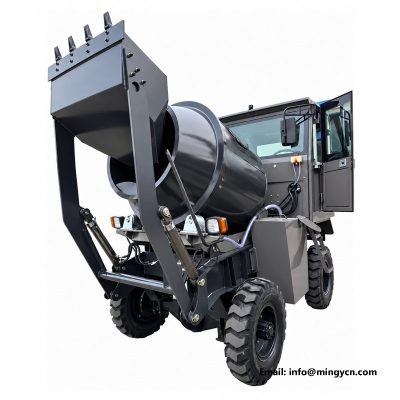
0.8 m³ 4WD Self Loading Concrete Mixer with Reinforced Front and Rear Axles, Deep Lug Tyres, 25 hp Diesel, for Southeast Asia, Africa and Central Asia
On the sites this machine is actually bought for, the axles and the tyres fail long before the drum does. A 0.8 m³ self loading concrete mixer spends its working life on farm tracks, village roads and unfinished earthworks, not on workshop floors. Every batch it carries is carried by four tyres and two axles across ground that was never prepared for it. That is why this variant of the standard 0.8 m³ four-wheel-drive machine is built around a reinforced front drive axle, a reinforced steering rear axle and deep-lug tyres with a tread block close to 30 mm thick.
This page is about that axle and tyre package. It covers what is physically different on the machine, what the reinforcement changes on unpaved sites, and how the same build holds up in the three markets where most of these mixers work: Southeast Asia, Africa and Central Asia. The specification, the shipping notes and the questions worth asking before you order are all further down the page.
A loaded batch is not gentle cargo. A rated load of 1,500 kg of mixed concrete, plus the drum, the water tank and the diesel, all ride on a chassis that is shorter than a small pickup. When that load drops into a rut at walking pace, the axle housing takes the whole shock as a bending load, and the sidewall of the tyre takes it as a pinch. Machines that are built for yard work are built with just enough axle for the rated load on flat ground. The first season of virgin ground takes the margin away.
The failure sequence on an under-specified machine is always in the same order. First the tyres chunk and crack where the tread blocks are thin. Then the front drive axle starts leaking at the housing seams because the casing has flexed. Then the steering rear axle knocks at the pivot. None of these failures is dramatic, and all of them pull the machine off site for weeks, because axle and tyre parts are the slowest items to reach a remote project.
Reinforcing the axles and fitting a thicker tread up front costs a few percentage points on the ex-works price. It removes the two most common season-enders from the list. That arithmetic is the entire reason this variant exists.
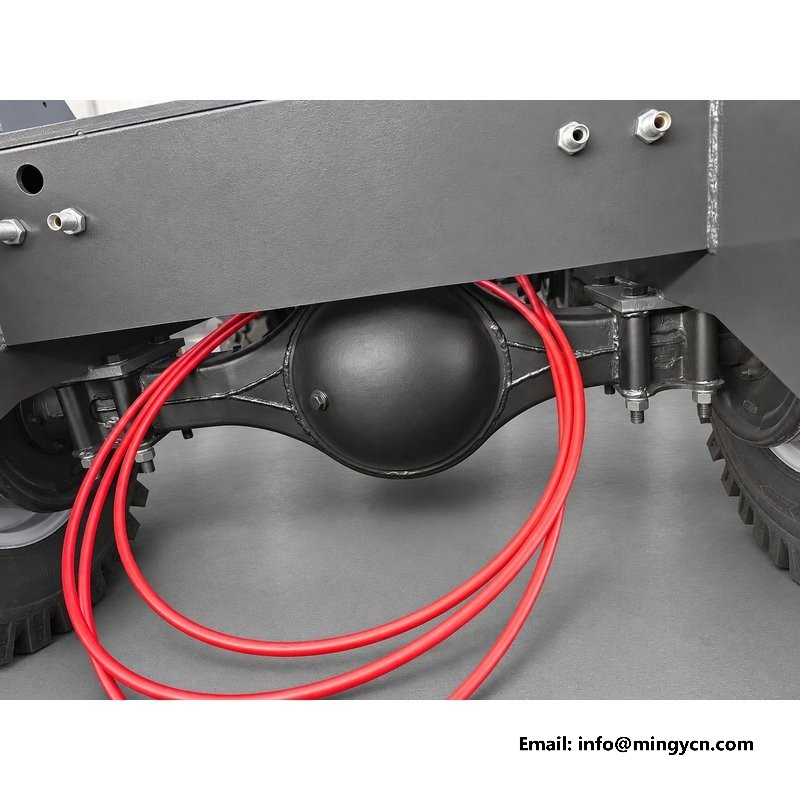
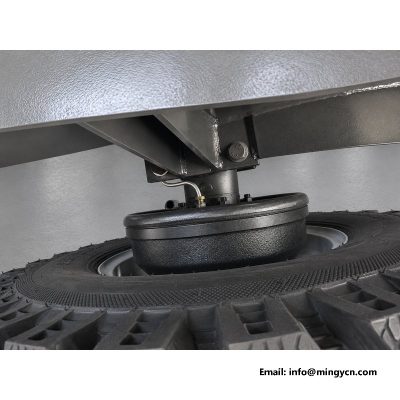
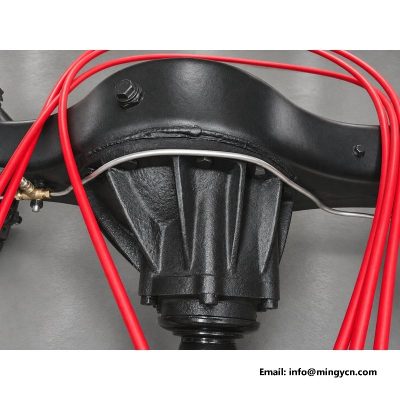
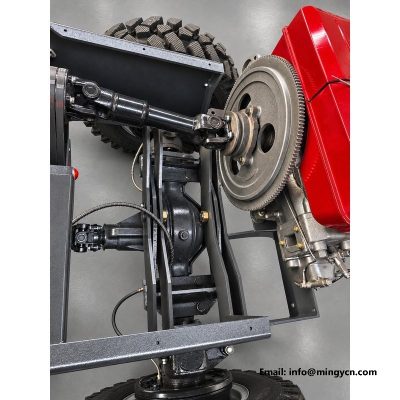
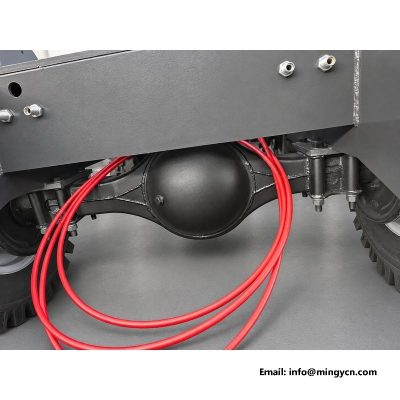
The front drive axle on this build is an uprated automotive-type housing in the 130 axle class, with a thicker cast steel banjo casing and enlarged bearing seats at the hub ends. The reinforcement is not a cosmetic rib: the casing wall is heavier, the flange that carries the final drive is machined from a thicker blank, and the hub studs and wheel fixings are the heavy pattern used on light trucks rather than on agricultural carts.
Two details are worth checking when you compare quotes between suppliers. The first is whether the front axle is a true drive axle or a reduced-cost variant that drives through a lighter differential; on a four-wheel-drive mixer the front axle pulls half the machine out of soft ground, so the differential and its bearings are load-bearing parts, not accessories. The second is the hub fixing: eight heavy studs on a braked hub is the specification to look for. Both are visible in the photograph above without any disassembly.
Because the axle is a standard industrial pattern rather than a proprietary casting, seals, bearings and shafts are items any agricultural machinery dealer in a district town can source. That matters more in the third year of a project than on the day the machine is unloaded.
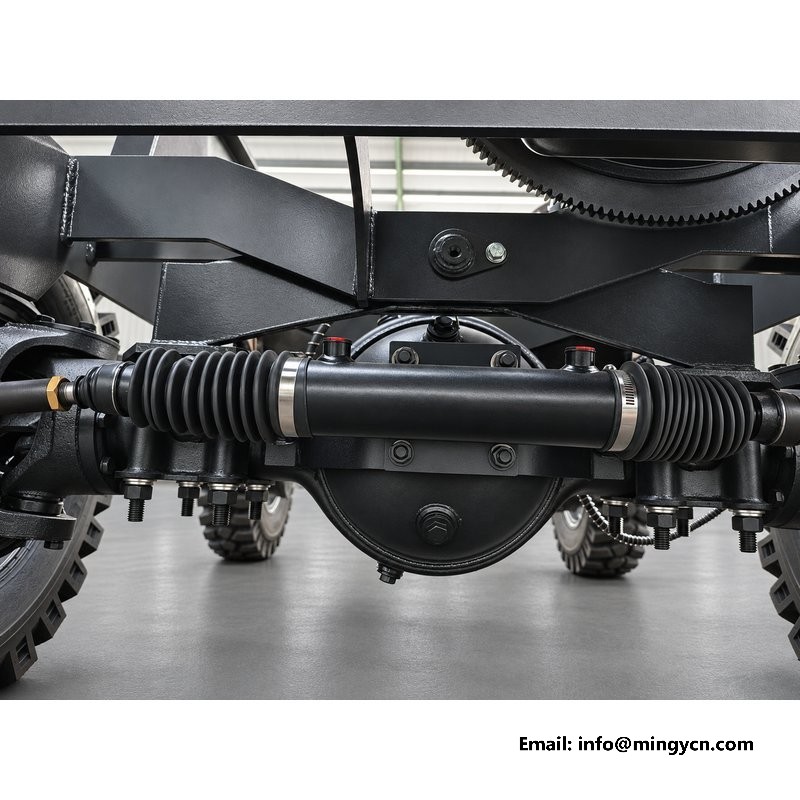
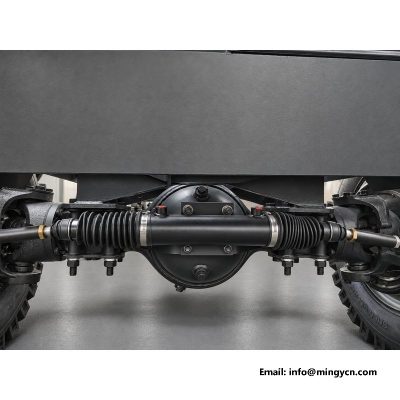
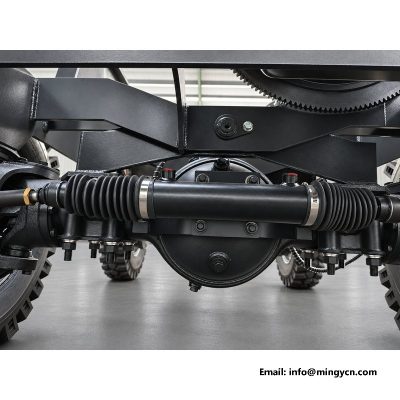
The rear axle is a 212-type steering axle, selected for four-wheel drive, mounted on a central pivot so the rear of the machine can oscillate relative to the frame. On uneven ground this does two jobs at once. In travel, the pivot lets all four tyres stay on the ground when the terrain twists, so traction and steering response do not drop out every time one wheel rides over a rock. Under load, it keeps the frame from being twisted between the front and rear contact patches, which is the load that eventually cracks imported welds around the drum mounting.
The driveshaft to the rear axle runs the length of the machine with a support bearing mid-span, and the coupling at the gearbox end is the flexible automotive type. The oscillation travel is deliberately limited by bump stops so the drum stays within its tilt envelope; a mixer is not a rock crawler, and the limits are set so the batch cannot spill at full articulation.
In practice, the oscillating rear axle is what makes the machine usable on canal banks, terraced plots and recently backfilled foundations, where a rigid rear axle would either spin one wheel in the air or lever the frame out of true.
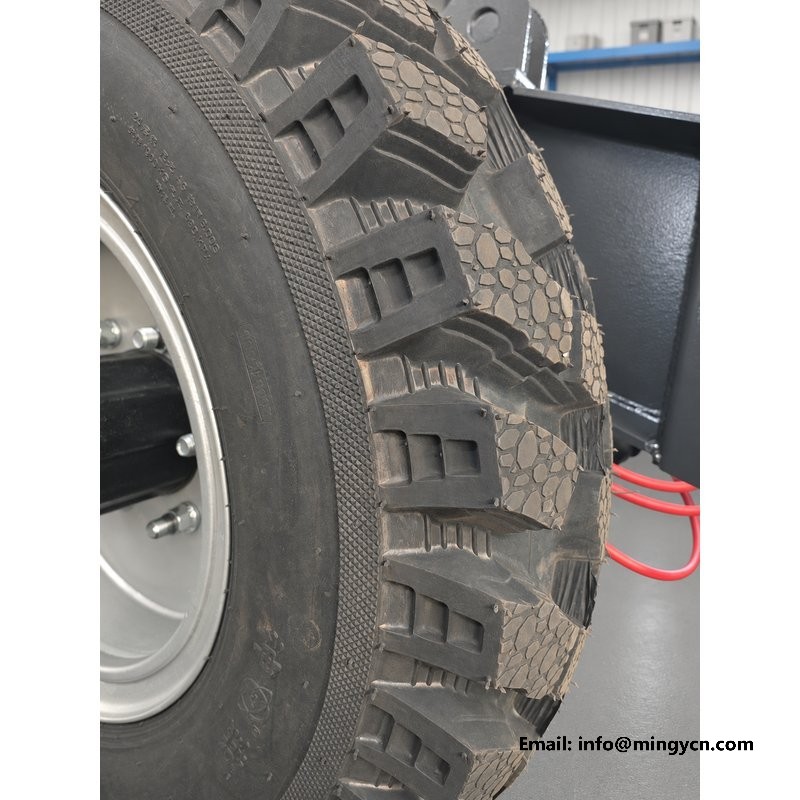
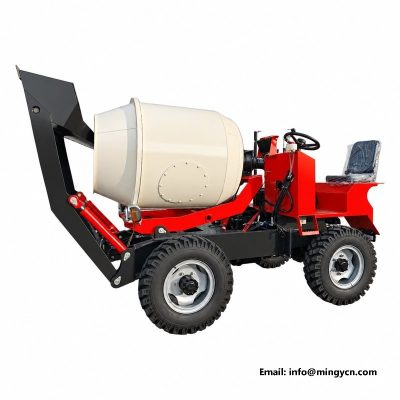
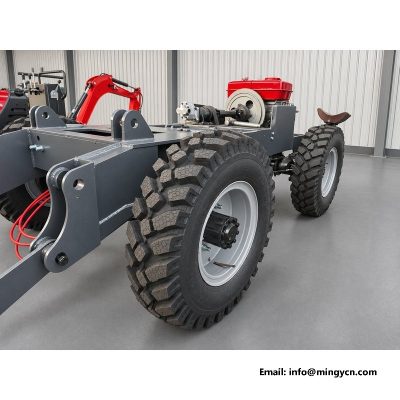
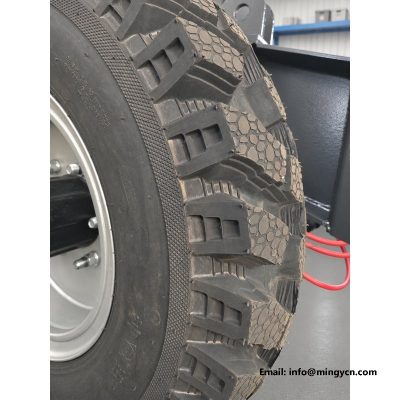
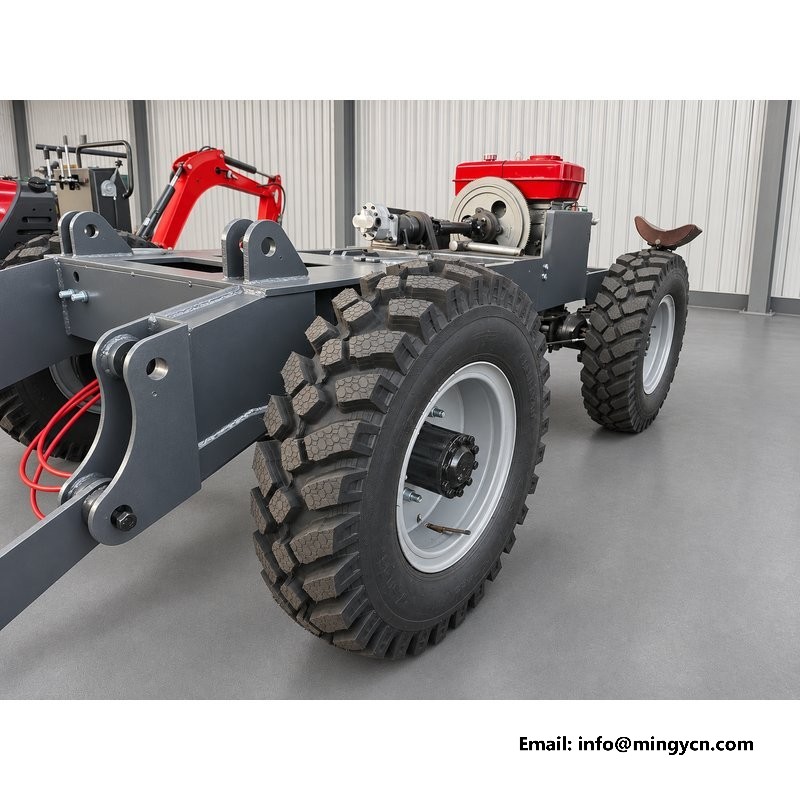
All four corners wear 7.50-16 bias-ply tyres in a deep traction pattern, and on this build the lug blocks are specified thick, close to 30 mm from crown to root. The photograph above is taken on the actual delivery machine, and the block depth can be checked with a rule at handover exactly as it is measured in the workshop.
What the deep lug buys on soft ground is simple: the blocks bite down through the loose top layer to the firmer material under it, and the wide gaps between them clear mud instead of packing solid. On sharp ground the benefit is different but just as practical. A thick tread block wears from the top for a long time before the casing is involved, so the tyre survives the gravel, rebar offcuts and broken masonry that a construction site spreads over every access track. Thin highway-pattern tyres of the same size fail at the casing long before their apparent tread is used up.
The front tyres on the standard machine are 8.25-16 and the rears 7.50-16; on this variant the deep-lug pattern is fitted to both axles so grip and wear stay matched front to rear. Tyres of this size are stocked by every truck tyre dealer in the regions this machine ships to, which keeps replacement local and cheap.
Power comes from a single-cylinder diesel of 25 hp class, hand-crank or electric start depending on the order, driving a layshaft gearbox with three forward ranges, one reverse and a separate travel gear. The engine is the same family that has powered small agricultural machinery across Asia and Africa for decades, which is the practical reason it is chosen: any mechanic who has serviced a walking tractor can service this engine, and filters, injector nozzles and spare pistons are on the shelf in every district town from Luzon to Uzbekistan.
The driveline from the gearbox splits to both axles for four-wheel drive, with the front drive taken through the reinforced axle described above. Hydraulic power steering is standard, fed from the same pump circuit that runs the drum, with the flow priority set so steering never fades while the drum is turning under load.
Fuel use at working throttle is in the range small mixers always occupy, a few litres per hour, and the single-cylinder layout means there is one injector, one filter set and one head gasket to stock rather than the four of a multi-cylinder engine. For a machine that often works an hour from the nearest town, simplicity is a maintenance strategy, not a compromise.
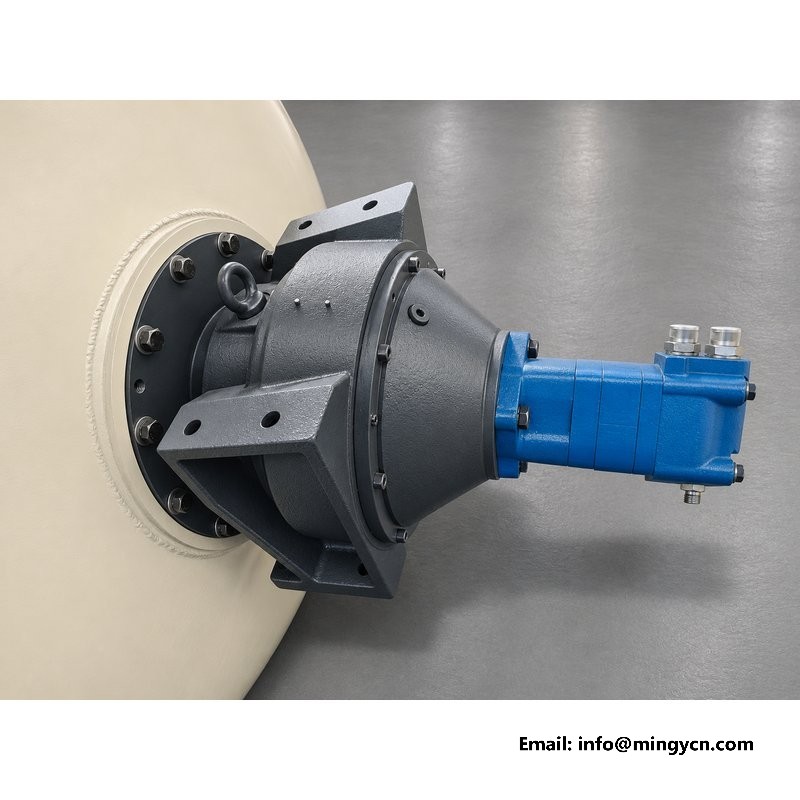
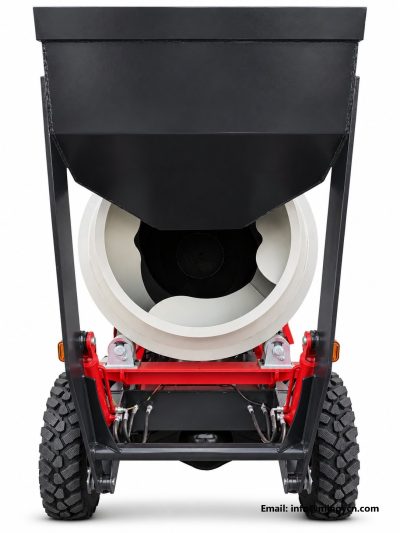
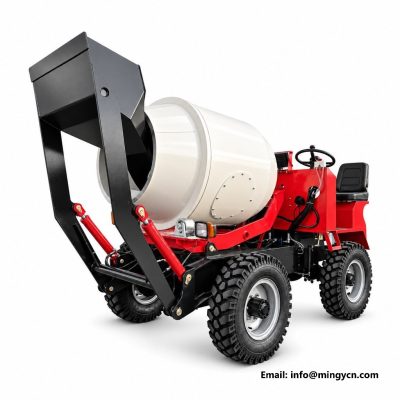
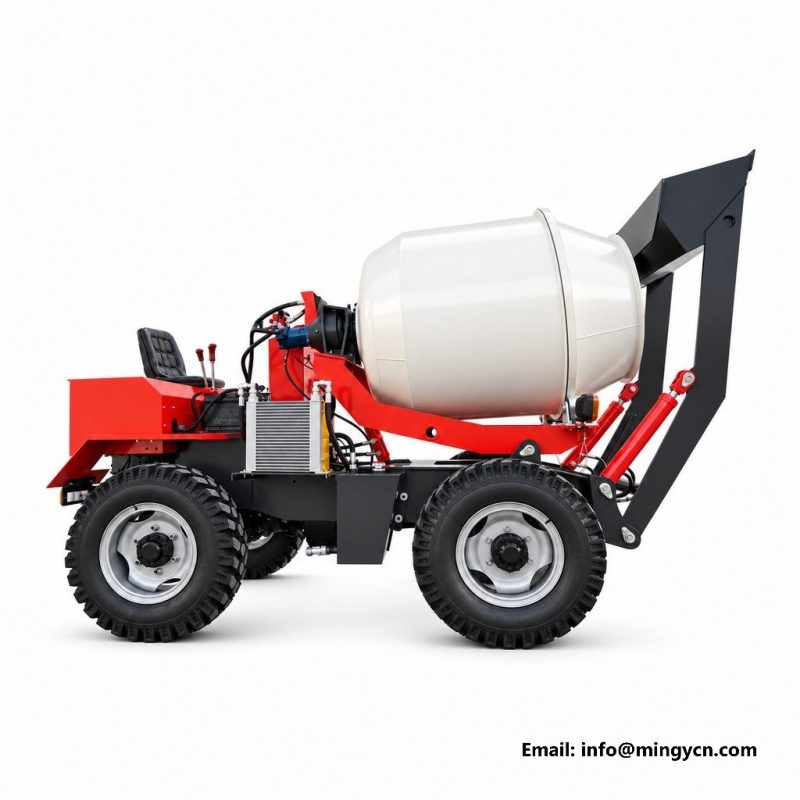
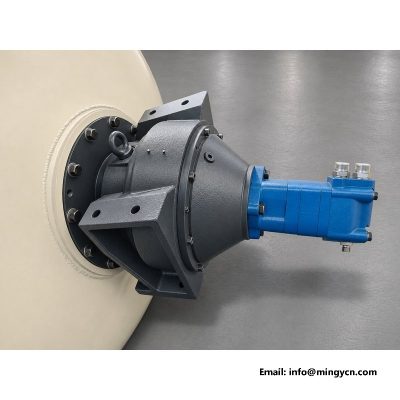
The drum is a 0.8 m³ class mixer drum in painted steel, driven at the rear by a hydraulic motor through a planetary reduction gearbox. Hydraulics rather than a belt or chain mean the drum speed holds under load, rotation reverses cleanly from charge to discharge without the operator leaving the seat, and there is no chain to tension in muddy conditions.
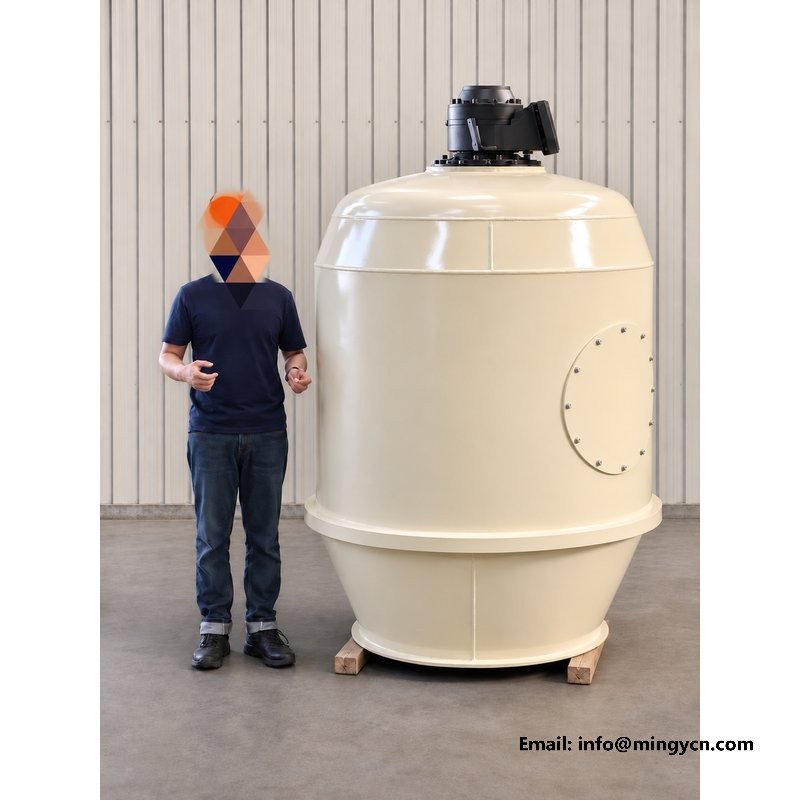
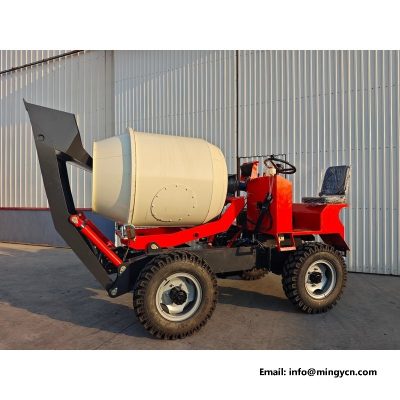
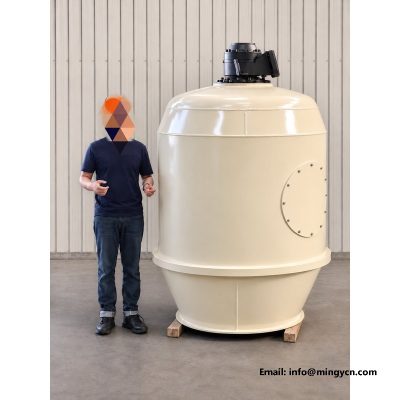
The second photograph shows the drum next to a person, which is the honest way to judge a capacity claim. The loading mouth sits at a height one person can shovel into, and the 0.8 m³ batch is the practical ceiling for a two-man crew working with a shovel and a water barrow: big enough that the crew spends its time mixing rather than loading, small enough that the batch is placed before it starts to stiffen in hot weather.
Drum rotation is hydraulic in both directions. Charging runs one way, discharge tilts and reverses the drum, and the same circuit allows the drum to turn slowly on long transfers so the batch does not segregate on the way to the pour. The self loading shovel on the front arm loads the aggregate and sand directly from the stockpile, and the water tank feeds a metered line into the drum rather than into the shovel, which is where batch-to-batch consistency actually comes from.
| Reference specification — 0.8 m³ 4WD self-loading concrete mixer, reinforced axle build | |
|---|---|
| Rated capacity | 0.8 m³ |
| Rated load | 1,500 kg |
| Overall dimensions (L x W x H) | 3,500 x 1,600 x 2,200 mm |
| Front tyre size | 8.25-16, deep lug, reinforced tread |
| Rear tyre size | 7.50-16, deep lug, reinforced tread |
| Minimum ground clearance | 204 mm |
| Steering angle | 28° |
| Turning dimension (outer tyre) | 2,464 mm |
| Maximum travel speed | 24 km/h |
| Transmission | 4WD |
| Gears | 3 forward / 1 reverse + travel gear |
| Front axle | 130-class drive axle, reinforced heavy-duty housing |
| Rear axle | 212 steering axle, 4WD, central oscillating pivot |
| Engine | single-cylinder diesel / 25 hp class |
| Steering | hydraulic power steering |
Dimensions are the transport envelope without the mirror set. Confirm the axle load rating and gross weight for your registration requirement before the machine is built, since axle ratings on the reinforced build are set by the tyre load index as much as by the axle itself.
Every claim on this page reduces to one sentence: the machine keeps its schedule on ground that would otherwise repair it weekly. In batching terms, the difference shows up as fewer unplanned stops. A mixer that does not need a tyre repaired or an axle repacked every week is a mixer that completes its planned batches, and on small works the planned batch is what the masons are standing around waiting for.
The second change is in the places the machine can reach. Deep lugs and four driven wheels climb wet clay ramps and sandy approaches that stop a highway-tyred machine part way. On road, culvert and small foundation work, the last fifty metres to the pour are routinely the worst fifty metres of the whole route, and they are exactly where this build earns its specification.
In the Philippines, Indonesia and mainland Southeast Asia the constraints are heat, humidity and rain on loose ground. Air-cooled single-cylinder diesels tolerate ambient temperatures that stress liquid-cooled engines, but they need clean cooling fins and an honest air path, so the daily routine is a brush-down of the shrouding before the first batch. Hydraulic oil runs hot in the monsoon months because the cooler is clogged with organic dust; the answer on site is the same as everywhere, check the cooler daily and change the oil on hours, not on hope.
Rain changes the ground faster than the weather report. A haul road that carried the morning batches dries into ruts by afternoon, and rutted clay is where thin treads and light axles go to fail. The deep-lug tread on this build is specified for exactly that afternoon condition. Island delivery is routine: the machine fits a 40-foot high-cube with the shovel folded, and port charges for the roll-on-roll-off islands are lower than for break-bulk because the machine drives off under its own power.
Kazakhstan, Uzbekistan, Kyrgyzstan and Tajikistan put distance between the site and the spares shelf. The machine travels there inside a container for weeks, and then works at the end of a road that may be graded twice a year. On those routes the parts that fail are the parts this page is about, so the build answers the distance question before it is asked: a reinforced front axle that tolerates corrugated access tracks, deep lugs that survive stony ground, and a single-cylinder engine whose every wearable part is a commodity item across the region.
Altitude derates naturally aspirated diesels by roughly one per cent per hundred metres. Above 2,000 metres the 25 hp single becomes a 20 hp single at full load, which is still enough for the 0.8 m³ batch at a slightly slower cycle. Tell the factory the site altitude when ordering; the governor and injector settings can be set for it before shipment, which costs nothing at order time and cannot be fixed with a screwdriver on site.
Across West, East and Central Africa the pattern repeats with sharper edges: laterite corrugations that chew tyre casings, fuel stations hours apart, and a spares economy that runs on what fits many machines. The deep-lug 7.50-16 and 8.25-16 sizes are common light-truck fitments, and the single-cylinder diesel shares parts with generations of small farm machinery. The reinforced axle housings are the parts least likely to be available locally anywhere, which is precisely why they are built heavy enough not to be needed.
For village water points, clinic builds and small bridge works, the machine is often the only powered equipment on site. It totes its own water, loads its own aggregate, and mixes where a transit mixer cannot physically stand. The reliability question is therefore not about convenience but about the whole build schedule, and the axle and tyre package is where that reliability is decided.
The package is heavier than the standard build, but it is not more complicated. Daily: a walk-round for cuts in the tyre sidewalls and lodged stones in the lug roots, and a glance at the hub faces for fresh grease or oil. Weekly: hub bearing play checked at the wheel rim, front axle breather cleared, and the rear pivot greased so the oscillation stays free. On the hours: oil changes in the axles at the intervals in the manual, and a torque check on the wheel nuts after the first fifty hours and after every tyre removal.
Tread depth is the one number worth writing down. Measure the lug blocks at delivery and again each month; when the block has worn to roughly half its original 30 mm, order the replacement set rather than waiting for the casing to show. Tyres are the cheapest wear part on the machine and the most expensive to fail on site, because a split casing strands the mixer wherever it stops.
The machine ships in a 40-foot high-cube container with the shovel arm folded and the battery disconnected, fixed to the container floor with welded stops and lashed. Documentation travels with the machine: packing list, engine and axle numbers matched to the commercial invoice, and a spare parts book with the axle and tyre part numbers already written in.
At handover, check four things against the photographs on this page. The tread block depth, measured with a rule at three points around the tyre. The hub stud pattern and count. The casting wall of the front axle housing, which is visibly thicker at the flange than the standard part. And the rear pivot bump stops, which should be present and intact. All four checks take ten minutes, and all four are the difference between the machine you ordered and a standard machine with a heavier price.
The reinforced front drive axle is specified with the four-wheel-drive build, because the front axle does real traction work in 4WD. The deep-lug tyre set and the oscillating steering rear axle can be ordered on either version. Say which combination you want at order time; the factory builds to the written specification.
Pattern depth and block thickness. The deep-lug blocks are close to 30 mm and shaped to clear mud; a highway tyre of the same size carries a shallower ribbed pattern meant for sealed roads. On soft or sharp ground the highway tyre packs and chunks, the deep lug keeps biting and wears down from the crown.
Yes, within the guard and articulation clearances, and it is a common request for very soft ground. Note that changing the front-to-rear rolling ratio is not an option on a 4WD machine, so both axles must change together. Confirm with the factory before ordering tyres locally, because the load index also changes.
A few tens of kilograms, mostly in the front axle housing and the heavier tyre casings. It does not change the container plan: the machine still ships one unit per 40-foot high cube with the shovel folded.
One set of front hub seals and bearings, a driveshaft universal joint, one tyre and tube of each size, a filter and injector set for the engine, and the hub stud and nut set. All of it fits in the drum for shipping and covers the failures that would otherwise stop a remote site for weeks.
Contact MINGYI Machinery for the current reinforced-axle self loading concrete mixer specification, export packing and a formal quotation for your market. E-mail: sales@mingycn.com | LINE (ID): mingyicn
For the standard build of the same machine, see 0.8m3 Rough Terrain Mixer: Ground Rules Before the Pour and Wheeled Diesel Self-Loading Mixer: Tyres and Traction. For the full range of drum and discharge configurations, browse the mini self loading concrete mixer category, and for site application notes, read the self loading mixer buying guides.