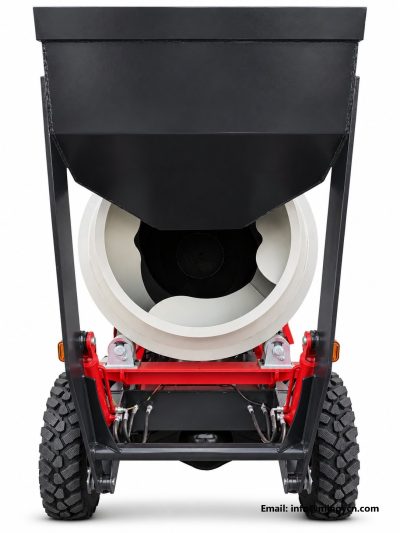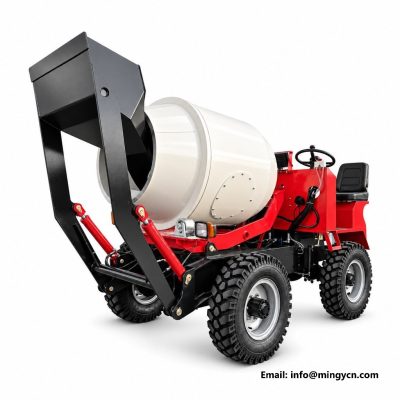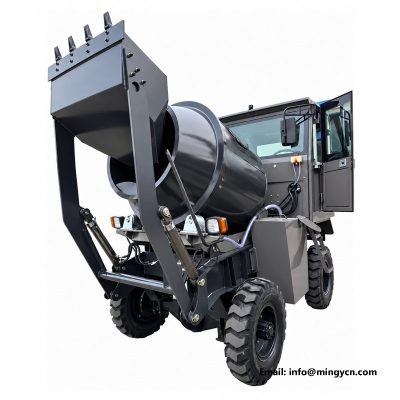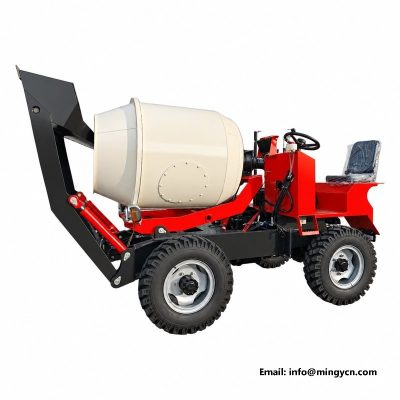
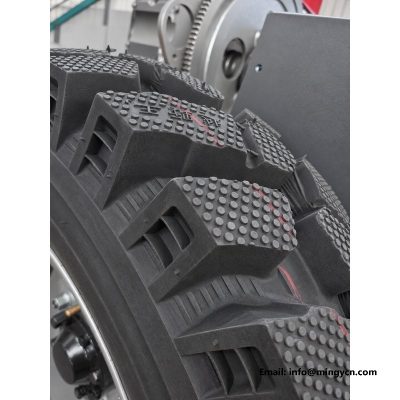
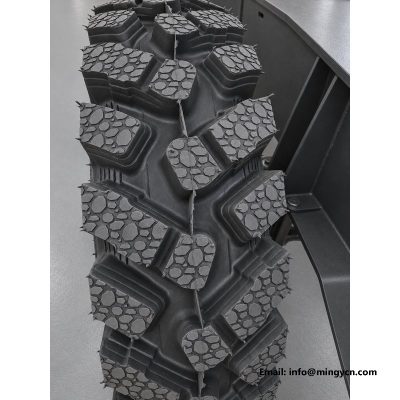
Deep Lug Tread Blocks Close to 30 mm Thick on the 7.50-16 and 8.25-16 Tyres of the 0.8 m3 Self Loading Mixer
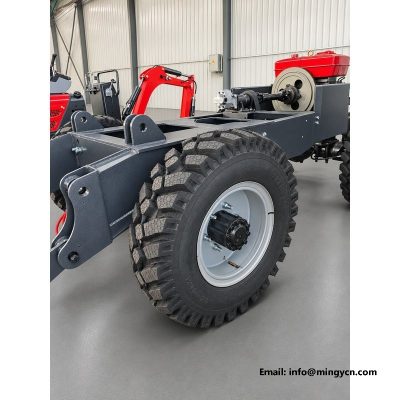
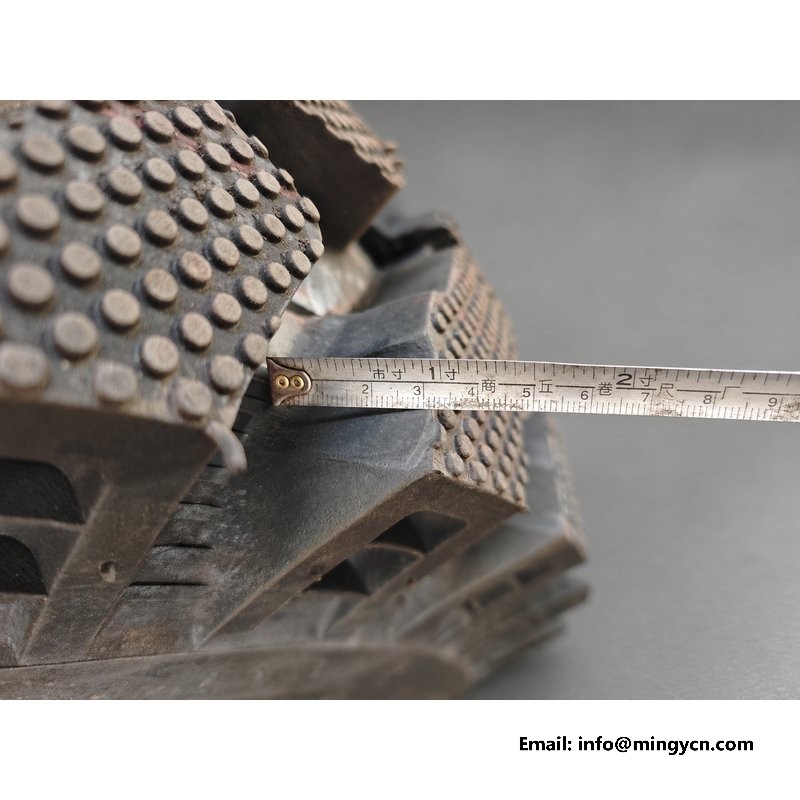
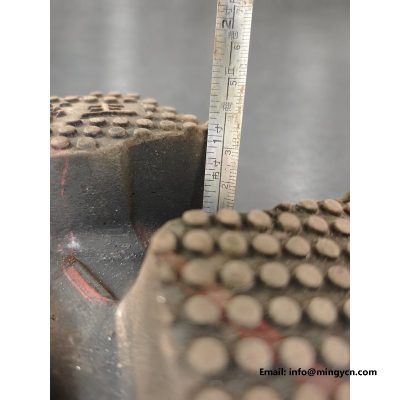
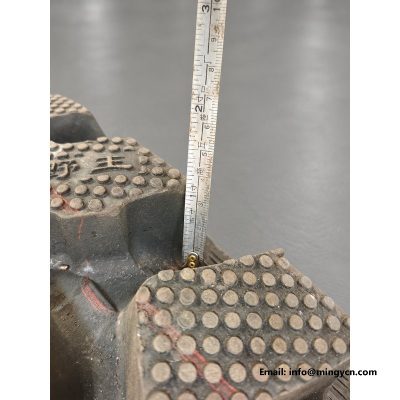
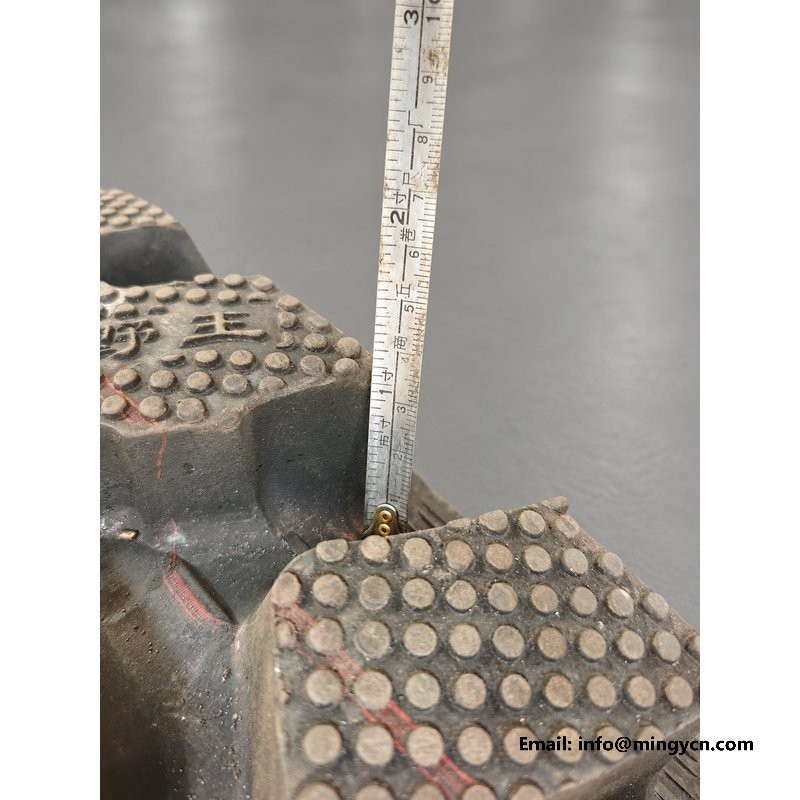
Any supplier can write “deep lug tyres” on a quotation. This page shows the measurement that turns the phrase into a number. On the photographs here, a steel rule stands against the tread blocks of the 0.8 m³ self loading mixer’s tyres in the workshop, and the blocks measure close to thirty millimetres from root to crown. That figure, and the shape of the block behind it, is the difference between tyres that survive a season of virgin ground and tyres that are done before the project is half built.
The sections below explain how the measurement is taken, why block thickness matters more than pattern name, how the tread is constructed, and how a buyer can repeat the same measurement at handover with nothing more than a rule.
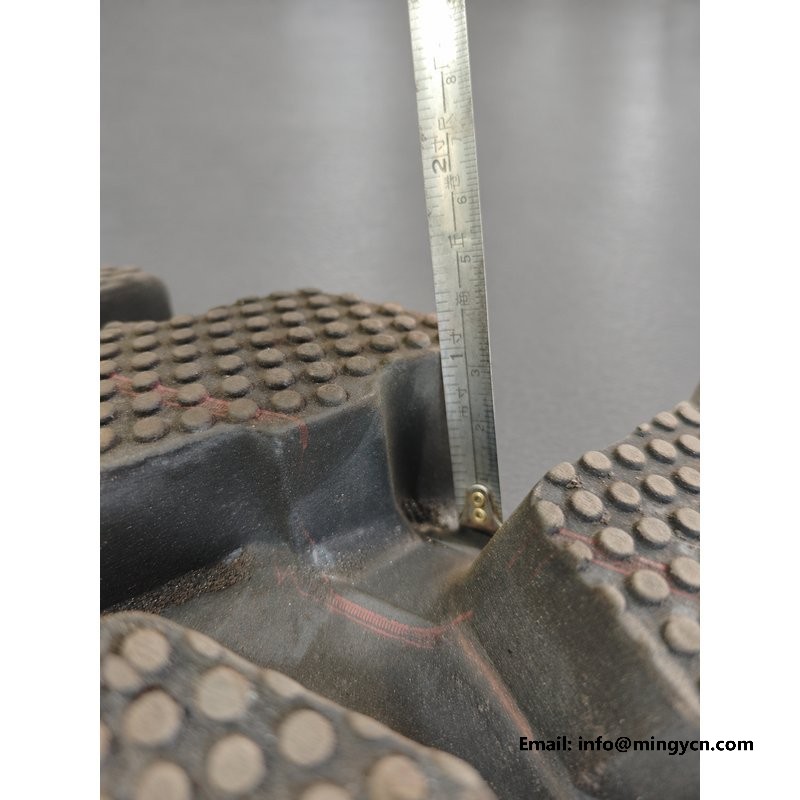
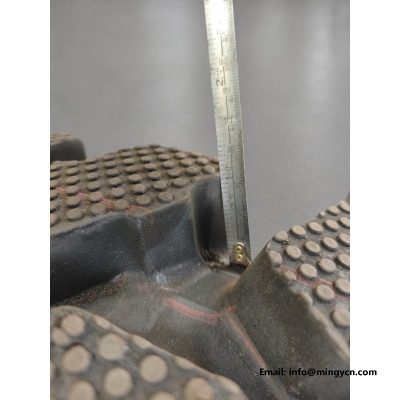
The method is deliberately simple so that anyone can repeat it. The rule is seated on the root surface between two lug blocks, standing vertically against the block face, and the reading is taken at the crown. Three points around the tyre, averaged, give the block depth. On the machine as delivered, the blocks on the driven wheels measure close to thirty millimetres, and the photographs in this page are of the actual production tyres rather than of a demonstration sample.
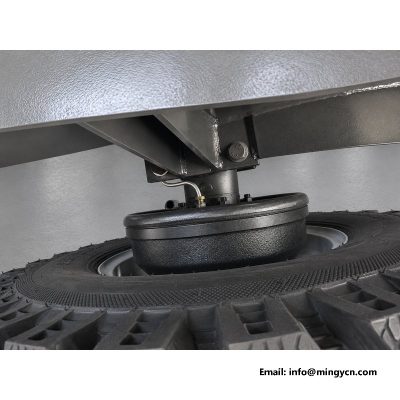
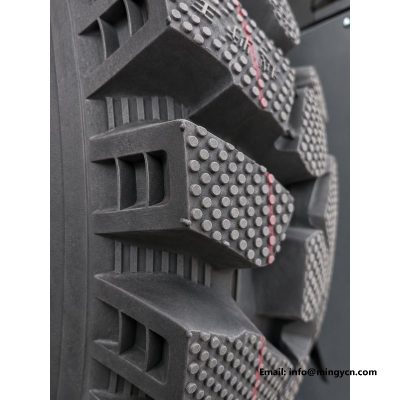
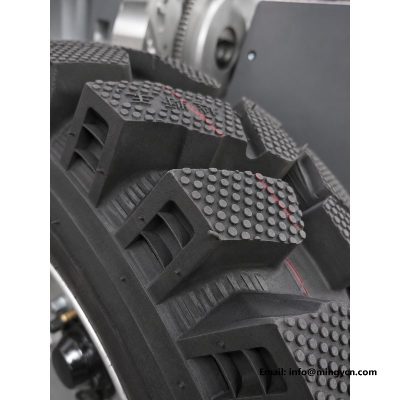
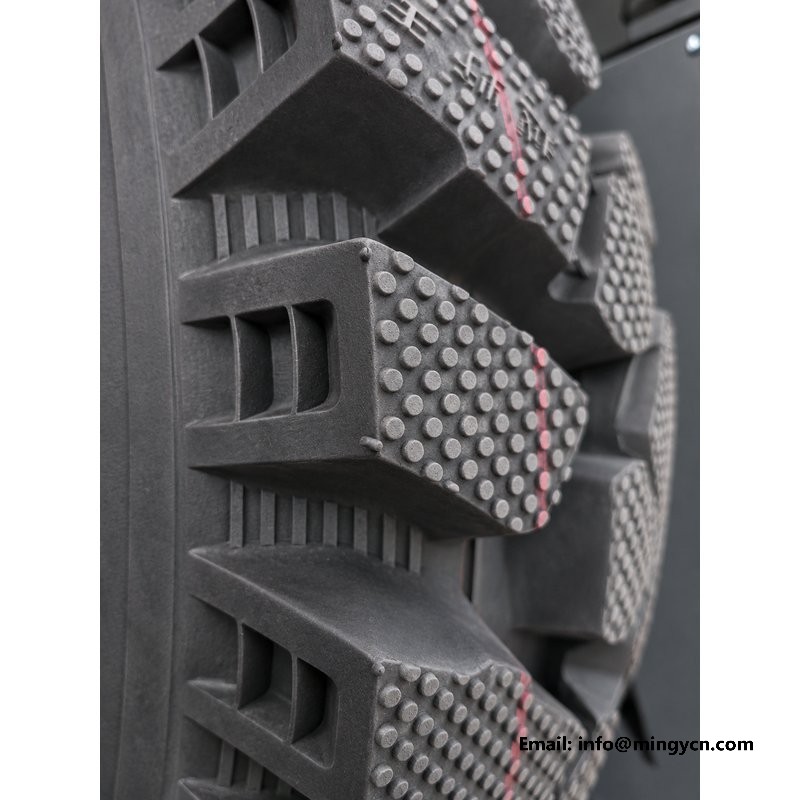
Depth alone is not the whole story, which is why the photographs also show the block shape. A tall block that tapers thinly will measure the same as a squat block with a wide foot and cut away half as fast. The blocks on this tyre keep near-full width from root to crown, so the measured depth stays meaningful as the tyre wears.
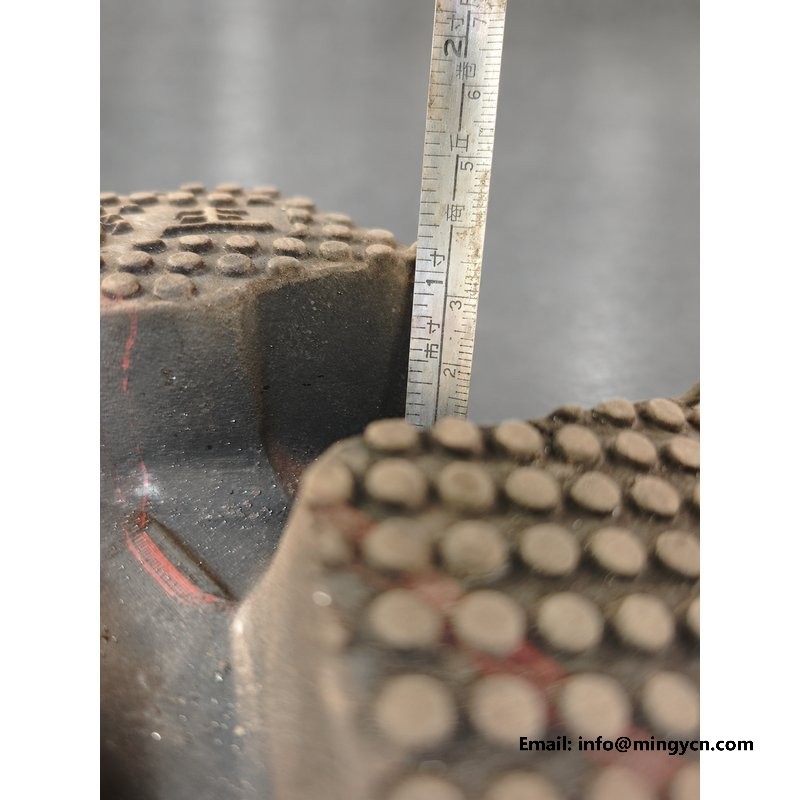
Deeper sounds better until physics joins the conversation. A lug block works by flexing: it loads as it meets the ground, grips, and springs free, shedding what stuck to it. A block that is too tall for its section flexes sideways, tears at the root, and chunks off in pieces. Around thirty millimetres on a 7.50-16 carcass is where the block is tall enough to bite through loose material and stiff enough to survive doing so. This is the same balance agricultural tyre makers strike on traction fitments, and it is why the figure repeats across the industry.
Buyers comparing quotations should treat any claimed depth far above this with curiosity and ask for the same photograph shown here, a rule against the block.
The tread is a bias-ply construction in a deep traction pattern. Bias ply matters on this machine for two reasons: the carcass presents a taller, more flexible footprint at low pressure, which is what loose ground wants, and the construction is repairable anywhere, because every village tyre shop has patched bias-ply tyres for decades. The rubber compound is a traction grade, cut-resistant rather than high-speed, matching a machine that spends its life at under 25 km/h on sharp ground.
The grooves between blocks are wide and open all the way to the root. That openness is what lets the pattern self-clean in clay; a pattern that packs solid becomes a slick tyre with extra steps.
Tread tells the history of its machine if you look at the right things. Even wear across the block face means pressures were right and the axles were aligned. Wear concentrated on one shoulder means the machine worked slopes hard or the alignment needs a look. Cracking at the root of the block means the tyre ran under-inflated for a long time. Chunks missing from the crown mean sharp ground and a hard life, which on a mixer is not a criticism, only a fact.
The order point is simple: when the block has worn to roughly half its original depth, order the replacement set. A deep-lug tyre worn to half still grips, but its casing is close to the ground, and the pinch damage that kills casings starts there.
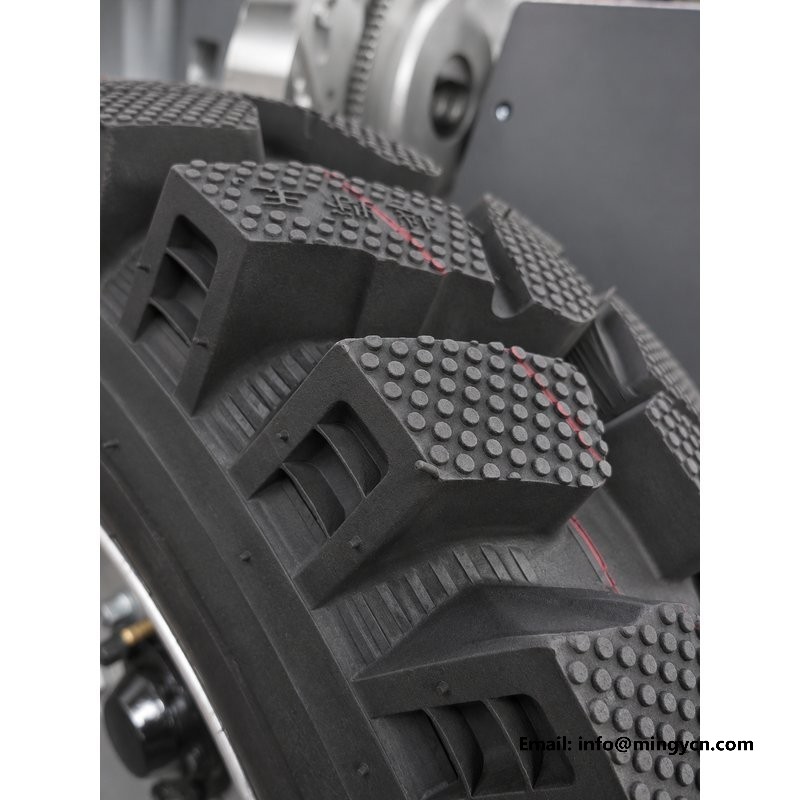
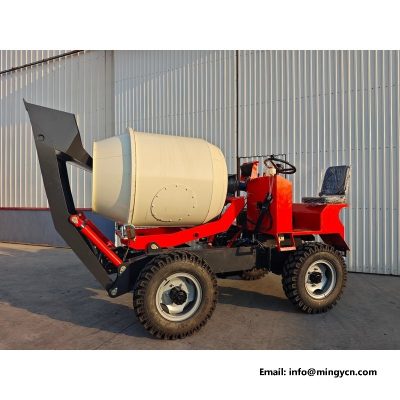
The machine wears 8.25-16 on the front axle and 7.50-16 at the rear, both in the same deep lug pattern. The wider front section carries the steering and the shovel reactions, where side load and braking live, and the extra section height adds air volume exactly where the loading shock arrives. The rear carries the drum load in straight lines and does the job on the narrower section. Keeping the same pattern front and rear means grip and wear stay matched, and a single replacement logic covers the machine.
Both sizes are among the most common light-truck fitments in the regions this machine ships to, so replacements come from local stock rather than from a factory order.
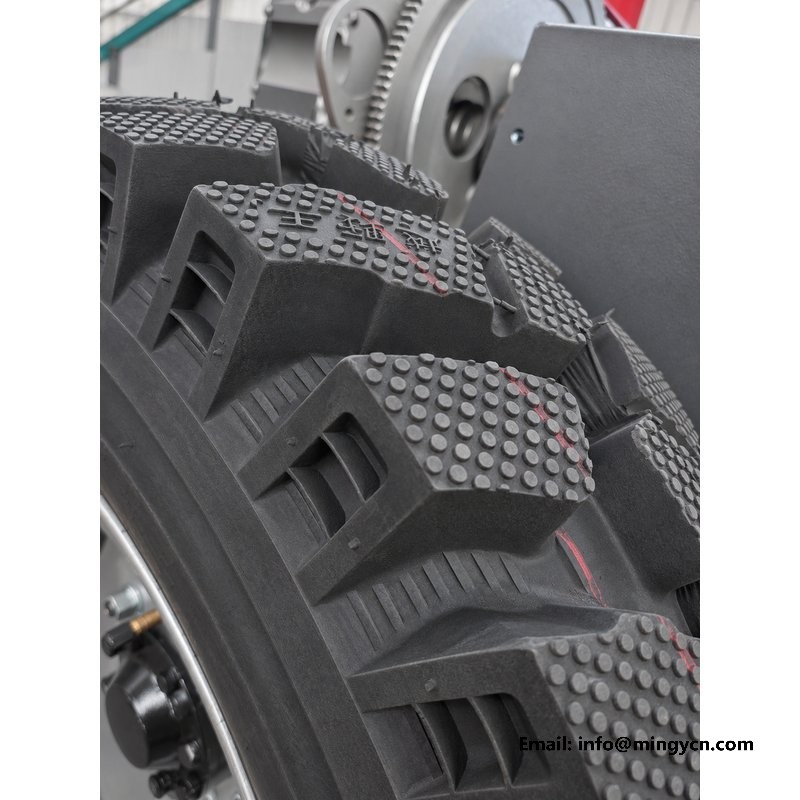
The same tyre is two different tyres depending on pressure. At site pressures, the carcass deflects and the tread opens its footprint wide, which is what loose ground rewards. At road pressures the footprint narrows, the machine runs lighter, and the wear pattern centres. The manual lists both settings, and the honest advice is that crews who adjust between site work and road travel get measurably more life from the set than crews who set it once and forget it.
Check pressures weekly with the machine cold. A tyre that loses pressure overnight has a tube or valve issue worth same-day attention, because a mixer tyre run flat for even a short distance can be destroyed by pinch, whatever its tread depth.
| Tyre reference — 0.8 m³ 4WD self-loading concrete mixer | |
|---|---|
| Front tyre size | 8.25-16, deep lug traction pattern |
| Rear tyre size | 7.50-16, deep lug traction pattern |
| Tread block depth | approximately 30 mm, measured root to crown |
| Construction | bias ply with tube |
| Compound | traction grade, cut resistant |
| Replacement trigger | block worn to approximately half depth |
Measurements are from production tyres as supplied with the machine. The same rule-and-block method applies at handover and at every inspection after.
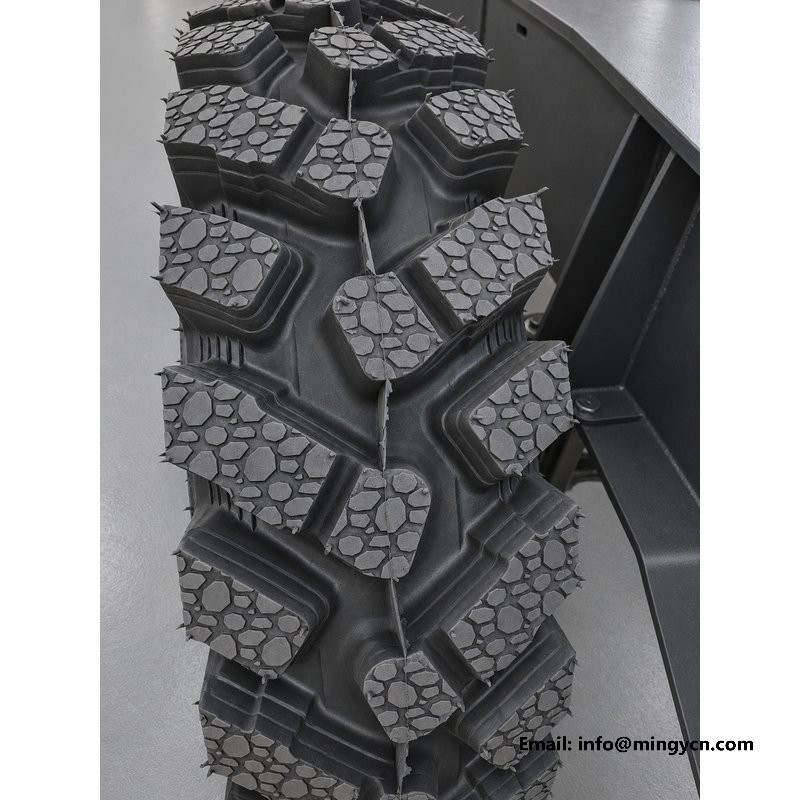
Repeating the workshop measurement at delivery takes five minutes and closes the loop on the quotation. Park the machine on level ground, chock it, and pick a lug at the three o’clock position on each wheel. Seat the rule on the root, read the crown, write the number down. Move two blocks around the tyre and repeat, then average. Do all four wheels. Any wheel measuring materially below the quotation figure, or unevenly around its own circumference, goes on the delivery note with a photograph.
The same numbers, recorded at delivery, become the baseline for every wear check afterwards. Without a starting figure, “worn” is an argument; with one, it is arithmetic.
A mixer spends a surprising share of its working day climbing: up ramps to pour, up site roads to the pad, up sloped ground when the layout forces it. On grade, every kilogram of the machine presses the tyres against a surface that wants them to spin, and the only thing turning weight into motion is the shear strength of those lug blocks engaging the ground. A block worn to half depth does not simply bite half as well; on loose material the loss is steeper, because the short block cannot reach down through the loose layer to the firmer ground beneath. The deep original block, close to thirty millimetres, reaches through the loose skin and finds traction on the compacted layer below. That is why this page treats tread depth as a working figure rather than a brochure one: the number decides whether the machine climbs a wet ramp loaded or waits at the bottom for the crew to push.
On a two-wheel-drive machine, the tread that matters is on one axle, and the other pair of tyres is mostly rolling stock. This mixer drives through all four wheels, so every tyre is a traction tyre all of the time, and the pattern has to do its work at every corner. That doubles the value of the deep lug: the front axle pulls out of the hole it dug while steering, and the rear keeps the drum level while it does. It also doubles the arithmetic at replacement time, because all four positions wear and all four need matched casings. Running a worn tyre next to a new one on a 4WD system upsets the drive distribution and accelerates wear on the newer set, which is why crews in remote areas replace in pairs and keep the deepest pair on the front where the steering loads land.
Demolition fill, river rock and rebar-covered scrap ground are hard on any tyre, and the compound here is a cut-resistant traction grade rather than a highway tread rubber, which resists slicing and chunking on sharp edges. The other half of the defence is geometry. Because the grooves run wide and open all the way to the root, a stone that enters the pattern on one block cycle is expelled on the next instead of lodging at the root and cutting the carcass as the tyre flexes. Patterns with narrow, deep grooves trap stone at the root, and a lodged stone working against a bias-ply carcass is how the slow punctures begin. The wide-groove design shown in the macro photographs is chosen for exactly this failure mode, which matters more on a mixer than on a tractor, because the mixer often works ground nobody has cleaned first.
Because 8.25-16 and 7.50-16 are common light-truck and agricultural sizes across Africa, Southeast Asia and Central Asia, the sensible strategy is local purchase of spares rather than shipping them from the factory. Tubes and a small compressor take little space in the courier’s crate, and a village tyre shop with a hand pump and patches can keep a bias-ply wheel alive indefinitely. A crew that carries one spare rear casing, one tube and a pressure gauge has covered the failure modes that actually stop work. The deep lug pattern itself argues for buying the spare early: a worn road tyre substituted onto one corner of a 4WD mixer degrades traction at every corner, so keeping a matched spare on the rack protects the set rather than only the wheel it replaces.
Depth figures are only useful if both sides trust how they were taken. Photograph the rule squared against the block with the root line visible, exactly as the workshop images on this page were framed, and keep the same framing at every later check. Note the clock position on the wheel where each reading came from, and photograph any anomaly at the same angle as the baseline. Ten minutes of this discipline at delivery settles every later dispute about wear, and it costs nothing but the habit.
No. Beyond the point where the block can support itself, extra depth adds flex, heat and tearing rather than grip. Around thirty millimetres on these sections is the balanced figure, and it matches what agricultural traction tyres of the same size carry.
Some room exists within the guards, and factories routinely quote alternative fitments for extreme conditions. The constraints are rolling ratio between the 4WD axles, guard clearance and rim availability. It is an order-time conversation, not a bolt-on experiment.
Static balancing on the rim after every tyre change is worth the five minutes. An unbalanced tyre shakes the steering at travel speed and wears the steering links prematurely for no benefit.
Measured in tread depth rather than months: a set worked on abrasive ground with correct pressures wears slowly and evenly, and crews commonly see multi-season life. The killers are under-inflation, overloading beyond the rated batch, and travelling loaded on hard roads with the shovel high.
Contact MINGYI Machinery for the current 0.8 m³ self loading concrete mixer specification, tyre fitment options and a formal quotation for your market. E-mail: sales@mingycn.com | LINE (ID): mingyicn
For the axles these tyres drive, see Reinforced Axle 0.8m3 Self Loading Mixer for Unpaved Sites and Wheeled Diesel Self-Loading Mixer: Tyres and Traction. The full range sits in the mini self loading concrete mixer category.