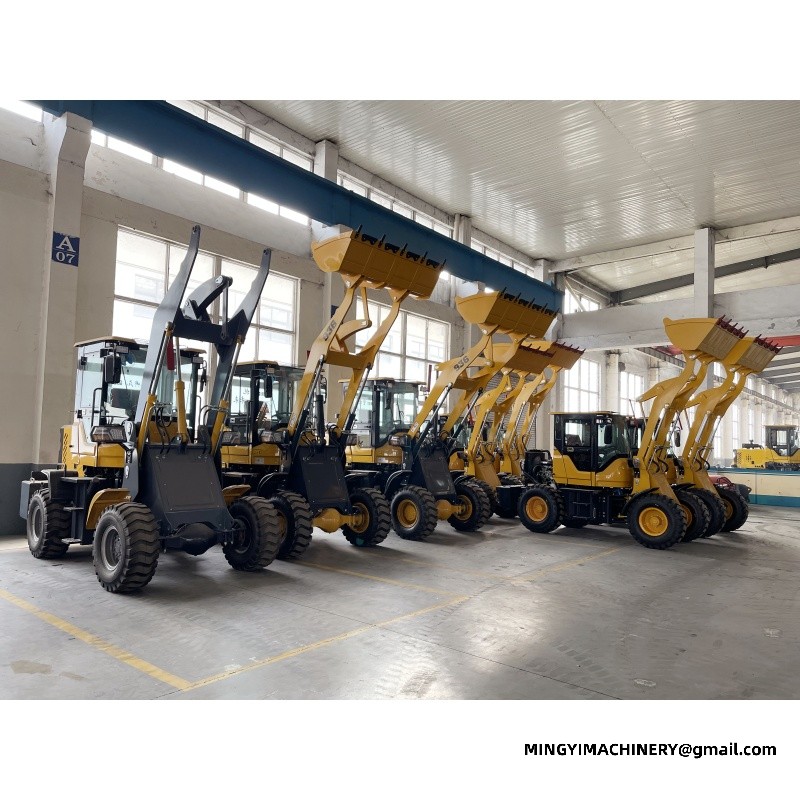
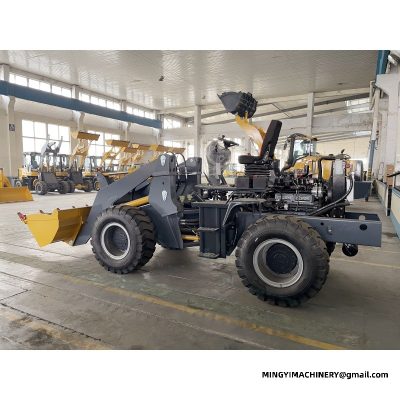
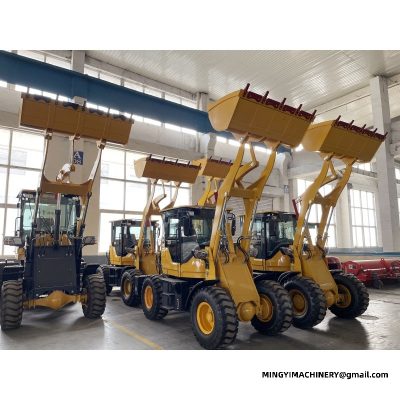
Three frame tiers, twenty-one documented builds, one parts package per tier: that is the whole compact wheel loader range in a line. The tiers separate on boom section and hinge steel rather than on paint — 25 mm boom wall and 30 mm cross-member at the bottom, 25 mm and 30 mm on the heavier build — and the builds within a tier share cylinders, pumps and attachments. Buckets run 0.4 m³ to 0.4 m³ and dump heights 3.2 m to 3.5 m. Here is how to place yourself on that ladder.
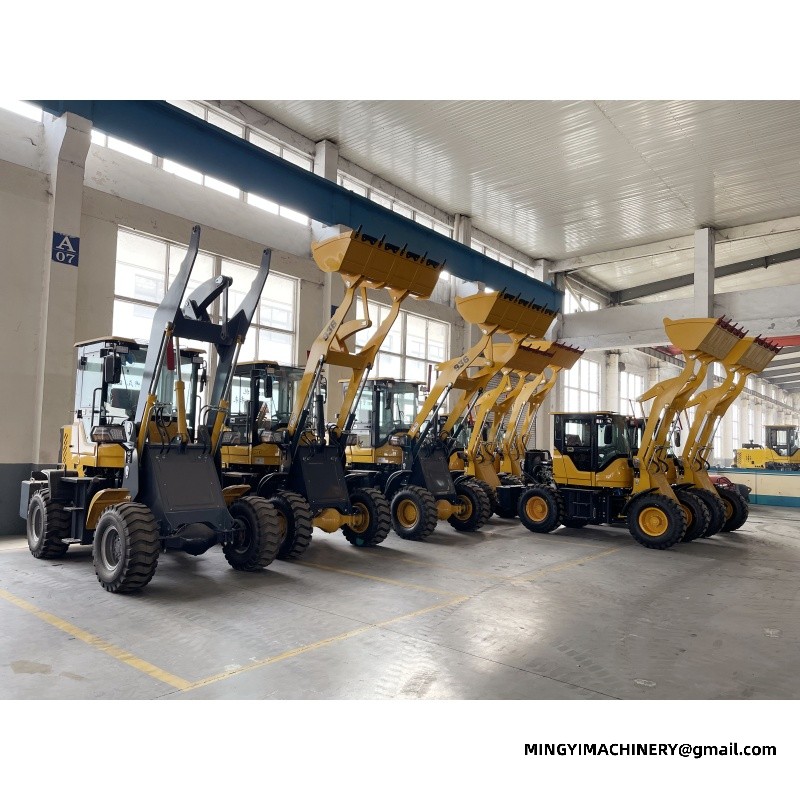
Put the two builds side by side and read four rows only. Bucket: 0.4 m³ against 0.52 m³. Dump height: 3.5 m against 4.2 m. Hinge steel: 30 mm and 20 mm against 45 mm and 30 mm. Cross-member: 30 mm against 45 mm.
Those four decide what the machine can carry, where it can put it, and how long the frame lasts doing it. Everything else on a specification sheet — paint, cab trim, lighting package — is cosmetic next to them. The pumps, 40 pump (490 engine); 1045 pump (4102 turbo engine) against 2063 pump, are the fifth row and matter only if the work is hydraulic rather than loading.
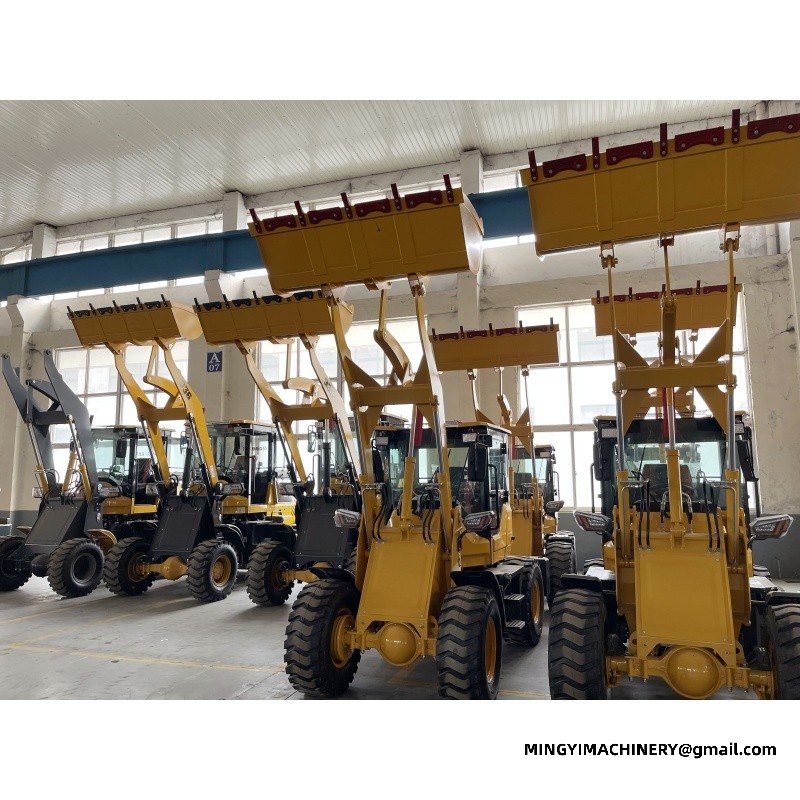
Cooling capacity is sized to the engine's heat rejection, so it appears in the table as a specification rather than a choice: 4105 core on the light-duty 3.5 m medium-frame wheel-side reduction wheel loader, 4105 core on the light-duty 4.2 m medium-frame wheel-side reduction wheel loader. Where the build offers two engines — the 490 with a 4100 core, the 4102 turbo with a 4105 raised core — the raised core is the one for hot climates, high altitude and any site where fine material hangs in the air.
Practical advice that takes nothing: blow the core out at the end of every shift in dusty work, in the reverse direction to airflow, and check the cap seat before blaming the radiator. On the light-duty 3.5 m medium-frame wheel-side reduction wheel loader the 4105 core core sits behind a 300 mm high x 800 mm wide rear frame with limited airflow at low engine speed; on the light-duty 4.2 m medium-frame wheel-side reduction wheel loader the 4105 core core is served by the same 25 pump driven circuit. Neither is difficult to keep clean, and both will lose a season to neglect.
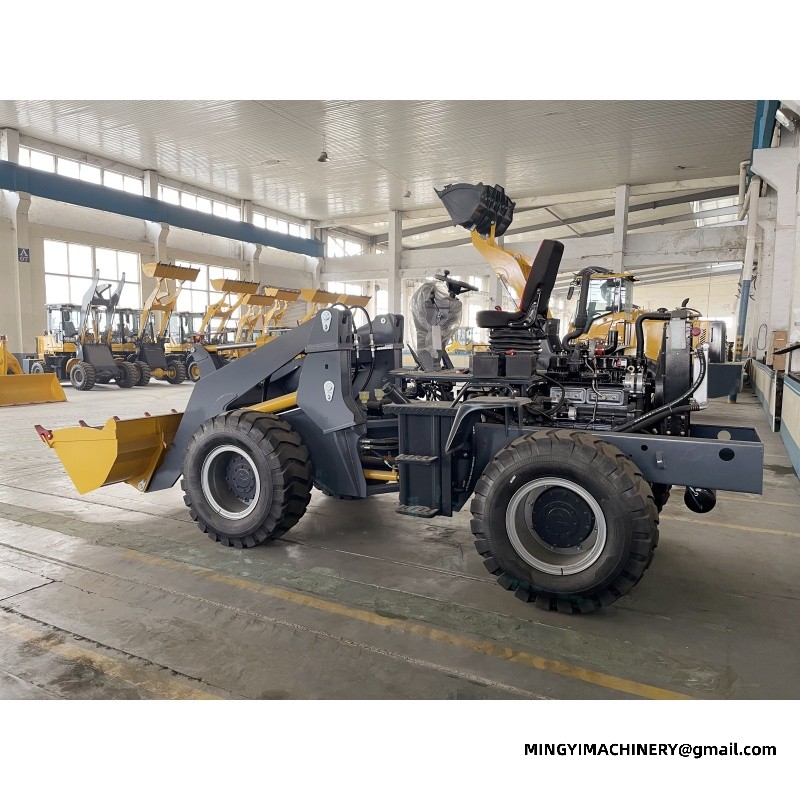
Operators get blamed for slow cycles that were decided in the frame shop. Where the lift is long, the pump and the cylinders set the pace: this build runs 40 pump (490 engine); 1045 pump (4102 turbo engine) with centre cylinder 45 / side cylinder 40. Where the run between face and truck is long, travel matters more, and that is the 316 pump and the 4.1 m wheelbase. Where the heap is packed, breakout matters most, and breakout comes from boom wall, 25 mm, working against bucket width.
Compare two builds on the same heap and the difference shows up as a few seconds a pass. The light-duty 4.2 m medium-frame wheel-side reduction wheel loader carries 0.52 m³ against 0.4 m³ on the heavy-duty 3.5 m small-frame wheel-side reduction wheel loader, and lifts to 4.2 m against 3.5 m. Bigger is not automatically faster: a bucket that fills completely in two passes beats one that fills partly in three, and the frame that stays tight keeps doing it in month thirty.
| Sample build from the range — light-duty 4.2 m medium-frame wheel-side reduction wheel loader | |
|---|---|
| Bucket capacity | 0.52 m³ |
| Dump height | 4.2 m |
| Track width | 1.6 m |
| Boom arm thickness | 30 mm |
| Boom arm width | 450 mm |
| Boom arm length | 2.9 m |
| Boom arm centre distance | 900 mm |
| Cross-member thickness | 45 mm |
| Front hinge plate thickness | 45 mm |
| Rear hinge plate thickness | 30 mm |
| Rear frame section | 300 mm high x 800 mm wide |
| Hydraulic cylinders | centre cylinder 60 / side cylinder 50 |
| Fuel tank | 70 L (75# large tank) |
| Battery | 80 Ah |
| Front wheel to counterweight | 4.3 m |
| Radiator | 4105 core |
| Work pump | 2063 pump |
| Travel pump | 25 pump |
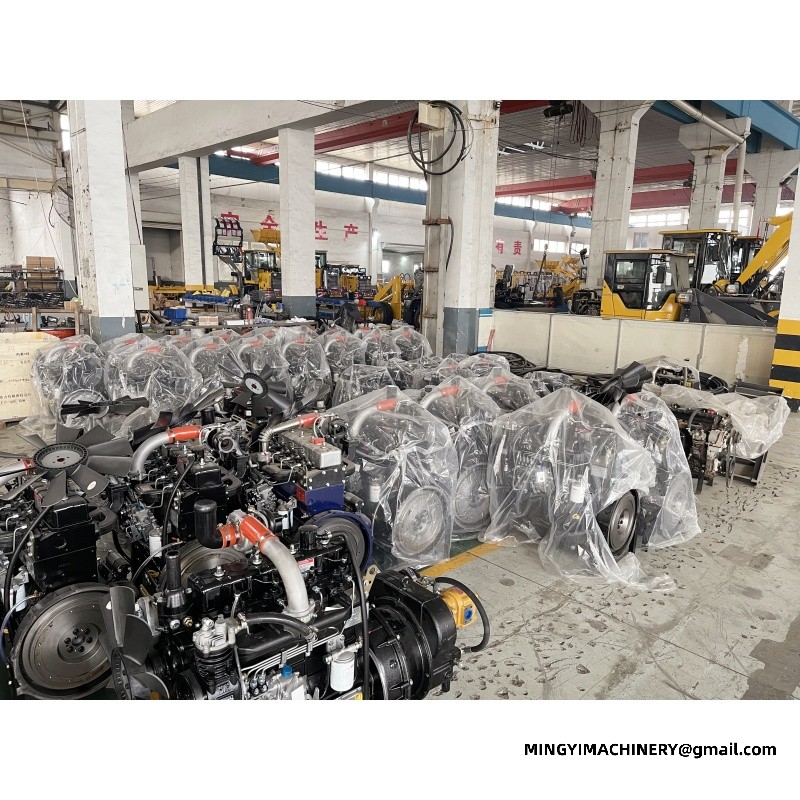
Airborne dust is the hardest thing a cooling system has to deal with, because it blocks the fin passages from the outside while the engine keeps producing heat. Core size is the buffer: 4100 core (490 engine); 4105 core (4102T engine) here against 4100 core (490 engine); 4105 core (4102T engine) on the heavy-duty 3.8 m small-frame wheel-side reduction wheel loader. Screen area and access for cleaning matter as much as volume, so ask how the core is mounted before asking how big it is.
Work pumps generate heat too, not only the engine. This build runs 40 pump (490 engine); 1045 pump (4102 turbo engine) alongside 316 pump, and sustained hydraulic work in a hot climate adds load that the radiator was not sized for on a temperate machine. Where the duty is continuous rather than intermittent — a stockpile that never stops rather than a site that loads three trucks an hour — specify the larger core even if the engine is the same.
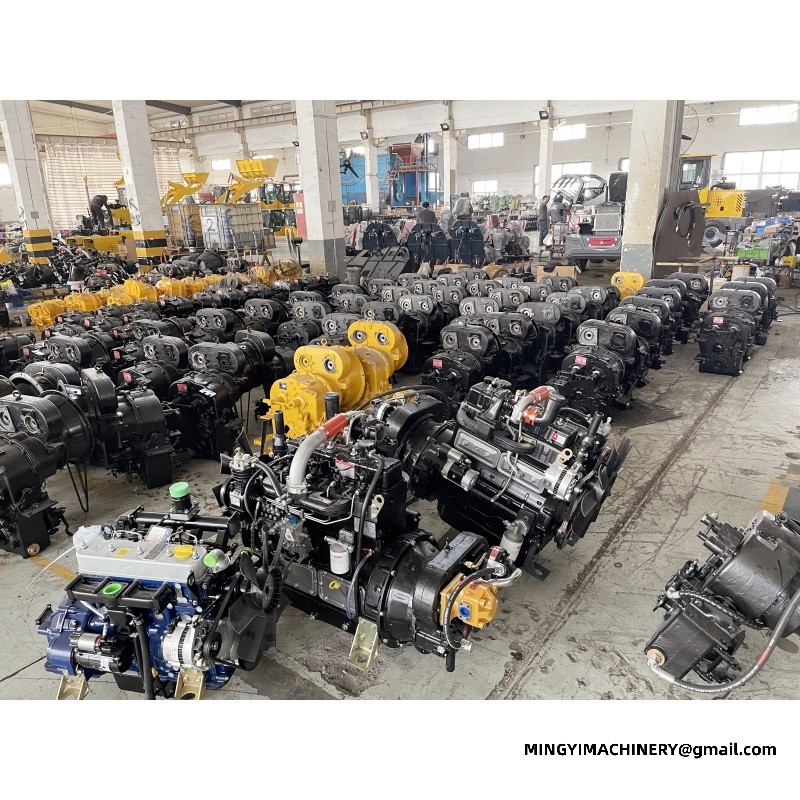
Fuel capacity on this range is specified per frame rather than per model: 64.7 L (75# small tank) on the heavy-duty 3.5 m small-frame wheel-side reduction wheel loader and 70 L (75# large tank) on the light-duty 4.5 m medium-frame wheel-side reduction wheel loader. Both are intended to cover a full shift at working throttle, and both assume the machine is not idling for hours between loads — idling is where a "full day" tank becomes a half-day tank.
Plan refuelling around the tank, not around the clock. On the heavy-duty 3.5 m small-frame wheel-side reduction wheel loader with 64.7 L (75# small tank) and a 0.4 m³ bucket at 3.5 m, a day of continuous loading will run the tank down; on the light-duty 4.5 m medium-frame wheel-side reduction wheel loader with 70 L (75# large tank) and 0.52 m³ at 4.5 m, the same day leaves allowance. Where a site has no bowser, that allowance is the difference between finishing at four and stopping at two.
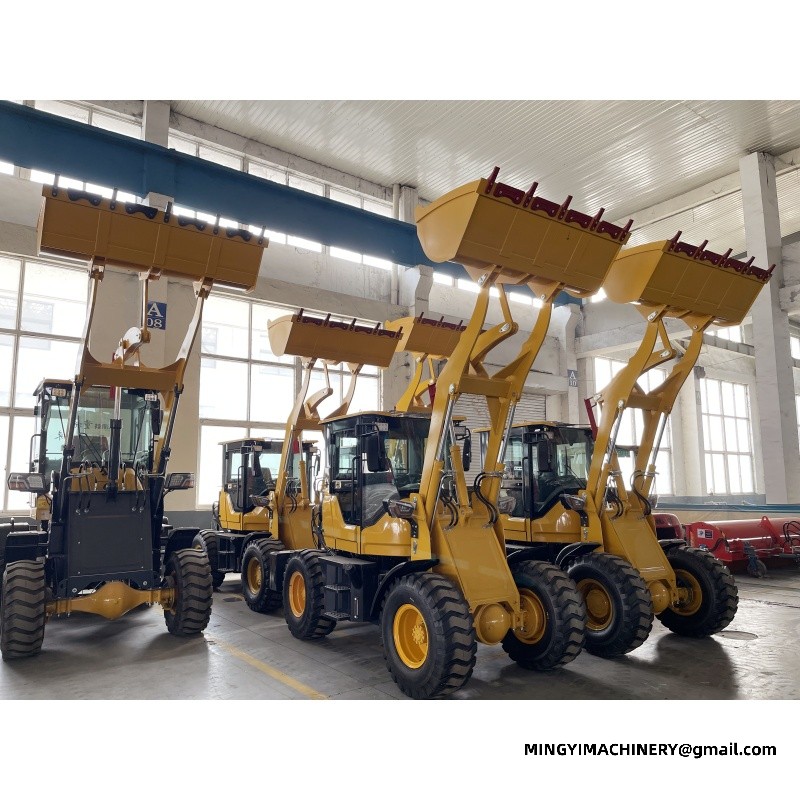
Daily: walk the machine, look at the ground under it, check the coolant level in the 4100 core (490 engine); 4105 core (4102T engine) package, and grease the hinge pins. The hinge is where wear starts, and on the heavy-duty 3.5 m small-frame wheel-side reduction wheel loader those are 30 mm front and 20 mm rear plates over a 30 mm cross-member — a greasing interval missed there takes pins and bores, not just grease.
Weekly: check the centre cylinder 45 / side cylinder 40 cylinder rods for scoring, the hoses for chafe, and the 40 pump (490 engine); 1045 pump (4102 turbo engine) and 316 pump connections for weeping. Monthly: torque the boom mount pins to the 890 mm spacing and inspect the cutting edge. On the light-duty 4.5 m medium-frame wheel-side reduction wheel loader the same schedule applies with 4105 core, centre cylinder 60 / side cylinder 50, 2063 pump and 960 mm. None of it is skilled work, and all of it is simpler than the failure it prevents.
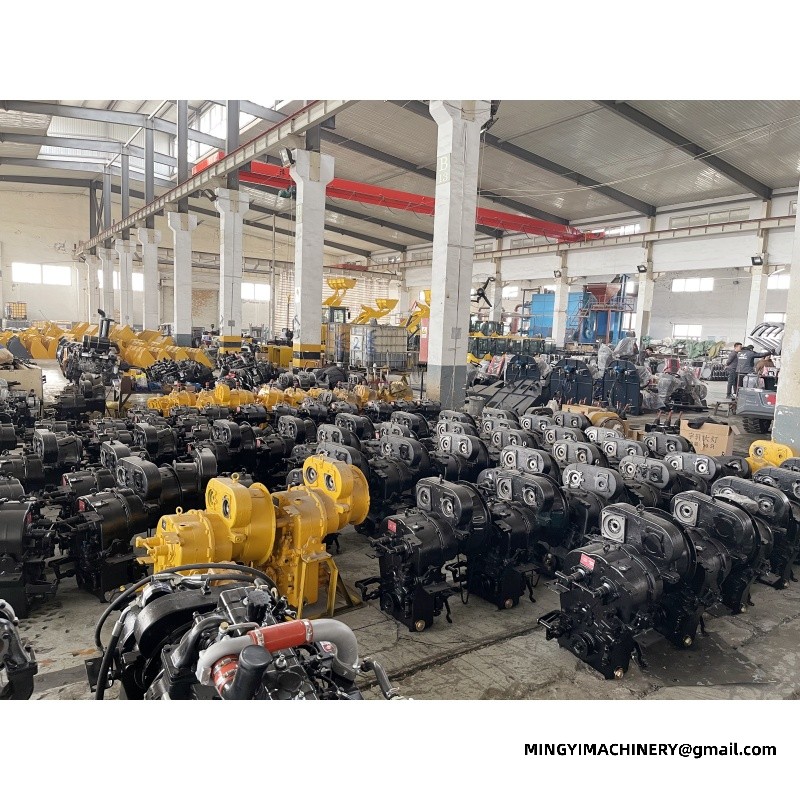
Keep the delivery photographs and the specification sheet with the machine. Bucket 0.4 m³, dump height 3.2 m, cylinders centre cylinder 45 / side cylinder 45, pump 40 pump (490 engine); 1045 pump (4102 turbo engine), track 1.5 m (wheel-side reduction axle); 1.45 m (Isuzu axle): a buyer who can verify five figures against the machine will pay for the certainty.
The frame figures do the rest. 30 mm and 20 mm hinge plates, 30 mm cross-member, 280 mm high x 800 mm wide rear section. Two machines of the same age and hours can be worth materially different amounts on those four rows alone, because they tell the buyer how much life is left in the part that is most lengthy to put right.
Overheating has four causes and only one of them is the radiator. In order of likelihood: blocked fins, a cap that will not hold pressure, a fan or drive problem, and genuine overloading. The core on this machine is 4100 core (490 engine); 4105 core (4102T engine); clean it first, from the clean side outwards.
If the machine is genuinely overloaded, the cause is upstream of the cooling system. A bucket carrying more than 0.4 m³ of dense material, cycled without pause, produces more heat than the system was sized to reject. The fix is a smaller bucket or a slower cycle, not a bigger radiator — and the frame, at 30 mm across the member, is the part that suffers if nobody makes that decision.
How does a compact wheel loader compare with a backhoe loader?
A loader moves more material per pass and carries it higher — 0.52 m³ at 3.5 m on the light-duty 3.5 m medium-frame wheel-side reduction wheel loader — while a backhoe digs below grade. Choose by which job you do most.
How is the counterweight mounted on a compact wheel loader?
Bolted to the rear frame section, 280 mm high x 800 mm wide on the heavy-duty 3.2 m small-frame wheel-side reduction wheel loader, rather than hung off brackets. Bracket-mounted ballast is what cracks under daily face work.
How many hours a day can a compact wheel loader run?
As many as the cooling and fuel allow: a 64.7 L (75# small tank) tank on the heavy-duty 3.2 m small-frame wheel-side reduction wheel loader and a 4100 core (490 engine); 4105 core (4102T engine) radiator. In dusty work the radiator, not the tank, is usually what sets the limit.
Which figures predict frame life on a compact wheel loader?
Rear hinge plate and cross-member: 20 mm and 30 mm on the heavy-duty 3.2 m small-frame wheel-side reduction wheel loader, against 20 mm and 30 mm on the heavy-duty 3.5 m small-frame wheel-side reduction wheel loader. Those two rows separate light duty from heavy duty.
Which compact wheel loader build suits site work?
The heavier one, because dump height and hinge steel govern the day: 0.52 m³ at 3.5 m with 30 mm rear hinge plates and a 45 mm cross-member.
What is the smallest compact wheel loader in the range?
The entry low-profile builds: a 0.4 m³ bucket at 3.8 m, 1.5 m (wheel-side reduction axle); 1.45 m (Isuzu axle) track and a 4.2 m front-to-counterweight length for indoor and nursery work.
Can a compact wheel loader run a hydraulic attachment?
Yes, provided the third circuit is ordered with the machine. The 40 pump (490 engine); 1045 pump (4102 turbo engine) work pump and 316 pump travel pump are specified per build, and plumbing added later is the usual source of leaks.
Every compact wheel loader in this range ships with the same five recorded figures — boom wall, boom width, front hinge, rear hinge and cross-member — checked against the published table before it leaves the factory. Ask for that record on any unit you are stated.
Cold weather and winter care for Compact Wheel Loader: Small-Frame Builds for Tight Sites
A cold start is easier when the machine is prepared the night before. The routine that keeps Compact Wheel Loader: Small-Frame Builds for Tight Sites working through winter is mostly a matter of fuel, battery and patience in the first ten minutes of the day.
Later additions and retrofits on Compact Wheel Loader: Small-Frame Builds for Tight Sites
Most additions are easier to plan than to add. Hydraulic services, mounting brackets and electrical capacity on Compact Wheel Loader: Small-Frame Builds for Tight Sites are build items, and deciding them at the specification stage is far easier than doing it later.
Hot, humid and dusty conditions around Compact Wheel Loader: Small-Frame Builds for Tight Sites
Humidity attacks the parts that are not used. Storage in a damp climate means Compact Wheel Loader: Small-Frame Builds for Tight Sites needs the exposed metal protected and the machine run regularly, because standing still does more damage than working.
Contact MINGYI Machinery for the current wheel loader lineup, configuration options and a formal specification for your market. E-mail: sales@mingycn.com | LINE (ID): mingyicn
Front Wheel Loader: Reading Boom, Hinge and Axle Specifications · Loader Machine for Construction: Specifying for Site Cycles · OEM Wheel Loader Manufacturer: Repeating a Build Exactly · Loaders









