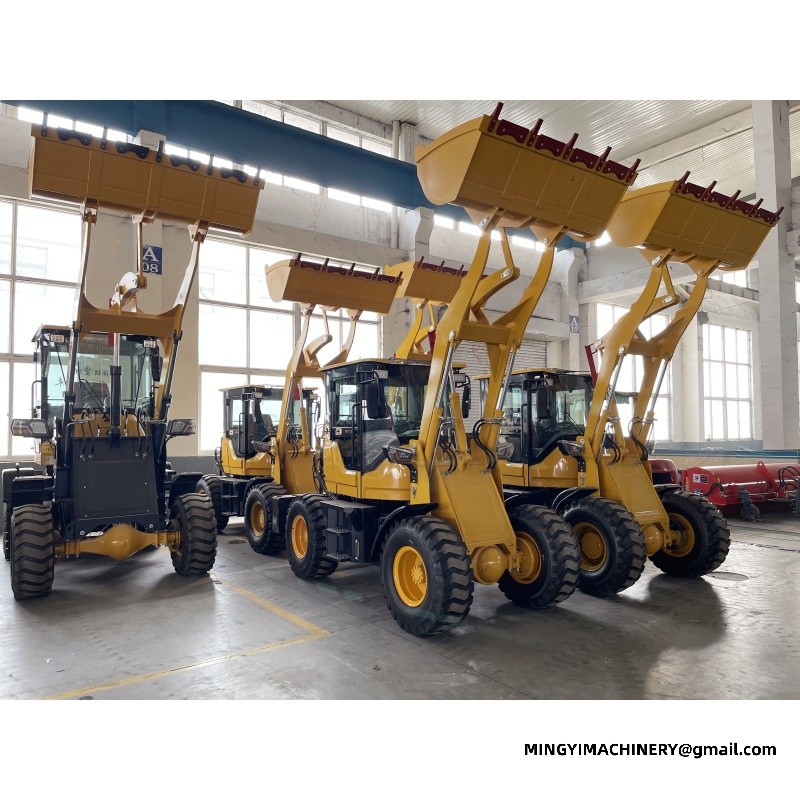
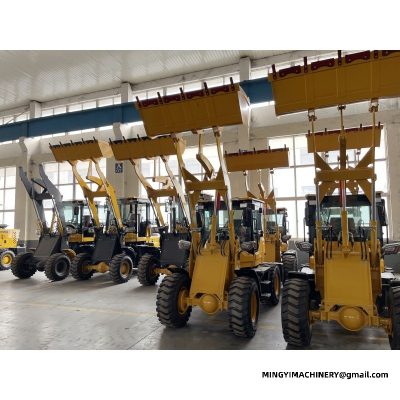
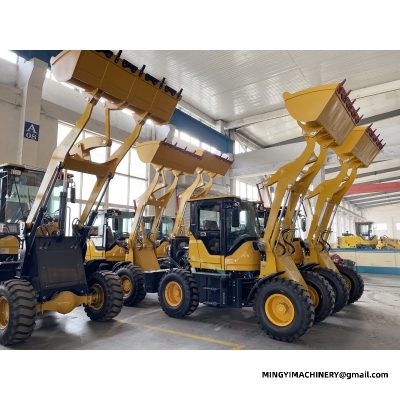
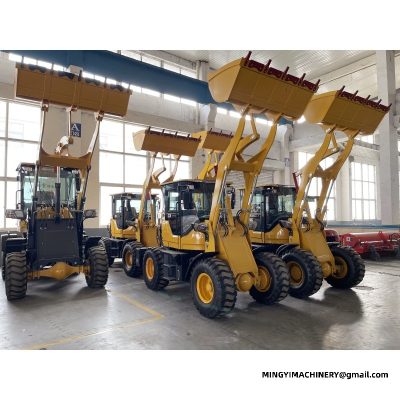
Duty decides the build, and duty is measured in cycles, not in tonnes. A loader machine for construction loading twenty trucks a day needs heavier steel than one moving pallets and feed. The figures move together: cross-member 45 mm against 45 mm, rear hinge 30 mm against 30 mm, cylinder set centre cylinder 60 / side cylinder 50 against centre cylinder 60 / side cylinder 50, radiator 4105 core against 4105 core. Buckets are 0.52 m³ and 0.52 m³, dump heights 3.8 m and 4.2 m. This page maps duty to build, with the numbers for each.
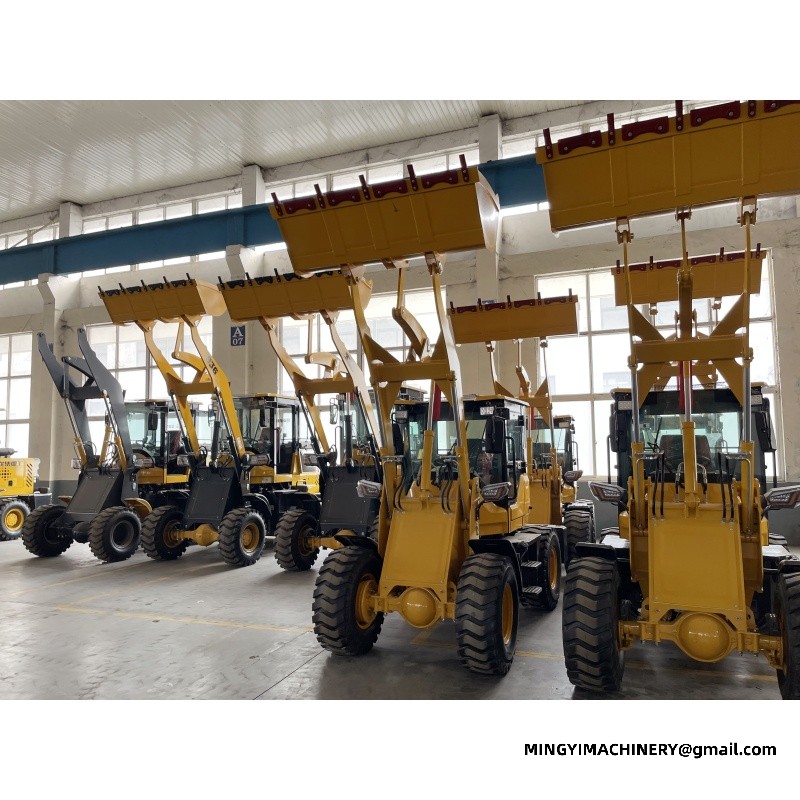
Two axle families appear across the range and the choice is about ground, not preference. Track width is the visible difference — 1.5 m (wheel-side reduction axle); 1.45 m (Isuzu axle) on the light-duty 3.2 m low-profile wheel loader against 1.5 m (wheel-side reduction axle); 1.45 m (Isuzu axle) on the light-duty 3.8 m small-frame wheel-side reduction wheel loader — but the mechanical difference is where the final reduction happens. An Isuzu-pattern axle reduces at the differential and sends torque down the shafts; a wheel-side reduction axle reduces at the hub.
Hub reduction is the right answer for soft lanes, ramps, uncompacted yards and pits, because torque arrives at the wheel instead of through a faster final drive that can spin. It is the wrong answer for long, fast, level transfers, where the extra unsprung mass and the lower top speed effort more than the traction gains. Read the track figures with the footprint — 4 m on the light-duty 3.2 m low-profile wheel loader, 4.1 m on the light-duty 3.8 m small-frame wheel-side reduction wheel loader — and the choice usually makes itself.
Capacity is bought and rarely used. If the receiving bodies sit below 4.5 m and the material is dense, a 0.52 m³ bucket that fills completely is faster than a 0.52 m³ bucket that fills to two-thirds, and it puts less into the hinge plates doing it.
Size matters twice more. A shorter machine, 4.7 m front wheel to counterweight against 4.3 m, works a tighter bay and turns inside its own length. A narrower one, 1.6 m against 1.6 m, passes gates the other cannot. Where the work is confined, buy on dimensions and let capacity follow.
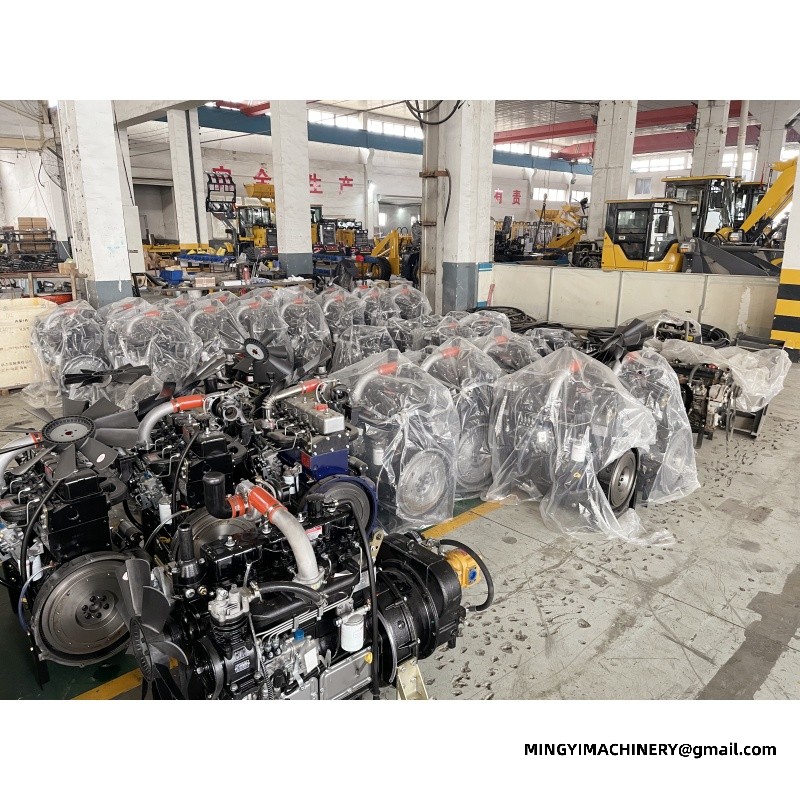
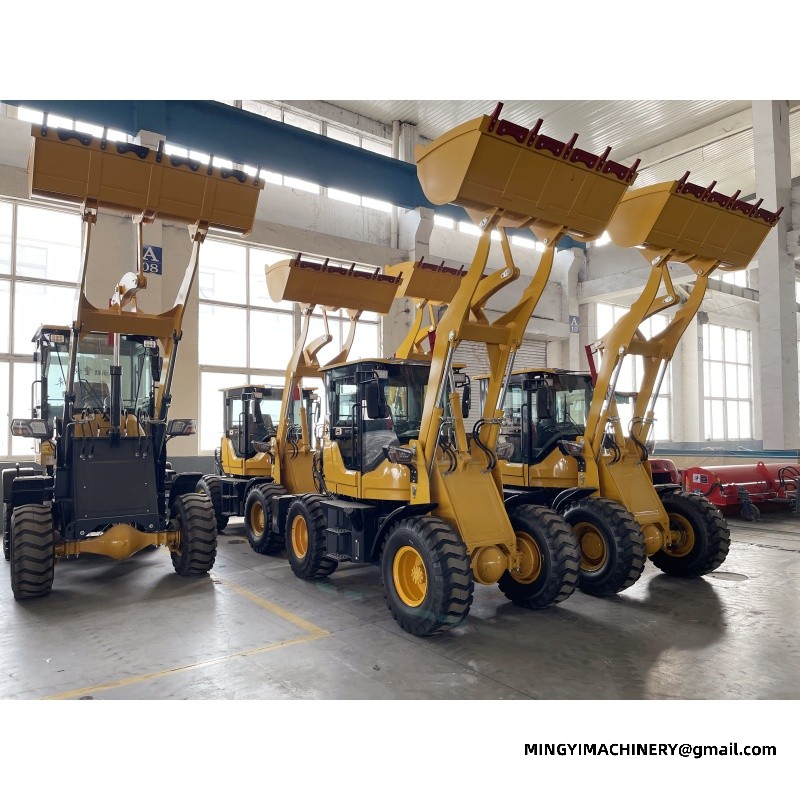
Bucket capacity decides how many passes you make; dump height decides whether the pass is possible at all. The standard 2.4 m low-profile wheel loader clears 2.4 m; the light-duty 3.8 m medium-frame wheel-side reduction wheel loader clears 3.8 m. Measure the receiving body at the front board rather than the side, because side boards sit lower and a machine that clears the side can still clip the front when it slews under load.
That single measurement eliminates most of the range before anything else is discussed. A low pan mixer or a one-ton site truck is served by 2.4 m; a body-up site tipper needs more; a crusher feed hopper or a high-board highway truck needs 3.8 m. Get it wrong and no amount of bucket volume, engine power or pump flow rescues the machine — it simply cannot put material where it has to go.
| Published build data — light-duty 4.5 m medium-frame wheel-side reduction wheel loader | |
|---|---|
| Bucket capacity | 0.52 m³ |
| Dump height | 4.5 m |
| Track width | 1.6 m |
| Boom arm thickness | 30 mm |
| Boom arm width | 450 mm |
| Boom arm length | 3.35 m |
| Boom arm centre distance | 960 mm |
| Cross-member thickness | 45 mm |
| Front hinge plate thickness | 45 mm |
| Rear hinge plate thickness | 30 mm |
| Rear frame section | 300 mm high x 800 mm wide |
| Hydraulic cylinders | centre cylinder 60 / side cylinder 50 |
| Fuel tank | 70 L (75# large tank) |
| Battery | 80 Ah |
| Front wheel to counterweight | 4.7 m |
| Radiator | 4105 core |
| Work pump | 2063 pump |
| Travel pump | 25 pump |
Front-wheel-to-counterweight length is the figure that decides whether a machine fits your site: 3.5 m on the standard 2.4 m low-profile wheel loader against 4.3 m on the light-duty 4.2 m medium-frame wheel-side reduction wheel loader. Track width is the second: 1.2 m (Isuzu axle); 1.3 m (wheel-side reduction axle) against 1.6 m. Together they set the turning circle and the narrowest gap the machine will pass, and they are the two numbers least likely to be stated in a sales conversation.
Access is a hard constraint and it fails silently. A loader that cannot turn in a shed is a loader that cannot work in that shed, whatever its bucket capacity. Compare 3.5 m at 1.2 m (Isuzu axle); 1.3 m (wheel-side reduction axle) on the standard 2.4 m low-profile wheel loader with 4.3 m at 1.6 m on the light-duty 4.2 m medium-frame wheel-side reduction wheel loader, measure your tightest turn and your narrowest doorway, and buy the machine that passes. Where the gap is marginal, the 3.5 m machine with its 0.3 m³ bucket will earn more than the 4.3 m one with 0.52 m³.
Operators describe a good machine as tight and a tired one as loose, and they are describing the hinge pins. New, the geometry is set by the plates: 25 mm forward, 14 mm aft. After a few thousand hours the geometry is set by how much those plates have allowed the pins to move, which is a function of thickness and of the 25 mm cross-member behind them.
This is why the figures are worth asking for rather than assuming. On the light-duty 3.8 m small-frame wheel-side reduction wheel loader the same two numbers are 25 mm and 14 mm. A machine that will spend its life on short cycles — many steering inputs per hour — should be bought on these figures rather than on bucket capacity, because capacity is simple to add and hinge life is not.
Lift and tilt come from a cylinder set and a pump pair, and both are specified per build. The light-duty 3.2 m small-frame wheel-side reduction wheel loader runs centre cylinder 45 / side cylinder 40 with a 40 pump (490 engine); 1045 pump (4102 turbo engine) work pump and a 316 pump travel pump; the light-duty 4.5 m medium-frame wheel-side reduction wheel loader runs centre cylinder 60 / side cylinder 50 with a 2063 pump work pump and a 25 pump travel pump. Splitting lift from travel is what keeps boom speed up while the machine is climbing a ramp loaded.
Cycle time is a product, not a published figure: bucket fill, lift height, travel distance and the operator's line all move it. What you can compare honestly is the hardware behind it. A centre cylinder 45 / side cylinder 40 set working a 2.3 m arm to 3.2 m is a different proposition from a centre cylinder 60 / side cylinder 50 set working 3.35 m to 4.5 m. On a short haul the smaller combination wins; over a longer push, or where the bucket is digging rather than shovelling, the larger bore and the 960 mm centre distance earn back the extra seconds of lift.
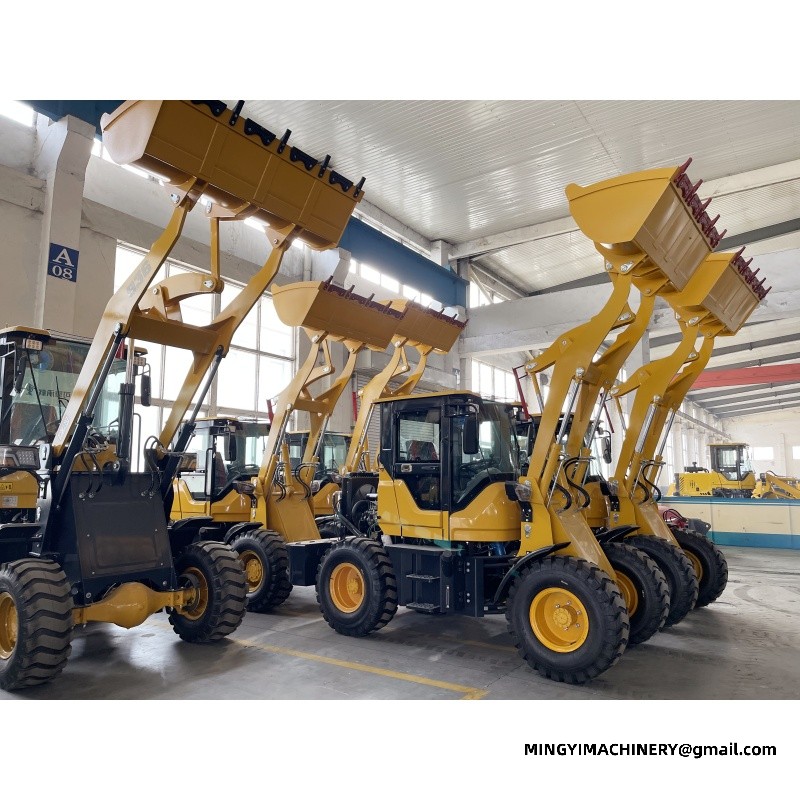
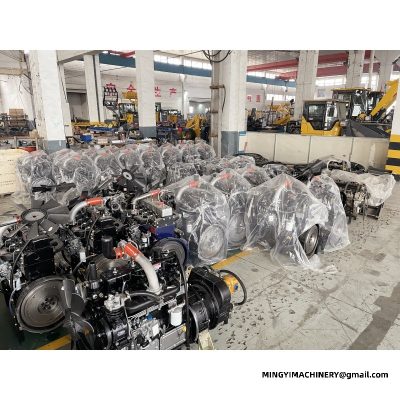
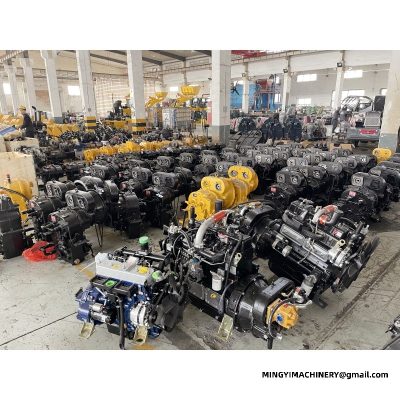
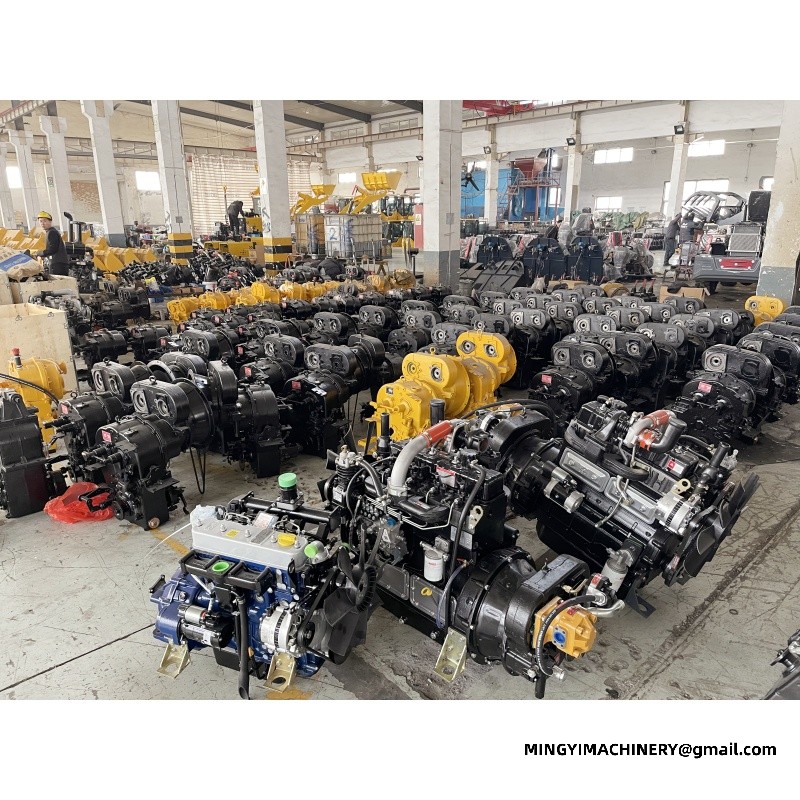
Every unit leaves the factory knock-down: booms and counterweights loose, tanks removed, batteries boxed and disconnected. Because rear frame sections stay within the 230 mm high x 800 mm wide to 280 mm high x 800 mm wide band across the range, two to three loaders ship in one forty-foot container.
What arrives is a machine plus a commissioning job. On the light-duty 3.2 m low-profile wheel loader that means fitting the 2.3 m boom to the 890 mm mounts, torquing the 25 mm hinge pins, filling the 54 L (50# tank) tank and the 4100 core (490 engine); 4105 core (4102T engine) cooling system, and connecting the battery. On the light-duty 3.5 m small-frame wheel-side reduction wheel loader the same sequence applies with 2.62 m, 25 mm, 64.7 L (75# small tank) and 4100 core (490 engine); 4105 core (4102T engine). Allow a day per machine, and allow for the fact that the battery will have sat for weeks.
Continuous stockpile duty is where light builds are separated from heavy ones, and the separation is visible in steel. The light-duty 3.5 m small-frame wheel-side reduction wheel loader lists 25 mm front and 14 mm rear hinge plates over a 25 mm cross-member and a 280 mm high x 800 mm wide rear frame, carrying 0.38 m³ to 3.5 m. The standard 2.4 m low-profile wheel loader lists 16 mm, 16 mm, 16 mm and 200 mm high x 750 mm wide, carrying 0.3 m³ to 2.4 m.
Choose by cycle count rather than by material. Below twenty truck loads a day the lighter machine is the better economics; above it, the heavier frame pays for itself in avoided downtime. Then specify the cooling package for the material — 4100 core (490 engine); 4105 core (4102T engine) raised core for fines and dust — and the axle for the floor. Both are simple at order time and neither is simple later.
Will a loader machine for construction start in a cold climate?
With the right pack, yes: 60 Ah (490 engine); 80 Ah (4102 turbo engine) on the light-duty 3.5 m small-frame wheel-side reduction wheel loader, the larger capacity where the turbo engine is fitted. Specify an isolator for anything shipping long-distance.
Which loader machine for construction build suits farm work?
The lighter one, for access: a 0.52 m³ bucket at 3.8 m, 1.6 m track and a 4.3 m footprint that turns between sheds. Gate and door widths decide first.
What does a loader machine for construction need to run a grapple?
A grapple sized to the 430 mm boom section and a hydraulic third circuit. The 2063 pump work pump is specified per build, so order the circuit with the machine.
What is the difference between the two hinge plates on a loader machine for construction?
The front plate carries boom loads, which are mostly vertical; the rear carries articulation, which is sideways and shock-loaded. Hence 25 mm front against 14 mm rear.
Can one spares kit cover a mixed loader machine for construction fleet?
Within a frame family, largely yes: the centre cylinder 40 / side cylinder 40 cylinder set and the 32 pump and 316 pump pumps are shared. Across families the cylinder set changes to centre cylinder 45 / side cylinder 40.
What radiator comes with this loader machine for construction build?
4100 core (490 engine); 4105 core (4102T engine) on the light-duty 3.5 m small-frame wheel-side reduction wheel loader and 4105 core on the light-duty 3.8 m medium-frame wheel-side reduction wheel loader. Where a build offers two engines, the raised core serves the turbo and is the one to specify for dusty work.
Is the wheel-side reduction axle worth specifying on a loader machine for construction?
If the ground is soft, rutted or sloped, yes: a 1.6 m track with hub reduction keeps traction where a faster axle would spin. On hard, level ground it is not needed.
Send the application and the receiving body height and we will match a loader machine for construction to it from the published range — 0.52 m³ bucket at 3.8 m, or 0.52 m³ at 4.2 m — and specification the build, the container plan and the spares package together.
Cold weather and winter care for Loader Machine for Construction: Specifying for Site Cycles
Cold exposes weak batteries, thick oil and water in the fuel. Preparing Loader Machine for Construction: Specifying for Site Cycles for winter means the right grade of oil, a battery in good condition and fuel that will not wax in the tank overnight.
Planning the season around Loader Machine for Construction: Specifying for Site Cycles
Seasonal work rewards a machine that can change duty. Through the year Loader Machine for Construction: Specifying for Site Cycles may move from one task to another, and the attachment list should be chosen for the whole year rather than for the first job.
Documents that travel with Loader Machine for Construction: Specifying for Site Cycles
Keeping the documents together is part of ownership. The manual, the service record and the build sheet for Loader Machine for Construction: Specifying for Site Cycles belong in one folder, and the machine is easier to sell later when that folder is complete.
Contact MINGYI Machinery for the current wheel loader lineup, configuration options and a formal specification for your market. E-mail: sales@mingycn.com | LINE (ID): mingyicn
Wheel Loader for Mining: Radiator Cores and Hub Reduction Axles · Wheel Loader for Agriculture: Gate Widths, Sheds and Wagons · China Wheel Loader Factory Supplier: Steady Supply Planning · Loaders









