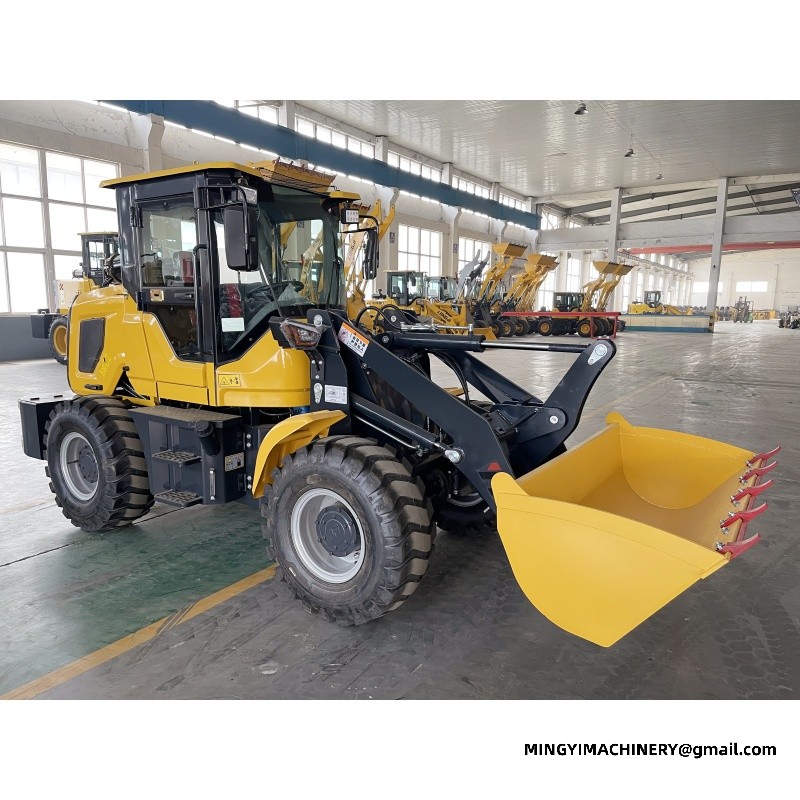
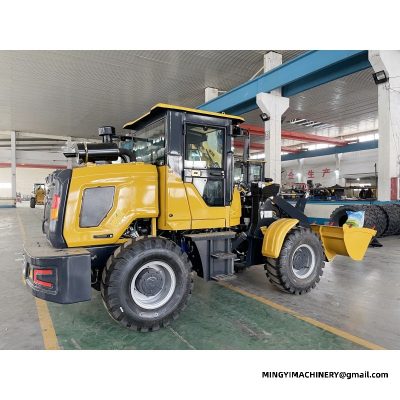
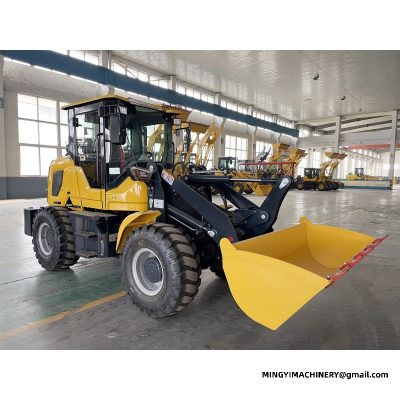
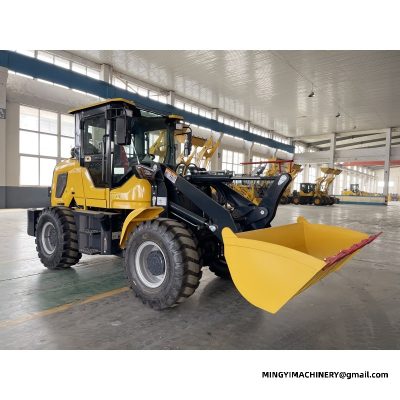
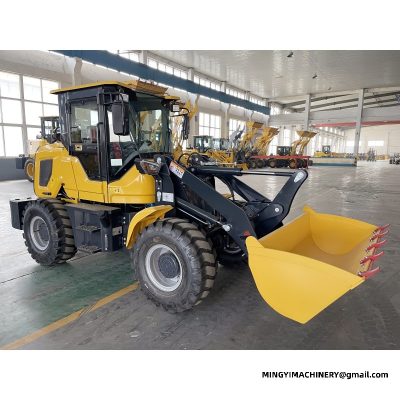
Every wheel loader for construction site enquiry comes down to three numbers: how much the bucket holds, how high it dumps, and how much steel sits behind the hinge. The rest of a specification sheet is consequence. On this range the first two run from 0.4 m³ on the heavy-duty 3.8 m small-frame wheel-side reduction wheel loader to 0.4 m³ on the heavy-duty 4.2 m small-frame wheel-side reduction wheel loader, and the third is published per build — 30 mm front and 20 mm rear hinge plates over a 30 mm cross-member. This page sets out how those figures are chosen, what they predict about behaviour on site, and where each build in the range fits.
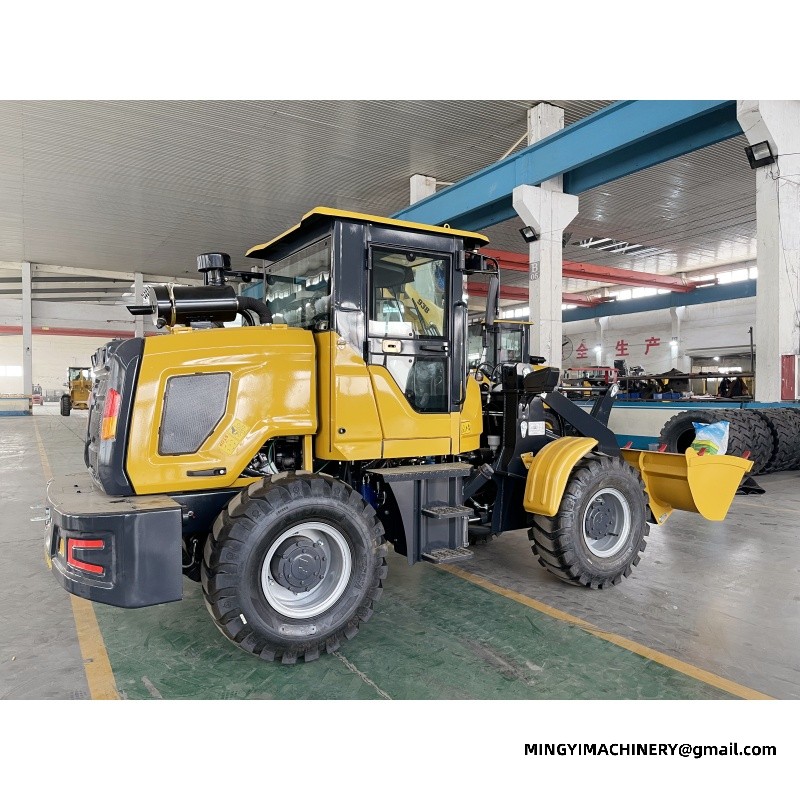
Every loader purchase starts with the thing being loaded into. On this range the choice runs from 2.4 m on the standard 2.4 m low-profile wheel loader to 3.8 m on the heavy-duty 3.8 m small-frame wheel-side reduction wheel loader, and the gap between those two figures is the gap between a machine that feeds a small mixer and one that feeds a highway truck.
Take the measurement at the highest point the bucket must clear, on the near side, with the truck loaded — a suspension that settles under load lowers the board. Then add allowance for the operator's approach angle. The standard 2.4 m low-profile wheel loader at 2.4 m with a 0.3 m³ bucket and a 1.85 m arm is a compact answer; the heavy-duty 3.8 m small-frame wheel-side reduction wheel loader at 3.8 m with 0.4 m³ and a 2.61 m arm is the answer where the board is high.
An agricultural loader is a small machine doing varied work, and the specification that matters is the one that lets it into the buildings. Track width 1.5 m (wheel-side reduction axle); 1.45 m (Isuzu axle) on the light-duty 3.2 m low-profile wheel loader against 1.5 m (wheel-side reduction axle); 1.45 m (Isuzu axle) on the heavy-duty 3.8 m small-frame wheel-side reduction wheel loader, footprint 4 m against 4.2 m, and dump height 3.2 m against 3.8 m for the wagon or hopper it fills.
Duty is seasonal and mostly light, which is why the light builds exist: a 0.38 m³ bucket with 25 mm cross-member and 14 mm rear hinge plates is correctly specified for silage, bagged goods and yard scraping. Where the machine also does heavy work — muck-out with a loaded bucket, or winter snow clearing — step to the heavier build with 30 mm and 20 mm. Over-specifying takes money once; under-specifying takes a frame.
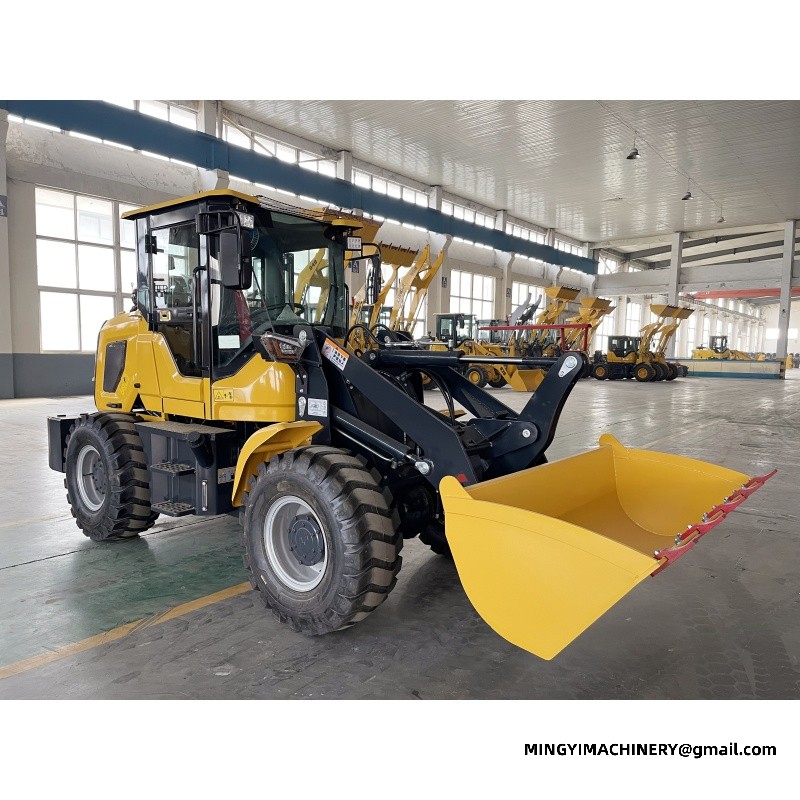
Photograph the specification plate, the cylinder markings and the frame plates on the day the machine arrives. Cylinders on this build are centre cylinder 45 / side cylinder 45; the pump is 40 pump (490 engine); 1045 pump (4102 turbo engine); the radiator is 4100 core (490 engine); 4105 core (4102T engine). Those three identify the build more reliably than any nameplate, because they are the parts that change between engine options.
Then photograph the geometry, because it is what a later claim will turn on. Dump height 3.8 m at full lift, arm length 2.61 m, spacing 890 mm, track 1.5 m (wheel-side reduction axle); 1.45 m (Isuzu axle). If a machine ever fails to clear a body it was sold to clear, those four photographs are the difference between a warranty claim and an argument.
| Reference specification — heavy-duty 3.8 m small-frame wheel-side reduction wheel loader | |
|---|---|
| Bucket capacity | 0.4 m³ |
| Dump height | 3.8 m |
| Track width | 1.5 m (wheel-side reduction axle); 1.45 m (Isuzu axle) |
| Boom arm thickness | 25 mm |
| Boom arm width | 430 mm |
| Boom arm length | 2.61 m |
| Boom arm centre distance | 890 mm |
| Cross-member thickness | 30 mm |
| Front hinge plate thickness | 30 mm |
| Rear hinge plate thickness | 20 mm |
| Rear frame section | 280 mm high x 800 mm wide |
| Hydraulic cylinders | centre cylinder 45 / side cylinder 45 |
| Fuel tank | 64.7 L (75# small tank) |
| Battery | 60 Ah (490 engine); 80 Ah (4102 turbo engine) |
| Front wheel to counterweight | 4.2 m |
| Radiator | 4100 core (490 engine); 4105 core (4102T engine) |
| Work pump | 40 pump (490 engine); 1045 pump (4102 turbo engine) |
| Travel pump | 316 pump |
A loader that is greased, cool and clean will run for years on its original frame. The components that need attention are the articulation — 16 mm and 16 mm hinge plates on the standard 2.4 m low-profile wheel loader — the boom mounts at 680 mm, and the cooling pack, 4100 core.
Set the intervals by duty, not by calendar. A machine working a dusty stockyard needs its core blown out daily; the same machine on a farm needs it monthly. A machine loading a face needs its pins greased every shift; one moving pallets needs it weekly. The specification tells you what to check — centre cylinder 40 / side cylinder 40 cylinders, 32 pump and 316 pump on the standard 2.4 m low-profile wheel loader, centre cylinder 60 / side cylinder 50, 2063 pump and 25 pump on the light-duty 3.8 m medium-frame wheel-side reduction wheel loader — and the duty tells you how often.
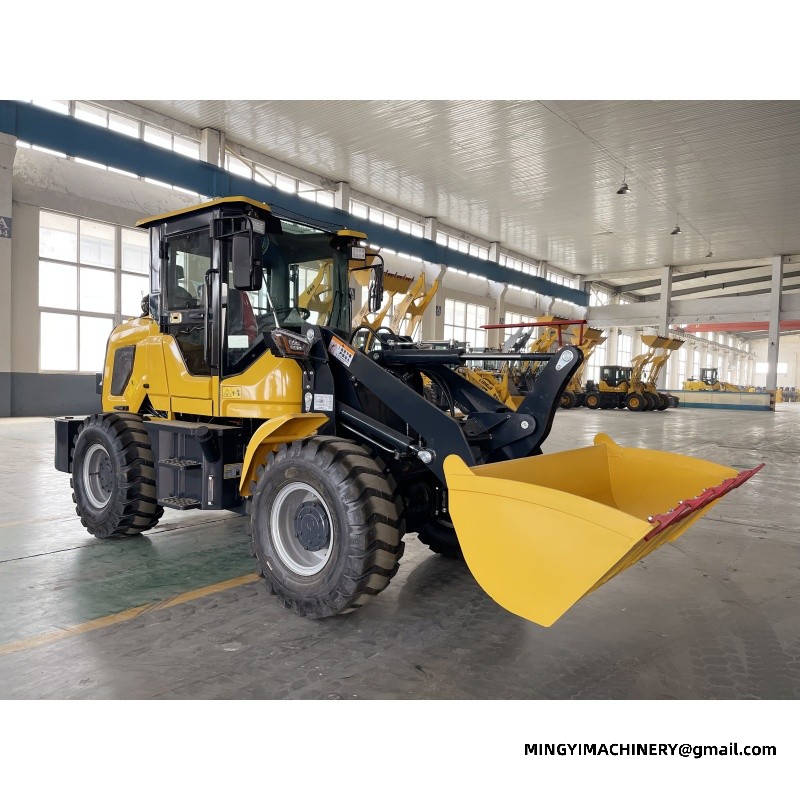
Frames do not usually break; they go loose, and looseness starts at the pins. The parts that govern it are the rear hinge plate, 20 mm, the cross-member behind it, 30 mm, and the rear frame section, 280 mm high x 800 mm wide. Buy on those three and the machine will still feel tight in year five.
Duty decides how long that takes. A machine loading twenty trucks a day ages differently from one moving material for two hours. On the light-duty 4.5 m medium-frame wheel-side reduction wheel loader the same three figures are 30 mm, 45 mm and 300 mm high x 800 mm wide; choosing between them is choosing how much duty the frame was built for, and it is the decision that outlasts every other option on the order.
Shipping is a dimensions problem before it is a freight problem. Front wheel to counterweight is 4.3 m on this build and 4.7 m on the light-duty 4.5 m medium-frame wheel-side reduction wheel loader; track is 1.6 m. Those two figures, plus the bucket, decide how many units fit a container and whether the machine travels assembled.
Dump height matters here for a reason that surprises people: a machine shipped with the arm raised will not fit under a container door. At 3.8 m of lift height the arm has to be strapped down, and the securing points are on the frame — the 280 mm high x 800 mm wide rear section and the cross-member behind it, not the cylinders.
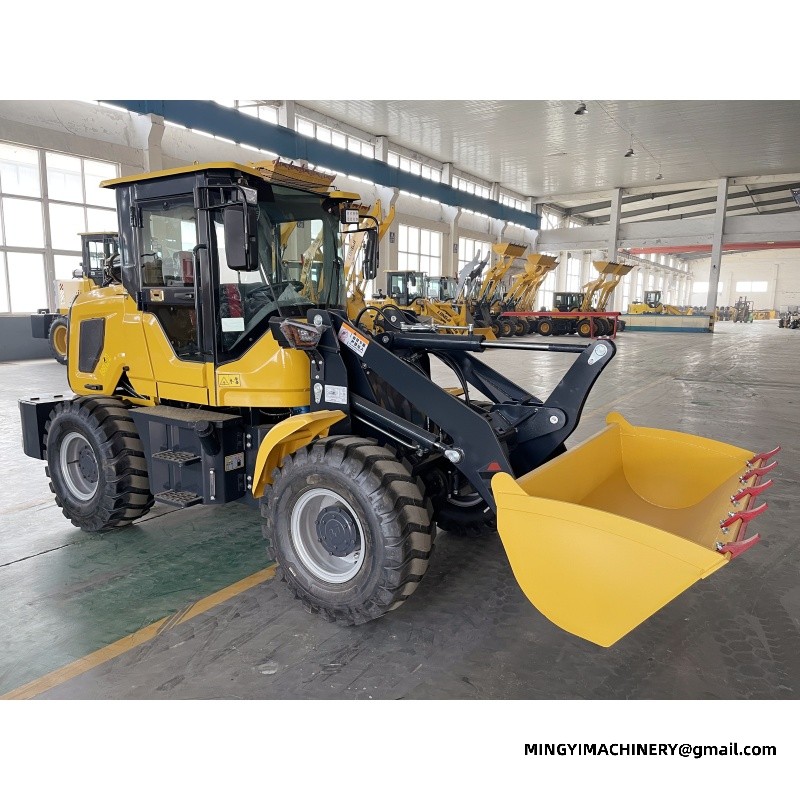
Construction duty is repetitive, dusty and unforgiving of a light frame. Specified for it, the light-duty 3.5 m medium-frame wheel-side reduction wheel loader carries a 0.52 m³ bucket to 3.5 m on 45 mm front and 30 mm rear hinge plates with a 45 mm cross-member and a 300 mm high x 800 mm wide rear frame. Lighter builds — the heavy-duty 3.8 m small-frame wheel-side reduction wheel loader at 0.4 m³, 3.8 m, 20 mm and 30 mm — suit smaller sites and lighter material.
Two site conditions change the specification. The first is the board height of the trucks, which fixes dump height and is measured, not guessed. The second is ground: a rough, rutted site with soft spots wants the wheel-side reduction axle at 1.6 m track over the lighter axle, and a site with long internal haul roads wants the opposite. Tell the factory both and the axle choice follows from the site, not from the catalogue.
Daily: walk the machine, look at the ground under it, check the coolant level in the 4100 core (490 engine); 4105 core (4102T engine) package, and grease the hinge pins. Weekly: check the cylinder rods for scoring — centre cylinder 45 / side cylinder 40 — and the pins behind the 25 mm front plate for movement. Monthly: check the cross-member and rear frame, 230 mm high x 800 mm wide, for cracks at the weld toes.
None of that needs a workshop, and all of it is what keeps a machine tight. The parts that fail without warning are the ones nobody looks at: the pins, the hoses behind the 40 pump (490 engine); 1045 pump (4102 turbo engine), and the battery terminals on 60 Ah (490 engine); 80 Ah (4102 turbo engine). A ten-minute walk-round finds all three before they stop the machine.
Do attachments interchange across the wheel loader for construction site range?
Within a frame family, yes, because the boom section matches. Across families, no: a 500 mm section on the heavy-duty 4.2 m small-frame wheel-side reduction wheel loader is not the 430 mm section on the light-duty 3.5 m medium-frame wheel-side reduction wheel loader.
What bucket capacity should a wheel loader for construction site be specified with?
Match it to the material and to the body being filled: 0.3 m³ on the standard 2.4 m low-profile wheel loader against 0.4 m³ on the heavy-duty 3.8 m small-frame wheel-side reduction wheel loader. Heavy material limits volume before the frame does.
Can a wheel loader for construction site take a quick coupler?
Yes, if the coupler is built for the boom section and centre distance — 370 mm wide on 890 mm spacing for the light-duty 3.2 m low-profile wheel loader.
What engine options are offered on a wheel loader for construction site?
Where two are offered, cooling and electrics change with them: 4100 core (490 engine); 4105 core (4102T engine) radiator and 60 Ah (490 engine); 80 Ah (4102 turbo engine) battery on the light-duty 3.2 m low-profile wheel loader, with the raised core belonging to the turbo option.
What is the fuel tank capacity of a wheel loader for construction site?
70 L (75# large tank) on the light-duty 3.5 m medium-frame wheel-side reduction wheel loader and 70 L (75# large tank) on the light-duty 3.8 m medium-frame wheel-side reduction wheel loader, both sized for a full shift at working throttle without a mid-day refuel.
What is the largest wheel loader for construction site in the range?
The medium-frame heavy builds: a 0.4 m³ bucket at 4.2 m on a 3.15 m boom with centre cylinder 45 / side cylinder 45 cylinders.
What radiator comes with this wheel loader for construction site build?
4100 core (490 engine); 4105 core (4102T engine) on the heavy-duty 3.8 m small-frame wheel-side reduction wheel loader and 4100 core (490 engine); 4105 core (4102T engine) on the heavy-duty 4.2 m small-frame wheel-side reduction wheel loader. Where a build offers two engines, the raised core serves the turbo and is the one to specify for dusty work.
Five figures settle any wheel loader for construction site enquiry: dump height, track width, boom wall, rear hinge plate and cross-member. On the heavy-duty 4.2 m small-frame wheel-side reduction wheel loader those are 4.2 m, 1.5 m (wheel-side reduction axle); 1.45 m (Isuzu axle), 25 mm, 20 mm and 30 mm. Send us yours and we will tell you which build meets them.
Planning the season around Wheel Loader for Construction Site: Board Heights and Turn Space
Workload is rarely even across the year, and the machine should be specified for the busy weeks. A Wheel Loader for Construction Site: Board Heights and Turn Space sized only for the average month will be the limiting factor exactly when the work is worth the most.
Keeping a service record for Wheel Loader for Construction Site: Board Heights and Turn Space
The record should follow the machine, not the owner. When Wheel Loader for Construction Site: Board Heights and Turn Space changes hands the service history travels with it, and a complete folder is often the difference between a quick sale and a long one.
Packing, loading and shipment of Wheel Loader for Construction Site: Board Heights and Turn Space
Export packing is part of the machine, not an afterthought. Wheel Loader for Construction Site: Board Heights and Turn Space is blocked and braced inside the container so that it arrives in the same condition it left, and the load plan is decided by the dimensions rather than by what fits loosely.
Contact MINGYI Machinery for the current wheel loader lineup, configuration options and a formal specification for your market. E-mail: sales@mingycn.com | LINE (ID): mingyicn
Wheel Loader for Material Handling: Forks, Grapples and Circuits · Wheel Loader for Aggregate Yard: Dust, Fines and Heavy Builds · Wheel Loader: The Checks Before First Start · Loaders









