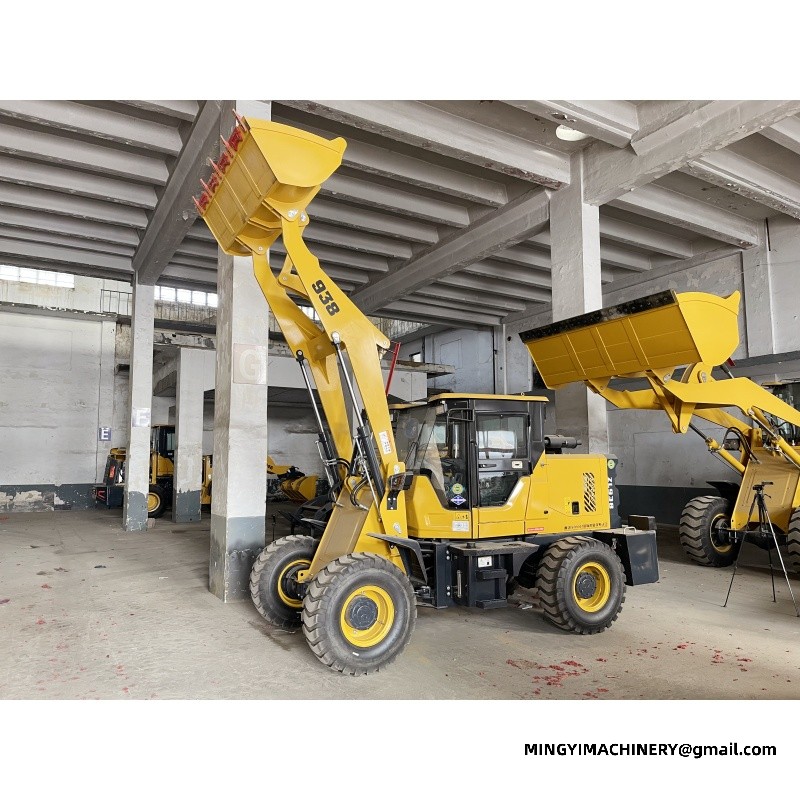
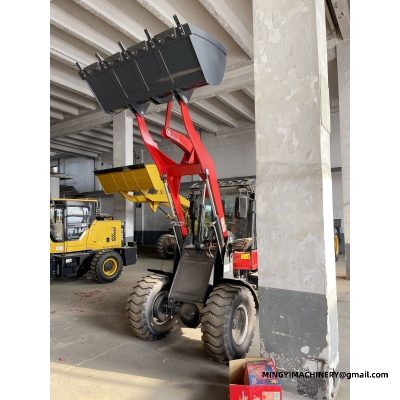
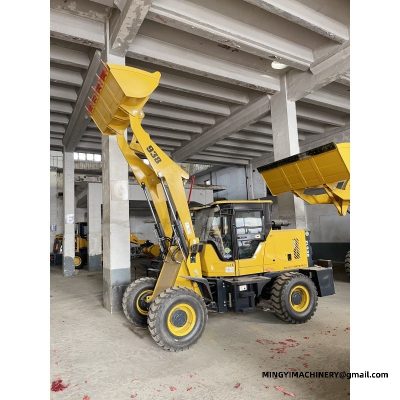
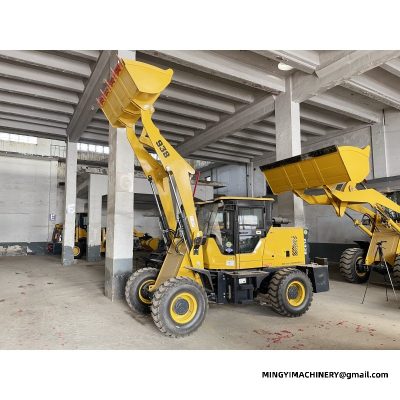
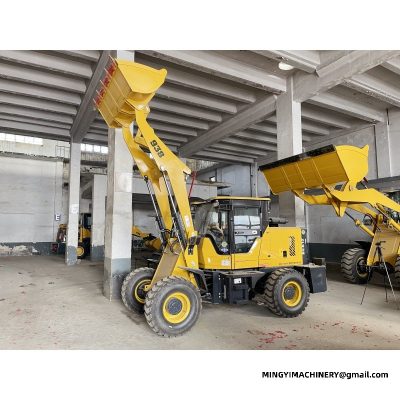
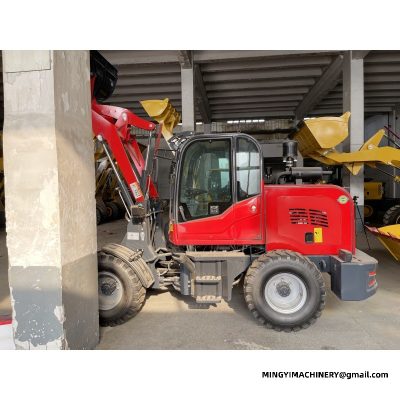
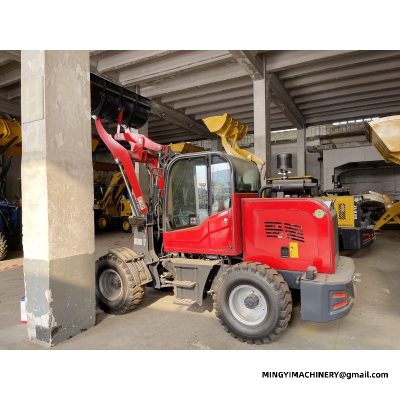
A wheel loader for material handling is a frame, a boom and a counterweight arranged around one job: moving material from a heap into something that has to carry it away. Every figure on the sheet serves that job or is decoration. Bucket capacity decides how many passes; dump height decides whether the pass is possible; hinge steel decides whether the machine is still tight in year three. Here the buckets run 0.65 m³ to 0.65 m³ and the dump heights 3.5 m to 3.8 m, with front hinge plates of 45 mm and rear plates of 30 mm on the heavier build. Below: how to read them, and what to specify.
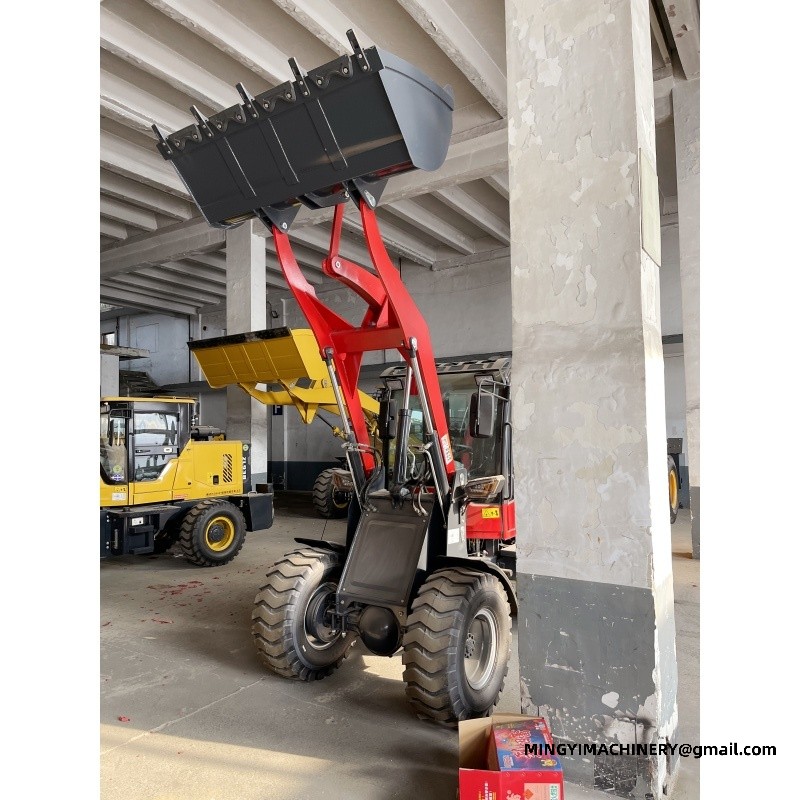
The useful way to read a range is as three decisions: how high, how heavy, and how wide. How high is dump height, 3.5 m against 4.5 m. How heavy is the steel, cross-member 45 mm against 45 mm and rear frame 300 mm high x 800 mm wide against 300 mm high x 800 mm wide. How wide is track, 1.6 m against 1.6 m.
Once those three are settled, the bucket follows from the material and the boom from the height: 0.65 m³ on a 3.15 m arm here, 0.65 m³ on 3.35 m there. Reading it in that order means the specification is decided by the work rather than by whichever machine happened to be in stock.
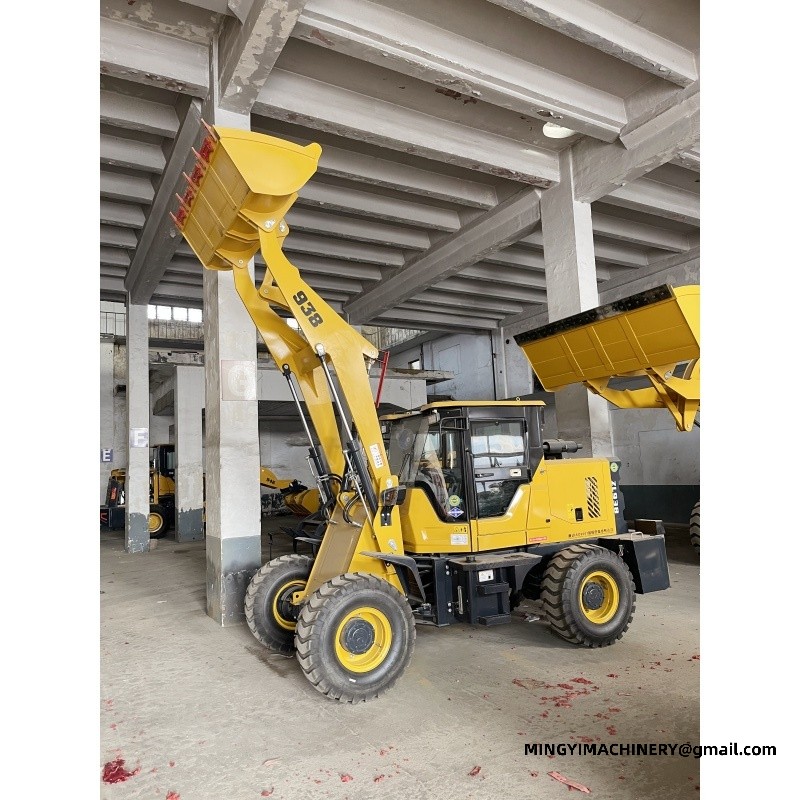
An articulated loader turns by bending in the middle, and the hinge is where that bending happens. Front plate 30 mm, rear plate 20 mm. The front is the thicker of the two on every build in the range, because it carries the boom and the payload directly, while the rear carries the engine and the counterweight through every steering movement and is sized for the twisting those movements produce rather than for the weight alone.
Pin wear is how hinges fail, and it shows up as a machine that wanders and a steering that feels vague. The cross-member is what prevents it: 30 mm holding the two sides of the frame at a fixed distance so the pins stay square. Compare 45 mm on the heavy-duty 3.5 m medium-frame wheel-side reduction wheel loader and the difference in plate thickness starts to make sense — they are specified together, not separately.
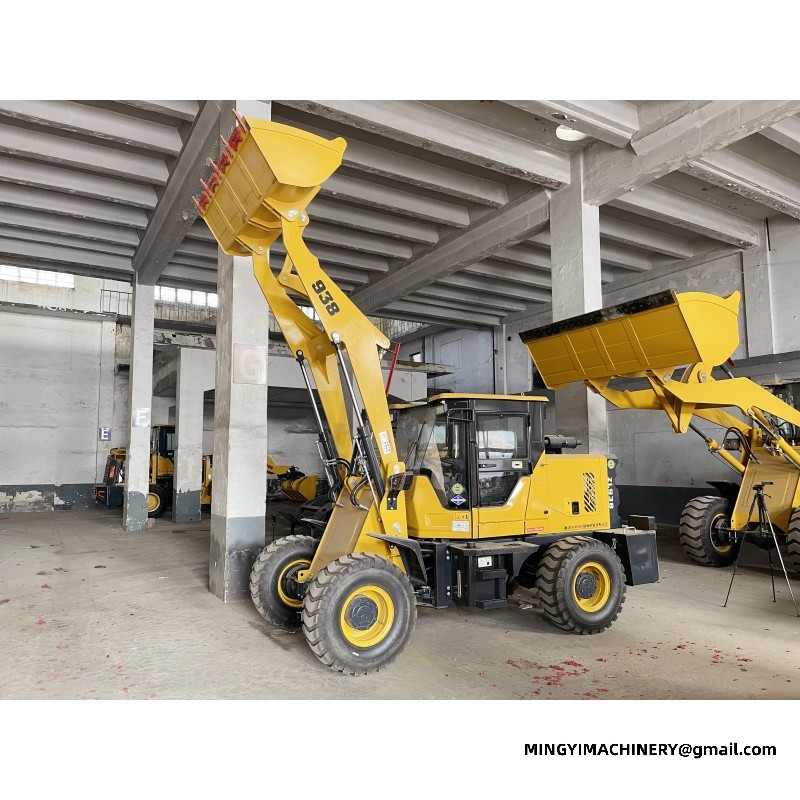
Breakout force is advertised; what you feel in the cab is the combination behind it. On the heavy-duty 3.5 m small-frame wheel-side reduction wheel loader that is a centre cylinder 45 / side cylinder 40 cylinder set on a 2.62 m boom with a 890 mm centre distance, lifting a 0.4 m³ bucket to 3.5 m. On the heavy-duty 3.8 m medium-frame wheel-side reduction wheel loader it is centre cylinder 60 / side cylinder 50 on a 2.9 m arm with 920 mm spacing, lifting 0.65 m³ to 3.8 m.
Heat is the failure mode nobody plans for. A pump working at the top of its flow all shift, in dust, at altitude, will cook its oil — and the 40 pump (490 engine); 1045 pump (4102 turbo engine) on the heavy-duty 3.5 m small-frame wheel-side reduction wheel loader and the 2063 pump on the heavy-duty 3.8 m medium-frame wheel-side reduction wheel loader were each sized against their own cylinder volumes and duty. The matching travel pumps, 316 pump and 25 pump, keep drive independent so a loaded climb does not stall the boom. Specify the third circuit at order time if a hydraulic tool is in the plan; plumbing added later is the most common source of leaks we see in the field.
| Published build data — heavy-duty 4.2 m medium-frame wheel-side reduction wheel loader | |
|---|---|
| Bucket capacity | 0.65 m³ |
| Dump height | 4.2 m |
| Track width | 1.6 m |
| Boom arm thickness | 30 mm |
| Boom arm width | 520 mm |
| Boom arm length | 3.16 m |
| Boom arm centre distance | 960 mm |
| Cross-member thickness | 45 mm |
| Front hinge plate thickness | 45 mm |
| Rear hinge plate thickness | 30 mm |
| Rear frame section | 300 mm high x 800 mm wide |
| Hydraulic cylinders | centre cylinder 60 / side cylinder 50 |
| Fuel tank | 70 L (75# large tank) |
| Battery | 80 Ah |
| Front wheel to counterweight | 4.55 m |
| Radiator | 4105 core |
| Work pump | 2063 pump |
| Travel pump | 25 pump |
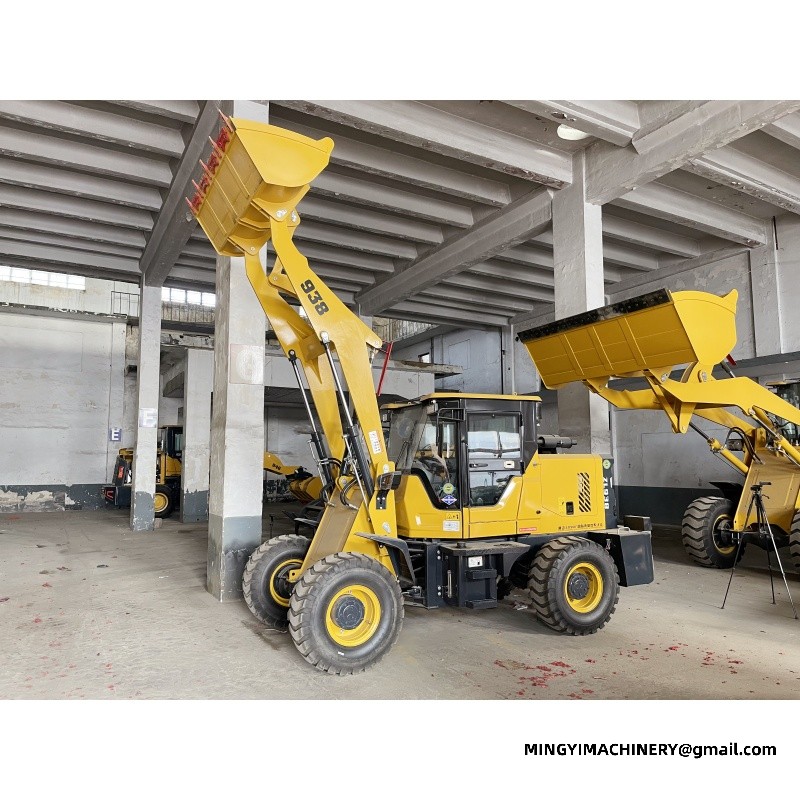
Most loader downtime is avoidable and most of what is avoidable is grease, coolant and hoses. Grease the articulation and the boom pins on the interval — on the heavy-duty 3.5 m small-frame wheel-side reduction wheel loader that is the 30 mm and 20 mm plates and the 890 mm boom mounts. Keep the 4100 core (490 engine); 4105 core (4102T engine) core clean, because overheating presents as lost power long before it presents as a fault.
Hoses are the second most common cause of a stopped machine and the easiest to plan for: a chafing hose on the centre cylinder 45 / side cylinder 40 circuit weeps before it bursts, and a weekly look finds it. Pumps — 40 pump (490 engine); 1045 pump (4102 turbo engine) and 316 pump on the heavy-duty 3.5 m small-frame wheel-side reduction wheel loader — rarely fail without warning; they get noisy first. On the heavy-duty 3.8 m medium-frame wheel-side reduction wheel loader the equivalents are centre cylinder 60 / side cylinder 50, 2063 pump and 25 pump. Keep a hose set and a filter set on site and most of this becomes a tea break rather than a week.
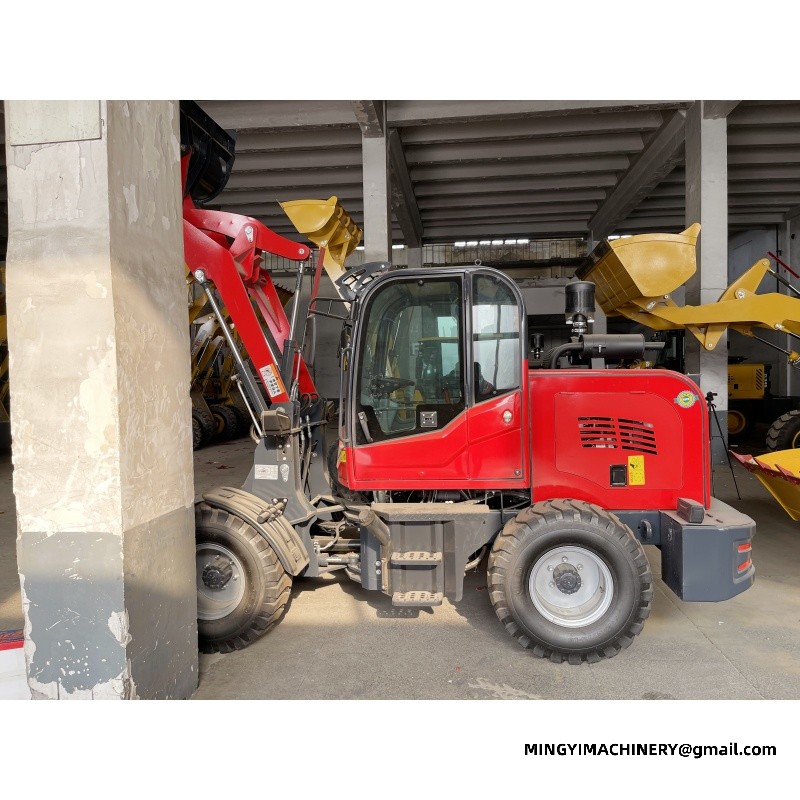
Machines kept past warranty should be bought on steel. Hinge plates 30 mm and 20 mm, cross-member 30 mm, rear frame 230 mm high x 800 mm wide: those are the figures that decide whether year five is a service year or a rebuild year.
The second decision is how repairable the machine is, and that is a parts question. Cylinders centre cylinder 45 / side cylinder 45, pump 40 pump (490 engine); 1045 pump (4102 turbo engine), radiator 4100 core (490 engine); 4105 core (4102T engine), battery 60 Ah (490 engine); 80 Ah (4102 turbo engine): if all four are standard items within the range, a machine can be kept indefinitely. If any is unique to one build, it cannot, and that is worth knowing before the order rather than at year six.
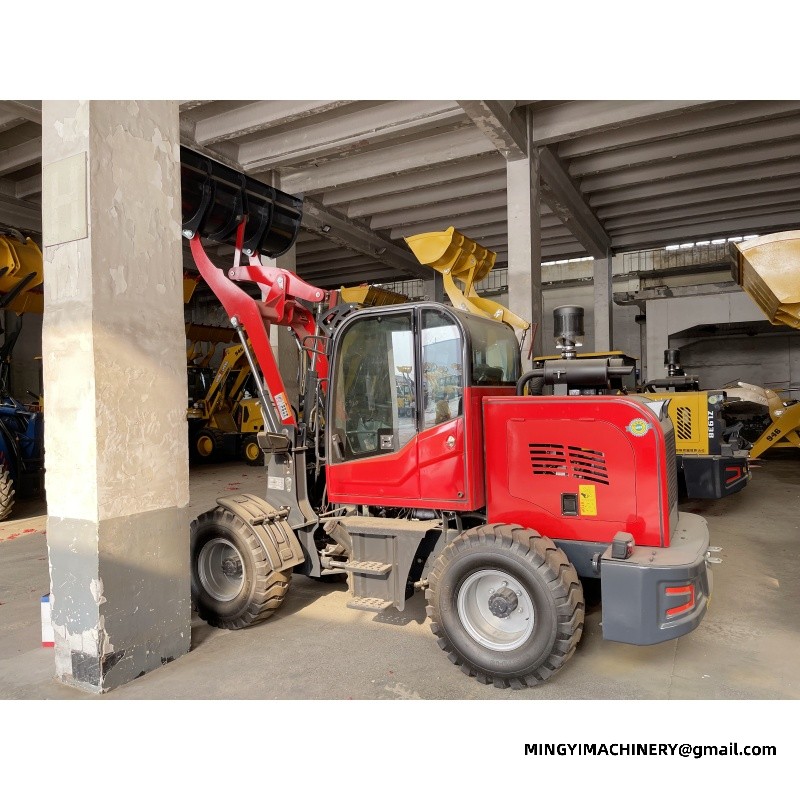
Some choices can be made after delivery and some cannot. Steel cannot: hinge plates at 30 mm and 20 mm, a 30 mm cross-member and a 230 mm high x 800 mm wide rear frame are decided when the frame is welded. Hydraulics mostly can: this build runs centre cylinder 45 / side cylinder 45 on a 40 pump (490 engine); 1045 pump (4102 turbo engine), and adding a service later is possible even if it is never as tidy as specifying it first.
The engine is the other early decision, because it drags three figures with it. Where two engines are offered, battery, radiator and pump all change: 60 Ah (490 engine); 80 Ah (4102 turbo engine), 4100 core (490 engine); 4105 core (4102T engine), 40 pump (490 engine); 1045 pump (4102 turbo engine). Choosing the engine late means choosing all three late, and usually accepting whatever is in stock.
A machine crossing an ocean is exposed to salt air for weeks, and the parts that suffer are the ones that were never painted: cylinder rods, hinge pins and electrical terminals. This build carries centre cylinder 45 / side cylinder 45 and hinge plates of 30 mm and 20 mm; all three should be greased and wrapped before loading rather than cleaned on arrival.
The battery is the other item to plan for. 60 Ah (490 engine); 80 Ah (4102 turbo engine) will not survive a long voyage connected, and a flat machine cannot be driven off a container. Specify a disconnect, and specify the radiator, 4100 core (490 engine); 4105 core (4102T engine), to be checked for fin corrosion on arrival — salt air attacks the core from outside and the symptom is overheating in the first month, which everyone blames on the thermostat.
A loader standing idle while a truck reverses is the most common waste on a site, and it is usually a layout problem rather than a machine problem. What the machine contributes is turn radius and visibility, and both come out of the dimensions: 3.5 m from front wheel to counterweight, 1.2 m (Isuzu axle); 1.3 m (wheel-side reduction axle) of track, and a rear frame section of 200 mm high x 750 mm wide. A shorter machine turns inside its own length and works a tighter bay.
The other half is dump geometry. With 2.8 m of clearance and a 2.05 m arm, the standard 2.8 m low-profile wheel loader can stand back from the body and still place material where the driver wants it, which is safer than crowding the board. The heavy-duty 3.5 m small-frame wheel-side reduction wheel loader reaches 3.5 m with a 2.62 m arm; on a narrow bay the shorter of the two may be the faster machine even if it holds less.
Do attachments interchange across the wheel loader for material handling range?
Within a frame family, yes, because the boom section matches. Across families, no: a 500 mm section on the heavy-duty 3.5 m medium-frame wheel-side reduction wheel loader is not the 500 mm section on the heavy-duty 3.8 m medium-frame wheel-side reduction wheel loader.
What does commissioning a wheel loader for material handling involve?
Fit the 3.15 m boom to the 920 mm mounts, torque the hinge pins, fill the 70 L (75# large tank) tank and the 4105 core circuit, and connect the battery. Allow a day per machine.
How does a wheel loader for material handling cope with dust?
Specify the raised core: 4100 core (490 engine); 4105 core (4102T engine) on the heavy-duty 3.2 m small-frame wheel-side reduction wheel loader against 4105 core on the heavy-duty 3.8 m medium-frame wheel-side reduction wheel loader, and blow the fins out at the end of every shift in fines or grain.
How is a wheel loader for material handling prepared for export?
Knock-down: booms and counterweights packed loose, tanks removed, batteries boxed and disconnected. Rear frame sections stay between 300 mm high x 800 mm wide and 300 mm high x 800 mm wide.
What is the difference between the two hinge plates on a wheel loader for material handling?
The front plate carries boom loads, which are mostly vertical; the rear carries articulation, which is sideways and shock-loaded. Hence 45 mm front against 30 mm rear.
Can one spares kit cover a mixed wheel loader for material handling fleet?
Within a frame family, largely yes: the centre cylinder 60 / side cylinder 50 cylinder set and the 2063 pump and 25 pump pumps are shared. Across families the cylinder set changes to centre cylinder 60 / side cylinder 50.
Can a wheel loader for material handling be used for snow clearance?
Yes, with a snow tool specified against the boom section — 500 mm on the heavy-duty 3.5 m medium-frame wheel-side reduction wheel loader — and the third circuit ordered if the tool is hydraulically actuated.
Specifications are built per order: machine, attachments, spares box and container plan together. Because rear frame sections stay between 300 mm high x 800 mm wide and 300 mm high x 800 mm wide across the wheel loader for material handling range, two to three units ship in one forty-foot box.
Handover and getting familiar with Wheel Loader for Material Handling: Forks, Grapples and Circuits
The first day with a new machine sets the pattern for the next five years. Handover for Wheel Loader for Material Handling: Forks, Grapples and Circuits covers the control layout, the daily check points and the limits the operator needs to know before the first real load is lifted or carried.
Packing, loading and shipment of Wheel Loader for Material Handling: Forks, Grapples and Circuits
Container loading is a planning exercise. The overall dimensions and the operating weight of Wheel Loader for Material Handling: Forks, Grapples and Circuits decide whether it ships whole, partly disassembled or with the attachment removed, and that decision is made before the booking.
Contact MINGYI Machinery for the current wheel loader lineup, configuration options and a formal specification for your market. E-mail: sales@mingycn.com | LINE (ID): mingyicn
Wheel Loader for Aggregate Yard: Dust, Fines and Heavy Builds · OEM Wheel Loader Manufacturer: Build Records and Model Mixes · Front End Loader: Attachment Changes and Hydraulics · Loaders









