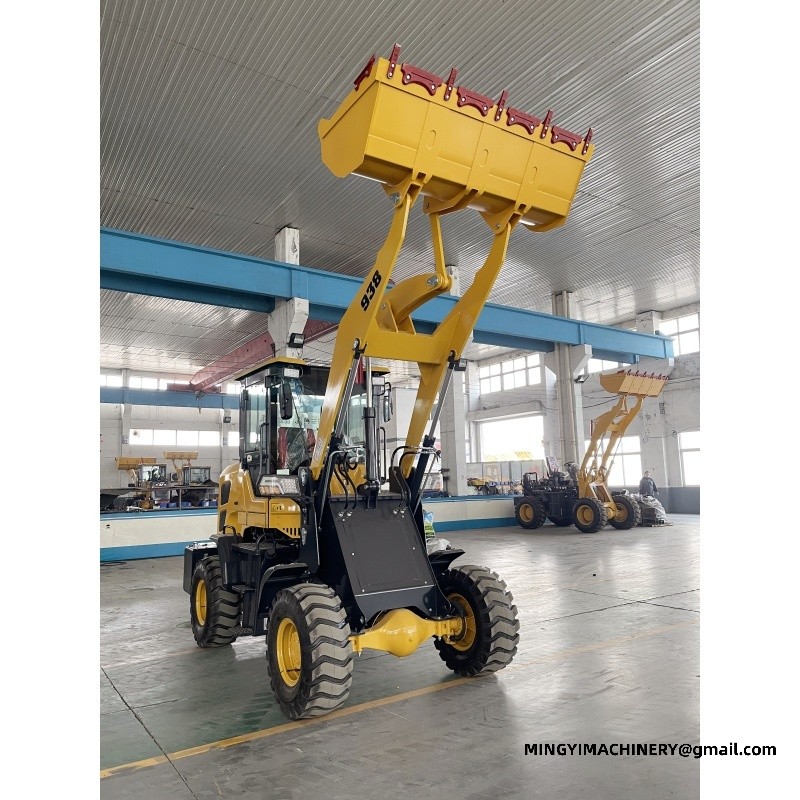
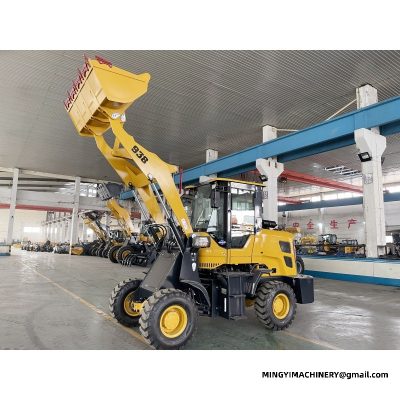
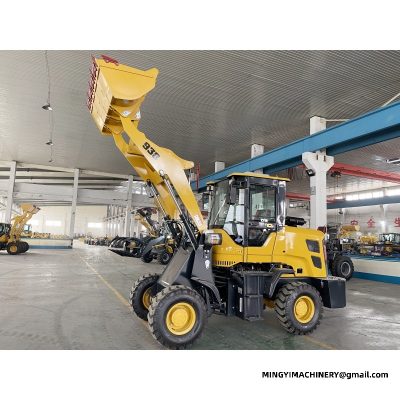
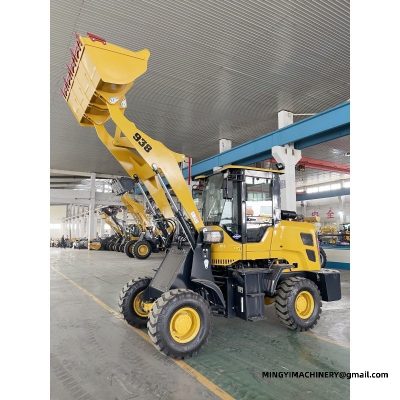
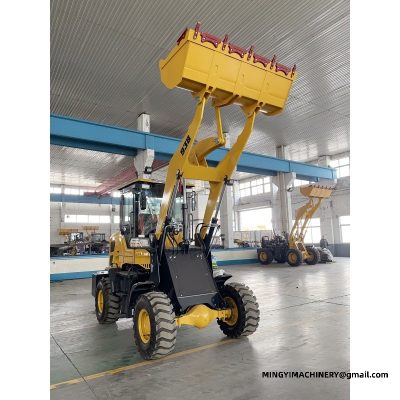
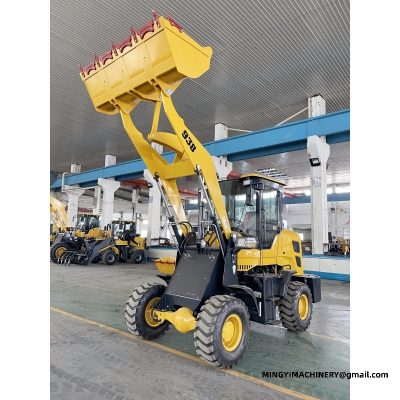
The useful question about any OEM wheel loader manufacturer is not what it is called but which frame sits underneath it. Two machines can share a capacity class and differ in every respect that matters: boom wall 25 mm against 25 mm, rear hinge plate 20 mm against 20 mm, cross-member 30 mm against 30 mm. This page takes the published specification of the range — buckets 0.4 m³ to 0.4 m³, dump heights 3.2 m to 3.2 m — and shows how each figure translates into behaviour, effort and service life.
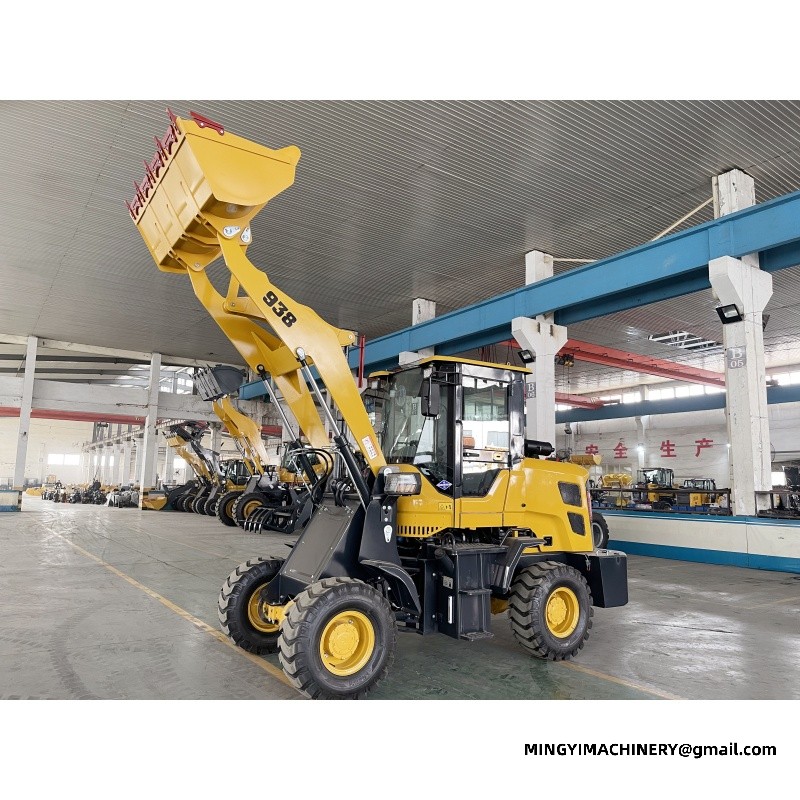
An attachment is only as useful as the hydraulics behind it. This build runs centre cylinder 45 / side cylinder 45 fed by a 40 pump (490 engine); 1045 pump (4102 turbo engine), and those two figures set the force available at the boom and the speed at which it arrives. A grapple, a fork carriage or a snow blower all ask for more flow than a bucket does.
The centre cylinder does the lifting and the side cylinders do the tilting, and they are specified together for a reason. On the heavy-duty 4.2 m small-frame wheel-side reduction wheel loader the pair is centre cylinder 45 / side cylinder 45. If an attachment needs a third service, the question to ask is whether the pump has the flow to run it without starving the lift circuit, because a machine that lifts slowly with a grapple on is not a machine with a grapple problem. It has a 40 pump (490 engine); 1045 pump (4102 turbo engine) problem.
Attachments are specified against the carrier, not against the machine's size class. The figures that matter are the boom section and the hinge geometry: 430 mm on the heavy-duty 3.2 m low-profile wheel loader against 430 mm on the light-duty 3.8 m medium-frame wheel-side reduction wheel loader, and centre distance 890 mm against 900 mm. Two loaders of the same rated capacity from different frame families will not share a fork frame.
Within one frame family the section and spacing match, so a single tool set covers the light and heavy builds of that frame — a genuine advantage for a mixed fleet. Across families it does not work. If you intend to run hydraulically actuated tools, a grapple, a four-in-one bucket or a hydraulic snow blade, order the third circuit at build time; the 40 pump (490 engine); 1045 pump (4102 turbo engine) and 2063 pump circuits are specified per build and plumbing added later is the most common source of field leaks.
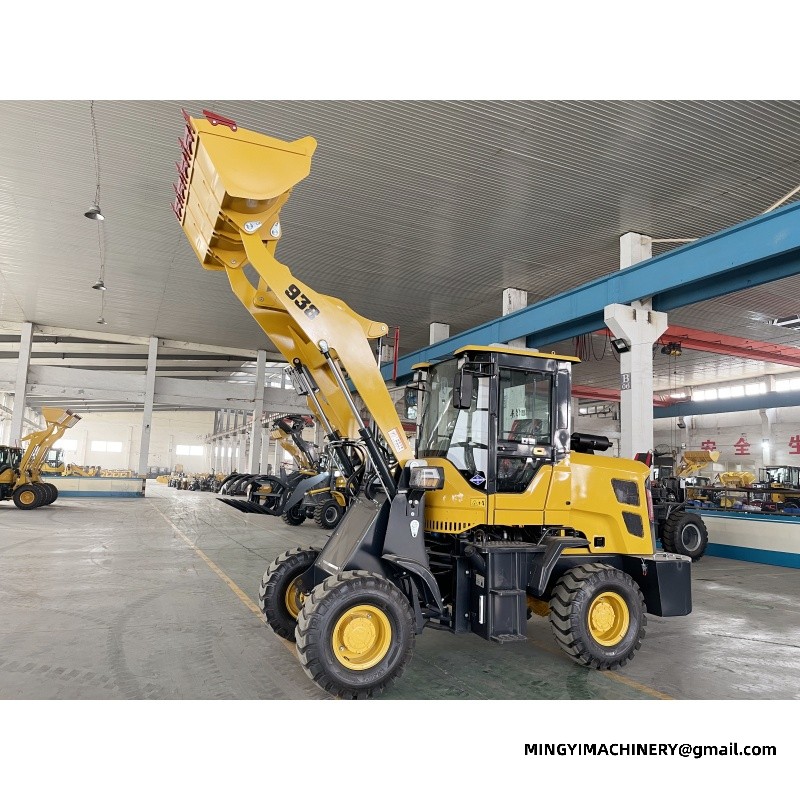
Two dimensions decide whether a loader is usable on a given site: the 4.1 m front-to-counterweight length of the heavy-duty 3.2 m low-profile wheel loader against the 4.3 m of the light-duty 3.8 m medium-frame wheel-side reduction wheel loader, and track width at 1.5 m (wheel-side reduction axle); 1.45 m (Isuzu axle) against 1.6 m. Everything else on the sheet — engine, pump, cylinder bore — matters only after the machine fits.
The pairing matters too. A 0.4 m³ bucket lifted to 3.2 m on a 4.1 m footprint is a different machine in practice from a 0.52 m³ bucket at 3.8 m on 4.3 m, even where the track figures are close. Where access is tight, take the shorter machine and accept the extra pass; where the ground is open, take the longer one and take the stability it buys with the 30 mm rear hinge plate.
| Sample build from the range — light-duty 3.8 m medium-frame wheel-side reduction wheel loader | |
|---|---|
| Bucket capacity | 0.52 m³ |
| Dump height | 3.8 m |
| Track width | 1.6 m |
| Boom arm thickness | 30 mm |
| Boom arm width | 430 mm |
| Boom arm length | 2.9 m |
| Boom arm centre distance | 900 mm |
| Cross-member thickness | 45 mm |
| Front hinge plate thickness | 45 mm |
| Rear hinge plate thickness | 30 mm |
| Rear frame section | 280 mm high x 800 mm wide |
| Hydraulic cylinders | centre cylinder 60 / side cylinder 50 |
| Fuel tank | 70 L (75# large tank) |
| Battery | 80 Ah |
| Front wheel to counterweight | 4.3 m |
| Radiator | 4105 core |
| Work pump | 2063 pump |
| Travel pump | 25 pump |
Hinge plates carry the pin loads that the boom and the steering articulation put into the frame, and they are where a loader shows its age first. The light-duty 3.5 m medium-frame wheel-side reduction wheel loader runs 45 mm front plates and 30 mm rear plates over a 45 mm cross-member; the light-duty 3.8 m medium-frame wheel-side reduction wheel loader runs 45 mm and 30 mm over 45 mm. Rear frame sections follow at 300 mm high x 800 mm wide and 280 mm high x 800 mm wide respectively.
The rear plate is the more telling of the two. Articulated steering loads the rear hinge every time the machine turns under load, and reversing out of a face with a full bucket doubles it. A 30 mm rear plate with a 45 mm cross-member is a light-duty specification; 30 mm over 45 mm is a heavy-duty one. Put those alongside the 0.52 m³ and 0.52 m³ buckets and the specification difference between the two builds stops looking arbitrary — it is steel.
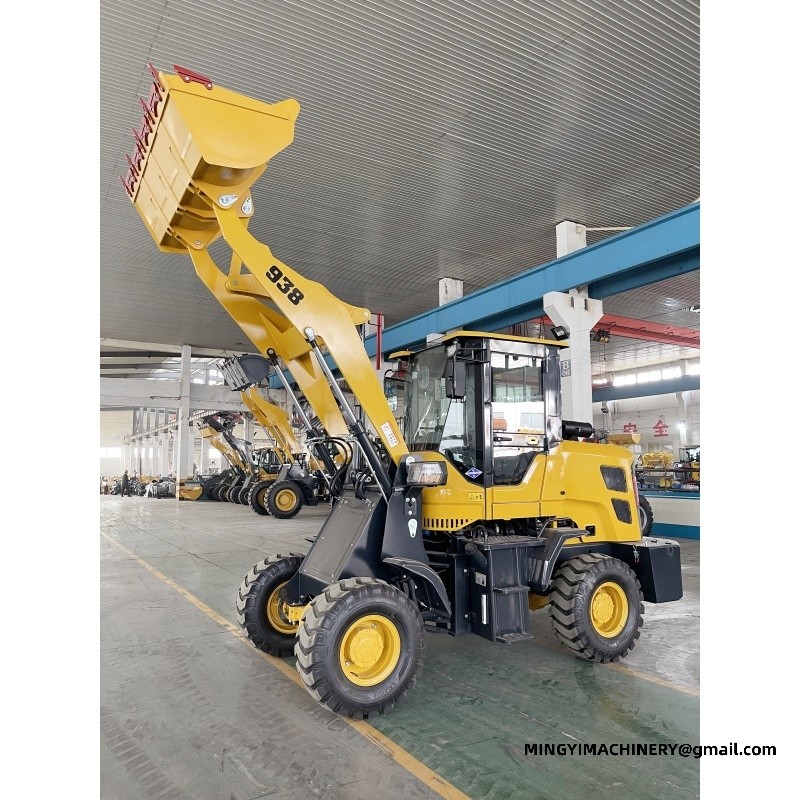
Relief pressure is only half the story; the other half is lever geometry, and lever geometry is decided by the boom and hinge dimensions. The heavy-duty 3.2 m low-profile wheel loader pairs a centre cylinder 45 / side cylinder 45 cylinder set with a 890 mm boom centre distance and a 2.3 m arm; the light-duty 3.5 m medium-frame wheel-side reduction wheel loader pairs centre cylinder 60 / side cylinder 50 with a 900 mm spacing and a 2.63 m arm. Wider spacing means the cylinders work through a better lever, which is how a bigger bucket is lifted without simply raising system pressure and heat.
Pump pairing is the second half. Work pump and travel pump are separate circuits on both machines — 40 pump (490 engine); 1045 pump (4102 turbo engine) and 316 pump on the heavy-duty 3.2 m low-profile wheel loader, 2063 pump and 25 pump on the light-duty 3.5 m medium-frame wheel-side reduction wheel loader — so steering and drive do not steal flow from the boom at the top of a lift. If you intend to run hydraulically actuated attachments, a grapple or a four-in-one bucket, order the third circuit at build time; retrofitting a valve block and plumbing in the field takes far more than specifying it on the order.
Hold the parts that stop the machine and cannot be improvised: hoses and seals for the centre cylinder 45 / side cylinder 45, a belt set, filters, and a battery to the 60 Ah (490 engine); 80 Ah (4102 turbo engine) rating. Do not hold the parts that are welded in — hinge plates at 30 mm and 20 mm, the 30 mm cross-member. Those are a repair, not a spare, and they are the same steel on every machine in the family.
The pump is the judgement call. 40 pump (490 engine); 1045 pump (4102 turbo engine) is a stocked item and a week of downtime if it is not; the 316 pump fails less often and is the one most fleets choose to order rather than hold. Decide on that by distance from the supplier, not by the effort of the part.
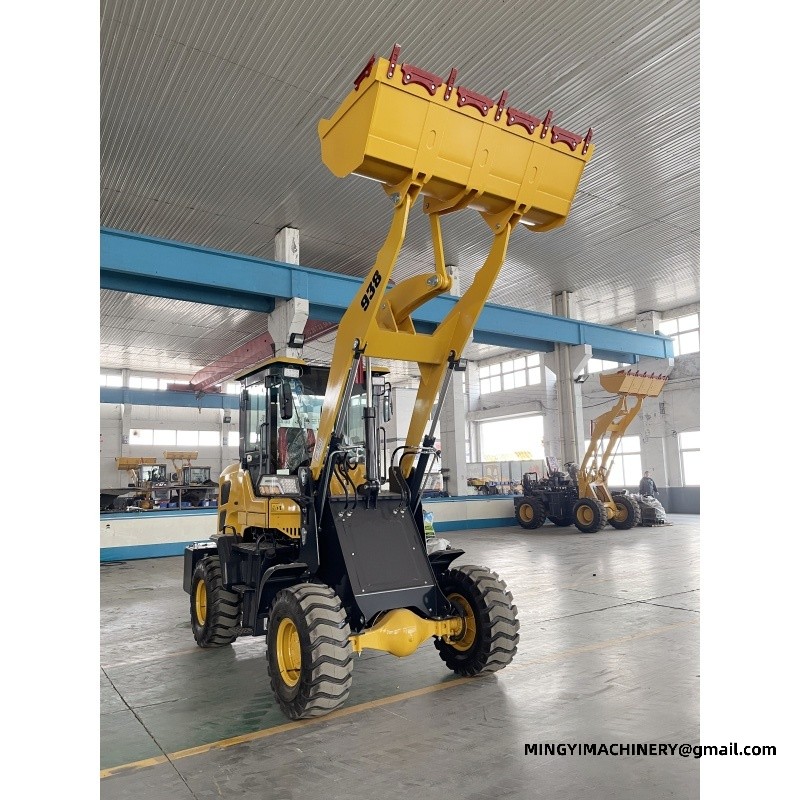
Articulated steering lets a loader turn inside its footprint, and every one of those turns is carried by two plates. Front hinge 30 mm, rear hinge 20 mm. The rear is the heavier because it carries the counterweight and the whole rear frame through every steering input.
Short wheelbase machines articulate harder and more often, which is why plate thickness matters more on a compact build, not less. At 4.2 m front wheel to counterweight and 1.5 m (wheel-side reduction axle); 1.45 m (Isuzu axle) of track, this machine will spend its life turning in tight spaces; a 30 mm cross-member is what keeps those plates in line while it does.
Ask any yard operator which part fails first and the answer is the articulation, not the engine. The rear hinge plate takes every reversing and turning load: 20 mm on the heavy-duty 3.2 m low-profile wheel loader against 20 mm on the heavy-duty 3.8 m small-frame wheel-side reduction wheel loader, on cross-members of 30 mm and 30 mm respectively. That pair of figures predicts whether the machine is still tight at year three.
The rest of the specification follows the duty. A 0.4 m³ bucket at 3.2 m with centre cylinder 45 / side cylinder 45 cylinders is right for loose stock and loading out; 0.4 m³ at 3.8 m with centre cylinder 45 / side cylinder 45 is right where the machine has to break out of a face. Ground decides the axle — 1.5 m (wheel-side reduction axle); 1.45 m (Isuzu axle) against 1.5 m (wheel-side reduction axle); 1.45 m (Isuzu axle) — and the material decides the radiator.
What bucket capacity should a OEM wheel loader manufacturer be specified with?
Match it to the material and to the body being filled: 0.4 m³ on the heavy-duty 3.2 m low-profile wheel loader against 0.52 m³ on the light-duty 3.5 m medium-frame wheel-side reduction wheel loader. Heavy material limits volume before the frame does.
Why does boom centre distance matter on a OEM wheel loader manufacturer?
It sets how side loads travel into the frame: 890 mm on the heavy-duty 3.2 m low-profile wheel loader against 890 mm on the heavy-duty 3.2 m small-frame wheel-side reduction wheel loader. Wider spacing lets the cylinders work through a better lever.
Will a OEM wheel loader manufacturer start in a cold climate?
With the right pack, yes: 60 Ah (490 engine); 80 Ah (4102 turbo engine) on the heavy-duty 3.8 m small-frame wheel-side reduction wheel loader, the larger capacity where the turbo engine is fitted. Specify an isolator for anything shipping long-distance.
What does the cross-member figure tell me about a OEM wheel loader manufacturer?
How well the frame resists the twisting that articulation puts into it: 30 mm on the heavy-duty 3.8 m small-frame wheel-side reduction wheel loader against 45 mm on the light-duty 3.5 m medium-frame wheel-side reduction wheel loader. It is the clearest marker of build class.
Can one spares kit cover a mixed OEM wheel loader manufacturer fleet?
Within a frame family, largely yes: the centre cylinder 45 / side cylinder 45 cylinder set and the 40 pump (490 engine); 1045 pump (4102 turbo engine) and 316 pump pumps are shared. Across families the cylinder set changes to centre cylinder 60 / side cylinder 50.
Which OEM wheel loader manufacturer build suits quarry or stockpile work?
The heavy build with the raised core: a 0.4 m³ bucket, 20 mm rear hinge plate, 30 mm cross-member and the 4100 core (490 engine); 4105 core (4102T engine) radiator for fines and dust.
How much reach does the boom of a OEM wheel loader manufacturer give?
Boom length is 2.62 m on the heavy-duty 3.5 m small-frame wheel-side reduction wheel loader and 2.9 m on the light-duty 4.2 m medium-frame wheel-side reduction wheel loader. Length buys reach and takes stability, so match it to the height you actually have to clear.
Every OEM wheel loader manufacturer in this range ships with the same five recorded figures — boom wall, boom width, front hinge, rear hinge and cross-member — checked against the published table before it leaves the factory. Ask for that record on any unit you are stated.
Later additions and retrofits on OEM Wheel Loader Manufacturer: Build Records and Model Mixes
An added function should pay for itself quickly. Whether OEM Wheel Loader Manufacturer: Build Records and Model Mixes gains a different bucket, a hydraulic service or a protection package, the test is the number of days a year it is actually used.
Moving OEM Wheel Loader Manufacturer: Build Records and Model Mixes between sites
Securing the load is not optional. Lashing OEM Wheel Loader Manufacturer: Build Records and Model Mixes at the points intended for it, checking the tension before the vehicle moves and rechecking after the first kilometres is standard practice rather than extra care.
Contact MINGYI Machinery for the current wheel loader lineup, configuration options and a formal specification for your market. E-mail: sales@mingycn.com | LINE (ID): mingyicn
China Wheel Loader Factory Supplier: Range, Spares, Loading · Wheel Loader Manufacturer China: Range, Builds and Export Terms · Wheel Loader Manufacturer: Questions to Ask the Factory · Loaders









