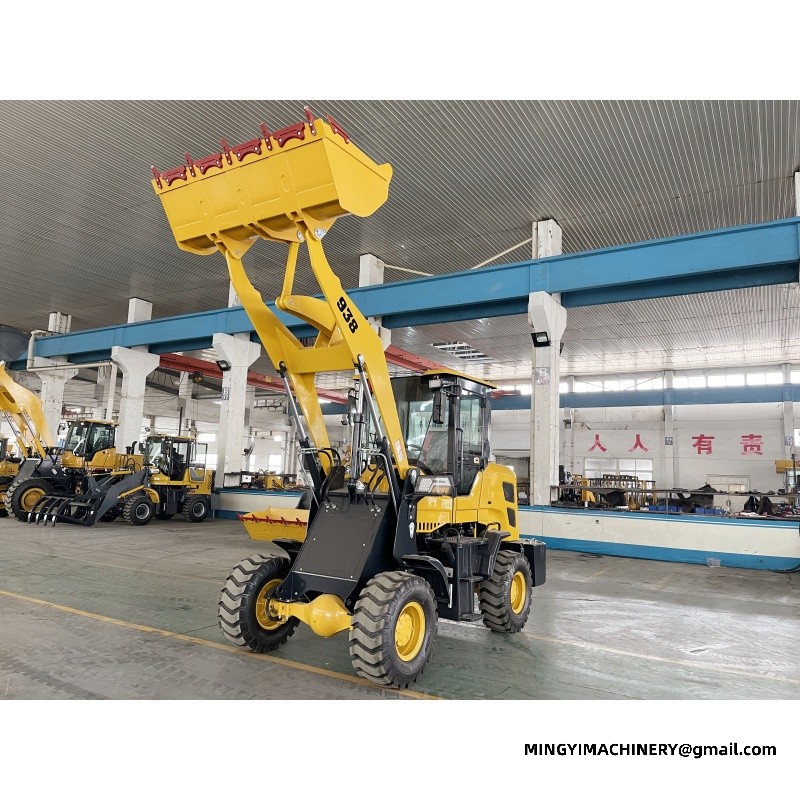
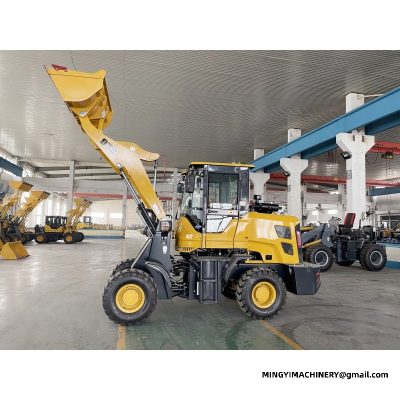
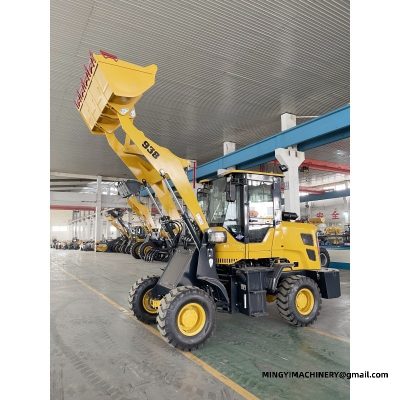
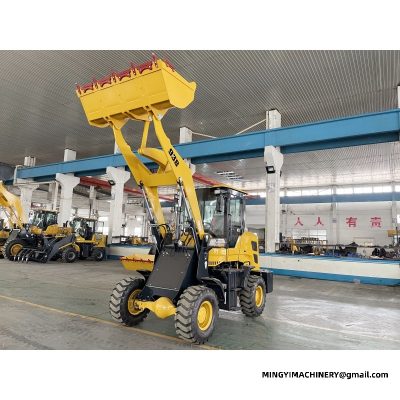
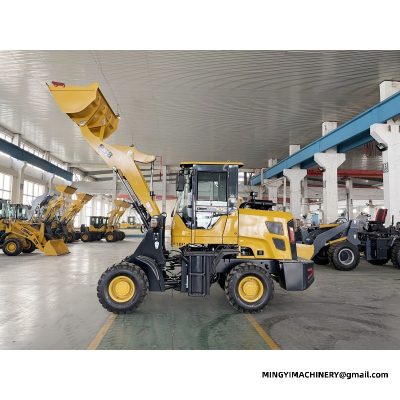
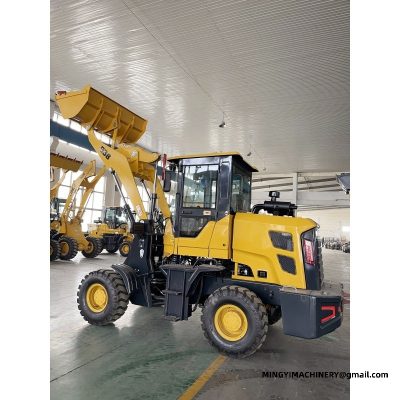
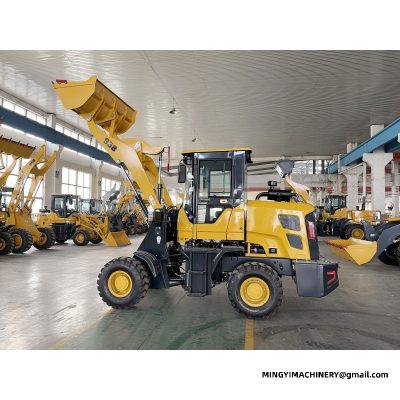
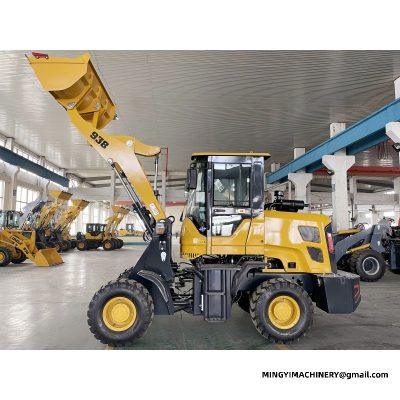
Buying a wheel loader for aggregate yard on capacity alone is the most common and most lengthy mistake in this class of machine.Capacity is simple to advertise and easy to change; stability, reach and frame life are neither. The light-duty 4.5 m medium-frame wheel-side reduction wheel loader carries 0.52 m³ to 4.5 m on a 3.35 m boom with a 960 mm centre distance, while the standard 2.4 m low-profile wheel loader carries 0.3 m³ to 2.4 m on 1.85 m and 680 mm. Those are the figures that decide what the machine can do on your site, and this page walks through them in the order a buyer should read them.
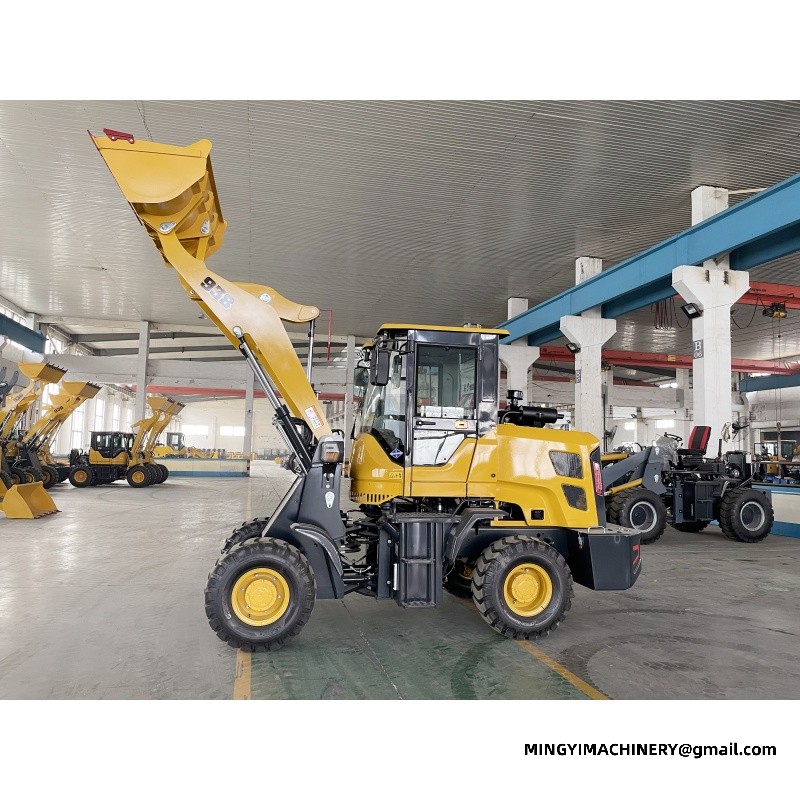
The standard bucket on this build is 0.3 m³, and it is the right tool for loose material moved from a heap to a body. Everything else is a compromise in one direction or another: forks give precision and lose volume, grapples give grip and lose speed, a snow blower gives reach and needs flow the bucket never asked for.
What makes attachments practical is whether the machine can lift them. Boom wall 20 mm and section 280 mm decide how much side load the arm takes, and the hinge plates — 16 mm at the front, 16 mm at the rear — decide how long the frame takes it. A grapple hanging off the end of a long arm is a side load the bucket never produces.
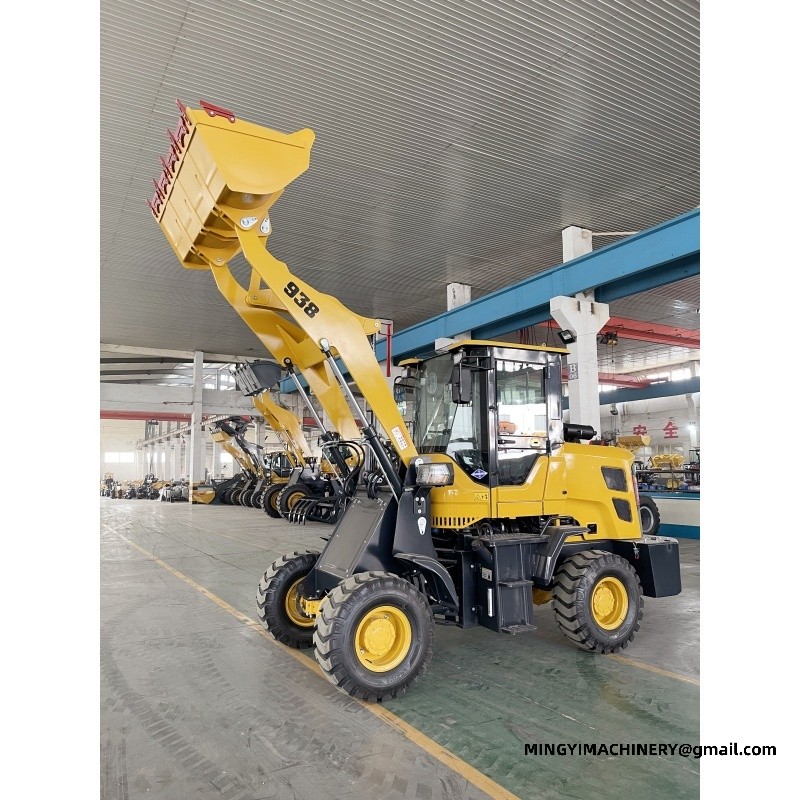
Put the two builds side by side and read four rows only. Bucket: 0.38 m³ against 0.4 m³. Dump height: 3.2 m against 4.5 m. Hinge steel: 25 mm and 14 mm against 30 mm and 20 mm. Cross-member: 25 mm against 30 mm.
Those four decide what the machine can carry, where it can put it, and how long the frame lasts doing it. Everything else on a specification sheet — paint, cab trim, lighting package — is cosmetic next to them. The pumps, 40 pump (490 engine); 1045 pump (4102 turbo engine) against 40 pump (490 engine); 1045 pump (4102 turbo engine), are the fifth row and matter only if the work is hydraulic rather than loading.
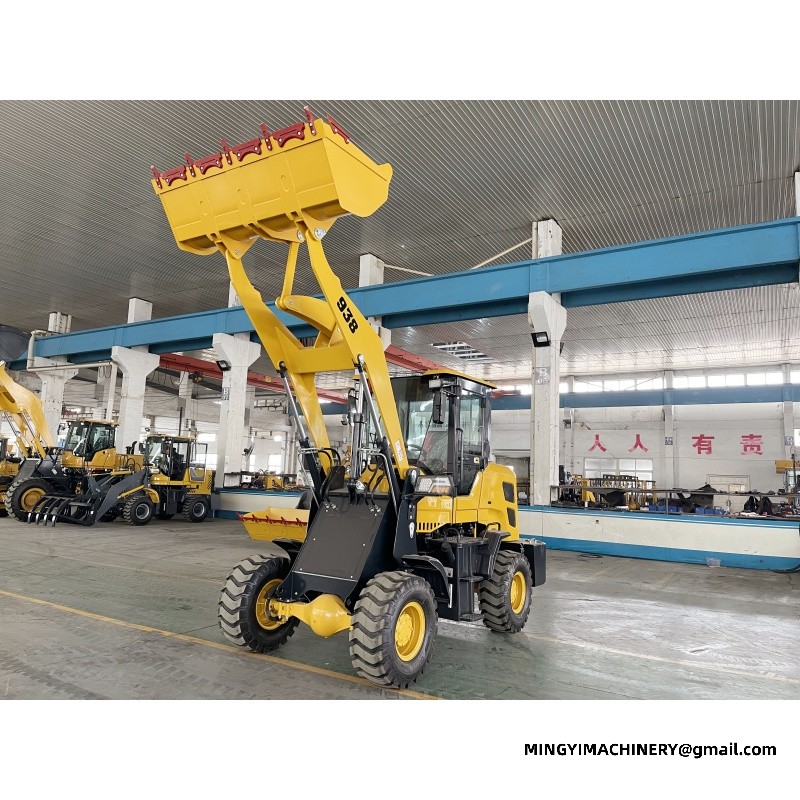
A battery specification is really an engine specification in disguise. 60 Ah (490 engine); 80 Ah (4102 turbo engine) tells you what the engine needs to turn over, and where two figures are listed it tells you the build is offered with more than one engine. The larger figure is the turbo; the smaller, the naturally aspirated option.
Match that to how the machine will be used. Continuous duty — one start, one long shift — is easy on a battery. Intermittent duty — yard work where the engine is stopped every time the operator gets out — is the hard case, and it is where the higher rating earns its keep. The rest of the electrical load is modest, so cranking is what the 60 Ah (490 engine); 80 Ah (4102 turbo engine) figure is really buying.
| Specification extract — light-duty 3.5 m small-frame wheel-side reduction wheel loader | |
|---|---|
| Bucket capacity | 0.38 m³ |
| Dump height | 3.5 m |
| Track width | 1.5 m (wheel-side reduction axle); 1.45 m (Isuzu axle) |
| Boom arm thickness | 25 mm |
| Boom arm width | 370 mm |
| Boom arm length | 2.62 m |
| Boom arm centre distance | 890 mm |
| Cross-member thickness | 25 mm |
| Front hinge plate thickness | 25 mm |
| Rear hinge plate thickness | 14 mm |
| Rear frame section | 280 mm high x 800 mm wide |
| Hydraulic cylinders | centre cylinder 45 / side cylinder 40 |
| Fuel tank | 64.7 L (75# small tank) |
| Battery | 60 Ah (490 engine); 80 Ah (4102 turbo engine) |
| Front wheel to counterweight | 4 m |
| Radiator | 4100 core (490 engine); 4105 core (4102T engine) |
| Work pump | 40 pump (490 engine); 1045 pump (4102 turbo engine) |
| Travel pump | 316 pump |
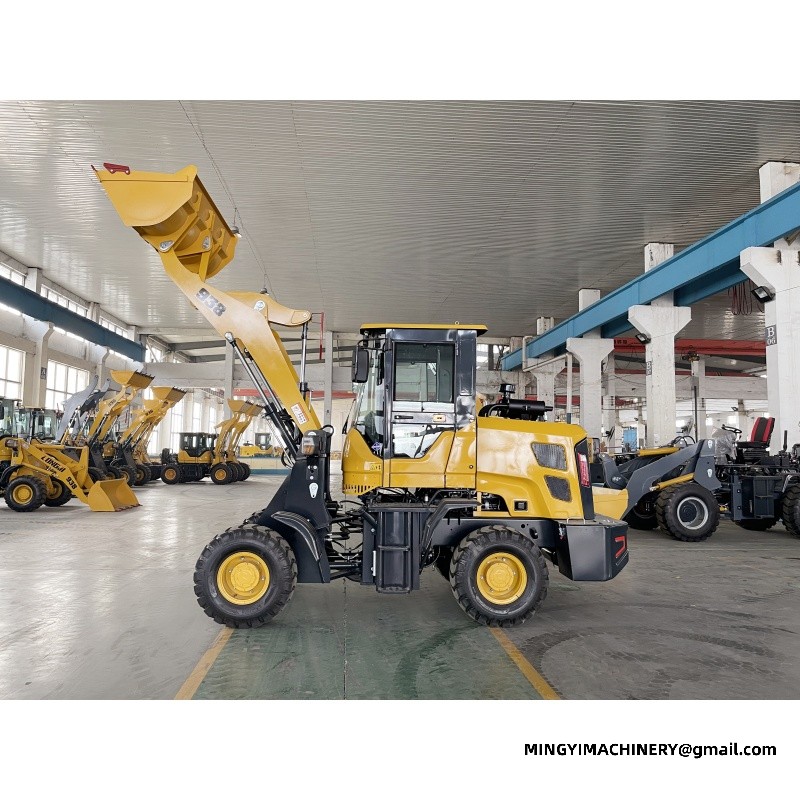
The most lengthy mistake in buying a loader is specifying capacity first. The light-duty 4.2 m small-frame wheel-side reduction wheel loader and the light-duty 4.5 m medium-frame wheel-side reduction wheel loader differ by 4.2 m against 4.5 m of clearance, and that difference decides which bodies each can fill. Capacity only decides how many passes it takes once clearance exists.
Where clearance is marginal, look at the boom rather than the machine: the light-duty 4.2 m small-frame wheel-side reduction wheel loader works a 3.15 m arm from a 890 mm centre distance, the light-duty 4.5 m medium-frame wheel-side reduction wheel loader a 3.35 m arm from 960 mm. A longer arm on a lighter frame buys height at the effort of stability, so match the arm to the counterweight — 4.1 m against 4.7 m — and not to a brochure figure.
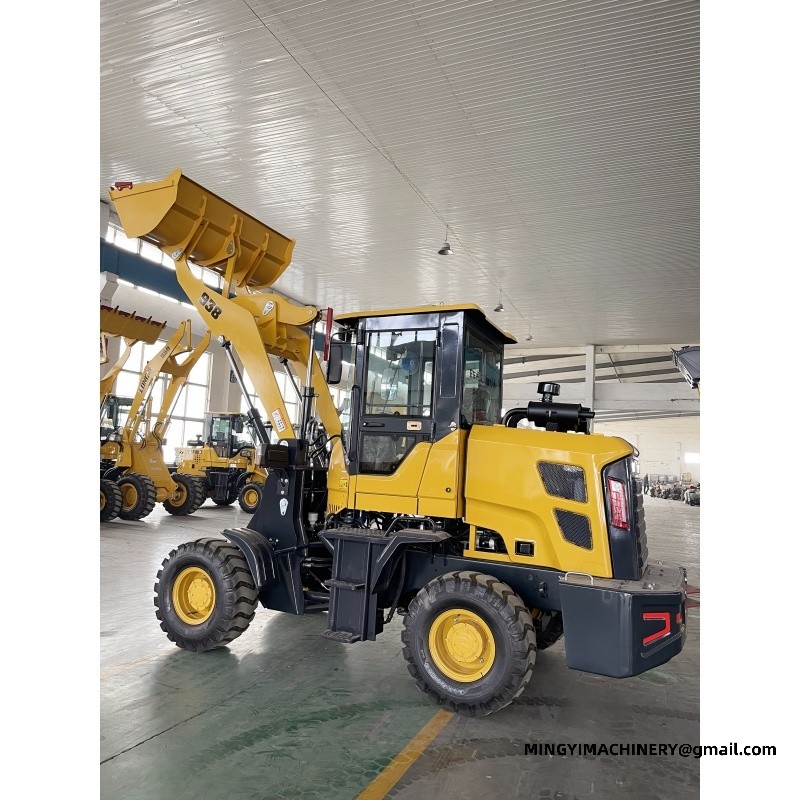
Over a full season, the differences that matter are not the ones on the sales sheet. Two machines, the light-duty 3.2 m low-profile wheel loader with 0.38 m³ at 3.2 m and the light-duty 3.8 m small-frame wheel-side reduction wheel loader with 0.38 m³ at 3.8 m, will differ in fuel by less than they differ in uptime, and they will differ in uptime mostly because of the cooling package — 4100 core (490 engine); 4105 core (4102T engine) against 4100 core (490 engine); 4105 core (4102T engine) — and the frame — 14 mm against 14 mm.
plan on the duty, then check the specification supports it. A light build in a quarry is a false economy; a heavy build on a farm is money spent for nothing. Where the duty is mixed, buy the frame for the hardest week of the year and the bucket for the average one — buckets are simple, frames are not, and the 40 pump (490 engine); 1045 pump (4102 turbo engine) and 316 pump on the light-duty 3.2 m low-profile wheel loader will run either.
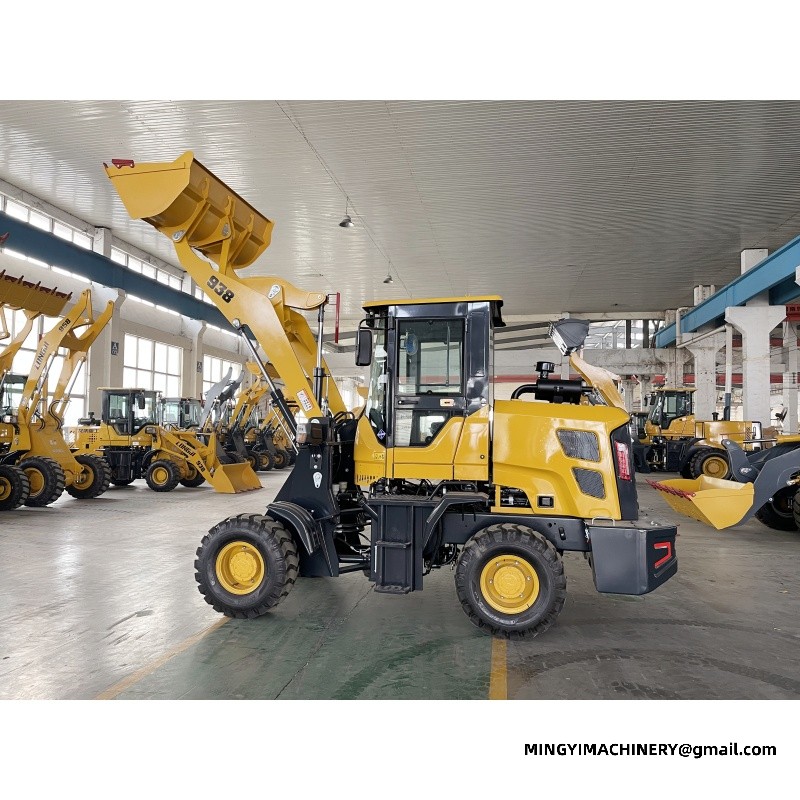
Second-hand buyers check three things and none of them is the hour meter. They rock the hinge and look for movement at the 16 mm front and 16 mm rear plates. They look along the boom for twist, which is a 280 mm section and 680 mm spacing question. They start it cold and listen, which is a 45 Ah (24 V) question.
Steel thickness is what makes the first check pass or fail, and it is on the sheet: cross-member 16 mm, rear frame 200 mm high x 750 mm wide. A machine built with those figures published and verifiable is easier to sell than one with a lower hour count and no specification, because the buyer can check the claim instead of trusting it.
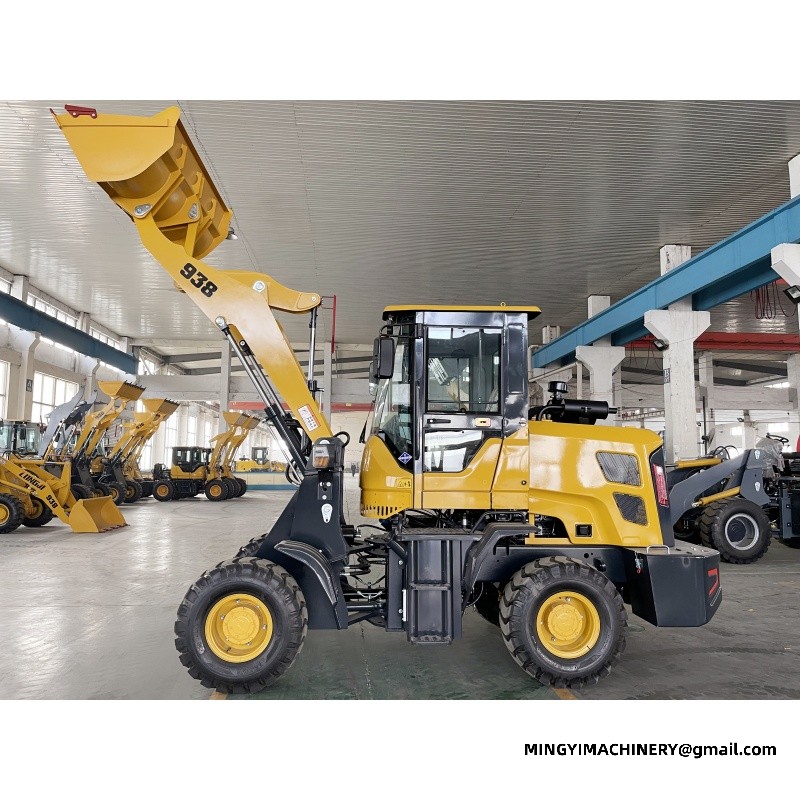
Export loading is a dimension problem. Rear frame width is the governing figure and it stays in a narrow band across this range — 230 mm high x 800 mm wide on the light-duty 3.2 m low-profile wheel loader, 280 mm high x 800 mm wide on the light-duty 3.2 m small-frame wheel-side reduction wheel loader — so two to three units load in a single forty-foot container with the booms and counterweights packed alongside.
Commissioning is the part buyers under-plan. Before the first start: torque the hinge pins, fill the 54 L (50# tank) tank and the 4100 core (490 engine); 4105 core (4102T engine) circuit, check the 40 pump (490 engine); 1045 pump (4102 turbo engine) and 316 pump connections, and charge or replace a battery that has sat through a voyage. Then check the five build figures — boom wall, boom width, front and rear hinge plates, cross-member — against the published table, because that is the one moment when a discrepancy is simple to fix.
A machine that wanders on the road and feels vague in the turn has worn hinge pins. The plates are 16 mm front and 16 mm rear over a 16 mm cross-member; when the pin bores ovalise, the geometry the frame was built to hold is gone, and no amount of steering adjustment brings it back.
Check it by loading the bucket, holding the machine on a slope and watching the joint while an operator rocks the steering. Movement there is wear; movement at the rear, over the 200 mm high x 750 mm wide section, is a different and more serious problem. Catching the first case takes a set of pins; missing it takes a frame.
Which axle should a wheel loader for aggregate yard be built with?
Match it to the ground. Track runs 1.6 m on the light-duty 4.5 m medium-frame wheel-side reduction wheel loader and 1.2 m (Isuzu axle); 1.3 m (wheel-side reduction axle) on the standard 2.4 m low-profile wheel loader; wheel-side reduction for soft or rutted surfaces, the Isuzu-pattern axle for hard, level ground.
How do I pick between the frame tiers of a wheel loader for aggregate yard?
By reach and duty. The light-duty 3.2 m small-frame wheel-side reduction wheel loader carries 0.38 m³ to 3.2 m on a 25 mm cross-member; the light-duty 3.2 m low-profile wheel loader carries 0.38 m³ to 3.2 m on 25 mm.
How many units of a wheel loader for aggregate yard fit one container?
Two to three, loaded knock-down. Rear frame sections stay between 300 mm high x 800 mm wide and 200 mm high x 750 mm wide across the range, so a forty-foot box takes a mixed pair or trio.
How does a wheel loader for aggregate yard differ from a skid steer?
Articulated steering and a 4.7 m front-to-counterweight length give the loader reach and a smoother ride on rough ground; a skid steer turns in its own length but carries less, higher effort per tonne moved.
What is the smallest wheel loader for aggregate yard in the range?
The entry low-profile builds: a 0.52 m³ bucket at 4.5 m, 1.6 m track and a 4.7 m front-to-counterweight length for indoor and nursery work.
How do I verify the build of a wheel loader for aggregate yard on delivery?
Five figures against the published table: boom wall 25 mm, boom width 370 mm, front hinge 25 mm, rear hinge 14 mm and cross-member 25 mm.
Is the wheel-side reduction axle worth specifying on a wheel loader for aggregate yard?
If the ground is soft, rutted or sloped, yes: a 1.5 m (wheel-side reduction axle); 1.45 m (Isuzu axle) track with hub reduction keeps traction where a faster axle would spin. On hard, level ground it is not needed.
Machines ship knock-down with booms and counterweights packed loose, tanks removed and batteries boxed. Allow a day per unit to commission: torque the pins, fill the 30.8 L (48# large tank, 20.5/70-16 tyres); 24.6 L (48# small tank, 8.25-16 tyres) tank and the 4100 core circuit, and check the build figures against the table.
Hot, humid and dusty conditions around Wheel Loader for Aggregate Yard: Dust, Fines and Heavy Builds
Dust is the enemy of every rotating joint. Keeping the radiator and the air intake of Wheel Loader for Aggregate Yard: Dust, Fines and Heavy Builds clean, and cleaning them before they are blocked rather than after, is what separates a machine that lasts from one that overheats.
Pre-delivery inspection before Wheel Loader for Aggregate Yard: Dust, Fines and Heavy Builds leaves the shop
What the customer sees on arrival is decided before departure. The walk-around given to Wheel Loader for Aggregate Yard: Dust, Fines and Heavy Builds covers the same points the operator will check on day one, so there are no surprises when the crate is opened at the destination.
Handover and getting familiar with Wheel Loader for Aggregate Yard: Dust, Fines and Heavy Builds
The first day with a new machine sets the pattern for the next five years. Handover for Wheel Loader for Aggregate Yard: Dust, Fines and Heavy Builds covers the control layout, the daily check points and the limits the operator needs to know before the first real load is lifted or carried.
Storage and long idle periods for Wheel Loader for Aggregate Yard: Dust, Fines and Heavy Builds
A stored machine should be brought back carefully. Before Wheel Loader for Aggregate Yard: Dust, Fines and Heavy Builds returns to work the fluids, the brakes and the controls are checked, because months of standing change more than a weekend does.
Contact MINGYI Machinery for the current wheel loader lineup, configuration options and a formal specification for your market. E-mail: sales@mingycn.com | LINE (ID): mingyicn
OEM Wheel Loader Manufacturer: Build Records and Model Mixes · China Wheel Loader Factory Supplier: Range, Spares, Loading · Hydraulic Wheel Loader: Pumps, Hoses and Daily Checks · Loaders









