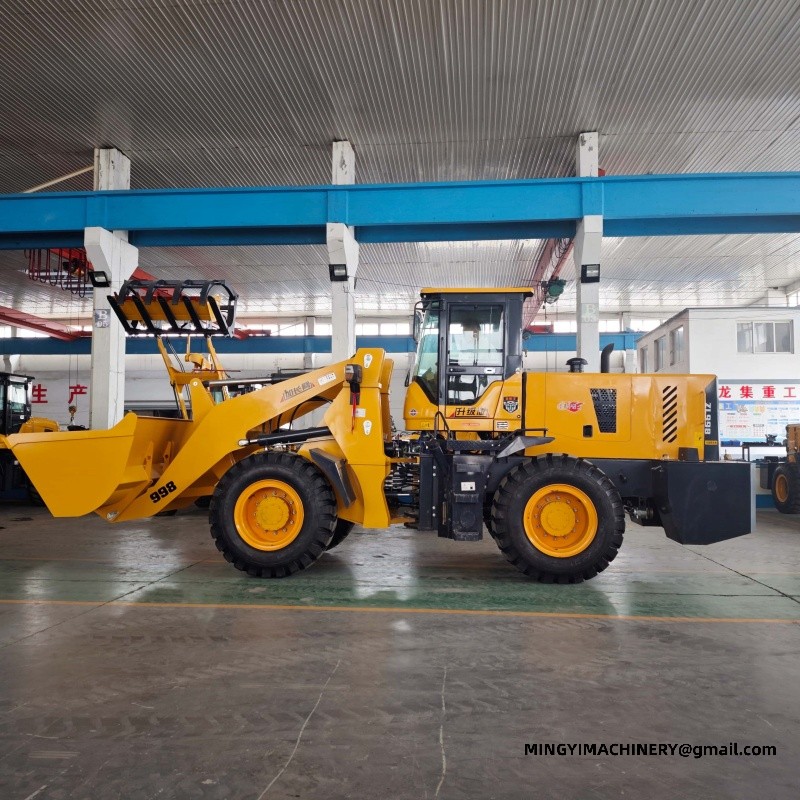
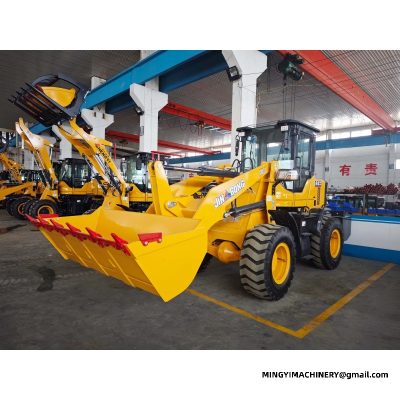
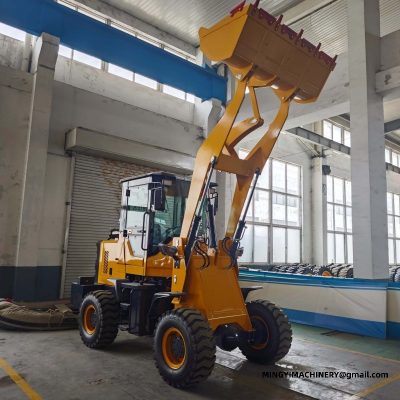
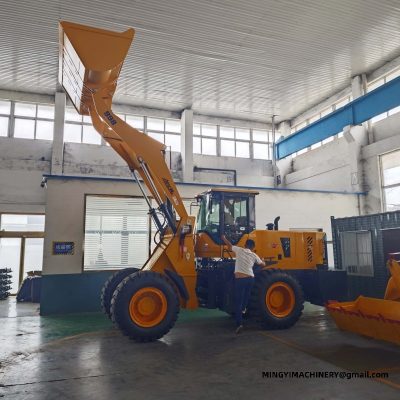
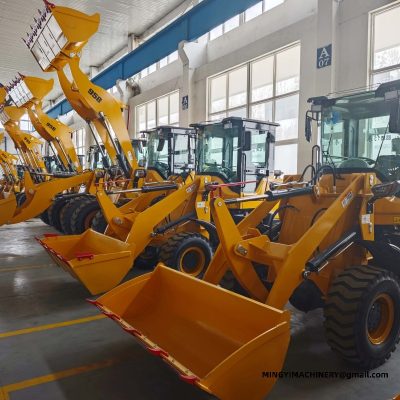
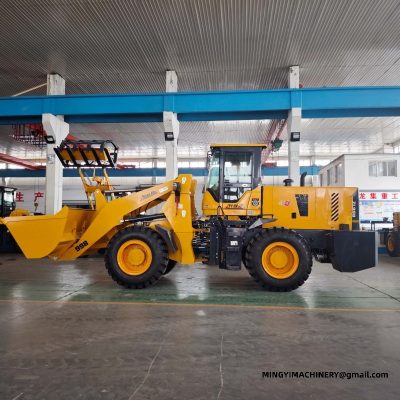
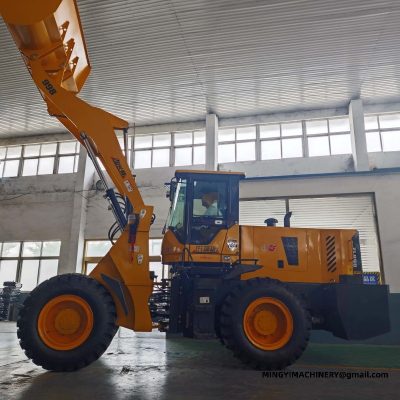
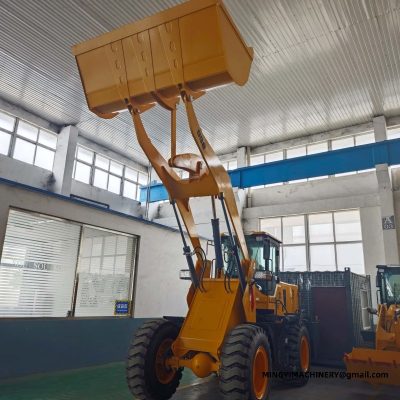
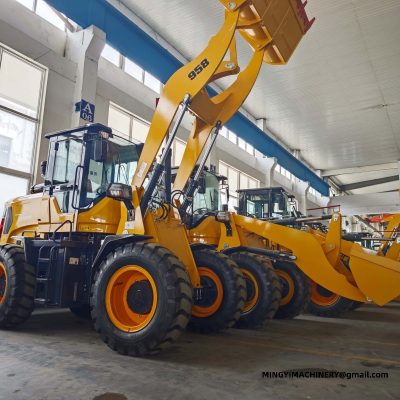
Most construction wheel loader shortlists are decided on the wrong figures. Engine power and bucket volume are stated first because they are easy, but the numbers that predict whether a machine earns its keep are the ones nobody leads with: rear hinge plate thickness, cross-member thickness, boom centre distance and radiator core. On the light-duty 4.5 m medium-frame wheel-side reduction wheel loader those read 30 mm, 45 mm, 960 mm and 4105 core; on the standard 2.4 m low-profile wheel loader they read 16 mm, 16 mm, 680 mm and 4100 core. This page explains what each one governs.
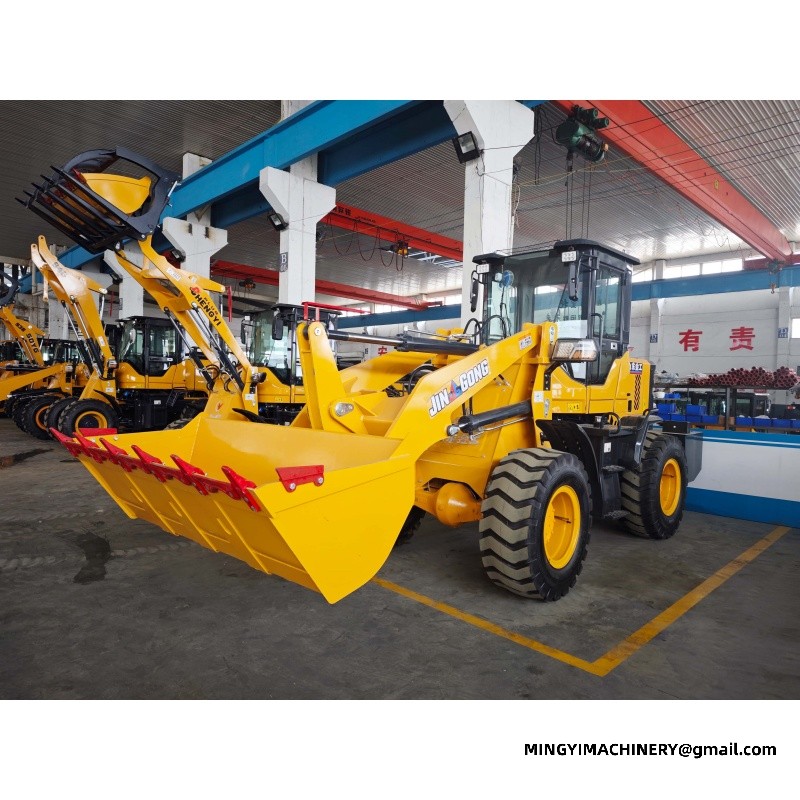
The standard bucket on this build is 0.3 m³, and it is the right tool for loose material moved from a heap to a body. Everything else is a compromise in one direction or another: forks give precision and lose volume, grapples give grip and lose speed, a snow blower gives reach and needs flow the bucket never asked for.
What makes attachments practical is whether the machine can lift them. Boom wall 20 mm and section 280 mm decide how much side load the arm takes, and the hinge plates — 16 mm at the front, 16 mm at the rear — decide how long the frame takes it. A grapple hanging off the end of a long arm is a side load the bucket never produces.
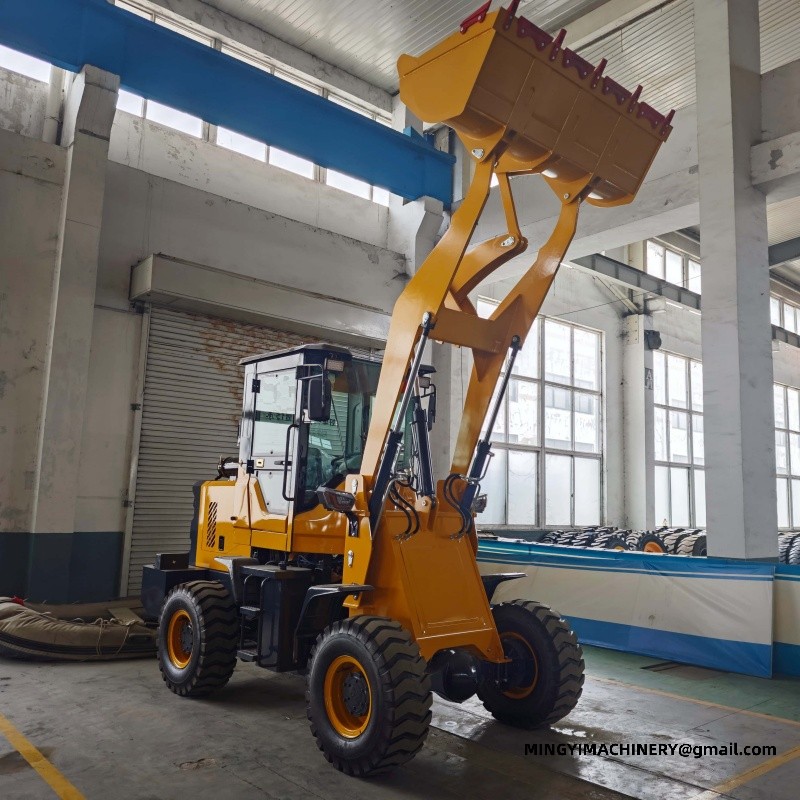
Two axle families appear across the range and the choice is about ground, not preference. Track width is the visible difference — 1.5 m (wheel-side reduction axle); 1.45 m (Isuzu axle) on the light-duty 3.2 m small-frame wheel-side reduction wheel loader against 1.5 m (wheel-side reduction axle); 1.45 m (Isuzu axle) on the light-duty 3.2 m low-profile wheel loader — but the mechanical difference is where the final reduction happens. An Isuzu-pattern axle reduces at the differential and sends torque down the shafts; a wheel-side reduction axle reduces at the hub.
Hub reduction is the right answer for soft lanes, ramps, uncompacted yards and pits, because torque arrives at the wheel instead of through a faster final drive that can spin. It is the wrong answer for long, fast, level transfers, where the extra unsprung mass and the lower top speed effort more than the traction gains. Read the track figures with the footprint — 3.8 m on the light-duty 3.2 m small-frame wheel-side reduction wheel loader, 4 m on the light-duty 3.2 m low-profile wheel loader — and the choice usually makes itself.
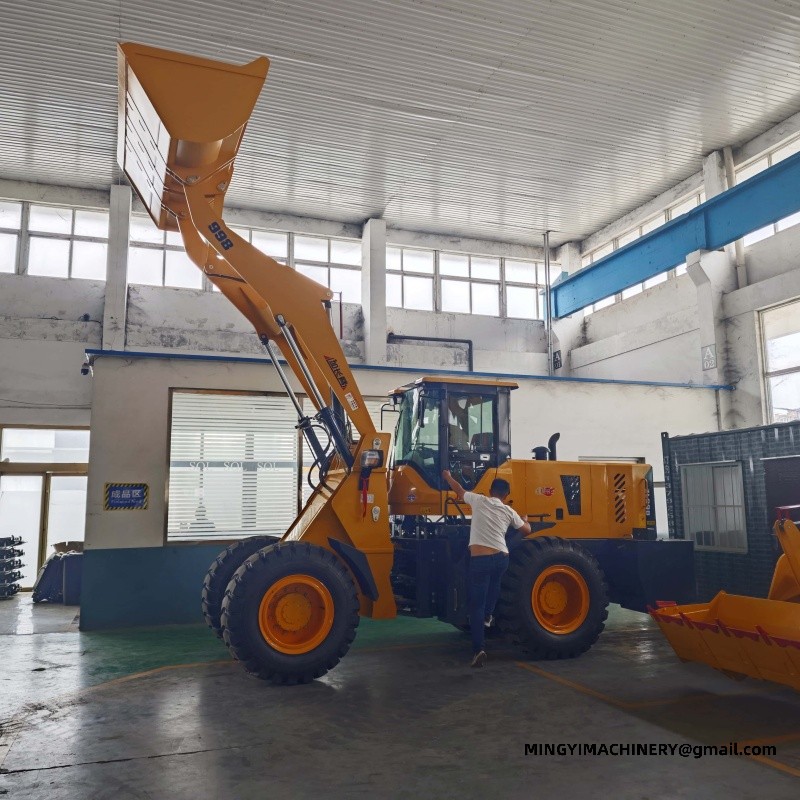
Radiator size follows the engine, not the frame. The light-duty 3.2 m small-frame wheel-side reduction wheel loader lists 4100 core (490 engine); 4105 core (4102T engine); the light-duty 4.2 m small-frame wheel-side reduction wheel loader lists 4100 core (490 engine); 4105 core (4102T engine). Where two engine options exist on one build, the cores differ — a 4100 core on the 490 engine and a 4105 on the 4102 turbo — and the taller, raised core is the one to specify wherever dust, chaff or dry sand blankets a standard radiator part-way through a shift.
Overheating is the single most common cause of a loader losing days rather than hours. It presents as power loss, then as a shift cut short, then as a head gasket. Choosing the raised core takes almost nothing at order time and cannot be retrofitted easily later. Pair that with the electrical package — 60 Ah (490 engine); 80 Ah (4102 turbo engine) on the light-duty 3.2 m small-frame wheel-side reduction wheel loader, 60 Ah (490 engine); 80 Ah (4102 turbo engine) on the light-duty 4.2 m small-frame wheel-side reduction wheel loader — and note that a battery specified for a naturally aspirated engine is often marginal for a turbo one in cold climates.
| Published build data — light-duty 3.2 m low-profile wheel loader | |
|---|---|
| Bucket capacity | 0.38 m³ |
| Dump height | 3.2 m |
| Track width | 1.5 m (wheel-side reduction axle); 1.45 m (Isuzu axle) |
| Boom arm thickness | 25 mm |
| Boom arm width | 370 mm |
| Boom arm length | 2.3 m |
| Boom arm centre distance | 890 mm |
| Cross-member thickness | 25 mm |
| Front hinge plate thickness | 25 mm |
| Rear hinge plate thickness | 14 mm |
| Rear frame section | 230 mm high x 800 mm wide |
| Hydraulic cylinders | centre cylinder 45 / side cylinder 40 |
| Fuel tank | 54 L (50# tank) |
| Battery | 60 Ah (490 engine); 80 Ah (4102 turbo engine) |
| Front wheel to counterweight | 4 m |
| Radiator | 4100 core (490 engine); 4105 core (4102T engine) |
| Work pump | 40 pump (490 engine); 1045 pump (4102 turbo engine) |
| Travel pump | 316 pump |
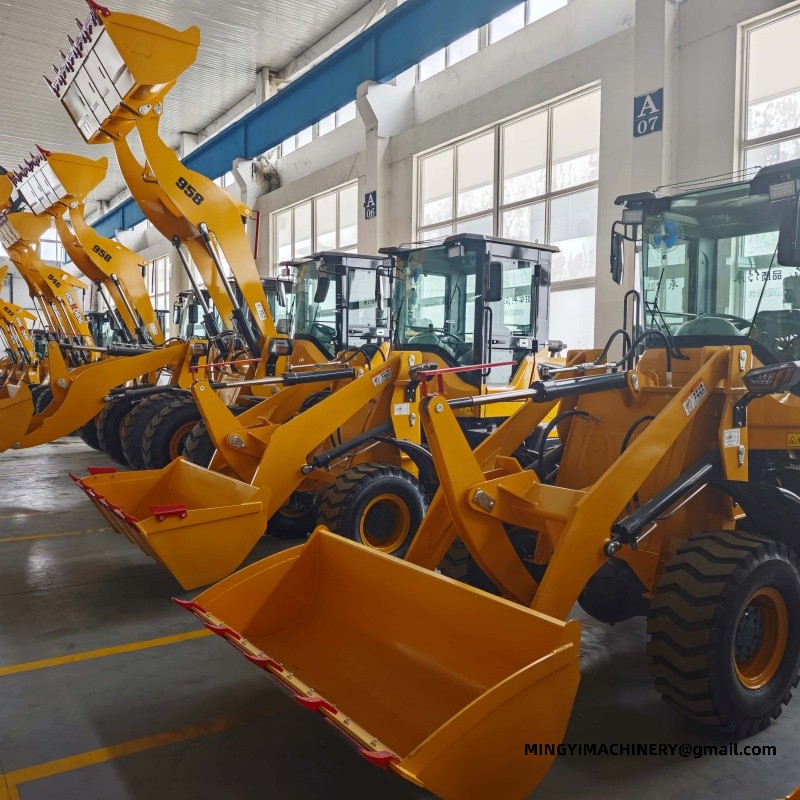
Operators get blamed for slow cycles that were decided in the frame shop. Where the lift is long, the pump and the cylinders set the pace: this build runs 40 pump (490 engine); 1045 pump (4102 turbo engine) with centre cylinder 45 / side cylinder 40. Where the run between face and truck is long, travel matters more, and that is the 316 pump and the 3.8 m wheelbase. Where the heap is packed, breakout matters most, and breakout comes from boom wall, 25 mm, working against bucket width.
Compare two builds on the same heap and the difference shows up as a few seconds a pass. The light-duty 3.2 m low-profile wheel loader carries 0.38 m³ against 0.38 m³ on the light-duty 3.2 m small-frame wheel-side reduction wheel loader, and lifts to 3.2 m against 3.2 m. Bigger is not automatically faster: a bucket that fills completely in two passes beats one that fills partly in three, and the frame that stays tight keeps doing it in month thirty.
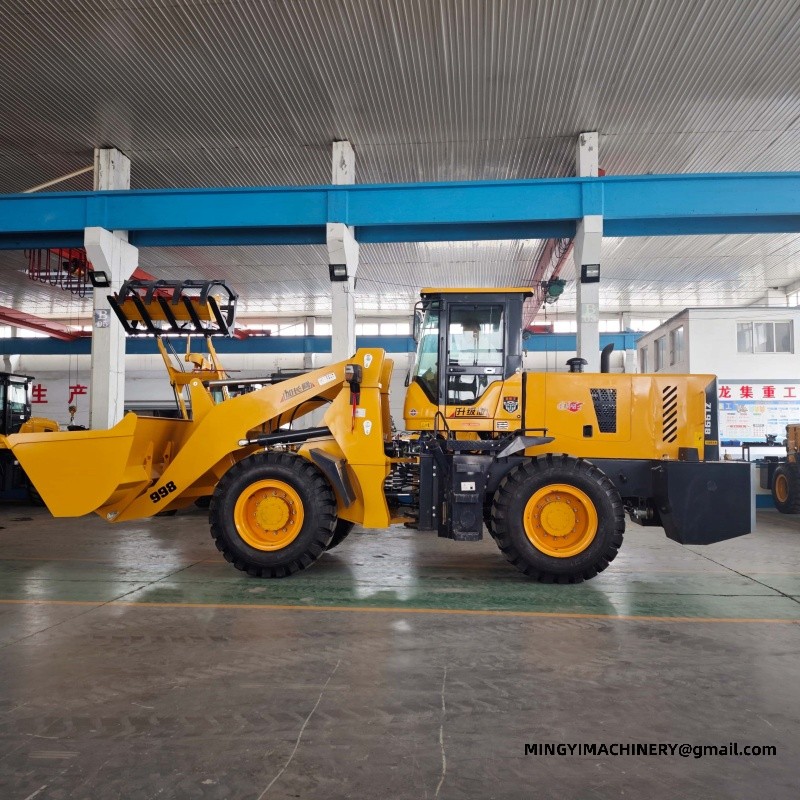
Battery capacity appears in the table as 60 Ah (490 engine); 80 Ah (4102 turbo engine) for the light-duty 3.2 m low-profile wheel loader and 60 Ah (490 engine); 80 Ah (4102 turbo engine) for the light-duty 3.2 m small-frame wheel-side reduction wheel loader. On builds with two engine options the two figures track the engines: the naturally aspirated unit cranks on less, the turbo needs more, and the 24 V system exists precisely because cranking a turbo diesel at minus ten needs the extra headroom.
What buyers should confirm before dispatch is not the capacity but the condition and the connections. Machines ship with batteries disconnected and boxed, so the first start is also the first check of every terminal. On the light-duty 3.2 m low-profile wheel loader that pack feeds the 4100 core (490 engine); 4105 core (4102T engine) cooling circuit's fan drive and the instrument cluster; on the light-duty 3.2 m small-frame wheel-side reduction wheel loader it feeds 4100 core (490 engine); 4105 core (4102T engine) and the same cluster. A marginal earth shows up as a slow crank in winter and as gauge flicker in summer.
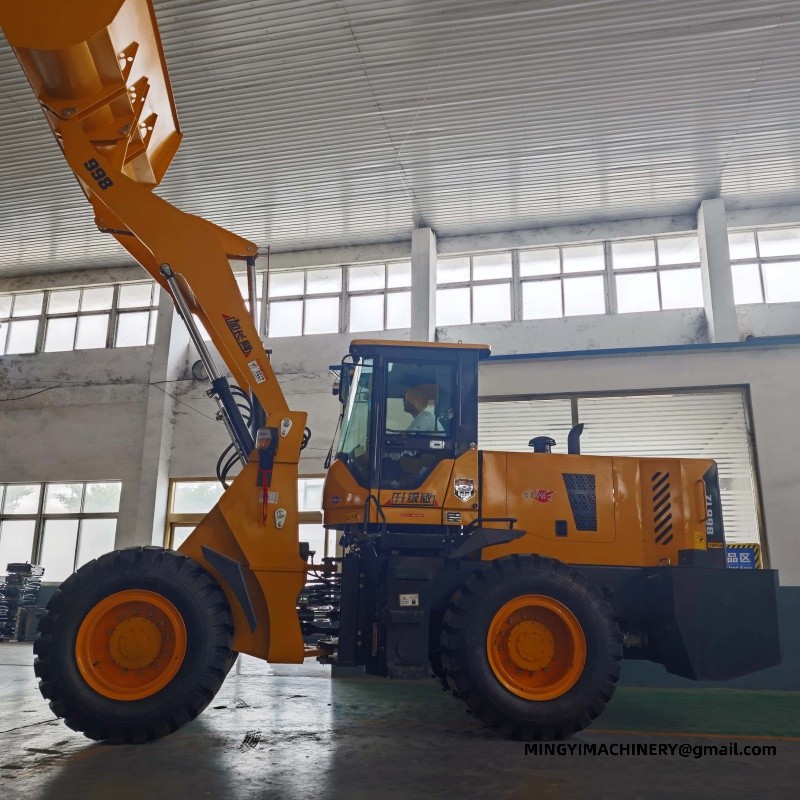
Two figures govern refuelling: tank capacity and consumption per hour, and only the first is published — 70 L (75# large tank) on the light-duty 4.5 m medium-frame wheel-side reduction wheel loader, 30.8 L (48# large tank, 20.5/70-16 tyres); 24.6 L (48# small tank, 8.25-16 tyres) on the standard 2.4 m low-profile wheel loader. Consumption depends on duty, and the duty differences between a 0.52 m³ bucket at 4.5 m and a 0.3 m³ bucket at 2.4 m are mostly about how hard the engine works per cycle.
What you can plan on: a machine working a short, level cycle will finish a shift on one tank; the same machine ripping from a face or loading up a ramp will not. If your site has no refuelling point, size the tank to the worst day rather than the average one, and specify the larger option where a build offers it. The cooling package is the other half of the same calculation — 4105 core on the light-duty 4.5 m medium-frame wheel-side reduction wheel loader and 4100 core on the standard 2.4 m low-profile wheel loader — because a machine that stops for temperature stops wherever it is.
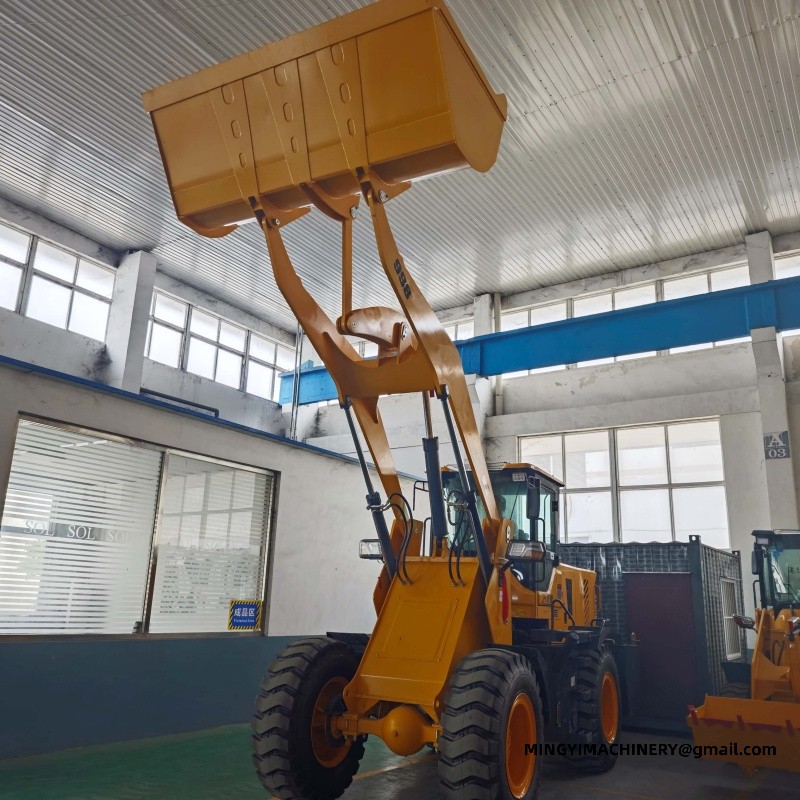
Most loader downtime is avoidable and most of what is avoidable is grease, coolant and hoses. Grease the articulation and the boom pins on the interval — on the light-duty 4.5 m medium-frame wheel-side reduction wheel loader that is the 45 mm and 30 mm plates and the 960 mm boom mounts. Keep the 4105 core core clean, because overheating presents as lost power long before it presents as a fault.
Hoses are the second most common cause of a stopped machine and the easiest to plan for: a chafing hose on the centre cylinder 60 / side cylinder 50 circuit weeps before it bursts, and a weekly look finds it. Pumps — 2063 pump and 25 pump on the light-duty 4.5 m medium-frame wheel-side reduction wheel loader — rarely fail without warning; they get noisy first. On the standard 2.4 m low-profile wheel loader the equivalents are centre cylinder 40 / side cylinder 40, 32 pump and 316 pump. Keep a hose set and a filter set on site and most of this becomes a tea break rather than a week.
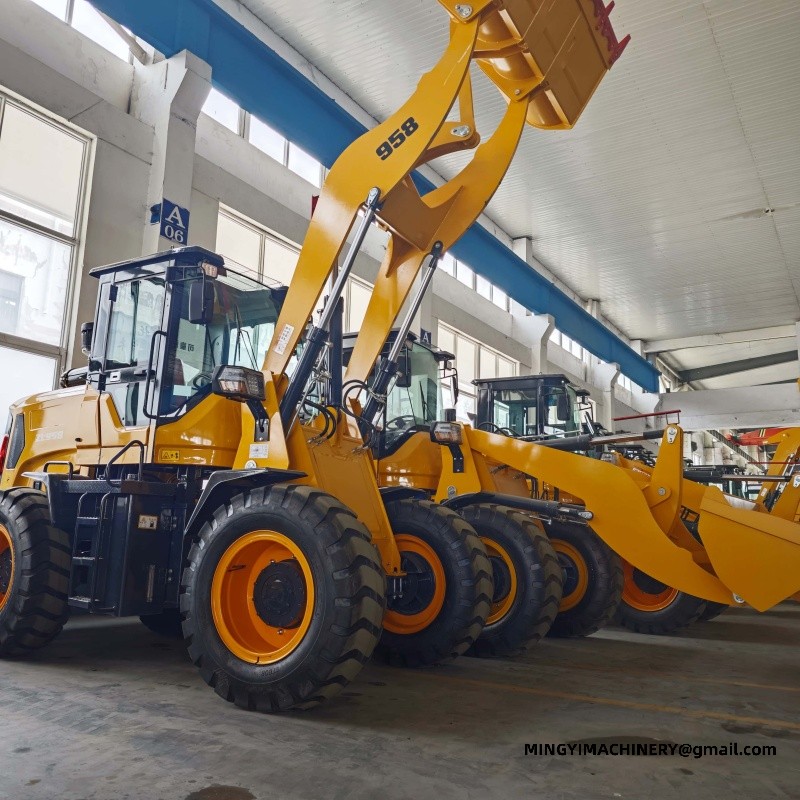
Fleet size falls out of cycle count, and cycle count falls out of bucket volume and dump height together. Take the daily tonnage, divide by what one bucket carries at 0.38 m³, and check that the receiving bodies sit under 3.2 m. If they do not, the calculation is wrong before it starts, and the heavy-duty 4.5 m small-frame wheel-side reduction wheel loader at 4.5 m is the machine the fleet actually needs.
Reserve capacity matters more than peak capacity because a fleet runs on its worst day, with one machine down and the face further away. Specifying the whole fleet on one build keeps that simple: same centre cylinder 45 / side cylinder 40, same 40 pump (490 engine); 1045 pump (4102 turbo engine), same 1.5 m (wheel-side reduction axle); 1.45 m (Isuzu axle), so one spare parts bin covers every machine and any operator can take any unit.
How is the battery specified on a construction wheel loader?
60 Ah (490 engine); 80 Ah (4102 turbo engine) on the light-duty 3.5 m small-frame wheel-side reduction wheel loader, matched to the engine it has to crank. The higher capacity belongs to the turbo option and matters in cold climates.
What boom wall thickness does a construction wheel loader need?
20 mm on the standard 2.4 m low-profile wheel loader against 25 mm on the light-duty 3.5 m small-frame wheel-side reduction wheel loader. A long arm on a thin wall lifts on paper and feels vague in the yard, so read wall and length together.
What bucket capacity should a construction wheel loader be specified with?
Match it to the material and to the body being filled: 0.38 m³ on the light-duty 4.2 m small-frame wheel-side reduction wheel loader against 0.52 m³ on the light-duty 4.5 m medium-frame wheel-side reduction wheel loader. Heavy material limits volume before the frame does.
What does commissioning a construction wheel loader involve?
Fit the 2.62 m boom to the 890 mm mounts, torque the hinge pins, fill the 64.7 L (75# small tank) tank and the 4100 core (490 engine); 4105 core (4102T engine) circuit, and connect the battery. Allow a day per machine.
How do I choose the right dump height for a construction wheel loader?
Measure the receiving body at the front board rather than the side: 3.2 m on the light-duty 3.2 m low-profile wheel loader, 3.5 m on the light-duty 3.5 m small-frame wheel-side reduction wheel loader. Clearance decides whether the pass is possible at all.
What engine options are offered on a construction wheel loader?
Where two are offered, cooling and electrics change with them: 4100 core radiator and 45 Ah (24 V) battery on the standard 2.4 m low-profile wheel loader, with the raised core belonging to the turbo option.
What is the difference between the two hinge plates on a construction wheel loader?
The front plate carries boom loads, which are mostly vertical; the rear carries articulation, which is sideways and shock-loaded. Hence 25 mm front against 20 mm rear.
Send the application and the receiving body height and we will match a construction wheel loader to it from the published range — 0.52 m³ bucket at 4.5 m, or 0.3 m³ at 2.4 m — and specification the build, the container plan and the spares package together.
Contact MINGYI Machinery for the current wheel loader lineup, configuration options and a formal specification for your market. E-mail: sales@mingycn.com | LINE (ID): mingyicn
Mining Wheel Loader: Cooling, Traction and Frame Specification · Agricultural Wheel Loader: Access, Attachments and Light Builds · Front End Loader: Attachment Changes and Hydraulics · Loaders









