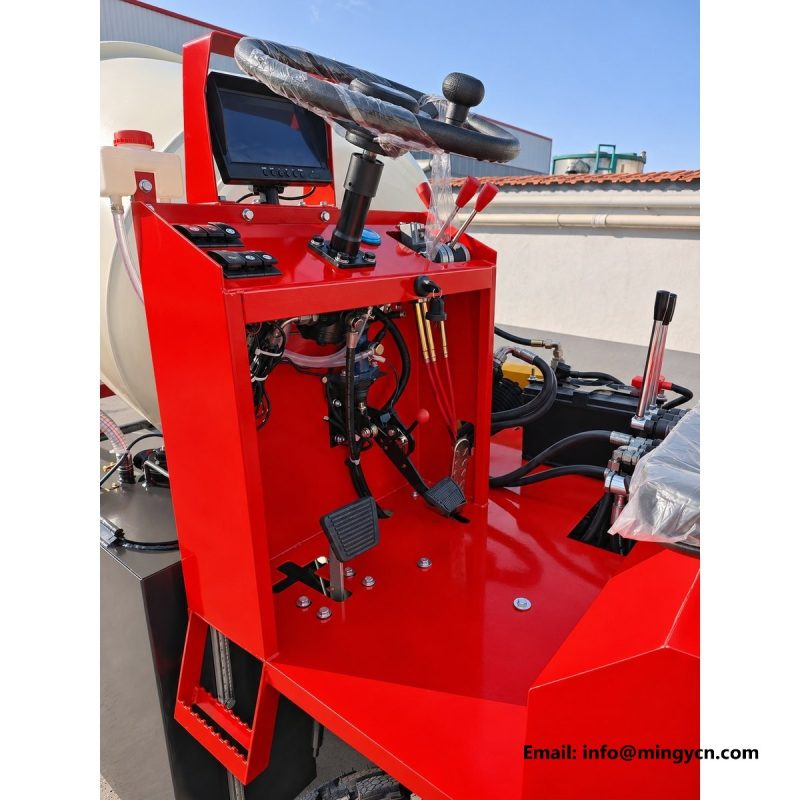
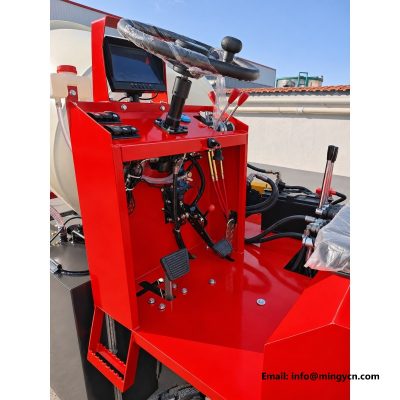
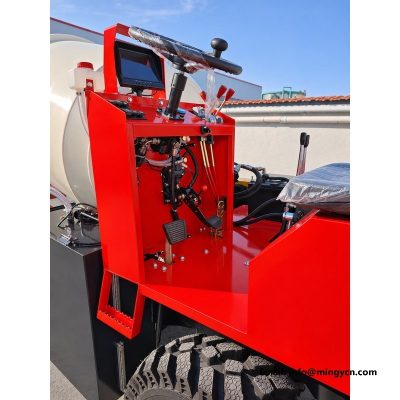
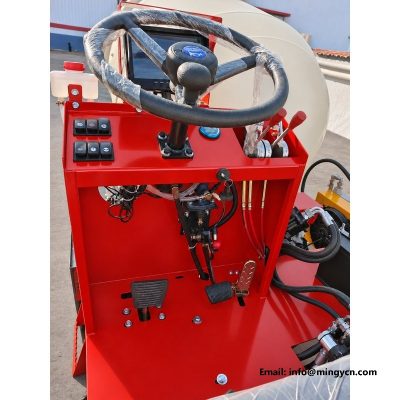
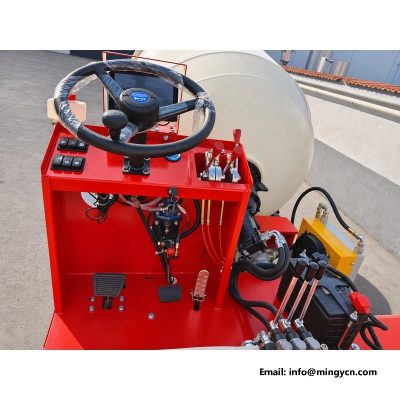
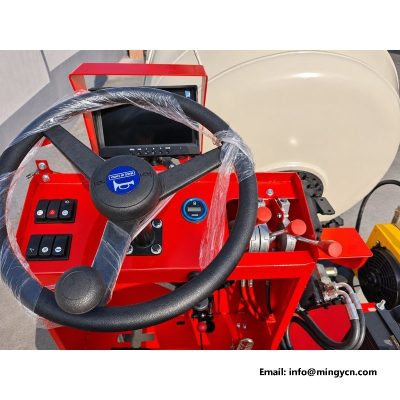
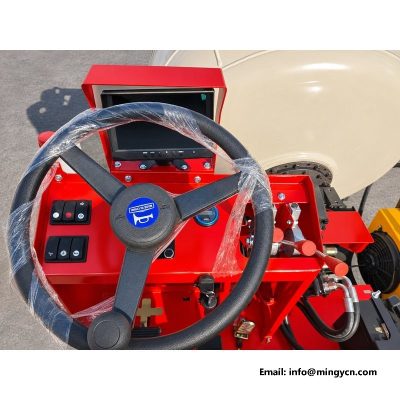
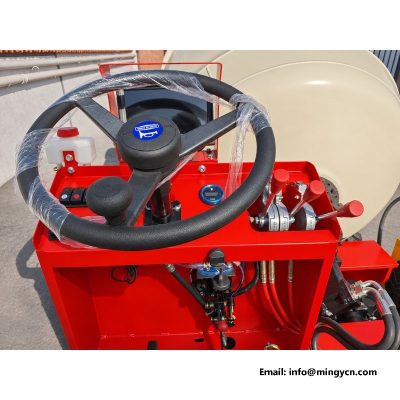
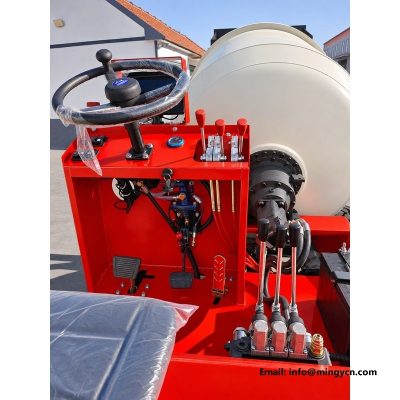
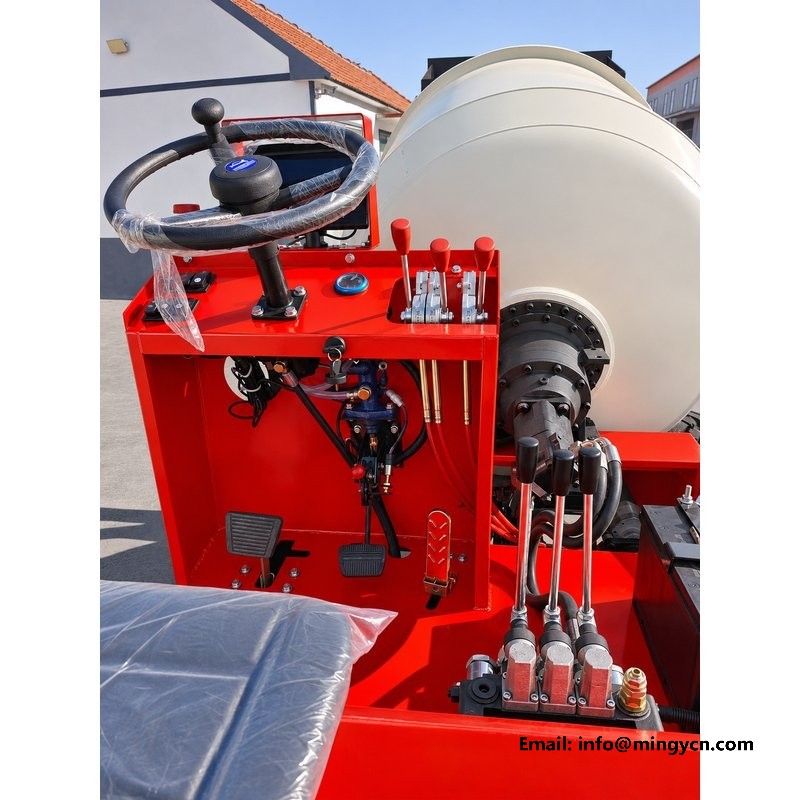
operator station steering seat and levers on 1.5m3 mixer
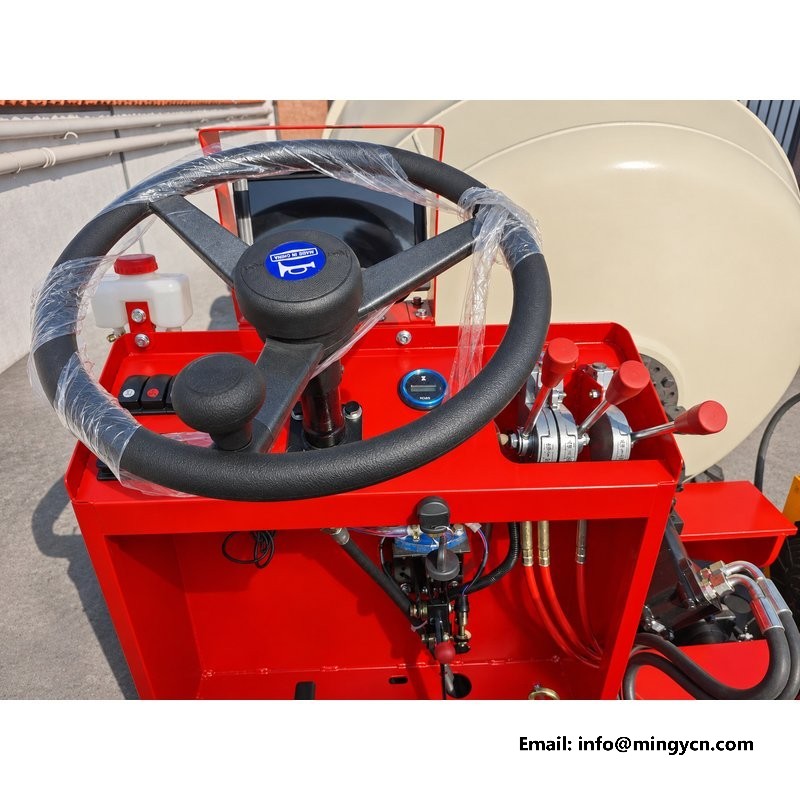
This page looks at the place where the operator spends the shift. The photographs move from the steering wheel to the seat, the lever group and the panel, and finally to the view forward from the driving position. The point is not to describe a cabin in isolation but to show how the controls of a self loading mixer are arranged for one person who loads, mixes and discharges without leaving the seat. Layout, reach, sight lines and the separation of travel controls from hydraulic controls all get attention, along with the checks that keep the steering and the levers predictable over years of daily use.
| Specification | 1.5 m³ self loading mixer |
|---|---|
| Steering angle | 28 degrees |
| Turning circle (outer tyre) | 2,464 mm |
| Maximum travel speed | 24 km/h |
| Steering | Hydraulic power steering |
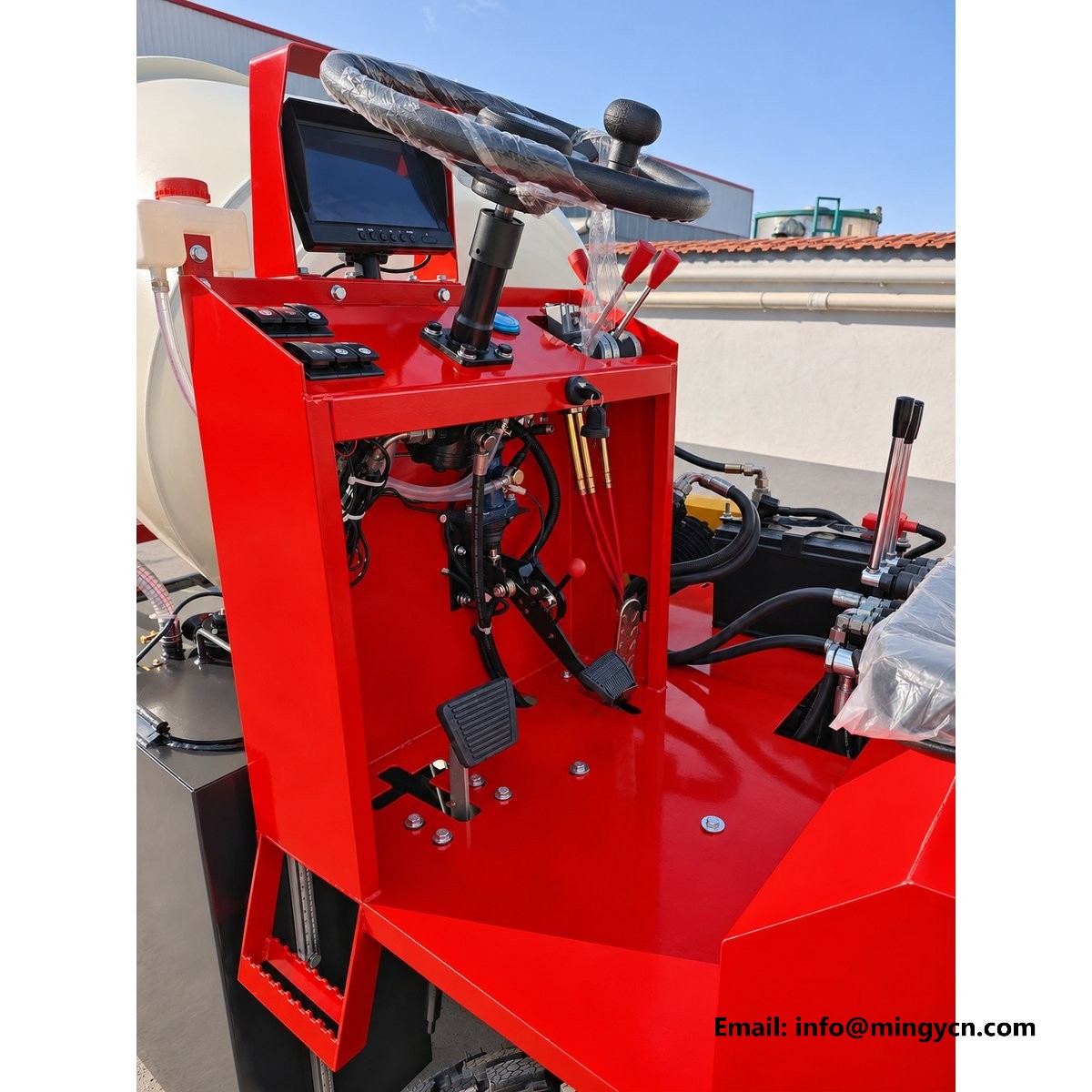
Everything the driver needs sits within reach of one seat: the steering wheel ahead, the travel gear lever to one side, the hydraulic levers grouped together, and the instrument panel in the line of sight. The layout looks simple, and it is meant to. A self loading mixer is run by one person who also loads, mixes and discharges, so any control that needs a stretch or a glance away from the hopper costs time on every cycle. Because the machine is 1,600 mm wide, the station is narrow and the seat sits close to the centre line. That central position is what gives the driver a view of both the hopper lip and the drum mouth without leaning. When you look at the photographs, trace the reach from the seat to each lever.
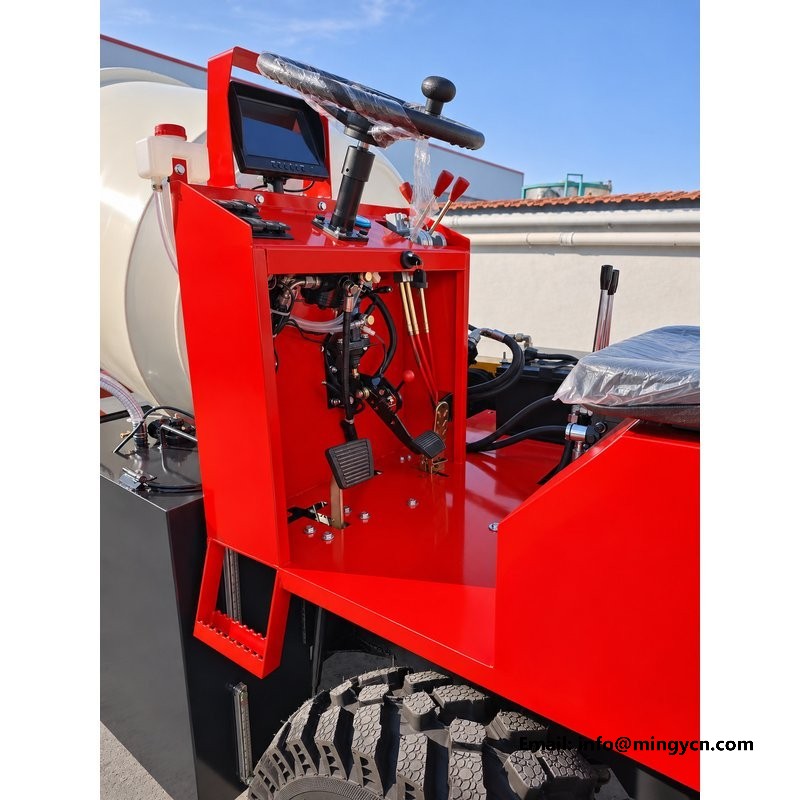
Steering is hydraulically assisted, so the effort at the rim stays low even with a full hopper out front. The feel is direct rather than heavy: the wheel returns as the machine straightens, and small corrections are possible without overshooting. Two figures describe the geometry rather than the feel. The steering angle is 28 degrees, and the turning circle measured at the outer tyre edge is 2,464 mm, which is compact for a machine 3,500 mm long. In practice that means the machine can be placed close to a wall or a drum and turned out again in a yard where a larger loader would need three attempts. The rear axle steers too, so the tail swings, and a driver new to this layout should allow for it. That is a matter of practice rather than of strength.
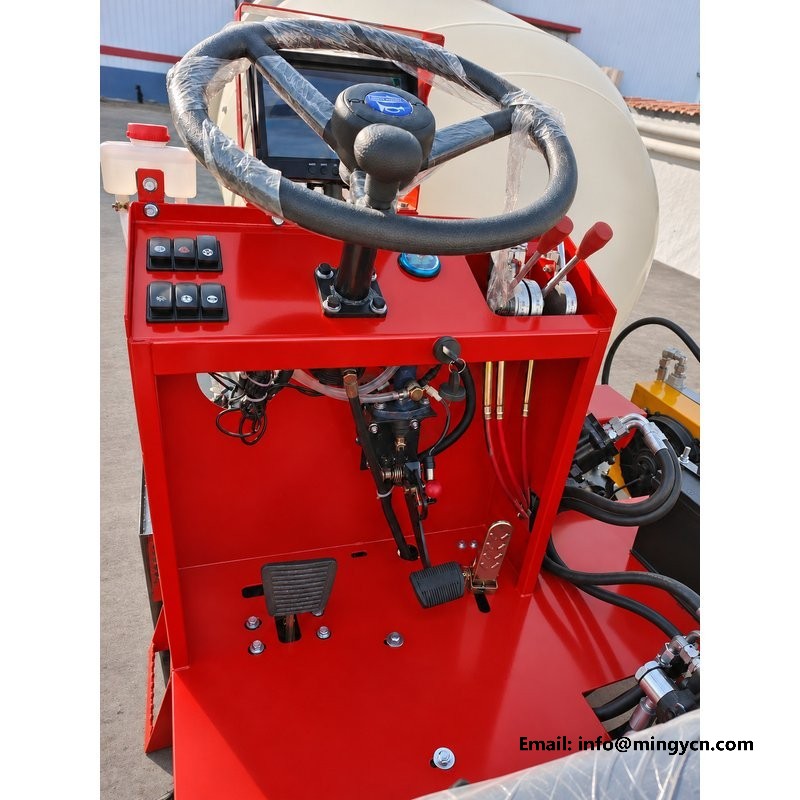
The gearbox offers three forward gears and one reverse, plus a road gear, and the machine reaches 24 km/h on the road. Travel is selected with one lever; the hydraulic functions sit on separate levers, and the separation is deliberate. When the two groups are mixed, a driver reaching for the lift while the machine is rolling can move the drum by mistake, and a drum that starts turning while the machine is moving is a spill waiting to happen. The grouping also lets the left hand stay on the wheel during a pour. Practise the pattern with the engine off until the hand finds each lever without looking. That is not a training formality; it is the difference between a clean tip and a bent lip on a bad day.
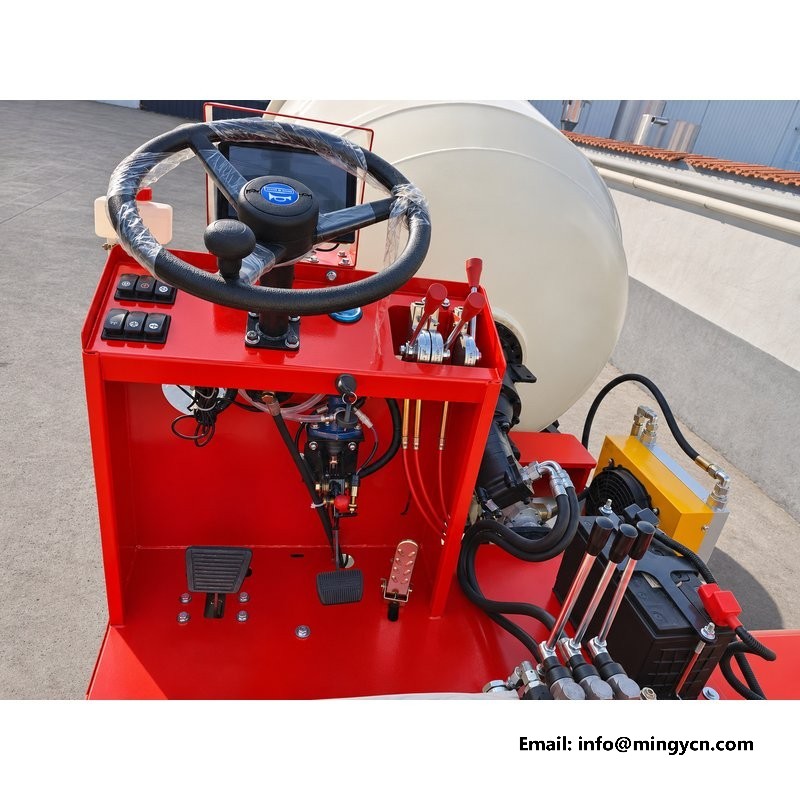
The seat slides fore and aft, and the correct position is the one that puts the hopper lip in view without the driver having to crane forward. Sit too far back and the lip disappears behind the front of the machine; sit too close and the wheel blocks the drum mouth when the hopper is raised. Set the position with the hopper on the ground first, then raise it and check that the pour edge is still visible at the top of the arc. Drivers of different heights will need different settings, which is why the adjuster should move freely and lock positively. A seat that creeps back under vibration slowly changes the view, and the driver compensates by leaning, which is how a long shift turns into a back problem.
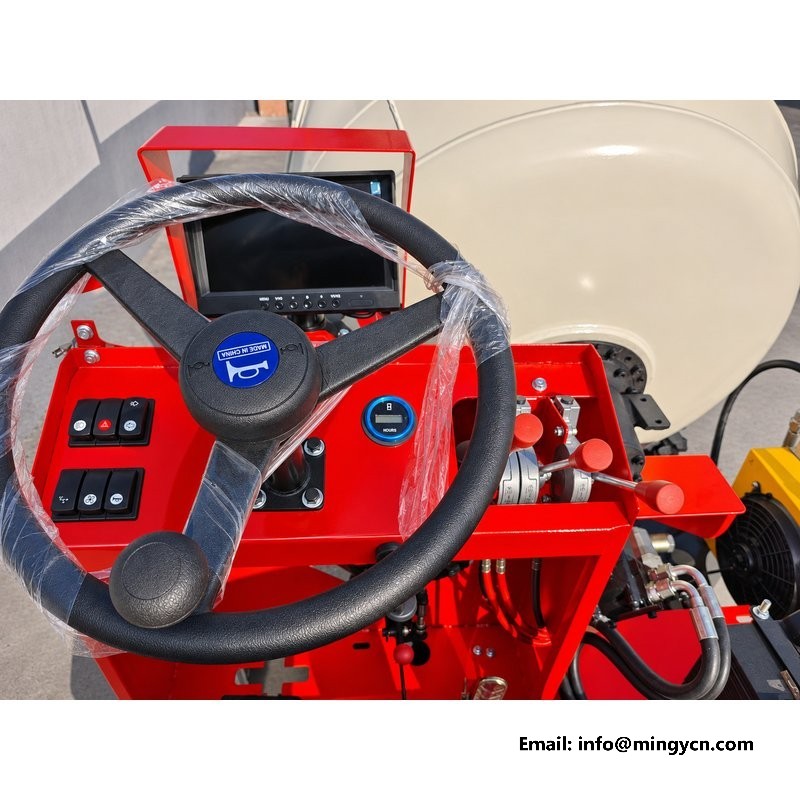
Mount and dismount facing the machine, using the steps and the handholds, with three points of contact at all times. It sounds like a formality until the first wet morning. Mud on the step, diesel on the handrail and a boot with a worn sole are between them responsible for most of the injuries around this class of machine. Keep the steps clean, and do not use the steering wheel or the hydraulic levers as a handhold, because both can move. Use the grab handle fitted for the purpose, and keep it dry. Park on level ground, lower the hopper, apply the parking brake and stop the engine before leaving the seat, even for a minute. Carrying tools or a sample bucket while climbing down is another habit worth breaking; hand the load down instead.
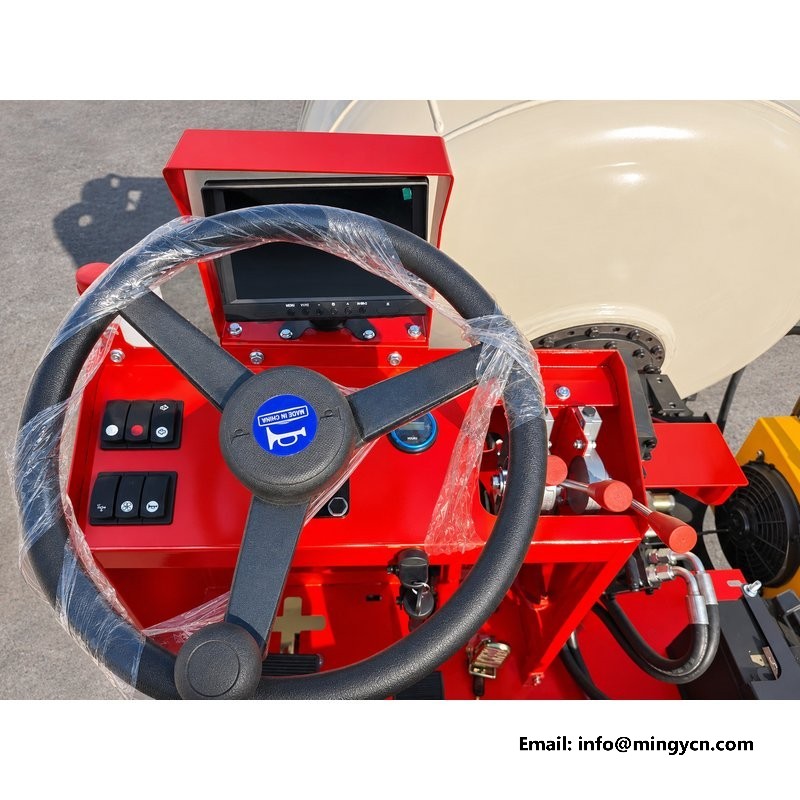
The panel in front of the seat groups the warning lamps and the gauges where a glance can take them in. The sequence at start-up tells you most of what you need: the lamps should come on with the key and go out once the engine is running, and any lamp that stays lit is asking for attention before the machine moves. Gauges are for trends rather than single readings. A temperature needle that sits higher than it did last week, or an hour meter showing a longer interval than you expected since the last service, matters more than an absolute figure. Learn where the needles normally sit on a cool morning and check them against that, not against a number in a manual. If a gauge ever reads outside its normal band, stop and look before the next load.
Around the panel the switches are marked with symbols rather than words, which is standard practice and also the reason handover matters. The usual grouping covers lighting, the horn and the work circuits, with the key switch and the stop control kept separate so that nothing is switched off by accident while the engine is running. Do not assume a symbol means the same thing on every machine; confirm each one with the operator before the first shift, with the engine off, and note anything that is not obvious. Labels fade, and a faded label on a switch that controls a hydraulic function is a hazard. If a switch has no clear marking, have it labelled. That takes a few minutes and removes a recurring guess from the daily routine.
A single-cylinder diesel of 25 hp is economical and simple, and it transmits a steady vibration through the frame that a multi-cylinder engine does not. The seat cushion and its mounting are what stand between that vibration and the driver's spine, so a worn cushion is a maintenance item, not a comfort item. Noise is the other cumulative load. Ear protection is normal on this class of machine, and a canopy or cab that fits well makes conversation possible without shouting. Posture matters as much as either: feet flat, back against the cushion, arms relaxed, levers within reach. Drivers who grip the wheel hard for a whole shift feel it in the shoulders by the afternoon. Relax the grip and take the breaks. A short stop every couple of hours does more for concentration than a longer one at the end of the day.
Some operating mistakes leave marks that are easy to read later. Holding the steering against full lock while the machine is stationary loads the pump for no benefit and heats the oil. Dumping while the machine is still rolling throws the load off centre and can bend the hopper lip on the drum edge. Raising a full hopper with the machine tilted on a slope puts a twisting load into the arms that they are not designed for. Resting a hand on a lever uses it as an armrest, and a small movement of the hand becomes a small movement of the drum. Watch for a driver who rests a foot on a pedal as well, since the same logic applies. None of these is dramatic on its own. Together they explain most of the premature wear found on machines that are otherwise well maintained.
With the engine running and the wheels straight ahead, turn the rim gently until the front wheels just begin to move, and note how far the rim travels before anything happens. A small amount is normal and comes from the joints in the linkage. A growing amount points to worn track rod ends, a loose sector shaft or a kingpin that needs attention, and it should be checked rather than driven around. On this machine the rear axle also steers, so repeat the check at the rear linkage; a worn joint there makes the machine feel vague in a way that is hard to place from the seat. Do the check on a hard, level surface, because a soft yard lets the tyres move and disguises the reading. Correct play restores the precision the 28 degree steering angle is there to give.
Before the first load of the day, with the engine idling, move each hydraulic lever through its full travel and let it go. It should return to neutral on its own, without sticking and without needing a nudge. A lever that stays partly engaged holds a circuit under pressure, heats the oil and creeps the function while the machine is working. Check the rubber boots at the base of the levers for splits; a split boot lets water and grit into the linkage, and the result is a lever that stiffens over a season. Look at the floor for fresh oil, and feel the pedal travel for anything that has changed since yesterday. These checks take a couple of minutes and catch most of the faults that stop a machine mid-shift.
Training on this machine works best in stages, and the stages should be completed empty before any material is involved. Start with the walk-around: the hopper, the arms, the tyres, the oil level and the steps. Then let the new operator drive the empty machine in an open area, using the gears and the steering until the rear axle swing becomes predictable. Only then introduce the hopper, first lowering and raising it on flat ground, then loading from a low pile, then pouring into the drum. The machine is 3,500 mm long and 2,200 mm high, so height barriers and doorways need checking before the first trip. Supervise the first full day, and write down what was covered. A short record of who was trained, on what, and by whom is worth keeping.
No. Steering is hydraulically assisted, so the effort at the wheel stays low even with a full load in the raised hopper. What changes is the feel rather than the effort: the front axle is carrying more weight, so the machine responds a little more slowly and the rear axle swing becomes more noticeable. Drivers should make their corrections earlier and avoid holding the wheel against full lock, which loads the pump and heats the oil without turning the machine any further.
The hydraulic levers are grouped together within reach of the seated operator, separate from the travel gear lever, so that a hand reaching for the lift cannot select a gear by mistake. The exact arrangement differs between builds, so confirm it on the machine rather than from a general description. With the engine off, sit in the seat and move each lever through its travel; every control should be reachable without leaning or twisting in the seat.
A small amount of lost motion at the rim is normal, because the linkage has several joints between the wheel and the road wheels. What matters is change. Measure the play now, write it down, and compare it at each service. Play that grows steadily points to worn track rod ends or a loose sector shaft, and on a machine with a steering rear axle the rear linkage should be checked at the same time, since wear there is harder to feel from the seat.
For the current specification, build options and a formal quotation for your market, contact MINGYI Machinery. E-mail: sales@mingycn.com | LINE (ID): mingyicn
1.5 m3 Self Loading Concrete Mixer: Full Specification and Walkaround · Gearbox, Levers and Hydraulic Routing on the 0.8m3 Mixer Chassis · Reversing Camera and Monitor on the 1.5m3 Self Loading Mixer









