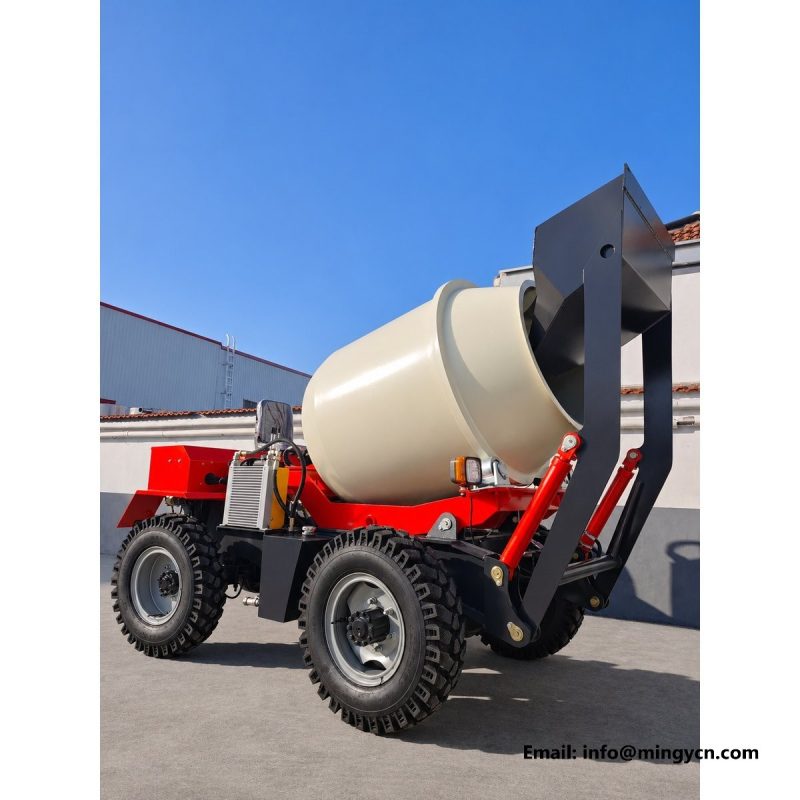
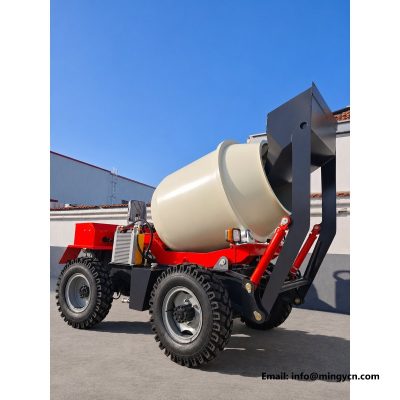
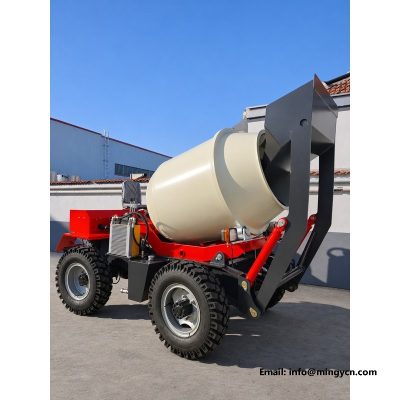
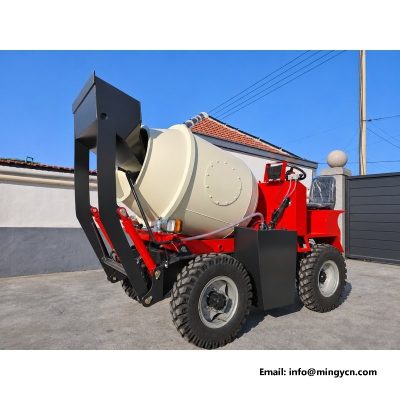
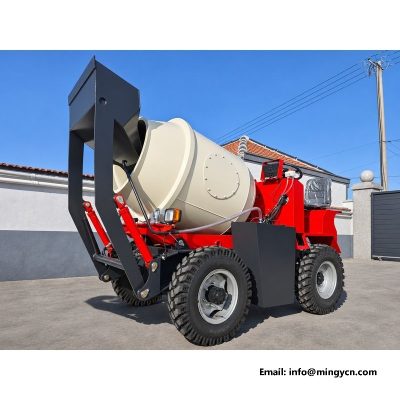
right hand side: wheelbase, tyres and frame rail
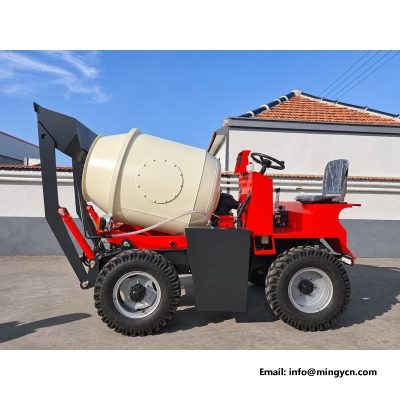
A side elevation is where a mixer stops being a picture and starts being a set of proportions. This second set works along the right flank of the 1.5 m3 machine, from the front wheel to the rear frame tail, and it reads the machine the way a fitter would: wheelbase first, tyre and rim second, frame rail third, then the details that decide how it behaves on a cross slope or in a narrow lane. Nothing here needs a tape measure, because the tyre gives you a scale and the drum gives you a datum. What follows is how to use both.
| Specification | 1.5 m³ self loading mixer |
|---|---|
| Overall dimensions (L x W x H) | 3,500 x 1,600 x 2,200 mm |
| Front tyres | 750-16 |
| Rear tyres | 750-16 |
| Minimum ground clearance | 204 mm |
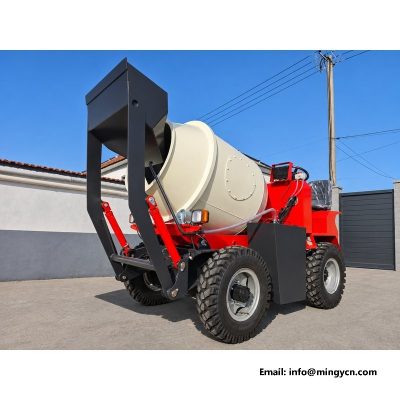
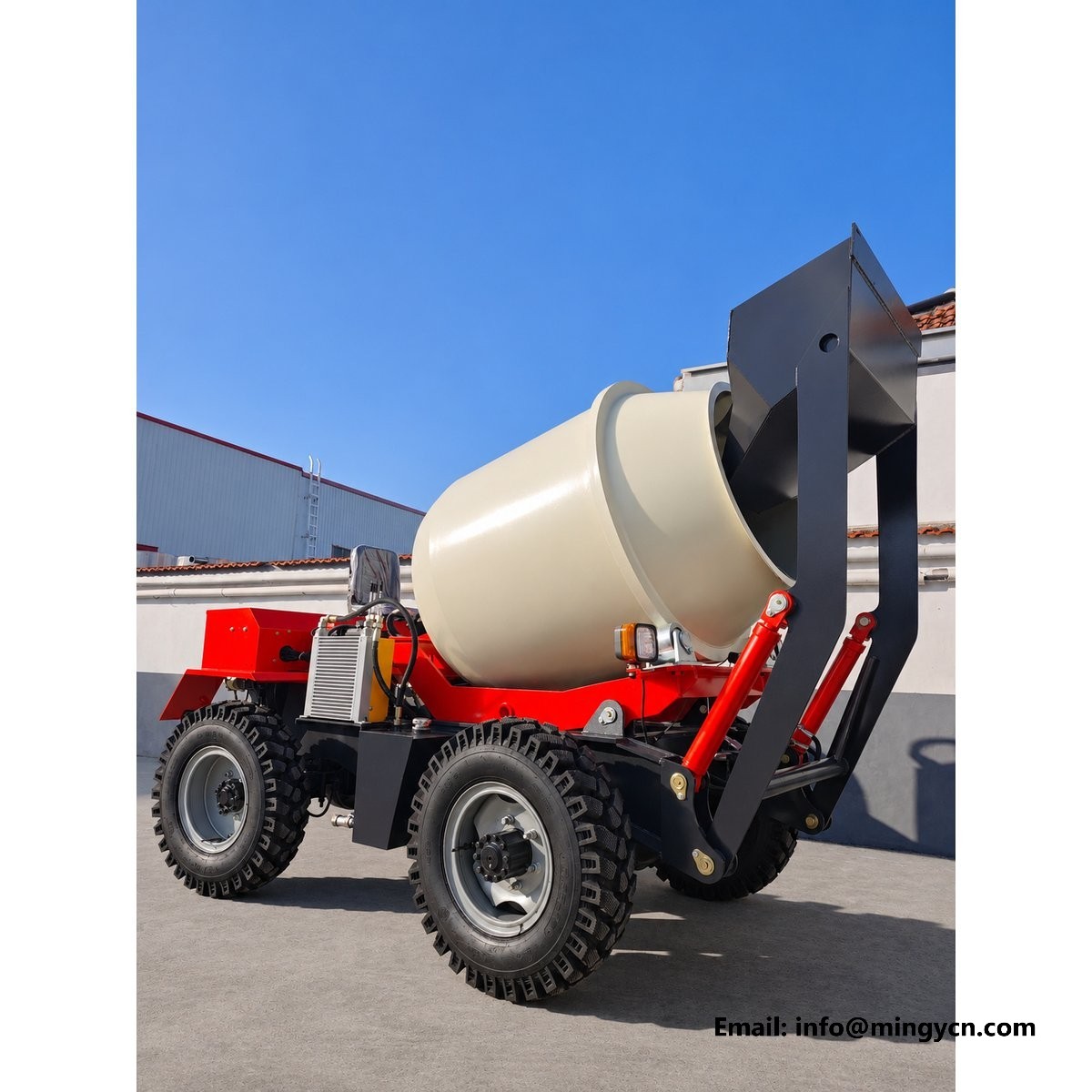
A side view is a drawing with the dimensions left out, and that is exactly how to use it. Before reading any caption, look at the machine as three blocks: hopper forward, drum centred, engine behind. Here the drum occupies the middle of the 3,500 mm overall length and the engine bay takes the tail, which is why the machine does not look nose heavy. A mixer that appears to lean forward in a side photograph usually has its drum too far ahead of the front axle. Proportion is the first test because it survives paint, lighting and a wide angle lens. Read the three blocks first, then look at where the drum sits relative to the front axle. The drum should sit between the axles rather than overhanging the front one, and the engine bay should look like ballast rather than an afterthought.
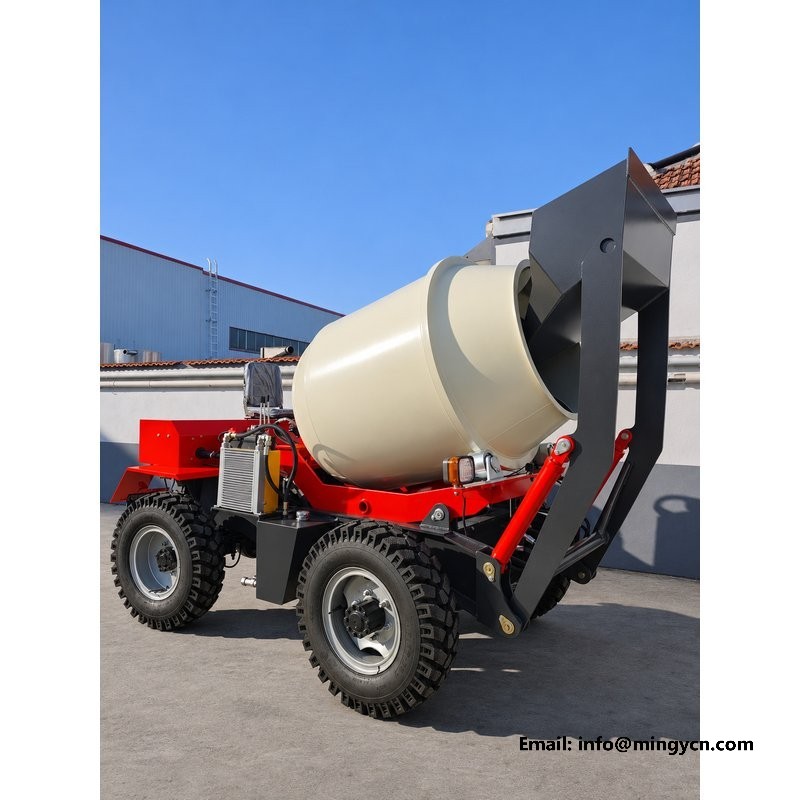
The distance between axle centres is not printed on most specification sheets, so the side photograph is where you estimate it. Measure the tyre diameters in the image and use them as a ruler: on 750-16 tyres the wheel centres give a scale that holds across the frame. What you want is a wheelbase long enough to keep the drum between the axles and short enough to keep the turning circle useful. This machine turns in 2,464 mm, a figure only reachable when the wheelbase is kept in proportion to the track. A stretched wheelbase buys ride comfort and spends manoeuvring room in a village street. Measure centre to centre in the image, multiply by the tyre diameter, and you have a working figure to set against the turning circle.
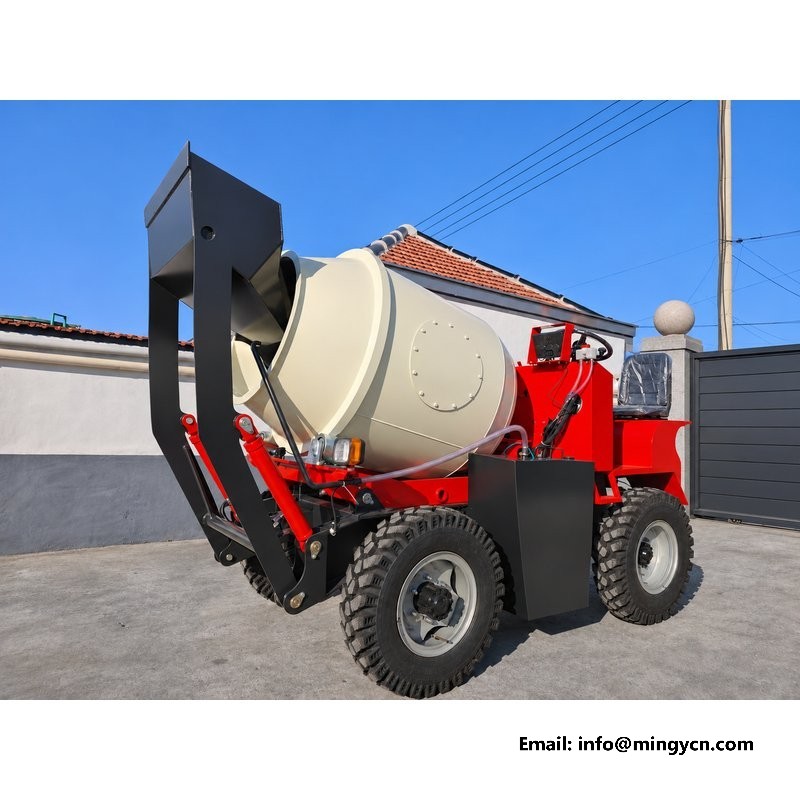
Side on, a tyre shows its working life. The 750-16 fitment on this machine carries a lug pattern deep enough for a building site and shallow enough not to tear up a finished driveway, and the sidewall should sit square to the rim with no bulge above the bead. Look at how the tyre meets the ground. Full contact across the tread width suggests inflation and load are matched. Contact only in the centre suggests over inflation for the load, and contact only at the shoulders suggests the opposite. On a machine with a 5,000 kg rated load the rear pair does most of the work. Tread depth is harder to judge, because a photograph flatters a worn tyre, so ask for the remaining lug depth in writing if the machine has been used.
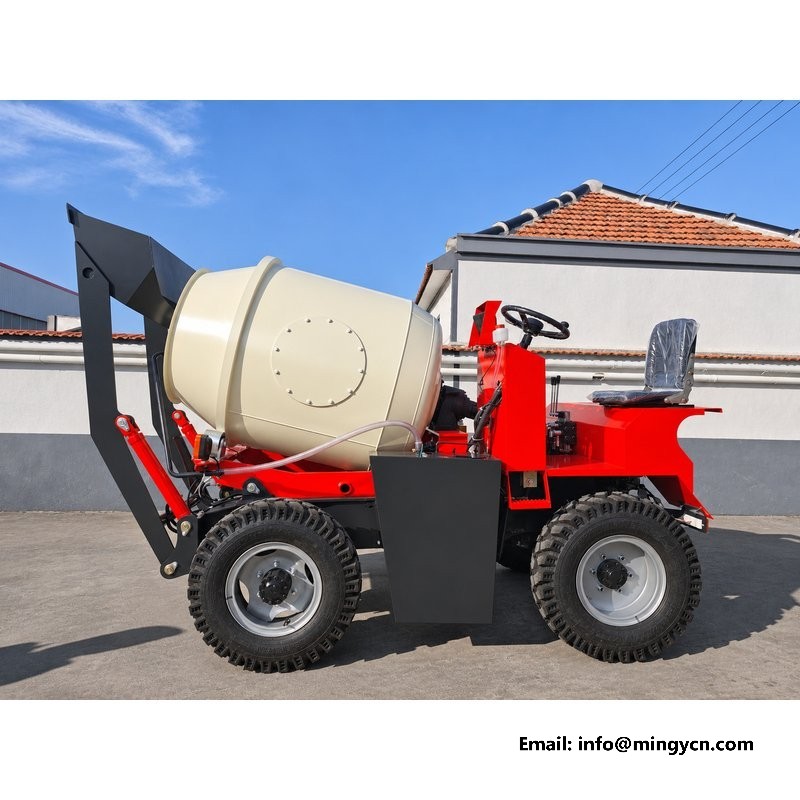
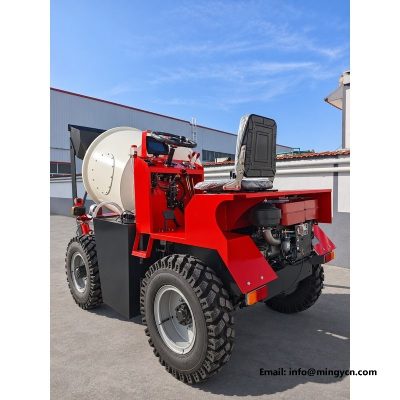
The right side gives a clean look at two hubs without the operator platform in the way. Check the rim for a welded centre disc rather than a pressed one, because the welded version tolerates a wheel that has been run loose. Look at stud length beyond the nut and at the seating face, which should be free of paint and burr. On the rear hub, the four-wheel-steering axle brings a steering arm and its linkage close to the wheel, and the photograph should show clearance between that linkage and the inner sidewall through the full arc. A gap that is only just visible at rest will close when the axle steers. A rim repainted around the stud holes usually means a wheel was changed at speed.
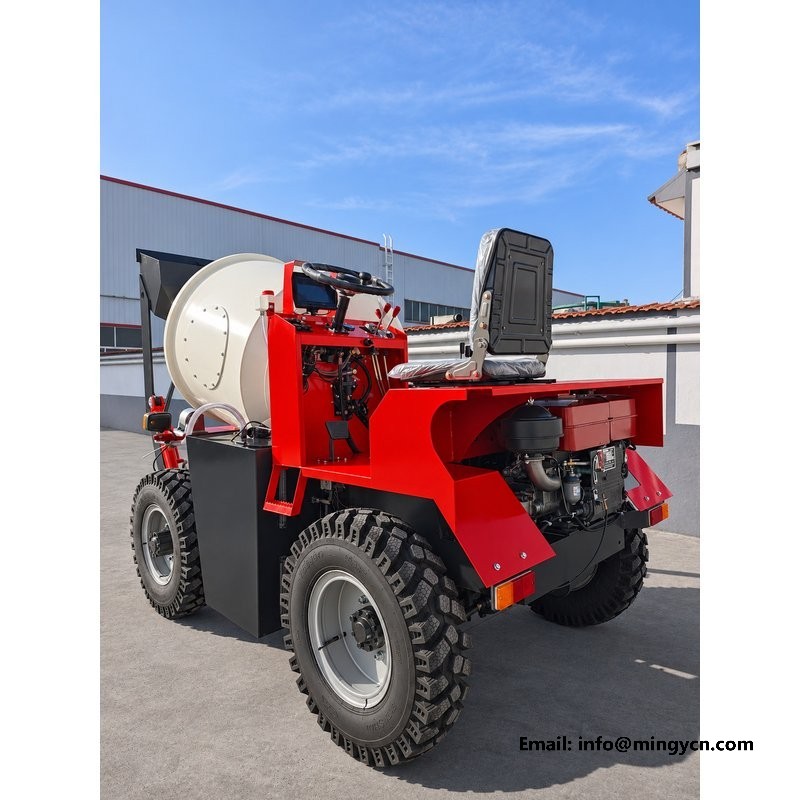
Sight along the frame rail in the side view and you are checking straightness, not thickness. A rail that runs true from the front riser to the rear crossmember has been welded in a jig. A rail with a visible kink at the drum saddle has been pulled into place. Straightness matters because a mixer frame works in torsion every time one wheel drops into a rut, and a kink becomes the place where a crack starts. Note also whether the rail is a closed section or an open channel. The closed section is heavier and stiffer, and it is the reason this side profile stays level when the drum is full. A rail repaired with a plate over the web needs explaining, not admiring.
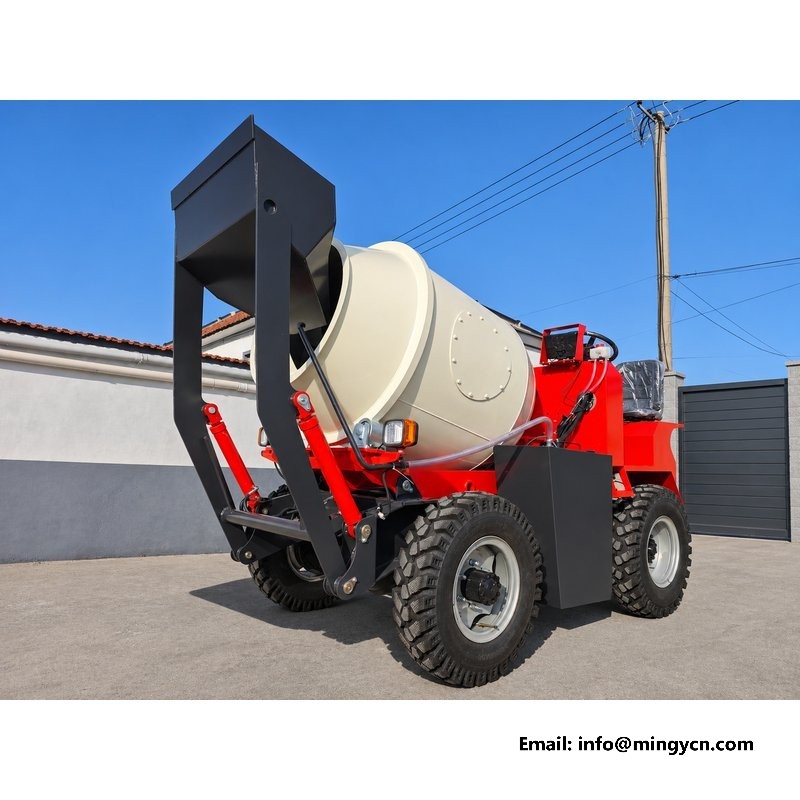
Every mixer frame has a point where the drum support crosses the rail, and there the side view stops being a silhouette and becomes structure. On this machine the saddle lands on a bolted plate rather than directly on the rail, so the drum can be shimmed and the mounting bolts renewed without cutting into the frame. In the photograph, look at the footprint of that plate. It should be wider than the saddle itself, with bolt heads visible on both sides of the rail. A saddle welded straight to the rail saves a fabrication step and takes away the only adjustment you will want two seasons from now. Bolted plates also let the drum come off for a rebuild without the frame leaving service.
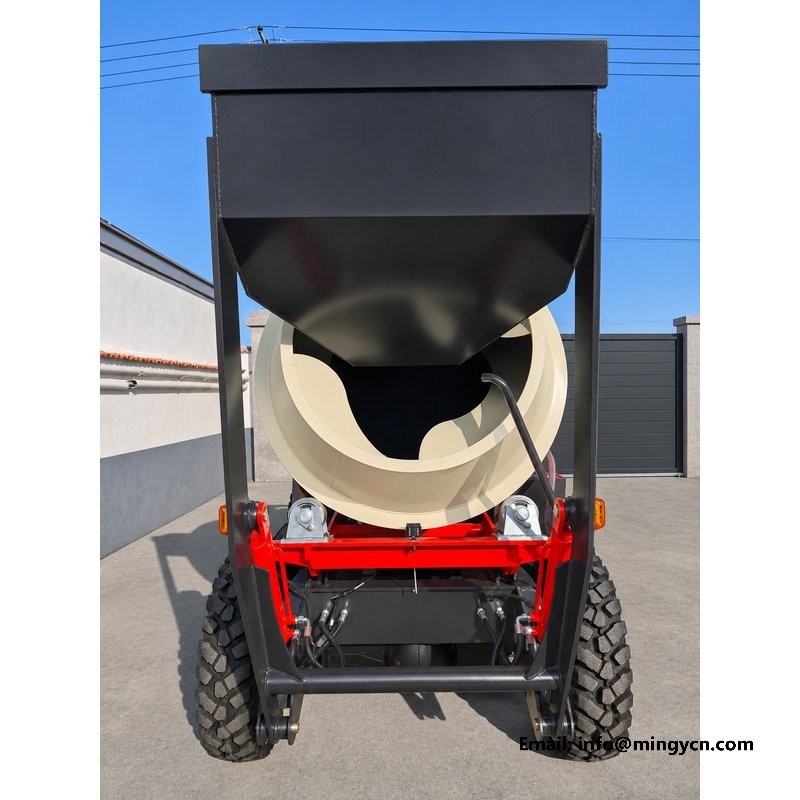
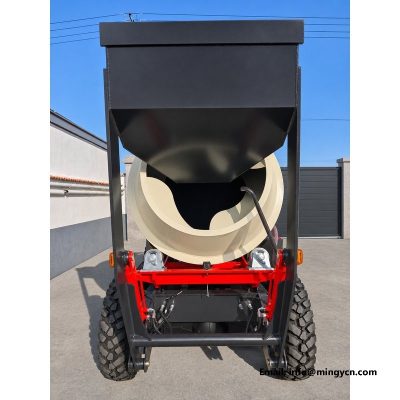
Body width is 1,600 mm, and the side view is where that number becomes a judgement about stability. Compare the outer edge of the tyre with the outer edge of the drum. If the tyres stand wider than the body, the machine resists tipping on a cross slope. If the body overhangs the tyres, the centre of gravity leaves the support polygon sooner. This machine keeps the wheels at the corners with modest overhang, which is the arrangement you want where the ground is never level. It also keeps the machine inside a narrow lane without folding anything. Narrow machines reach pours a lorry cannot, and stability is the price paid for that access. A machine that is narrow at the drum and wide at the tyres is easier to place against a wall than one that is the other way round.
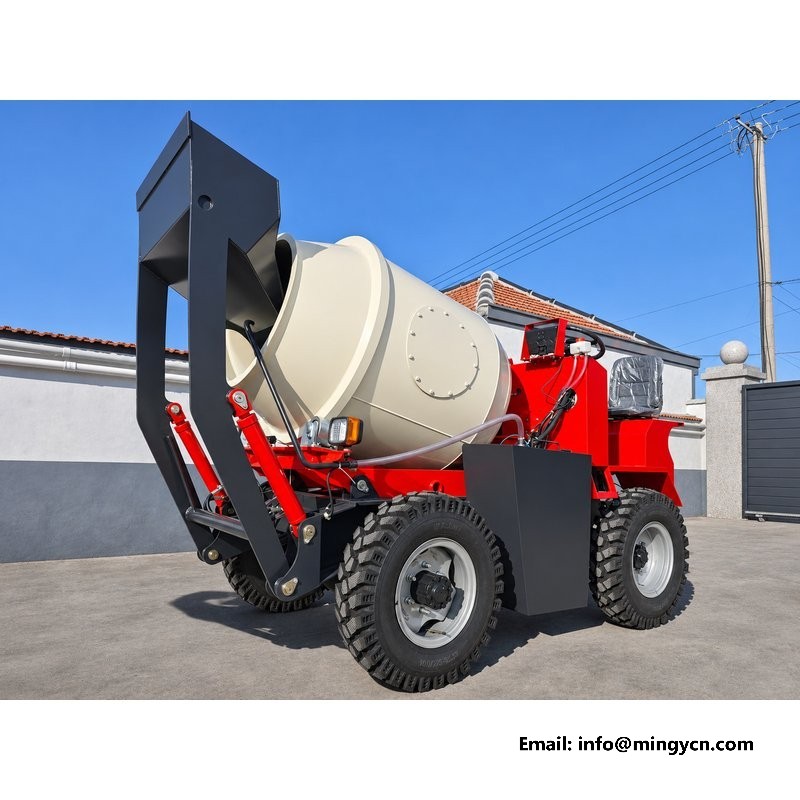
The right side is the working side for anyone inspecting the machine, and the photograph should show whether that is comfortable. Look at the space between tyre and frame at the point where a boot would land, and at whether the drum saddle leaves a natural step. A machine with a clear path from ground to platform gets checked every morning. One that demands a scramble gets checked when something breaks. On this side the tank and the platform sit behind the front wheel, so the walkway is short, but the tank is also exposed to whatever the tread picks up. With four-wheel steering, the rear wheel swings toward this walkway, so it has to stay clear of that arc.
Side photographs show guards better than front ones, because the gaps are seen in profile. Check the clearance between the tyre and the nearest fixed edge over the full suspension travel, not just at rest. A gap that looks generous when parked can close when one wheel climbs a kerb. Then follow the spray path. Water thrown off the tread at 24 km/h travels rearward and outward, and it will find any opening in the engine bay or the platform floor. A mudguard that stops short of the frame leaves a line of grit along the rail, and grit holds moisture against painted steel. A welded guard is stronger, but a damaged one cannot be replaced without cutting. Look at the gap between guard and tyre where the tread carries the most mud, because that is where a guard either clears or rubs.
A side photograph and a specification sheet check each other. The sheet gives 3,500 x 1,600 x 2,200 mm, a 1,900 kg operating weight and 750-16 tyres. The photograph shows whether those figures describe the machine in front of you. Measure height from ground to the top of the drum guard against the overall height, and length from hopper lip to rear frame against the overall length. If the proportions do not fit, one of the two is wrong. This is not distrust for its own sake. Dimension sheets get copied between models more often than anyone admits. Do the arithmetic before the viewing, so the photograph is a check rather than a discovery. If the drawing and the machine disagree, the drawing is the one to question, because a frame taken square cannot lie about proportion.
It can be estimated but not measured. Use the 750-16 tyre as a scale: the wheel centres sit a fixed multiple of the tyre diameter apart, and that ratio holds across every frame in the set. What the side view confirms directly is the relationship between wheelbase, the 2,464 mm turning circle and the 3,500 mm overall length. If the machine looks long between the axles while the turning circle is quoted as tight, ask for the axle centre distance in writing.
They keep the rolling radius matched, which is what a four-wheel-drive and four-wheel-steer machine needs. With 750-16 on all corners and a 28 degree steering angle, the front and rear wheels track similar arcs, so the machine does not scrub sideways in a tight turn. Mismatched tyre heights between axles would make the driveline fight itself on hard ground and would show up first as uneven wear on the rear tyres.
For the current specification, build options and a formal quotation for your market, contact MINGYI Machinery. E-mail: sales@mingycn.com | LINE (ID): mingyicn
1.5 m3 Self Loading Concrete Mixer: Full Specification and Walkaround · 750-16 Tyres and Isuzu Front Axle on the 1.5m3 Mixer · 1.5m3 Self Loading Mixer from Every Angle: A Yard Photo Reference









